
Understanding Standards Track IETF MIB Modules SNMP Counters
Understanding Standards Track IETF MIB Modules (SNMP Counters Tutorial) Chris Elliott Cisco Systems, Inc. Michael R. Mac. Faden Riverstone Networks, Inc. draft#18
Goals • Be able to differentiate between CLI counters and SNMP counters • Learn how to locate counters in IETF Standards track documents • Understand various SNMP counter types • Review SNMP counters defined/Layer 1 -3 12/1/2020 2
Why Counters? • Why counters matter… – Subsystem performance monitoring • errors • utilization/measure of activity – Most debugging activities require counters • fault isolation – Resource usage evaluation/planning • trending & thresholds – Basis for most billing applications 12/1/2020 3
CLI Counters • Command Line Interfaces – No standards body currently defines one • Yet most CLIs have common traits – Each counter is named • packets input, packets output – CLI Counters start at zero and increase in value • base starting point undefined, usually system start – CLI Counters may also decrease in value • Telco style event performance counters 12/1/2020 4
CLI Counters • The definition of what a given counter counts is dependent on vendor documentation – and on independent observation • Are formatted for direct human consumption – 0 packets input, 0 packets output • Many implementations provide command to clear/reset counter – clear interface ethernet 3 12/1/2020 5

CLI Counters • Show commands and expect scripting remain basic way of life in element management. c 4500#sh int e 1 Ethernet 1 is up, line protocol is down Last clearing of "show interface" counters never Output queue 0/40, 0 drops; input queue 0/75, 0 drops 0 packets input, 0 bytes, 0 no buffer Received 0 broadcasts, 0 runts, 0 giants 0 input errors, 0 CRC, 0 frame, 0 overrun, 0 ignored, 0 abort 0 input packets with dribble condition detected 187352 packets output, 11347294 bytes, 0 underruns 187352 output errors, 0 collisions, 3 interface resets 12/1/2020 6
SNMP Counters • Allow you to compare apples to apples – Counters have standard definitions • as defined by IETF, IEEE, some vendors… • regardless of network element type or vendor – and globally unique, hard to pronounce names • 1. 3. 6. 1. 2. 1. 17. 2. 4 dot 1 d. Stp. Top. Changes • Have a well specified size – 32 or 64 bits wide • 64 bit data-type available in SNMP v 2 c or v 3 • Hacks for SNMPv 1 include split counters 12/1/2020 7
SNMP Counters • Counters do not necessarily start at zero – Vendor implementation friendly • Are not for direct human consumption – require a DELTA function to compute rate • Can tell if the counter value polled is valid – Each counter has a well defined indicator that represents the validity of the sample taken known as a “discontinuity” 12/1/2020 8
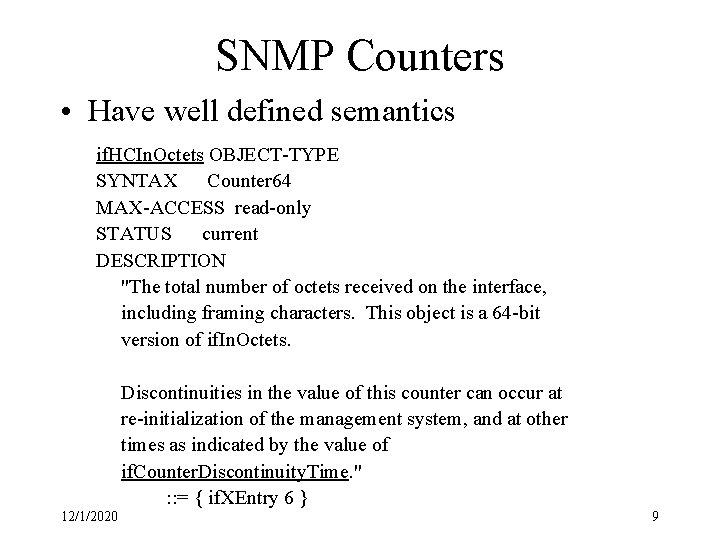
SNMP Counters • Have well defined semantics if. HCIn. Octets OBJECT-TYPE SYNTAX Counter 64 MAX-ACCESS read-only STATUS current DESCRIPTION "The total number of octets received on the interface, including framing characters. This object is a 64 -bit version of if. In. Octets. Discontinuities in the value of this counter can occur at re-initialization of the management system, and at other times as indicated by the value of if. Counter. Discontinuity. Time. " : : = { if. XEntry 6 } 12/1/2020 9
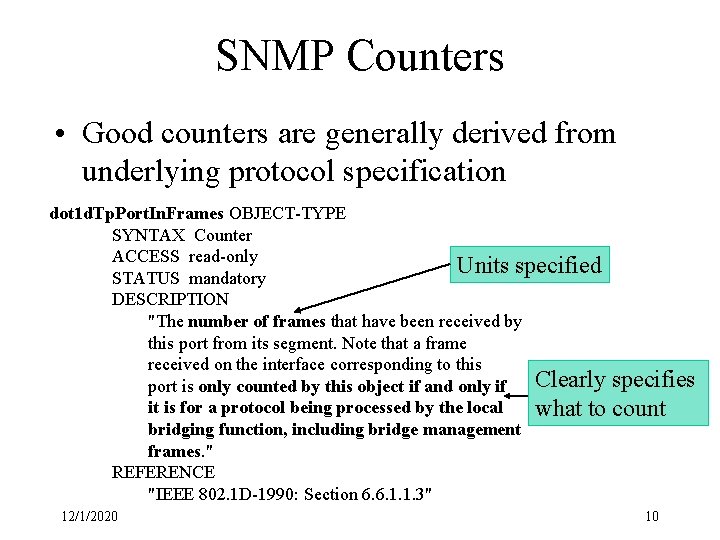
SNMP Counters • Good counters are generally derived from underlying protocol specification dot 1 d. Tp. Port. In. Frames OBJECT-TYPE SYNTAX Counter ACCESS read-only Units specified STATUS mandatory DESCRIPTION "The number of frames that have been received by this port from its segment. Note that a frame received on the interface corresponding to this Clearly specifies port is only counted by this object if and only if it is for a protocol being processed by the local what to count bridging function, including bridge management frames. " REFERENCE "IEEE 802. 1 D-1990: Section 6. 6. 1. 1. 3" 12/1/2020 10
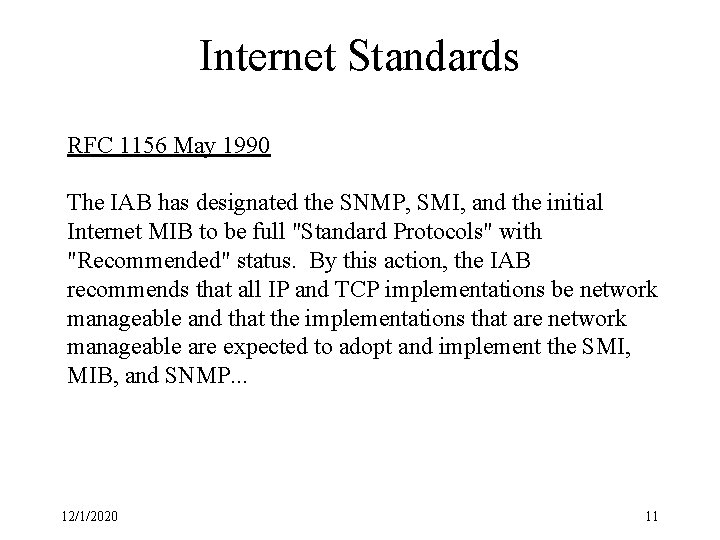
Internet Standards RFC 1156 May 1990 The IAB has designated the SNMP, SMI, and the initial Internet MIB to be full "Standard Protocols" with "Recommended" status. By this action, the IAB recommends that all IP and TCP implementations be network manageable and that the implementations that are network manageable are expected to adopt and implement the SMI, MIB, and SNMP. . . 12/1/2020 11
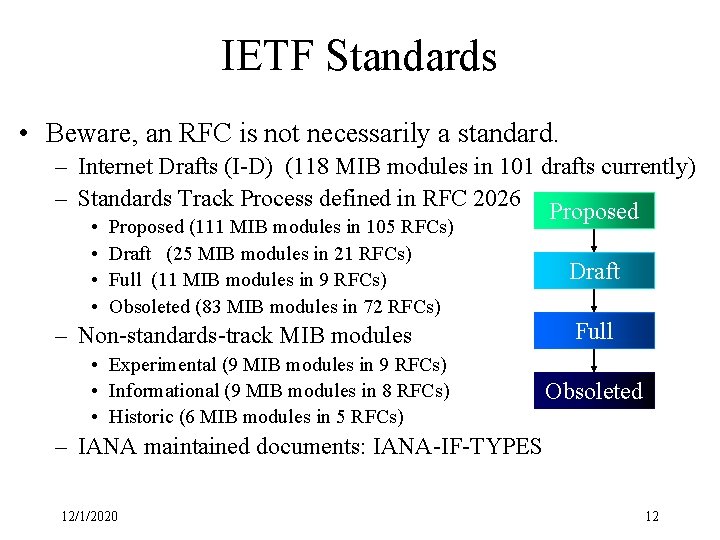
IETF Standards • Beware, an RFC is not necessarily a standard. – Internet Drafts (I-D) (118 MIB modules in 101 drafts currently) – Standards Track Process defined in RFC 2026 Proposed • • Proposed (111 MIB modules in 105 RFCs) Draft (25 MIB modules in 21 RFCs) Full (11 MIB modules in 9 RFCs) Obsoleted (83 MIB modules in 72 RFCs) – Non-standards-track MIB modules • Experimental (9 MIB modules in 9 RFCs) • Informational (9 MIB modules in 8 RFCs) • Historic (6 MIB modules in 5 RFCs) Draft Full Obsoleted – IANA maintained documents: IANA-IF-TYPES 12/1/2020 12
MIB module information • How to stay informed on MIB Modules • Operations & Management Area of – http: //www. ietf. org http: //www. rfc-editor. org – Specific web site for O&M – http: //www. ops. ietf. org • A mailing list: – mibs@ietf. org • Bill Fenner’s site: – http: //www. aciri. org/fenner/mibs/ 12/1/2020 13
• Understanding various SNMP counter types 12/1/2020 14
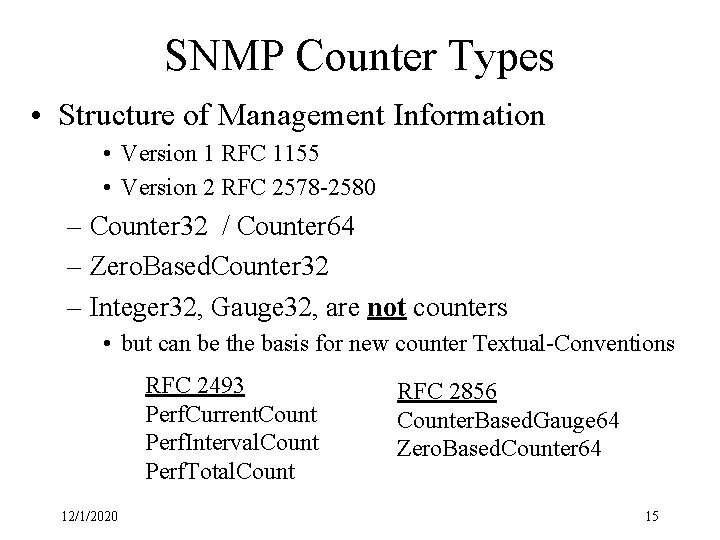
SNMP Counter Types • Structure of Management Information • Version 1 RFC 1155 • Version 2 RFC 2578 -2580 – Counter 32 / Counter 64 – Zero. Based. Counter 32 – Integer 32, Gauge 32, are not counters • but can be the basis for new counter Textual-Conventions RFC 2493 Perf. Current. Count Perf. Interval. Count Perf. Total. Count 12/1/2020 RFC 2856 Counter. Based. Gauge 64 Zero. Based. Counter 64 15
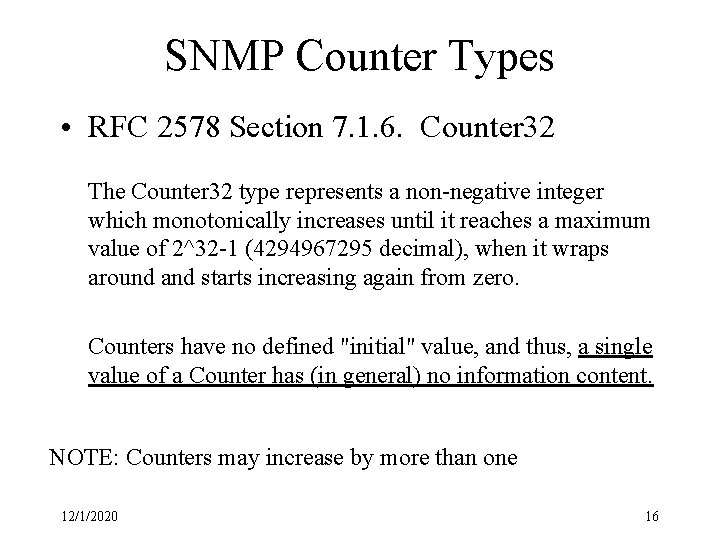
SNMP Counter Types • RFC 2578 Section 7. 1. 6. Counter 32 The Counter 32 type represents a non-negative integer which monotonically increases until it reaches a maximum value of 2^32 -1 (4294967295 decimal), when it wraps around and starts increasing again from zero. Counters have no defined "initial" value, and thus, a single value of a Counter has (in general) no information content. NOTE: Counters may increase by more than one 12/1/2020 16
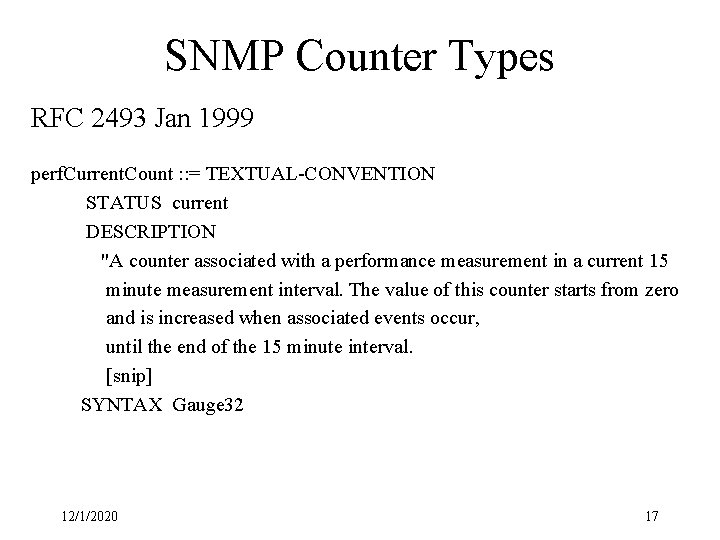
SNMP Counter Types RFC 2493 Jan 1999 perf. Current. Count : : = TEXTUAL-CONVENTION STATUS current DESCRIPTION "A counter associated with a performance measurement in a current 15 minute measurement interval. The value of this counter starts from zero and is increased when associated events occur, until the end of the 15 minute interval. [snip] SYNTAX Gauge 32 12/1/2020 17
Counter Identification • Need a scheme that allows two vendors or products within a vendor to compare like items. – Object Identifiers (OID) were chosen as the identification scheme. – An OID is an ordered sequence of non-negative integers written left to right, containing at least two elements (0. 0) – Bound to simple names in MIB Modules: • “if. In. Octets” is 1. 3. 6. 1. 2. 2. 1. 10 12/1/2020 18
Counter Identification • OIDs are not limited to SNMP protocol – Are useful, globally unique values that can be used for identifying anything. • Once a MIB module is published, OIDs are bound for all time to the objects defined. – Objects can not be deleted! See RFC 2665 • Can only be made obsolete • Even minor changes to an object are discouraged 12/1/2020 19
Counter Identification • Most common prefixes are: – 1. 3. 6. 1. 2. 1 – 1. 3. 6. 1. 3 – 1. 3. 6. 1. 4. 1 - contains MIB-II/std. objects - experimental MIB modules - contains vendor’s objects • IEEE 802. 3 ad Link Aggregation is: – 1. 2. 840. 10006. 300. 43 • Enterprise OIDs are delegated by IANA 12/1/2020 20
Tools for Managing OIDs • Useful tools for managing OID/names – libsmi (open source) • http: //www. ibr. cs. tu-bs. de/projects/libsmi/ – smidump -f identifiers – SMICng (commercial) • http: //www. snmpinfo. com – smicng -L 12/1/2020 21
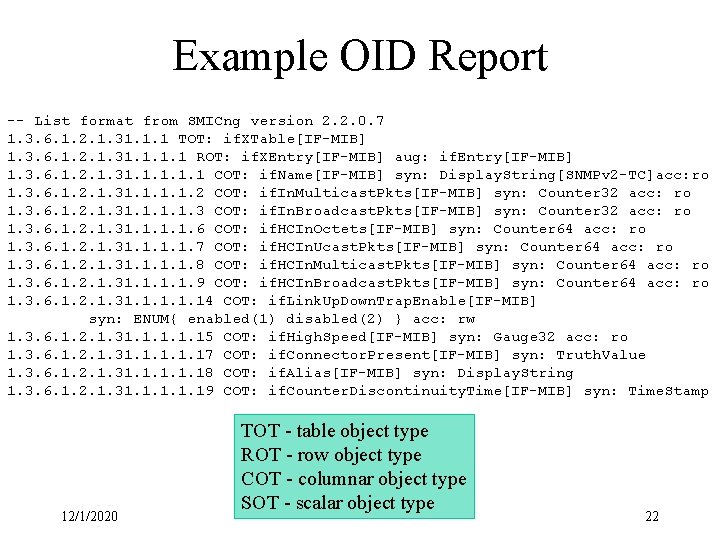
Example OID Report -- List format from SMICng version 2. 2. 0. 7 1. 3. 6. 1. 2. 1. 31. 1. 1 TOT: if. XTable[IF-MIB] 1. 3. 6. 1. 2. 1. 31. 1 ROT: if. XEntry[IF-MIB] aug: if. Entry[IF-MIB] 1. 3. 6. 1. 2. 1. 31. 1. 1 COT: if. Name[IF-MIB] syn: Display. String[SNMPv 2 -TC]acc: ro 1. 3. 6. 1. 2. 1. 31. 1. 2 COT: if. In. Multicast. Pkts[IF-MIB] syn: Counter 32 acc: ro 1. 3. 6. 1. 2. 1. 31. 1. 3 COT: if. In. Broadcast. Pkts[IF-MIB] syn: Counter 32 acc: ro 1. 3. 6. 1. 2. 1. 31. 1. 6 COT: if. HCIn. Octets[IF-MIB] syn: Counter 64 acc: ro 1. 3. 6. 1. 2. 1. 31. 1. 7 COT: if. HCIn. Ucast. Pkts[IF-MIB] syn: Counter 64 acc: ro 1. 3. 6. 1. 2. 1. 31. 1. 8 COT: if. HCIn. Multicast. Pkts[IF-MIB] syn: Counter 64 acc: ro 1. 3. 6. 1. 2. 1. 31. 1. 9 COT: if. HCIn. Broadcast. Pkts[IF-MIB] syn: Counter 64 acc: ro 1. 3. 6. 1. 2. 1. 31. 1. 14 COT: if. Link. Up. Down. Trap. Enable[IF-MIB] syn: ENUM{ enabled(1) disabled(2) } acc: rw 1. 3. 6. 1. 2. 1. 31. 1. 15 COT: if. High. Speed[IF-MIB] syn: Gauge 32 acc: ro 1. 3. 6. 1. 2. 1. 31. 1. 17 COT: if. Connector. Present[IF-MIB] syn: Truth. Value 1. 3. 6. 1. 2. 1. 31. 1. 18 COT: if. Alias[IF-MIB] syn: Display. String 1. 3. 6. 1. 2. 1. 31. 1. 19 COT: if. Counter. Discontinuity. Time[IF-MIB] syn: Time. Stamp 12/1/2020 TOT - table object type ROT - row object type COT - columnar object type SOT - scalar object type 22
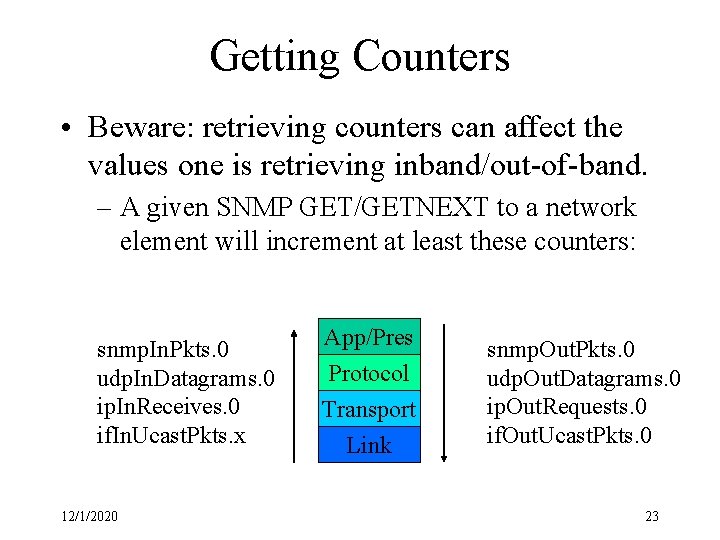
Getting Counters • Beware: retrieving counters can affect the values one is retrieving inband/out-of-band. – A given SNMP GET/GETNEXT to a network element will increment at least these counters: snmp. In. Pkts. 0 udp. In. Datagrams. 0 ip. In. Receives. 0 if. In. Ucast. Pkts. x 12/1/2020 App/Pres Protocol Transport Link snmp. Out. Pkts. 0 udp. Out. Datagrams. 0 ip. Out. Requests. 0 if. Out. Ucast. Pkts. 0 23
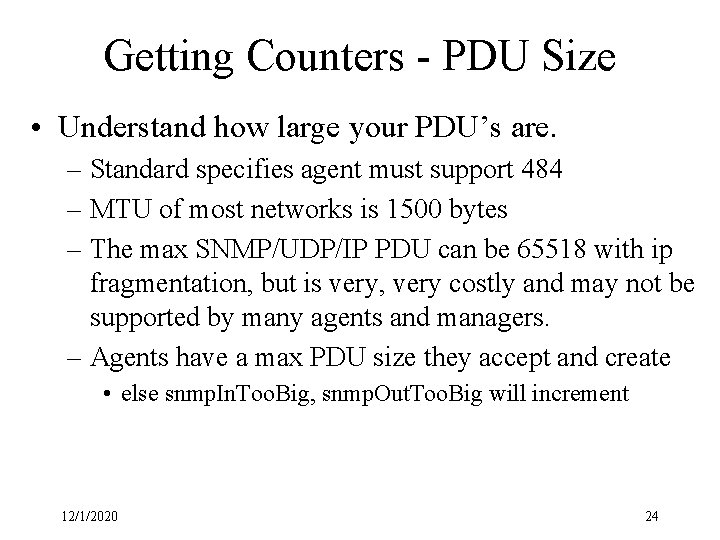
Getting Counters - PDU Size • Understand how large your PDU’s are. – Standard specifies agent must support 484 – MTU of most networks is 1500 bytes – The max SNMP/UDP/IP PDU can be 65518 with ip fragmentation, but is very, very costly and may not be supported by many agents and managers. – Agents have a max PDU size they accept and create • else snmp. In. Too. Big, snmp. Out. Too. Big will increment 12/1/2020 24
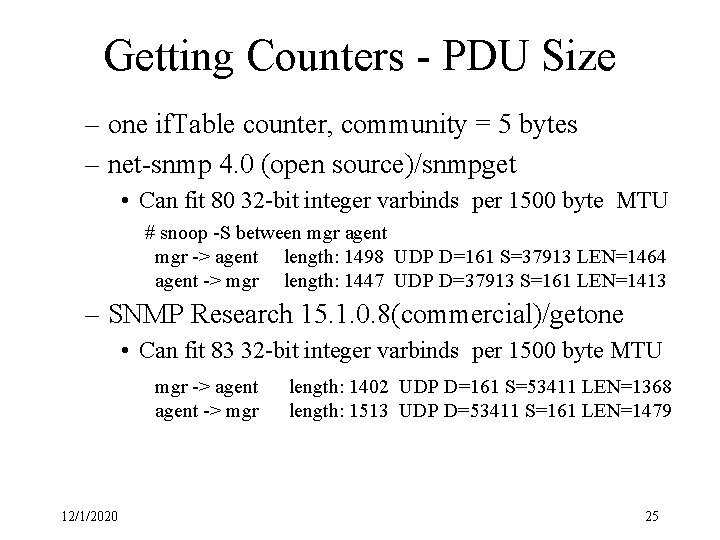
Getting Counters - PDU Size – one if. Table counter, community = 5 bytes – net-snmp 4. 0 (open source)/snmpget • Can fit 80 32 -bit integer varbinds per 1500 byte MTU # snoop -S between mgr agent mgr -> agent length: 1498 UDP D=161 S=37913 LEN=1464 agent -> mgr length: 1447 UDP D=37913 S=161 LEN=1413 – SNMP Research 15. 1. 0. 8(commercial)/getone • Can fit 83 32 -bit integer varbinds per 1500 byte MTU mgr -> agent -> mgr 12/1/2020 length: 1402 UDP D=161 S=53411 LEN=1368 length: 1513 UDP D=53411 S=161 LEN=1479 25
Data Collection Best Practices • How you poll counters/form requests can impact the quality of the data for analysis • How you poll for counters can skew your information/graphs. • Skew defined per Webster’s dictionary: – To give a bias to; distort. • Time is the major factor causing skew 12/1/2020 26
Data Collection Best Practices Time Skew • Group multiple objects in a given Get or Get. Next request to minimize time differences in sampling like objects. • GETt=1, 2, 3, . . { (x = if. Index, y = time) • if. In. UCast. Pkts. x, if. Out. UCast. Pkts. x, • if. In. Discards. x, if. Out. Discards. x • if. In. Errors. x, if. Out. Errors. x • sys. Up. Time. 0, if. Counter. Discontinuity. Time. x } 12/1/2020 27
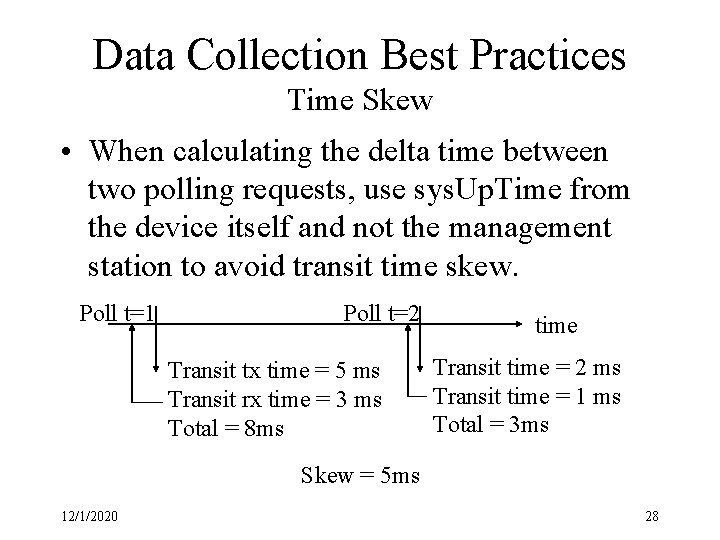
Data Collection Best Practices Time Skew • When calculating the delta time between two polling requests, use sys. Up. Time from the device itself and not the management station to avoid transit time skew. Poll t=1 Poll t=2 Transit tx time = 5 ms Transit rx time = 3 ms Total = 8 ms time Transit time = 2 ms Transit time = 1 ms Total = 3 ms Skew = 5 ms 12/1/2020 28
Data Collection Best Practices Using Perf Counters • All digital circuit interfaces (DS 0, DS 1, E 1, DS 3, E 3, SONET, SDH) use time based counters – Perf. Current. Count (RFC 2493) • Current Interval counters can decrease in value • Must align polling with device on 15 minute boundaries – Perf. Interval. Count • Provides history up to 24 hours in 96 15 -minute intervals • All devices and management stations need to be in time sync—use NTP 12/1/2020 29
Data Collection Best Practices Counter Discontinuity • Counters should not be reset without a way to determine the reset – Leads to inaccurate delta calculations • Two ways to determine a counter reset: – Polling sys. Up. Time for reset • Reset every time SNMP agent is reset • Note: sys. Up. Time wraps every 1. 36 years – Poll the discontinuity timer if it exists • Look in the description of the counter in the MIB module 12/1/2020 30
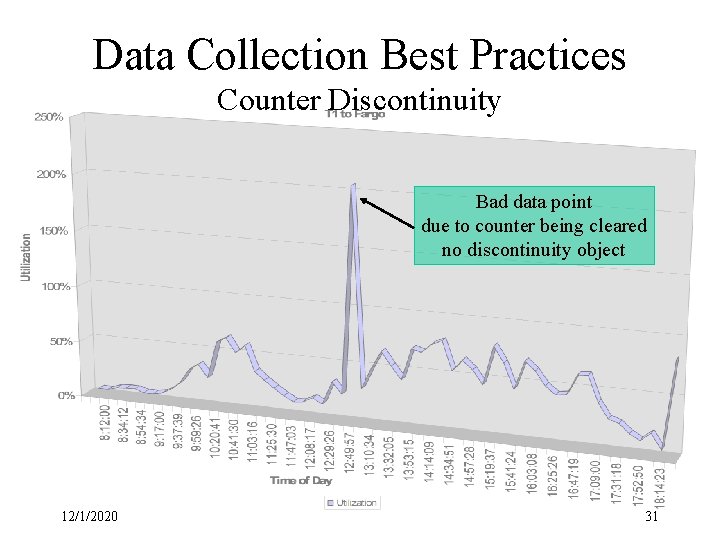
Data Collection Best Practices Counter Discontinuity Bad data point due to counter being cleared no discontinuity object 12/1/2020 31
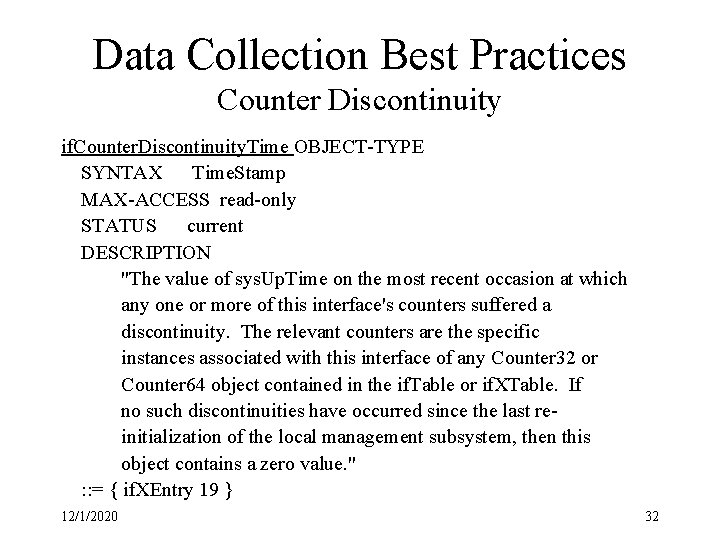
Data Collection Best Practices Counter Discontinuity if. Counter. Discontinuity. Time OBJECT-TYPE SYNTAX Time. Stamp MAX-ACCESS read-only STATUS current DESCRIPTION "The value of sys. Up. Time on the most recent occasion at which any one or more of this interface's counters suffered a discontinuity. The relevant counters are the specific instances associated with this interface of any Counter 32 or Counter 64 object contained in the if. Table or if. XTable. If no such discontinuities have occurred since the last reinitialization of the local management subsystem, then this object contains a zero value. " : : = { if. XEntry 19 } 12/1/2020 32
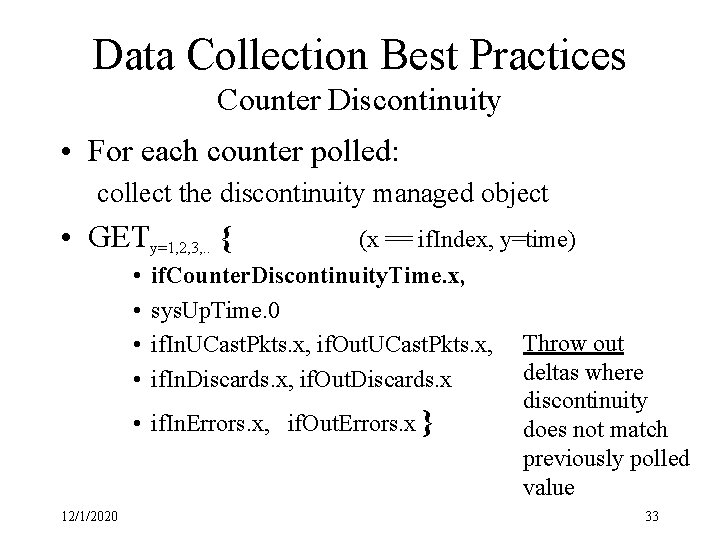
Data Collection Best Practices Counter Discontinuity • For each counter polled: collect the discontinuity managed object • GETy=1, 2, 3, . . { • • (x == if. Index, y=time) if. Counter. Discontinuity. Time. x, sys. Up. Time. 0 if. In. UCast. Pkts. x, if. Out. UCast. Pkts. x, if. In. Discards. x, if. Out. Discards. x • if. In. Errors. x, if. Out. Errors. x } 12/1/2020 Throw out deltas where discontinuity does not match previously polled value 33
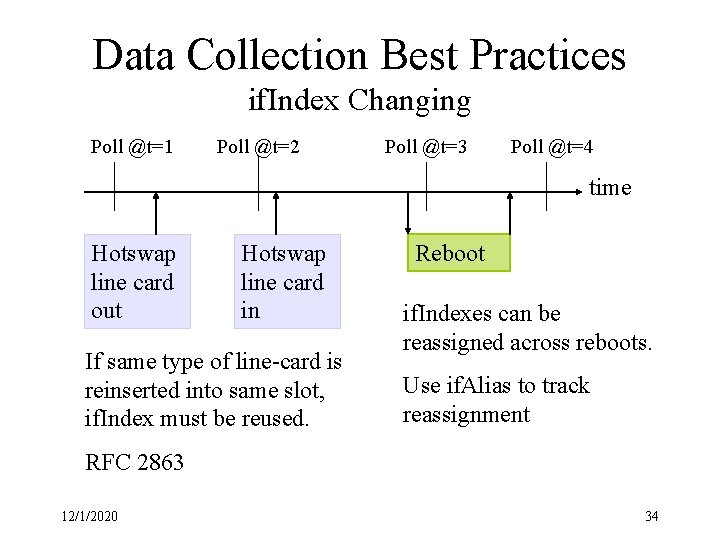
Data Collection Best Practices if. Index Changing Poll @t=1 Poll @t=2 Poll @t=3 Poll @t=4 time Hotswap line card out Hotswap line card in If same type of line-card is reinserted into same slot, if. Index must be reused. Reboot if. Indexes can be reassigned across reboots. Use if. Alias to track reassignment RFC 2863 12/1/2020 34
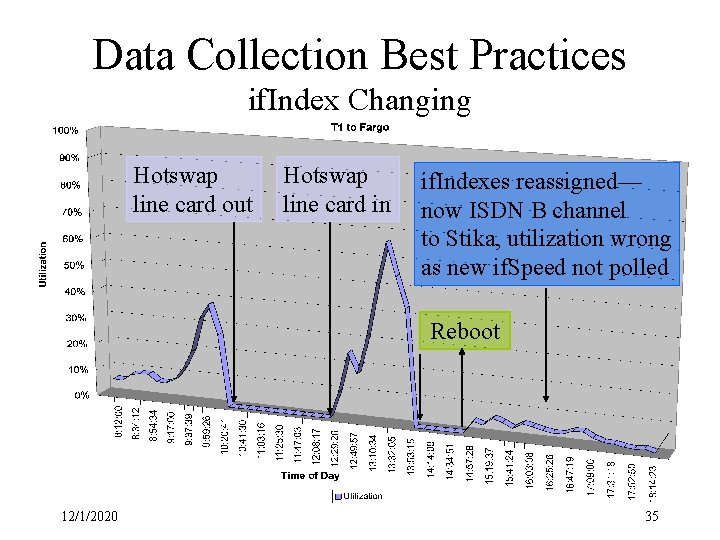
Data Collection Best Practices if. Index Changing Hotswap line card out Hotswap line card in if. Indexes reassigned— now ISDN B channel to Stika, utilization wrong as new if. Speed not polled Reboot 12/1/2020 35
Data Collection Best Practices Setting Minimum Poll Interval • What is the minimum polling interval? – Different implementations of a given counter can differ reasonably differ in refresh rate: – When testing vendors products, determine if the counter refresh rate is acceptable for your deployment needs • < 1 second, 1 minute, 5 minutes, 15 minutes, … – Remember to calculate data storage requirements – Careful! Check vendor hardware/software counter size underlying the SMI counter !! 12/1/2020 36
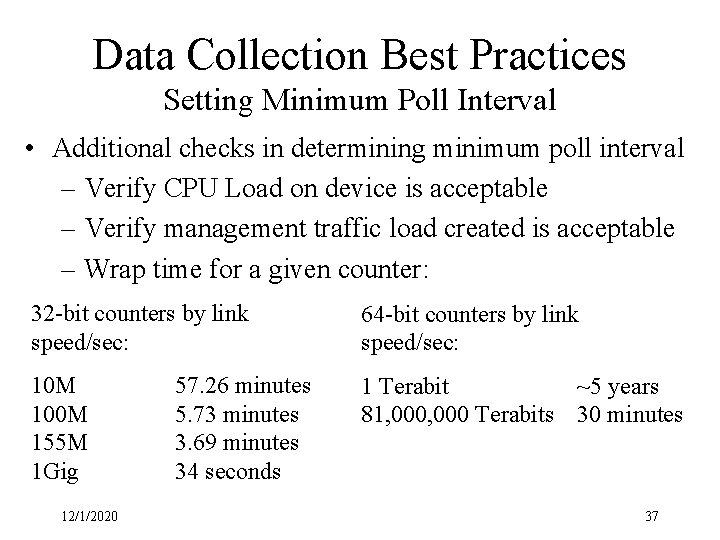
Data Collection Best Practices Setting Minimum Poll Interval • Additional checks in determining minimum poll interval – Verify CPU Load on device is acceptable – Verify management traffic load created is acceptable – Wrap time for a given counter: 32 -bit counters by link speed/sec: 64 -bit counters by link speed/sec: 10 M 100 M 155 M 1 Gig 1 Terabit ~5 years 81, 000 Terabits 30 minutes 12/1/2020 57. 26 minutes 5. 73 minutes 3. 69 minutes 34 seconds 37
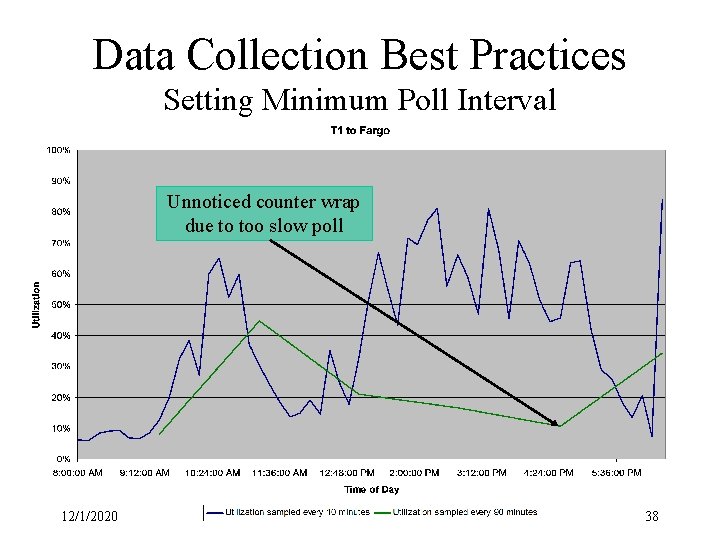
Data Collection Best Practices Setting Minimum Poll Interval Unnoticed counter wrap due to too slow poll 12/1/2020 38
Data Collection Best Practices Counter Width • Determine which counter size to poll for a given managed object. – 64 bit counters are often named “High Capacity” or HC as in if. HCIn. Octets – Another strategy is high/low 32 bit objects – Section 3. 1. 6 of RFC 2863 provides to vendors as follows for IETF Standards abiding Agent implementations for byte/packet counters 12/1/2020 39
Data Collection Best Practices Counter Width • Abiding IETF Implementations will provide byte/packet counters at widths of: – if. Speed <= 200 Mbps • 32 -bit byte and packet counters – if. Speed > 200 Mbps && < 650 Mbps • 32 -bit packet counters and 64 -bit byte counters – if. Speed >= 650 Mbps • 64 -bit byte and packet counters – Implementations may provide additional counters, i. e. 64 -bit byte counters for 100 M interfaces 12/1/2020 40
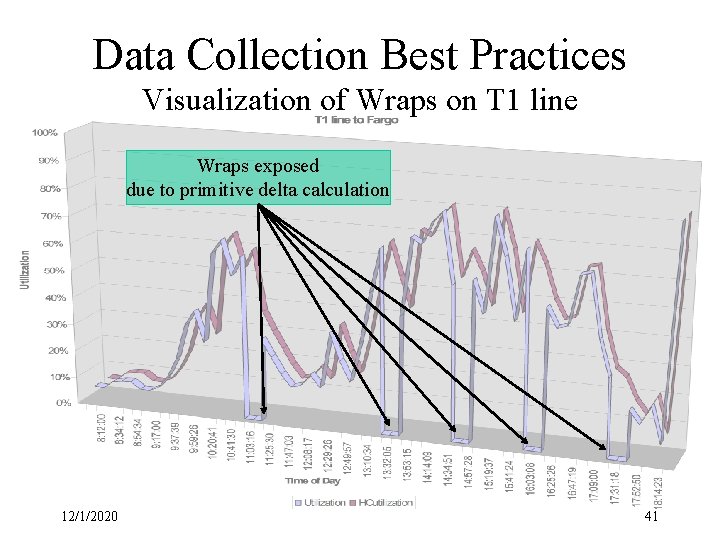
Data Collection Best Practices Visualization of Wraps on T 1 line Wraps exposed due to primitive delta calculation 12/1/2020 41
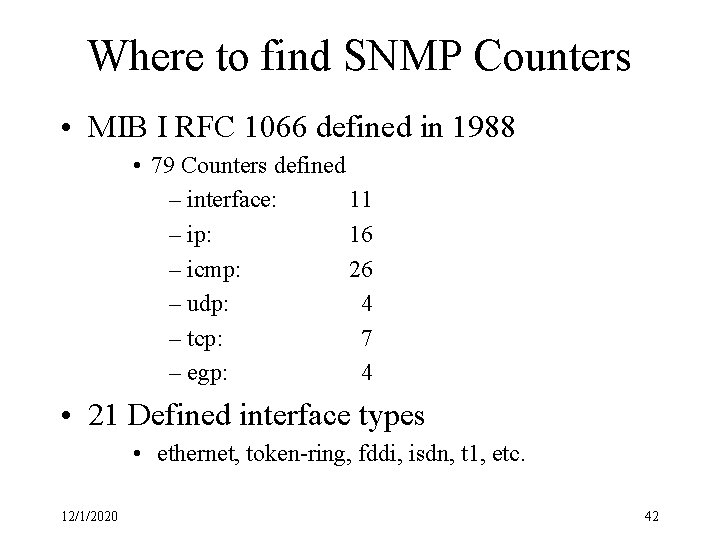
Where to find SNMP Counters • MIB I RFC 1066 defined in 1988 • 79 Counters defined – interface: 11 – ip: 16 – icmp: 26 – udp: 4 – tcp: 7 – egp: 4 • 21 Defined interface types • ethernet, token-ring, fddi, isdn, t 1, etc. 12/1/2020 42
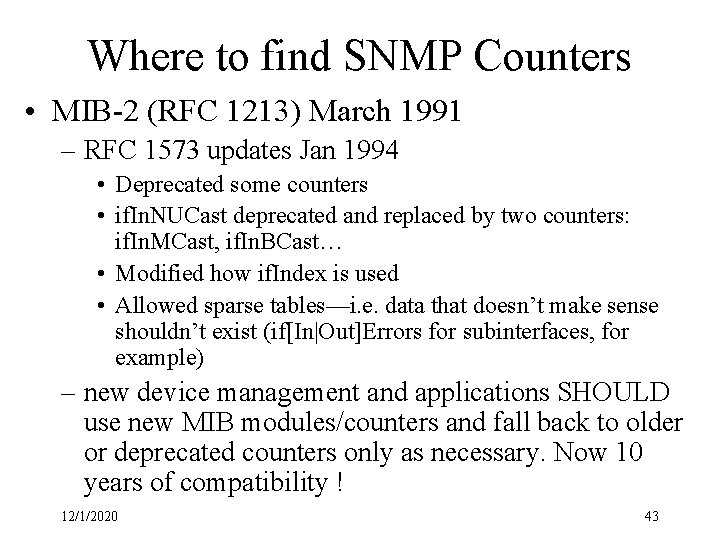
Where to find SNMP Counters • MIB-2 (RFC 1213) March 1991 – RFC 1573 updates Jan 1994 • Deprecated some counters • if. In. NUCast deprecated and replaced by two counters: if. In. MCast, if. In. BCast… • Modified how if. Index is used • Allowed sparse tables—i. e. data that doesn’t make sense shouldn’t exist (if[In|Out]Errors for subinterfaces, for example) – new device management and applications SHOULD use new MIB modules/counters and fall back to older or deprecated counters only as necessary. Now 10 years of compatibility ! 12/1/2020 43
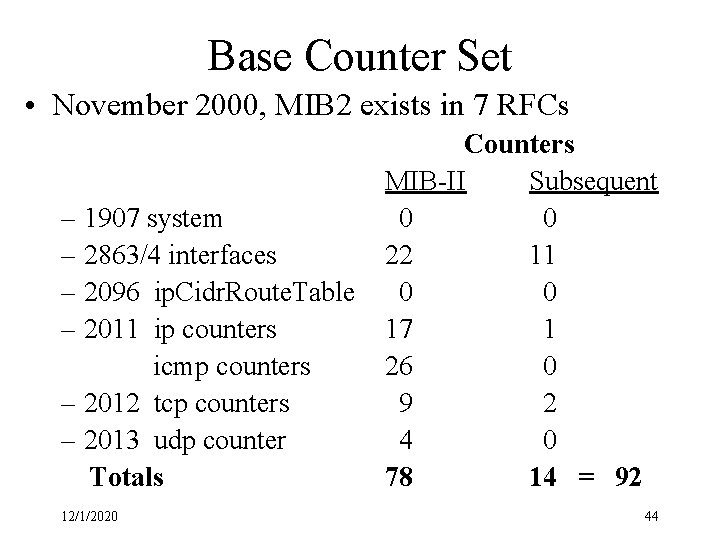
Base Counter Set • November 2000, MIB 2 exists in 7 RFCs – 1907 system – 2863/4 interfaces – 2096 ip. Cidr. Route. Table – 2011 ip counters icmp counters – 2012 tcp counters – 2013 udp counter Totals 12/1/2020 Counters MIB-II Subsequent 0 0 22 11 0 0 17 1 26 0 9 2 4 0 78 14 = 92 44
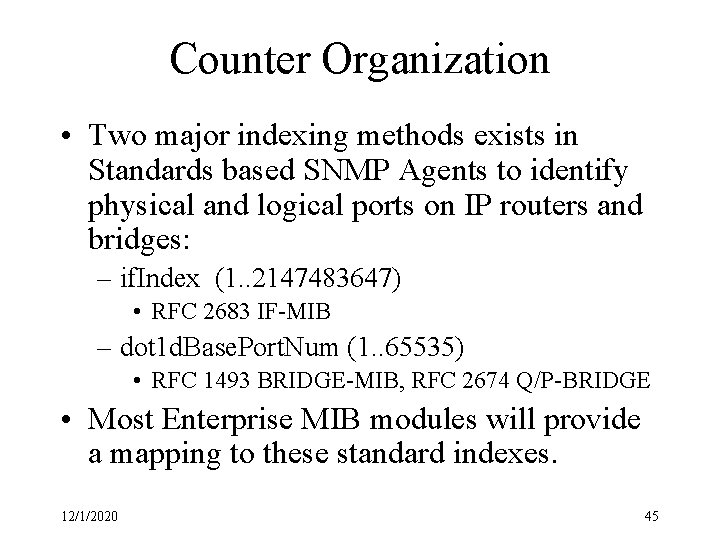
Counter Organization • Two major indexing methods exists in Standards based SNMP Agents to identify physical and logical ports on IP routers and bridges: – if. Index (1. . 2147483647) • RFC 2683 IF-MIB – dot 1 d. Base. Port. Num (1. . 65535) • RFC 1493 BRIDGE-MIB, RFC 2674 Q/P-BRIDGE • Most Enterprise MIB modules will provide a mapping to these standard indexes. 12/1/2020 45
Network Interfaces • Is an if. Index logical or physical? – In old days, one used if. Type, but these values are not generally well defined. Some RFCs define the value to use Ether. Like-MIB, Frame Relay, ATM. . . others do not, such as 802. 1 Q VLANS in RFC 2674. – Use if. Connector. Present. x to determine if you are looking at a logical or physical interface. 12/1/2020 46
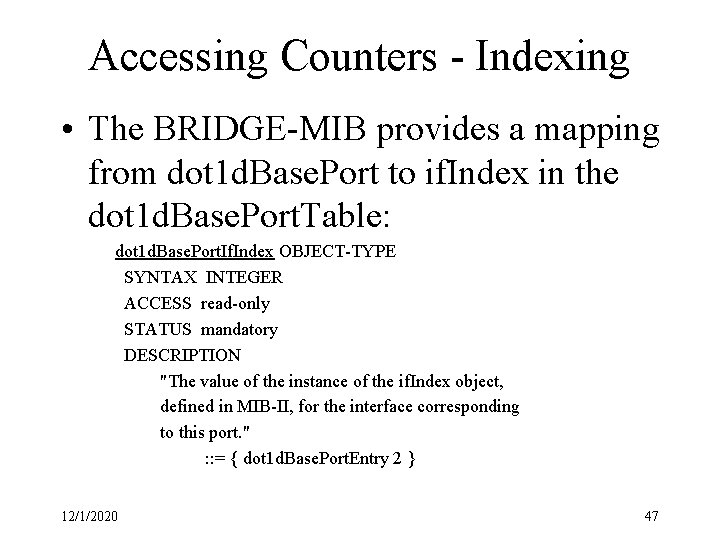
Accessing Counters - Indexing • The BRIDGE-MIB provides a mapping from dot 1 d. Base. Port to if. Index in the dot 1 d. Base. Port. Table: dot 1 d. Base. Port. If. Index OBJECT-TYPE SYNTAX INTEGER ACCESS read-only STATUS mandatory DESCRIPTION "The value of the instance of the if. Index object, defined in MIB-II, for the interface corresponding to this port. " : : = { dot 1 d. Base. Port. Entry 2 } 12/1/2020 47
Accessing Counters - Indexing • If. Index’s are not by required to be fixed for all time to a given slot/port. – Only rule is that if. Index can’t change from one media to another w/o disrupting sys. Up. Time • Routed vs Bridged Ports – All ports that bridge have an if. Index and dot 1 d. Base. Port. Num assigned – If a port does not perform bridging, no dot 1 d. Base. Port. Num is assigned 12/1/2020 48
Identifying Indexes Or how do I find counters for POS 3/5? • What if. Index corresponds to my CLI description of “interface ethernet 0”? • Use if. Name managed object in if. XTable! – Its sole purpose is to cross reference the Command Line Interface representation of a given port, ex: if. Index 23 ~ pos 3/5 • if. Descr or if. Alias may also have it, but that is at the discretion of the vendor. 12/1/2020 49
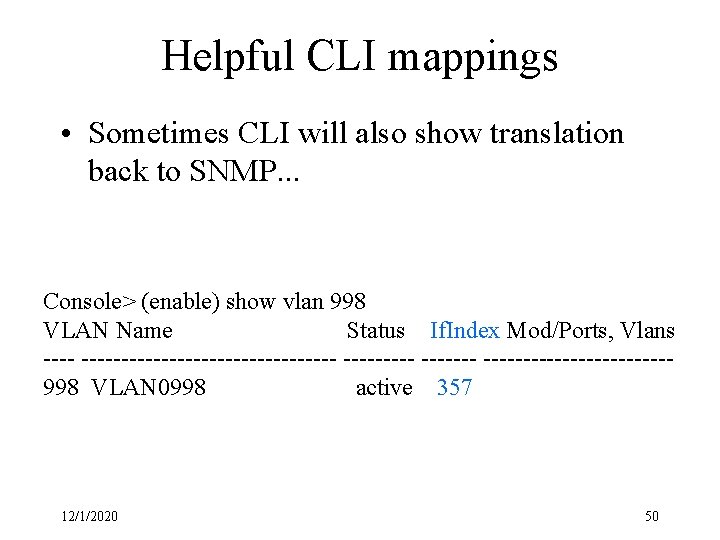
Helpful CLI mappings • Sometimes CLI will also show translation back to SNMP. . . Console> (enable) show vlan 998 VLAN Name Status If. Index Mod/Ports, Vlans ------------------ ---------------998 VLAN 0998 active 357 12/1/2020 50
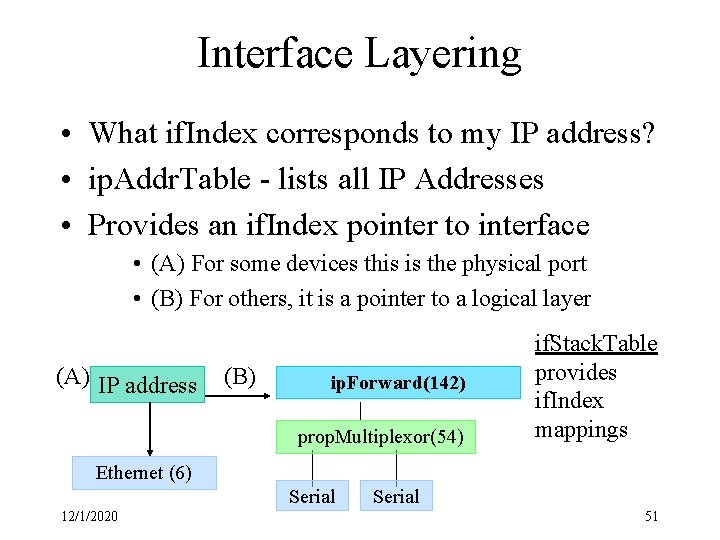
Interface Layering • What if. Index corresponds to my IP address? • ip. Addr. Table - lists all IP Addresses • Provides an if. Index pointer to interface • (A) For some devices this is the physical port • (B) For others, it is a pointer to a logical layer (A) IP address (B) ip. Forward(142) prop. Multiplexor(54) if. Stack. Table provides if. Index mappings Ethernet (6) Serial 12/1/2020 Serial 51
Layer 2 Addressing • What if. Index corresponds to a given MAC? – Two standard ways to find this: – Use the ARP Table • ip. Net. To. Media – Indexed by if. Index, and MAC address – Use the transparent Bridge Table • dot 1 d. Tp. Fdb. Table – Indexed by source MAC address 12/1/2020 52
• Review SNMP counters defined/Layer 1 -3 12/1/2020 53
Layers 1 -2 • • • Ethernet 803. 3 ad Link Aggregation Serial Cable Modem PPP Frame Relay ATM MPLS 802. 1 D/Q Bridging RMON 12/1/2020 54
Ethernet • Ethernet. Like-MIB (dot 3) RFC 2665 – obsoletes RFC 2358 which obsoletes RFC 1650 • Now supports all flavors of Ethernet – 10, 100, and 1000 megabit/sec New Gig Ethernet counters dot 3 In. Pause. Frames, dot 3 Out. Pause. Frames dot 3 Control. In. Unknown. Opcodes dot 3 Pause. Table provides: dot 3 Stats. Duplex. Status 12/1/2020 55
Ethernet RFC 2665 • dot 3 Stats. Table • • • 12/1/2020 – By If. Index (dot 3 Stats. Index) dot 3 Stats. Alignment. Errors dot 3 Stats. FCSErrors dot 3 Stats. Single. Collision. Frames dot 3 Stats. Multiple. Collision. Frames dot 3 Stats. Deferred. Transmissions dot 3 Stats. Late. Collisions dot 3 Stats. Excessive. Collisions dot 3 Stats. Internal. Mac. Transmit. Errors dot 3 Stats. Carrier. Sense. Errors dot 3 Stats. Frame. Too. Longs dot 3 Stats. Internal. Mac. Receive. Errors 56
Ethernet • MAU-MIB RFC 2668 • New Gig Ethernet Support: • rp. Mau. False. Carriers – A count of the number of false carrier events during IDLE in 100 BASE-X links • rp. Mau. Media. Available. State. Exits – A count of the number of times that rp. Mau. Media. Available for this MAU instance leaves the state available(3). 12/1/2020 57
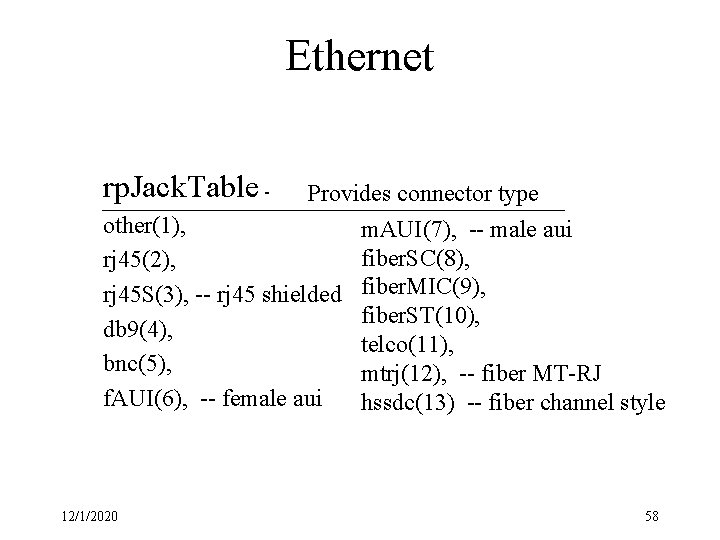
Ethernet rp. Jack. Table - Provides connector type other(1), m. AUI(7), -- male aui fiber. SC(8), rj 45(2), rj 45 S(3), -- rj 45 shielded fiber. MIC(9), fiber. ST(10), db 9(4), telco(11), bnc(5), mtrj(12), -- fiber MT-RJ f. AUI(6), -- female aui hssdc(13) -- fiber channel style 12/1/2020 58
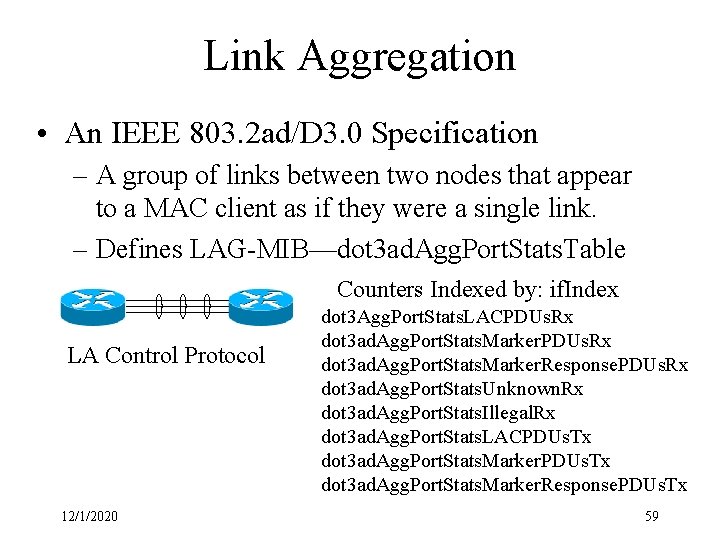
Link Aggregation • An IEEE 803. 2 ad/D 3. 0 Specification – A group of links between two nodes that appear to a MAC client as if they were a single link. – Defines LAG-MIB—dot 3 ad. Agg. Port. Stats. Table Counters Indexed by: if. Index LA Control Protocol 12/1/2020 dot 3 Agg. Port. Stats. LACPDUs. Rx dot 3 ad. Agg. Port. Stats. Marker. Response. PDUs. Rx dot 3 ad. Agg. Port. Stats. Unknown. Rx dot 3 ad. Agg. Port. Stats. Illegal. Rx dot 3 ad. Agg. Port. Stats. LACPDUs. Tx dot 3 ad. Agg. Port. Stats. Marker. Response. PDUs. Tx 59
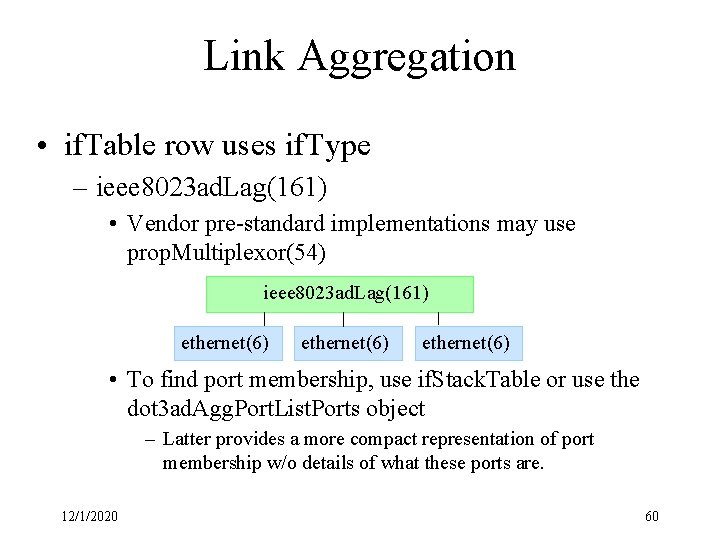
Link Aggregation • if. Table row uses if. Type – ieee 8023 ad. Lag(161) • Vendor pre-standard implementations may use prop. Multiplexor(54) ieee 8023 ad. Lag(161) ethernet(6) • To find port membership, use if. Stack. Table or use the dot 3 ad. Agg. Port. List. Ports object – Latter provides a more compact representation of port membership w/o details of what these ports are. 12/1/2020 60
Serial Interfaces RFC 2494 -6 • Serial Interfaces (DS 0/DS 1/E 1/DS 3/E 3/SONET/SDH) – Use of Perf. Hist counters which are GAUGE • current values can decrease – Some IP devices keep only current 15 minutes others can keep complete 24 hours worth of 15 minute statistics. – No requirement for 15 minute intervals to match current wall clock time. 12/1/2020 61
Serial Interfaces • Since counters are kept in 15 minute buckets, one can correlate performance across a TDM circuit. • Performance is calculated using error counters instead of packet discard counters, i. e. : Bit Error Rate – Errored Seconds – Severely Errored Seconds – Unavailable Seconds 12/1/2020 62
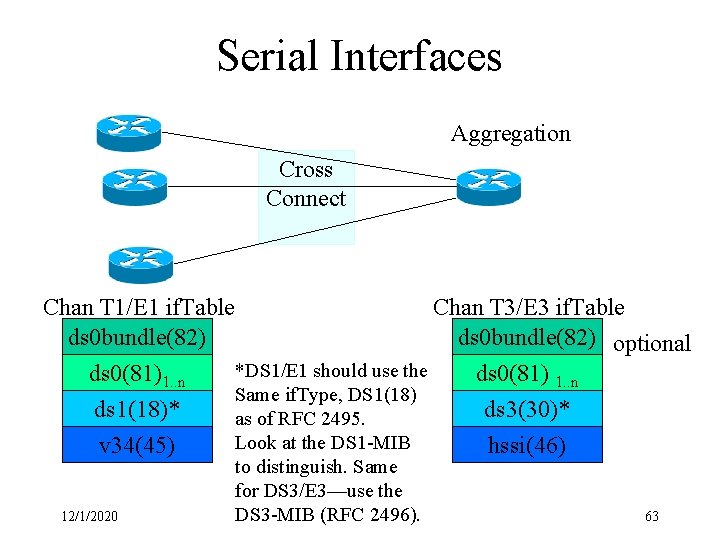
Serial Interfaces Aggregation Cross Connect Chan T 1/E 1 if. Table Chan T 3/E 3 if. Table ds 0 bundle(82) optional *DS 1/E 1 should use the ds 0(81)1. . n ds 0(81) 1. . n Same if. Type, DS 1(18) ds 1(18)* ds 3(30)* as of RFC 2495. v 34(45) 12/1/2020 Look at the DS 1 -MIB to distinguish. Same for DS 3/E 3—use the DS 3 -MIB (RFC 2496). hssi(46) 63
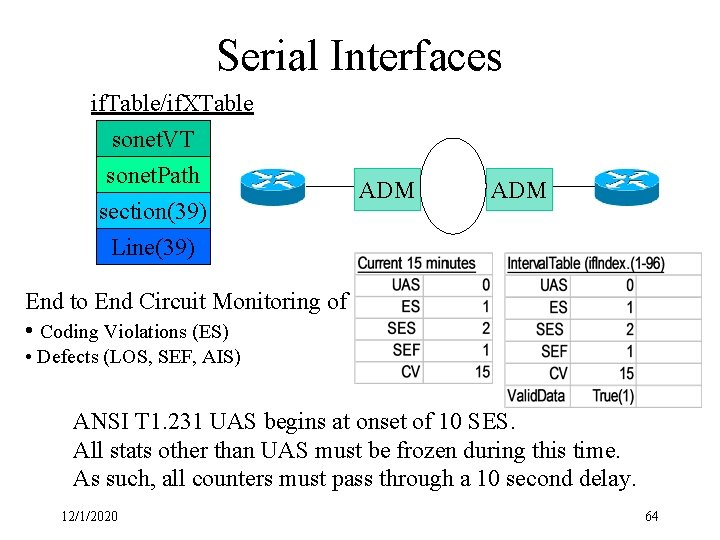
Serial Interfaces if. Table/if. XTable sonet. VT sonet. Path section(39) ADM Line(39) End to End Circuit Monitoring of • Coding Violations (ES) • Defects (LOS, SEF, AIS) ANSI T 1. 231 UAS begins at onset of 10 SES. All stats other than UAS must be frozen during this time. As such, all counters must pass through a 10 second delay. 12/1/2020 64
SONET/SDH • Linear Automatic Protection Switching • MIB Module currently under development • draft-ietf-atommib-sonetaps-mib-02. txt • 1: n and 1+1 support aps. Status. Table indexed by: aps. Config. Name aps. Status. Mode. Mismatches aps. Status. Channel. Mismatches aps. Status. PSBFs aps. Status. FEPLFs 12/1/2020 aps. Chan. Status. Table indexed by: aps. Chan. Group. Name, aps. Chan. Number aps. Chan. Signal. Degrades aps. Chan. Signal. Failures aps. Chan. Switchovers aps. Chan. Last. Switchover 65
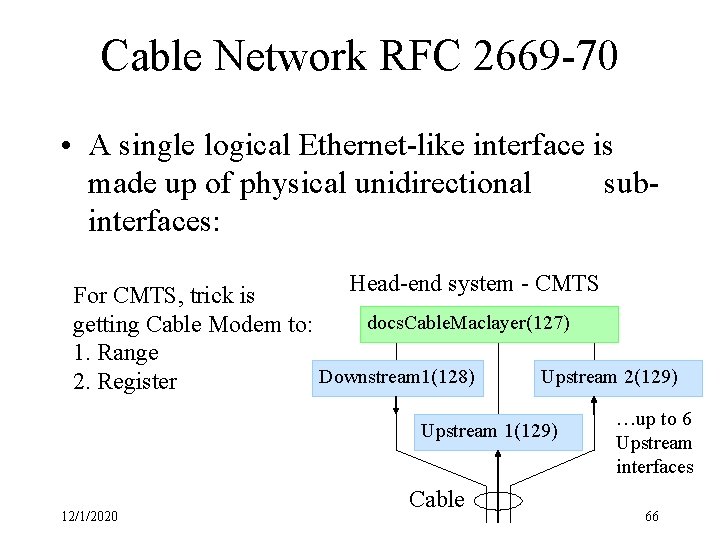
Cable Network RFC 2669 -70 • A single logical Ethernet-like interface is made up of physical unidirectional subinterfaces: Head-end system - CMTS For CMTS, trick is docs. Cable. Maclayer(127) getting Cable Modem to: 1. Range Downstream 1(128) Upstream 2(129) 2. Register Upstream 1(129) 12/1/2020 Cable …up to 6 Upstream interfaces 66
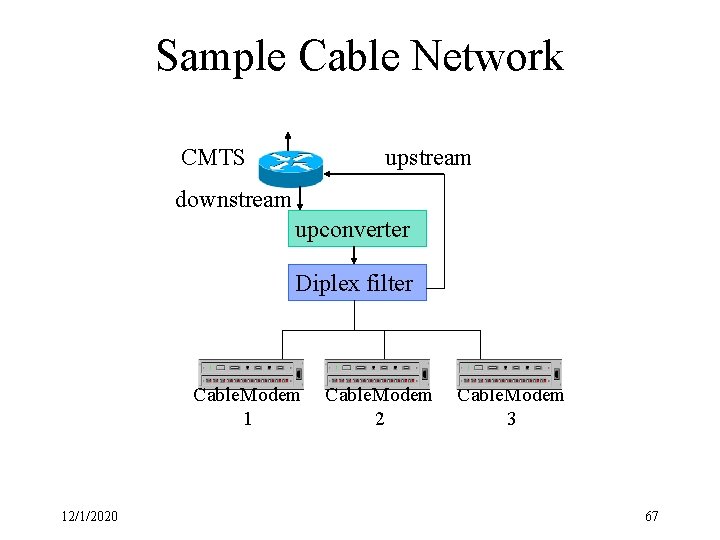
Sample Cable Network CMTS upstream downstream upconverter Diplex filter Cable. Modem 1 12/1/2020 Cable. Modem 2 Cable. Modem 3 67
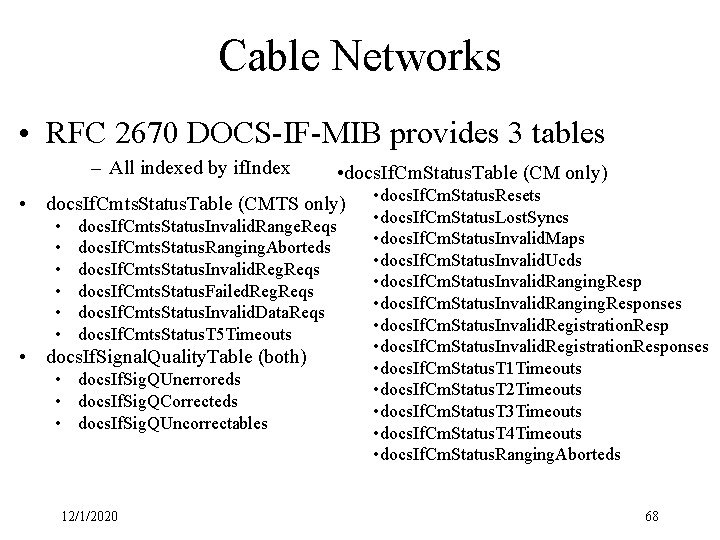
Cable Networks • RFC 2670 DOCS-IF-MIB provides 3 tables – All indexed by if. Index • docs. If. Cm. Status. Table (CM only) • docs. If. Cmts. Status. Table (CMTS only) • docs. If. Cm. Status. Resets • • • docs. If. Cmts. Status. Invalid. Range. Reqs docs. If. Cmts. Status. Ranging. Aborteds docs. If. Cmts. Status. Invalid. Reg. Reqs docs. If. Cmts. Status. Failed. Reg. Reqs docs. If. Cmts. Status. Invalid. Data. Reqs docs. If. Cmts. Status. T 5 Timeouts • docs. If. Signal. Quality. Table (both) • docs. If. Sig. QUnerroreds • docs. If. Sig. QCorrecteds • docs. If. Sig. QUncorrectables 12/1/2020 • docs. If. Cm. Status. Lost. Syncs • docs. If. Cm. Status. Invalid. Maps • docs. If. Cm. Status. Invalid. Ucds • docs. If. Cm. Status. Invalid. Ranging. Responses • docs. If. Cm. Status. Invalid. Registration. Responses • docs. If. Cm. Status. T 1 Timeouts • docs. If. Cm. Status. T 2 Timeouts • docs. If. Cm. Status. T 3 Timeouts • docs. If. Cm. Status. T 4 Timeouts • docs. If. Cm. Status. Ranging. Aborteds 68
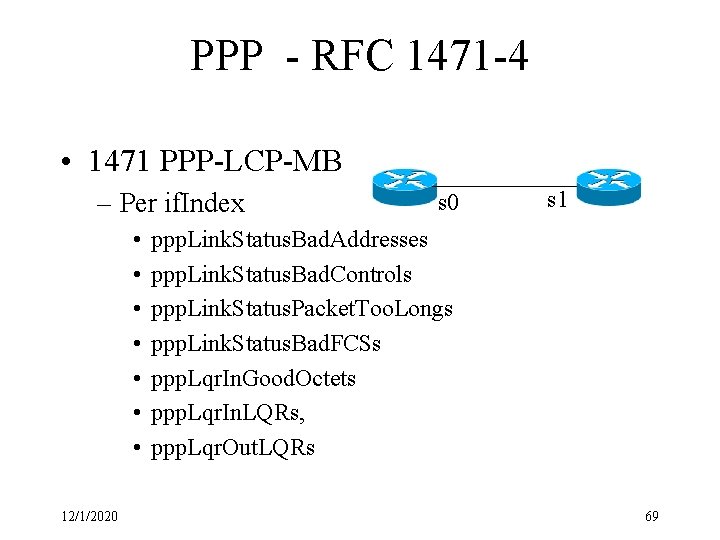
PPP - RFC 1471 -4 • 1471 PPP-LCP-MB – Per if. Index • • 12/1/2020 s 1 ppp. Link. Status. Bad. Addresses ppp. Link. Status. Bad. Controls ppp. Link. Status. Packet. Too. Longs ppp. Link. Status. Bad. FCSs ppp. Lqr. In. Good. Octets ppp. Lqr. In. LQRs, ppp. Lqr. Out. LQRs 69
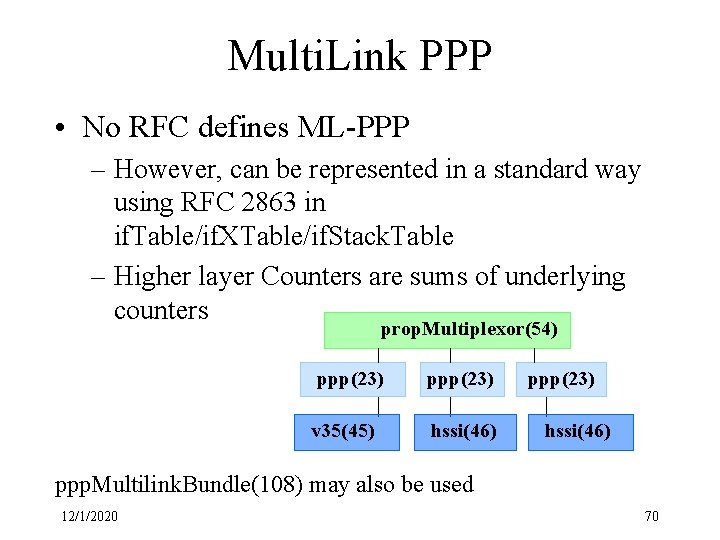
Multi. Link PPP • No RFC defines ML-PPP – However, can be represented in a standard way using RFC 2863 in if. Table/if. XTable/if. Stack. Table – Higher layer Counters are sums of underlying counters prop. Multiplexor(54) ppp(23) v 35(45) hssi(46) ppp(23) hssi(46) ppp. Multilink. Bundle(108) may also be used 12/1/2020 70
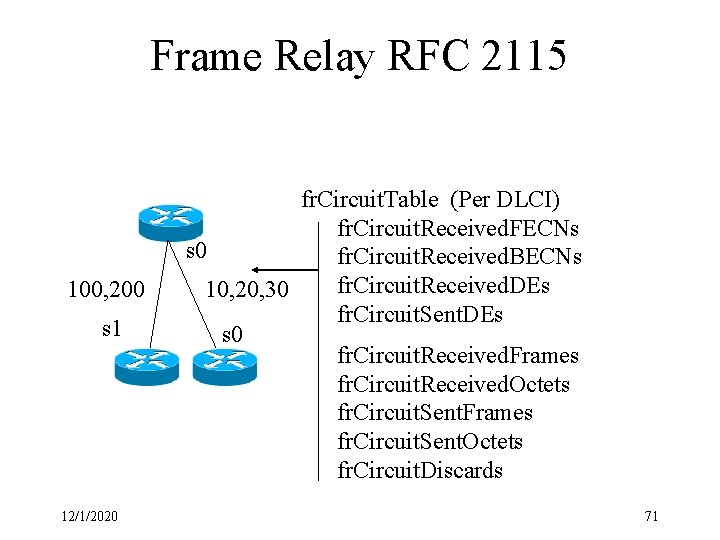
Frame Relay RFC 2115 100, 200 s 1 12/1/2020 fr. Circuit. Table (Per DLCI) fr. Circuit. Received. FECNs s 0 fr. Circuit. Received. BECNs fr. Circuit. Received. DEs 10, 20, 30 fr. Circuit. Sent. DEs s 0 fr. Circuit. Received. Frames fr. Circuit. Received. Octets fr. Circuit. Sent. Frames fr. Circuit. Sent. Octets fr. Circuit. Discards 71
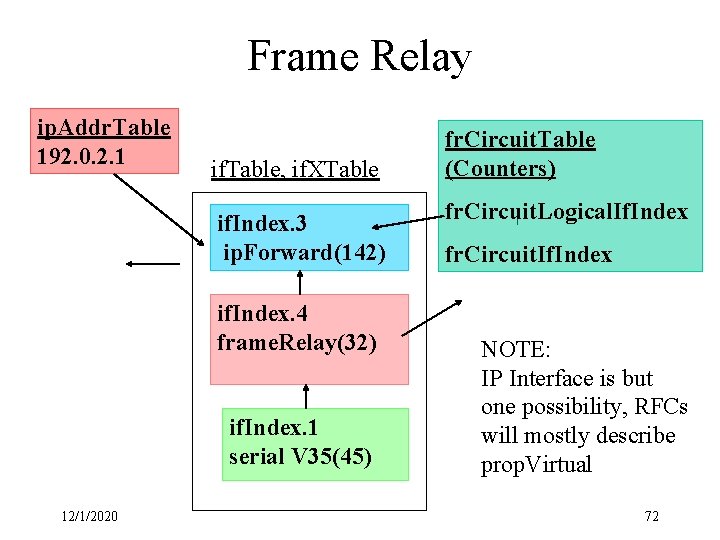
Frame Relay ip. Addr. Table 192. 0. 2. 1 if. Table, if. XTable if. Index. 3 ip. Forward(142) if. Index. 4 frame. Relay(32) if. Index. 1 serial V 35(45) 12/1/2020 fr. Circuit. Table (Counters) fr. Circuit. Logical. If. Index fr. Circuit. If. Index NOTE: IP Interface is but one possibility, RFCs will mostly describe prop. Virtual 72
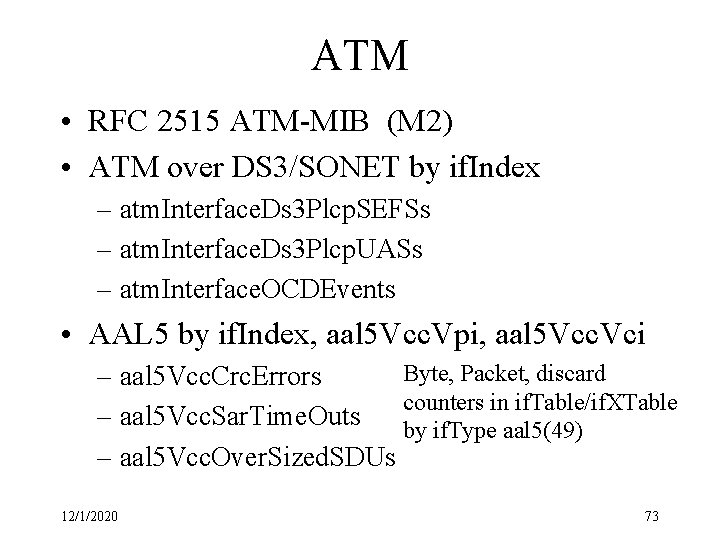
ATM • RFC 2515 ATM-MIB (M 2) • ATM over DS 3/SONET by if. Index – atm. Interface. Ds 3 Plcp. SEFSs – atm. Interface. Ds 3 Plcp. UASs – atm. Interface. OCDEvents • AAL 5 by if. Index, aal 5 Vcc. Vpi, aal 5 Vcc. Vci Byte, Packet, discard – aal 5 Vcc. Crc. Errors counters in if. Table/if. XTable – aal 5 Vcc. Sar. Time. Outs by if. Type aal 5(49) – aal 5 Vcc. Over. Sized. SDUs 12/1/2020 73
ATM • atm. Vcl. Table manages per VC – Indexed by {if. Index, atm. Vcl. Vpi, atm. Vcl. Vci} – Has if. Table like capabilities: • atm. Vcl. Admin. Status / atm. Vcl. Oper. Status • atm. Vcl. Last. Change – Unfortunately: no if. Index pointer to identify upper layer components, use Enterprise MIB to map to IP address or MAC addresses associated with this. – Per VC stats found in B-ICI Specification, – ATM-RMON MIB (Cisco) plus CISCO-AAL 5 -MIB 12/1/2020 75
MPLS • Three drafts current in development: – draft-ietf-mpls-ftn-mib-00. txt • MPLS-FTN-MIB • Associate FEC with LSP – draft-ietf-mpls-lsr-mib-07. txt • MPLS-LSR-MIB • setup mpls per interface, LSPs, cross-connect, etc – draft-ietf-mpls-te-mib-05. txt • MPLS-TE-MIB • configures tunnels, tunnel resources 12/1/2020 76
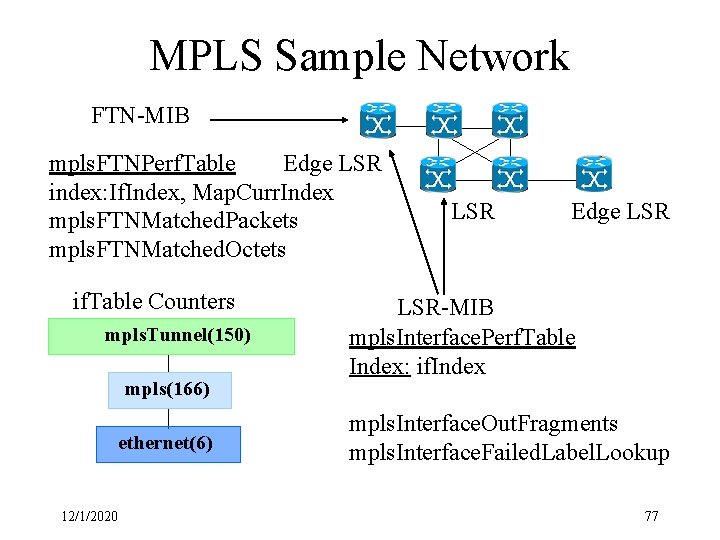
MPLS Sample Network FTN-MIB mpls. FTNPerf. Table Edge LSR index: If. Index, Map. Curr. Index mpls. FTNMatched. Packets mpls. FTNMatched. Octets if. Table Counters mpls. Tunnel(150) mpls(166) ethernet(6) 12/1/2020 LSR Edge LSR-MIB mpls. Interface. Perf. Table Index: if. Index mpls. Interface. Out. Fragments mpls. Interface. Failed. Label. Lookup 77
MPLS • Currently draft-ietf-mpls-lsr-mib-07. txt – mpls. In. Segment. Perf. Table • Index: mpls. Out. Segment. Index – mpls. In. Segment. Octets – mpls. In. Segment. Packets – mpls. In. Segment. Errors – mpls. In. Segment. Discards 12/1/2020 78
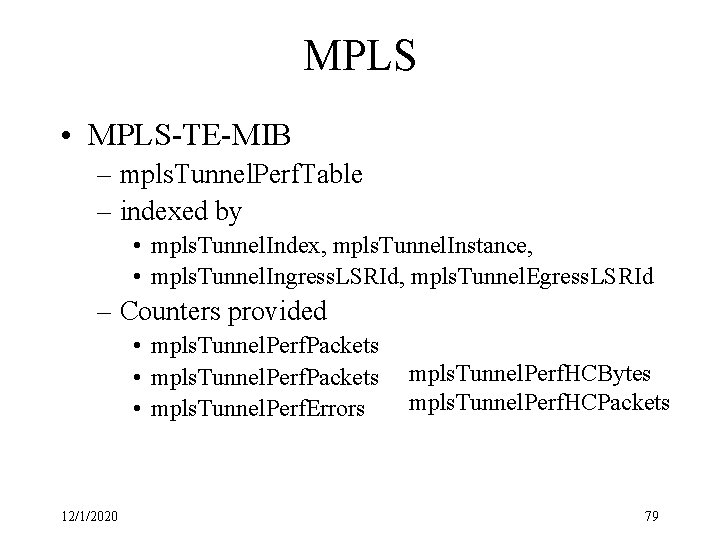
MPLS • MPLS-TE-MIB – mpls. Tunnel. Perf. Table – indexed by • mpls. Tunnel. Index, mpls. Tunnel. Instance, • mpls. Tunnel. Ingress. LSRId, mpls. Tunnel. Egress. LSRId – Counters provided • mpls. Tunnel. Perf. Packets • mpls. Tunnel. Perf. Errors 12/1/2020 mpls. Tunnel. Perf. HCBytes mpls. Tunnel. Perf. HCPackets 79
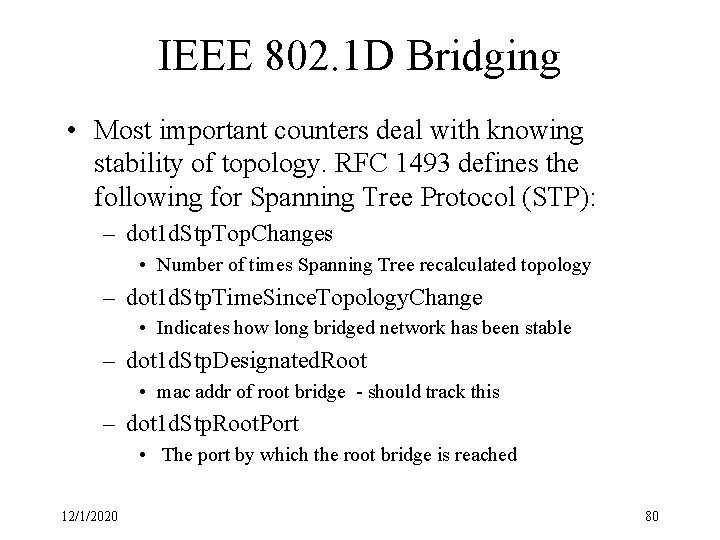
IEEE 802. 1 D Bridging • Most important counters deal with knowing stability of topology. RFC 1493 defines the following for Spanning Tree Protocol (STP): – dot 1 d. Stp. Top. Changes • Number of times Spanning Tree recalculated topology – dot 1 d. Stp. Time. Since. Topology. Change • Indicates how long bridged network has been stable – dot 1 d. Stp. Designated. Root • mac addr of root bridge - should track this – dot 1 d. Stp. Root. Port • The port by which the root bridge is reached 12/1/2020 80
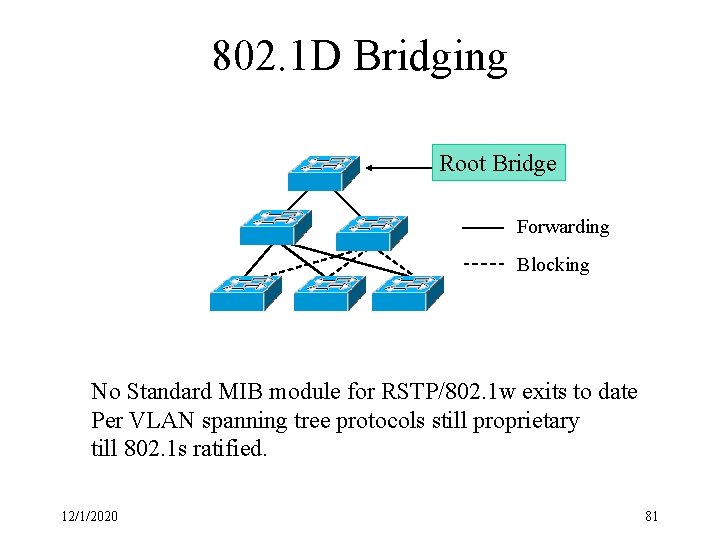
802. 1 D Bridging Root Bridge Forwarding Blocking No Standard MIB module for RSTP/802. 1 w exits to date Per VLAN spanning tree protocols still proprietary till 802. 1 s ratified. 12/1/2020 81
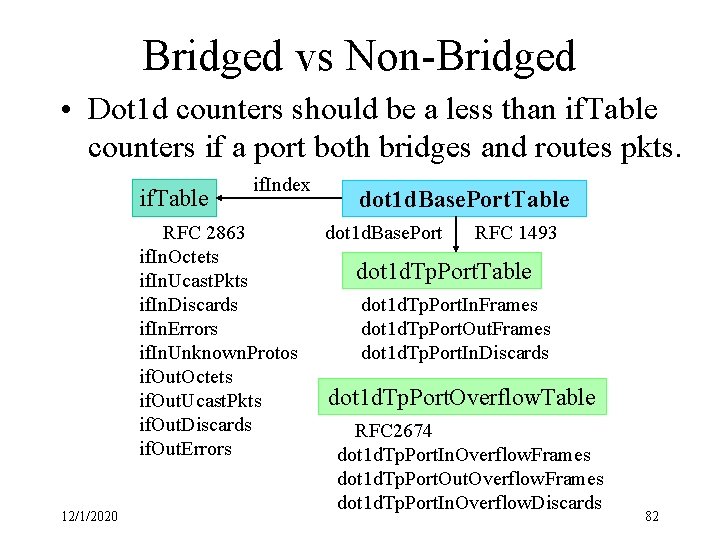
Bridged vs Non-Bridged • Dot 1 d counters should be a less than if. Table counters if a port both bridges and routes pkts. if. Table if. Index RFC 2863 if. In. Octets if. In. Ucast. Pkts if. In. Discards if. In. Errors if. In. Unknown. Protos if. Out. Octets if. Out. Ucast. Pkts if. Out. Discards if. Out. Errors 12/1/2020 dot 1 d. Base. Port. Table dot 1 d. Base. Port RFC 1493 dot 1 d. Tp. Port. Table dot 1 d. Tp. Port. In. Frames dot 1 d. Tp. Port. Out. Frames dot 1 d. Tp. Port. In. Discards dot 1 d. Tp. Port. Overflow. Table RFC 2674 dot 1 d. Tp. Port. In. Overflow. Frames dot 1 d. Tp. Port. Out. Overflow. Frames dot 1 d. Tp. Port. In. Overflow. Discards 82
IEEE 802. 1 P/Q • RFC 2674 defines Virtual LANS – Q-BRIDGE-MIB – P-BRIDGE-MIB • dot 1 d. Tp. Port. Overflow. Table extends RFC 1493 counters • Per VLAN (vid: 1 -4094) Stats – dot 1 q. Tp. Vlan. Port. In. Frames – dot 1 q. Tp. Vlan. Port. Out. Frames – dot 1 q. Tp. Vlan. Port. In. Discards 12/1/2020 83
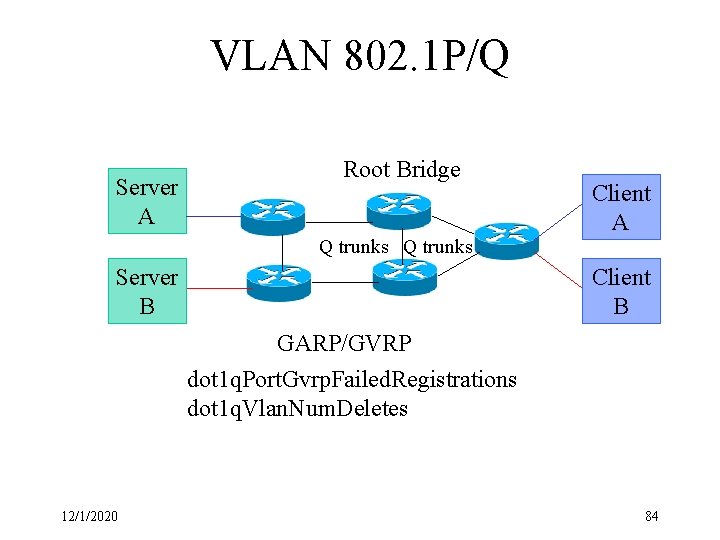
VLAN 802. 1 P/Q Server A Root Bridge Client A Q trunks Server B Client B GARP/GVRP dot 1 q. Port. Gvrp. Failed. Registrations dot 1 q. Vlan. Num. Deletes 12/1/2020 84
RMON • RFC 2819 defines RMON-MIB – Passive Monitor for Ethernet • ether. Stats, ether. History Tables provide – – – ether. Stats. CRCAlign. Errors ether. Stats. Undersize. Pkts ether. Stats. Oversize. Pkts ether. Stats. Fragments ether. Stats. Jabbers ether. Stats. Collisions • Uses OID of if. Index as data. Source pointer – RFC 2665 provides more detail 12/1/2020 85
RMON • Traffic patterns – Host Table provides bytes, pkts per MAC • Like dot 1 d. Tp. Fdb. Table w/o counters – Matrix - Bytes Packets – Ethernet Packet distributions ether. Stats. Pkts 64 Octets ether. Stats. Pkts 65 to 127 Octets ether. Stats. Pkts 128 to 255 Octets ether. Stats. Pkts 256 to 511 Octets ether. Stats. Pkts 512 to 1023 Octets ether. Stats. Pkts 1024 to 1518 Octets 12/1/2020 86
Layers 3 -7 • • • IPv 4 Stack/CIDR Route Table VRRP BGP OSPF IS-IS RMON 2 12/1/2020 87
IPv 4 • RFC 2011 defines IP Layer – defines seventeen counters – If a device supports multiple IP Stacks, these counters will apply to one of the stacks per vendor’s discretion – If the device supports the ENTITY-MIB (2737) • then multiple MIBS can be represented in a given agent MIB (BRIDGE, OSPF, BGP) 12/1/2020 88
IPv 4 • RFC 2096 ip. Cidr. Route. Table – Indexed by: • dest ip, netmask, tos, next hop • Provides: – Age of route – Next hop AS – ip. Cidr. Route. Table (RFC 2096 1/97) replaced • ip. Forward. Table (RFC 1354 7/92) replaced • ip. Route. Table (RFC 1213 3/91) 12/1/2020 89
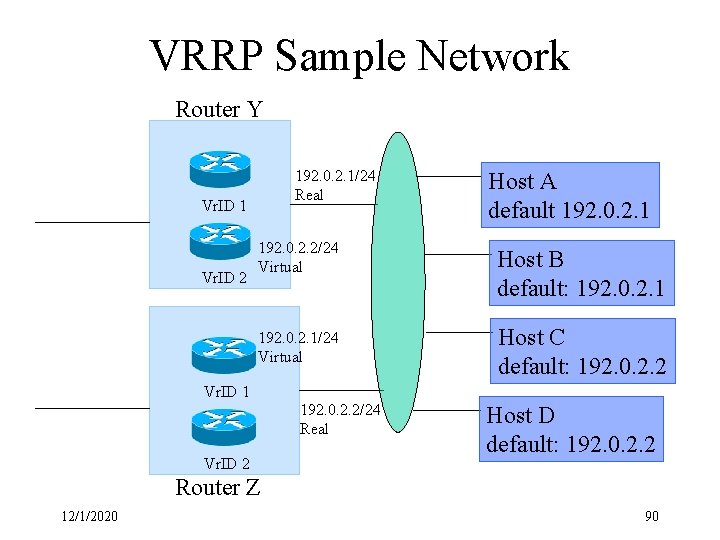
VRRP Sample Network Router Y 192. 0. 2. 1/24 Real Vr. ID 1 Vr. ID 2 Host A default 192. 0. 2. 1 192. 0. 2. 2/24 Virtual Host B default: 192. 0. 2. 1/24 Virtual Host C default: 192. 0. 2. 2 Vr. ID 1 192. 0. 2. 2/24 Real Vr. ID 2 Host D default: 192. 0. 2. 2 Router Z 12/1/2020 90
VRRP Counters - RFC 2787 • Global counters – vrrp. Router. Checksum. Errors – vrrp. Router. Version. Errors – vrrp. Router. Vr. Id. Errors • vrrp. Router. Stats. Table per Vr. ID – vrrp. Stats. Become. Master – vrrp. Stats. Advertise. Rcvd – vrrp. Stats. Advertise. Interval. Errors – vrrp. Stats. Ip. Ttl. Errors 12/1/2020 91
BGP • BGP-MIB RFC 1657 – Provides current status of e. BGP, i. BGP peers bgp. Peer. Table index: bgp. Peer. Remote. Addr (IPv 4 addr) • bgp. Peer. In. Updates • bgp. Peer. Out. Updates • bgp. Peer. In. Total. Messages • bgp. Peer. Out. Total. Messages • bgp. Peer. Last. Error • bgp. Peer. Fsm. Established. Transitions 12/1/2020 92
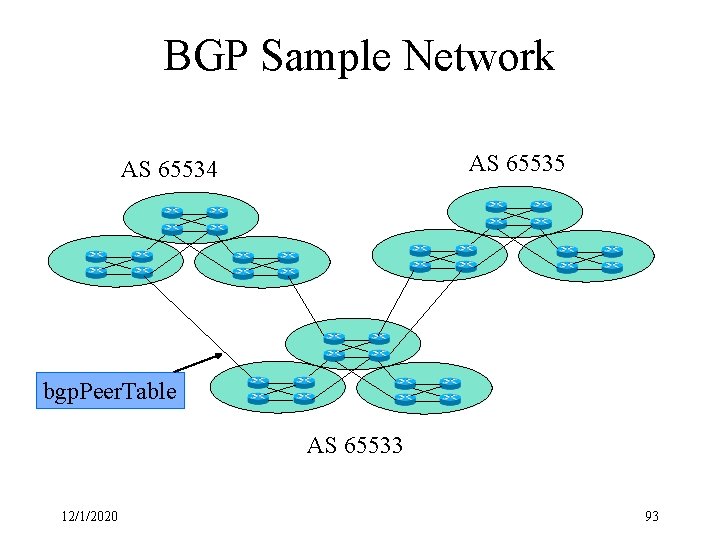
BGP Sample Network AS 65535 AS 65534 bgp. Peer. Table AS 65533 12/1/2020 93
BGP • TCP Status per BGP session is also available per RFC 2012 in – tcp. Conn. Table • Indexed by: tcp. Conn. Local. Address, tcp. Conn. Local. Port, tcp. Conn. Rem. Address, tcp. Conn. Rem. Port • Missing all functionality of follow on BGP RFCs since RFC 1654. – Cisco BGP Accounting MIB Module useful for tracking traffic aggregates on per AS level 12/1/2020 94
OSPF • RFC 1850 defines some useful objects: ospf. Area. Table indexed by Area ID ospf. Spf. Runs - number of times Djkstra was run ospf. If. Table indexed by: IP Address, if. Index or Zero ospf. If. Events - number of time state changed 12/1/2020 95
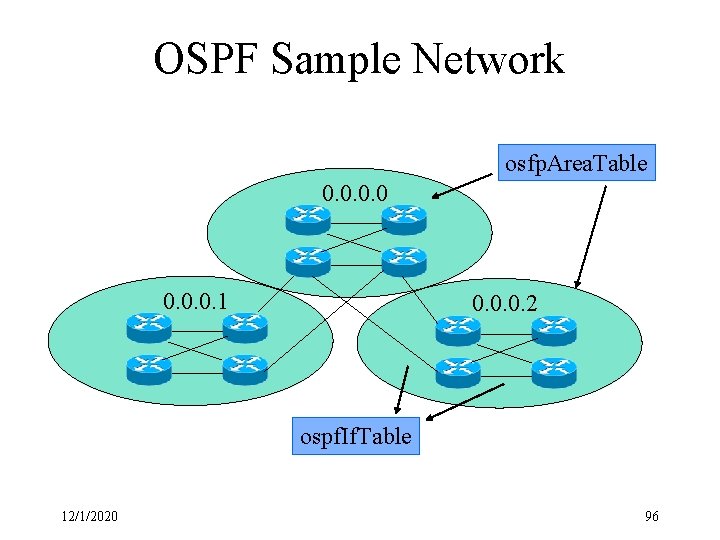
OSPF Sample Network osfp. Area. Table 0. 0. 1 0. 0. 0. 2 ospf. If. Table 12/1/2020 96
OSPF MIB Module • RFC 1850 does not keep a counter for LSDB overflows, it does have a notification for such an event though: ospf. Lsdb. Overflow • There exist additional counters for: – Virtual Links – Neighbors 12/1/2020 97
IS-IS MIB Module • Internet Draft in development – draft-ietf-isis-wg-mib-03. txt isis. Sys. Table indexed by: instance of protocol (sys. Inst) Eleven counters isis. Sys. Log. Adjacency. Changes 12/1/2020 isis. Circ. Table indexed by sys. Inst, circ. Inst Eight Counters including Changes in Adjacency: isis. Circ. Adj. Changes 98
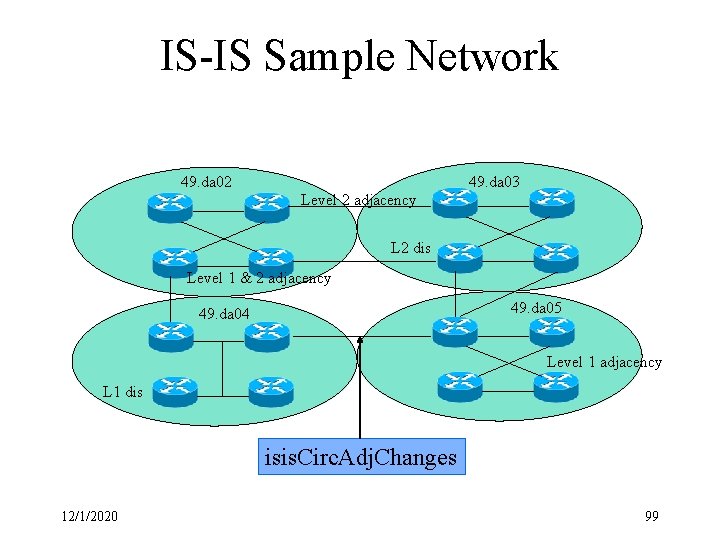
IS-IS Sample Network 49. da 02 49. da 03 Level 2 adjacency L 2 dis Level 1 & 2 adjacency 49. da 05 49. da 04 Level 1 adjacency L 1 dis isis. Circ. Adj. Changes 12/1/2020 99
RMON 2 • RFC 2021 monitors network/applications – Network Layer • nl. Host - bytes, packets • nl. Matrix - bytes, packets Src->Dest, Dest->Src – Application Layer • al. Host • al. Matrix • Uses an “if. Index” as a data. Source – Per Protocol Distributions • per port, based on protocol dictionary 12/1/2020 100
RMON 2 • Uses counters that start from zero • Per RFC, useful if counters are in rows in tables that come and go or if table is indexed using Time. Filter – Protocol. Dir. Stats. Table • Indexed by: – protocol. Dist. Control. Index, » control table that created this row – protocol. Dir. Local. Index (PDLI) » pointer to protocol that this collection represents • protocol. Dist. Stats. Pkts • protocol. Dist. Stats. Octets 12/1/2020 101
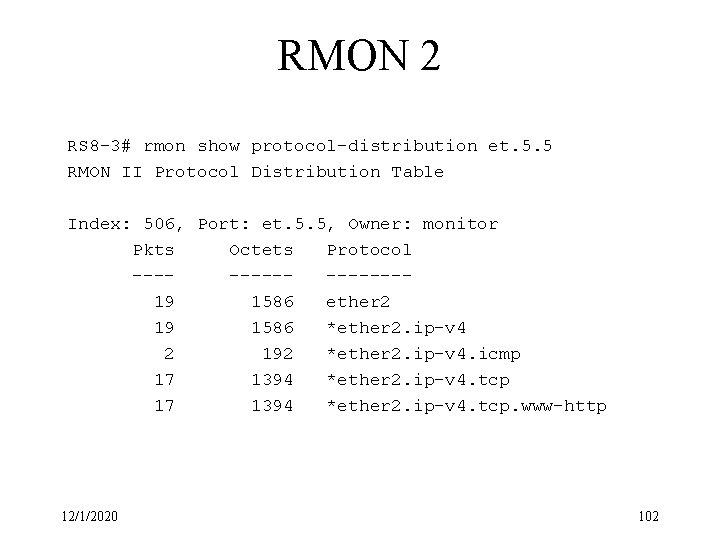
RMON 2 RS 8 -3# rmon show protocol-distribution et. 5. 5 RMON II Protocol Distribution Table Index: 506, Port: et. 5. 5, Owner: monitor Pkts Octets Protocol --------19 1586 ether 2 19 1586 *ether 2. ip-v 4 2 192 *ether 2. ip-v 4. icmp 17 1394 *ether 2. ip-v 4. tcp. www-http 12/1/2020 102
Acknowledgments • Many thanks to the following reviewers – – – – Premal Ashar, Riverstone Joe Clarke, Cisco Systems Greg Hankins, Riverstone Marc Lasserre, Riverstone Greg Mintel, Cisco Systems David Perkins, SNMPinfo Dave Pothier, Cisco Systems Daniel Vltavsky, Riverstone • Thanks to the talented and dedicated authors of all Standards Track MIB Modules 12/1/2020 103
- Slides: 102