
Understanding Standards Advanced Higher Course Event Principal Assessor


- Slides: 31
Understanding Standards: Advanced Higher Course Event Principal Assessor (PA) Advanced Higher Gàidhlig
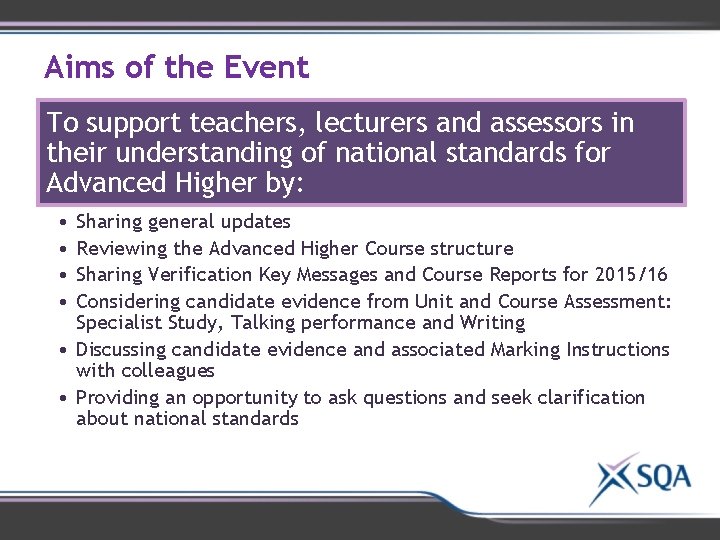
Aims of the Event To support teachers, lecturers and assessors in their understanding of national standards for Advanced Higher by: • • Sharing general updates Reviewing the Advanced Higher Course structure Sharing Verification Key Messages and Course Reports for 2015/16 Considering candidate evidence from Unit and Course Assessment: Specialist Study, Talking performance and Writing • Discussing candidate evidence and associated Marking Instructions with colleagues • Providing an opportunity to ask questions and seek clarification about national standards
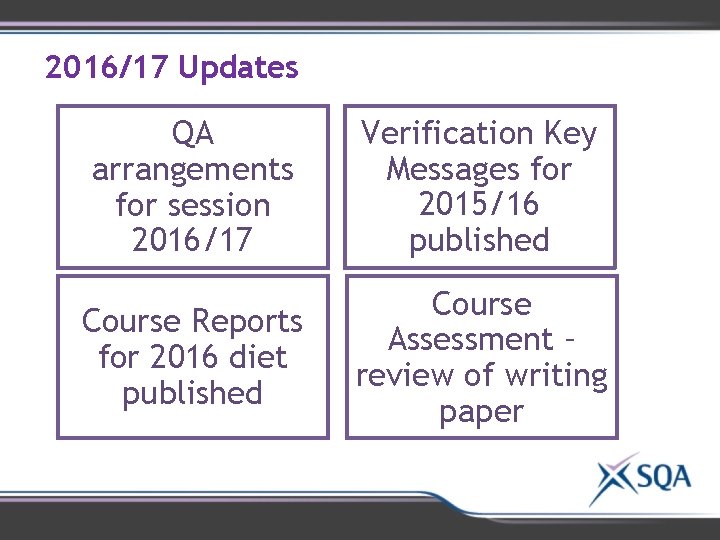
2016/17 Updates QA arrangements for session 2016/17 Verification Key Messages for 2015/16 published Course Reports for 2016 diet published Course Assessment – review of writing paper
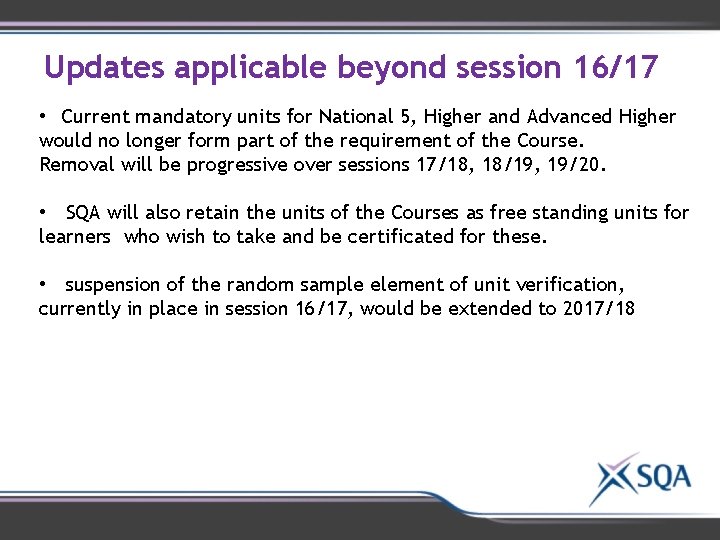
Updates applicable beyond session 16/17 • Current mandatory units for National 5, Higher and Advanced Higher would no longer form part of the requirement of the Course. Removal will be progressive over sessions 17/18, 18/19, 19/20. • SQA will also retain the units of the Courses as free standing units for learners who wish to take and be certificated for these. • suspension of the random sample element of unit verification, currently in place in session 16/17, would be extended to 2017/18
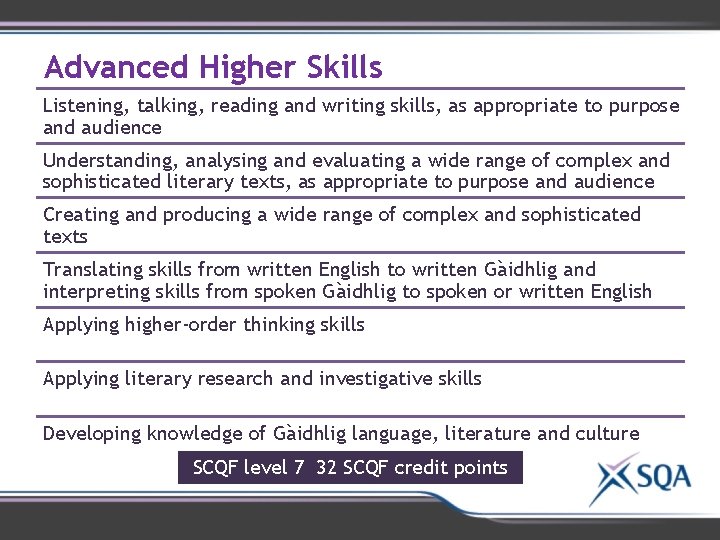
Advanced Higher Skills Listening, talking, reading and writing skills, as appropriate to purpose and audience Understanding, analysing and evaluating a wide range of complex and sophisticated literary texts, as appropriate to purpose and audience Creating and producing a wide range of complex and sophisticated texts Translating skills from written English to written Gàidhlig and interpreting skills from spoken Gàidhlig to spoken or written English Applying higher-order thinking skills Applying literary research and investigative skills Developing knowledge of Gàidhlig language, literature and culture SCQF level 7 32 SCQF credit points
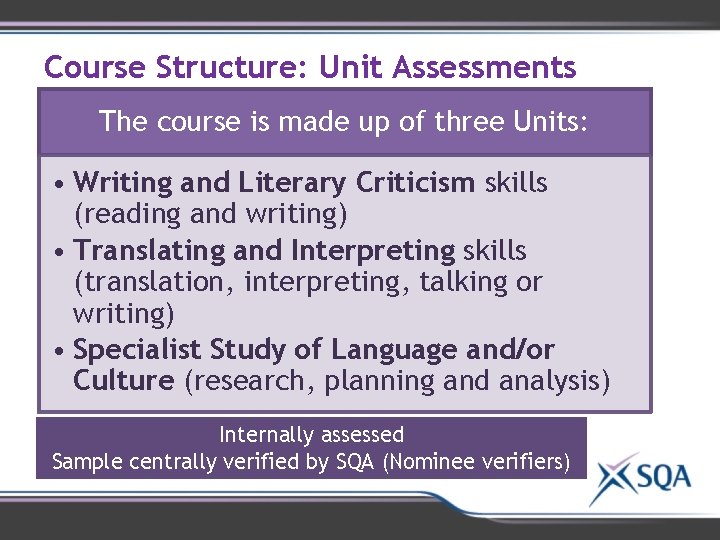
Course Structure: Unit Assessments The course is made up of three Units: • Writing and Literary Criticism skills (reading and writing) • Translating and Interpreting skills (translation, interpreting, talking or writing) • Specialist Study of Language and/or Culture (research, planning and analysis) Internally assessed Sample centrally verified by SQA (Nominee verifiers)
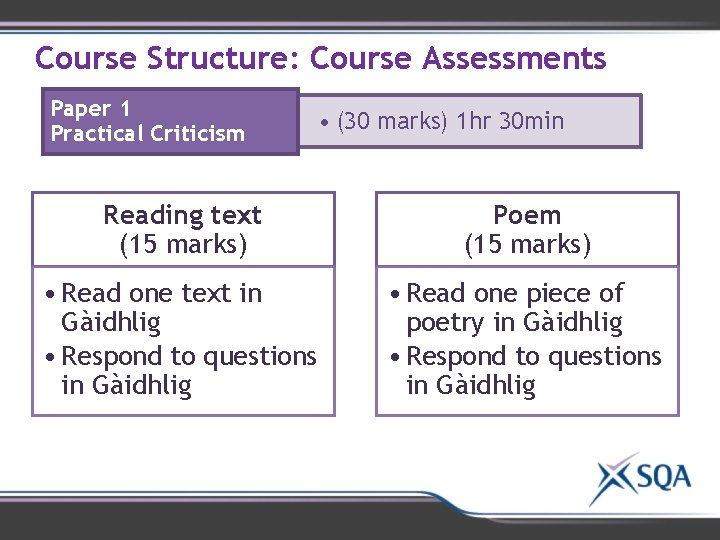
Course Structure: Course Assessments Paper 1 Practical Criticism • (30 marks) 1 hr 30 min Reading text (15 marks) Poem (15 marks) • Read one text in Gàidhlig • Respond to questions in Gàidhlig • Read one piece of poetry in Gàidhlig • Respond to questions in Gàidhlig
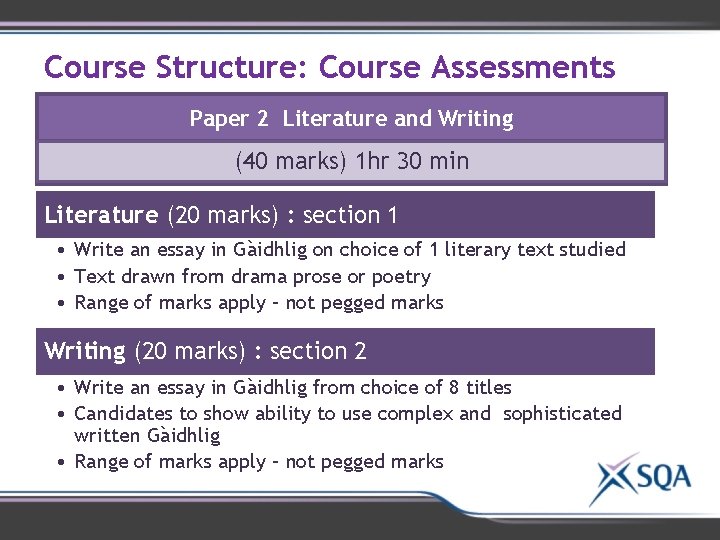
Course Structure: Course Assessments Paper 2 Literature and Writing (40 marks) 1 hr 30 min Literature (20 marks) : section 1 • Write an essay in Gàidhlig on choice of 1 literary text studied • Text drawn from drama prose or poetry • Range of marks apply – not pegged marks Writing (20 marks) : section 2 • Write an essay in Gàidhlig from choice of 8 titles • Candidates to show ability to use complex and sophisticated written Gàidhlig • Range of marks apply – not pegged marks
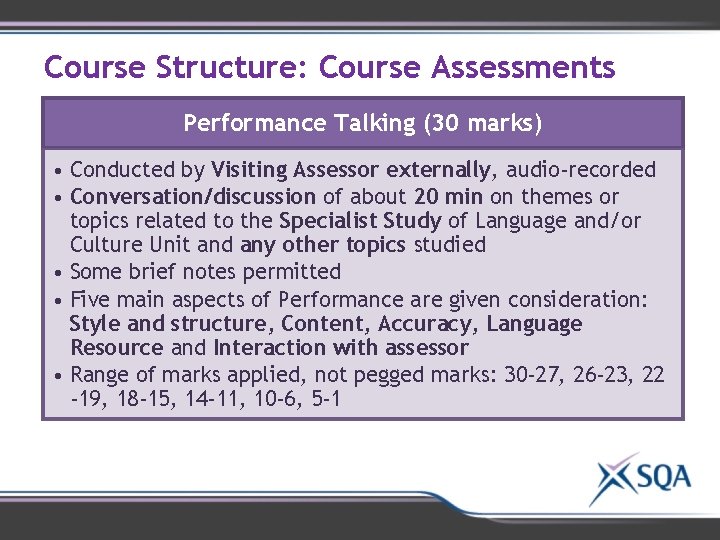
Course Structure: Course Assessments Performance Talking (30 marks) • Conducted by Visiting Assessor externally, audio-recorded • Conversation/discussion of about 20 min on themes or topics related to the Specialist Study of Language and/or Culture Unit and any other topics studied • Some brief notes permitted • Five main aspects of Performance are given consideration: Style and structure, Content, Accuracy, Language Resource and Interaction with assessor • Range of marks applied, not pegged marks: 30 -27, 26 -23, 22 -19, 18 -15, 14 -11, 10 -6, 5 -1
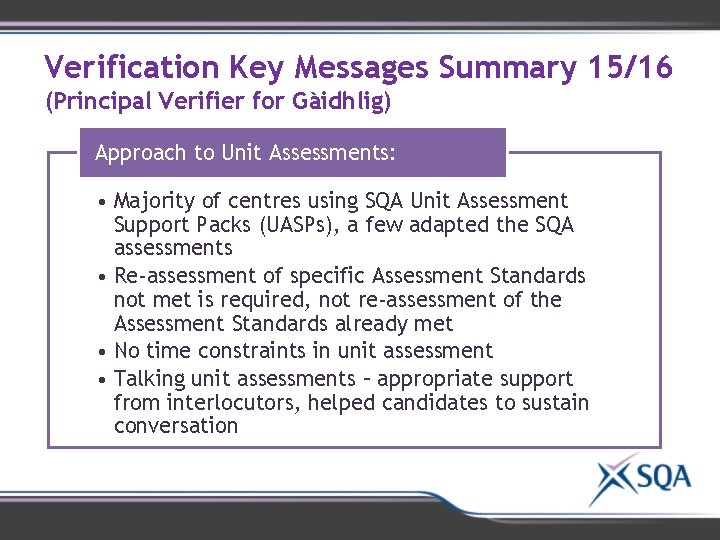
Verification Key Messages Summary 15/16 (Principal Verifier for Gàidhlig) Approach to Unit Assessments: • Majority of centres using SQA Unit Assessment Support Packs (UASPs), a few adapted the SQA assessments • Re-assessment of specific Assessment Standards not met is required, not re-assessment of the Assessment Standards already met • No time constraints in unit assessment • Talking unit assessments – appropriate support from interlocutors, helped candidates to sustain conversation
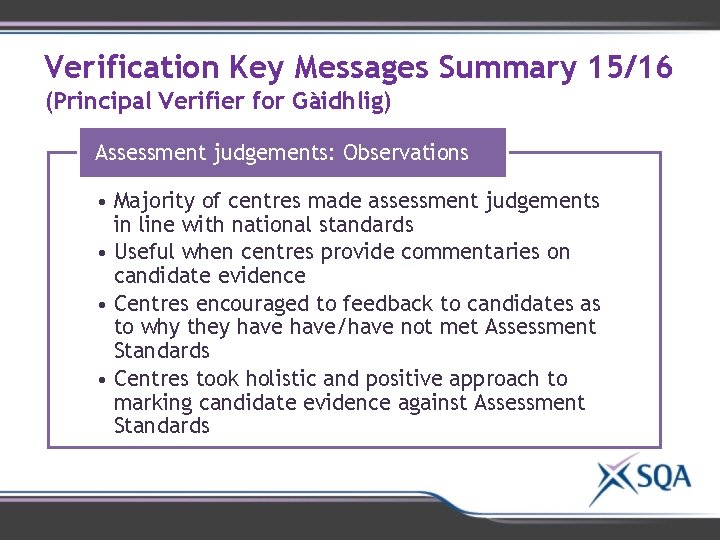
Verification Key Messages Summary 15/16 (Principal Verifier for Gàidhlig) Assessment judgements: Observations • Majority of centres made assessment judgements in line with national standards • Useful when centres provide commentaries on candidate evidence • Centres encouraged to feedback to candidates as to why they have/have not met Assessment Standards • Centres took holistic and positive approach to marking candidate evidence against Assessment Standards
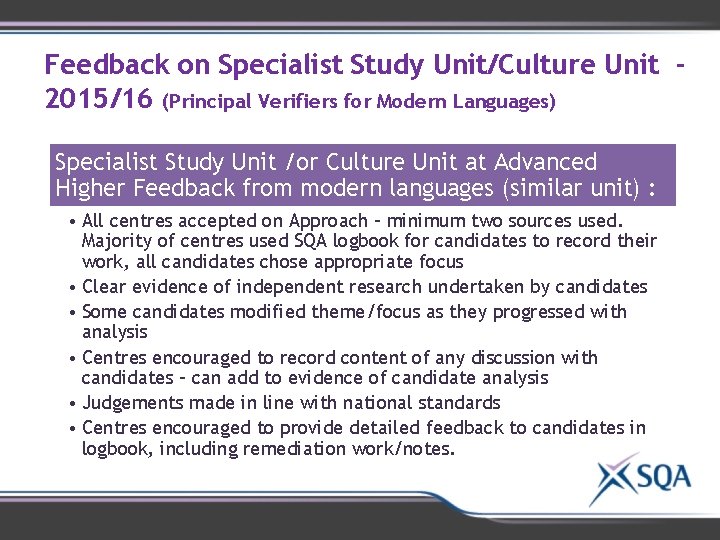
Feedback on Specialist Study Unit/Culture Unit 2015/16 (Principal Verifiers for Modern Languages) Specialist Study Unit /or Culture Unit at Advanced Higher Feedback from modern languages (similar unit) : • All centres accepted on Approach – minimum two sources used. Majority of centres used SQA logbook for candidates to record their work, all candidates chose appropriate focus • Clear evidence of independent research undertaken by candidates • Some candidates modified theme/focus as they progressed with analysis • Centres encouraged to record content of any discussion with candidates – can add to evidence of candidate analysis • Judgements made in line with national standards • Centres encouraged to provide detailed feedback to candidates in logbook, including remediation work/notes.
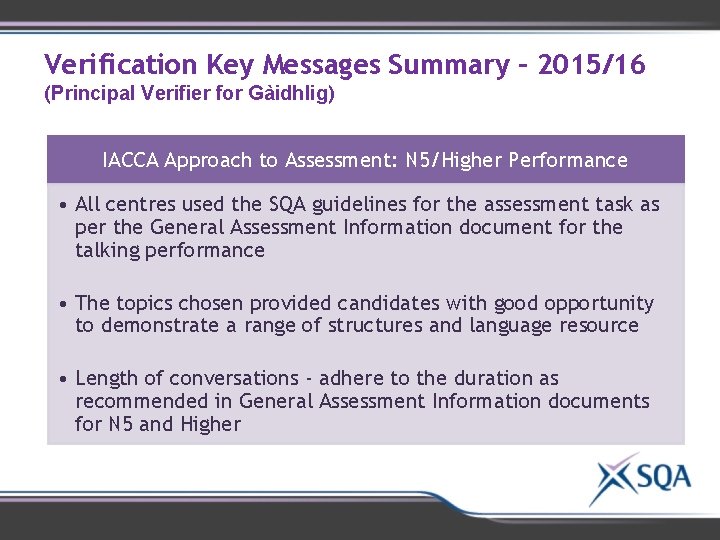
Verification Key Messages Summary – 2015/16 (Principal Verifier for Gàidhlig) IACCA Approach to Assessment: N 5/Higher Performance • All centres used the SQA guidelines for the assessment task as per the General Assessment Information document for the talking performance • The topics chosen provided candidates with good opportunity to demonstrate a range of structures and language resource • Length of conversations - adhere to the duration as recommended in General Assessment Information documents for N 5 and Higher
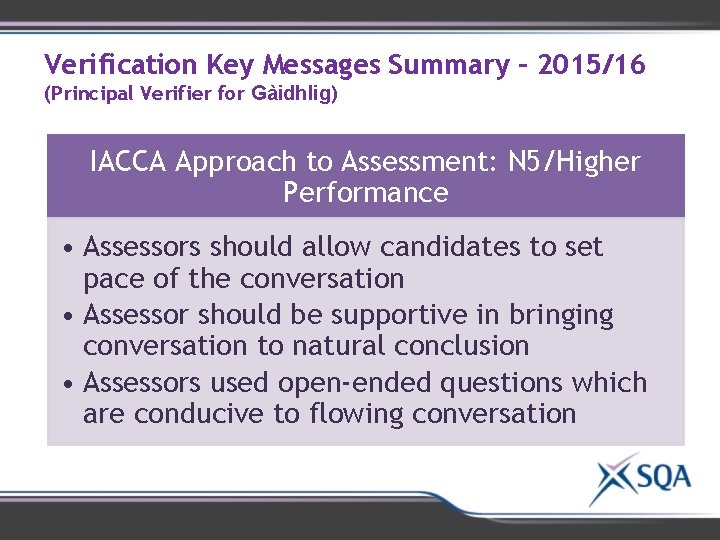
Verification Key Messages Summary – 2015/16 (Principal Verifier for Gàidhlig) IACCA Approach to Assessment: N 5/Higher Performance • Assessors should allow candidates to set pace of the conversation • Assessor should be supportive in bringing conversation to natural conclusion • Assessors used open-ended questions which are conducive to flowing conversation
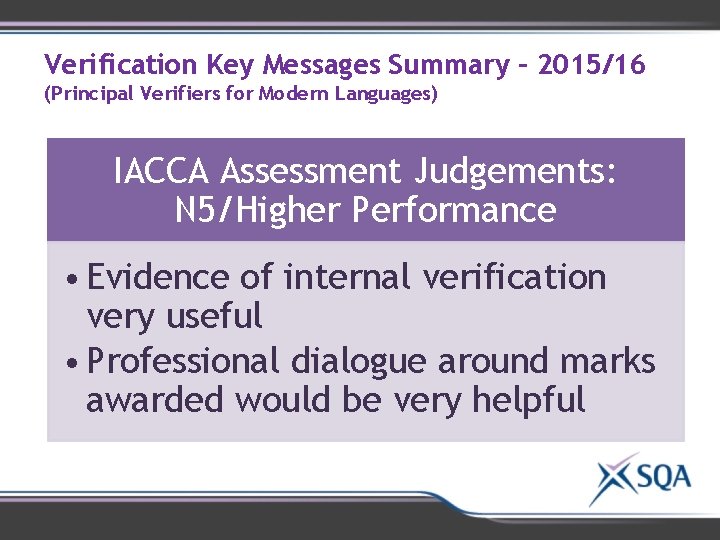
Verification Key Messages Summary – 2015/16 (Principal Verifiers for Modern Languages) IACCA Assessment Judgements: N 5/Higher Performance • Evidence of internal verification very useful • Professional dialogue around marks awarded would be very helpful
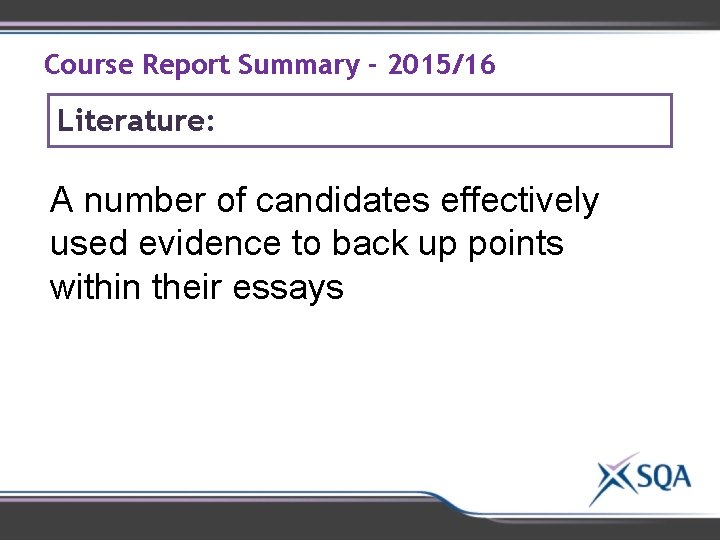
Course Report Summary - 2015/16 Literature: A number of candidates effectively used evidence to back up points within their essays
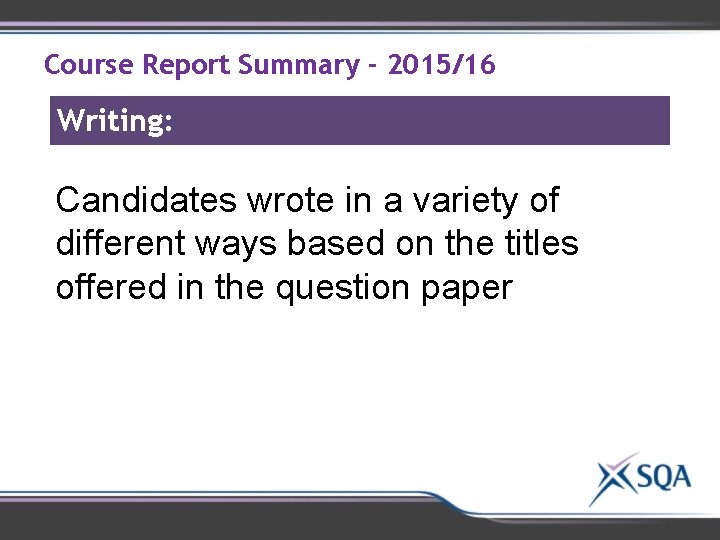
Course Report Summary - 2015/16 Writing: Candidates wrote in a variety of different ways based on the titles offered in the question paper
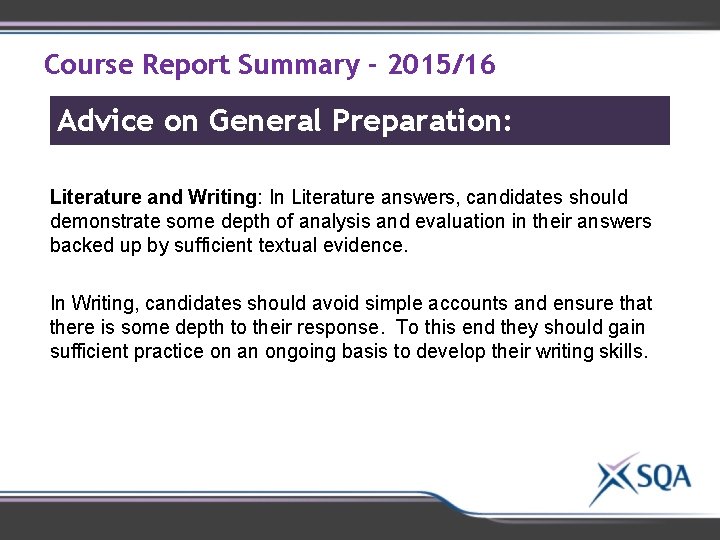
Course Report Summary - 2015/16 Advice on General Preparation: Literature and Writing: In Literature answers, candidates should demonstrate some depth of analysis and evaluation in their answers backed up by sufficient textual evidence. In Writing, candidates should avoid simple accounts and ensure that there is some depth to their response. To this end they should gain sufficient practice on an ongoing basis to develop their writing skills.
Workshop 1 – approximately 1 h 15 min • Consider candidate evidence AH Course Assessment: • Discuss with colleagues Literature and feedback after and Writing each piece of candidate evidence
Course Report Summary - 2015/16 Talking Performance: Visiting assessors spoke of all pupils’ willingness to engage in conversation
Course Report Summary - 2015/16 Advice on General Preparation: Talking performance: Candidates to ensure they have a thorough knowledge of their specialist study topic including methods of research and the work covered during the course
Workshop 2 – approximately 1 h 15 min • Refer to Marking Instructions and range of AH marks Performance: • Discuss with colleagues and Talking feedback after each piece of candidate evidence
Course Report Summary - 2015/16 Practical Criticism Most candidates performed quite well in answering the questions based on the prose passage and the poem
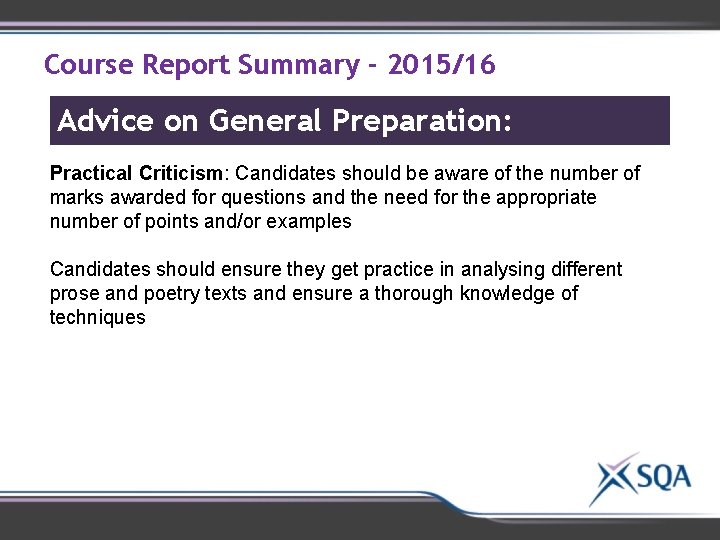
Course Report Summary - 2015/16 Advice on General Preparation: Practical Criticism: Candidates should be aware of the number of marks awarded for questions and the need for the appropriate number of points and/or examples Candidates should ensure they get practice in analysing different prose and poetry texts and ensure a thorough knowledge of techniques
Workshop 3 – approximately 1 hour • Refer to Marking AH Course Instructions and range of Assessment: marks Practical • Discuss with colleagues and feedback after each piece Criticism of candidate evidence
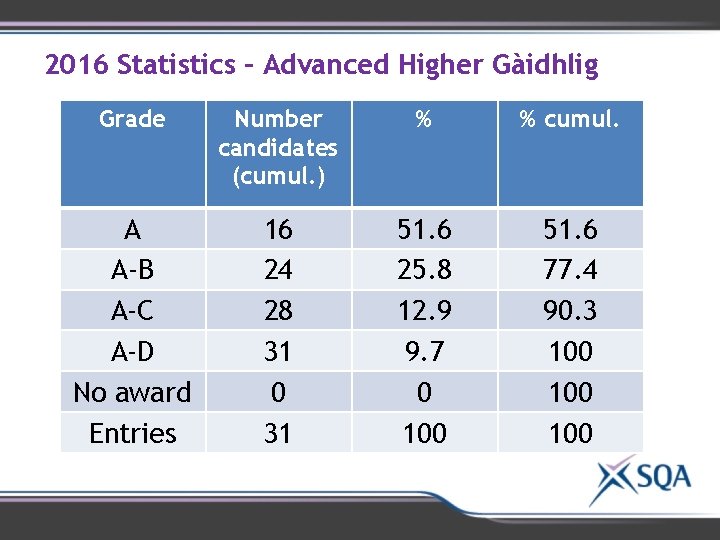
2016 Statistics – Advanced Higher Gàidhlig Grade Number candidates (cumul. ) % % cumul. A A-B A-C A-D No award Entries 16 24 28 31 0 31 51. 6 25. 8 12. 9 9. 7 0 100 51. 6 77. 4 90. 3 100 100
Sources of Further Information Gàidhlig Advanced Higher page http: //www. sqa. org. uk/sqa/48454. html Gàidhlig home page - Verification Key Message Reports, Course Reports, Subject review reports and subject updates http: //www. sqa. org. uk/sqa/45675. html Exemplification http: //www. understandingstandards. org. uk 2016 Statistical Information on National Qualifications and Awards http: //www. sqa. org. uk/sqa/64717. html
SQA Marker Opportunities Marker applications are encouraged from new Markers who would like to join a marking team for 2017 Nat 5 / Higher / Advanced Higher opportunities SQA’s new e. Recruiter system, where applications may be submitted, is available online: https: //appointeeopportunities. sqa. org. uk
Any Questions?
www. sqa. org. uk│0303 333 0330