
Understanding special needs Week 2 221110 Revision time





- Slides: 21
Understanding special needs Week 2 22/11/10
Revision time n n Two models of disability Importance of disability awareness – any images? People-first language Definition of special needs
Definition of special needs n n n The term is used by childcare and educational professionals to describe children whose development is atypical i. e. not following the pattern seen in most children May be anywhere between very mild to being profoundly and multiply disabled At the end of the day they are all “children first!”
Types of special needs/disabilities n Physical e. g. • Cerebral palsy • Spina bifida • Spinal muscular atrophy • Muscular dystrophy • Cystic fibrosis • Childhood arthritis • Epilepsy
Learning/intellectual disabilities n n n Down syndrome Autism (in some cases) Dyslexia Fragile X syndrome Rett’s syndrome
Sensory disabilities n n n Hearing impairment Visual impairment Specific language disorder Sensory impairment Cleft palate
Other disabilities including hidden disabilities n n n Developmental co-ordination disorders ADHD/ADD Emotional and behavioural difficulties
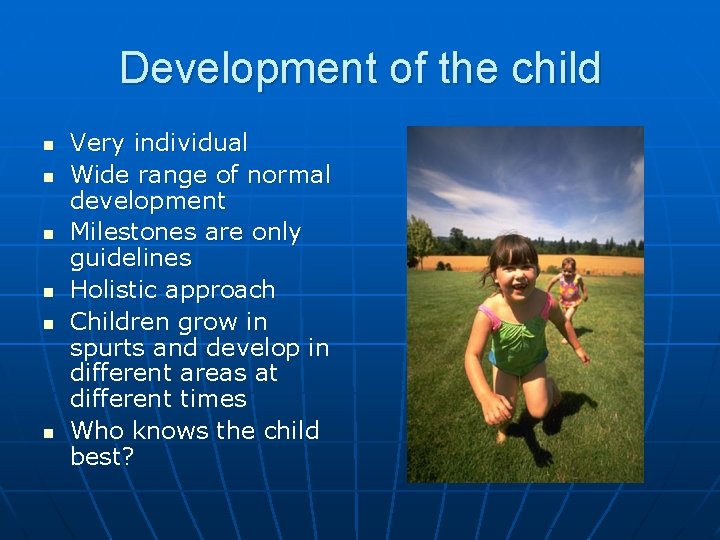
Development of the child n n n Very individual Wide range of normal development Milestones are only guidelines Holistic approach Children grow in spurts and develop in different areas at different times Who knows the child best?
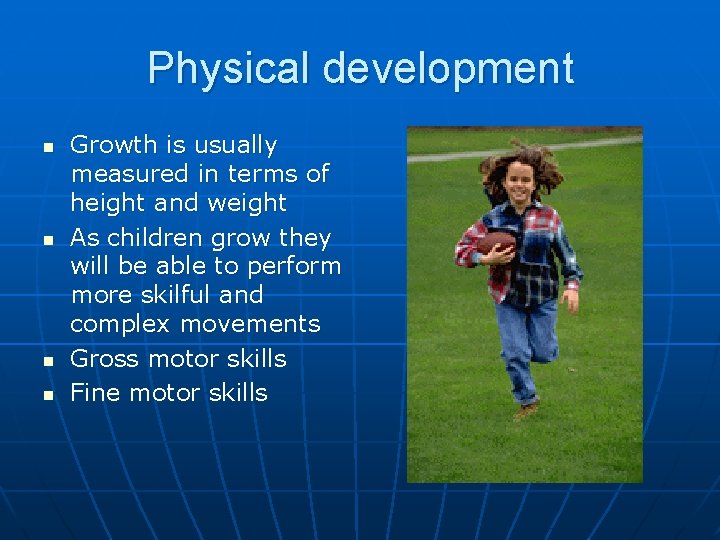
Physical development n n Growth is usually measured in terms of height and weight As children grow they will be able to perform more skilful and complex movements Gross motor skills Fine motor skills
Language development n n n Language is the main way in which humans communicate Linked very closely to other senses Coo, babble, words, phrases, sentences Receptive, expressive, sound system, voice and fluency Boys versus girls Nature (Chomsky) versus nurture (Skinner)
The importance of play n n n n Very important part of development Provides entertainment, stimulation, outlet for energy and encourages exploration Helps to teach shapes, numbers, colours, sizes and textures Encourages child to become a social being, to be part of a group and to share It allows for creativity and fantasy Helps children to discover what they enjoy and what they excel at Provides an alternative means to express fears, needs and wants
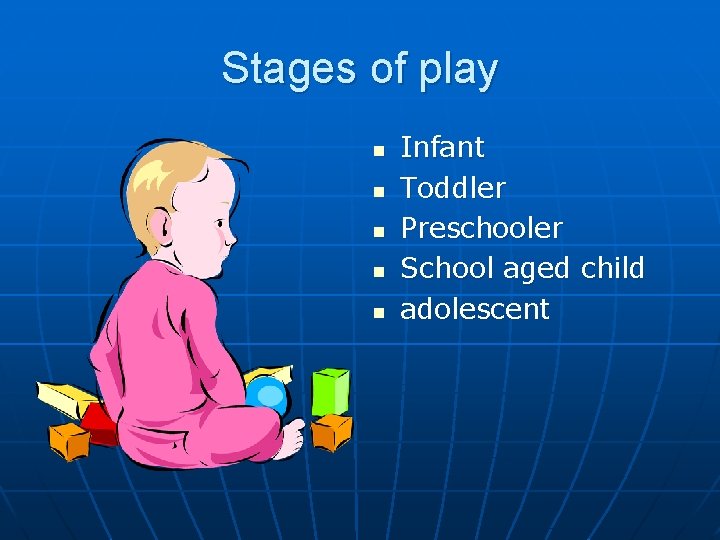
Stages of play n n n Infant Toddler Preschooler School aged child adolescent
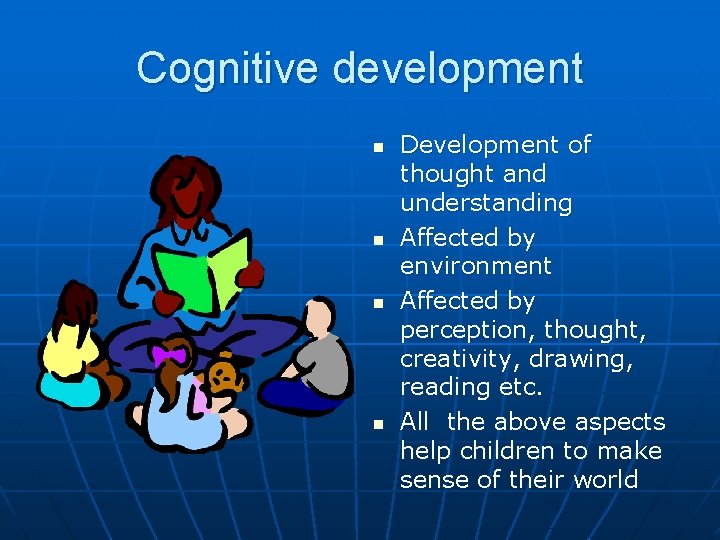
Cognitive development n n Development of thought and understanding Affected by environment Affected by perception, thought, creativity, drawing, reading etc. All the above aspects help children to make sense of their world
Piaget’s stages of cognitive development n n Sensorimotor 0 -2 years – imitation, memory, object permanence, more goal orientated Pre-operational 2 -7 years – language development, understanding of symbols, some problem solving, will have difficulty seeing another person’s point of view Concrete operational 7 -11 years – logical problem solving, understand laws of conversation and reversibility Formal operational 11 -15 years+ - abstract problem solving, more scientific, will develop concerns about social issues and identity
Lev Vygotsky n n Cognitive development affected by children’s environment and social development Role of teachers very important Education should help to develop children’s personalities, encourage creative potential, conform to individual development and encourage social opportunities Teachers and others should not force views upon students and should actually encourage personal activity.
Jerome Brunner n 3 stages of cognitive development • Enactive 0 -3 years– represent world by actions e. g. cry for food • Iconic 3 -8 years – importance of images e. g. birthdays, Santa • Symbolic 8 years+ - dependant on language Brunner is credited with the idea of Discovery Learning i. e. learning through the environment
Social development n n n Development of the concept of self and a child’s personality Development of social relationship worth parents and others Moral development
Personality development n n n Personality changes accompany physical and cognitive growth Children develop more realistic selfconcept and become more independent of parents Peers are an important influence in the development of attitudes, values and skills
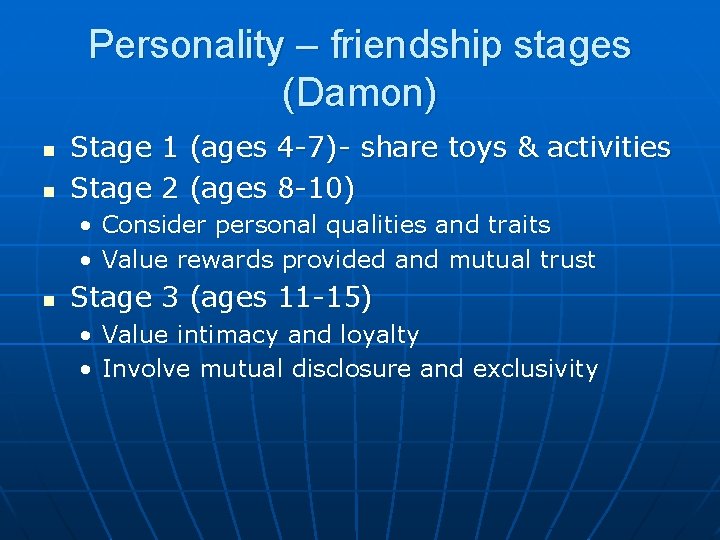
Personality – friendship stages (Damon) n n Stage 1 (ages 4 -7)- share toys & activities Stage 2 (ages 8 -10) • Consider personal qualities and traits • Value rewards provided and mutual trust n Stage 3 (ages 11 -15) • Value intimacy and loyalty • Involve mutual disclosure and exclusivity
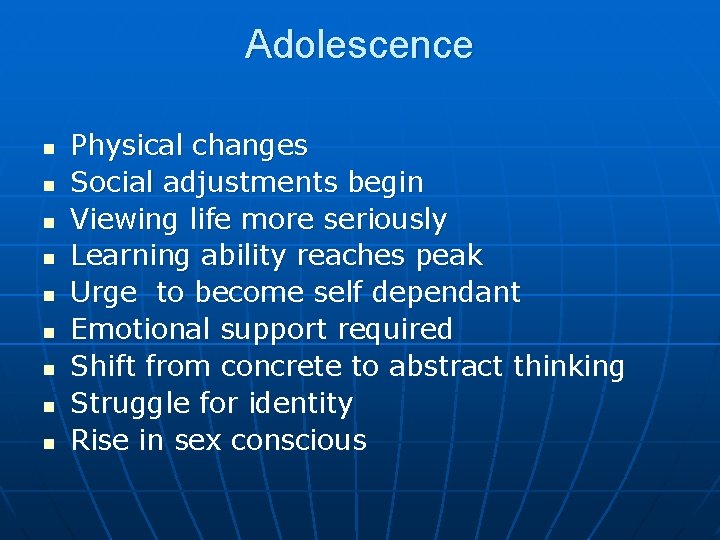
Adolescence n n n n n Physical changes Social adjustments begin Viewing life more seriously Learning ability reaches peak Urge to become self dependant Emotional support required Shift from concrete to abstract thinking Struggle for identity Rise in sex conscious
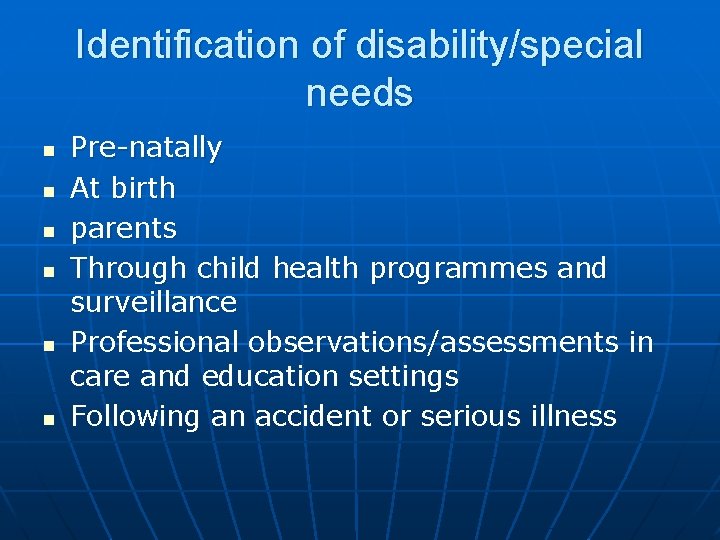
Identification of disability/special needs n n n Pre-natally At birth parents Through child health programmes and surveillance Professional observations/assessments in care and education settings Following an accident or serious illness