
Understanding Sources of Conflict A look at organizational

- Slides: 14
Understanding Sources of Conflict A look at organizational norms that can create conflict at work Presented by: Bob Schout Power. Skills Training & Development, Inc.
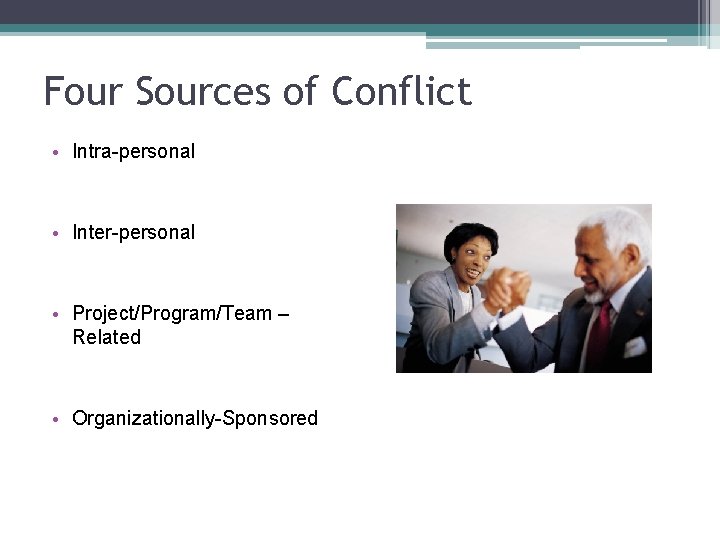
Four Sources of Conflict • Intra-personal • Inter-personal • Project/Program/Team – Related • Organizationally-Sponsored
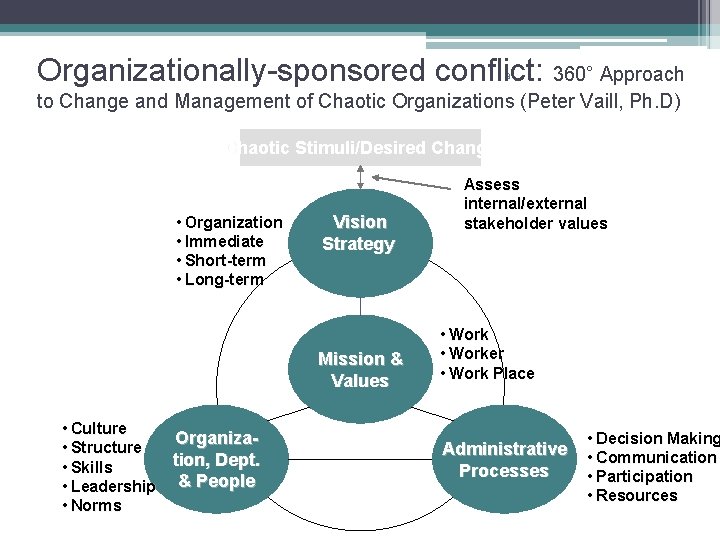
Organizationally-sponsored conflict: 360° Approach 3 to Change and Management of Chaotic Organizations (Peter Vaill, Ph. D) Chaotic Stimuli/Desired Change • Organization • Immediate • Short-term • Long-term Vision Strategy Mission & Values • Culture Organiza • Structure tion, Dept. • Skills • Leadership & People • Norms Assess internal/external stakeholder values • Worker • Work Place Administrative Processes • Decision Making • Communication • Participation • Resources
Project-Program-Team Related Conflict (Source: United States Peace Corps Training Program for Organizational Entry) Workplace norms that can create conflict!
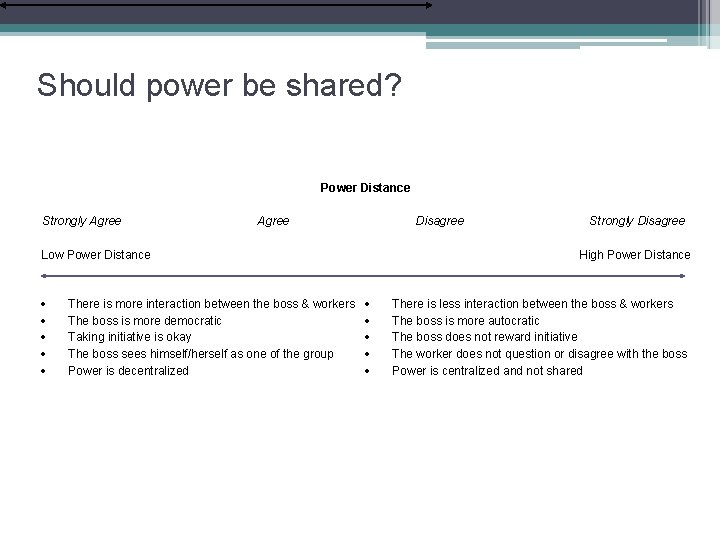
Should power be shared? Power Distance Strongly Agree Disagree Low Power Distance There is more interaction between the boss & workers The boss is more democratic Taking initiative is okay The boss sees himself/herself as one of the group Power is decentralized Strongly Disagree High Power Distance There is less interaction between the boss & workers The boss is more autocratic The boss does not reward initiative The worker does not question or disagree with the boss Power is centralized and not shared
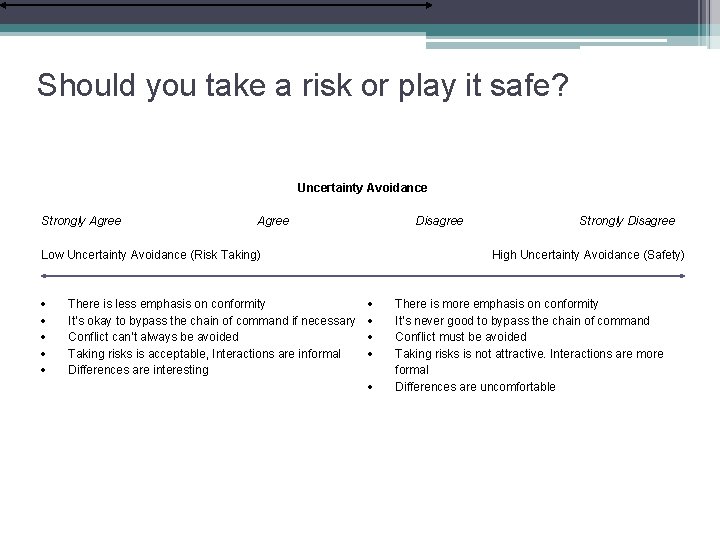
Should you take a risk or play it safe? Uncertainty Avoidance Strongly Agree Disagree Low Uncertainty Avoidance (Risk Taking) There is less emphasis on conformity It’s okay to bypass the chain of command if necessary Conflict can’t always be avoided Taking risks is acceptable, Interactions are informal Differences are interesting Strongly Disagree High Uncertainty Avoidance (Safety) There is more emphasis on conformity It’s never good to bypass the chain of command Conflict must be avoided Taking risks is not attractive. Interactions are more formal Differences are uncomfortable
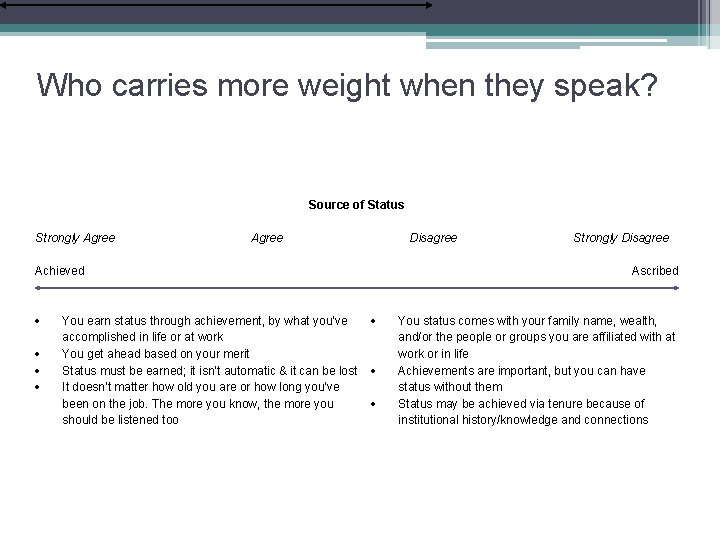
Who carries more weight when they speak? Source of Status Strongly Agree Disagree Achieved You earn status through achievement, by what you’ve accomplished in life or at work You get ahead based on your merit Status must be earned; it isn’t automatic & it can be lost It doesn’t matter how old you are or how long you’ve been on the job. The more you know, the more you should be listened too Strongly Disagree Ascribed You status comes with your family name, wealth, and/or the people or groups you are affiliated with at work or in life Achievements are important, but you can have status without them Status may be achieved via tenure because of institutional history/knowledge and connections
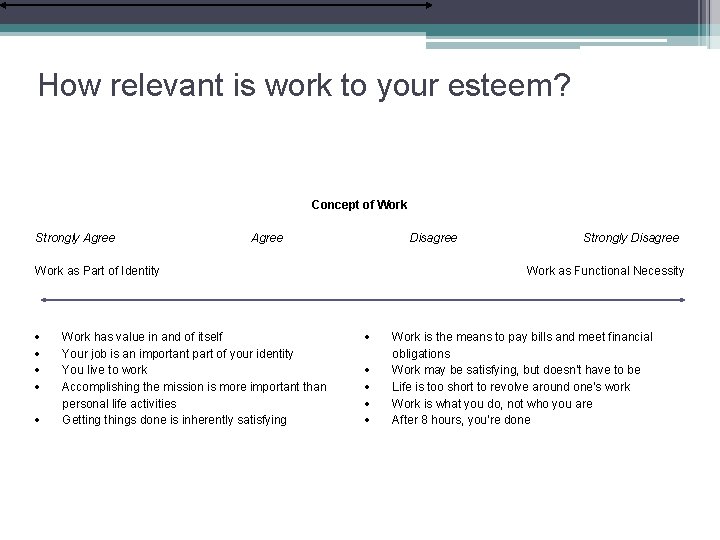
How relevant is work to your esteem? Concept of Work Strongly Agree Disagree Work as Part of Identity Work has value in and of itself Your job is an important part of your identity You live to work Accomplishing the mission is more important than personal life activities Getting things done is inherently satisfying Strongly Disagree Work as Functional Necessity Work is the means to pay bills and meet financial obligations Work may be satisfying, but doesn’t have to be Life is too short to revolve around one’s work Work is what you do, not who you are After 8 hours, you’re done
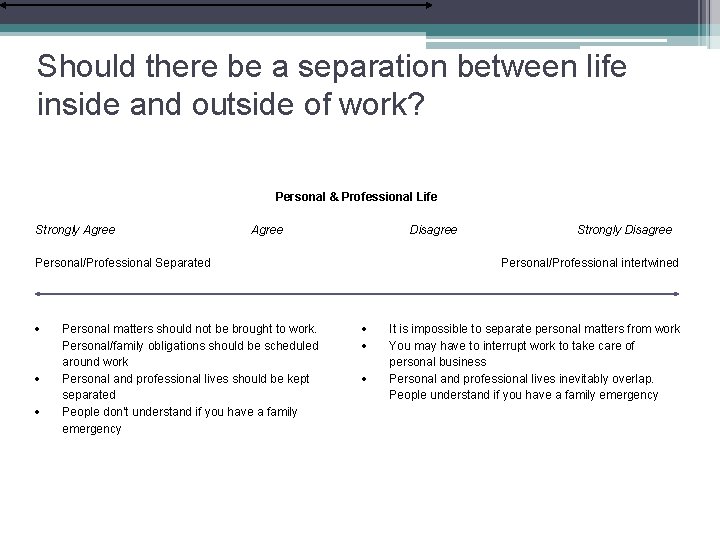
Should there be a separation between life inside and outside of work? Personal & Professional Life Strongly Agree Disagree Personal/Professional Separated Personal matters should not be brought to work. Personal/family obligations should be scheduled around work Personal and professional lives should be kept separated People don’t understand if you have a family emergency Strongly Disagree Personal/Professional intertwined It is impossible to separate personal matters from work You may have to interrupt work to take care of personal business Personal and professional lives inevitably overlap. People understand if you have a family emergency
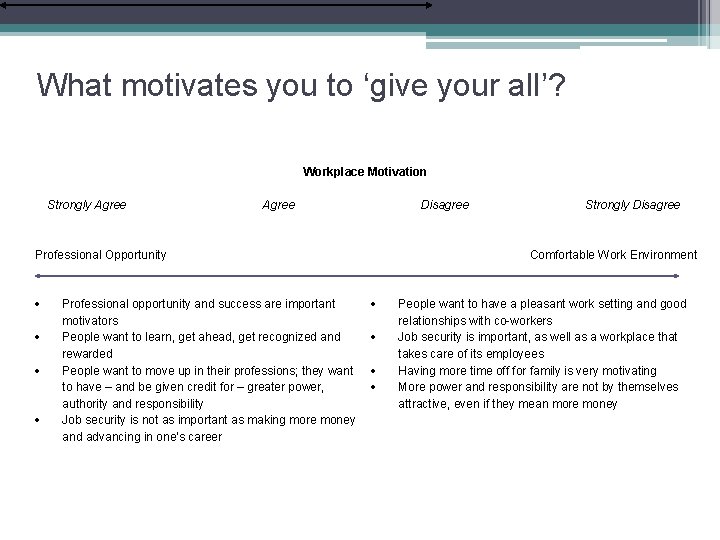
What motivates you to ‘give your all’? Workplace Motivation Strongly Agree Disagree Professional Opportunity Professional opportunity and success are important motivators People want to learn, get ahead, get recognized and rewarded People want to move up in their professions; they want to have – and be given credit for – greater power, authority and responsibility Job security is not as important as making more money and advancing in one’s career Strongly Disagree Comfortable Work Environment People want to have a pleasant work setting and good relationships with co-workers Job security is important, as well as a workplace that takes care of its employees Having more time off for family is very motivating More power and responsibility are not by themselves attractive, even if they mean more money
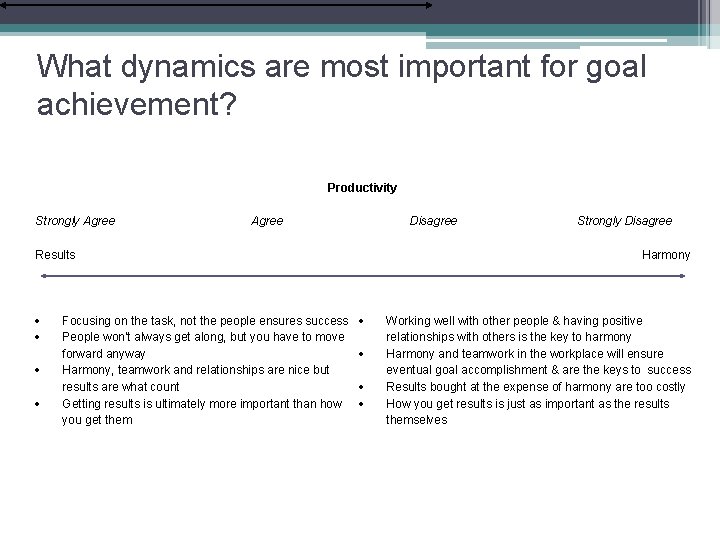
What dynamics are most important for goal achievement? Productivity Strongly Agree Disagree Results Focusing on the task, not the people ensures success People won’t always get along, but you have to move forward anyway Harmony, teamwork and relationships are nice but results are what count Getting results is ultimately more important than how you get them Strongly Disagree Harmony Working well with other people & having positive relationships with others is the key to harmony Harmony and teamwork in the workplace will ensure eventual goal accomplishment & are the keys to success Results bought at the expense of harmony are too costly How you get results is just as important as the results themselves
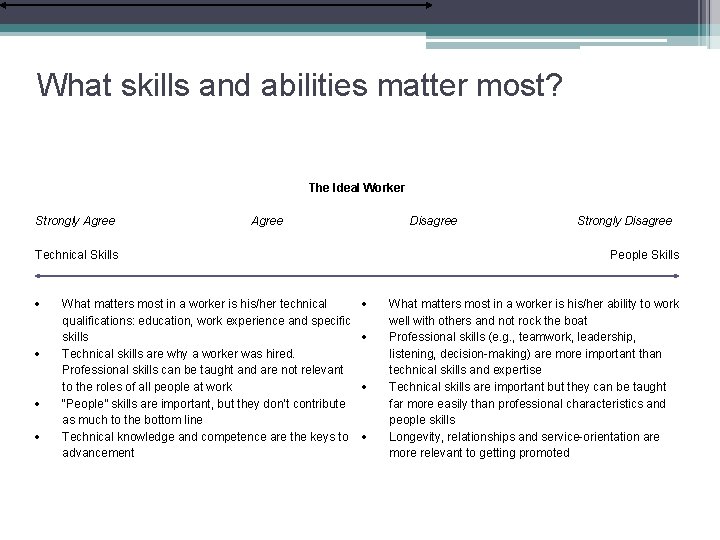
What skills and abilities matter most? The Ideal Worker Strongly Agree Disagree Technical Skills What matters most in a worker is his/her technical qualifications: education, work experience and specific skills Technical skills are why a worker was hired. Professional skills can be taught and are not relevant to the roles of all people at work “People” skills are important, but they don’t contribute as much to the bottom line Technical knowledge and competence are the keys to advancement Strongly Disagree People Skills What matters most in a worker is his/her ability to work well with others and not rock the boat Professional skills (e. g. , teamwork, leadership, listening, decision-making) are more important than technical skills and expertise Technical skills are important but they can be taught far more easily than professional characteristics and people skills Longevity, relationships and service-orientation are more relevant to getting promoted
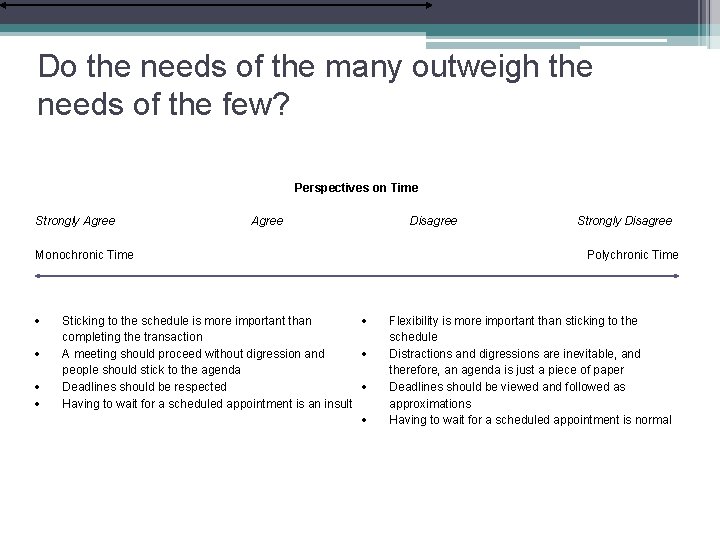
Do the needs of the many outweigh the needs of the few? Perspectives on Time Strongly Agree Monochronic Time Sticking to the schedule is more important than completing the transaction A meeting should proceed without digression and people should stick to the agenda Deadlines should be respected Having to wait for a scheduled appointment is an insult Disagree Strongly Disagree Polychronic Time Flexibility is more important than sticking to the schedule Distractions and digressions are inevitable, and therefore, an agenda is just a piece of paper Deadlines should be viewed and followed as approximations Having to wait for a scheduled appointment is normal
For further information, contact: Bob Schout Power. Skills Training & Development, Inc. Bob@yourpowerskills. com Facebook. com/Robert J Schout Twitter@yourpowerskills (Ph) 619 -517 -6299