
Understanding Service Changes of Transit Agencies for Modelling

- Slides: 35
Understanding Service Changes of Transit Agencies for Modelling the Bus Transit Network Evolution Amr M. Mohammed 1 Amer Shalaby 2 Eric J Miller 3 1: Morrison Hershfield Ltd. 2, 3: Dept. of Civil Engineering, University of Toronto Paper presented at the 2011 GIS in Public Transportation Conference URISA – The Association of GIS Professionals September 15 th 2011 P-TRANE
Overview Introduction l Bus Network Evolution Model l Phase I: Mississauga Transit l Types of Changes l Phase II: P-TRANE l Results l Conclusions and Recommendations l Current Developments (City of Ottawa: Hospital Link, LRT) l Mohammed, Shalaby and Miller P-TRANE
Introduction l Bus operators/agencies Constantly Adjust networks (changes) l Behaviour l Response to: Dynamic of Ridership Changes & Budget Mohammed, Shalaby and Miller P-TRANE
Introduction l Model captures changes over time: l l Predict network shape & functionality Future Time steps Aid for developers, Transit & urban planners Component in urban-transportation demand simulation frameworks (e. g. ILUTE) Mohammed, Shalaby and Miller P-TRANE
Introduction P-TRANE “Changes triggered by socioeconomic & Urban factors (Land-Use) & dictated/Guided by service standards practices” Two-phase Empirical Study (Multiple regression & simultaneous equations) – USING Arc. GIS Service Standards (P-TRANE) - USING Arc. GIS Mohammed, Shalaby and Miller P-TRANE
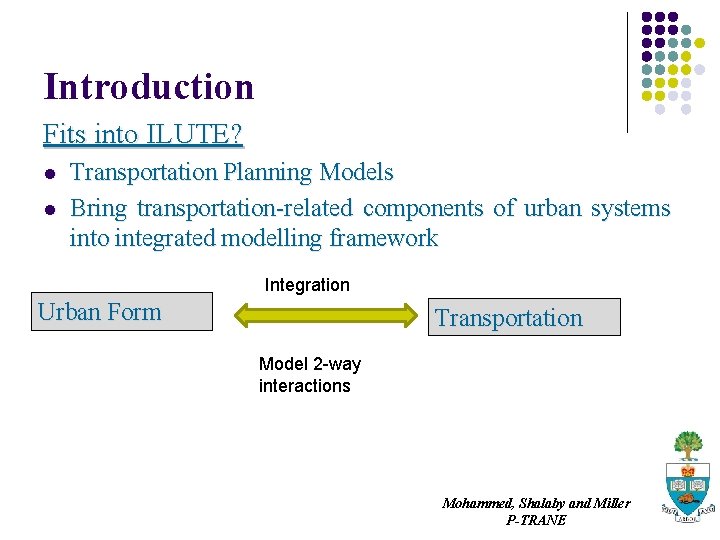
Introduction Fits into ILUTE? l l Transportation Planning Models Bring transportation-related components of urban systems into integrated modelling framework Integration Urban Form Transportation Model 2 -way interactions Mohammed, Shalaby and Miller P-TRANE
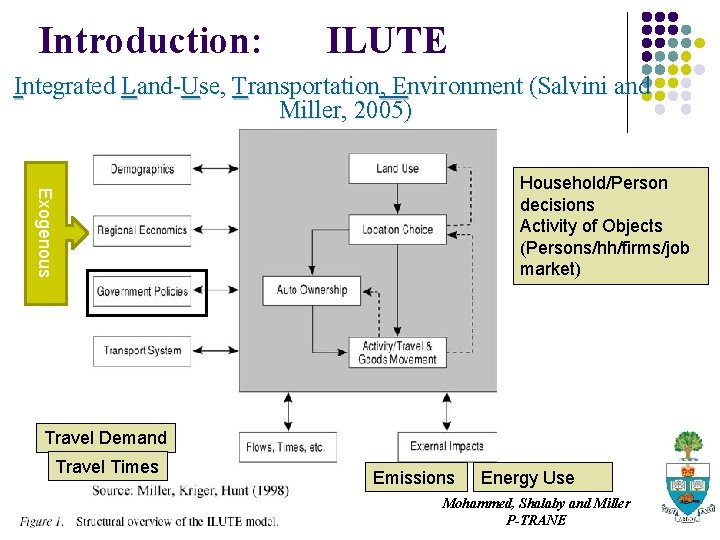
Introduction: ILUTE Integrated Land-Use, Transportation, Environment (Salvini and Miller, 2005) Exogenous Household/Person decisions Activity of Objects (Persons/hh/firms/job market) Travel Demand Travel Times Emissions Energy Use Mohammed, Shalaby and Miller P-TRANE
Bus Evolution Model Phase I: Empirical analysis l l Supply historical trends Macroscopic Mutual effect between Demand & Supply ‘Demand supply are recursive & simultaneous’ (e. g. Taylor & Miller 2003, Peng 1997) Phase II: P-TRANE l l l GIS of bus network growth Microscopic (bus line /period/branch detail) Service Standards Mohammed, Shalaby and Miller P-TRANE
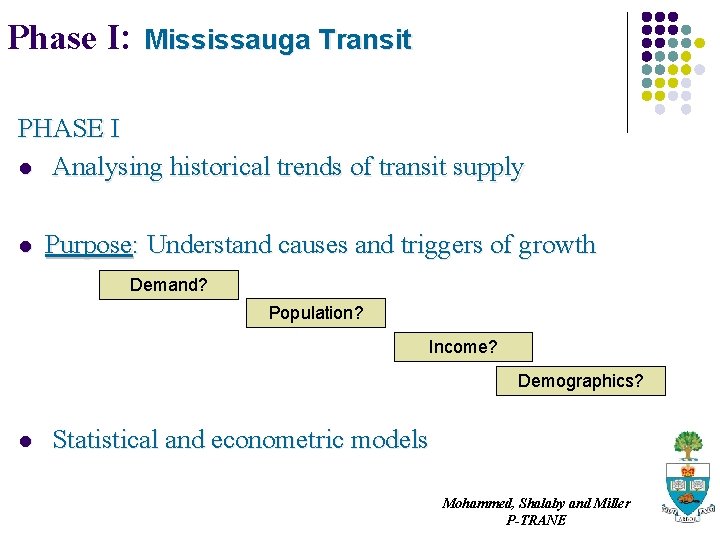
Phase I: Mississauga Transit PHASE I l Analysing historical trends of transit supply l Purpose: Understand causes and triggers of growth Demand? Population? Income? Demographics? l Statistical and econometric models Mohammed, Shalaby and Miller P-TRANE
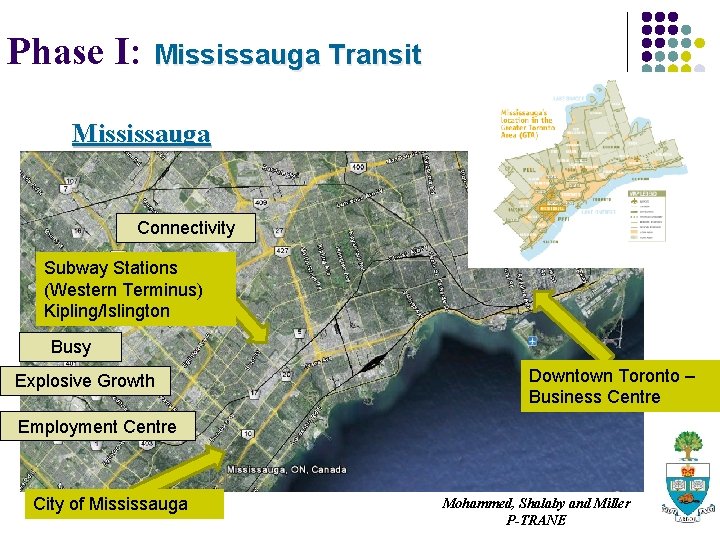
Phase I: Mississauga Transit Mississauga Connectivity Subway Stations (Western Terminus) Kipling/Islington Busy Explosive Growth Downtown Toronto – Business Centre Employment Centre City of Mississauga Mohammed, Shalaby and Miller P-TRANE
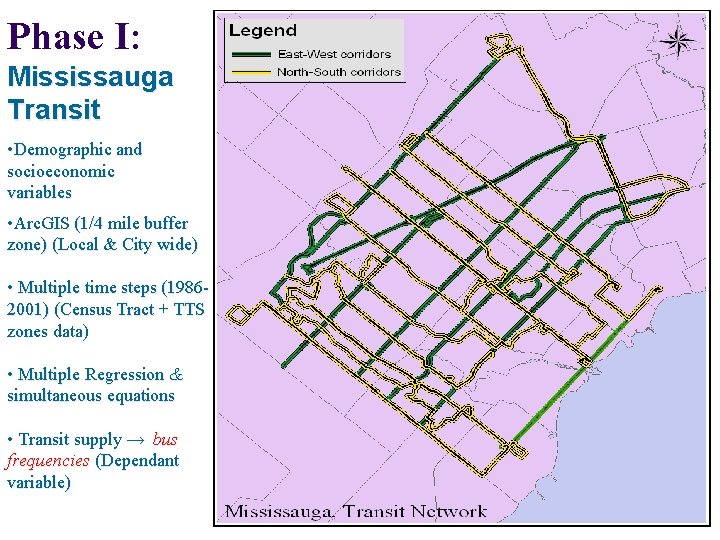
Phase I: Mississauga Transit • Demographic and socioeconomic variables • Arc. GIS (1/4 mile buffer zone) (Local & City wide) • Multiple time steps (19862001) (Census Tract + TTS zones data) • Multiple Regression & simultaneous equations • Transit supply → bus frequencies (Dependant variable) Mohammed, Shalaby and Miller PREMOTRANE
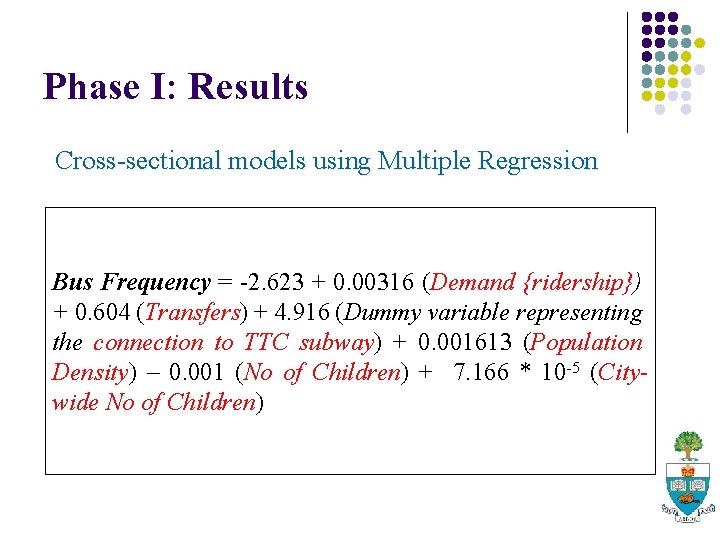
Phase I: Results Cross-sectional models using Multiple Regression Bus Frequency = -2. 623 + 0. 00316 (Demand {ridership}) + 0. 604 (Transfers) + 4. 916 (Dummy variable representing the connection to TTC subway) + 0. 001613 (Population Density) – 0. 001 (No of Children) + 7. 166 * 10 -5 (Citywide No of Children)
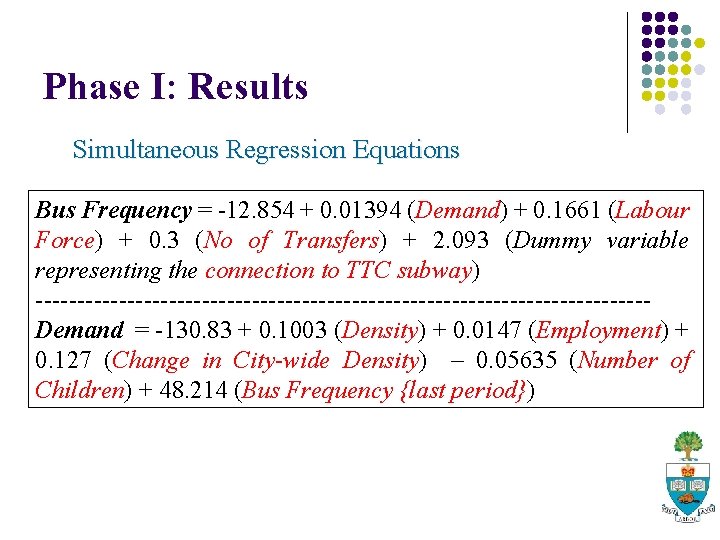
Phase I: Results Simultaneous Regression Equations Bus Frequency = -12. 854 + 0. 01394 (Demand) + 0. 1661 (Labour Force) + 0. 3 (No of Transfers) + 2. 093 (Dummy variable representing the connection to TTC subway) -------------------------------------Demand = -130. 83 + 0. 1003 (Density) + 0. 0147 (Employment) + 0. 127 (Change in City-wide Density) – 0. 05635 (Number of Children) + 48. 214 (Bus Frequency {last period})
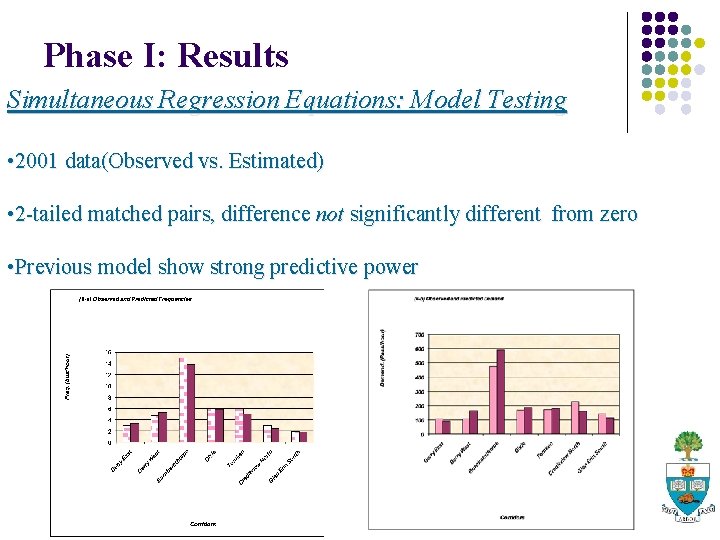
Phase I: Results Simultaneous Regression Equations: Model Testing • 2001 data(Observed vs. Estimated) • 2 -tailed matched pairs, difference not significantly different from zero • Previous model show strong predictive power
Transit Evolution Model P T R A N E Phase II “Prediction Model of Transit Network Evolution” Previously PREMOTRANE Mohammed, Shalaby and Miller P-TRANE
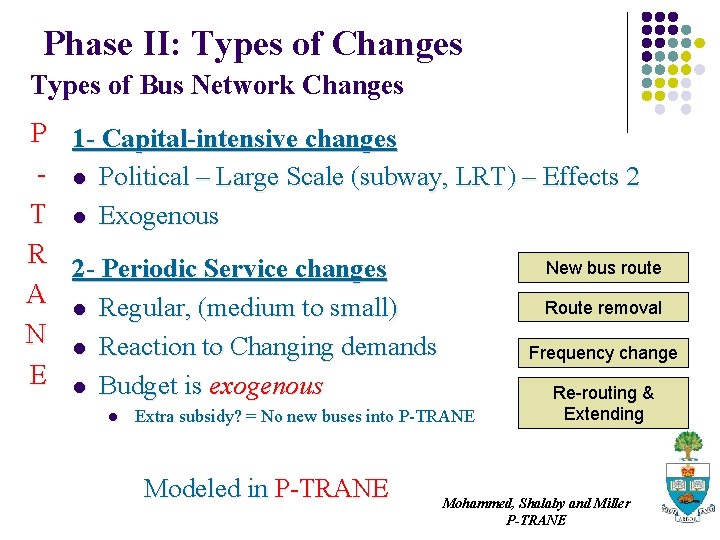
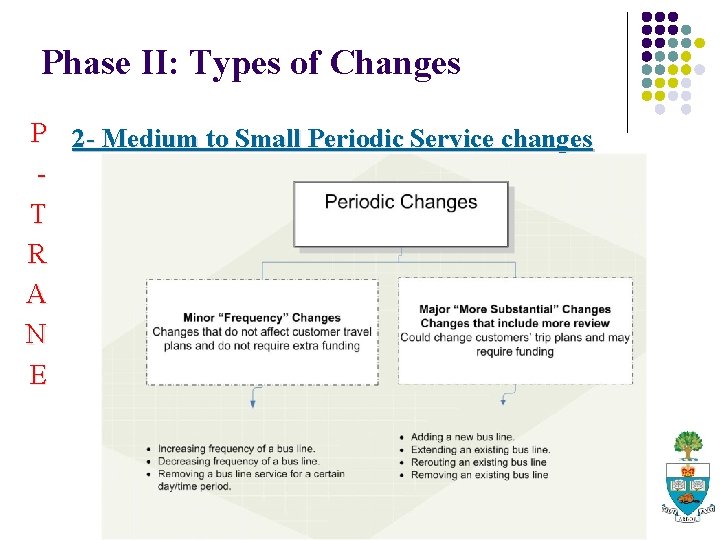
Phase II: Types of Changes Types of Bus Network Changes P 1 - Capital-intensive changes - l Political – Large Scale (subway, LRT) – Effects 2 T l Exogenous R New bus route 2 - Periodic Service changes A l Regular, (medium to small) Route removal N l Reaction to Changing demands Frequency change E l Budget is exogenous Re-routing & l Extra subsidy? = No new buses into P-TRANE Modeled in P-TRANE Extending Mohammed, Shalaby and Miller P-TRANE
Phase II: Types of Changes P 2 - Medium to Small Periodic Service changes T R A N E Mohammed, Shalaby and Miller PREMOTRANE
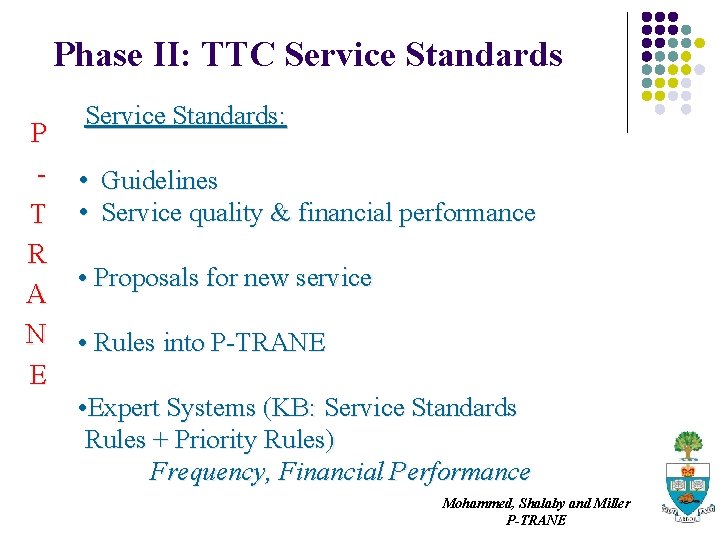
Phase II: TTC Service Standards P T R A N E Service Standards: • Guidelines • Service quality & financial performance • Proposals for new service • Rules into P-TRANE • Expert Systems (KB: Service Standards Rules + Priority Rules) Frequency, Financial Performance Mohammed, Shalaby and Miller P-TRANE
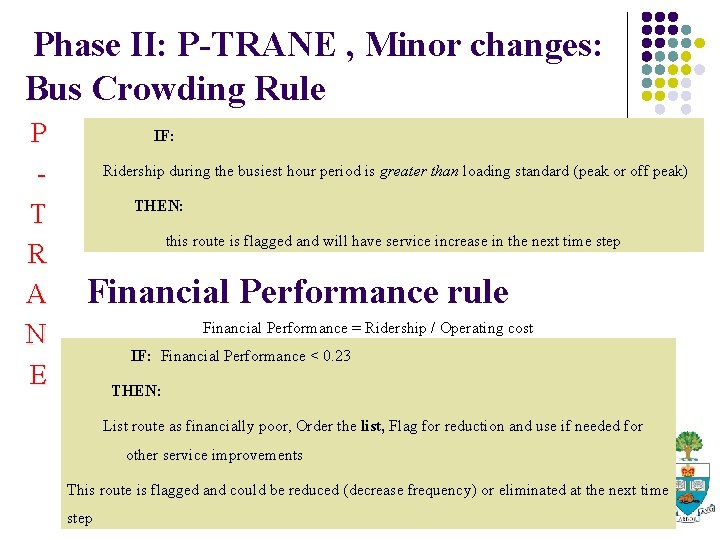
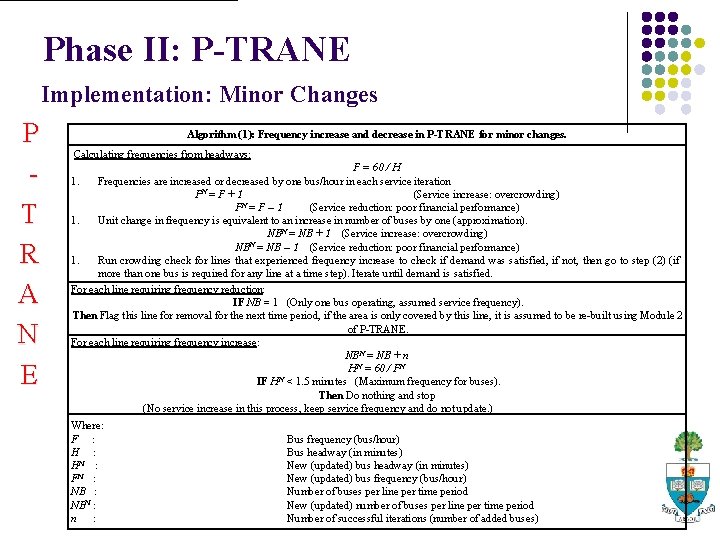
Phase II: P-TRANE , Minor changes: Bus Crowding Rule P T R A N E IF: Ridership during the busiest hour period is greater than loading standard (peak or off peak) THEN: this route is flagged and will have service increase in the next time step Financial Performance rule Financial Performance = Ridership / Operating cost IF: Financial Performance < 0. 23 THEN: List route as financially poor, Order the list, Flag for reduction and use if needed for other service improvements This route is flagged and could be reduced (decrease frequency) or eliminated at the next time step
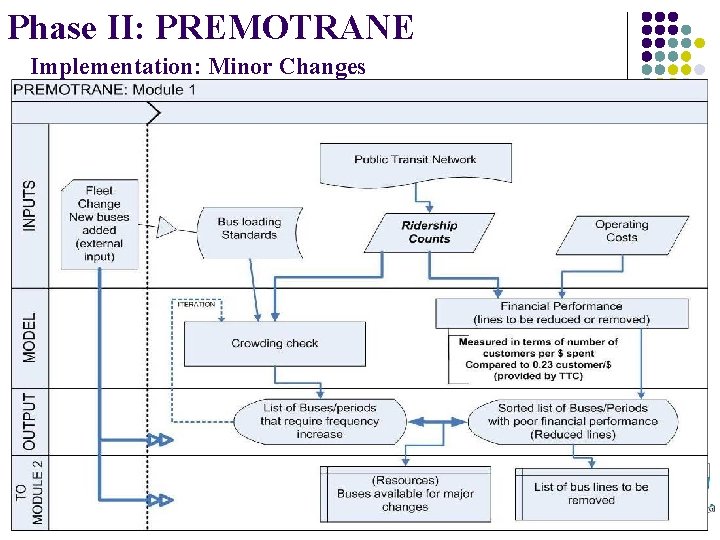
Phase II: PREMOTRANE Implementation: Minor Changes P R E M O T R A N E
Phase II: P-TRANE Implementation: Minor Changes P T R A N E Algorithm (1): Frequency increase and decrease in P-TRANE for minor changes. Calculating frequencies from headways: F = 60 / H 1. Frequencies are increased or decreased by one bus/hour in each service iteration FN = F + 1 (Service increase: overcrowding) FN = F – 1 (Service reduction: poor financial performance) 1. Unit change in frequency is equivalent to an increase in number of buses by one (approximation). NBN = NB + 1 (Service increase: overcrowding) N NB = NB – 1 (Service reduction: poor financial performance) 1. Run crowding check for lines that experienced frequency increase to check if demand was satisfied, if not, then go to step (2) (if more than one bus is required for any line at a time step). Iterate until demand is satisfied. For each line requiring frequency reduction: IF NB = 1 (Only one bus operating, assumed service frequency). Then Flag this line for removal for the next time period, if the area is only covered by this line, it is assumed to be re-built using Module 2 of P-TRANE. For each line requiring frequency increase: NBN = NB + n HN = 60 / FN N IF H < 1. 5 minutes (Maximum frequency for buses). Then Do nothing and stop (No service increase in this process, keep service frequency and do not update. ) Where: F : HN : FN : NBN : n : Bus frequency (bus/hour) Bus headway (in minutes) New (updated) bus frequency (bus/hour) Number of buses per line per time period New (updated) number of buses per line per time period Number of successful iterations (number of added buses)
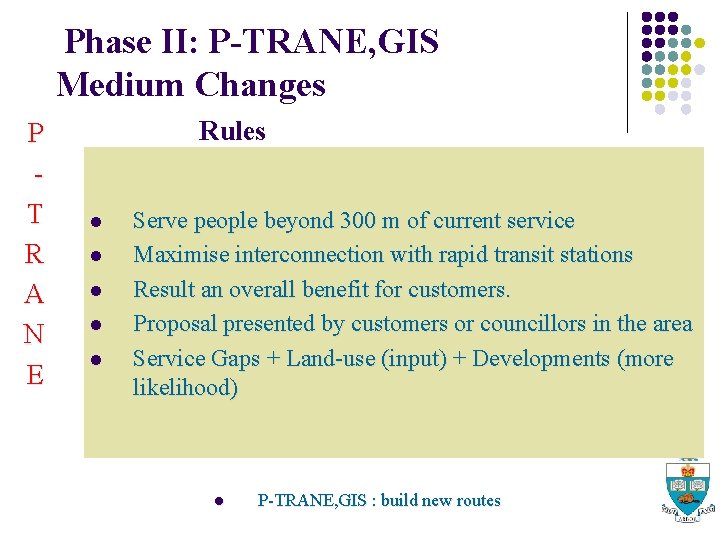
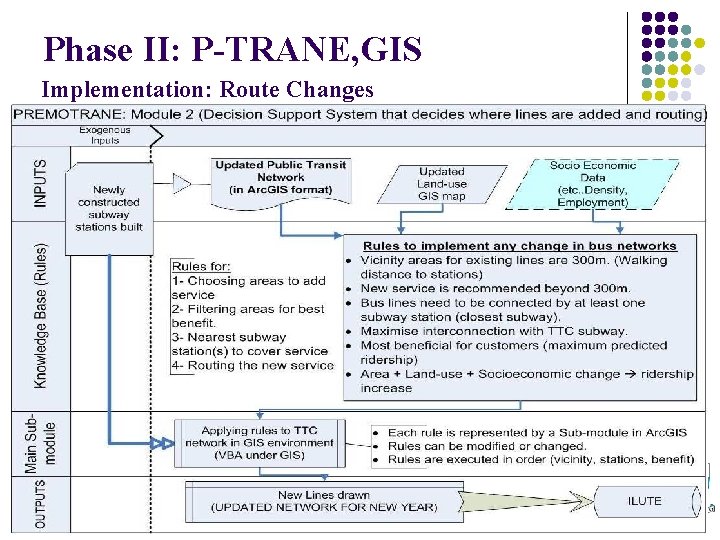
Phase II: P-TRANE, GIS Medium Changes P T R A N E Rules l l l Serve people beyond 300 m of current service Maximise interconnection with rapid transit stations Result an overall benefit for customers. Proposal presented by customers or councillors in the area Service Gaps + Land-use (input) + Developments (more likelihood) l P-TRANE, GIS : build new routes
Phase II: P-TRANE, GIS Implementation: Route Changes P R E M O T R A N E
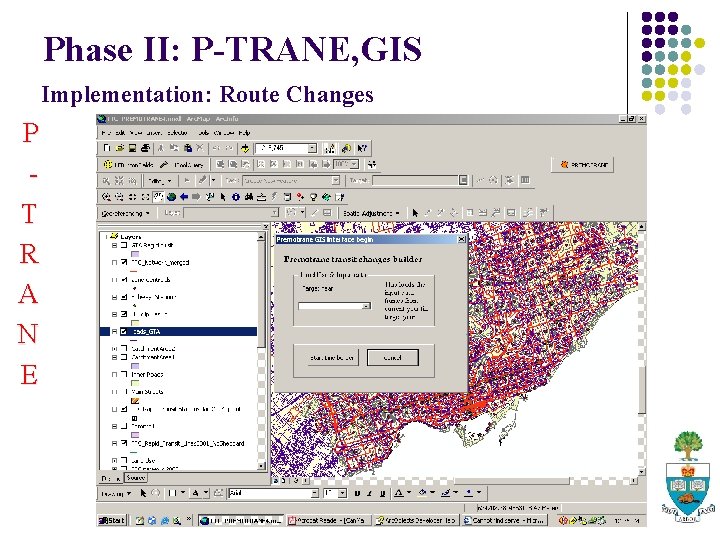
Phase II: P-TRANE, GIS Implementation: Route Changes P T R A N E
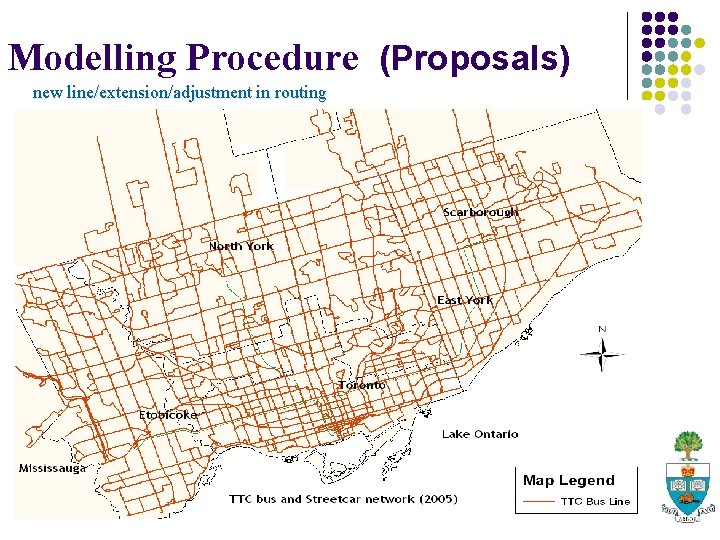
Modelling Procedure (Proposals) new line/extension/adjustment in routing P R E M O T R A N E Mohammed, Shalaby and Miller PREMOTRANE
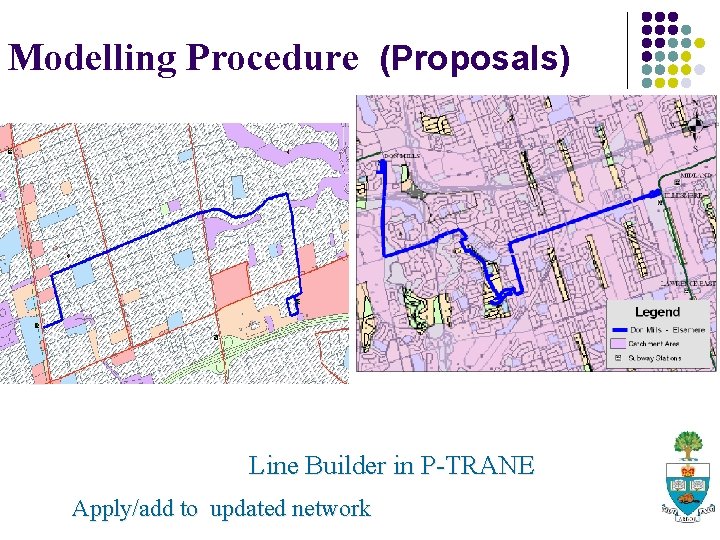
Modelling Procedure (Proposals) P T R A N E Line Builder in P-TRANE Apply/add to updated network
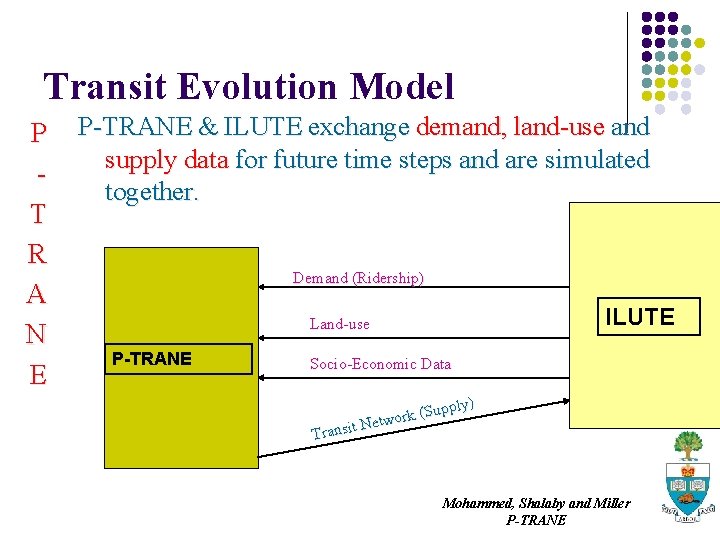
Transit Evolution Model P T R A N E P-TRANE & ILUTE exchange demand, land-use and supply data for future time steps and are simulated together. Demand (Ridership) ILUTE Land-use P-TRANE Socio-Economic Data ) Supply ( k r o t Netw Transi Mohammed, Shalaby and Miller P-TRANE
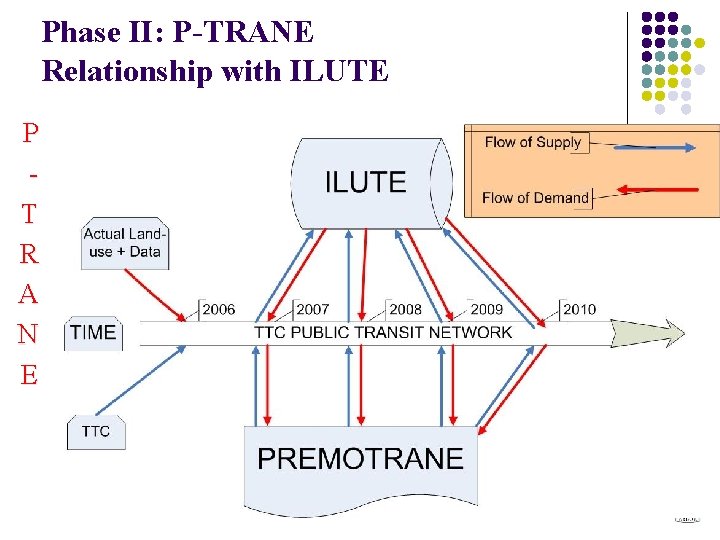
Phase II: P-TRANE Relationship with ILUTE P T R A N E
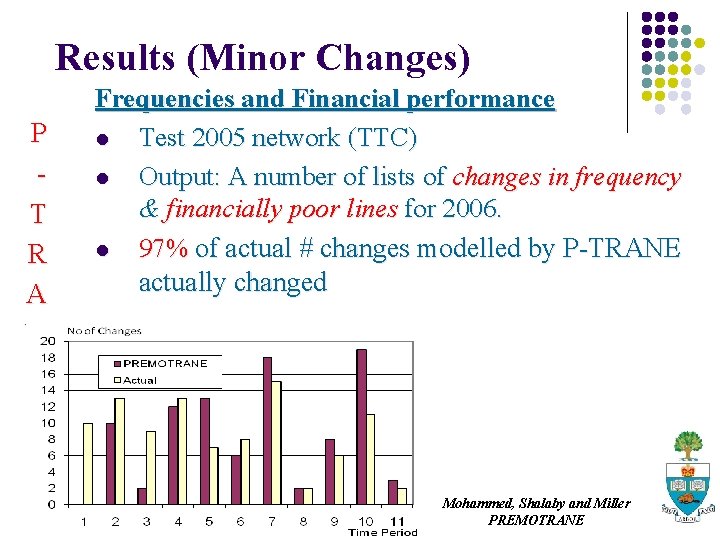
Results (Minor Changes) P T R A N E Frequencies and Financial performance l Test 2005 network (TTC) l Output: A number of lists of changes in frequency & financially poor lines for 2006. l 97% of actual # changes modelled by P-TRANE actually changed Mohammed, Shalaby and Miller PREMOTRANE
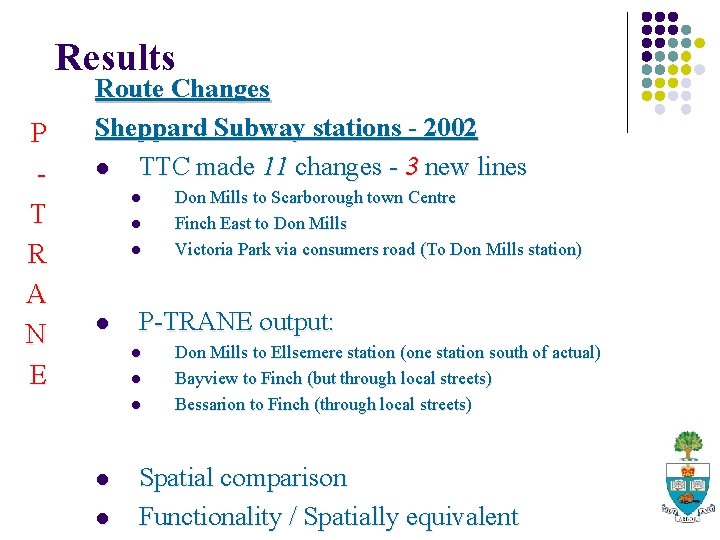
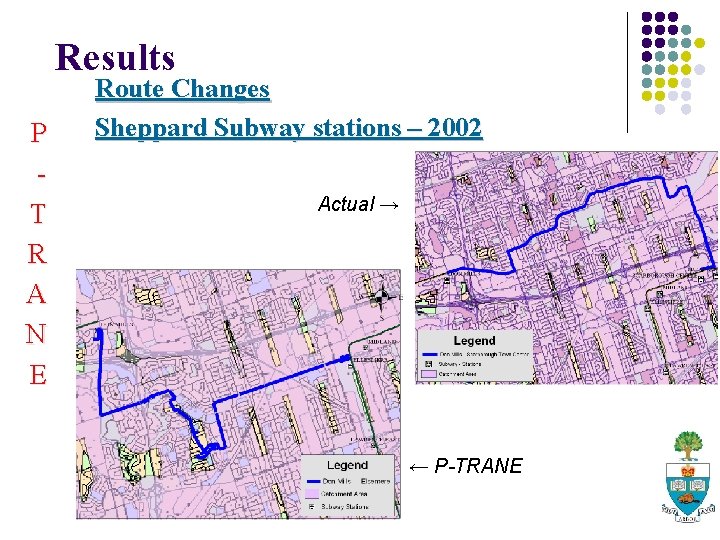
Results P T R A N E Route Changes Sheppard Subway stations - 2002 l TTC made 11 changes - 3 new lines l l P-TRANE output: l l l Don Mills to Scarborough town Centre Finch East to Don Mills Victoria Park via consumers road (To Don Mills station) Don Mills to Ellsemere station (one station south of actual) Bayview to Finch (but through local streets) Bessarion to Finch (through local streets) Spatial comparison Functionality / Spatially equivalent
Results P T R A N E Route Changes Sheppard Subway stations – 2002 Actual → ← P-TRANE
Conclusions P T R A N E P-TRANE l For the first time, Transit network evolution l Two phase project (empirical & DSS) l P-TRANE – a (GIS) framework l Simulates changes spatially and temporally l Predictive model, describes service standards l Component in ILUTE, l GIS, User-friendly, Promising Results
Conclusions P T R A N E P-TRANE l DSS For Transit Agencies (e. g. TTC, OCTranspo) l Test future policies, alternatives, standards l Simulates Periodic Changes of Service/Feeder Bus Routes Prior to (Capital Intensive) Projects l E. g. , New LRT BRT, Subway Stations, Mohammed, Shalaby and Miller P-TRANE
Current Developments P T R A N E l l Ottawa Transit: (LRT & Hospital Link BRT) Effects on feeder bus network; Testing, validating and updating; Next Steps l Effects of Labour Unions l Budget Model Mohammed, Shalaby and Miller P-TRANE