
Understanding Sentences College Readers Understand Key Parts of
- Slides: 20
Understanding Sentences College Readers Understand Key Parts of Academic Sentences. Adapted from the Guide to College Reading
Are academic sentences complex? • Sentences have parts to express basic meaning. • Many academic sentences combine ideas. • Academic text also features lots of complicated sentences. Do academic sentences put you on the spot?
Steps to Reading Sentences 1) Locate the key Is the dad impressed by his son’s vocabulary? ideas. 2) Study the modifiers. 3) Check unknown words. 4) Paraphrase, using your own words to express ideas.
How to locate key ideas Find the Subject, Verb, and Object: – The subject, often a noun, identifies the person or object the sentence is about. – The verb, tells what the person or object is doing or has done. – The object completes the verb. • The average college student reads academic texts three hours per day. • Many professors have three academic degrees, including master’s and doctorates.
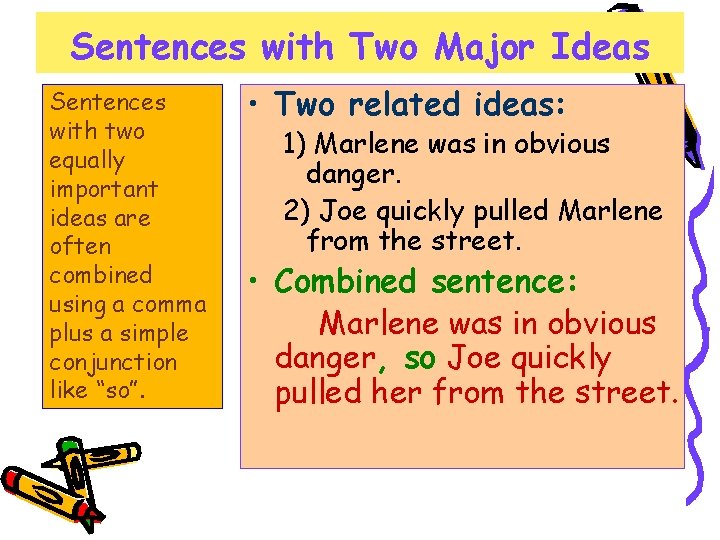
Sentences with Two Major Ideas Sentences with two equally important ideas are often combined using a comma plus a simple conjunction like “so”. • Two related ideas: 1) Marlene was in obvious danger. 2) Joe quickly pulled Marlene from the street. • Combined sentence: Marlene was in obvious danger, so Joe quickly pulled her from the street.
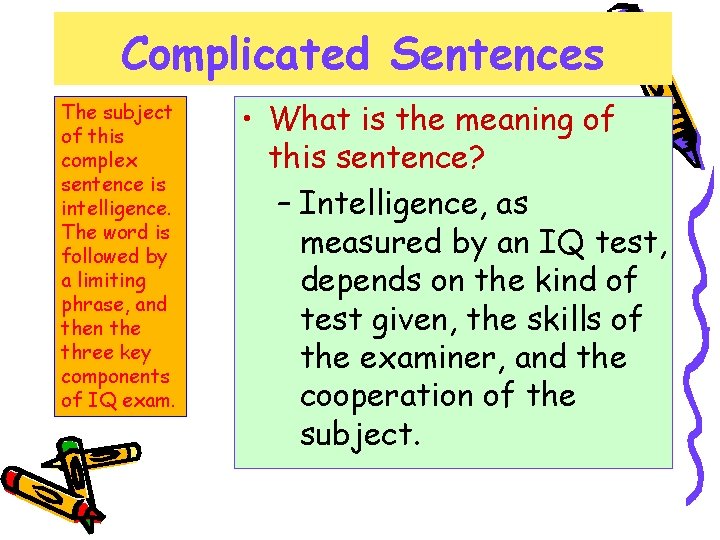
Complicated Sentences The subject of this complex sentence is intelligence. The word is followed by a limiting phrase, and then the three key components of IQ exam. • What is the meaning of this sentence? – Intelligence, as measured by an IQ test, depends on the kind of test given, the skills of the examiner, and the cooperation of the subject.
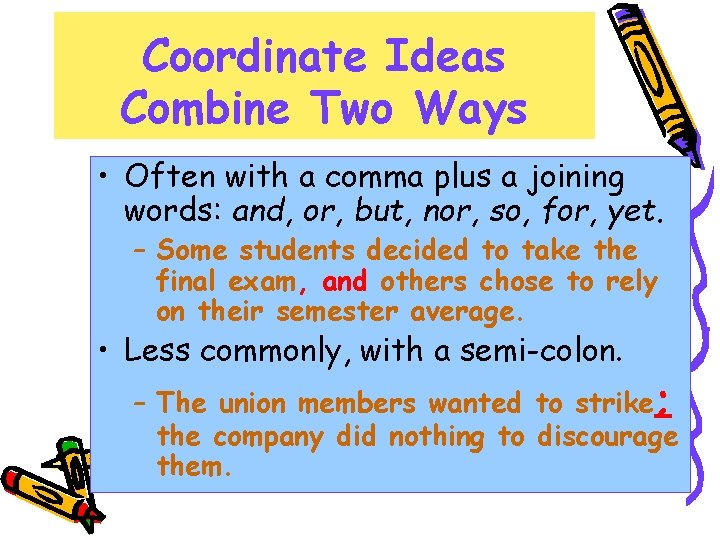
Coordinate Ideas Combine Two Ways • Often with a comma plus a joining words: and, or, but, nor, so, for, yet. – Some students decided to take the final exam, and others chose to rely on their semester average. • Less commonly, with a semi-colon. – The union members wanted to strike; the company did nothing to discourage them.
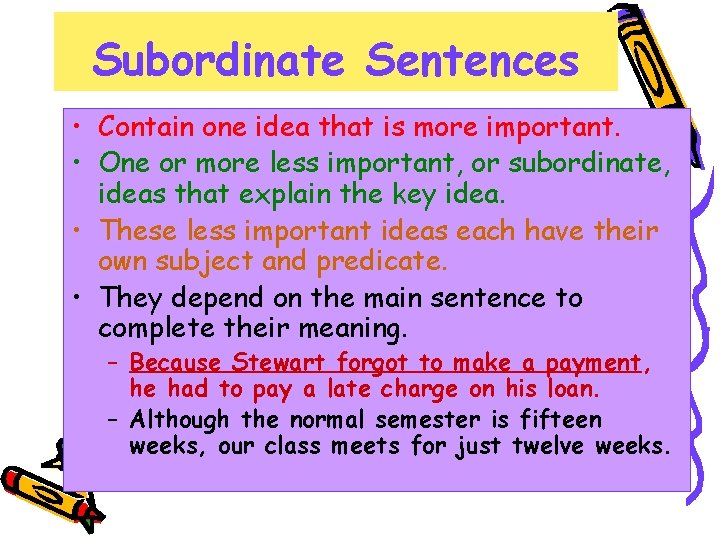
Subordinate Sentences • Contain one idea that is more important. • One or more less important, or subordinate, ideas that explain the key idea. • These less important ideas each have their own subject and predicate. • They depend on the main sentence to complete their meaning. – Because Stewart forgot to make a payment, he had to pay a late charge on his loan. – Although the normal semester is fifteen weeks, our class meets for just twelve weeks.
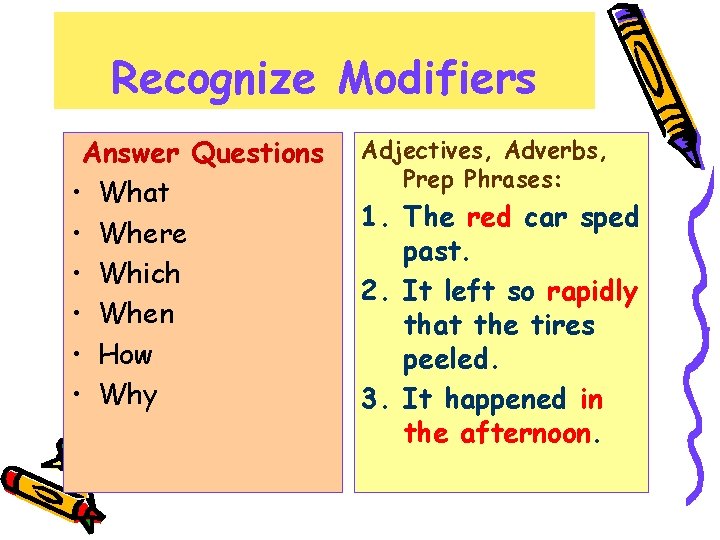
Recognize Modifiers Answer Questions • What • Where • Which • When • How • Why Adjectives, Adverbs, Prep Phrases: 1. The red car sped past. 2. It left so rapidly that the tires peeled. 3. It happened in the afternoon.
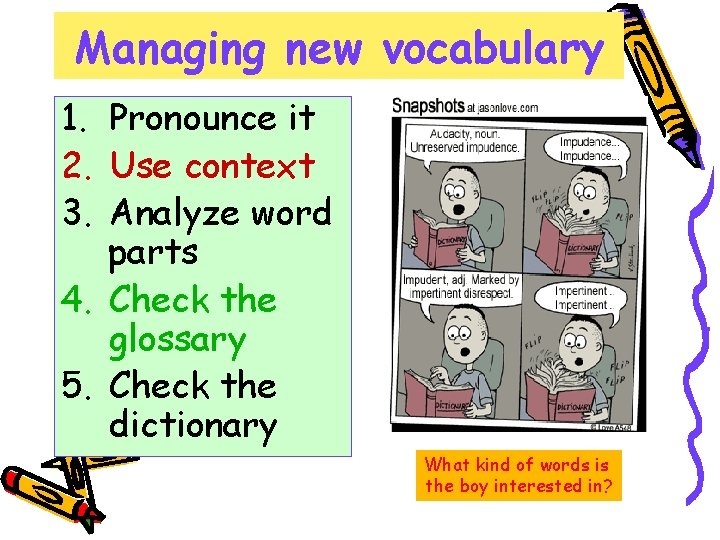
Managing new vocabulary 1. Pronounce it 2. Use context 3. Analyze word parts 4. Check the glossary 5. Check the dictionary What kind of words is the boy interested in?
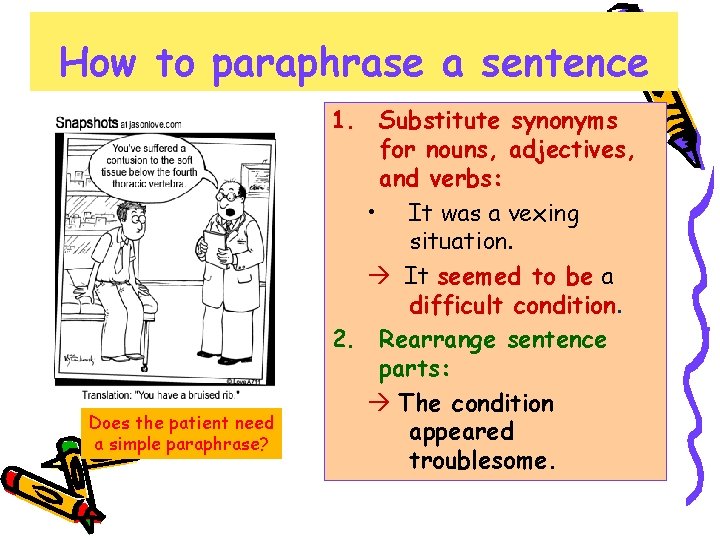
How to paraphrase a sentence Does the patient need a simple paraphrase? 1. Substitute synonyms for nouns, adjectives, and verbs: • It was a vexing situation. It seemed to be a difficult condition. 2. Rearrange sentence parts: The condition appeared troublesome.
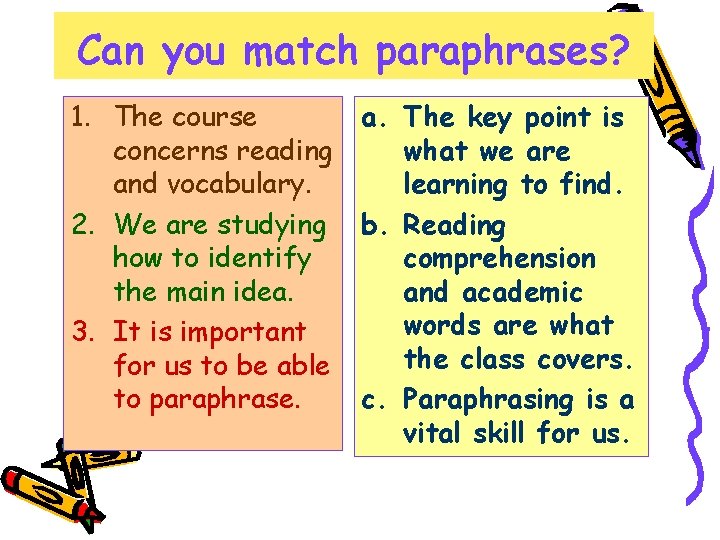
Can you match paraphrases? 1. The course a. The key point is concerns reading what we are and vocabulary. learning to find. 2. We are studying b. Reading how to identify comprehension the main idea. and academic words are what 3. It is important the class covers. for us to be able to paraphrase. c. Paraphrasing is a vital skill for us.
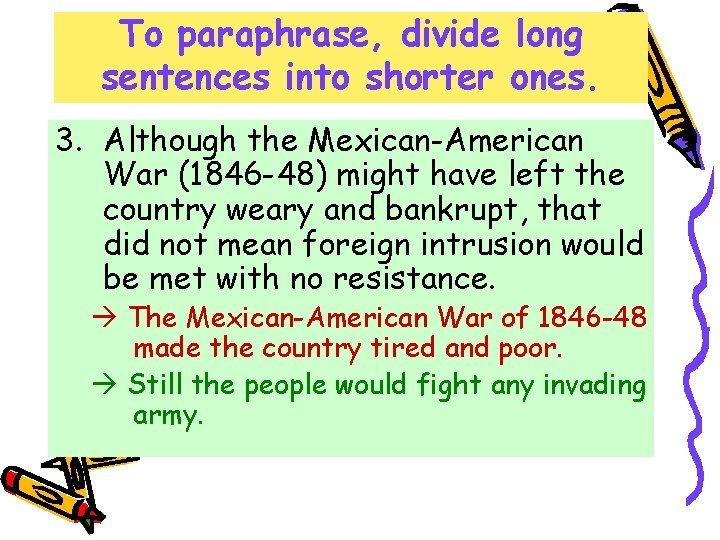
To paraphrase, divide long sentences into shorter ones. 3. Although the Mexican-American War (1846 -48) might have left the country weary and bankrupt, that did not mean foreign intrusion would be met with no resistance. The Mexican-American War of 1846 -48 made the country tired and poor. Still the people would fight any invading army.
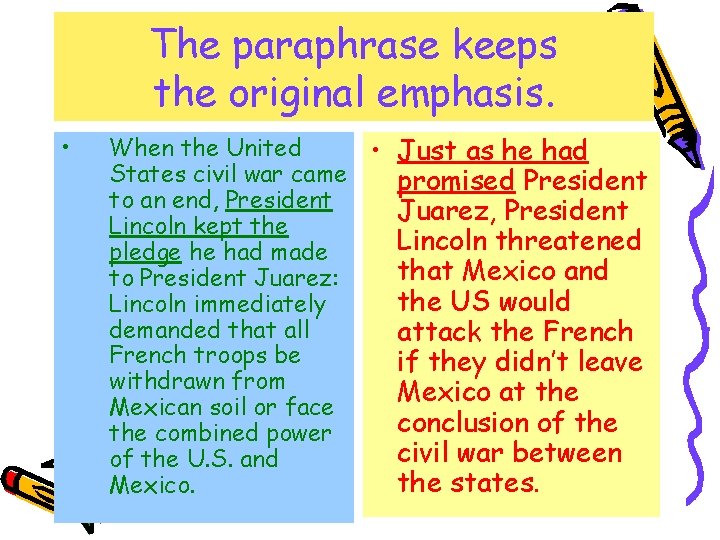
The paraphrase keeps the original emphasis. • When the United • Just as he had States civil war came promised President to an end, President Juarez, President Lincoln kept the Lincoln threatened pledge he had made that Mexico and to President Juarez: the US would Lincoln immediately demanded that all attack the French troops be if they didn’t leave withdrawn from Mexico at the Mexican soil or face conclusion of the combined power civil war between of the U. S. and the states. Mexico.
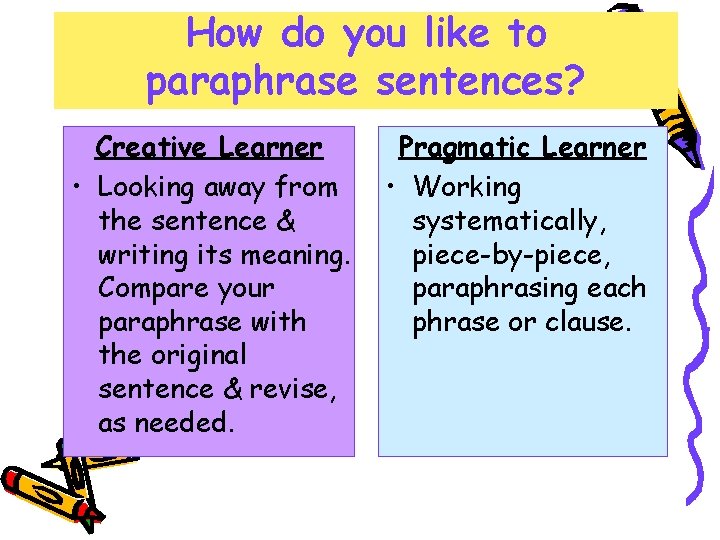
How do you like to paraphrase sentences? Creative Learner • Looking away from the sentence & writing its meaning. Compare your paraphrase with the original sentence & revise, as needed. Pragmatic Learner • Working systematically, piece-by-piece, paraphrasing each phrase or clause.
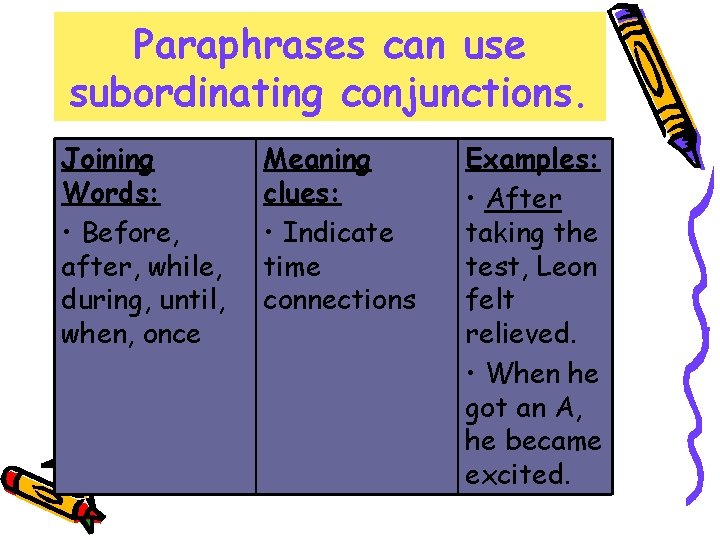
Paraphrases can use subordinating conjunctions. Joining Words: • Before, after, while, during, until, when, once Meaning clues: • Indicate time connections Examples: • After taking the test, Leon felt relieved. • When he got an A, he became excited.
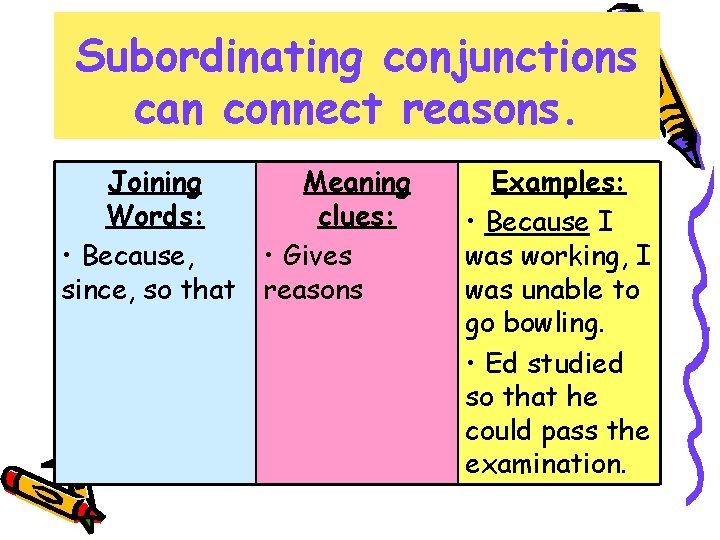
Subordinating conjunctions can connect reasons. Joining Meaning Words: clues: • Because, • Gives since, so that reasons Examples: • Because I was working, I was unable to go bowling. • Ed studied so that he could pass the examination.
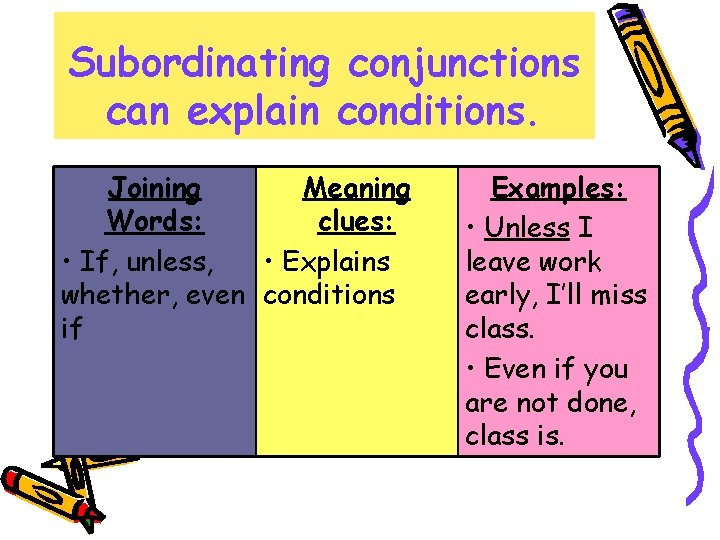
Subordinating conjunctions can explain conditions. Joining Meaning Words: clues: • If, unless, • Explains whether, even conditions if Examples: • Unless I leave work early, I’ll miss class. • Even if you are not done, class is.
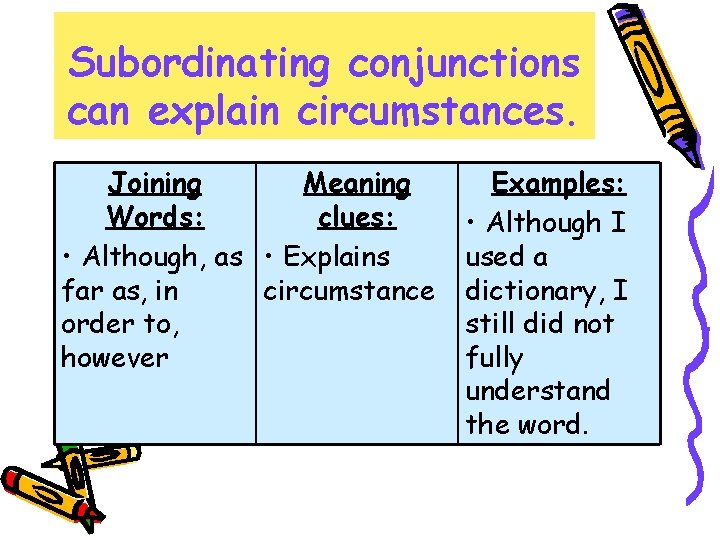
Subordinating conjunctions can explain circumstances. Joining Meaning Words: clues: • Although, as • Explains far as, in circumstance order to, however Examples: • Although I used a dictionary, I still did not fully understand the word.
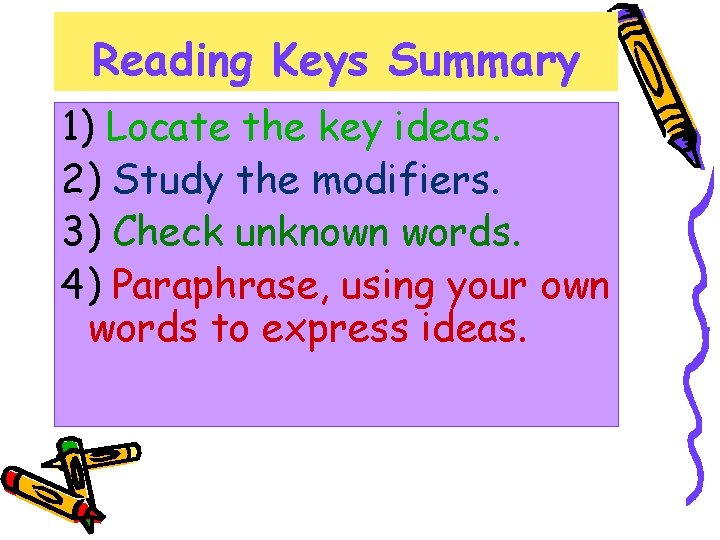
Reading Keys Summary 1) Locate the key ideas. 2) Study the modifiers. 3) Check unknown words. 4) Paraphrase, using your own words to express ideas.