
Understanding RNA Structure and Function using Molecular Dynamics
- Slides: 1
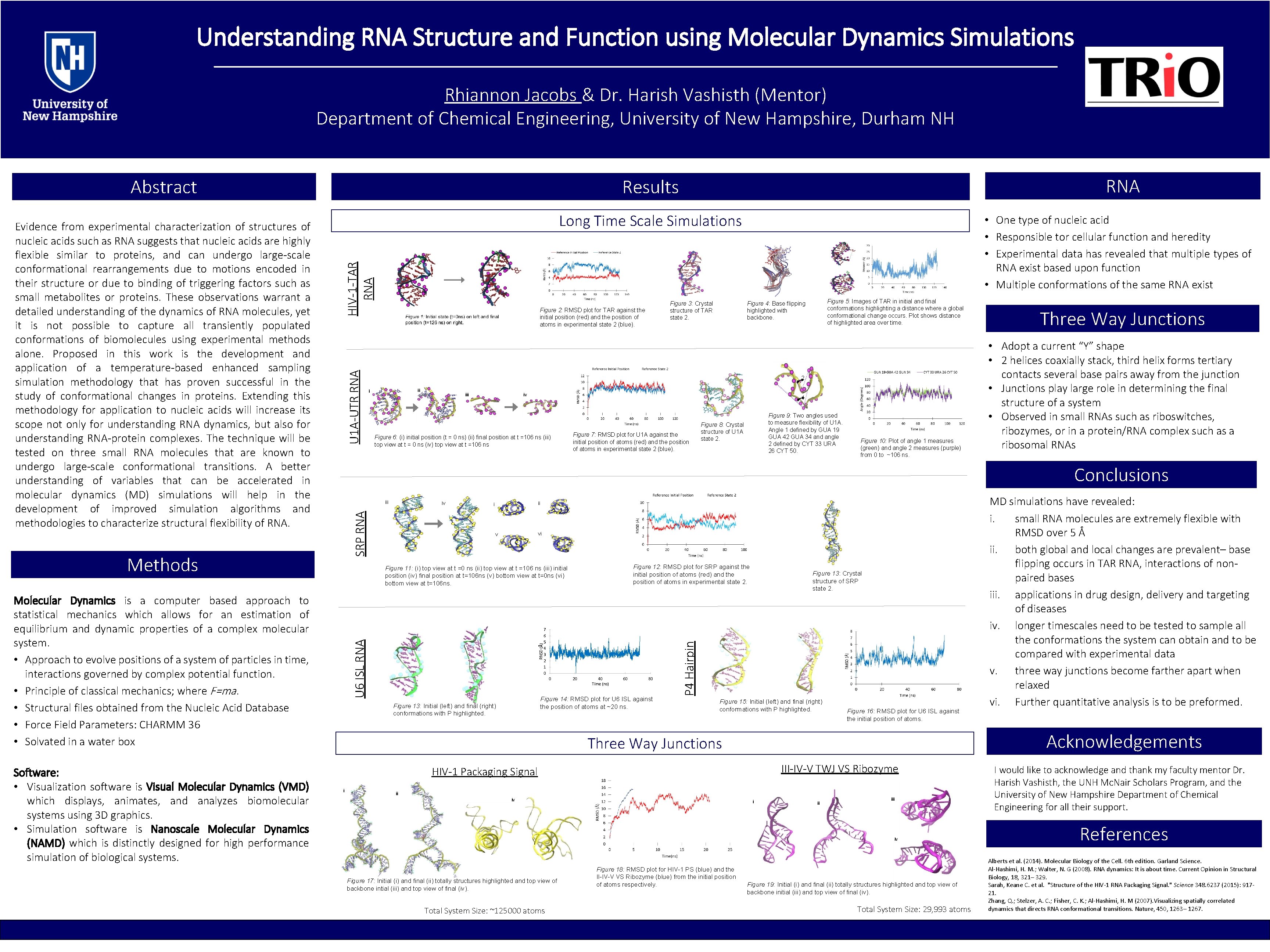
Understanding RNA Structure and Function using Molecular Dynamics Simulations ________________________________________________________________ Rhiannon Jacobs & Dr. Harish Vashisth (Mentor) Department of Chemical Engineering, University of New Hampshire, Durham NH Abstract HIV-1 -TAR RNA Long Time Scale Simulations Figure 5: Images of TAR in initial and final conformations highlighting a distance where a global conformational change occurs. Plot shows distance of highlighted area over time. Figure 4: Base flipping highlighted with backbone. 2 ii i iii iv 1 Figure 6: (i) initial position (t = 0 ns) (ii) final position at t =106 ns (iii) top view at t = 0 ns (iv) top view at t =106 ns iv Figure 9: Two angles used to measure flexibility of U 1 A. Angle 1 defined by GUA 19 GUA 42 GUA 34 and angle 2 defined by CYT 33 URA 26 CYT 50. Figure 8: Crystal structure of U 1 A state 2. Figure 10: Plot of angle 1 measures (green) and angle 2 measures (purple) from 0 to ~106 ns. ii i SRP RNA Figure 7: RMSD plot for U 1 A against the initial position of atoms (red) and the position of atoms in experimental state 2 (blue). vi v Figure 12: RMSD plot for SRP against the initial position of atoms (red) and the position of atoms in experimental state 2. Figure 11: (i) top view at t =0 ns (ii) top view at t =106 ns (iii) initial position (iv) final position at t=106 ns (v) bottom view at t=0 ns (vi) bottom view at t=106 ns. RNSD (Å) U 6 ISL RNA Molecular Dynamics is a computer based approach to statistical mechanics which allows for an estimation of equilibrium and dynamic properties of a complex molecular system. • Approach to evolve positions of a system of particles in time, interactions governed by complex potential function. • Principle of classical mechanics; where F=ma. • Structural files obtained from the Nucleic Acid Database • Force Field Parameters: CHARMM 36 • Solvated in a water box Software: • Visualization software is Visual Molecular Dynamics (VMD) which displays, animates, and analyzes biomolecular systems using 3 D graphics. • Simulation software is Nanoscale Molecular Dynamics (NAMD) which is distinctly designed for high performance simulation of biological systems. Figure 2: RMSD plot for TAR against the initial position (red) and the position of atoms in experimental state 2 (blue). iii Methods Figure 3: Crystal structure of TAR state 2. • One type of nucleic acid • Responsible tor cellular function and heredity • Experimental data has revealed that multiple types of RNA exist based upon function • Multiple conformations of the same RNA exist 7 6 5 4 3 2 1 0 0 20 40 Time (ns) 60 80 Figure 14: RMSD plot for U 6 ISL against the position of atoms at ~20 ns. Figure 13: Initial (left) and final (right) conformations with P highlighted. Figure 13: Crystal structure of SRP state 2. P 4 Hairpin U 1 A-UTR RNA Evidence from experimental characterization of structures of nucleic acids such as RNA suggests that nucleic acids are highly flexible similar to proteins, and can undergo large-scale conformational rearrangements due to motions encoded in their structure or due to binding of triggering factors such as small metabolites or proteins. These observations warrant a detailed understanding of the dynamics of RNA molecules, yet it is not possible to capture all transiently populated conformations of biomolecules using experimental methods alone. Proposed in this work is the development and application of a temperature-based enhanced sampling simulation methodology that has proven successful in the study of conformational changes in proteins. Extending this methodology for application to nucleic acids will increase its scope not only for understanding RNA dynamics, but also for understanding RNA-protein complexes. The technique will be tested on three small RNA molecules that are known to undergo large-scale conformational transitions. A better understanding of variables that can be accelerated in molecular dynamics (MD) simulations will help in the development of improved simulation algorithms and methodologies to characterize structural flexibility of RNA Results Figure 15: Initial (left) and final (right) conformations with P highlighted. Figure 16: RMSD plot for U 6 ISL against the initial position of atoms. III-IV-V TWJ VS Ribozyme HIV-1 Packaging Signal ii iv i ii iv Figure 17: Initial (i) and final (ii) totally structures highlighted and top view of backbone intial (iii) and top view of final (iv). Total System Size: ~125000 atoms Figure 18: RMSD plot for HIV-1 PS (blue) and the II-IV-V VS Ribozyme (blue) from the initial position of atoms respectively. • Adopt a current “Y” shape • 2 helices coaxially stack, third helix forms tertiary contacts several base pairs away from the junction • Junctions play large role in determining the final structure of a system • Observed in small RNAs such as riboswitches, ribozymes, or in a protein/RNA complex such as a ribosomal RNAs Conclusions MD simulations have revealed: i. small RNA molecules are extremely flexible with RMSD over 5 Å ii. both global and local changes are prevalent– base flipping occurs in TAR RNA, interactions of nonpaired bases iii. applications in drug design, delivery and targeting of diseases iv. longer timescales need to be tested to sample all the conformations the system can obtain and to be compared with experimental data v. three way junctions become farther apart when relaxed vi. Further quantitative analysis is to be preformed. Acknowledgements Three Way Junctions i Three Way Junctions Figure 19: Initial (i) and final (ii) totally structures highlighted and top view of backbone initial (iii) and top view of final (iv). Total System Size: 29, 993 atoms I would like to acknowledge and thank my faculty mentor Dr. Harish Vashisth, the UNH Mc. Nair Scholars Program, and the University of New Hampshire Department of Chemical Engineering for all their support. References Alberts et al. (2014). Molecular Biology of the Cell. 6 th edition. Garland Science. Al-Hashimi, H. M. ; Walter, N. G (2008). RNA dynamics: It is about time. Current Opinion in Structural Biology, 18, 321– 329. Sarah, Keane C. et al. "Structure of the HIV-1 RNA Packaging Signal. " Science 348. 6237 (2015): 91721. Zhang, Q. ; Stelzer, A. C. ; Fisher, C. K. ; Al-Hashimi, H. M (2007). Visualizing spatially correlated dynamics that directs RNA conformational transitions. Nature, 450, 1263– 1267.