
Understanding Risk by Rich Denning The Ohio State
Understanding Risk by Rich Denning The Ohio State University November 2013
Presentation Objectives • In November 2006, Time Magazine featured the question “Why we worry about the things we shouldn’t and ignore things we should” • In this presentation, we will discuss: – What we mean when we say something is unsafe. – The relationship between safety and risk. – The major health risks are that we face in our daily lives. – The character and magnitude of nuclear power plant accident risk.
Safety • Is it safe to cross the street? • What could happen to you? – You could be injured. – You could die. – Nothing. • You look both ways and assess the likelihood of being hit. • Safety is not just a question of the potential size of the hazard, it also depends on the likelihood.
Risk • Definition of risk “Risk is the potential for some unwanted event to occur. Risk is a function of the likelihood of the unwanted event and its consequences. ” National Infrastructure Protection Center • Risk always has some element of (unwanted) consequence and some element of likelihood • Simple measure of risk: – Probability of an event times its consequences. • Risk assessment is a tool that we use to quantify safety.
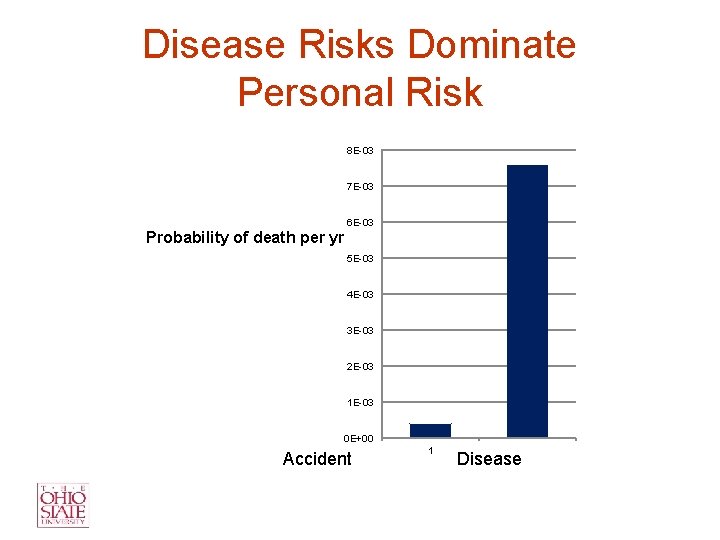
Disease Risks Dominate Personal Risk 8 E-03 7 E-03 6 E-03 Probability of death per yr 5 E-03 4 E-03 3 E-03 2 E-03 1 E-03 0 E+00 Accident 1 Disease 2

Accident Risks Type Annual Fatalities (2010) Transportation (motor vehicles) 37, 961 Falls 26, 009 Poisoning 33, 041 Drowning 3, 782 Fire/Smoke 2, 782 Other 17, 284 Total 120, 859 • Risk per year = 120, 859/309 million = 0. 0004/yr
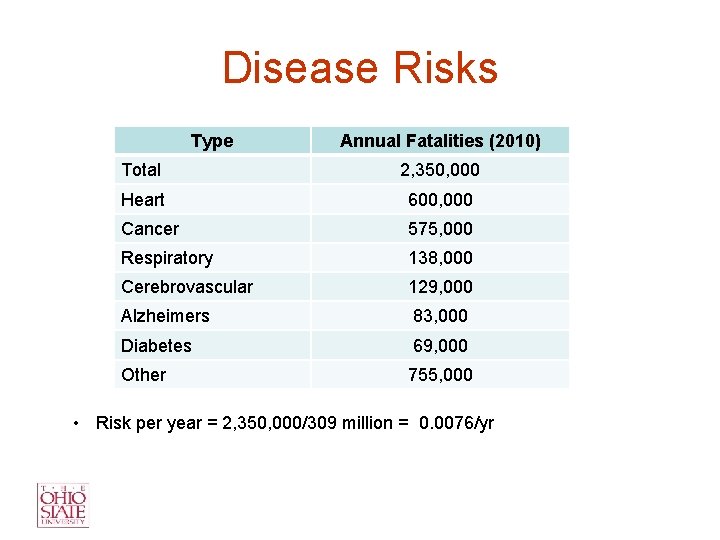
Disease Risks Type Annual Fatalities (2010) Total 2, 350, 000 Heart 600, 000 Cancer 575, 000 Respiratory 138, 000 Cerebrovascular 129, 000 Alzheimers 83, 000 Diabetes 69, 000 Other 755, 000 • Risk per year = 2, 350, 000/309 million = 0. 0076/yr
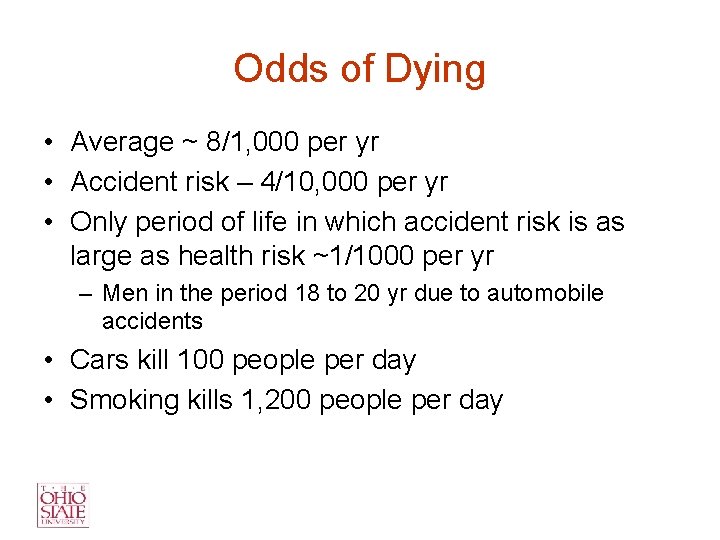
Odds of Dying • Average ~ 8/1, 000 per yr • Accident risk – 4/10, 000 per yr • Only period of life in which accident risk is as large as health risk ~1/1000 per yr – Men in the period 18 to 20 yr due to automobile accidents • Cars kill 100 people per day • Smoking kills 1, 200 people per day
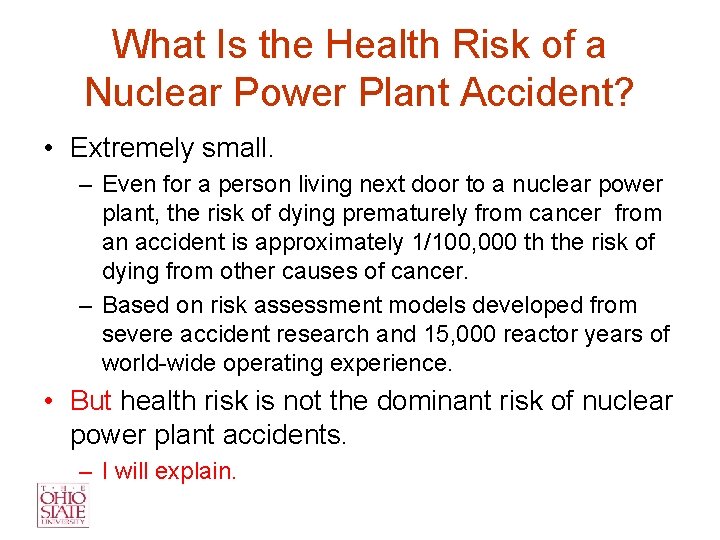
What Is the Health Risk of a Nuclear Power Plant Accident? • Extremely small. – Even for a person living next door to a nuclear power plant, the risk of dying prematurely from cancer from an accident is approximately 1/100, 000 th the risk of dying from other causes of cancer. – Based on risk assessment models developed from severe accident research and 15, 000 reactor years of world-wide operating experience. • But health risk is not the dominant risk of nuclear power plant accidents. – I will explain.
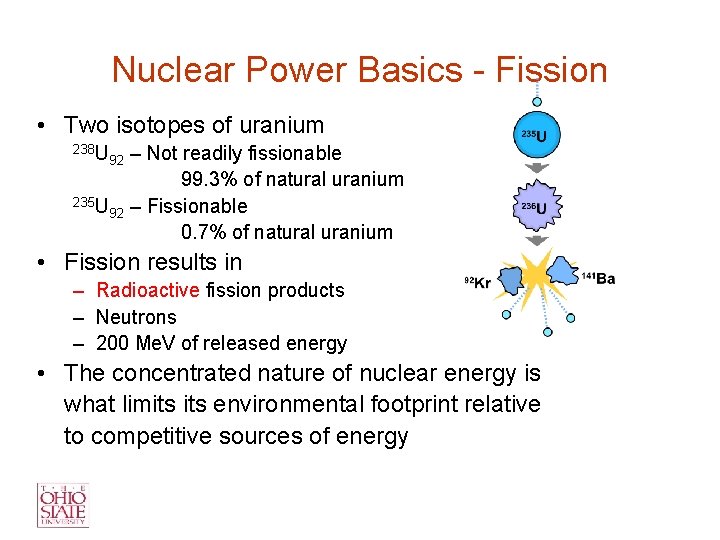
Nuclear Power Basics - Fission • Two isotopes of uranium 238 U – Not readily fissionable 99. 3% of natural uranium 235 U 92 – Fissionable 0. 7% of natural uranium 92 • Fission results in – Radioactive fission products – Neutrons – 200 Me. V of released energy • The concentrated nature of nuclear energy is what limits environmental footprint relative to competitive sources of energy
Fission Products and Reactor Safety • All reactor safety problems are associated with the radioactive fission products. – Because they are radioactive, they produce heat (decay heat) that must be continually removed to prevent fuel melting. – Because they are radioactive (emit radiation), if they are release to the environment people can be exposed to the emitted radiation and their health can be affected.
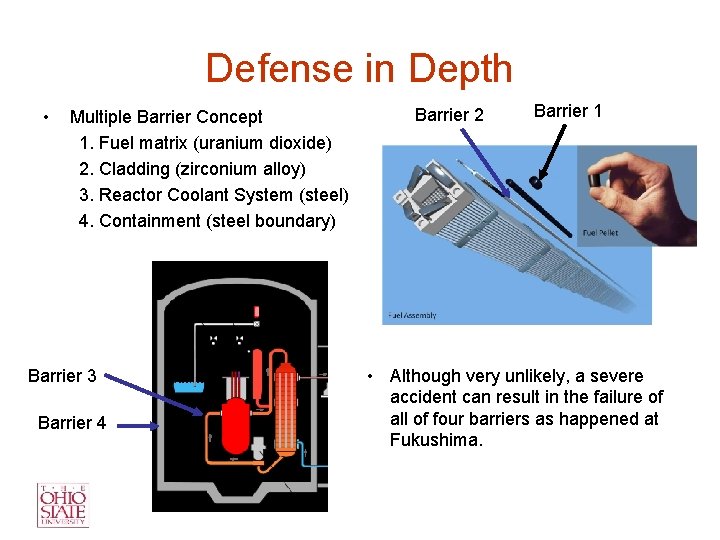
Defense in Depth • Multiple Barrier Concept 1. Fuel matrix (uranium dioxide) 2. Cladding (zirconium alloy) 3. Reactor Coolant System (steel) 4. Containment (steel boundary) Barrier 3 Barrier 4 Barrier 2 Barrier 1 • Although very unlikely, a severe accident can result in the failure of all of four barriers as happened at Fukushima.
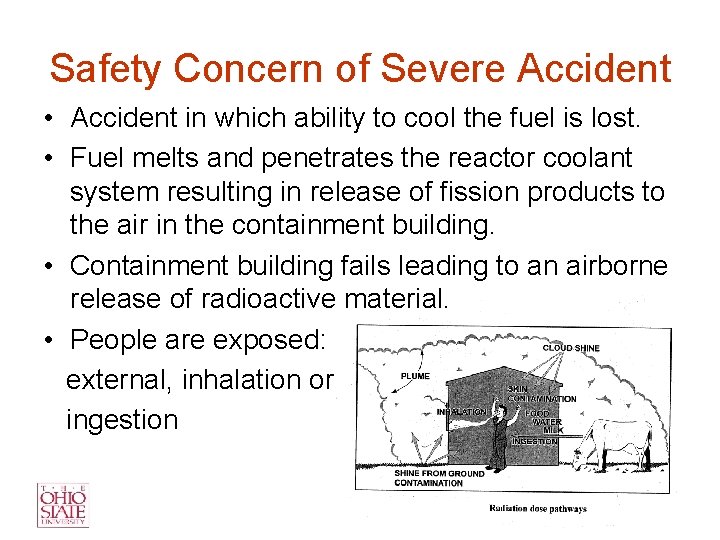
Safety Concern of Severe Accident • Accident in which ability to cool the fuel is lost. • Fuel melts and penetrates the reactor coolant system resulting in release of fission products to the air in the containment building. • Containment building fails leading to an airborne release of radioactive material. • People are exposed: external, inhalation or ingestion
Measuring Human Exposure to Radiation • Ionizing radiation damages cells. • Rem is a unit of measure that determines the biological effect of radiation exposure – It is independent of the type of radiation. • Sievert is the SI unit (=100 rem) but historically rem has been more commonly used in the U. S.

Health Effects of Exposure – High Dose • Radiation sickness (high doses) • LD 50/30 is the “lethal dose for 50 percent of the population within 30 days without medical intervention”. • Lethal dose LD 50/30 = 450 rem (some variability with age) • Signs of radiation sickness ~100 rem • In risk assessments with modern models, risk to public of early fatality effectively non-existent 15
Health Effects of Exposure – Low Dose • Cancer possible at lower doses • Random behavior – radiation can increase probability of getting cancer but can’t say who will get cancer • Appear with some delay in time (latency period). • Typically described in terms of mrem (1 millirem = 0. 001 rem) 16
Background Radiation • Humans are unavoidably exposed to radiation that arises from cosmic rays and the decay of naturally occurring radioactive materials. • Average exposure – Natural sources of radiation (cosmic rays, house construction) – 320 mrem per year – Medical procedures – 320 mrem per year 17
Low Dose Issue • Does a high background dose of radiation increase the incidence of cancer in a population? – We don’t know. – There is no evidence that people living in Denver with a higher background dose of radiation have a higher incidence of cancer than people in Columbus? – The effect is so small, it is very difficult to measure.
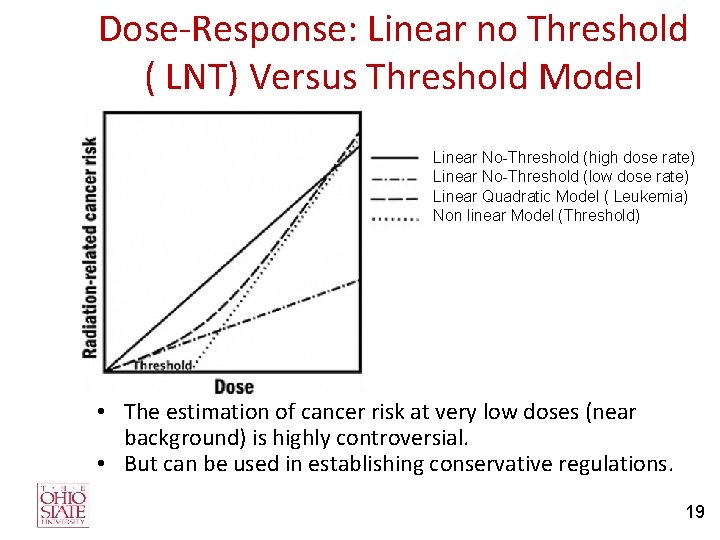
Dose-Response: Linear no Threshold ( LNT) Versus Threshold Model Linear No-Threshold (high dose rate) Linear No-Threshold (low dose rate) Linear Quadratic Model ( Leukemia) Non linear Model (Threshold) • The estimation of cancer risk at very low doses (near background) is highly controversial. • But can be used in establishing conservative regulations. 19
Terrestrial and Cosmic Sources • Radioactive minerals in the soil – Potassium - 40 – Decay products of uranium and thorium – Average of 28 mrem/year (not including radon) • Cosmic radiation – Shielded by the atmosphere – Exposure in Denver is about twice as high as in Ohio – Flying in an airplane at high altitude increases exposure – Average of 27 mrem/year 20
Internal Radiation We are Naturally Radioactive ! • Potassium-40 enters the body through the food chain – A natural and necessary nutrient – Is ~ 0. 01% of all potassium • Carbon makes up about 23% of our body weight – Carbon-14 is produced in the atmosphere by cosmic radiation – It enters our body through the food chain and by breathing • Average of ~40 m. Rem/year from internal radiation 21
Radiation And Our Body • Radioactive material in the body produces approximately one-half million decays per minute. • Plus, it is exposed to radiation from the environment and cosmic rays. • Billions of our cells are hit each day. • Nearly all the trillions of cells are hit each year, many more than once. – Cells have effective repair mechanisms. – Cancer is primarily a disease of the aged. • However, cancer CAN begin with disruption of the DNA of a single cell minimize radiation exposures 22
Public Exposure in Actual Accidents - Chernobyl • Chernobyl was not the same type of reactor as operated in the U. S. and did not have the same level of defense-in-depth. • The release of fission products involved a large fraction of the reactor inventory. • Extensive land contamination occurred. • The only measurable increase in cancer was thyroid cancers in children. – These consequences would have been avoided if the FSU had admitted that the accident was happening.
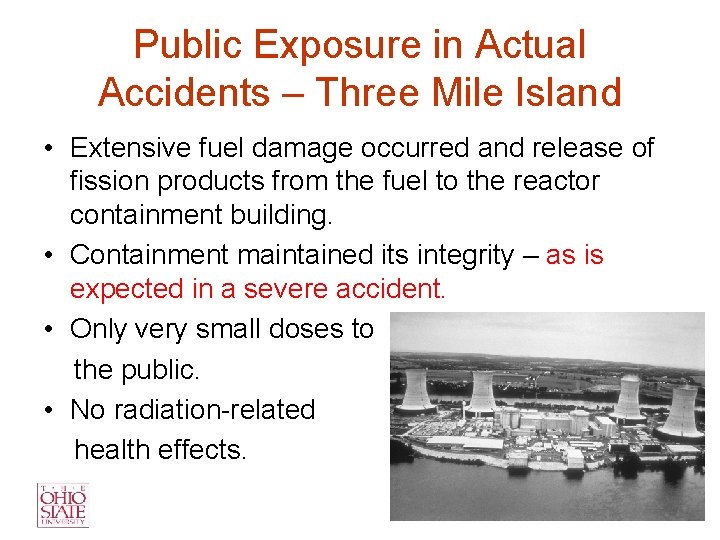
Public Exposure in Actual Accidents – Three Mile Island • Extensive fuel damage occurred and release of fission products from the fuel to the reactor containment building. • Containment maintained its integrity – as is expected in a severe accident. • Only very small doses to the public. • No radiation-related health effects.
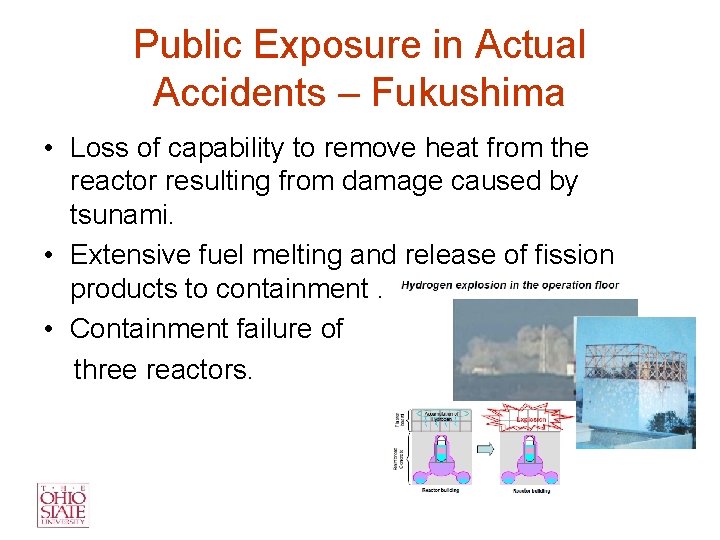
Public Exposure in Actual Accidents – Fukushima • Loss of capability to remove heat from the reactor resulting from damage caused by tsunami. • Extensive fuel melting and release of fission products to containment. • Containment failure of three reactors.
Public Exposure in Actual Accidents – Fukushima • Substantial release of fission products but much less than at Chernobyl. • Contamination of a large area and the need to relocate a large number of people. • However, the maximum actual exposures will be similar to background radiation. – No member of the public has received or is likely to receive a dose that would significantly increase their likelihood of incurring cancer. – Confirmed by WHO and UNSCEAR.
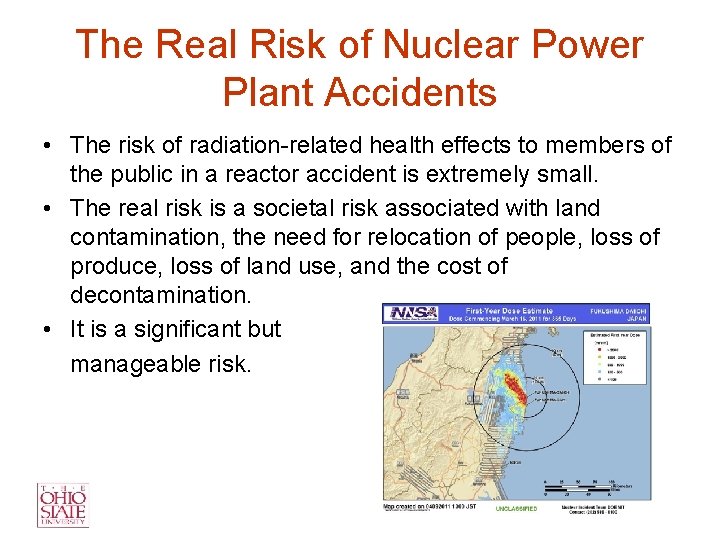
The Real Risk of Nuclear Power Plant Accidents • The risk of radiation-related health effects to members of the public in a reactor accident is extremely small. • The real risk is a societal risk associated with land contamination, the need for relocation of people, loss of produce, loss of land use, and the cost of decontamination. • It is a significant but manageable risk.
Why Bother? • Why accept any risk? Why don’t we just use a safe alternative? • All forms of energy generation have associated health risks: mining deaths, drilling deaths, natural gas explosions, respiratory deaths. – Must consider the entire life cycle: mining (drilling), transportation, operations, waste disposal. • Per unit of energy produced, nuclear energy is the safest mode of energy production.
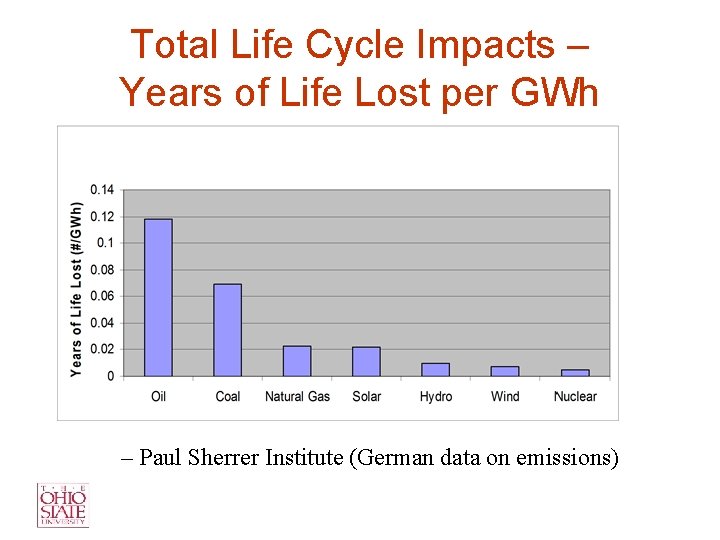
Total Life Cycle Impacts – Years of Life Lost per GWh – Paul Sherrer Institute (German data on emissions)
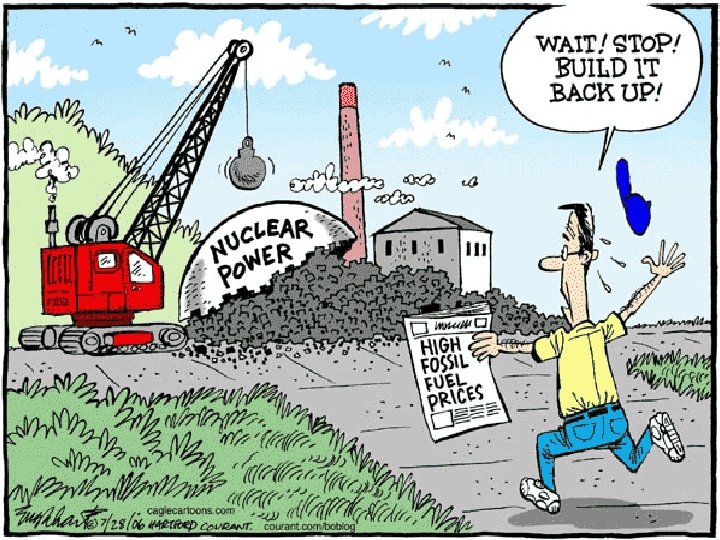
The Need • Within the lifespan of the children that we teach, the world will face four converging crises: global warming, inadequate fresh water supply, loss of arable land (and food supply), and the need to replace fossil fuels as an energy source. • Renewables will only be capable of satisfying a fraction of the total energy need. • Nuclear must be a major component of the energy mix.
31

Backup Slides
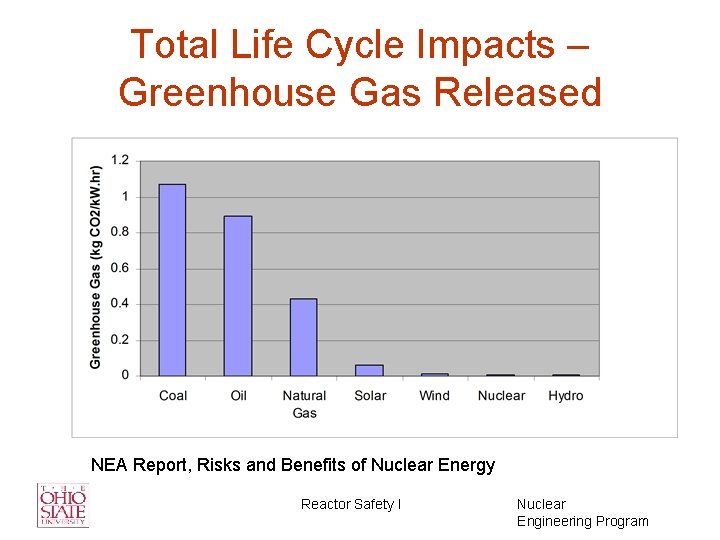
Total Life Cycle Impacts – Greenhouse Gas Released NEA Report, Risks and Benefits of Nuclear Energy Reactor Safety I Nuclear Engineering Program
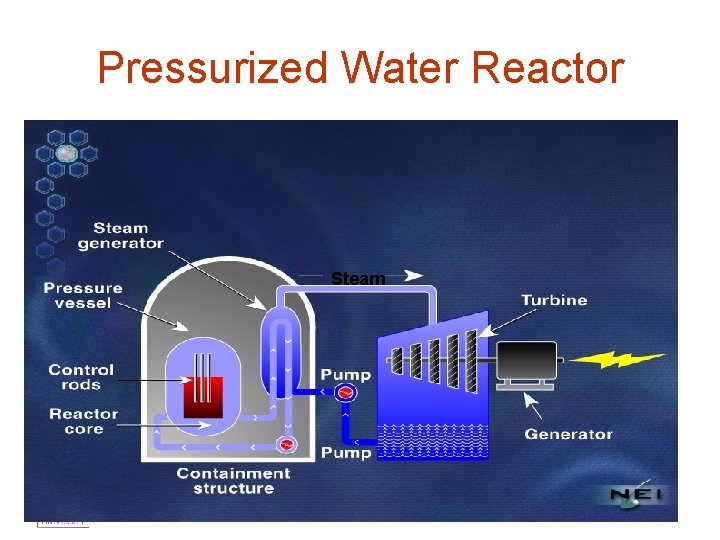
Pressurized Water Reactor Steam
- Slides: 34