
Understanding Retention and Attrition of Special Education Teachers




![large numbers of special education teachers approaching retirement, [? ? show most recent graph]](https://slidetodoc.com/presentation_image/51a4a6a35d2ee61cb601021550218aff/image-10.jpg "large numbers of special education teachers approaching retirement, [? ? show most recent graph]")




- Slides: 29
Understanding Retention and Attrition of Special Education Teachers in Nevada Through a Longititudinal Study:
Each fall 100 s of new special education teachers enter Nevada schools but by June, 19% have given up being a teacher. • This session will explore the large exodus of special education teachers through a longititudinal study. • The first part will be a discussion of findings, some solutions, and implications for policy changes. • The second part will explain how Nevada repurposed existing data creating a database for studying teacher attrition that can be replicated in other states.
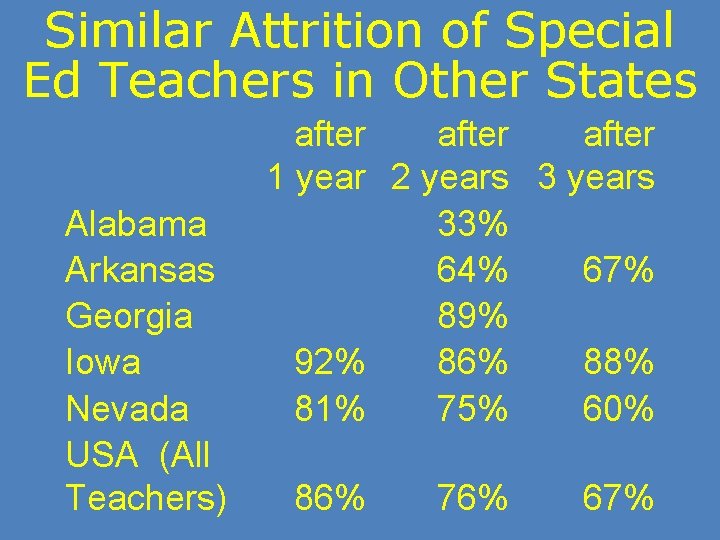
Large Numbers of Special Ed Teachers Give up the Classroom • Only 60% of Nevada special education teachers remain teaching after the first three years • Explore reasons behind the high attrition • Many of these findings have implications for policy changes – At the state level – At the federal level
Similar Attrition of Special Ed Teachers in Other States Alabama Arkansas Georgia Iowa Nevada USA (All Teachers) after 1 year 2 years 33% 64% 67% 89% 92% 86% 88% 81% 75% 60% 86% 76% 67%
Large Problem of Teachers Leaving the Classroom after They: • • earned degrees in chosen field Invested several years in college Spent tens of thousands of dollars Only to find that they did not want to teach in special education
Longitudinal Study of Special Education Teachers • Taught from 1997 through 2010 • Identify trends over time • Answered many questions • But created a whole new set of questions as we came to understand attrition of special education teachers
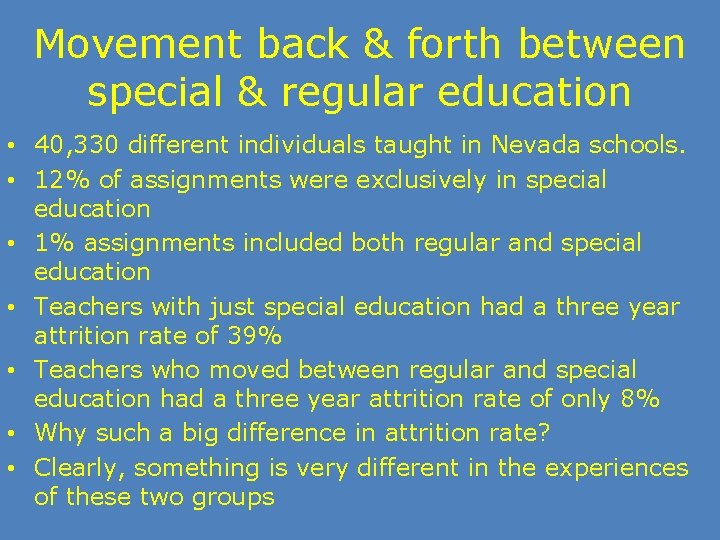
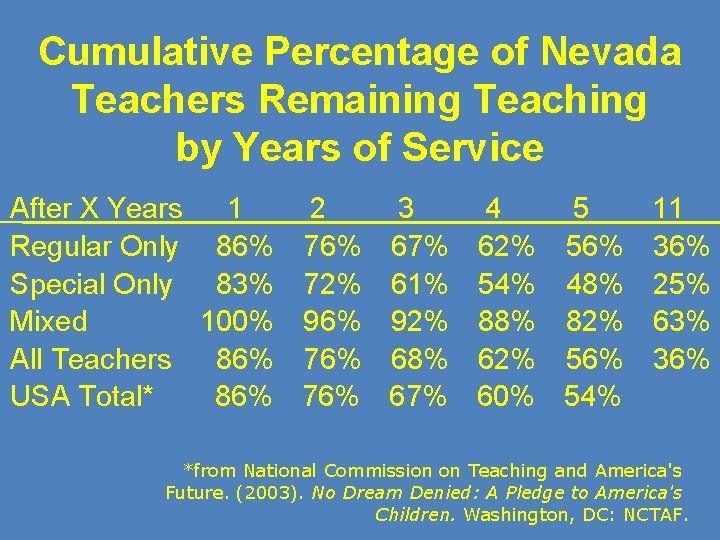
Movement back & forth between special & regular education • 40, 330 different individuals taught in Nevada schools. • 12% of assignments were exclusively in special education • 1% assignments included both regular and special education • Teachers with just special education had a three year attrition rate of 39% • Teachers who moved between regular and special education had a three year attrition rate of only 8% • Why such a big difference in attrition rate? • Clearly, something is very different in the experiences of these two groups
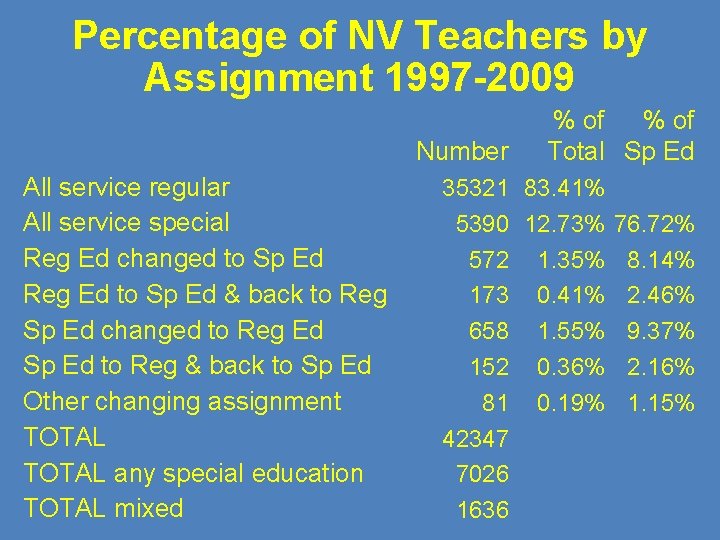
Percentage of NV Teachers by Assignment 1997 -2009 Number All service regular All service special Reg Ed changed to Sp Ed Reg Ed to Sp Ed & back to Reg Sp Ed changed to Reg Ed Sp Ed to Reg & back to Sp Ed Other changing assignment TOTAL any special education TOTAL mixed % of Total Sp Ed 35321 83. 41% 5390 12. 73% 76. 72% 572 1. 35% 8. 14% 173 0. 41% 2. 46% 658 1. 55% 9. 37% 152 0. 36% 2. 16% 81 42347 7026 1636 0. 19% 1. 15%
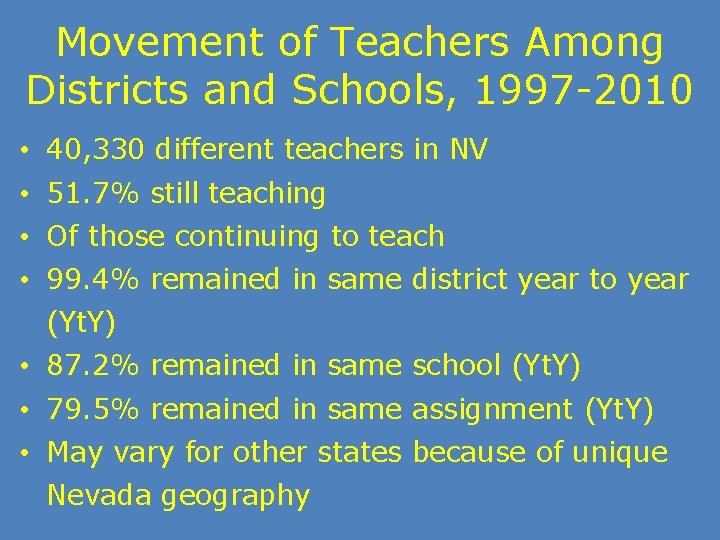
Movement of Teachers Among Districts and Schools, 1997 -2010 • 40, 330 different teachers in NV • 51. 7% still teaching • Of those continuing to teach • 99. 4% remained in same district year to year (Yt. Y) • 87. 2% remained in same school (Yt. Y) • 79. 5% remained in same assignment (Yt. Y) • May vary for other states because of unique Nevada geography
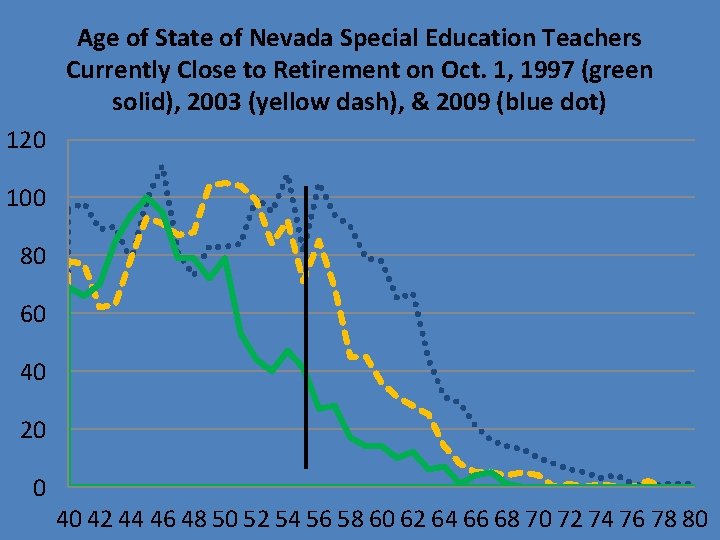
large numbers of special education teachers approaching retirement, [? ? show most recent graph]
Age of State of Nevada Special Education Teachers Currently Close to Retirement on Oct. 1, 1997 (green solid), 2003 (yellow dash), & 2009 (blue dot) 120 100 80 60 40 20 0 40 42 44 46 48 50 52 54 56 58 60 62 64 66 68 70 72 74 76 78 80
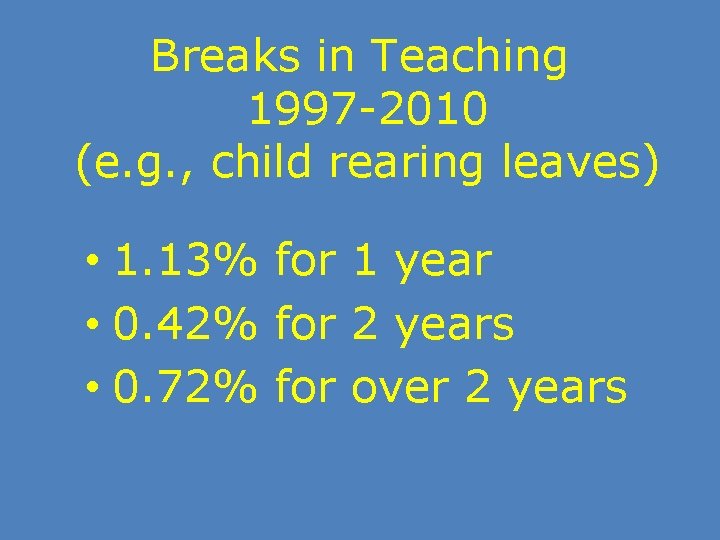
Breaks in Teaching 1997 -2010 (e. g. , child rearing leaves) • 1. 13% for 1 year • 0. 42% for 2 years • 0. 72% for over 2 years
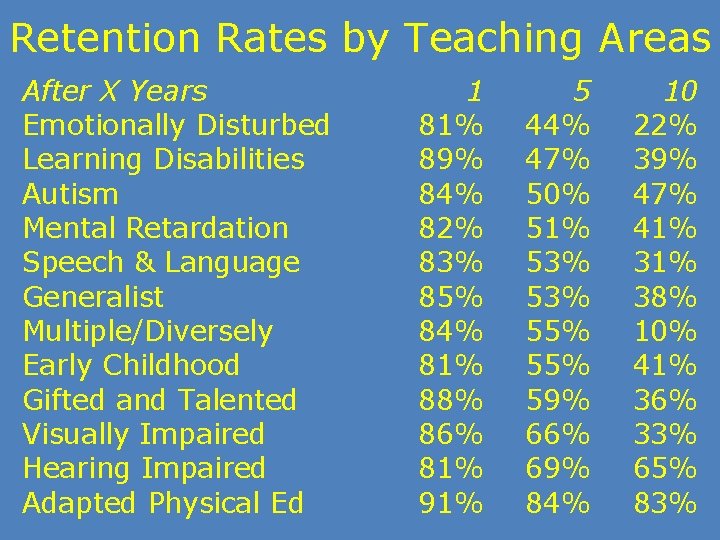
Retention Rates by Teaching Areas After X Years Emotionally Disturbed Learning Disabilities Autism Mental Retardation Speech & Language Generalist Multiple/Diversely Early Childhood Gifted and Talented Visually Impaired Hearing Impaired Adapted Physical Ed 1 81% 89% 84% 82% 83% 85% 84% 81% 88% 86% 81% 91% 5 44% 47% 50% 51% 53% 55% 59% 66% 69% 84% 10 22% 39% 47% 41% 38% 10% 41% 36% 33% 65% 83%
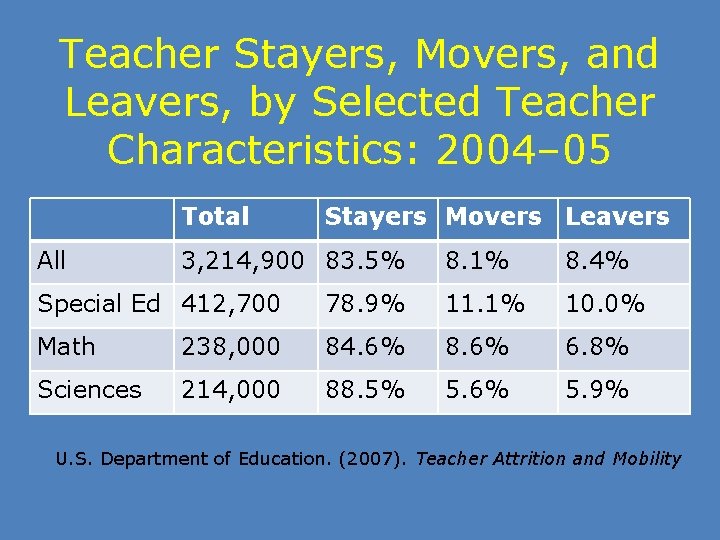
Teacher Stayers, Movers, and Leavers, by Selected Teacher Characteristics: 2004– 05 Total All Stayers Movers Leavers 3, 214, 900 83. 5% 8. 1% 8. 4% Special Ed 412, 700 78. 9% 11. 1% 10. 0% Math 238, 000 84. 6% 8. 6% 6. 8% Sciences 214, 000 88. 5% 5. 6% 5. 9% U. S. Department of Education. (2007). Teacher Attrition and Mobility
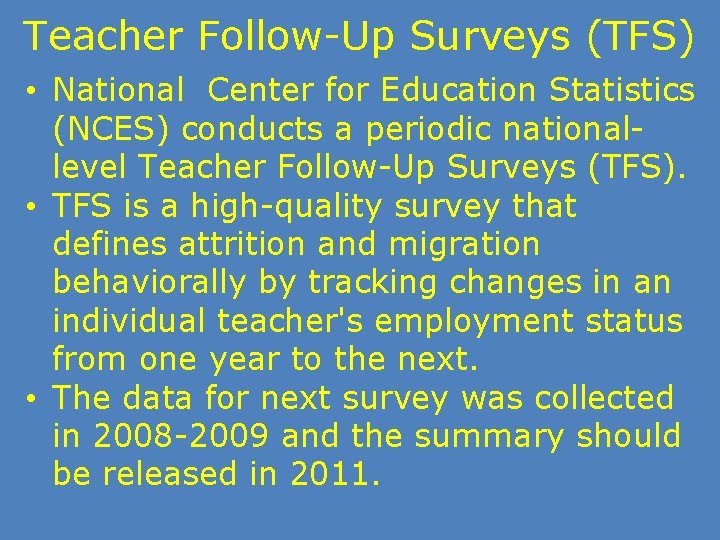
Teacher Follow-Up Surveys (TFS) • National Center for Education Statistics (NCES) conducts a periodic nationallevel Teacher Follow-Up Surveys (TFS). • TFS is a high-quality survey that defines attrition and migration behaviorally by tracking changes in an individual teacher's employment status from one year to the next. • The data for next survey was collected in 2008 -2009 and the summary should be released in 2011.
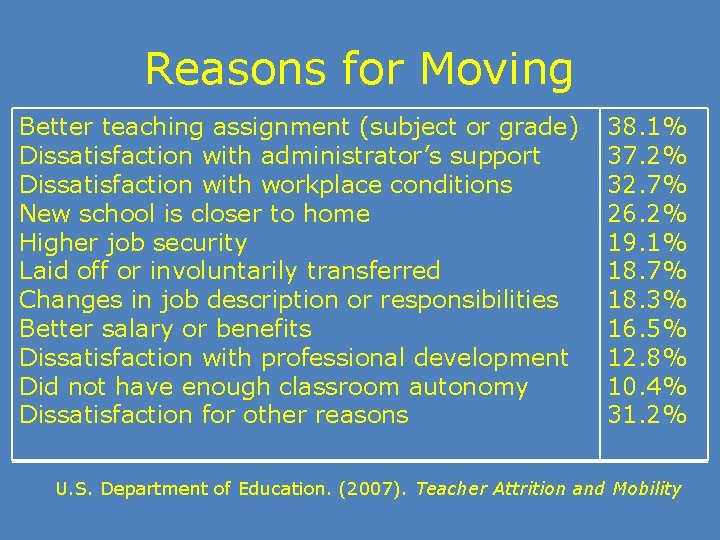
Reasons for Moving Better teaching assignment (subject or grade) Dissatisfaction with administrator’s support Dissatisfaction with workplace conditions New school is closer to home Higher job security Laid off or involuntarily transferred Changes in job description or responsibilities Better salary or benefits Dissatisfaction with professional development Did not have enough classroom autonomy Dissatisfaction for other reasons 38. 1% 37. 2% 32. 7% 26. 2% 19. 1% 18. 7% 18. 3% 16. 5% 12. 8% 10. 4% 31. 2% U. S. Department of Education. (2007). Teacher Attrition and Mobility
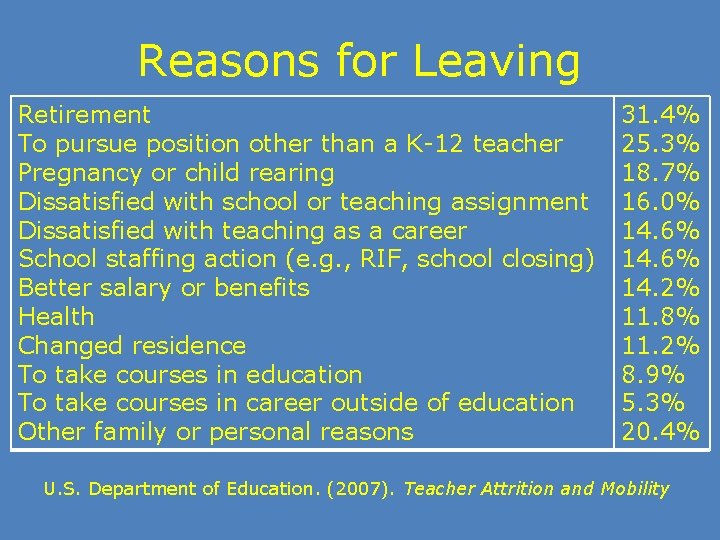
Reasons for Leaving Retirement To pursue position other than a K-12 teacher Pregnancy or child rearing Dissatisfied with school or teaching assignment Dissatisfied with teaching as a career School staffing action (e. g. , RIF, school closing) Better salary or benefits Health Changed residence To take courses in education To take courses in career outside of education Other family or personal reasons 31. 4% 25. 3% 18. 7% 16. 0% 14. 6% 14. 2% 11. 8% 11. 2% 8. 9% 5. 3% 20. 4% U. S. Department of Education. (2007). Teacher Attrition and Mobility
The second part of the presentation will deal with the process used to collect and analyze the data. • Although each state will be different, the basic process used in Nevada can be generalized to other states.
NCLB • Data pulled directly from the NV teacher assignment database • Used for NCLB reporting purposes • Highly Qualified Teachers: To be deemed highly qualified, teachers must have: – 1) a bachelor's degree – 2) full state certification – 3) prove that they know each subject they teach
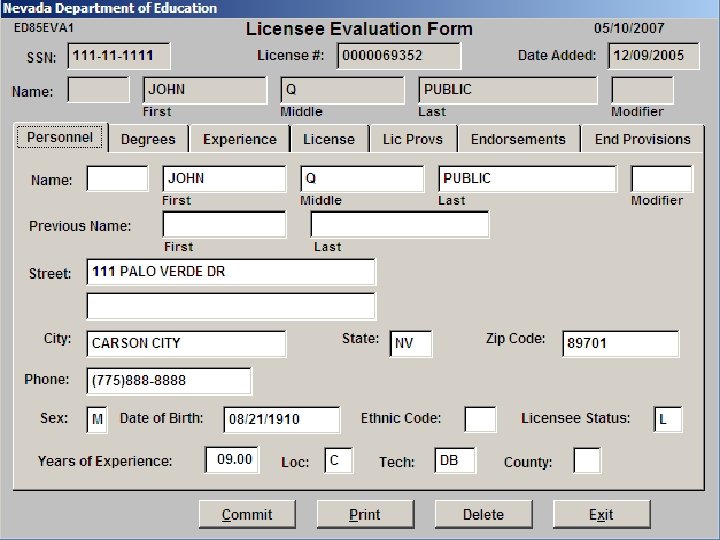
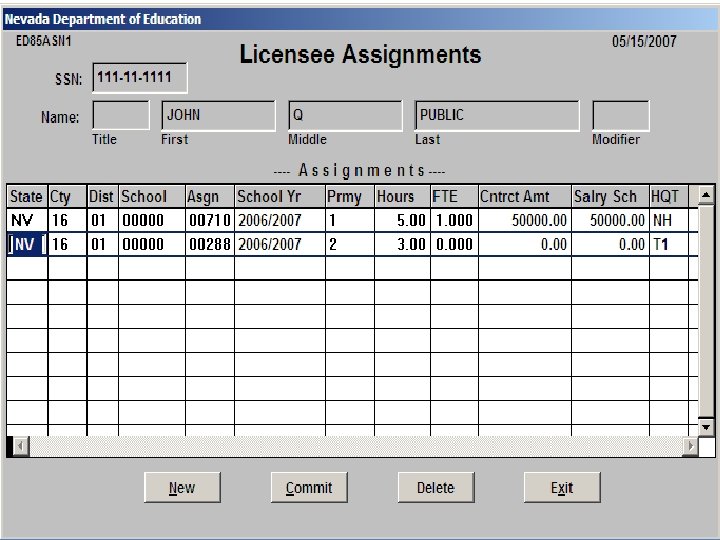
Highly Qualified Teachers • Since every state must file these reports, there should be a similar database within each state. • The original Nevada database is organized on a year-by-year basis showing: – Classes/courses taught by each teacher – demographic information such as • Age • Certifications held – Class information such as • school, • grade • district – Assignments collected in October
• Insert screen shot of teacher info for one year
For Analysis of Retention and Attrition • Data were repurposed • Show each teacher's career – From 1997 through 2010 – Classes taught each year – Started Teaching – When they left Teaching. • The data also show a variety of other factors such as – Teacher movement between districts and schools, – Extended absences or leaves (e. g. , child rearing), – Changing assignments particularly between special and regular education.
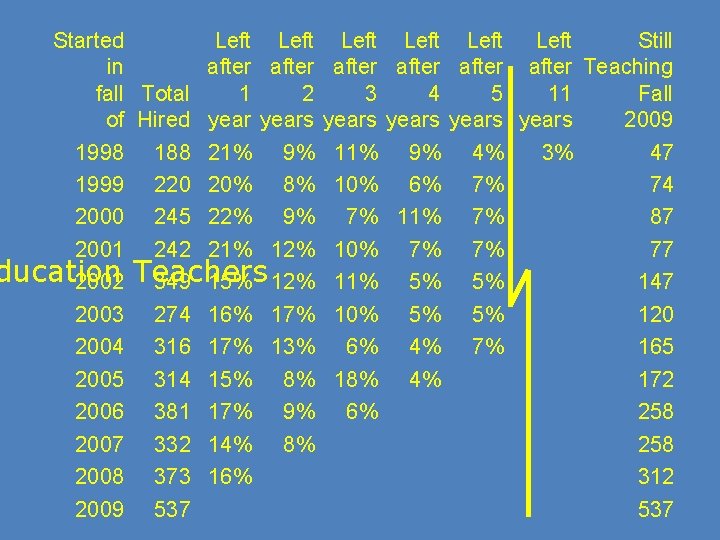
Started Left Left Still in after after Teaching fall Total 1 2 3 4 5 11 Fall of Hired years years 2009 1998 188 21% 9% 11% 9% 4% 3% 47 1999 220 20% 8% 10% 6% 7% 74 2000 245 22% 9% 7% 11% 7% 87 2001 242 21% 12% 10% 7% 7% 77 ducation 2002 Teachers 349 15% 12% 11% 5% 5% 147 2003 274 16% 17% 10% 5% 5% 120 2004 316 17% 13% 6% 4% 7% 165 2005 314 15% 8% 18% 4% 172 2006 381 17% 9% 6% 258 2007 332 14% 8% 258 2008 373 16% 312 2009 537
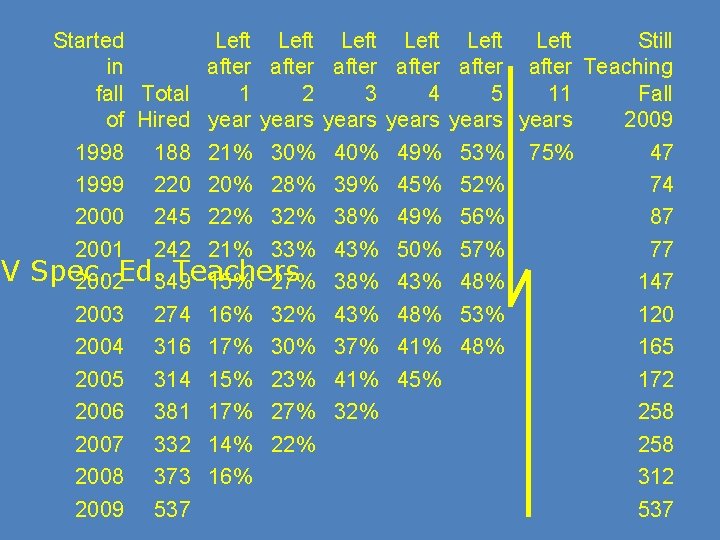
NV Started Left in after fall Total 1 2 of Hired years 1998 188 21% 30% 1999 220 20% 28% 2000 245 22% 32% 2001 242 21% 33% Spec. Teachers 2002 Ed. 349 15% 27% 2003 274 16% 32% 2004 316 17% 30% 2005 314 15% 23% 2006 381 17% 2007 332 14% 22% 2008 373 16% 2009 537 Left after 3 years 40% 39% 38% 43% 37% 41% 32% Left after 4 years 49% 45% 49% 50% 43% 48% 41% 45% Left Still after Teaching 5 11 Fall years 2009 53% 75% 47 52% 74 56% 87 57% 77 48% 147 53% 120 48% 165 172 258 312 537
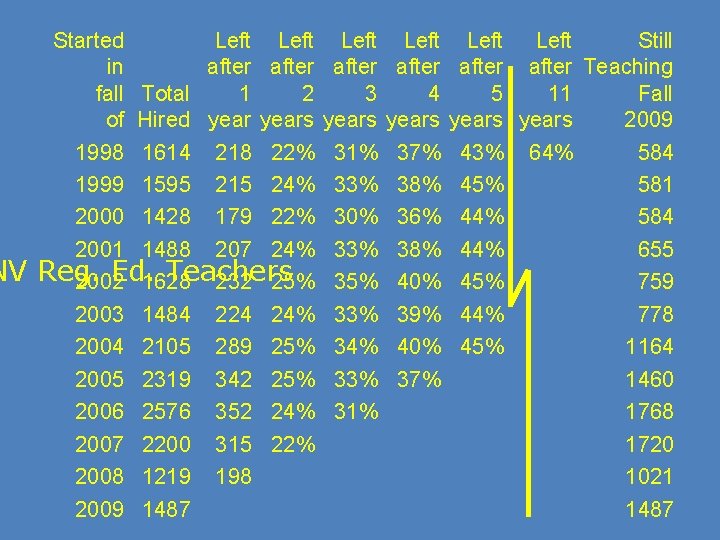
NV Started Left in after fall Total 1 2 of Hired years 1998 1614 218 22% 1999 1595 215 24% 2000 1428 179 22% 2001 1488 207 24% Reg. Ed. Teachers 2002 1628 232 25% 2003 1484 224 24% 2004 2105 289 25% 2005 2319 342 25% 2006 2576 352 24% 2007 2200 315 22% 2008 1219 198 2009 1487 Left after 3 years 31% 33% 30% 33% 35% 33% 34% 33% 31% Left after 4 years 37% 38% 36% 38% 40% 39% 40% 37% Left Still after Teaching 5 11 Fall years 2009 43% 64% 584 45% 581 44% 584 44% 655 45% 759 44% 778 45% 1164 1460 1768 1720 1021 1487
Cumulative Percentage of Nevada Teachers Remaining Teaching by Years of Service After X Years 1 2 3 4 5 11 Regular Only 86% 76% 67% 62% 56% 36% Special Only 83% 72% 61% 54% 48% 25% Mixed 100% 96% 92% 88% 82% 63% All Teachers 86% 76% 68% 62% 56% 36% USA Total* 86% 76% 67% 60% 54% *from National Commission on Teaching and America's Future. (2003). No Dream Denied: A Pledge to America's Children. Washington, DC: NCTAF.
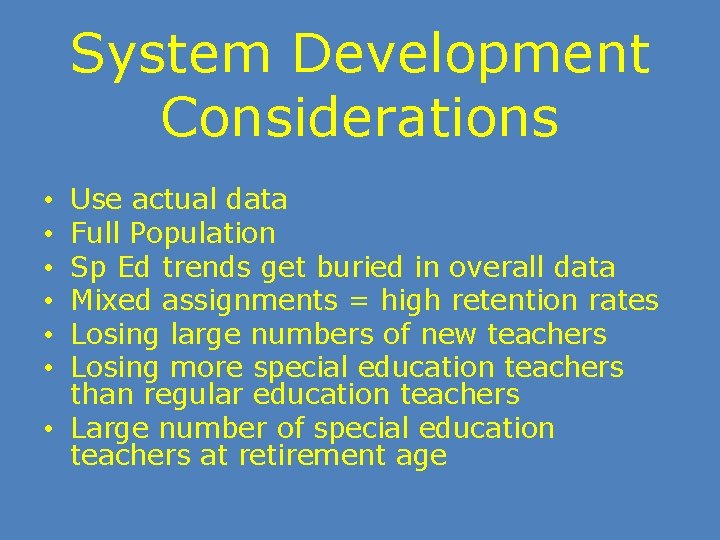
System Development Considerations Use actual data Full Population Sp Ed trends get buried in overall data Mixed assignments = high retention rates Losing large numbers of new teachers Losing more special education teachers than regular education teachers • Large number of special education teachers at retirement age • • •
References National Commission on Teaching and America's Future. (2003). No Dream Denied: A Pledge to America's Children. Washington, DC: NCTAF U. S. Department of Education, National Center for Education Statistics, Institute of Education Sciences. (2007). Teacher Attrition and Mobility: Results from the 2004 -05 Teacher Follow-up Survey. Washington, DC: U. S. Department of Education.