
Understanding Resource Conversion Professor Fernando Diz Readings Modern

- Slides: 28
Understanding Resource Conversion Professor Fernando Diz
Readings • Modern Security Analysis: Principles and Technique by Martin J. Whitman and Fernando Diz, Wiley 2013. (MSA) 1. MSA Chapter 22, 2. https: //moiglobal. com/what-we-mean-by-resource-conversion/ , 3. This handout.
Arbitrage and resource conversion • Arbitrage is the practice of taking advantage of a price/value difference for the same or related asset in two markets and structuring an operation to profit from the difference. • Resource conversion is a general term describing an operation involving the conversion of assets to other uses, financing and/or control, or any combination of those, that is triggered by an arbitrage opportunity, and it is designed to profit from it. • Resource conversion is the operation set in motion to profit from an arbitrage opportunity.
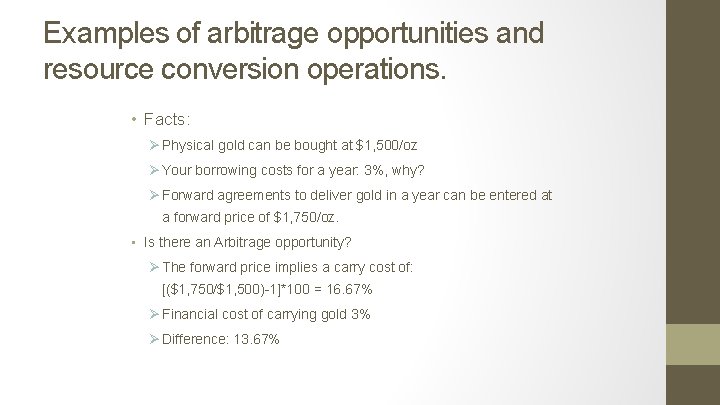
Examples of arbitrage opportunities and resource conversion operations. • Facts: Ø Physical gold can be bought at $1, 500/oz Ø Your borrowing costs for a year: 3%, why? Ø Forward agreements to deliver gold in a year can be entered at a forward price of $1, 750/oz. • Is there an Arbitrage opportunity? Ø The forward price implies a carry cost of: [($1, 750/$1, 500)-1]*100 = 16. 67% Ø Financial cost of carrying gold 3% Ø Difference: 13. 67%
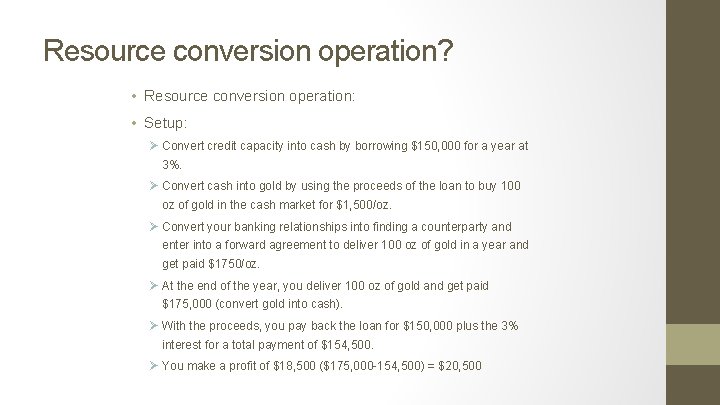
Resource conversion operation? • Resource conversion operation: • Setup: Ø Convert credit capacity into cash by borrowing $150, 000 for a year at 3%. Ø Convert cash into gold by using the proceeds of the loan to buy 100 oz of gold in the cash market for $1, 500/oz. Ø Convert your banking relationships into finding a counterparty and enter into a forward agreement to deliver 100 oz of gold in a year and get paid $1750/oz. Ø At the end of the year, you deliver 100 oz of gold and get paid $175, 000 (convert gold into cash). Ø With the proceeds, you pay back the loan for $150, 000 plus the 3% interest for a total payment of $154, 500. Ø You make a profit of $18, 500 ($175, 000 -154, 500) = $20, 500
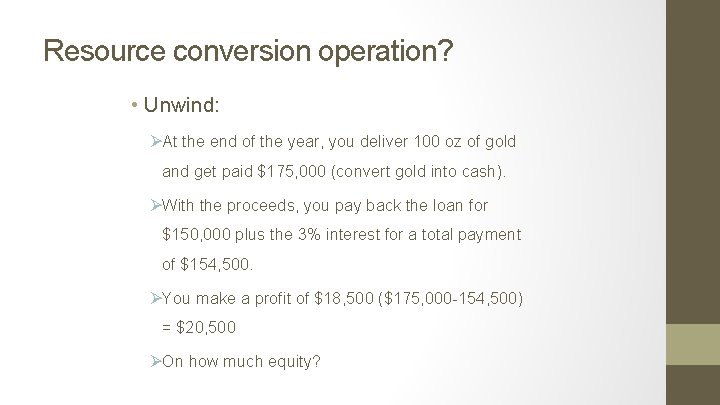
Resource conversion operation? • Unwind: ØAt the end of the year, you deliver 100 oz of gold and get paid $175, 000 (convert gold into cash). ØWith the proceeds, you pay back the loan for $150, 000 plus the 3% interest for a total payment of $154, 500. ØYou make a profit of $18, 500 ($175, 000 -154, 500) = $20, 500 ØOn how much equity?
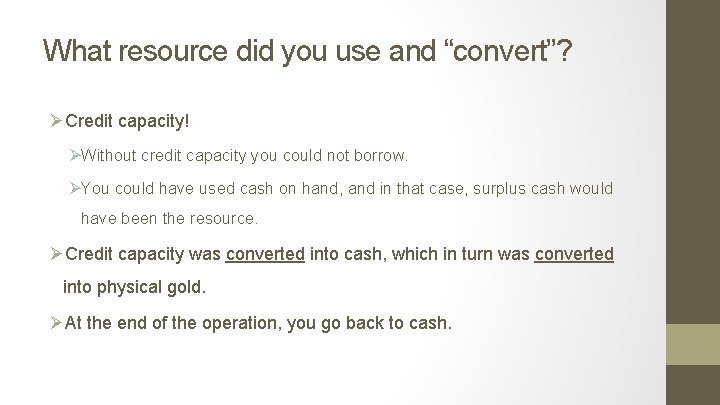
What resource did you use and “convert”? ØCredit capacity! ØWithout credit capacity you could not borrow. ØYou could have used cash on hand, and in that case, surplus cash would have been the resource. ØCredit capacity was converted into cash, which in turn was converted into physical gold. ØAt the end of the operation, you go back to cash.
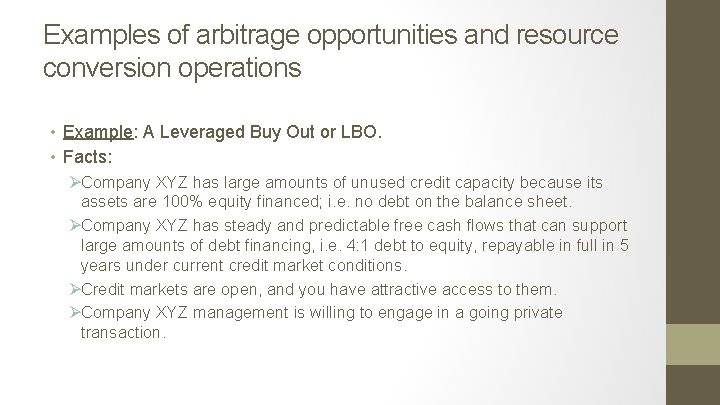
Examples of arbitrage opportunities and resource conversion operations • Example: A Leveraged Buy Out or LBO. • Facts: ØCompany XYZ has large amounts of unused credit capacity because its assets are 100% equity financed; i. e. no debt on the balance sheet. ØCompany XYZ has steady and predictable free cash flows that can support large amounts of debt financing, i. e. 4: 1 debt to equity, repayable in full in 5 years under current credit market conditions. ØCredit markets are open, and you have attractive access to them. ØCompany XYZ management is willing to engage in a going private transaction.
Examples of arbitrage opportunities and resource conversion operations • Arbitrage? • I could grow $1 of equity into $5 of equity in 5 years through the paydown of debt alone. • This represents +- 38% per year IRR • So, in the public market a common stock purchase yields an uncertain IRR in 5 years but in the private market, through an LBO transaction, a 38% IRR. • What is this?
What resources do I use and “convert”? • Resource conversion operation: • Convert credit capacity of Company XYZ into a bridge loan to financial sponsor: YOU. Odd, right? • Convert established banking relationships into bridge loan and eventual conversion into a Company XYZ loan/s • Convert public equity into private equity through a tender offer for all public equity and delisting from exchange. • Convert publicly controlled company into privately controlled company through a sale type transaction followed with a merger transaction.
Activists and control people look at two markets for arbitrage opportunities ØOPMI (outside passive minority investor) market, which measures the prices at which outsiders trade common stocks. ØMarket for control of businesses, which reflects the value of businesses.
How do the prices or values compare in these two markets? • It is safe to say that the value of control of a business would be different than the prices paid for common stocks in the open markets by OPMIs. • Game. Stop comes to mind:
How do these prices or values compare? ØControl people may conclude that the market prices for common stocks are materially below the values of the business. Gamestop? • In that event, purchasing common stock is like a means of acquiring assets at a fraction of their value. ØInsiders, promoters, or companies themselves seek to acquire common stocks at prices that represent some differential between the values being ascribed in the non-control OPMI market and the value of the business. See Mike Burry or Ryan Cohen letters to GME Board on Web site.
How do the prices or values compare in these two markets? • OPMI prices at which GME stock trades in December 2020 is between $13 -$16. • Is the control value of the company greater or lower than these OPMI prices? • Why?
How do these prices or values compare? ØFrequently, the value of control of a business would be below the market price of its common stock. Tesla? Game. Stop in January 2021? • In that instance, common stock is like overvalued currency. ØThe resource conversion activity triggered is that an activist would seek to: • Either sell common stocks owned personally, and/or • Have the controlled company sell new common stock; i. e. new issues or new securities in merger, acquisition or follow-on transactions.
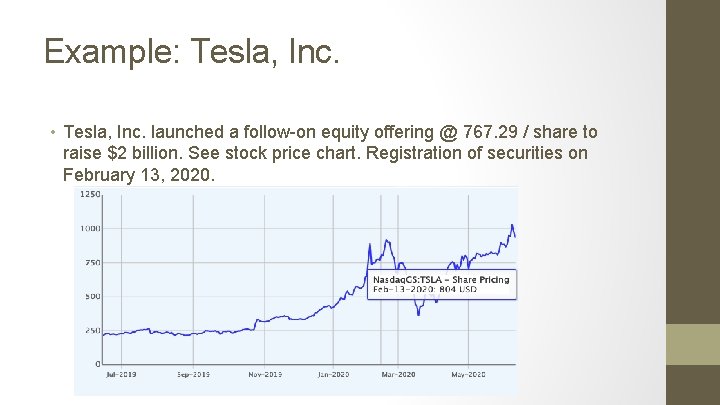
Example: Tesla, Inc. • Tesla, Inc. launched a follow-on equity offering @ 767. 29 / share to raise $2 billion. See stock price chart. Registration of securities on February 13, 2020.
Long-term arbitrage between OPMI prices and control values • That valuations ordinarily should be different between these two markets seems obvious. Why? • Because valuing businesses is different from predicting stock prices in the near-future. What do you think creates a bias towards the second activity?
What creates this long-term arbitrage? ØDisparities between prices in the OPMI markets and control values create arbitrage opportunities. ØThese arbitrage opportunities create the impetus for “resource conversion activity” to profit from these disparities. ØWho takes advantage of these opportunities? : Control players.
Resource conversion valuation: what does it involve? ØInvolves the: üIdentification of the various resource conversion operations that could unlock value not reflected in stock prices. ØThis type of valuation is totally unrelated to the forecasting of stock prices in the near-future. ØIt requires a much broader knowledge of a company as well as insight into the situations that would give rise to those opportunities.
Examples of RESOURCES that can be converted in a RC operation ØLarge amount of unused credit capacity or cash: • Allows management to be opportunistic: eg. Berkshire Hathaway was able to make very profitable investments in Goldman Sachs and General Electric during the 2008 crisis. • Controlling shareholder of Colombian company Exito, could use its Subsidiary credit capacity to raise capital AND expand Exito’s control in Latin America. • Potential for taking a company private in an MBO or LBO utilizing the company’s credit capacity.
Examples of RESOURCES that can be converted in a RC operation ØTax assets that cannot be used by the company • Investment tax credits in excess of offsetting income or inability of the company to take advantage of the tax credits. This, combined with unused credit capacity gave rise to the Trans. Union transaction. • Net Operating Losses that could be used in a transaction, Liberty Media and Sirius.
Examples of RESOURCES that can be converted in a RC operation ØUnderperforming segments that are obscuring good performance • Bloated corporate segment (Xerox) • Unprofitable and inefficient segment (Motorola) • Hidden gems (Toys. RUs, hiding profitable segments by pooling their results with segments with much better performance) • Potential sale of division, spinoff or splitoff.
Examples of RESOURCES that can be converted in a RC operation ØOwned and very valuable real estate that can be put to: • A different use • Different financing (sale-lease back) • Different ownership and control
Examples of RESOURCES that can be converted in a RC operation • Separate and salable assets: • Corporate jets • Real estate that is not needed for the going concern
Examples of RESOURCES that can be converted in a RC operation ØUnsuccessful acquisitions policies: • Break up the company in its independent pieces
Examples of RESOURCES that can be converted in a RC operation ØRestructurings that cannot be done unless in Chapter 11: • Restructuring of pension obligations • Restructuring of lease portfolio
Examples of RESOURCES that can be converted in a RC operation ØIncompetent or overly entrenched management not willing to embark in resource conversion activities: • Fight to remake control of the Board. GME?