
UNDERSTANDING RESEARCH RESULTS STATISTICAL INFERENCE 2012 The Mc
- Slides: 23
UNDERSTANDING RESEARCH RESULTS: STATISTICAL INFERENCE © 2012 The Mc. Graw-Hill Companies, Inc.
ü ü ü Explain how researchers use inferential statistics to evaluate sample data Distinguish between the null hypothesis and the research hypothesis Discuss probability in statistical inference, including the meaning of statistical significance © 2012 The Mc. Graw-Hill Companies, Inc.
ü ü ü Describe the t test, and explain the difference between one-tailed and two-tailed tests Describe the F test, including systematic variance and error variance Distinguish between Type I and Type II errors © 2012 The Mc. Graw-Hill Companies, Inc.
ü ü Discuss the factors that influence the probability of a Type II error Discuss the reasons a researcher may obtain nonsignificant results Define power of a statistical test Describe the criteria for selecting an appropriate statistical test © 2012 The Mc. Graw-Hill Companies, Inc.
ü Inferential statistics are necessary because ü ü ü the results of a given study are based on data obtained from a single sample of researcher participants and Data are not based on an entire population of scores Allows conclusions on the basis of sample data © 2012 The Mc. Graw-Hill Companies, Inc.
ü ü Allow researchers to make inferences about the true differences in populations of scores based on a sample of data from that population Allows that the difference between sample means may reflect random error rather than a real difference © 2012 The Mc. Graw-Hill Companies, Inc.
ü Null Hypothesis ü ü H 0: The means of the populations from which the samples were drawn equal Research Hypothesis ü H 1: The means of the populations from which the samples were drawn equal © 2012 The Mc. Graw-Hill Companies, Inc.
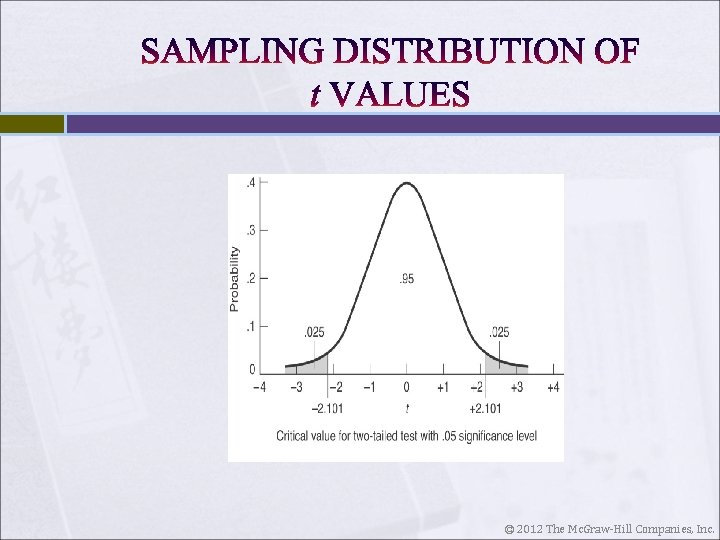
ü Probability: The Case of ESP ü ü ü Are correct answers due to chance or due to something more? Sampling Distributions Sample Size © 2012 The Mc. Graw-Hill Companies, Inc.
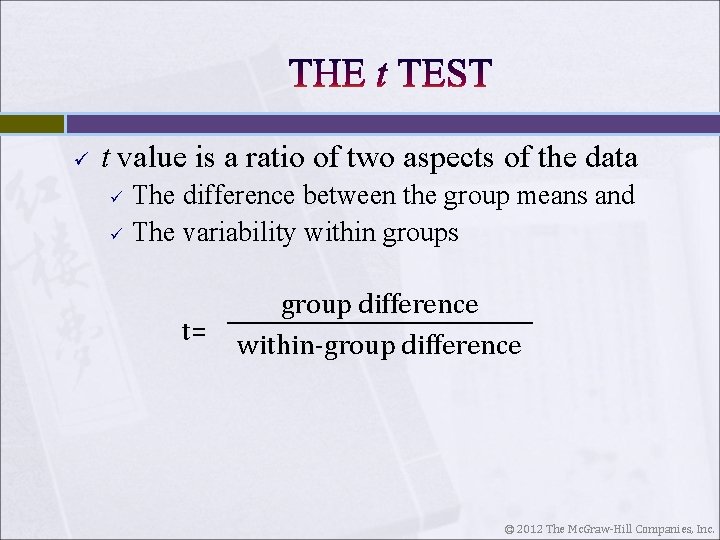
ü t value is a ratio of two aspects of the data ü ü The difference between the group means and The variability within groups t= group difference within-group difference © 2012 The Mc. Graw-Hill Companies, Inc.
© 2012 The Mc. Graw-Hill Companies, Inc.
ü ü Degrees of Freedom One-Tailed Two-Tailed Tests The F Test (analysis of variance) ü ü Systematic variance Error variance © 2012 The Mc. Graw-Hill Companies, Inc.
ü ü ü Calculating Effect Size Confidence Intervals and Statistical Significance © 2012 The Mc. Graw-Hill Companies, Inc.
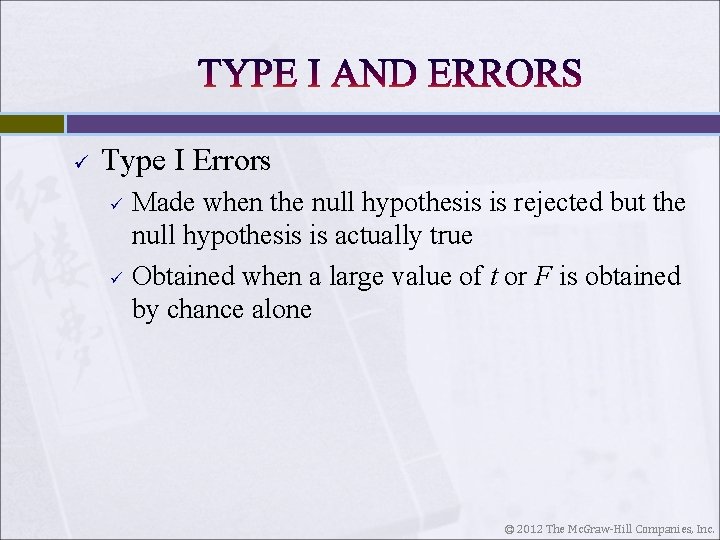
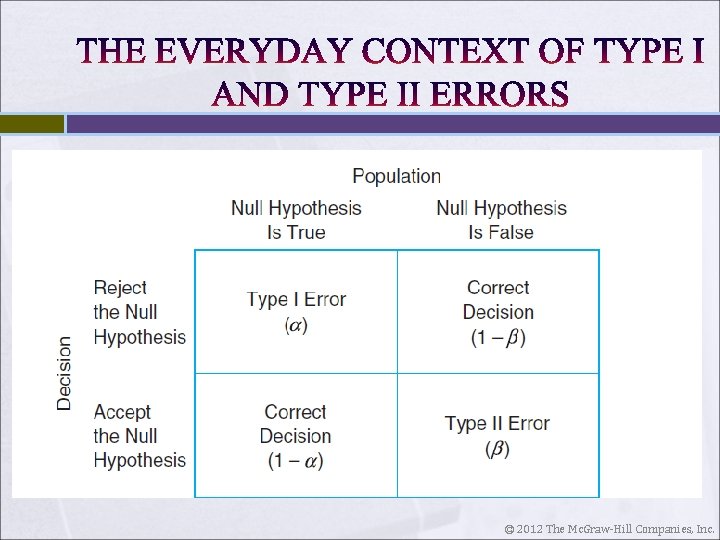
ü Type I Errors ü ü Made when the null hypothesis is rejected but the null hypothesis is actually true Obtained when a large value of t or F is obtained by chance alone © 2012 The Mc. Graw-Hill Companies, Inc.
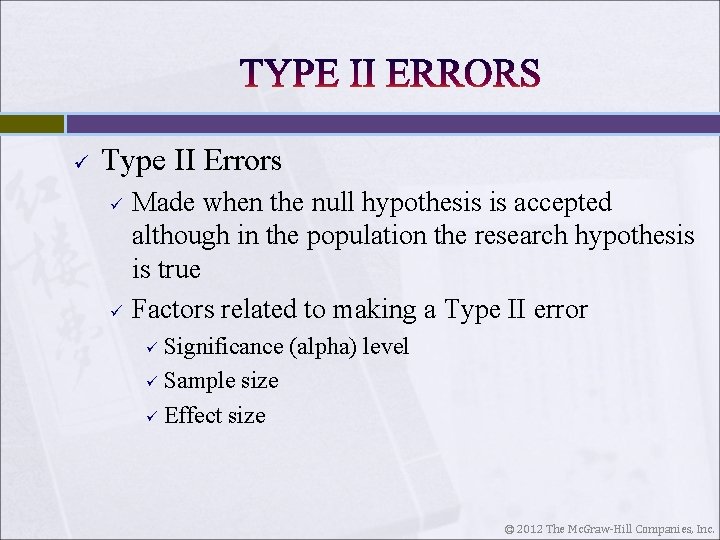
ü Type II Errors ü ü Made when the null hypothesis is accepted although in the population the research hypothesis is true Factors related to making a Type II error Significance (alpha) level ü Sample size ü Effect size ü © 2012 The Mc. Graw-Hill Companies, Inc.
© 2012 The Mc. Graw-Hill Companies, Inc.
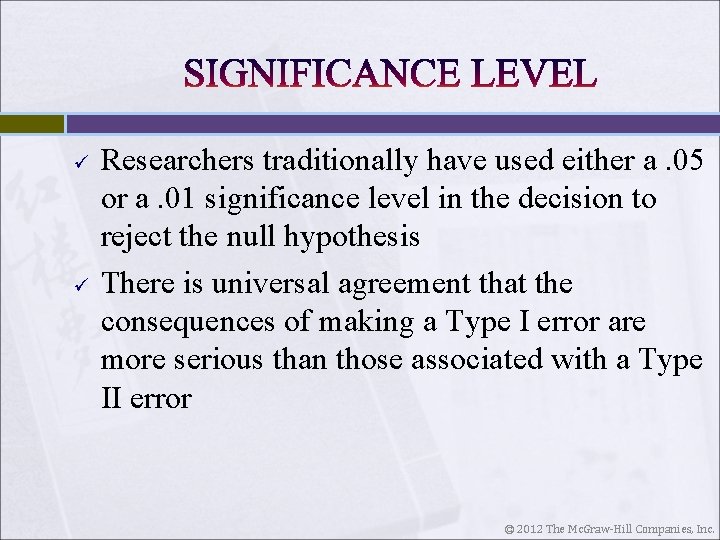
ü ü Researchers traditionally have used either a. 05 or a. 01 significance level in the decision to reject the null hypothesis There is universal agreement that the consequences of making a Type I error are more serious than those associated with a Type II error © 2012 The Mc. Graw-Hill Companies, Inc.
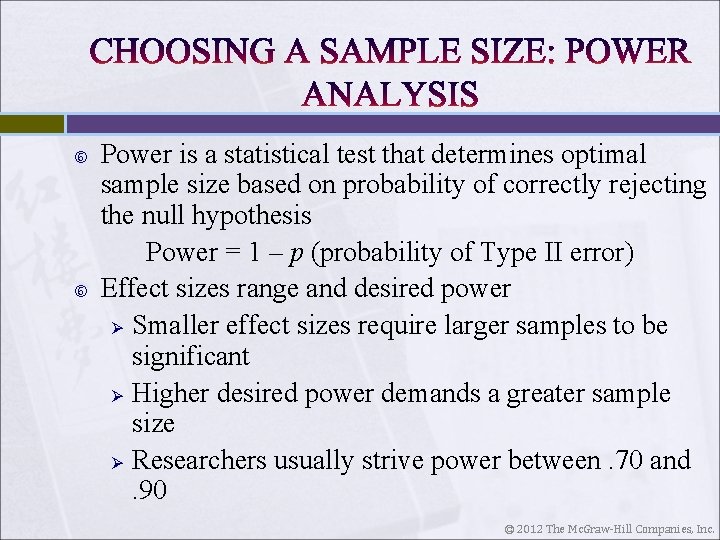
Power is a statistical test that determines optimal sample size based on probability of correctly rejecting the null hypothesis Power = 1 – p (probability of Type II error) Effect sizes range and desired power Ø Smaller effect sizes require larger samples to be significant Ø Higher desired power demands a greater sample size Ø Researchers usually strive power between. 70 and. 90 © 2012 The Mc. Graw-Hill Companies, Inc.
Scientists attach little importance to results of a single study Detailed understanding requires numerous studies examining same variables Researchers look at the results of studies that replicate previous investigations © 2012 The Mc. Graw-Hill Companies, Inc.
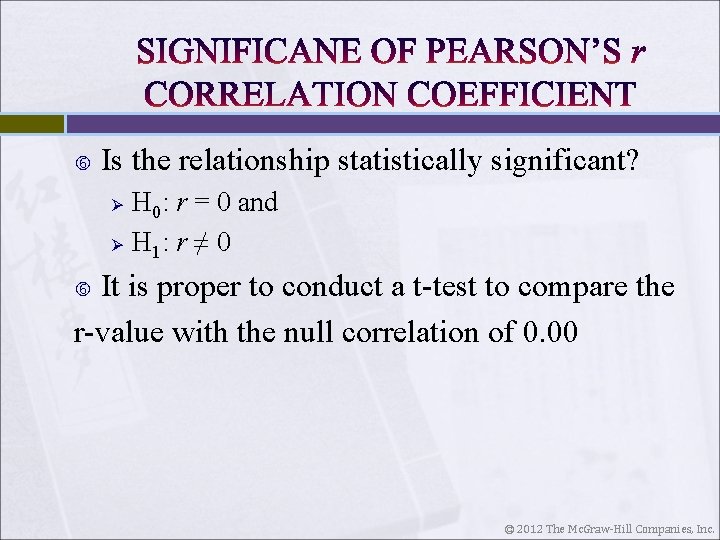
Is the relationship statistically significant? Ø Ø H 0: r = 0 and H 1: r ≠ 0 It is proper to conduct a t-test to compare the r-value with the null correlation of 0. 00 © 2012 The Mc. Graw-Hill Companies, Inc.
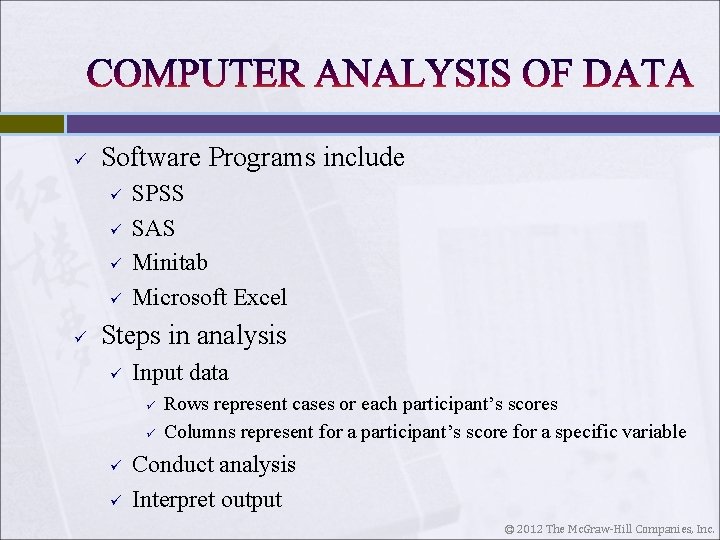
ü Software Programs include ü ü ü SPSS SAS Minitab Microsoft Excel Steps in analysis ü Input data ü ü Rows represent cases or each participant’s scores Columns represent for a participant’s score for a specific variable Conduct analysis Interpret output © 2012 The Mc. Graw-Hill Companies, Inc.
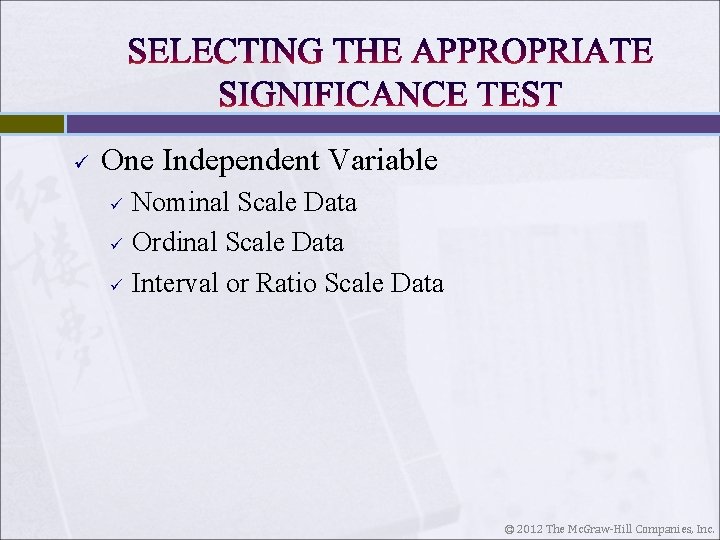
ü One Independent Variable ü ü ü Nominal Scale Data Ordinal Scale Data Interval or Ratio Scale Data © 2012 The Mc. Graw-Hill Companies, Inc.
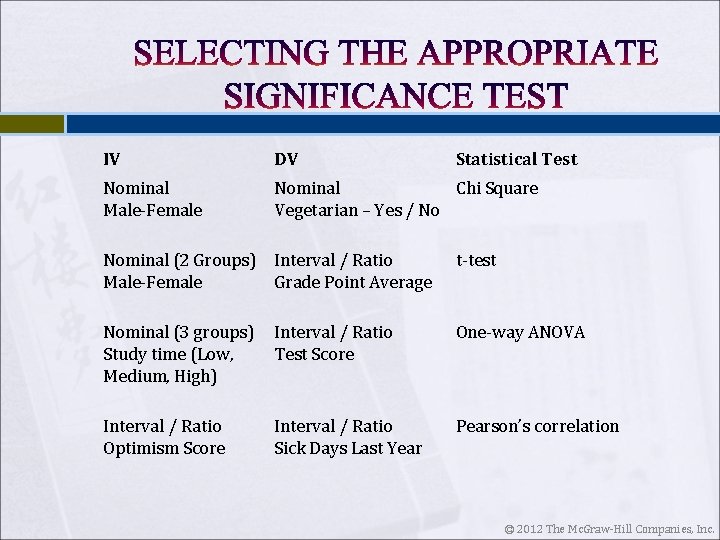
IV DV Statistical Test Nominal Male-Female Nominal Chi Square Vegetarian – Yes / No Nominal (2 Groups) Male-Female Interval / Ratio Grade Point Average t-test Nominal (3 groups) Study time (Low, Medium, High) Interval / Ratio Test Score One-way ANOVA Interval / Ratio Optimism Score Interval / Ratio Sick Days Last Year Pearson’s correlation © 2012 The Mc. Graw-Hill Companies, Inc.
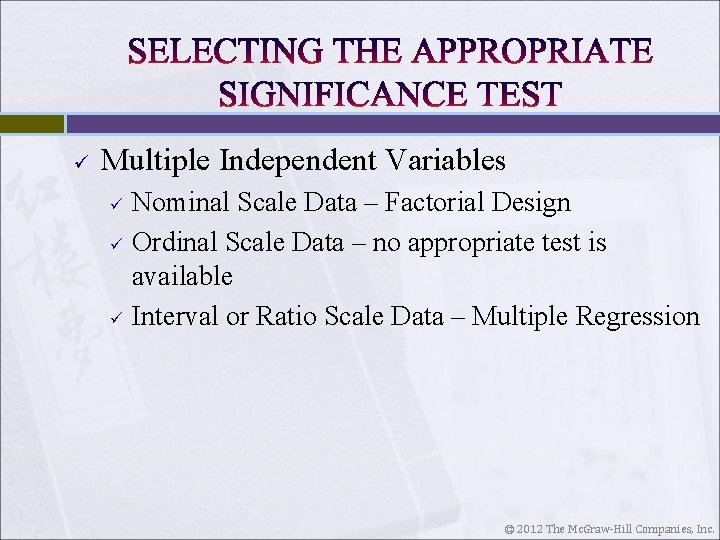
ü Multiple Independent Variables ü ü ü Nominal Scale Data – Factorial Design Ordinal Scale Data – no appropriate test is available Interval or Ratio Scale Data – Multiple Regression © 2012 The Mc. Graw-Hill Companies, Inc.