
Understanding Quantitative Microbial Risk Assessment To Support Decision

Understanding Quantitative Microbial Risk Assessment To Support Decision Makings For Food Safety Management Bing Wang, Ph. D Assistant Professor of Food Safety Risk Assessment Department of Food Science and Technology University of Nebraska-Lincoln Midwest AOAC • 06/05/2018
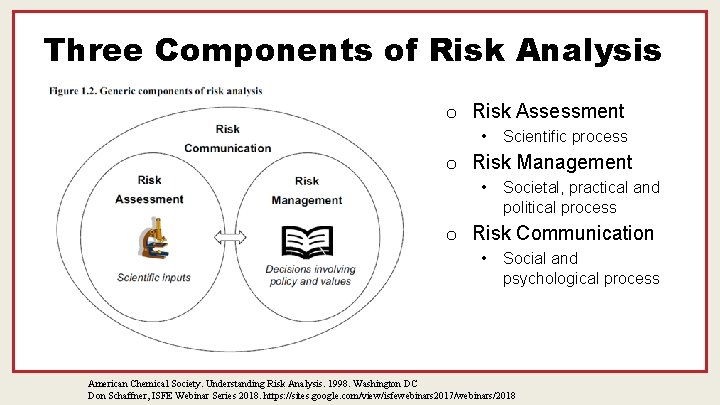
Three Components of Risk Analysis o Risk Assessment • Scientific process o Risk Management • Societal, practical and political process o Risk Communication • Social and psychological process American Chemical Society. Understanding Risk Analysis. 1998. Washington DC Don Schaffner, ISFE Webinar Series 2018. https: //sites. google. com/view/isfewebinars 2017/webinars/2018
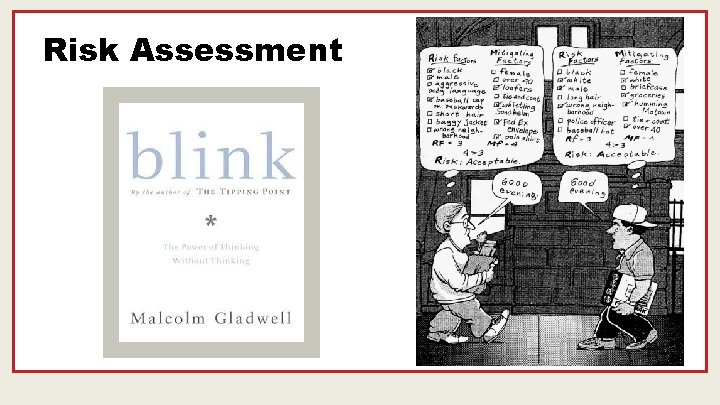
Risk Assessment
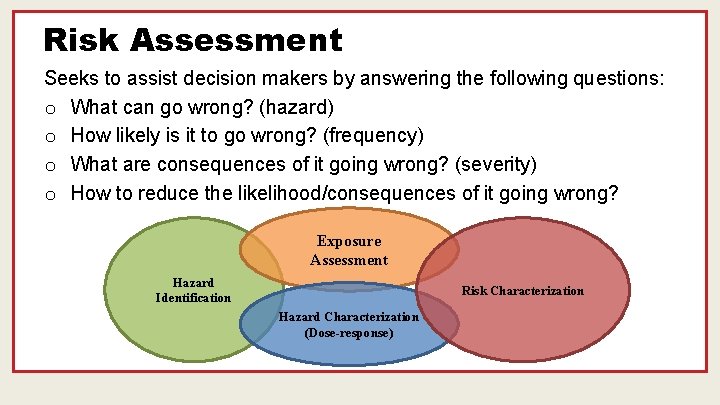
Risk Assessment Seeks to assist decision makers by answering the following questions: o What can go wrong? (hazard) o How likely is it to go wrong? (frequency) o What are consequences of it going wrong? (severity) o How to reduce the likelihood/consequences of it going wrong? Exposure Assessment Hazard Identification Risk Characterization Hazard Characterization (Dose-response)

Risk Assessment Approaches o o o o Risk profile Risk ranking Attribution-based risk assessment Risk prioritization Trade-off analysis Safety assessment Quantitative microbial risk assessment Dearfield, K. L. , Hoelzer, K. , Kause, J. R. : Review of Various Approaches for Assessing Public Health Risks in Regulatory Decision Making: Choosing the Right Approach for the Problem. Journal of Food Protection 77(8), 1428 -1440 (2014). doi: 10. 4315/0362 -028 x. jfp-14 -046
Quantitative Microbial Risk Assessment (QMRA) o o o Quantitative risk estimates Quantify impact of risk factors Evaluate potential interventions Risk estimates in common public health metrics Quantify uncertainty and variability
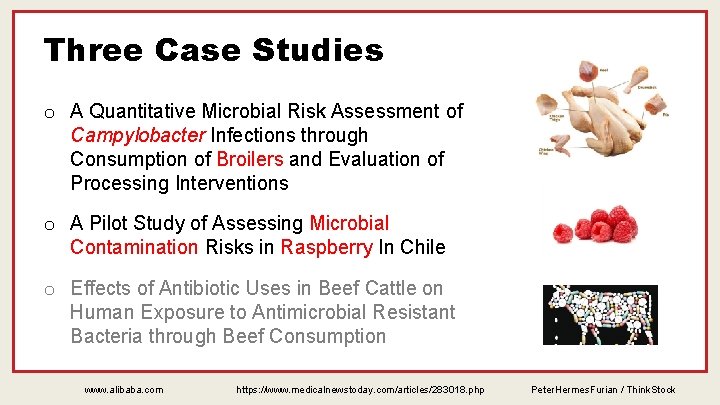
Three Case Studies o A Quantitative Microbial Risk Assessment of Campylobacter Infections through Consumption of Broilers and Evaluation of Processing Interventions o A Pilot Study of Assessing Microbial Contamination Risks in Raspberry In Chile o Effects of Antibiotic Uses in Beef Cattle on Human Exposure to Antimicrobial Resistant Bacteria through Beef Consumption www. alibaba. com https: //www. medicalnewstoday. com/articles/283018. php Peter. Hermes. Furian / Think. Stock
Campylobacter in Broilers Study A Quantitative Microbial Risk Assessment of Campylobacter Infections through Consumption of Broilers and Evaluation of Processing Interventions
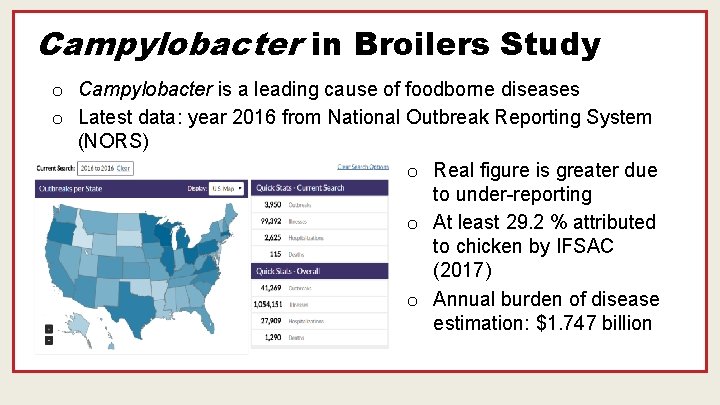
Campylobacter in Broilers Study o Campylobacter is a leading cause of foodborne diseases o Latest data: year 2016 from National Outbreak Reporting System (NORS) o Real figure is greater due to under-reporting o At least 29. 2 % attributed to chicken by IFSAC (2017) o Annual burden of disease estimation: $1. 747 billion
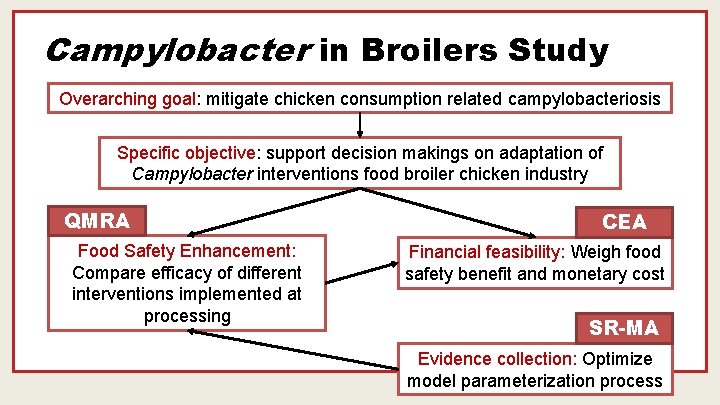
Campylobacter in Broilers Study Overarching goal: mitigate chicken consumption related campylobacteriosis Specific objective: support decision makings on adaptation of Campylobacter interventions food broiler chicken industry QMRA Food Safety Enhancement: Compare efficacy of different interventions implemented at processing CEA Financial feasibility: Weigh food safety benefit and monetary cost SR-MA Evidence collection: Optimize model parameterization process
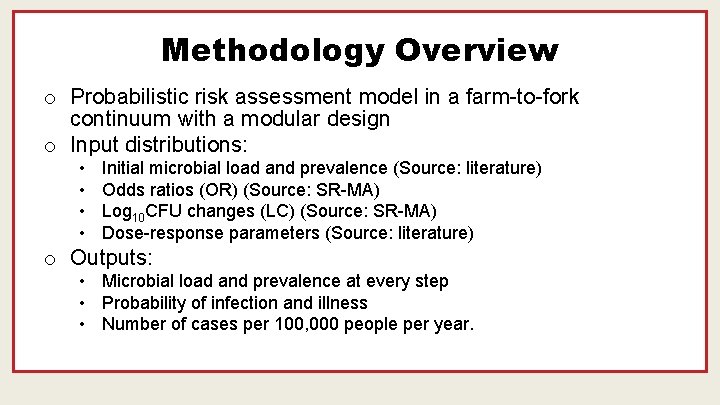
Methodology Overview o Probabilistic risk assessment model in a farm-to-fork continuum with a modular design o Input distributions: • • Initial microbial load and prevalence (Source: literature) Odds ratios (OR) (Source: SR-MA) Log 10 CFU changes (LC) (Source: SR-MA) Dose-response parameters (Source: literature) o Outputs: • Microbial load and prevalence at every step • Probability of infection and illness • Number of cases per 100, 000 people per year.
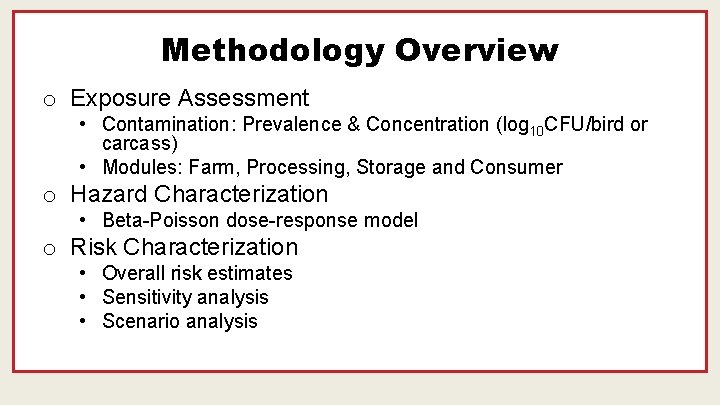
Methodology Overview o Exposure Assessment • Contamination: Prevalence & Concentration (log 10 CFU/bird or carcass) • Modules: Farm, Processing, Storage and Consumer o Hazard Characterization • Beta-Poisson dose-response model o Risk Characterization • Overall risk estimates • Sensitivity analysis • Scenario analysis
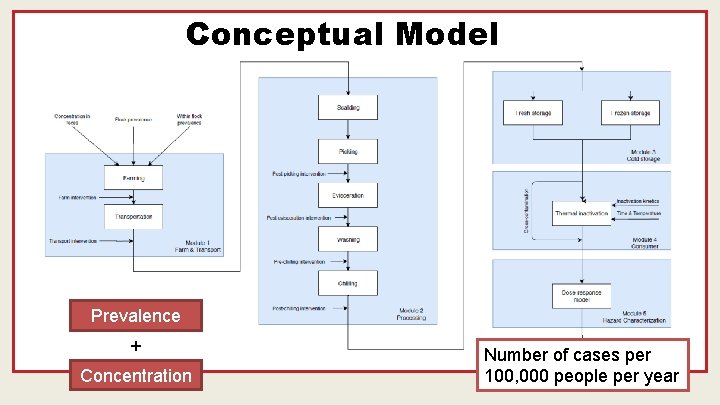
Conceptual Model Prevalence + Concentration Number of cases per 100, 000 people per year
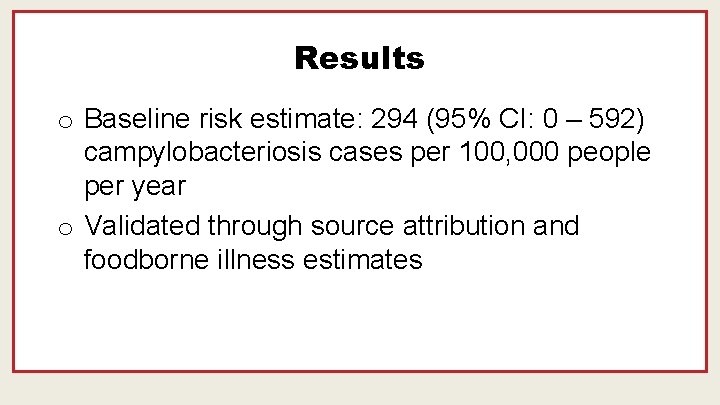
Results o Baseline risk estimate: 294 (95% CI: 0 – 592) campylobacteriosis cases per 100, 000 people per year o Validated through source attribution and foodborne illness estimates
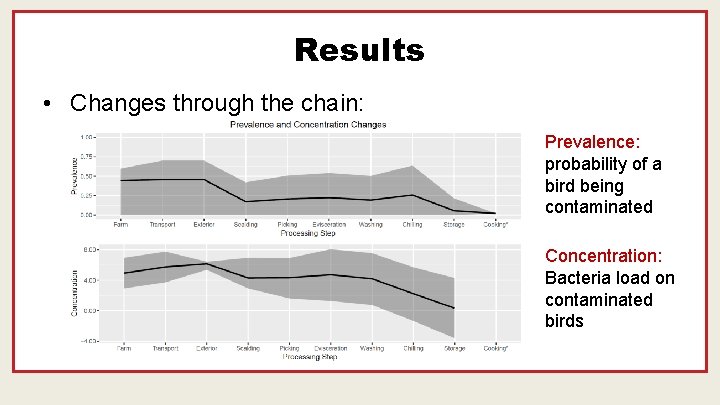
Results • Changes through the chain: Prevalence: probability of a bird being contaminated Concentration: Bacteria load on contaminated birds
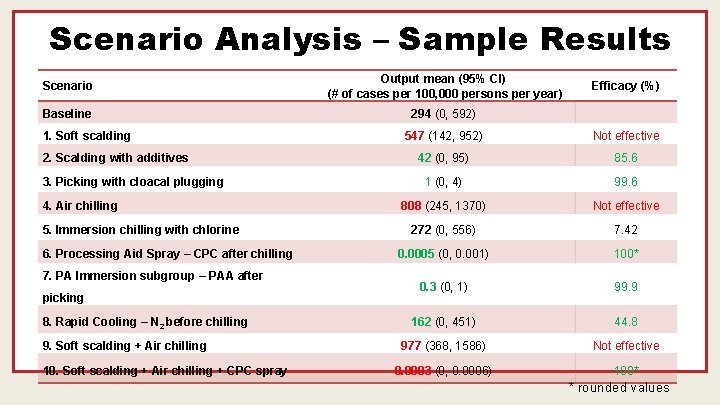
Scenario Analysis – Sample Results Scenario Output mean (95% CI) (# of cases per 100, 000 persons per year) Baseline 294 (0, 592) 1. Soft scalding 2. Scalding with additives 3. Picking with cloacal plugging 4. Air chilling 5. Immersion chilling with chlorine 6. Processing Aid Spray – CPC after chilling 7. PA Immersion subgroup – PAA after picking 8. Rapid Cooling – N 2 before chilling 9. Soft scalding + Air chilling 10. Soft scalding + Air chilling + CPC spray Efficacy (%) 547 (142, 952) Not effective 42 (0, 95) 85. 6 1 (0, 4) 99. 6 808 (245, 1370) Not effective 272 (0, 556) 7. 42 0. 0005 (0, 0. 001) 100* 0. 3 (0, 1) 99. 9 162 (0, 451) 44. 8 977 (368, 1586) Not effective 0. 0003 (0, 0. 0006) 100* * rounded values
Campylobacter in Broilers Summary o Processing aids are among the most effective processing interventions. o Implementation of SR-MA study into the model provided the best estimate possible o Model and results will be a guideline for poultry industry professionals and risk managers o Results of this study will be the main inputs for the future cost analysis study.

Raspberry in Chile Study The triad of government-academic-industry partnership: narrowing gaps between science and decision making for enhancing food safety in developing countries: A pilot study of assessing microbial contamination risks in raspberry in Chile
Raspberry in Chile Study o Food export sales constitutes 25% of all Chilean exports. o Upgrading Chilean National Food Quality and Safety System (SNICA) by integrating risk analysis framework. o Pilot project to control microbial contamination in raspberries, as a part of Raspberry Official Control Program (ROCP).
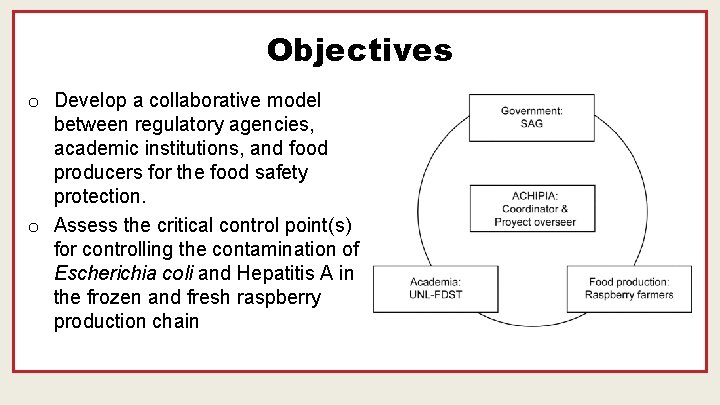
Objectives o Develop a collaborative model between regulatory agencies, academic institutions, and food producers for the food safety protection. o Assess the critical control point(s) for controlling the contamination of Escherichia coli and Hepatitis A in the frozen and fresh raspberry production chain
Process of Chile Raspberry Project 1) 2) 3) 4) 5) 6) 7) Develop a schematic map for the microbial transmission along raspberry supply chain flow chart; Create and administer surveys for Chile-specific data on on-farm, collection center and packaging practices; Collect data for model parameterization from the survey conducted in this project, documented literature and fill data gaps through expert elicitation; Build a QMRA model with Monte Carlo simulation; Conduct the sensitivity analysis for the identification of critical control point(s); Conduct scenario analysis to evaluate the efficacy of potential interventions in protecting the microbial safety of raspberry products; and Provide recommendations on microbial risk management based on the risk assessment results.
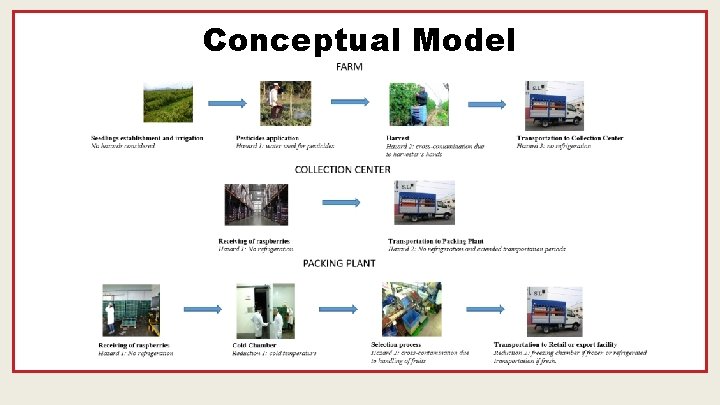
Conceptual Model
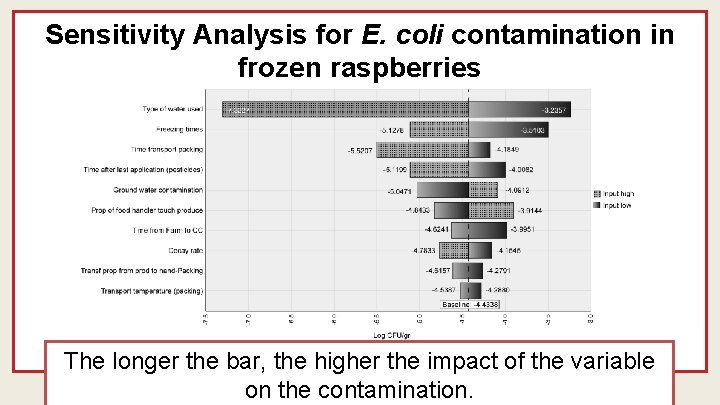
Sensitivity Analysis for E. coli contamination in frozen raspberries The longer the bar, the higher the impact of the variable on the contamination.
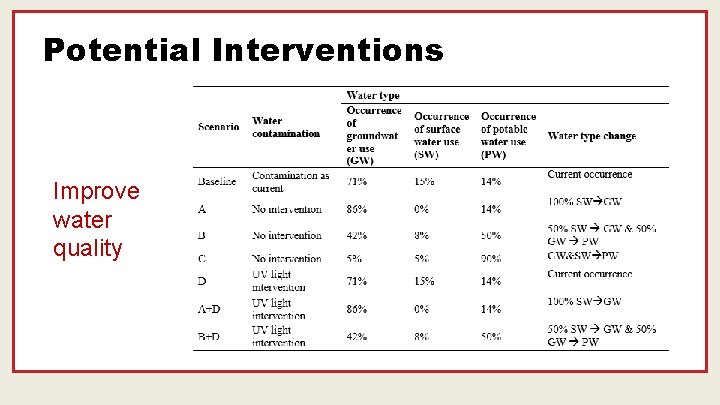
Potential Interventions Improve water quality
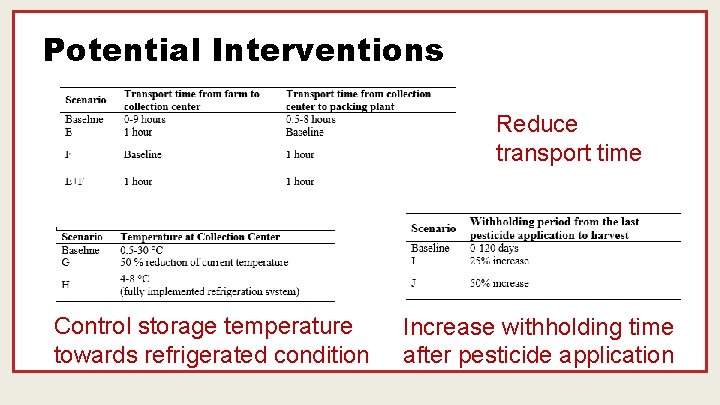
Potential Interventions Reduce transport time Control storage temperature towards refrigerated condition Increase withholding time after pesticide application
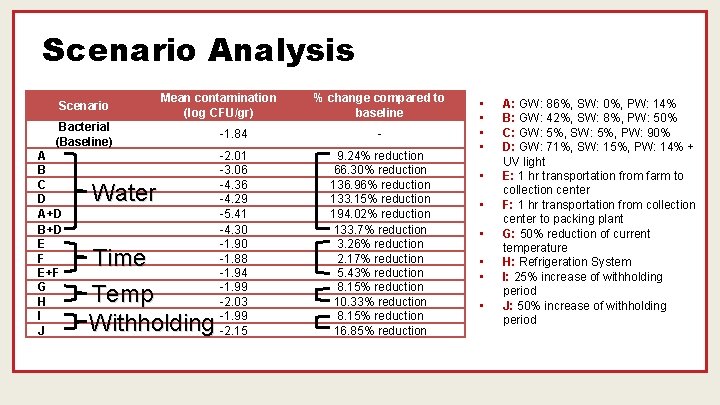
Scenario Analysis Scenario Mean contamination (log CFU/gr) Bacterial (Baseline) A B C D A+D B+D E F E+F G H I J Water Time Temp Withholding % change compared to baseline -1. 84 - -2. 01 -3. 06 -4. 36 -4. 29 -5. 41 -4. 30 -1. 90 -1. 88 -1. 94 -1. 99 -2. 03 -1. 99 -2. 15 9. 24% reduction 66. 30% reduction 136. 96% reduction 133. 15% reduction 194. 02% reduction 133. 7% reduction 3. 26% reduction 2. 17% reduction 5. 43% reduction 8. 15% reduction 10. 33% reduction 8. 15% reduction 16. 85% reduction • • • A: GW: 86%, SW: 0%, PW: 14% B: GW: 42%, SW: 8%, PW: 50% C: GW: 5%, SW: 5%, PW: 90% D: GW: 71%, SW: 15%, PW: 14% + UV light E: 1 hr transportation from farm to collection center F: 1 hr transportation from collection center to packing plant G: 50% reduction of current temperature H: Refrigeration System I: 25% increase of withholding period J: 50% increase of withholding period
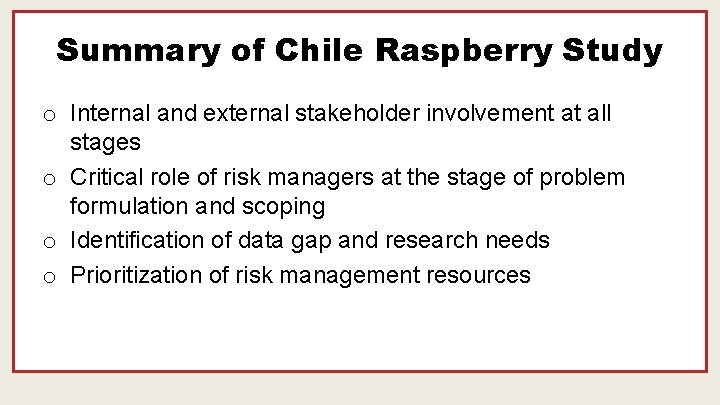
Summary of Chile Raspberry Study o Internal and external stakeholder involvement at all stages o Critical role of risk managers at the stage of problem formulation and scoping o Identification of data gap and research needs o Prioritization of risk management resources
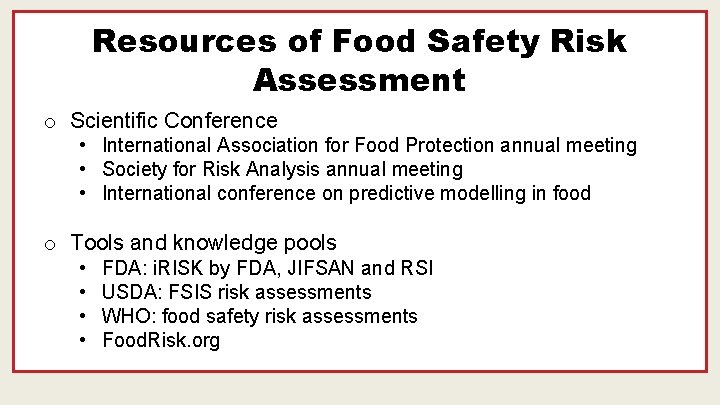
Resources of Food Safety Risk Assessment o Scientific Conference • International Association for Food Protection annual meeting • Society for Risk Analysis annual meeting • International conference on predictive modelling in food o Tools and knowledge pools • • FDA: i. RISK by FDA, JIFSAN and RSI USDA: FSIS risk assessments WHO: food safety risk assessments Food. Risk. org

Thank you! Bing Wang, Ph. D Assistant Professor of Food Safety Risk Assessment Food Science and Technology • 250 FIC 402 -472 -2517 • bing. DOTwang. ATunl. DOTedu
- Slides: 29