
Understanding Psychosocial Mental Health Issues in PreSchool Children
- Slides: 27
Understanding Psychosocial & Mental Health Issues in Pre-School Children Orientation Workshop for Anganwadi Teachers 18 th & 19 th August 2014 Community-Based Child & Adolescent Mental Health Project Dept. of Child & Adolescent Psychiatry NIMHANS, Bangalore
Objectives of Orientation Workshop • To introduce our community project and how we will support your work in the next few years. • To provide an orientation on some key areas of working with pre-school children – child development – identification of disability – emotional and behaviour problems • Understanding your needs/ areas for training & capacity building.
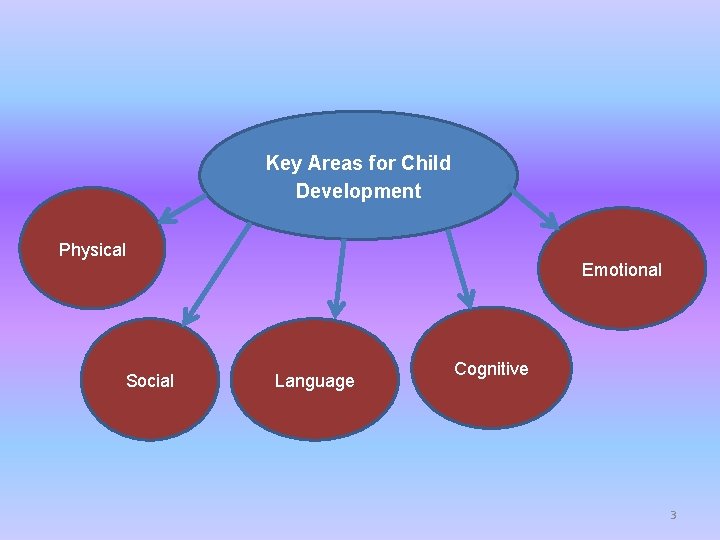
Key Areas for Child Development Physical Emotional Social Language Cognitive 3
Physical Development • General growth and nutrition • Sensory experiences • Gross Motor Skills: mobility, ability to handle objects • Fine Motor Skills: pre-writing skills, transfer functions, eye-hand coordination • Physical skills necessary self- help: buttoning, brushing, feeding etc. …Types of activities you do for physical development? 4
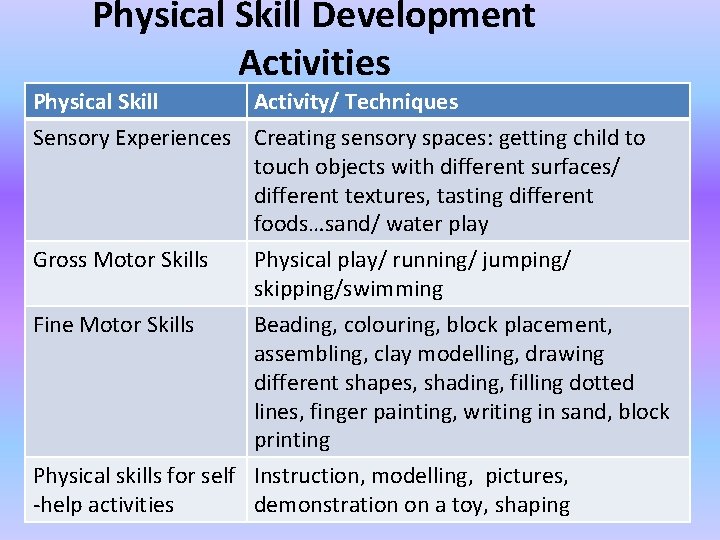
Physical Skill Development Activities Physical Skill Activity/ Techniques Sensory Experiences Creating sensory spaces: getting child to touch objects with different surfaces/ different textures, tasting different foods…sand/ water play Gross Motor Skills Fine Motor Skills Physical play/ running/ jumping/ skipping/swimming Beading, colouring, block placement, assembling, clay modelling, drawing different shapes, shading, filling dotted lines, finger painting, writing in sand, block printing Physical skills for self Instruction, modelling, pictures, -help activities demonstration on a toy, shaping 5
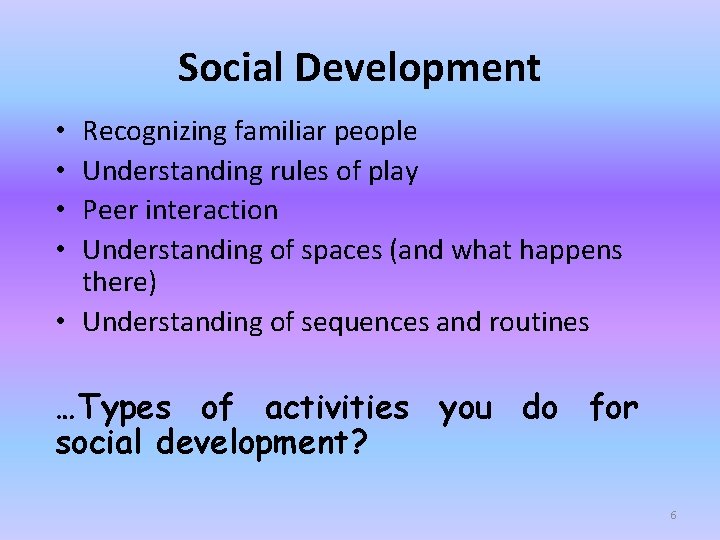
Social Development Recognizing familiar people Understanding rules of play Peer interaction Understanding of spaces (and what happens there) • Understanding of sequences and routines • • …Types of activities you do for social development? 6
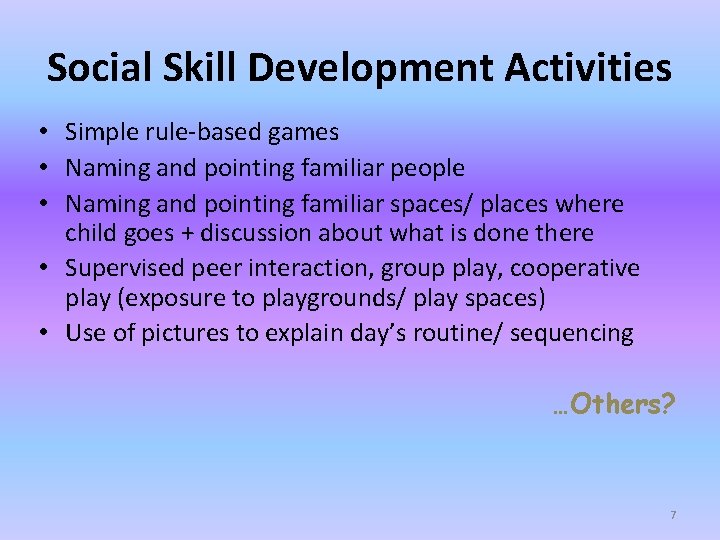
Social Skill Development Activities • Simple rule-based games • Naming and pointing familiar people • Naming and pointing familiar spaces/ places where child goes + discussion about what is done there • Supervised peer interaction, group play, cooperative play (exposure to playgrounds/ play spaces) • Use of pictures to explain day’s routine/ sequencing …Others? 7
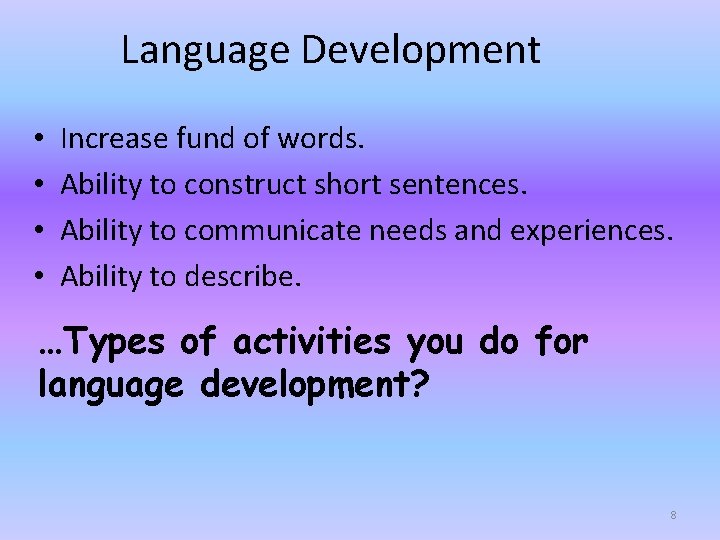
Language Development • • Increase fund of words. Ability to construct short sentences. Ability to communicate needs and experiences. Ability to describe. …Types of activities you do for language development? 8
Speech and Language Skill Development Activities Naming and pointing games Story telling Phone games Describing games (using pictures or real life observations/events or television clips) • Concept book/ flash cards …Others? • • 9
Cognitive Development • • • Fund of information Knowledge of use of objects Ability to form associations Ability to form categories Sequencing and organizing abilities Ability to understand concepts such as shape, size, distance, directions …Types of activities you do for cognitive development? 10
Cognitive Skills Development Activities Puzzles Identification of colors, shapes Story telling (including discussions) Story Completion Use of pictures for sequencing events/ stories Play to demonstrate use of objects Attention enhancing tasks (joining dots, spotting the difference, eye-hand coordination activities) • Concept book/ flash cards …Others? • • 11
Emotional Development Attachment and bonding Ability to identify emotions Ability to report emotional states Ability to regulate emotions Ability to recognize emotional state of another person and ascribe simple reasons to causality • Differentiating between positive and negative emotions • • • …Types of activities you do for emotional development? 12
Activities for Emotional Development • Providing frequent and timely responses of love/ affection to child, incl. positive feed-back, verbal and non-verbal. • Identifying emotions through pictures • Story telling • Story completion • Visual analogue (emotion scale) • Listing situations in which a certain emotion is felt (‘you are happy when…’) …Others? 13
Identifying Disabilities What types of disabilities do you observe in young children? List them… How do you identify them?
Basic Disability Assessment 1. Compared with other children, did the child have any serious delay in sitting, standing or walking? 2. Compared with other children does the child have difficulty seeing, either in the daytime or at night? 3. Does the child appear to have difficulty hearing? 4. When you tell the child to do something, does he/she seem to understand what you are saying? 5. Does the child have difficulty in walking or moving his/her arms or does he/she have weakness and/or stiffness in the arms or legs? 6. Does the child sometimes have fits, become rigid, or lose consciousness? 7. Does the child learn to do things like other children his/her age? 8. Does the child speak at all (can he/she make himself/herself understood in words; can he/she say any recognizable words)? 9. Is the child's speech in any way different from normal (not clear enough to be understood by people other than his/her immediate family)? Can he/she name at least one object (for example, an animal, a toy, cup/ spoon)? 10. Compared with other children of his/her age, does the child appear in any way mentally backward, dull or slow? 15
Responding to Disability Depending on the disability… More physical development activities? More emotional development activities? More social development activities? More cognitive development activities? More speech/language development activities?
Emotional & Behaviour Problems What are common emotional and behaviour problems you observe in young children? List them…
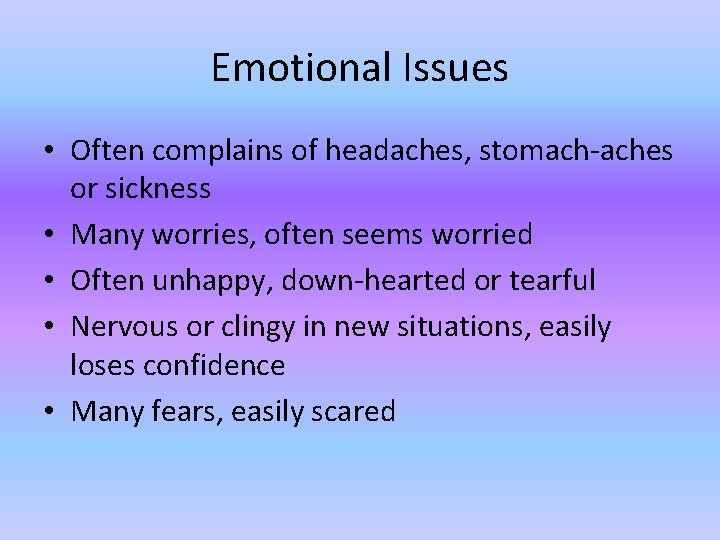
Emotional Issues • Often complains of headaches, stomach-aches or sickness • Many worries, often seems worried • Often unhappy, down-hearted or tearful • Nervous or clingy in new situations, easily loses confidence • Many fears, easily scared
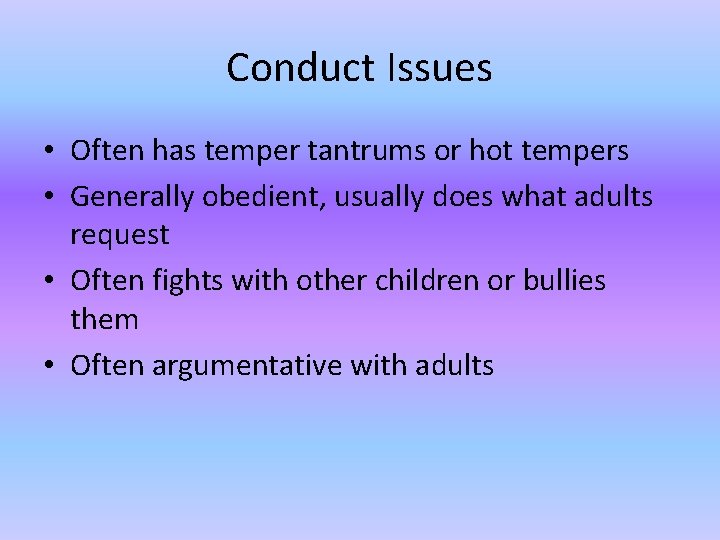
Conduct Issues • Often has temper tantrums or hot tempers • Generally obedient, usually does what adults request • Often fights with other children or bullies them • Often argumentative with adults
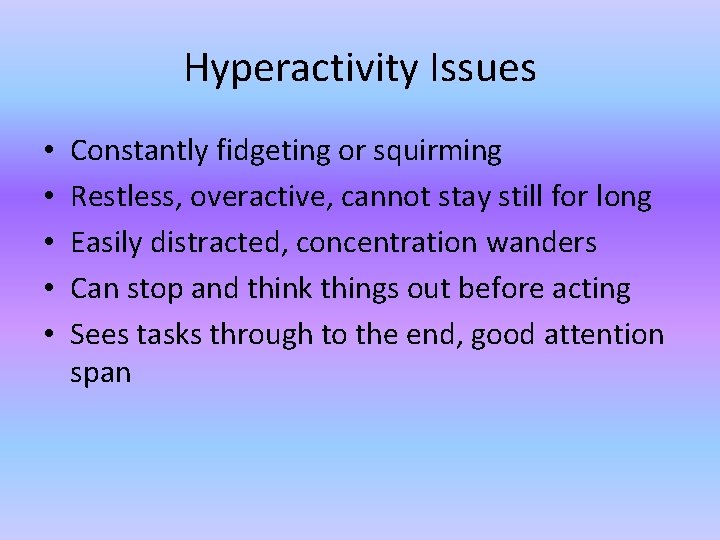
Hyperactivity Issues • • • Constantly fidgeting or squirming Restless, overactive, cannot stay still for long Easily distracted, concentration wanders Can stop and think things out before acting Sees tasks through to the end, good attention span
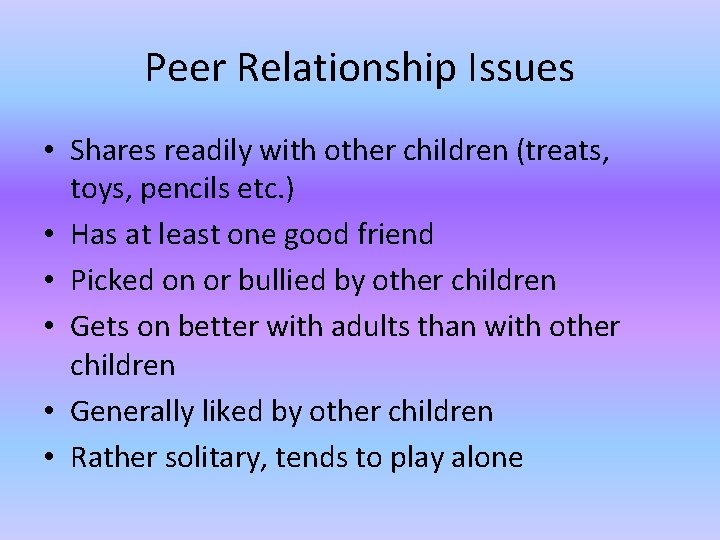
Peer Relationship Issues • Shares readily with other children (treats, toys, pencils etc. ) • Has at least one good friend • Picked on or bullied by other children • Gets on better with adults than with other children • Generally liked by other children • Rather solitary, tends to play alone
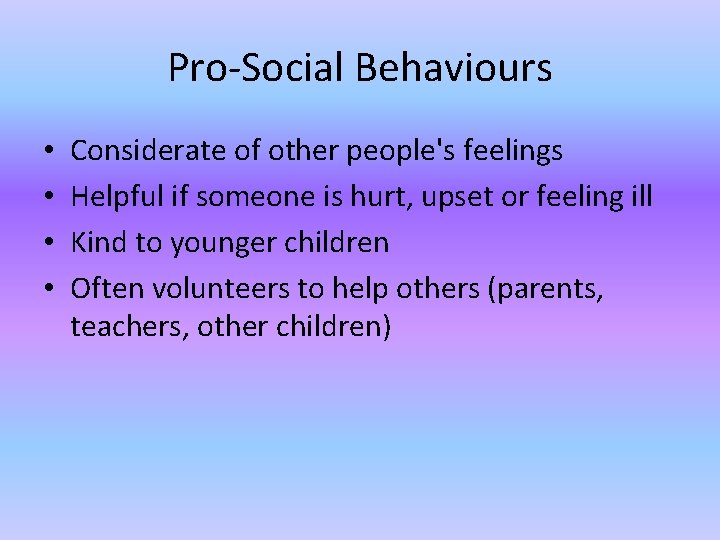
Pro-Social Behaviours • • Considerate of other people's feelings Helpful if someone is hurt, upset or feeling ill Kind to younger children Often volunteers to help others (parents, teachers, other children)
Responding to Emotional & Behavior Problems What do you do in case of… • • • Emotional issues? Conduct problems? Hyperactivity problems? Peer relationship problems? Pro-social behaviour problems?
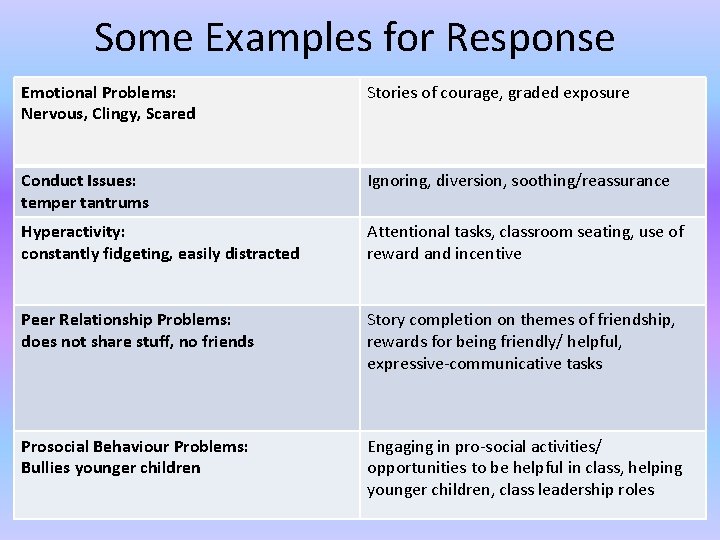
Some Examples for Response Emotional Problems: Nervous, Clingy, Scared Stories of courage, graded exposure Conduct Issues: temper tantrums Ignoring, diversion, soothing/reassurance Hyperactivity: constantly fidgeting, easily distracted Attentional tasks, classroom seating, use of reward and incentive Peer Relationship Problems: does not share stuff, no friends Story completion on themes of friendship, rewards for being friendly/ helpful, expressive-communicative tasks Prosocial Behaviour Problems: Bullies younger children Engaging in pro-social activities/ opportunities to be helpful in class, helping younger children, class leadership roles
Training Needs What are some areas you specifically need training on? - Knowledge/ Information - Skills (what children’s issues are difficult to manage? )
Other Issues • Tell us a little about the curriculum used in early child/ non-formal education? • Have you received any quality standards/ specifications for the curriculum that you need to follow? What are they? • Are play and learning materials provided for each anganwadi? In adequate quantity? • What assessment processes are in place for children—to ensure that program is tailored to child’s needs? (Assessment proforma in place? ) • Any challenges you face in doing your work?
Feedback and Summary What did you learn today? – One new thing? – A new idea? – Something you would like to know more about?