
Understanding Privilege and Oppression Welcome to an Amazing


- Slides: 21
Understanding Privilege and Oppression
Welcome to an Amazing Journey What an amazing journey to embark upon… What an incredible gift to create this space What a wonderful opportunity for us to engage, to discover new possibilities for healing social divides As with any new uncharted journey, we build the path as we walk together – there are smooth patches and rough ones. . So this is our challenge – To make a commitment to hang in there with each other To gain the truths that each of us have To create what we deeply believe is possible among us To evoke the courage and strength in each other to make the world more just. -- Ratnesh Nagda
Intergroup Dialogue The process of intergroup dialogue helps create a collective meaning and deeper understanding.
Building Blocks n Suspension n Listening n Identifying of judgment one’s assumptions n Inquiry and reflection
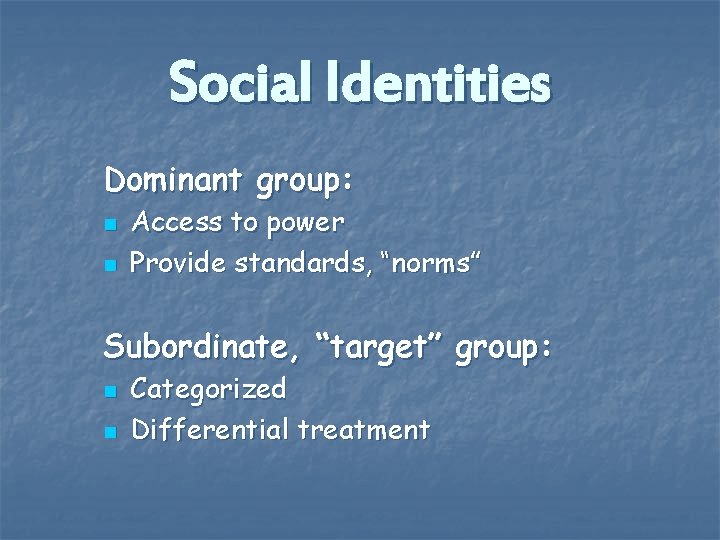
Social Identities Dominant group: n n Access to power Provide standards, “norms” Subordinate, “target” group: n n Categorized Differential treatment
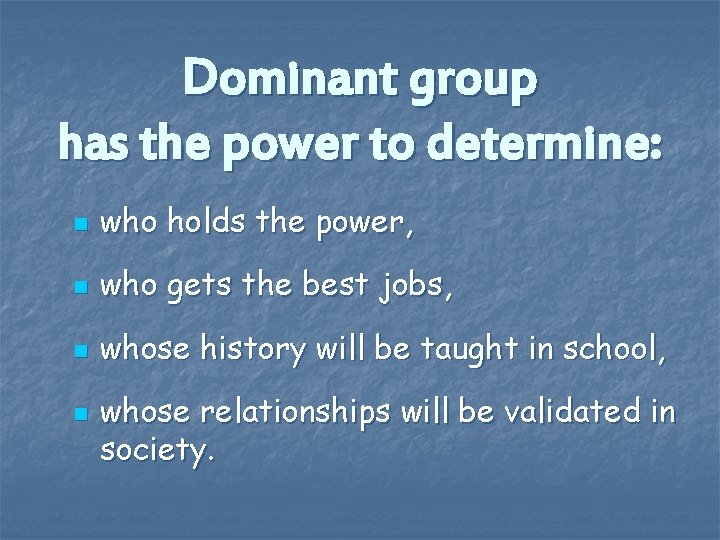
Dominant group has the power to determine: n who holds the power, n who gets the best jobs, n whose history will be taught in school, n whose relationships will be validated in society.
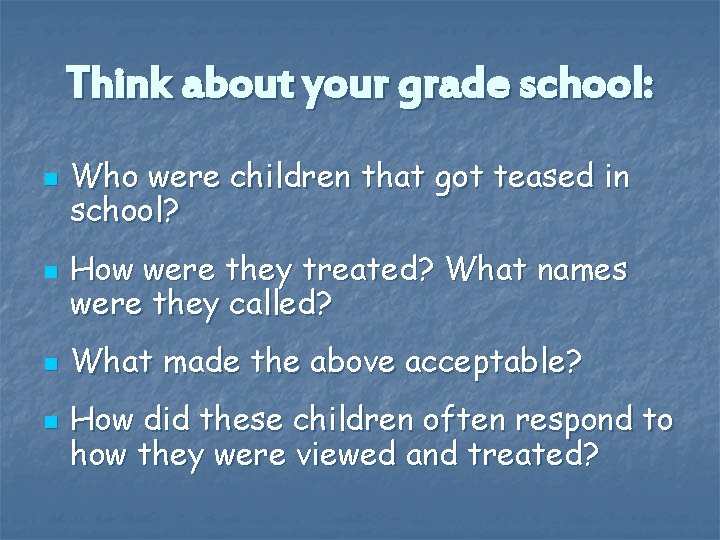
Think about your grade school: n n Who were children that got teased in school? How were they treated? What names were they called? What made the above acceptable? How did these children often respond to how they were viewed and treated?
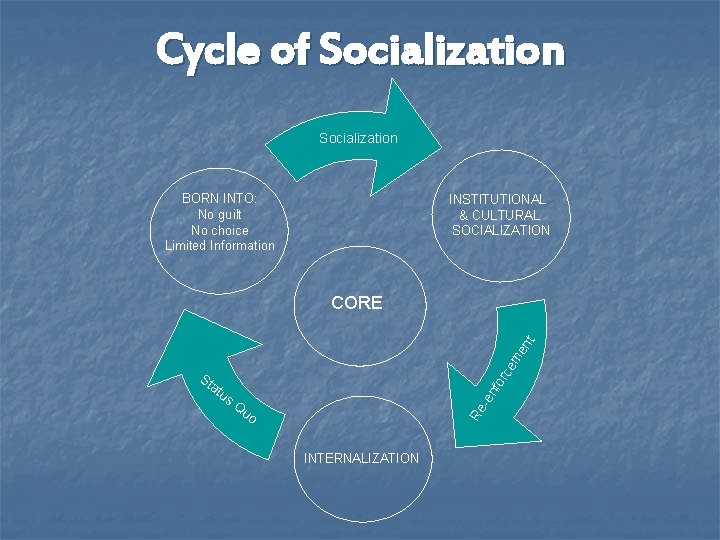
Cycle of Socialization BORN INTO: No guilt No choice Limited Information INSTITUTIONAL & CULTURAL SOCIALIZATION Qu nf o us -e at o Re St rce me nt CORE INTERNALIZATION
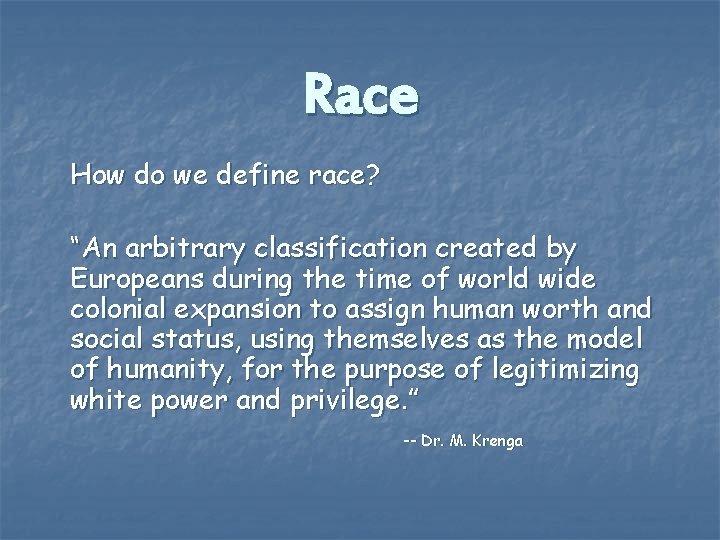
Race How do we define race? “An arbitrary classification created by Europeans during the time of world wide colonial expansion to assign human worth and social status, using themselves as the model of humanity, for the purpose of legitimizing white power and privilege. ” -- Dr. M. Krenga
VIDEO
Personal Reflection n How was this process for you? n Did you notice anything new? n What were the similarities or differences?
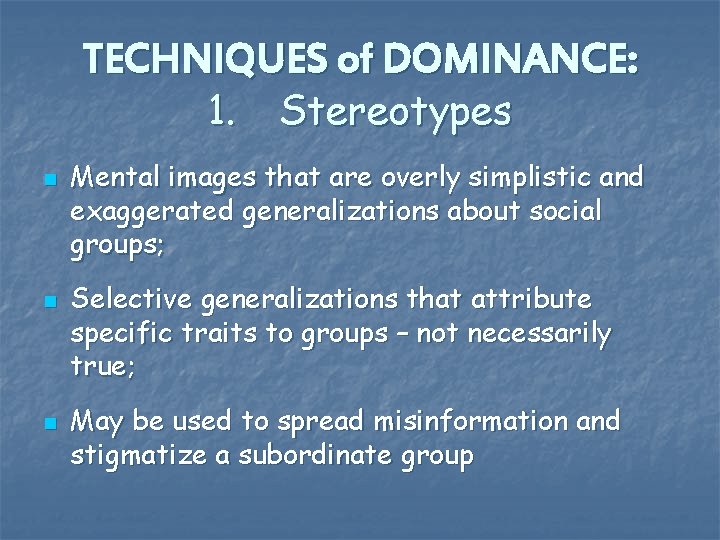
TECHNIQUES of DOMINANCE: 1. n n n Stereotypes Mental images that are overly simplistic and exaggerated generalizations about social groups; Selective generalizations that attribute specific traits to groups – not necessarily true; May be used to spread misinformation and stigmatize a subordinate group
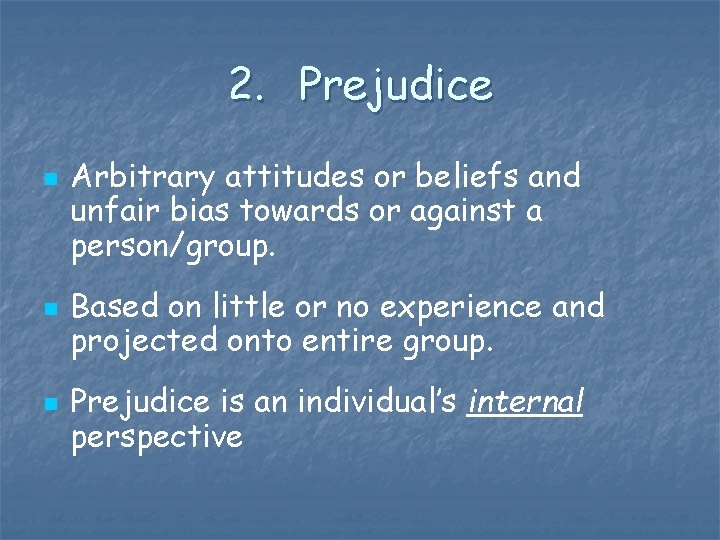
2. Prejudice n n n Arbitrary attitudes or beliefs and unfair bias towards or against a person/group. Based on little or no experience and projected onto entire group. Prejudice is an individual’s internal perspective
3. Discrimination n n Action based on prejudice. Excluding, ignoring, avoiding, threatening, ridiculing, jokes, slurs, violence, unfair treatment. Discrimination is an individual’s external behavior
VIDEO
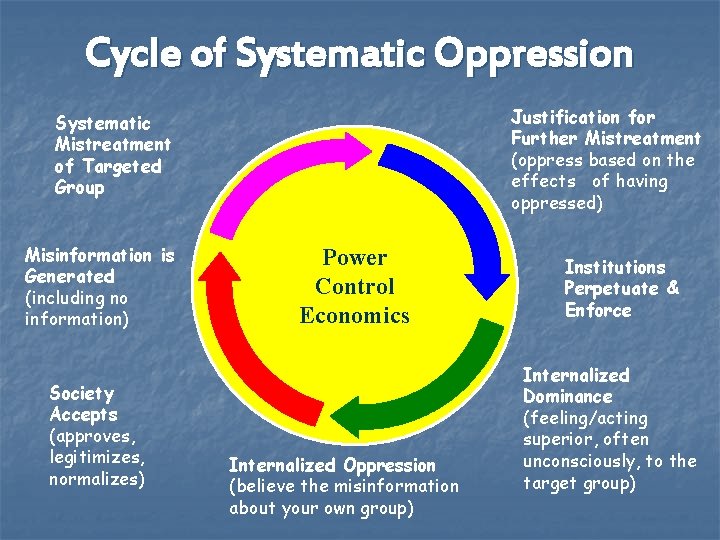
Cycle of Systematic Oppression Justification for Further Mistreatment (oppress based on the effects of having oppressed) Systematic Mistreatment of Targeted Group Misinformation is Generated (including no information) Society Accepts (approves, legitimizes, normalizes) Power Control Economics Internalized Oppression (believe the misinformation about your own group) Institutions Perpetuate & Enforce Internalized Dominance (feeling/acting superior, often unconsciously, to the target group)
5 Faces of Oppression n Exploitation n Marginalization n Powerlessness n Cultural Imperialism n Violence
Internalized Oppression Incorporation and acceptance by people within a target group of the prejudices against them. “We hate ourselves because We grew up And live in a society that hates us” -- Michael Denneny
Privilege “…unearned assets that I can count on cashing in each day, but about which I was ‘meant’ to remain oblivious… like an invisible weightless knapsack of special provisions, maps, passports, codebooks, visas, clothes, tools and blank checks. ” -- Peggy Mc. Intosh
What do we mean by “Privilege”? n n n Members of the “privileged” group gain benefits simply by their affiliation with the dominant side of the power system. We take them for granted – because we don’t see them! They are often presented as being based on “merit” rather than simple affiliation.
Privilege allows us to: n Feel at home in the world n Escape dangers that others may suffer n n Choose whether or not to address certain issues of oppression or injustice Not have to hide parts of our identity or lifestyle