
Understanding peoplecentered integrated care principles and processes Dr
- Slides: 24
Understanding people-centered integrated care: principles and processes Dr Nick Goodwin CEO, International Foundation for Integrated Care Webinar No. 6: People-Centered Models of Care and Integrated Health Services. Universal Health Coverage: Building a path forward in the Region of the Americas, 2 nd June 2014
Outline Dr Nick Goodwin is CEO of the International Foundation for Integrated Care IFIC is a non-profit members’ network that crosses organisational and professional boundaries to bring people together to advance the science, knowledge and adoption of integrated care policy and practice. The Foundation seeks to achieve this through the development and exchange of ideas among academics, researchers, managers, clinicians, policy makers and users and carers of services throughout the World. 1. Understanding integrated care 2. The difference between integration of services and integrated care 3. Universal health coverage, people-centered care and integrated care 4. Case examples 5. Conclusions
What is Integrated Care?
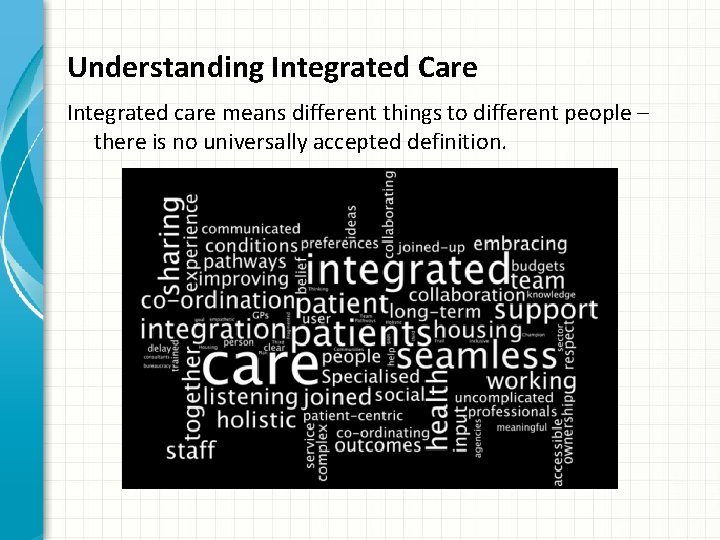
Understanding Integrated Care Integrated care means different things to different people – there is no universally accepted definition.
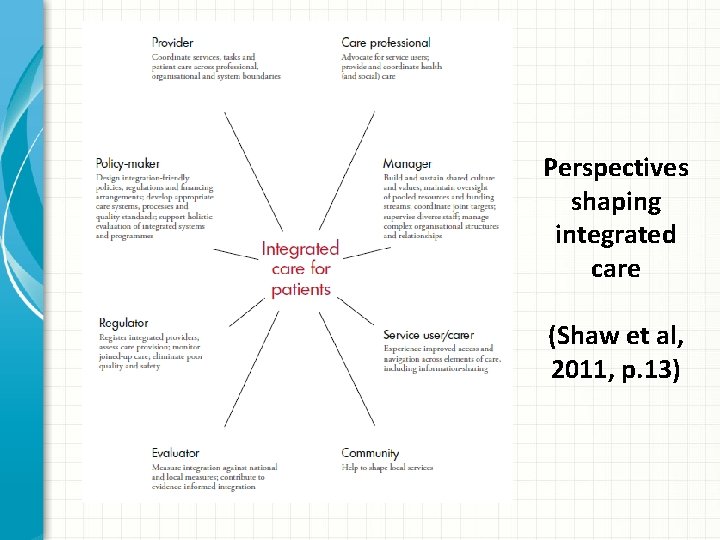
Perspectives shaping integrated care (Shaw et al, 2011, p. 13)
Who is integrated care for? • Integrated care is an approach for people and communities where gaps in care, or poor care co-ordination, leads to an adverse impact on care experiences and care outcomes. • In the European context, integrated care tends to focus on frail older people, to those living with long-term chronic and mental health illnesses, and to those with medically complex needs or requiring urgent care. • In the Global context, integrated care has similar principles to primary health care through its focus on comprehensive, co-ordinated, continuous care – for example, in bringing together vertical disease management programmes (e. g. HIV/AIDS and TB), or supporting the development needs of children and families • Integrated care should not be solely regarded as a response to managing medical problems, the principles extend to the wider definition of promoting health and wellbeing • Integrated care is most effective when it is population-based and takes into account the holistic needs of patients. Disease-based approaches ultimately lead to new silos of care.
Integrated care is centred around the needs of service users ‘The patient’s perspective is at the heart of any discussion about integrated care. Achieving integrated care requires those involved with planning and providing services to ‘impose the patient’s perspective as the organising principle of service delivery’ (Shaw et al, 2011, after Lloyd and Wait, 2005)
The Difference Between Integration of Services and Integrated Care Integration is the combination of processes, methods and tools that facilitate integrated care. Integrated care results when the culmination of these processes directly benefits communities, patients or service users – it is by definition ‘patient-centred’ and ‘population-oriented’ Integrated care may be judged successful if it contributes to better care experiences; improved care outcomes; delivered more cost-effectively ‘Without integration at various levels [of health systems], all aspects of health care performance can suffer. Patients get lost, needed services fail to be delivered, or are delayed, quality and patient satisfaction decline, and the potential for cost-effectiveness diminishes. ’ (Kodner and Spreeuwenburg, 2002, p 2)
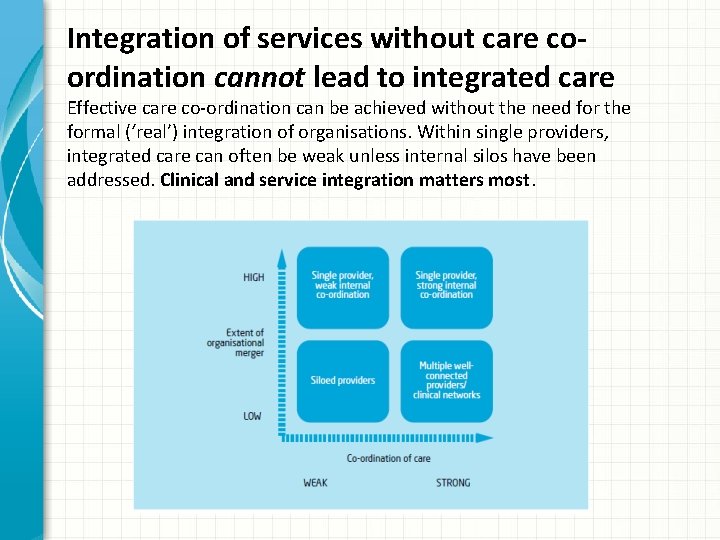
Integration of services without care coordination cannot lead to integrated care Effective care co-ordination can be achieved without the need for the formal (‘real’) integration of organisations. Within single providers, integrated care can often be weak unless internal silos have been addressed. Clinical and service integration matters most.
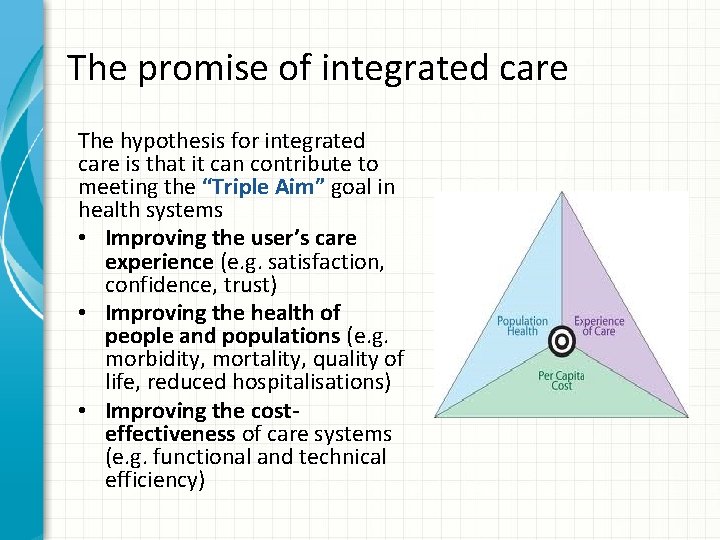
The promise of integrated care The hypothesis for integrated care is that it can contribute to meeting the “Triple Aim” goal in health systems • Improving the user’s care experience (e. g. satisfaction, confidence, trust) • Improving the health of people and populations (e. g. morbidity, mortality, quality of life, reduced hospitalisations) • Improving the costeffectiveness of care systems (e. g. functional and technical efficiency)
Person-Centered and People-Centered Care
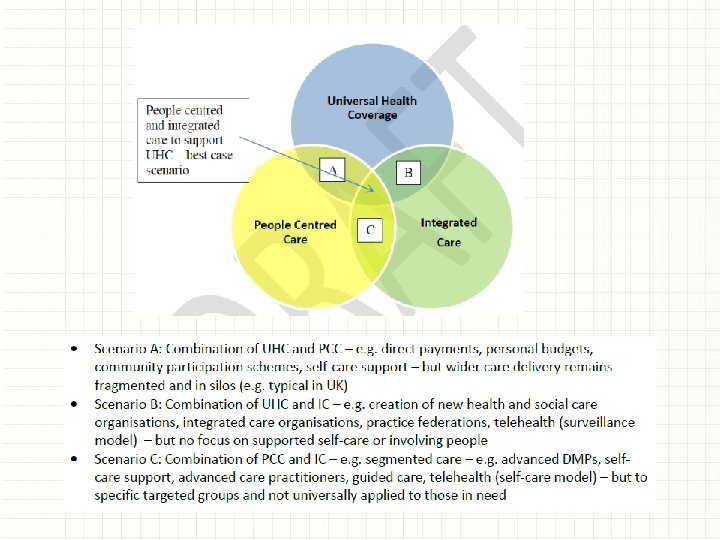
• Person centred care is about care approaches and practices that see the person as a whole with many levels of needs and goals with these needs coming from their own personal social determinants of health. Hence, to be ‘person-centred’ means being responsive to holistic needs and so tailor care to individuals’ or group’s specific characteristics and potential. • People centred care goes beyond a model or care that confronts common epidemiological population profiles to one that considers holistic needs and aims of the community in an evolutionary movement that should strengthens individuals and communities’ competencies and action towards health and well-being. People centred care also encompasses person-centred care.
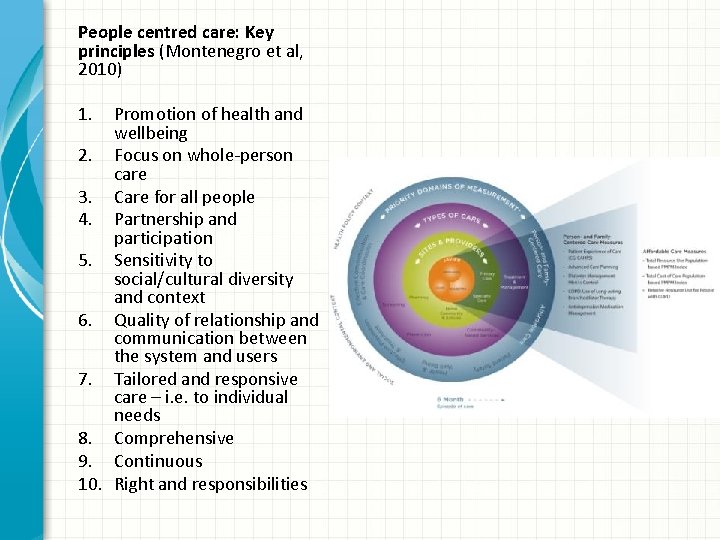
People centred care: Key principles (Montenegro et al, 2010) 1. Promotion of health and wellbeing 2. Focus on whole-person care 3. Care for all people 4. Partnership and participation 5. Sensitivity to social/cultural diversity and context 6. Quality of relationship and communication between the system and users 7. Tailored and responsive care – i. e. to individual needs 8. Comprehensive 9. Continuous 10. Right and responsibilities
The Relationship between Integrated Care and People. Centered Care
Some Case Examples
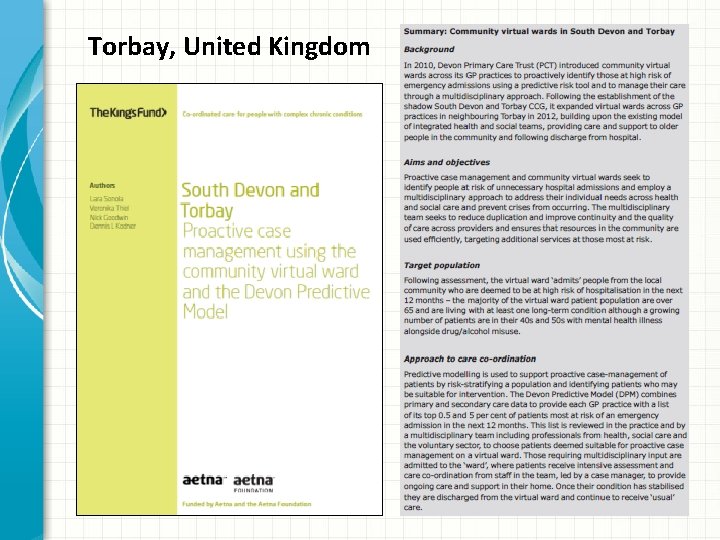
Torbay, United Kingdom
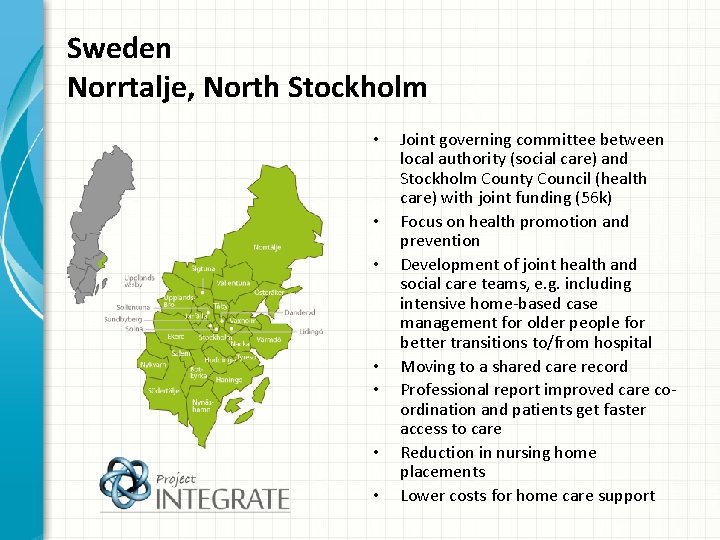
Sweden Norrtalje, North Stockholm • • Joint governing committee between local authority (social care) and Stockholm County Council (health care) with joint funding (56 k) Focus on health promotion and prevention Development of joint health and social care teams, e. g. including intensive home-based case management for older people for better transitions to/from hospital Moving to a shared care record Professional report improved care coordination and patients get faster access to care Reduction in nursing home placements Lower costs for home care support
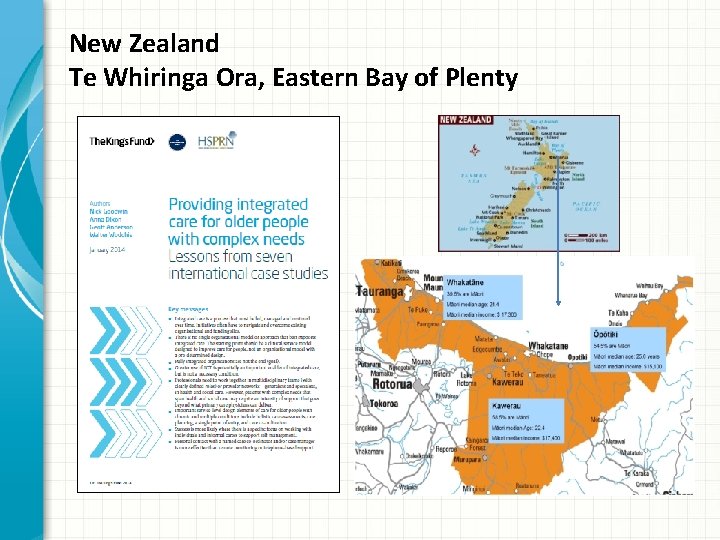
New Zealand Te Whiringa Ora, Eastern Bay of Plenty
Te Whiringa Organisation • Merger of three primary care agencies in the Eastern Bay of Plenty region to create the Eastern Bay Primary Care Alliance (EBPHA). Collaborative model with a community-based health and disability support provider Objectives • providing access to care; reducing disparities in health outcomes; improving primary care management of chronic and long-term conditions; reducing preventable hospital admissions and hospital length of stay; • providing a holistic patient-centered and whānau ora approach to care, and educating service users and their whānau in self-management of chronic care lifestyle changes. Target population and approach • People with chronic illness admitted to hospital two or more times or had six or more ambulatory care visits in the past 12 months. • The TWO program includes assessment, care coordination, telephone support, and telemedicine monitoring as a tool for self-management education. These services are delivered by paired nurse and community-based care coordinators. • The goal is to stabilize patients in the community and improve selfmanagement. Results • Reductions in bed day use and hospital utilization – greater propensity to selfcare and improvements in physical and mental wellbeing
Concluding remarks
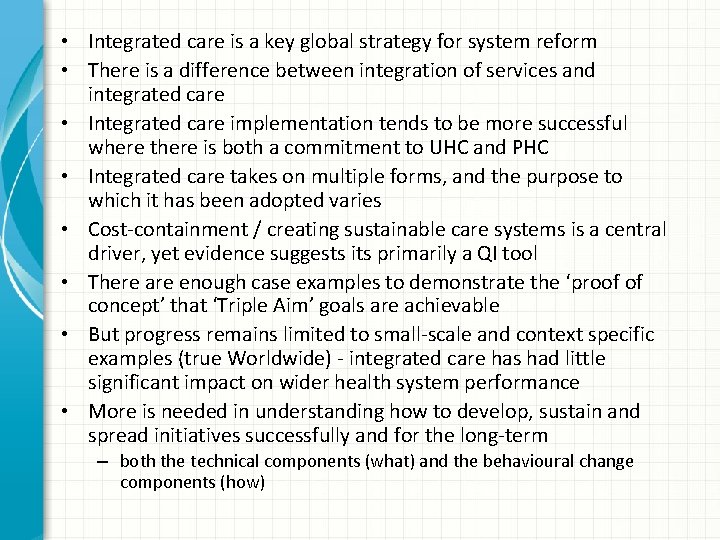
• Integrated care is a key global strategy for system reform • There is a difference between integration of services and integrated care • Integrated care implementation tends to be more successful where there is both a commitment to UHC and PHC • Integrated care takes on multiple forms, and the purpose to which it has been adopted varies • Cost-containment / creating sustainable care systems is a central driver, yet evidence suggests its primarily a QI tool • There are enough case examples to demonstrate the ‘proof of concept’ that ‘Triple Aim’ goals are achievable • But progress remains limited to small-scale and context specific examples (true Worldwide) - integrated care has had little significant impact on wider health system performance • More is needed in understanding how to develop, sustain and spread initiatives successfully and for the long-term – both the technical components (what) and the behavioural change components (how)
Contact Dr Nick Goodwin CEO, International Foundation for Integrated Care nickgoodwin@integratedcarefoundation. org www. integratedcarefoundation. org @goodwin_nick @IFICinfo