
Understanding patients and health professionals perspective to build

Understanding patients’ and health professionals’ perspective to build confidence and trust WALTER ATZORI Senior Programme Officer, European Patients’ Forum Artic Light e. Health Conference 2012, Lulea 20 June 2012
Content • The European Patients’ Forum in the Health and e. Health arena • Exploring user perspective: the case of Telehealth • User-centred e. Health: how much progress did we make? • The link between patient empowerment and e. Health • The way forward: a user perspective
The European Patients’ Forum • Independent, non-governmental umbrella organisation set up in 2003 • VISION: High-quality, patient-centred, equitable healthcare for all patients in the EU • MISSION: To provide a strong and united patients’ voice –> Putting patients at the centre of EU health policy • 54 member organisations: • • 13 National coalitions • 41 EU-level disease-specific umbrella patient organisations 150 million patients with chronic conditions across the EU
e. Health: 10 years back in time • It was more about the “e” than “Health” (ICT driven) • e. Health (the “new thing”) vs. conventional healthcare (“the old thing”) • “Technology driven” as opposed to “demand driven” • Patients side-lined as stakeholders • Too many expectations of e. Health • • Narrow-looking assessment methodologies and tools User acceptance was largely neglected
EPF in the e. Health environment • EPF’s priorities in e. Health • exploring patient acceptance • patient - professionals relationship with a focus on confidence and trust • investigating impact of e. Health on patient empowerment • establishing networks at EU-level with other key stakeholders to put patient at the center • Projects / Joint Actions • Cooperating with other stakeholders e. Health Stakeholder Group - High level Task Force on e. Health • Transparent dialogue with e. Health industry
the Chain of Trust Project Why Chain of TRUST? • Poor awareness, and acceptance among patients and health professionals are barriers to telehealth adoption • Yet we still lack a thorough understanding of user perspective in telehealth Purpose: • To improve available knowledge of the specific views – needs, perceptions on the added value and concerns of telehealth users • To increase awareness and understanding at all levels
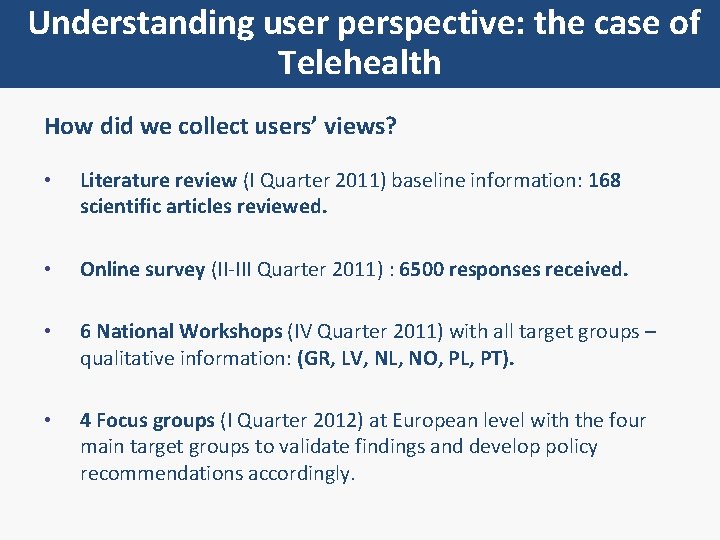
Understanding user perspective: the case of Telehealth How did we collect users’ views? • Literature review (I Quarter 2011) baseline information: 168 scientific articles reviewed. • Online survey (II-III Quarter 2011) : 6500 responses received. • 6 National Workshops (IV Quarter 2011) with all target groups – qualitative information: (GR, LV, NL, NO, PL, PT). • 4 Focus groups (I Quarter 2012) at European level with the four main target groups to validate findings and develop policy recommendations accordingly.
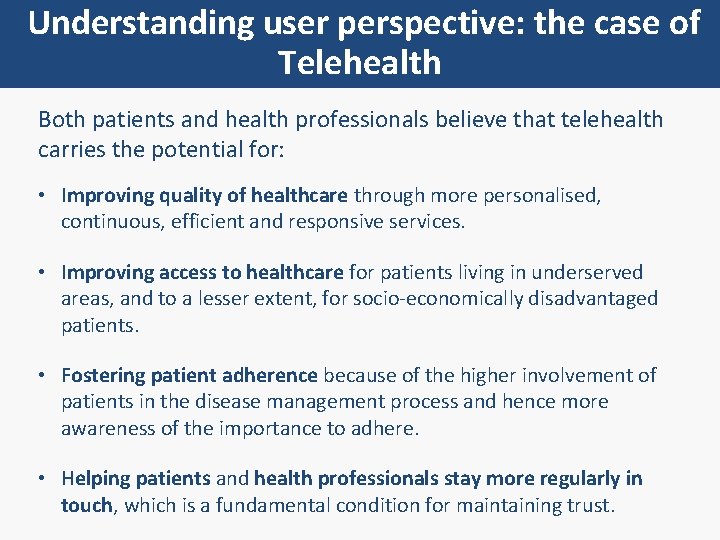
Understanding user perspective: the case of Telehealth Both patients and health professionals believe that telehealth carries the potential for: • Improving quality of healthcare through more personalised, continuous, efficient and responsive services. • Improving access to healthcare for patients living in underserved areas, and to a lesser extent, for socio-economically disadvantaged patients. • Fostering patient adherence because of the higher involvement of patients in the disease management process and hence more awareness of the importance to adhere. • Helping patients and health professionals stay more regularly in touch, which is a fundamental condition for maintaining trust.
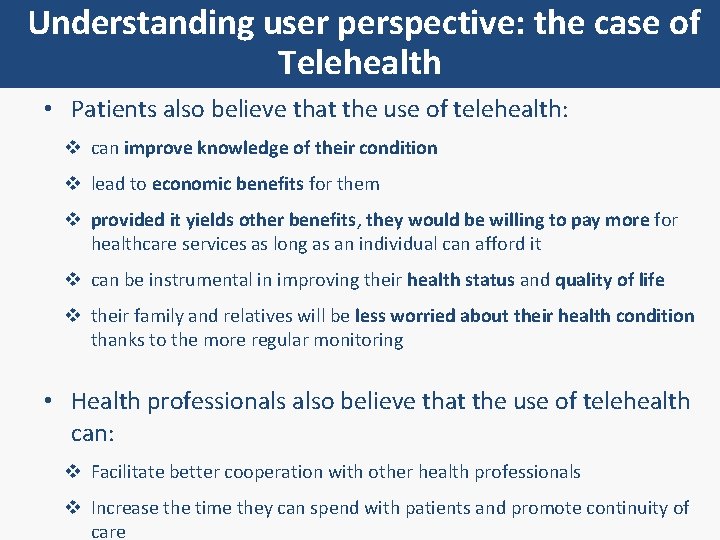
Understanding user perspective: the case of Telehealth • Patients also believe that the use of telehealth: v can improve knowledge of their condition v lead to economic benefits for them v provided it yields other benefits, they would be willing to pay more for healthcare services as long as an individual can afford it v can be instrumental in improving their health status and quality of life v their family and relatives will be less worried about their health condition thanks to the more regular monitoring • Health professionals also believe that the use of telehealth can: v Facilitate better cooperation with other health professionals v Increase the time they can spend with patients and promote continuity of care
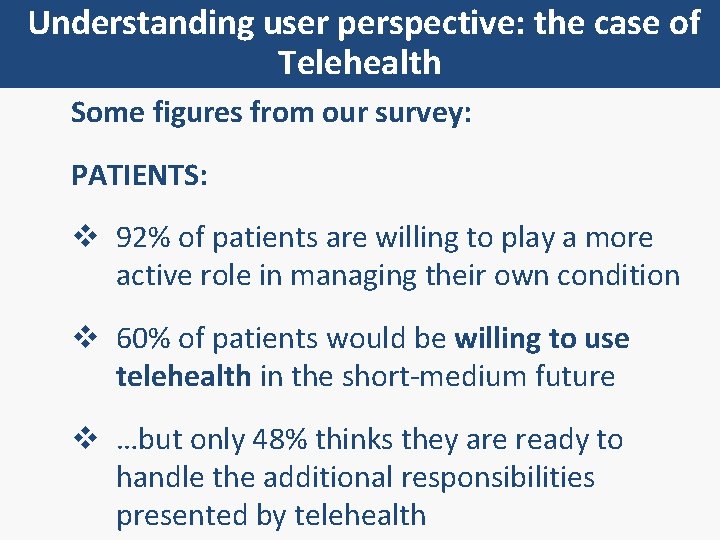
Understanding user perspective: the case of Telehealth Some figures from our survey: PATIENTS: v 92% of patients are willing to play a more active role in managing their own condition v 60% of patients would be willing to use telehealth in the short-medium future v …but only 48% thinks they are ready to handle the additional responsibilities presented by telehealth
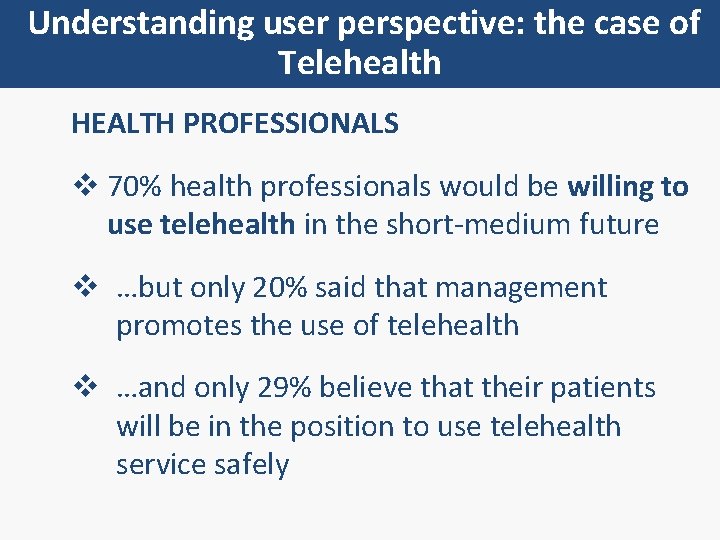
Understanding user perspective: the case of Telehealth HEALTH PROFESSIONALS v 70% health professionals would be willing to use telehealth in the short-medium future v …but only 20% said that management promotes the use of telehealth v …and only 29% believe that their patients will be in the position to use telehealth service safely
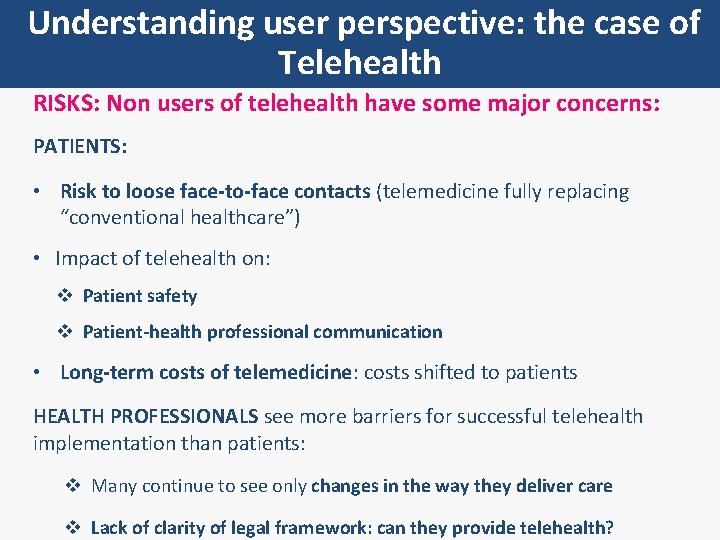
Understanding user perspective: the case of Telehealth RISKS: Non users of telehealth have some major concerns: PATIENTS: • Risk to loose face-to-face contacts (telemedicine fully replacing “conventional healthcare”) • Impact of telehealth on: v Patient safety v Patient-health professional communication • Long-term costs of telemedicine: costs shifted to patients HEALTH PROFESSIONALS see more barriers for successful telehealth implementation than patients: v Many continue to see only changes in the way they deliver care v Lack of clarity of legal framework: can they provide telehealth?
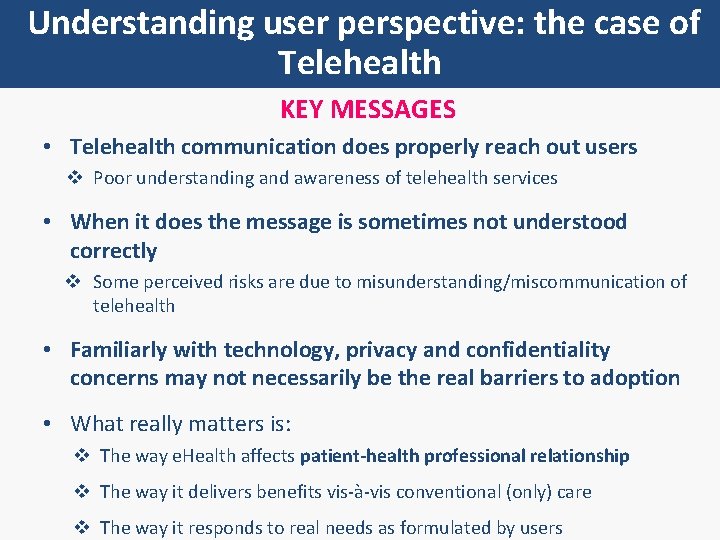
Understanding user perspective: the case of Telehealth KEY MESSAGES • Telehealth communication does properly reach out users v Poor understanding and awareness of telehealth services • When it does the message is sometimes not understood correctly v Some perceived risks are due to misunderstanding/miscommunication of telehealth • Familiarly with technology, privacy and confidentiality concerns may not necessarily be the real barriers to adoption • What really matters is: v The way e. Health affects patient-health professional relationship v The way it delivers benefits vis-à-vis conventional (only) care v The way it responds to real needs as formulated by users
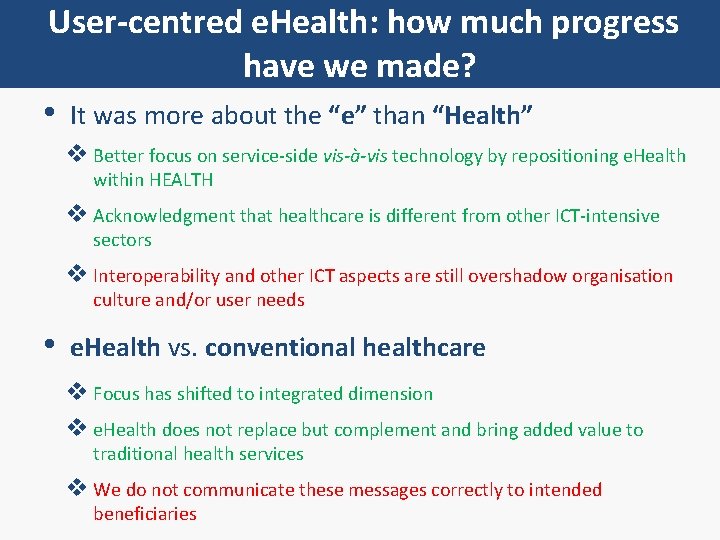
User-centred e. Health: how much progress have we made? • It was more about the “e” than “Health” v Better focus on service-side vis-à-vis technology by repositioning e. Health within HEALTH v Acknowledgment that healthcare is different from other ICT-intensive sectors v Interoperability and other ICT aspects are still overshadow organisation culture and/or user needs • e. Health vs. conventional healthcare v Focus has shifted to integrated dimension v e. Health does not replace but complement and bring added value to traditional health services v We do not communicate these messages correctly to intended beneficiaries
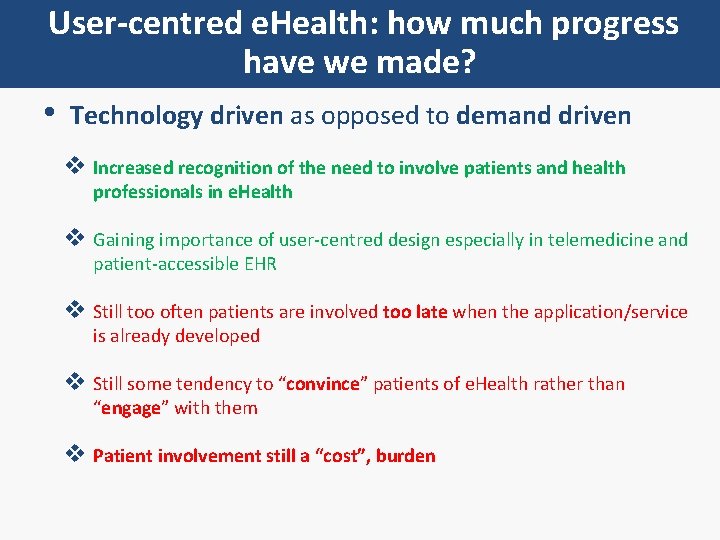
User-centred e. Health: how much progress have we made? • Technology driven as opposed to demand driven v Increased recognition of the need to involve patients and health professionals in e. Health v Gaining importance of user-centred design especially in telemedicine and patient-accessible EHR v Still too often patients are involved too late when the application/service is already developed v Still some tendency to “convince” patients of e. Health rather than “engage” with them v Patient involvement still a “cost”, burden
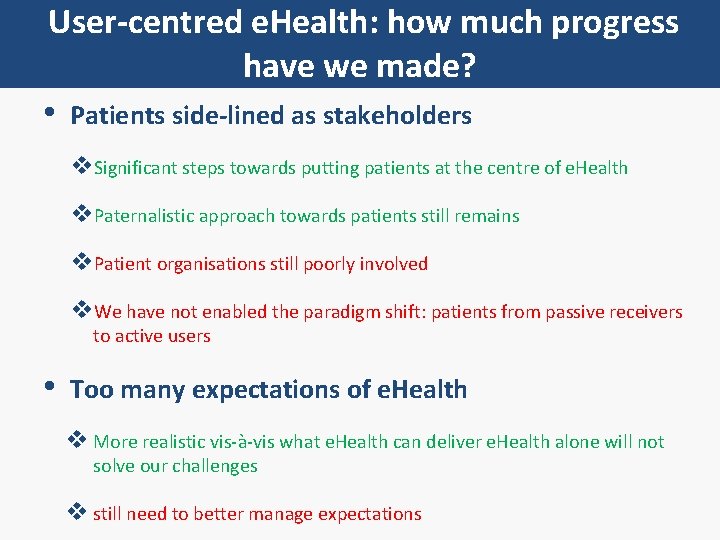
User-centred e. Health: how much progress have we made? • Patients side-lined as stakeholders v. Significant steps towards putting patients at the centre of e. Health v. Paternalistic approach towards patients still remains v. Patient organisations still poorly involved v. We have not enabled the paradigm shift: patients from passive receivers to active users • Too many expectations of e. Health v More realistic vis-à-vis what e. Health can deliver e. Health alone will not solve our challenges v still need to better manage expectations
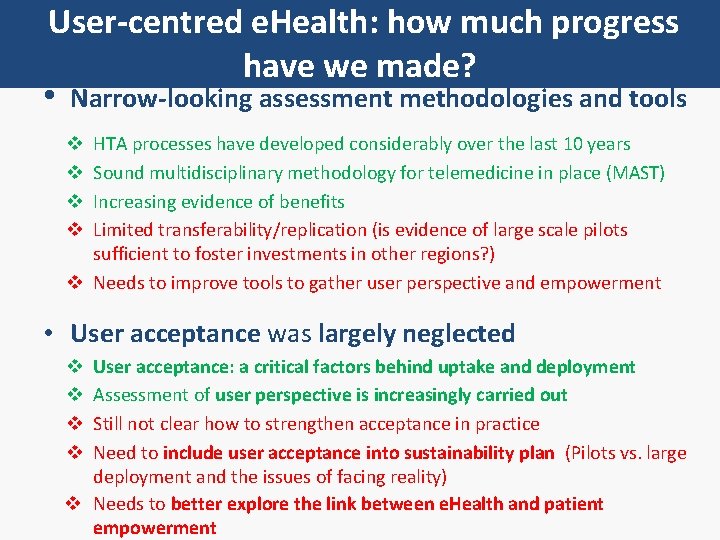
User-centred e. Health: how much progress have we made? • Narrow-looking assessment methodologies and tools HTA processes have developed considerably over the last 10 years Sound multidisciplinary methodology for telemedicine in place (MAST) Increasing evidence of benefits Limited transferability/replication (is evidence of large scale pilots sufficient to foster investments in other regions? ) v Needs to improve tools to gather user perspective and empowerment v v • User acceptance was largely neglected User acceptance: a critical factors behind uptake and deployment Assessment of user perspective is increasingly carried out Still not clear how to strengthen acceptance in practice Need to include user acceptance into sustainability plan (Pilots vs. large deployment and the issues of facing reality) v Needs to better explore the link between e. Health and patient empowerment v v
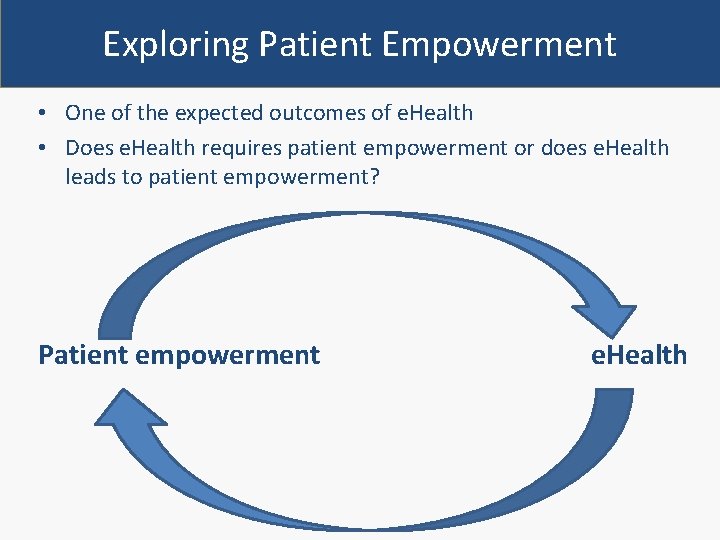
Exploring Patient Empowerment • One of the expected outcomes of e. Health • Does e. Health requires patient empowerment or does e. Health leads to patient empowerment? Patient empowerment e. Health
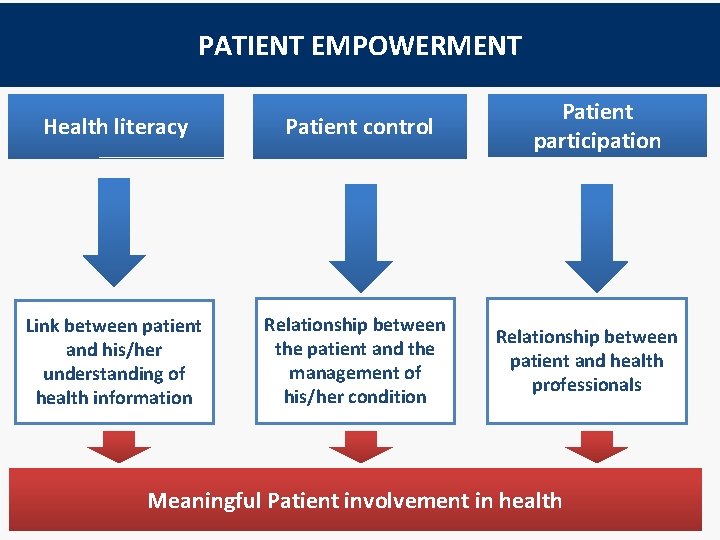
PATIENT EMPOWERMENT Health literacy Patient control Link between patient and his/her understanding of health information Relationship between the patient and the management of his/her condition Patient participation Relationship between patient and health professionals Meaningful Patient involvement in health
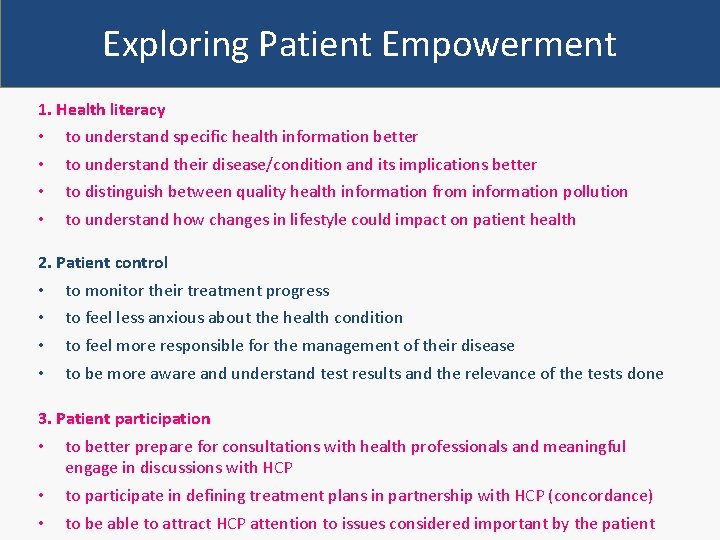
Exploring Patient Empowerment 1. Health literacy • • to understand specific health information better to understand their disease/condition and its implications better to distinguish between quality health information from information pollution to understand how changes in lifestyle could impact on patient health 2. Patient control • • to monitor their treatment progress to feel less anxious about the health condition to feel more responsible for the management of their disease to be more aware and understand test results and the relevance of the tests done 3. Patient participation • to better prepare for consultations with health professionals and meaningful engage in discussions with HCP • • to participate in defining treatment plans in partnership with HCP (concordance) to be able to attract HCP attention to issues considered important by the patient
The way forward: a user perspective • First of all never take user acceptance for granted: putting acceptance at the heart of e. Health at all levels • Provide incentives to promote user-centred design and development at (macro, meso, micro level) • We need to manage expectations: let’s speak the truth: e. Health is not a panacea for everything • We need e. Health ambassadors and more enlightened politicians
The way forward: a user perspective • Health literacy programmes for patients and training for health professionals to go hand in hand with e. Health implementation • Presenting e. Health as part of healthcare innovation processes and link it to new financing models and change management • Promote personalised e. Health vs. “one-fits-all” solutions • Bring patients, health professionals and managers together: do not involve them separately
To conclude with one last thought…… • Involving patients in e. Health require resources, but… • The costs of not involving patients can be much higher than the cost of not involving them • Think of patient involvement as an investment and not as a cost !!
and a few questions… • How can we capitalise on increasing knowledge of user perspective and acceptance to make better decisions? • How can we better communicate e. Health to users? • How can we communicate benefits to health professionals so as to avoid they only see changes in care delivery process? • What kind of incentives can be provided at national and regional level to promote user-centered e. Health? • How can we turn perceived risks into opportunities? • How can we strengthen the link between e. Health and patient empowerment?
Thank you for your attention! www. eu-patient. eu walter. atzori@eu-patient. eu
- Slides: 25