
Understanding pathways taken by TVET college NCV students
Understanding pathways taken by TVET college NCV students through college and beyond James Keevy, Jennifer Shindler and Double-Hugh Marera National Skills Conference 23 -24 March 2017

Background: NCV courses in TVET colleges • TVET colleges formally constituted in 2002 • Sector comprises 50 new FET colleges with 165 campus sites were established across the nine provinces. • Colleges offer NATED courses and since 2007 they offer the National Certificate Vocational (NCV) courses. • NATED and NCV provide training at levels 2, 3 and 4 on the NQF and are open to those who have completed at least Grade 9. • NCV was initially intended to replace the NATED courses. But this has not happened • Enrolment in the NCV - 130 000 to 150 000 for the last 5 years. • Massive growth in NATED courses - now four times that of the NCV. 3
Background to NCV research • Key challenge faced by DHET: how to manage the envisaged expansion of the TVET colleges without destabilising the sector. • Lack of reliable data around the role of TVET Colleges in relation to the supply of skills - key weakness. • In order to fill this gap, a research project was commissioned and designed to provide data specifically related to NCV on: • the status of colleges in relation to meeting the needs of young schools leavers and • the challenges that colleges face in effectively preparing youth for the labour market. 4
Research Design • The research was designed to comprise two waves • WAVE 1: An in-college survey of NCV students (NCV 2 -4) was conducted in 30 TVET colleges (122 campuses) in 2010. • Aim of Wave 1: • • Understand learner backgrounds Factors bringing them to TVET colleges Experience in TVET college Role of TVET colleges in preparing the youth for labour market • In total 18 131 learners were surveyed. 5
Research design: Wave 2 WAVE 2: Was a tracer survey of the same students after a period of time. • Contact details collected during 2010 survey • Aim of Wave 2: • examine experiences on leaving TVET colleges and entering the labour market. • Population -18 131 students surveyed in 2010. • Sampling frame - 17 387 individuals. • 9 000 individuals randomly selected. • 100 individuals formed part of the pilot, leaving 8 900 individuals • The survey was carried out telephonically • 3 113 agreed to participate, a response rate of 37. 2% 6
Wave 2 • Wave 2 obtained data on: • Transition pathways • Employment opportunities • Income range of those that are employed • Kinds of industries or sectors accessed • Link between employment and field of study. • Role of the college in preparing the student to get a job. 7
Profile of 2015 respondents • 53% were female and 46% were male. This is similar to the gender breakdown of the 18 131 who participated in 2010. • Majority of respondents are African (92%) followed by Coloured (6%), White (1%) and Indian (less than 1%). • 66% were aged between 26 and 30 and 22% were aged 25 and under. • 23% living in Gauteng followed by Mpumalanga (18%) and Kwa. Zulu-Natal (14%). • Most respondents (65%) still living in the town or city where they studied in 2010. 8
Profile of 2015 respondents, contd • Most respondents live with family members (79%), in particular with one or both parents (50%). A small proportion (13%) live alone and some live with their spouse (5%). • 68% live in households that comprise between 2 and 6 people, while 4% live in households made up of 10 or more people. • 76% live in a formal dwelling while the rest live in informal accommodation or traditional dwellings. 9
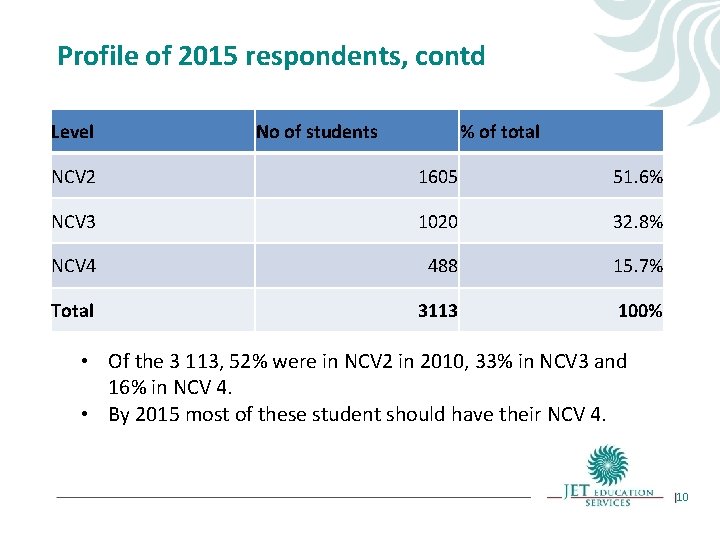
Profile of 2015 respondents, contd Level No of students % of total NCV 2 1605 51. 6% NCV 3 1020 32. 8% NCV 4 488 15. 7% Total 3113 100% • Of the 3 113, 52% were in NCV 2 in 2010, 33% in NCV 3 and 16% in NCV 4. • By 2015 most of these student should have their NCV 4. 10

Completion of NCV 4 by 2015 by level of study in 2010 100% 90% 80% 70% 60% 50% 40% 30% 20% 10% 0% 69% 59% 44% 62% Not completed Completed 31% 41% 56% NCV Level 2 NCV Level 3 NCV Level 4 38% Total • 38% completed NCV 4 by 2015 with 4% still studying towards NCV qualification in 2015. • Of those who were in NCV 4 in 2010 only 56% had got their NCV 4 by 2015 11
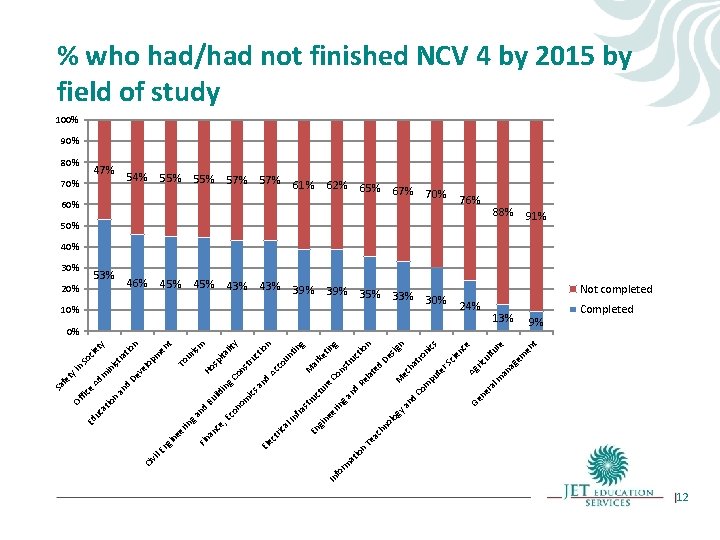
fo r n io at m m 50% 24% 0% en t re 76% ag em an ul tu 30% al 70% ric 10% nc e 33% Sc ie cs 67% ne r er ni ro 60% Ag pu t 35% m Co n sig 65% ha t ec De n ct io in g 39% M d te la Re ns tru 62% Ge nd ya og ac hn ol Te nd ga rin ke t 39% Co g 61% In ct ur e M ar 43% ee ru tin n io 43% un Ac co ct 57% gin st fra In d ru 57% En al ric ct El e an 45% ics y lit ita sp st on g. C in ild 55% om co n , E Bu ism 45% ce Ho ur 55% an nd 46% To 54% Fin ga rin en t 20% in ee n tio ra 53% pm lo ve De ist ty 47% En g d an in 70% vil n m So cie 30% io Ad n yi fe t 80% Ci uc at Ed Of fic e Sa % who had/had not finished NCV 4 by 2015 by field of study 100% 90% 88% 91% 40% Not completed 13% 9% Completed 12
Reasons for not completing NCV 4 • Lack of finance is the main reason given for not completing the NCV qualification (37%). • But 60% of those surveyed in 2015 had government bursaries in 2010. • Bursary would have continued if they finished each year in stipulated time. • Clearly most of the students are not able to complete their studies in the stipulated time and had to fund for their own studies. • Other reasons given for not completing the NCV qualification included: Still Awaiting certificate (15%); Failure/Outstanding Subjects (13%); Wrong Course for Me (6%); Got a Job (5%); , or moved to N 4 (4%). 13
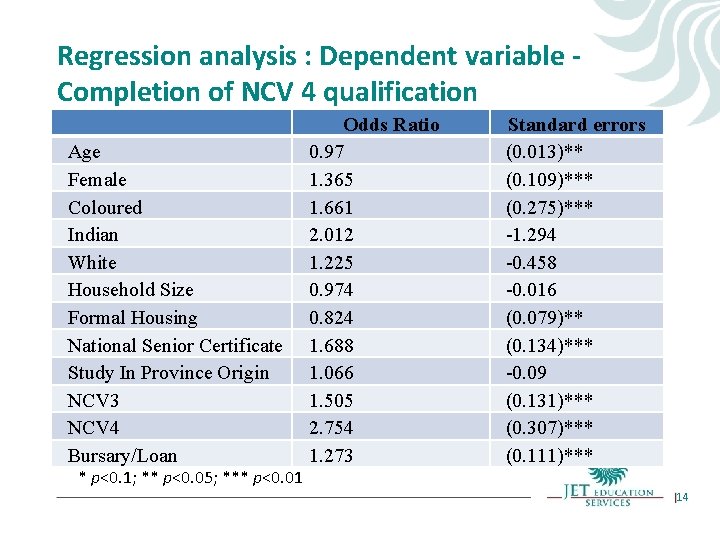
Regression analysis : Dependent variable Completion of NCV 4 qualification Age Female Coloured Indian White Household Size Formal Housing National Senior Certificate Study In Province Origin NCV 3 NCV 4 Bursary/Loan * p<0. 1; ** p<0. 05; *** p<0. 01 Odds Ratio 0. 97 1. 365 1. 661 2. 012 1. 225 0. 974 0. 824 1. 688 1. 066 1. 505 2. 754 1. 273 Standard errors (0. 013)** (0. 109)*** (0. 275)*** -1. 294 -0. 458 -0. 016 (0. 079)** (0. 134)*** -0. 09 (0. 131)*** (0. 307)*** (0. 111)*** 14
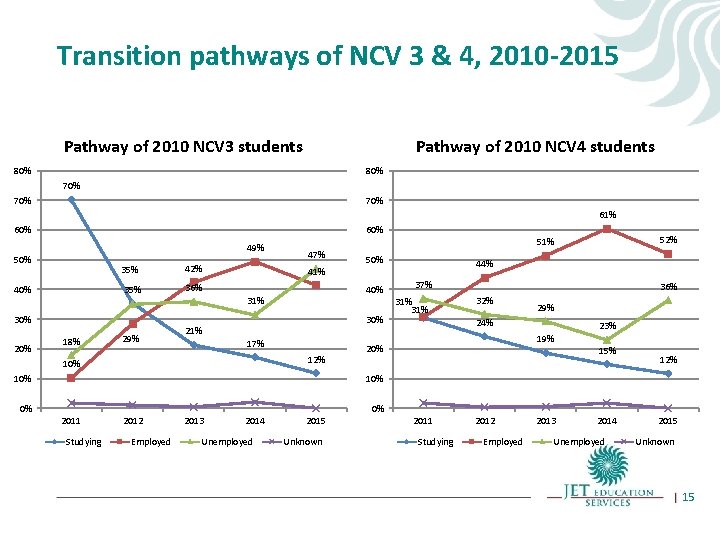
Transition pathways of NCV 3 & 4, 2010 -2015 Pathway of 2010 NCV 3 students Pathway of 2010 NCV 4 students 80% 70% 70% 61% 60% 49% 50% 35% 40% 30% 20% 18% 29% 42% 47% 41% 36% 31% 21% 50% 40% 30% 17% 12% 10% 0% 0% 2011 Studying 2012 Employed 2013 2014 Unemployed 2015 Unknown 44% 37% 31% 36% 32% 29% 24% 23% 19% 20% 10% 52% 51% 2011 Studying 2012 Employed 2013 15% 2014 Unemployed 12% 2015 Unknown 15
Employment, contd Kind of employment 100% 90% 22, 9% 80% 8, 8% 70% 60% 50% 40% 68, 3% 30% 20% 10% 0% All employed Contract Informal/Piece Work Permanent 16
Employment, contd 73, 3% 80, 0% 70, 0% 60, 0% 50, 0% 40, 0% 30, 0% 20, 0% 10, 0% 19, 1% 3, 7% on Pe te co te Pr iva pa m e ie c /P al fo rm rs ny O 1, 0% In Se f-e m pl oy w or k ed t en rn m ve 0, 1% NG 2, 8% Go Respondents Types of Employers Types of Epmployers 17
Completion of NCV 4 and employment status by 2015 % employed and not employed according to whether or not achieved NCV 4 by 2015 100% 80% 39% 32% 36% 61% 68% 64% Did not complete Completed Total 60% 40% 20% 0% Employed Never been employed 18
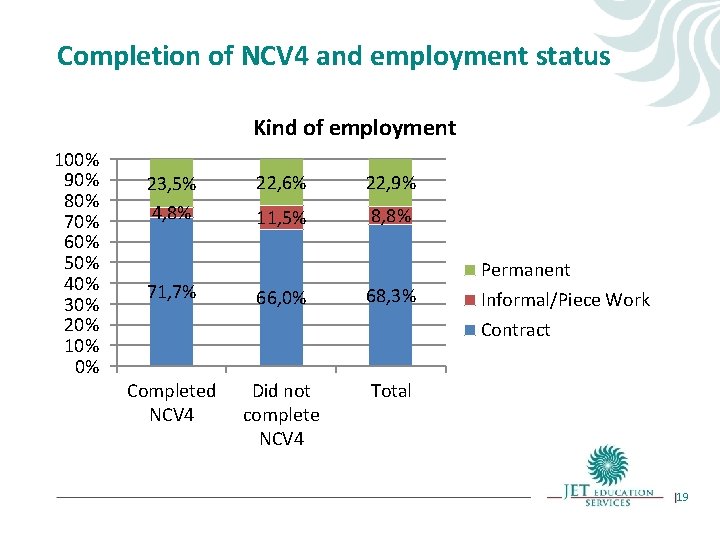
Completion of NCV 4 and employment status Kind of employment 100% 90% 80% 70% 60% 50% 40% 30% 20% 10% 0% 23, 5% 4, 8% 22, 6% 22, 9% 11, 5% 8, 8% 71, 7% 66, 0% 68, 3% Completed NCV 4 Did not complete NCV 4 Total Permanent Informal/Piece Work Contract 19
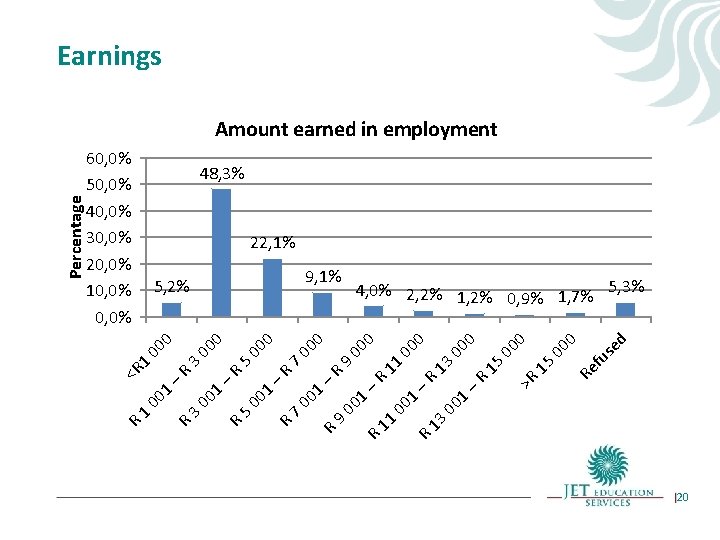
Earnings 60, 0% 50, 0% 40, 0% 30, 0% 20, 0% 10, 0% 48, 3% 22, 1% 9, 1% se d Re fu 0 R 13 00 1 >R 15 00 0 00 – R R – 1 00 11 R 15 13 00 00 11 R – 1 00 9 R 0 0 0 9 R – 1 00 R 7 1 00 5 R 4, 0% 2, 2% 1, 2% 0, 9% 1, 7% 5, 3% 00 0 7 R – 1 00 3 00 0 00 5 3 R – R 1 00 1 <R 1 00 00 0 0 5, 2% R Percentage Amount earned in employment 20
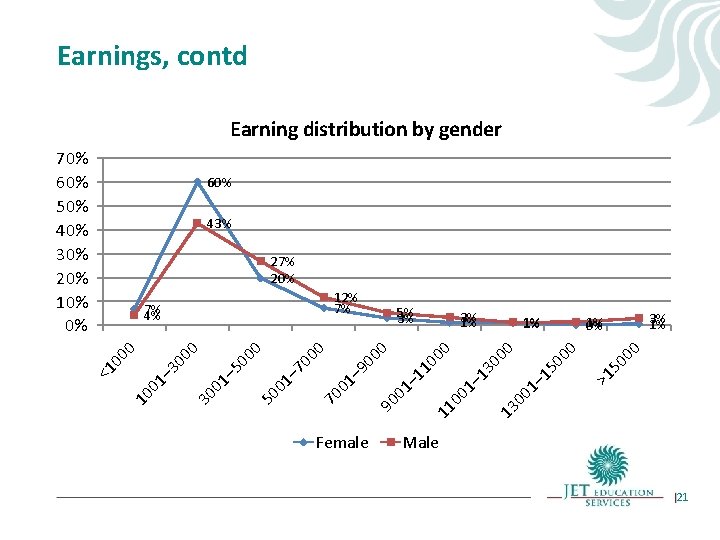
Earnings, contd Earning distribution by gender 70% 60% 50% 40% 30% 20% 10% 0% 60% 43% 27% 20% 00 00 1– 15 50 0 0 00 11 00 1– 13 00 00 – 1 1 01 3% 1% 1% 0% 1% >1 3% 1% 0 0 Female 90 – 9 70 01 00 – 7 01 00 0 0 50 – 5 30 01 00 – 3 01 10 00 0 0 00 <1 5% 3% 13 12% 7% 7% 4% Male 21
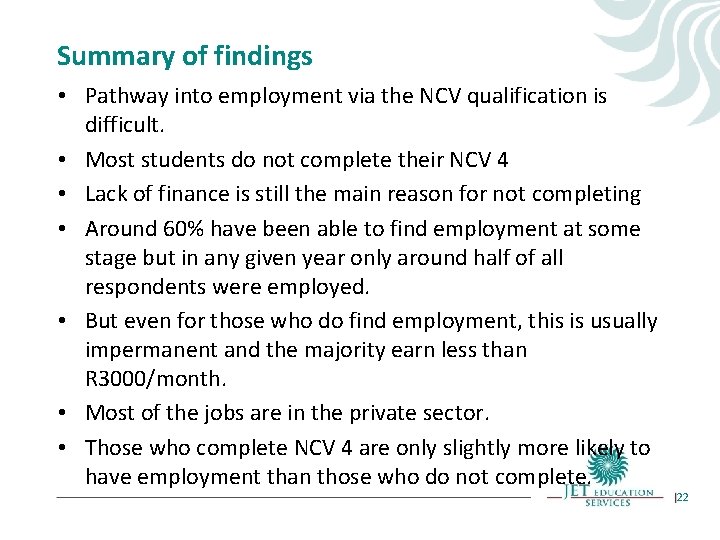
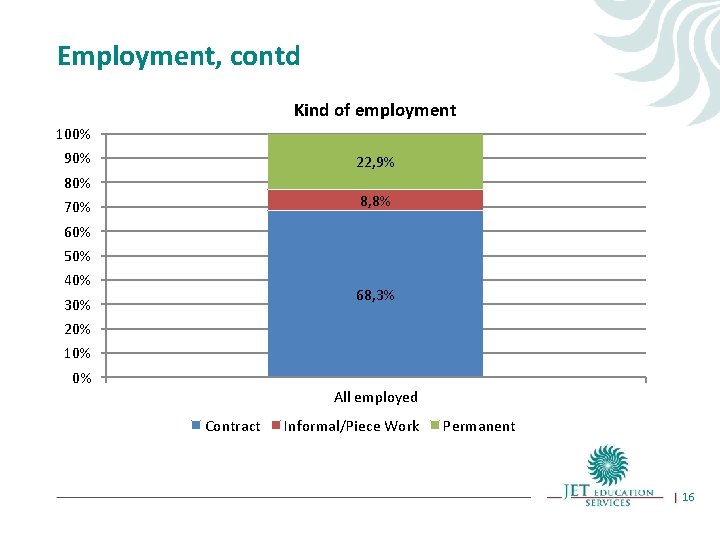
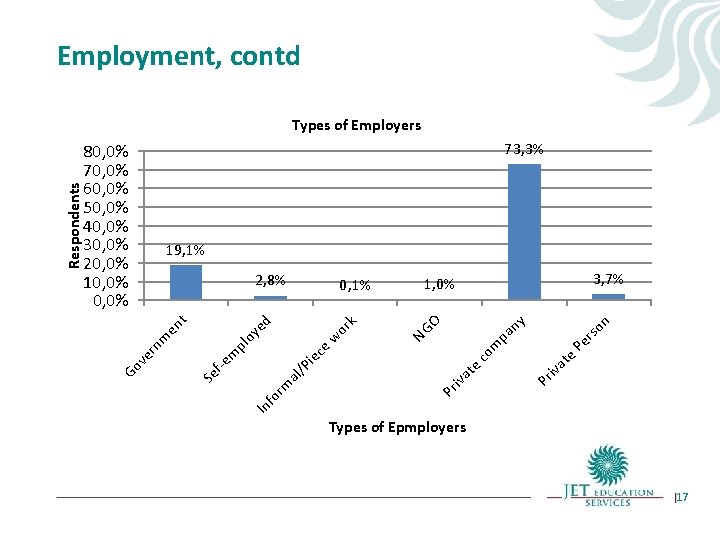
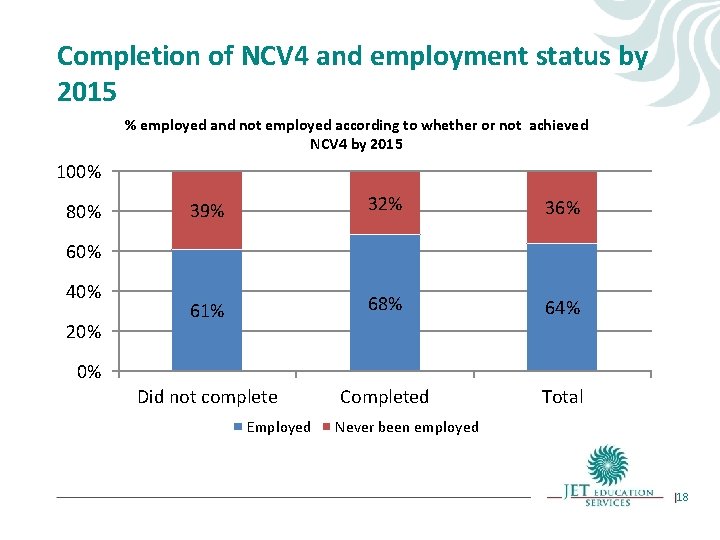
Summary of findings • Pathway into employment via the NCV qualification is difficult. • Most students do not complete their NCV 4 • Lack of finance is still the main reason for not completing • Around 60% have been able to find employment at some stage but in any given year only around half of all respondents were employed. • But even for those who do find employment, this is usually impermanent and the majority earn less than R 3000/month. • Most of the jobs are in the private sector. • Those who complete NCV 4 are only slightly more likely to have employment than those who do not complete. 22

www. jet. org. za info@jet. org. za
- Slides: 23