
UNDERSTANDING PARTICIPANTS AS CONSUMERS Why Do We Participate

- Slides: 32
UNDERSTANDING PARTICIPANTS AS CONSUMERS
Why Do We Participate? • Personal Improvement – Better health, sense of accomplishment, develop positive values, etc. • Sport Appreciation – Enjoy the game and competition • Social Facilitation – Spend time with others, feel like part of a group
Adult Sport Participant Market: General Observations • Majority of American adults do not participate in many of the most common sports • Numbers conflicting; Surgeon General’s Report (only 15% of adults say that they exercise regularly) • Why?
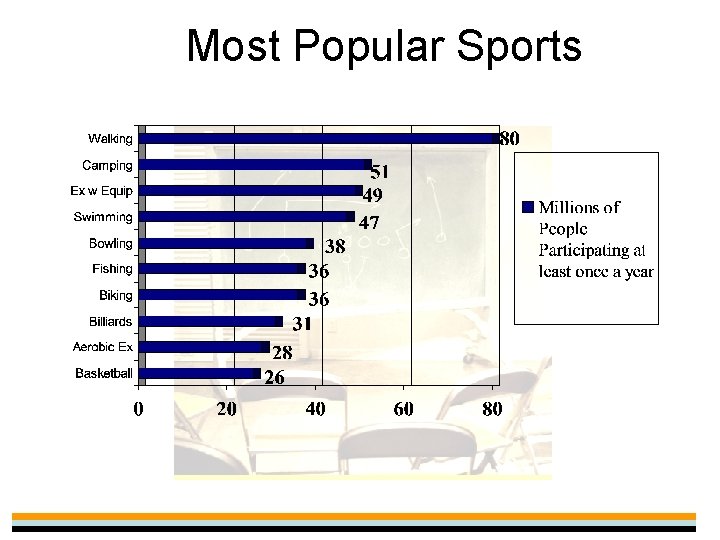
Most Popular Sports
Participant Consumption Behavior • Actions performed when searching for, participating in, and evaluating the sports activities that consumers believe will satisfy their needs and desires • Attempts to understand participant consumption behavior focus on: – Why consumers participate in certain sports – What are the benefits – When, where, and how often they participate
Sports Participant Behavior a Subset of Consumer Behavior (CB) • What is consumer behavior? • What does the "black box" view of consumers imply? • Why are models of consumer behavior important? • How can a model of consumer behavior be constructed? • What are some examples of models of consumer behavior?
Model of Buying Behavior • Marketing factors and other stimuli are inputs into the “buyer’s black box” • Stimuli are evaluated in light of the buyer’s decision process and characteristics • Buyer responses influence choice of the product, brand, vendor, as well as the timing and amount of purchase
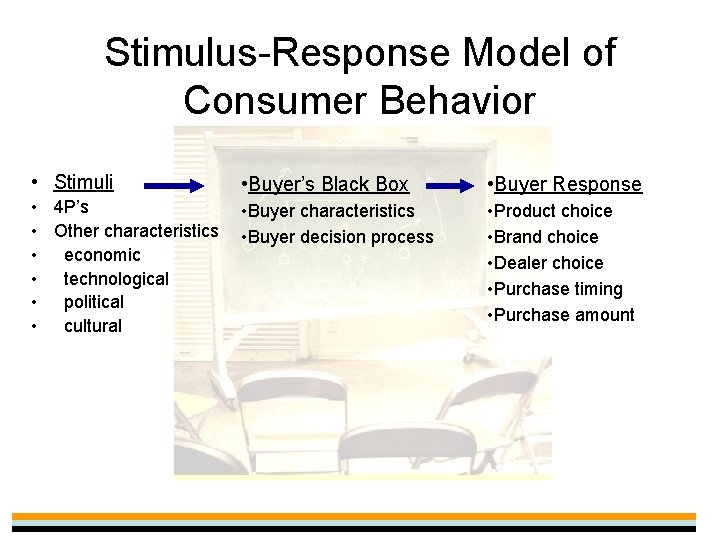
Stimulus-Response Model of Consumer Behavior • Stimuli • Buyer’s Black Box • Buyer Response • 4 P’s • Other characteristics • economic • technological • political • cultural • Buyer characteristics • Buyer decision process • Product choice • Brand choice • Dealer choice • Purchase timing • Purchase amount
CB Models Simplest CB models have 3 stages: 1. Prepurchase Need recognition, evaluation 2. Consumption Purchase, use or experience, disposal 3. Post-purchase
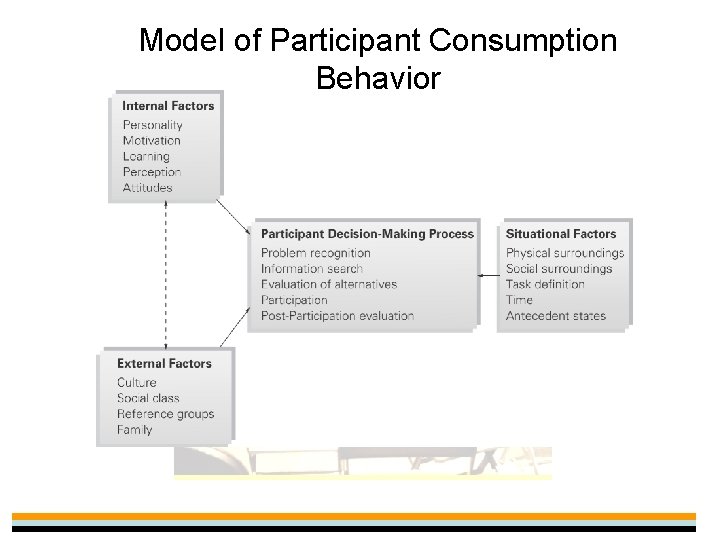
Model of Participant Consumption Behavior
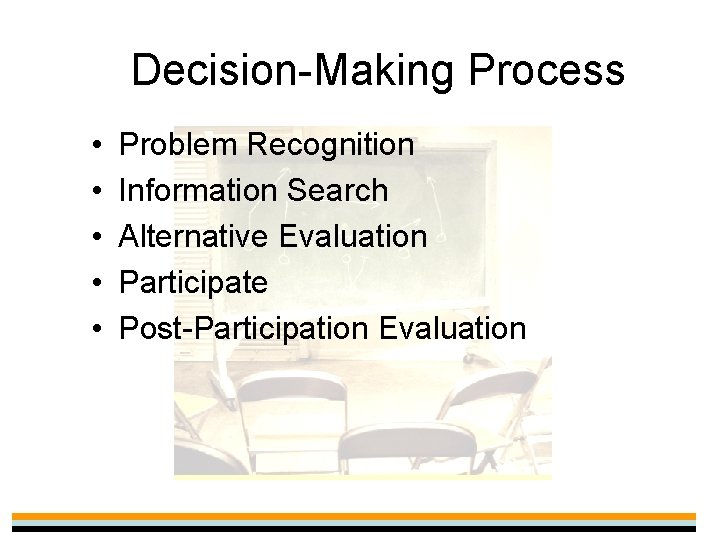
Decision-Making Process • • • Problem Recognition Information Search Alternative Evaluation Participate Post-Participation Evaluation
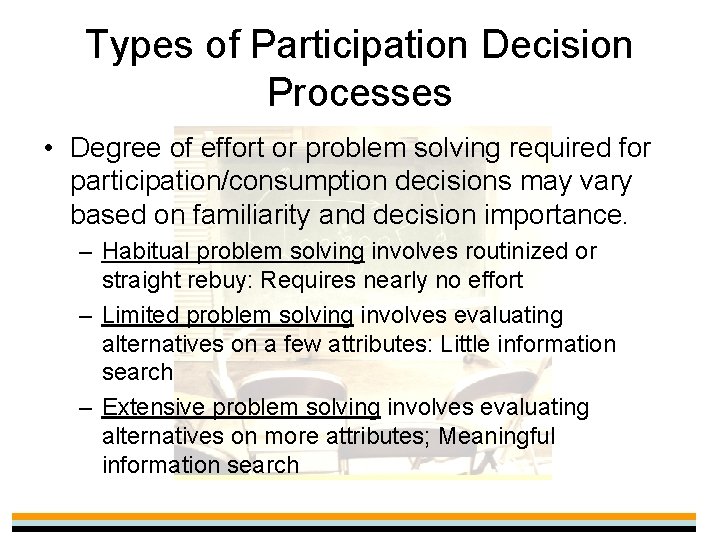
Types of Participation Decision Processes • Degree of effort or problem solving required for participation/consumption decisions may vary based on familiarity and decision importance. – Habitual problem solving involves routinized or straight rebuy: Requires nearly no effort – Limited problem solving involves evaluating alternatives on a few attributes: Little information search – Extensive problem solving involves evaluating alternatives on more attributes; Meaningful information search
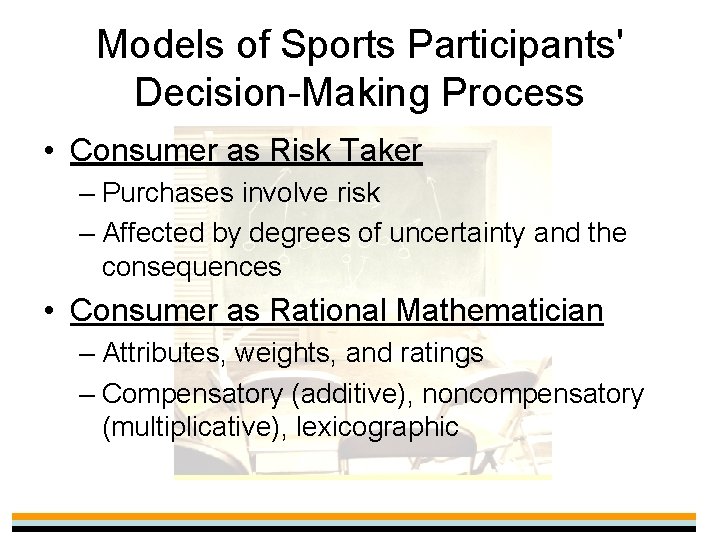
Models of Sports Participants' Decision-Making Process • Consumer as Risk Taker – Purchases involve risk – Affected by degrees of uncertainty and the consequences • Consumer as Rational Mathematician – Attributes, weights, and ratings – Compensatory (additive), noncompensatory (multiplicative), lexicographic
Are Consumers Rational? • Economists expect consumers will maximize their own utility, but from what do consumers obtain utility? – Examples: Coffee mug and chocolate bar
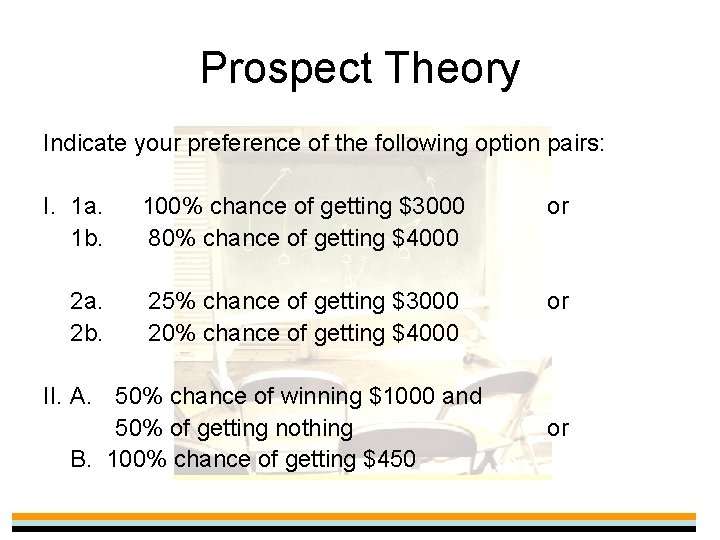
Prospect Theory Indicate your preference of the following option pairs: I. 1 a. 1 b. 100% chance of getting $3000 80% chance of getting $4000 or 2 a. 2 b. 25% chance of getting $3000 20% chance of getting $4000 or II. A. 50% chance of winning $1000 and 50% of getting nothing B. 100% chance of getting $450 or
Internal (Psychological) Factors • • • Personality Motivation (for fulfillment of needs) Perception Learning Beliefs and attitudes Unique to each person
Personality & Self-Concept • Personality: unique psychological characteristics that lead to relatively consistent and lasting responses to one’s environment • Generally defined in terms of traits • Self-concept suggests that people’s possessions contribute to and reflect their identities • Useful for segmentation
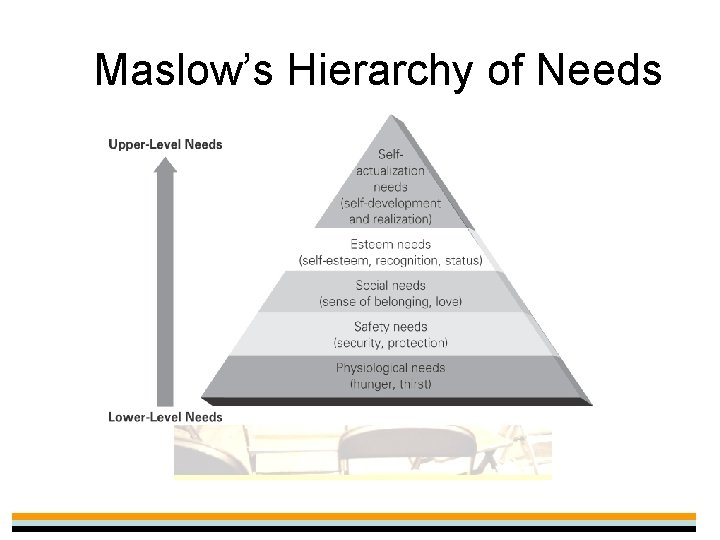
Motives and Needs • A motive (or drive) is a need that is sufficiently pressing to direct the person to seek satisfaction • Can vary across people and cultures • Maslow’s hierarchy of needs explains why people are driven by needs at particular times • Hierarchy implies that lower level needs must be satisfied prior to higher level needs
Maslow’s Hierarchy of Needs
Perception • Process by which people select, organize, and interpret information to form a meaningful picture of the world – Selective attention – Selective distortion – Selective retention
Learning • Relatively permanent change in behavior due to experience • Interplay of drives, stimuli, cues, responses, and reinforcement – – Drives: Internal stimulus that calls for action Stimuli: Objects that move drive to motive Cues: Minor stimuli that affect response Reinforcement: Feedback on action • Strongly influenced by behavioral consequences (classical and operant conditioning) – Behaviors with satisfying results tend to be repeated – Behaviors with unsatisfying results tend to be avoided
Beliefs and Attitudes • Belief – Descriptive thought about a brand or service – May be based on real knowledge, opinion, or faith • Attitude – Describes a person’s evaluations, feelings and tendencies toward an object or idea – Difficult to change
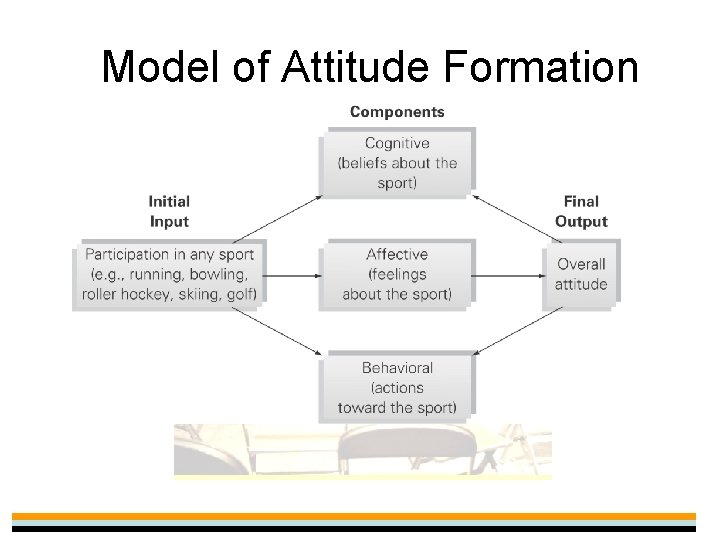
Model of Attitude Formation
External (Sociological) Factors • • Derived from external environments Culture Social class Reference groups
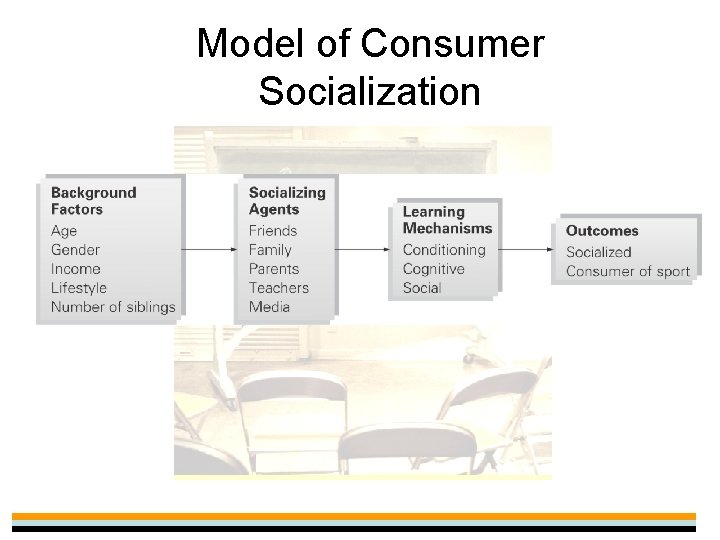
Culture • Culture is the most basic cause of a person's wants and behavior – Learned from family, church, school, peers, and colleagues – Reflects basic values, perceptions, wants, and behaviors – Cultural shifts create opportunities for new products or may otherwise influence consumer behavior – Affects socialization, including sports participation
Subcultures • Groups of people with shared value systems based on common life experiences • Examples of major subcultures in U. S. – Hispanic consumers – African-American consumers – Asian-American consumers – Mature consumers
Social Class • Society’s relatively permanent and ordered divisions whose members share similar values, interests, and behaviors • Measured by a combination of occupation, income, education, wealth, and other variables
Reference Groups • Groups: – People who influence the information, attitudes, and behaviors of other group members – Types: • • Family Membership Reference (Opinion Leaders) Aspirational – Includes athlete role models
Model of Consumer Socialization
Situational Factors • Temporary factors in a particular time or place • Physical surroundings – Location, weather, facilities, etc. • Social surroundings – e. g. , Who is present? , crowds • Time – constraints and availability • Reason for participation • Antecedent states – Physiological (e. g. , energy, aches and pains) – Psychological (e. g. , moods)
Personal Factors • Age and Life-Cycle Stage – People change things bought during lifetimes • Occupation – Influences purchase of clothing and other goods • Economic Situation – Some goods and services especially incomesensitive
Personal Factors (cont. ) • Lifestyle – Pattern of living as expressed in psychographics • Activities • Interests • Opinions