
Understanding Operating Systems Fifth Edition Chapter 3 Memory
- Slides: 50
Understanding Operating Systems Fifth Edition Chapter 3 Memory Management: Virtual Memory
Introduction • Evolution of virtual memory – Paged, demand paging, segmented/demand paging – Foundation for current virtual memory methods • Improvement areas – Need for continuous program storage – Need for placement of entire program in memory during execution – Fragmentation – Overhead due to relocation Understanding Operating Systems, Fifth Edition 2
Introduction (continued) • Page replacement policies – First-In First-Out – Least Recently Used • Clock replacement and bit-shifting – Mechanics of paging – The working set • Virtual memory – Concepts and advantages • Cache memory – Concepts and advantages Understanding Operating Systems, Fifth Edition 3
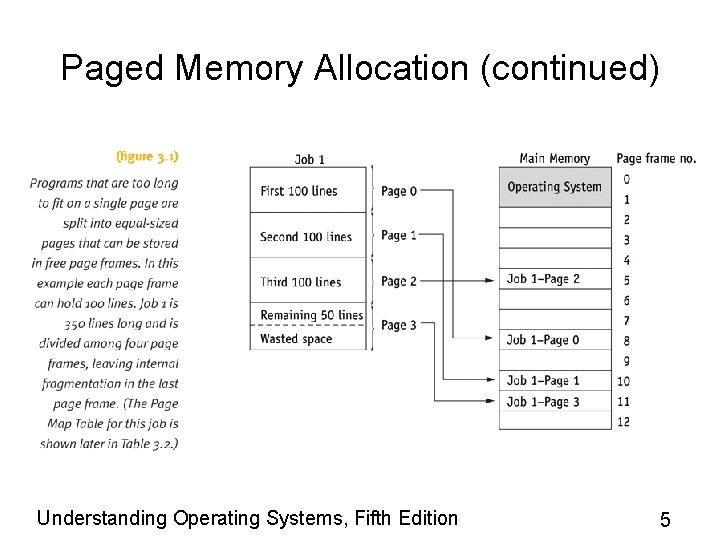
Paged Memory Allocation • Divides each incoming job into pages of equal size • Best condition – Page size = Memory block size (page frames) = Size of disk section (sector, block) • Sizes depend on operating system and disk sector size • Memory manager tasks prior to program execution – Determines number of pages in program – Locates enough empty page frames in main memory – Loads all program pages into page frames • Advantage of storing program noncontiguously – New problem: keeping track of job’s pages Understanding Operating Systems, Fifth Edition 4
Paged Memory Allocation (continued) Understanding Operating Systems, Fifth Edition 5
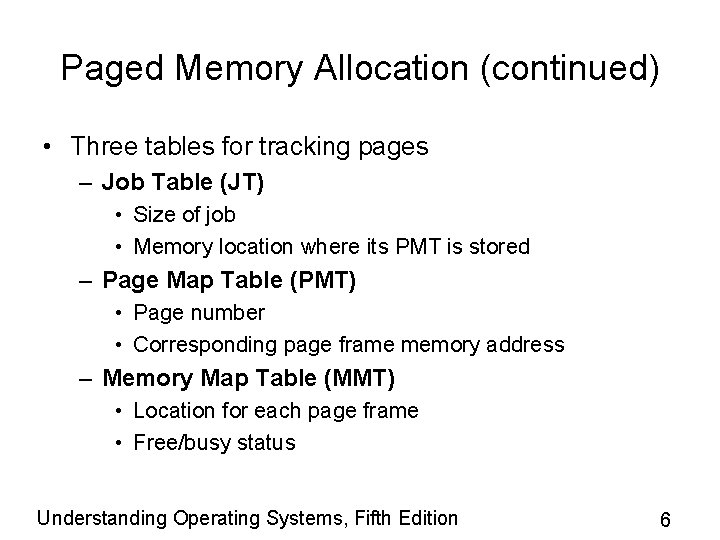
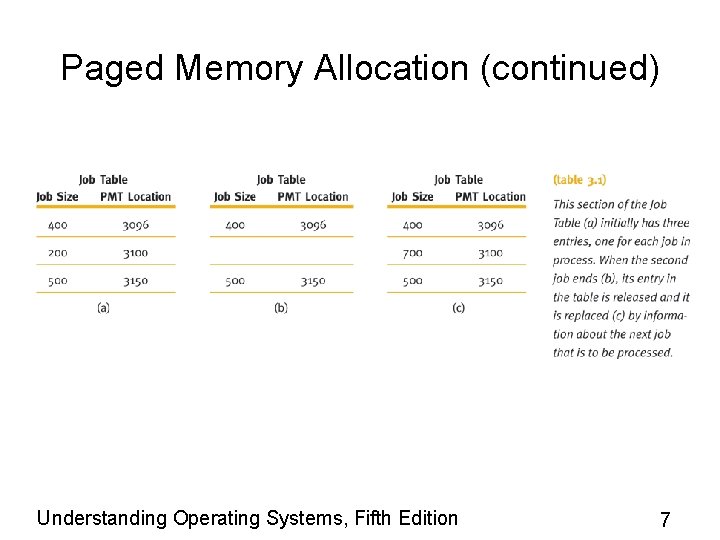
Paged Memory Allocation (continued) • Three tables for tracking pages – Job Table (JT) • Size of job • Memory location where its PMT is stored – Page Map Table (PMT) • Page number • Corresponding page frame memory address – Memory Map Table (MMT) • Location for each page frame • Free/busy status Understanding Operating Systems, Fifth Edition 6
Paged Memory Allocation (continued) Understanding Operating Systems, Fifth Edition 7
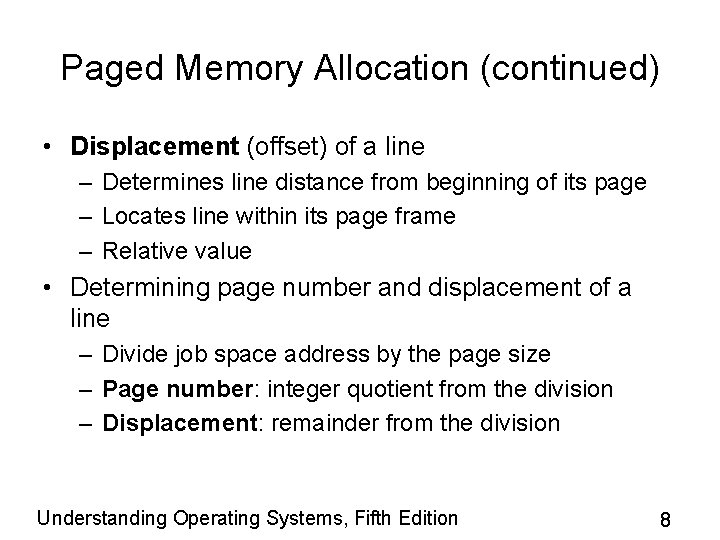
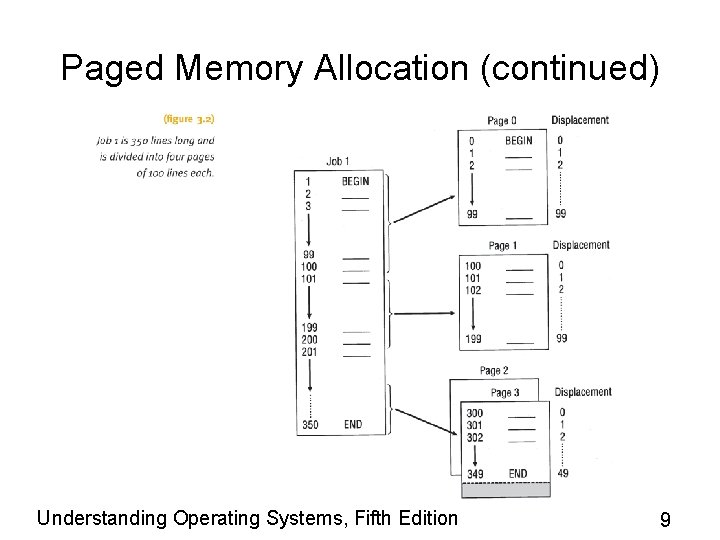
Paged Memory Allocation (continued) • Displacement (offset) of a line – Determines line distance from beginning of its page – Locates line within its page frame – Relative value • Determining page number and displacement of a line – Divide job space address by the page size – Page number: integer quotient from the division – Displacement: remainder from the division Understanding Operating Systems, Fifth Edition 8
Paged Memory Allocation (continued) Understanding Operating Systems, Fifth Edition 9
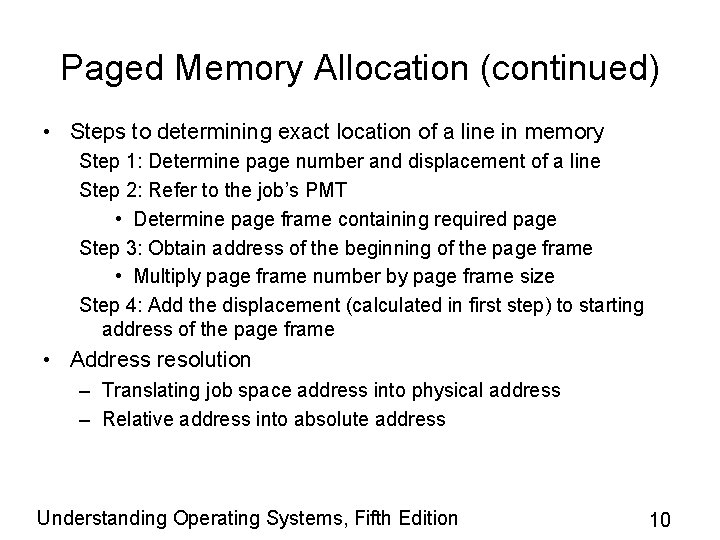
Paged Memory Allocation (continued) • Steps to determining exact location of a line in memory Step 1: Determine page number and displacement of a line Step 2: Refer to the job’s PMT • Determine page frame containing required page Step 3: Obtain address of the beginning of the page frame • Multiply page frame number by page frame size Step 4: Add the displacement (calculated in first step) to starting address of the page frame • Address resolution – Translating job space address into physical address – Relative address into absolute address Understanding Operating Systems, Fifth Edition 10
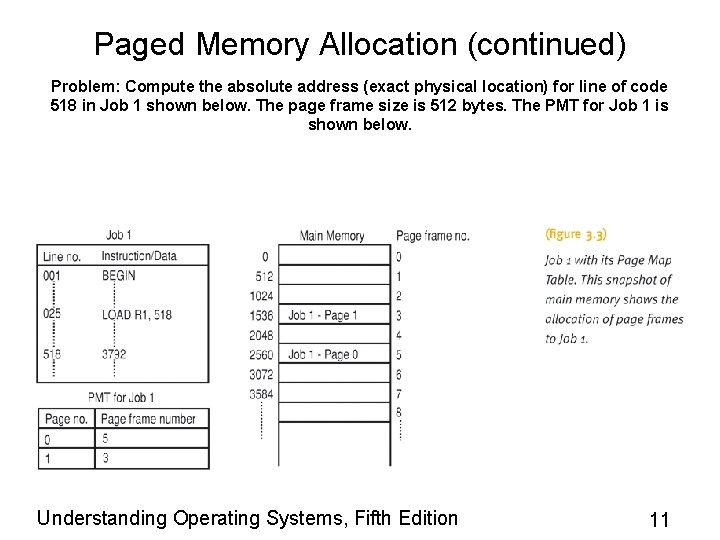
Paged Memory Allocation (continued) Problem: Compute the absolute address (exact physical location) for line of code 518 in Job 1 shown below. The page frame size is 512 bytes. The PMT for Job 1 is shown below. Understanding Operating Systems, Fifth Edition 11
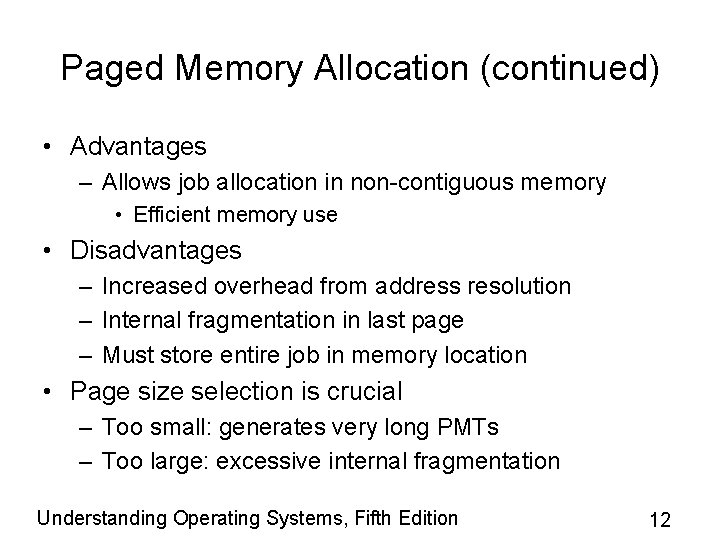
Paged Memory Allocation (continued) • Advantages – Allows job allocation in non-contiguous memory • Efficient memory use • Disadvantages – Increased overhead from address resolution – Internal fragmentation in last page – Must store entire job in memory location • Page size selection is crucial – Too small: generates very long PMTs – Too large: excessive internal fragmentation Understanding Operating Systems, Fifth Edition 12
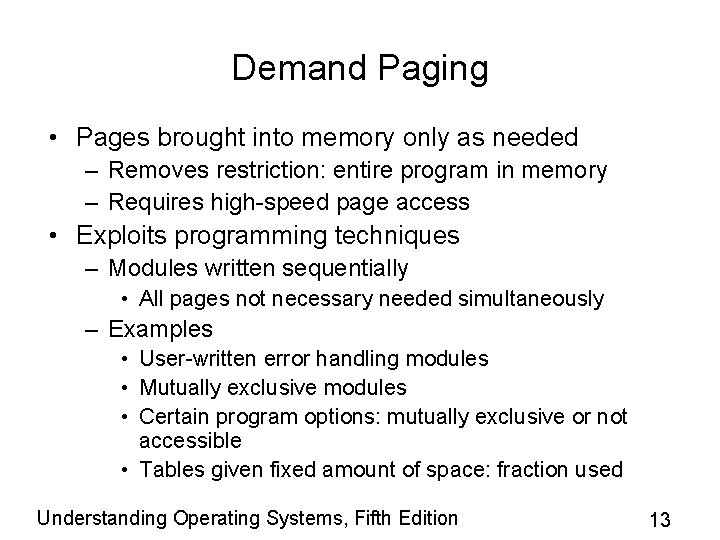
Demand Paging • Pages brought into memory only as needed – Removes restriction: entire program in memory – Requires high-speed page access • Exploits programming techniques – Modules written sequentially • All pages not necessary needed simultaneously – Examples • User-written error handling modules • Mutually exclusive modules • Certain program options: mutually exclusive or not accessible • Tables given fixed amount of space: fraction used Understanding Operating Systems, Fifth Edition 13
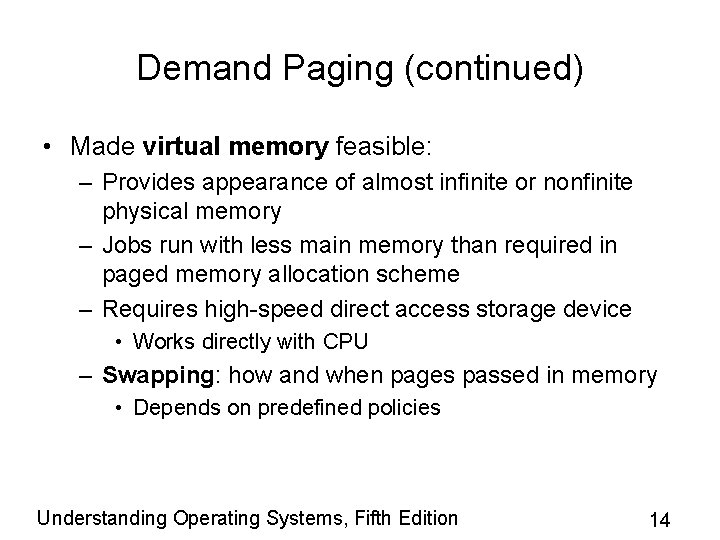
Demand Paging (continued) • Made virtual memory feasible: – Provides appearance of almost infinite or nonfinite physical memory – Jobs run with less main memory than required in paged memory allocation scheme – Requires high-speed direct access storage device • Works directly with CPU – Swapping: how and when pages passed in memory • Depends on predefined policies Understanding Operating Systems, Fifth Edition 14
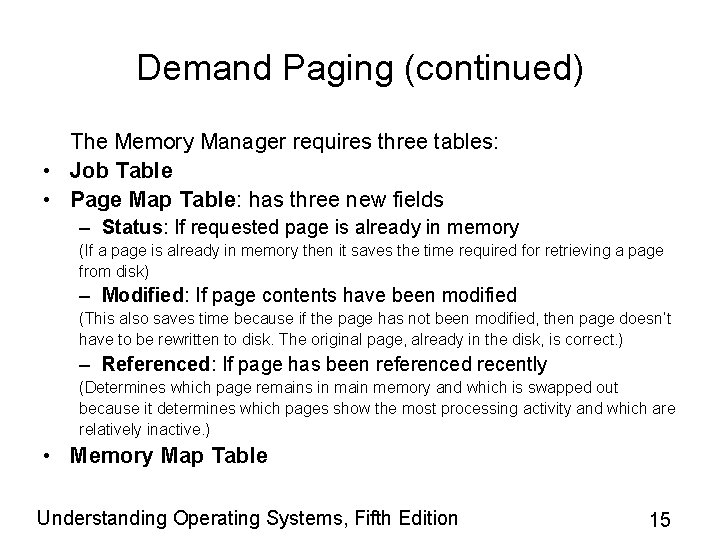
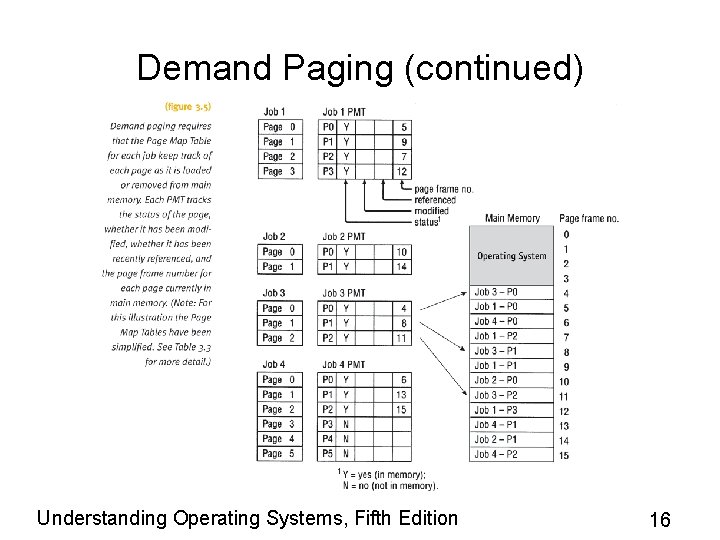
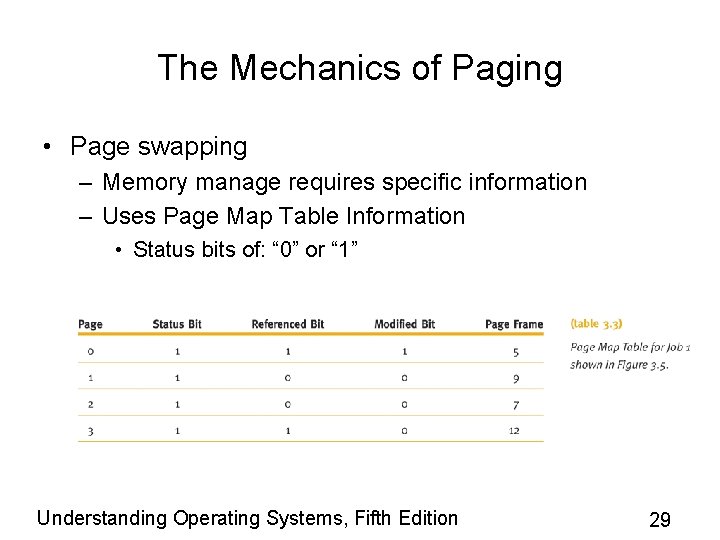
Demand Paging (continued) The Memory Manager requires three tables: • Job Table • Page Map Table: has three new fields – Status: If requested page is already in memory (If a page is already in memory then it saves the time required for retrieving a page from disk) – Modified: If page contents have been modified (This also saves time because if the page has not been modified, then page doesn’t have to be rewritten to disk. The original page, already in the disk, is correct. ) – Referenced: If page has been referenced recently (Determines which page remains in main memory and which is swapped out because it determines which pages show the most processing activity and which are relatively inactive. ) • Memory Map Table Understanding Operating Systems, Fifth Edition 15
Demand Paging (continued) Understanding Operating Systems, Fifth Edition 16
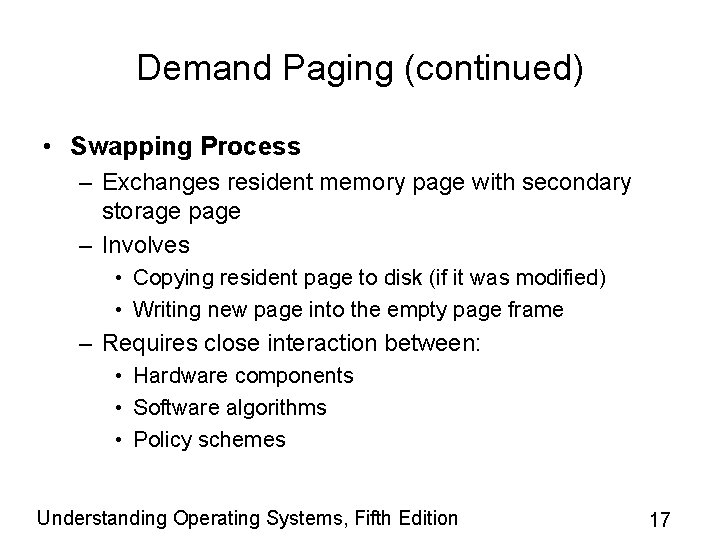
Demand Paging (continued) • Swapping Process – Exchanges resident memory page with secondary storage page – Involves • Copying resident page to disk (if it was modified) • Writing new page into the empty page frame – Requires close interaction between: • Hardware components • Software algorithms • Policy schemes Understanding Operating Systems, Fifth Edition 17
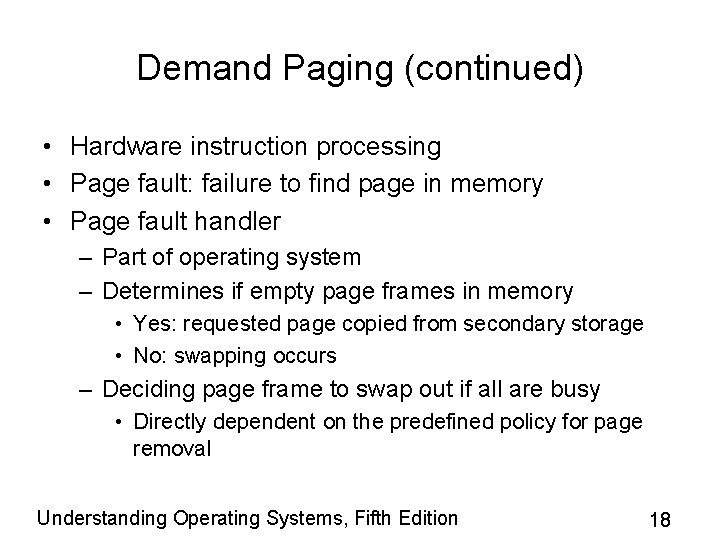
Demand Paging (continued) • Hardware instruction processing • Page fault: failure to find page in memory • Page fault handler – Part of operating system – Determines if empty page frames in memory • Yes: requested page copied from secondary storage • No: swapping occurs – Deciding page frame to swap out if all are busy • Directly dependent on the predefined policy for page removal Understanding Operating Systems, Fifth Edition 18
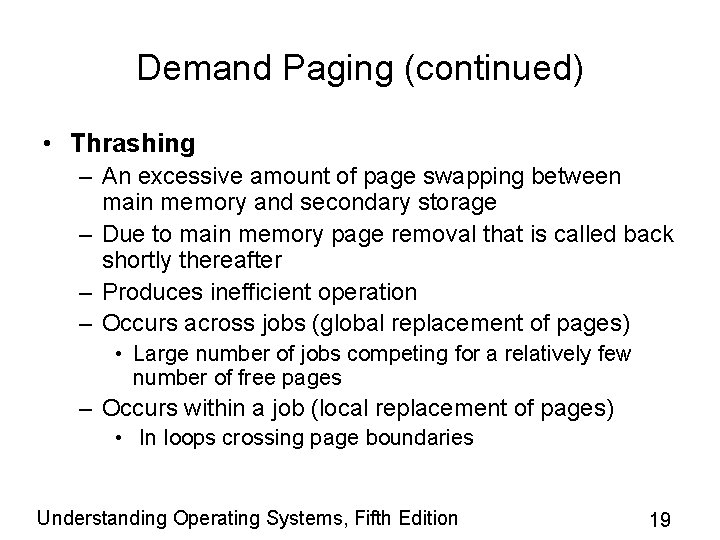
Demand Paging (continued) • Thrashing – An excessive amount of page swapping between main memory and secondary storage – Due to main memory page removal that is called back shortly thereafter – Produces inefficient operation – Occurs across jobs (global replacement of pages) • Large number of jobs competing for a relatively few number of free pages – Occurs within a job (local replacement of pages) • In loops crossing page boundaries Understanding Operating Systems, Fifth Edition 19
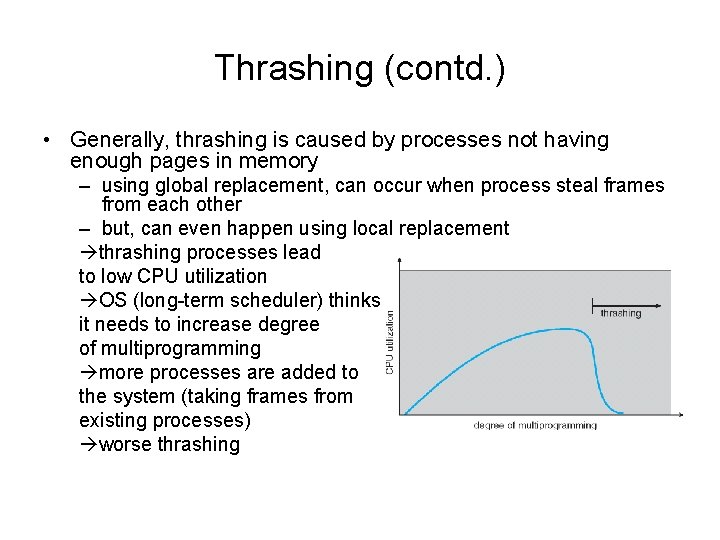
Thrashing (contd. ) • Generally, thrashing is caused by processes not having enough pages in memory – using global replacement, can occur when process steal frames from each other – but, can even happen using local replacement thrashing processes lead to low CPU utilization OS (long-term scheduler) thinks it needs to increase degree of multiprogramming more processes are added to the system (taking frames from existing processes) worse thrashing
Demand Paging (continued) • Advantages – Job no longer constrained by the size of physical memory (concept of virtual memory) – Utilizes memory more efficiently than previous schemes (section of jobs that were seldom or not at all used (such as error routines) weren’t loaded into memory unless they were specifically requested) • Disadvantages – Increased overhead caused by tables and page interrupts Understanding Operating Systems, Fifth Edition 21
Page Replacement Policies and Concepts • Policy to select page removal – Crucial to system efficiency • Page replacement polices – First-In First-Out (FIFO) policy • Best page to remove is one in memory longest – Least Recently Used (LRU) policy • Best page to remove is least recently accessed • Mechanics of paging concepts • The working set concept Understanding Operating Systems, Fifth Edition 22
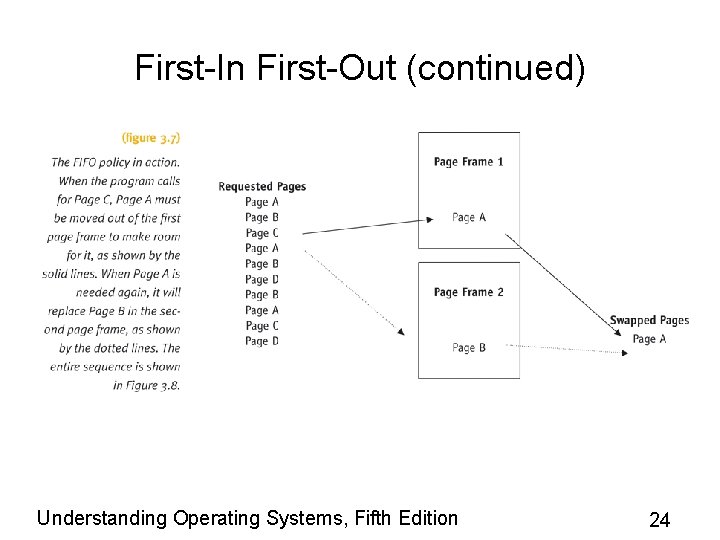
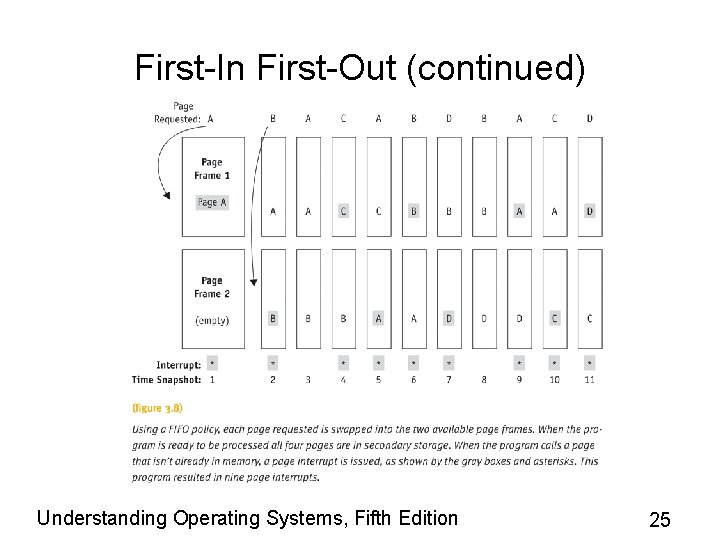
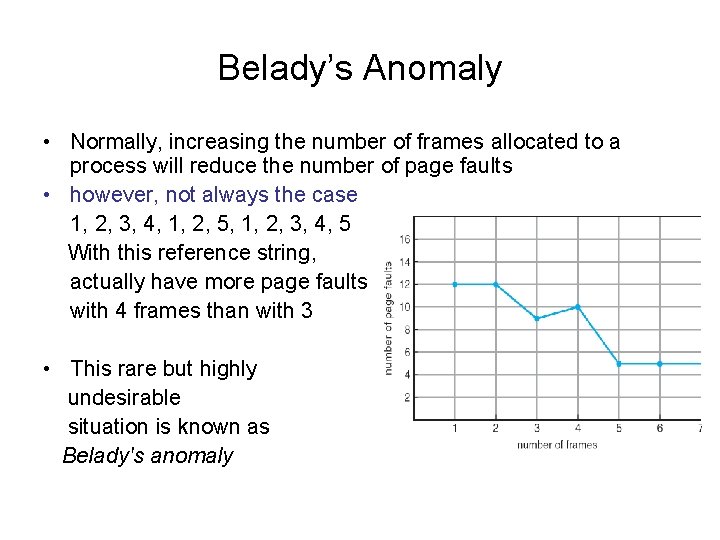
First-In First-Out • Removes page in memory the longest • Efficiency – Ratio of page interrupts to page requests – FIFO example: not so good • Failure rate is 9/11 or 82% or Success rate is 18% • Belady’s/FIFO anomaly – More memory does not lead to better performance Understanding Operating Systems, Fifth Edition 23
First-In First-Out (continued) Understanding Operating Systems, Fifth Edition 24
First-In First-Out (continued) Understanding Operating Systems, Fifth Edition 25
Belady’s Anomaly • Normally, increasing the number of frames allocated to a process will reduce the number of page faults • however, not always the case 1, 2, 3, 4, 1, 2, 5, 1, 2, 3, 4, 5 With this reference string, actually have more page faults with 4 frames than with 3 • This rare but highly undesirable situation is known as Belady's anomaly
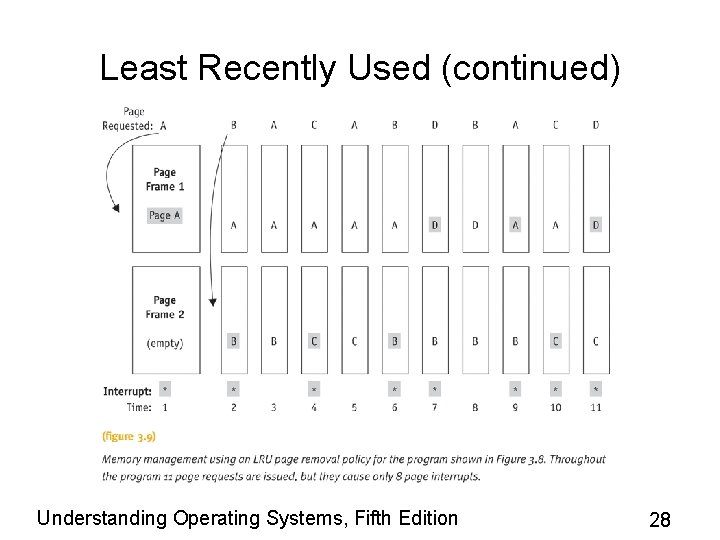
Least Recently Used • Removes page least recently accessed • Efficiency – Causes either decrease in or same number of interrupts – Slightly better (compared to FIFO): 8/11 or 73% • LRU is a stack algorithm removal policy – Increasing main memory will cause either a decrease in or the same number of page interrupts – Does not experience FIFO anomaly Understanding Operating Systems, Fifth Edition 27
Least Recently Used (continued) Understanding Operating Systems, Fifth Edition 28
The Mechanics of Paging • Page swapping – Memory manage requires specific information – Uses Page Map Table Information • Status bits of: “ 0” or “ 1” Understanding Operating Systems, Fifth Edition 29
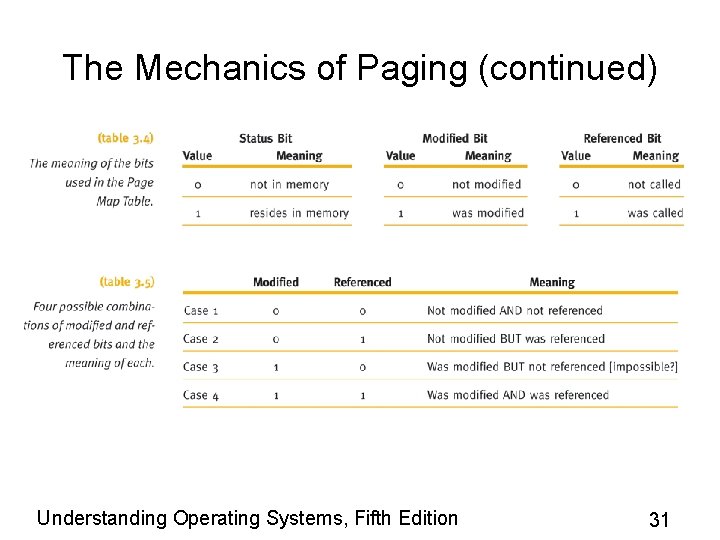
The Mechanics of Paging (continued) • Page map table bit meaning – Status bit • Indicates if page currently in memory – Referenced bit • Indicates if page referenced recently • Used by LRU to determine page to swap – Modified bit • Indicates if page contents altered • Used to determine if page must be rewritten to secondary storage when swapped out • Four combinations of modified and referenced bits Understanding Operating Systems, Fifth Edition 30
The Mechanics of Paging (continued) Understanding Operating Systems, Fifth Edition 31
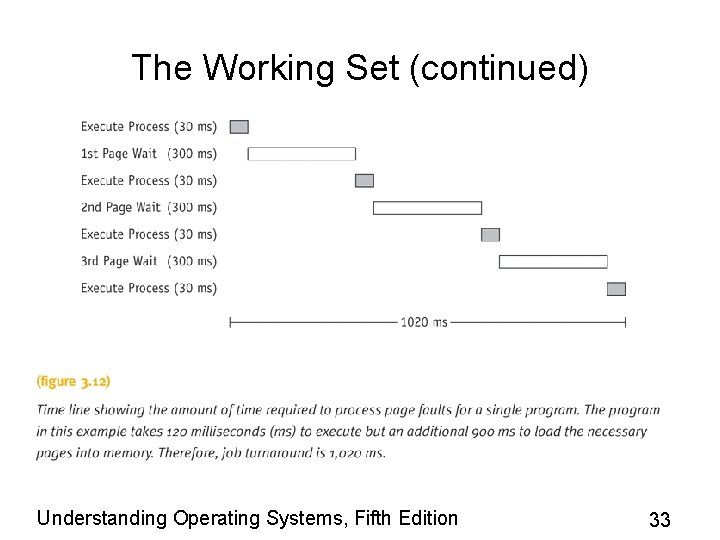
The Working Set • Set of pages residing in memory accessed directly without incurring a page fault – Improves performance of demand page scheme • Requires concept of “locality of reference” – Occurs in well-structured programs • Only small fraction of pages needed during program execution • Time sharing systems considerations • System decides – Number of pages comprising working set – Maximum number of pages allowed for a working set Understanding Operating Systems, Fifth Edition 32
The Working Set (continued) Understanding Operating Systems, Fifth Edition 33
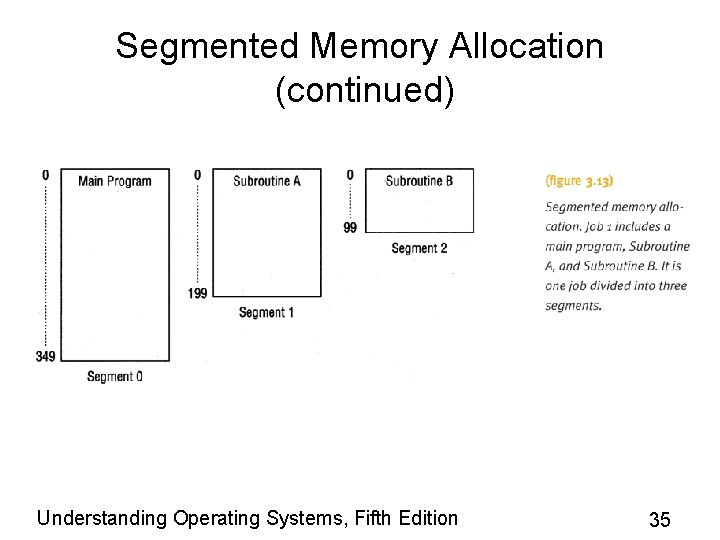
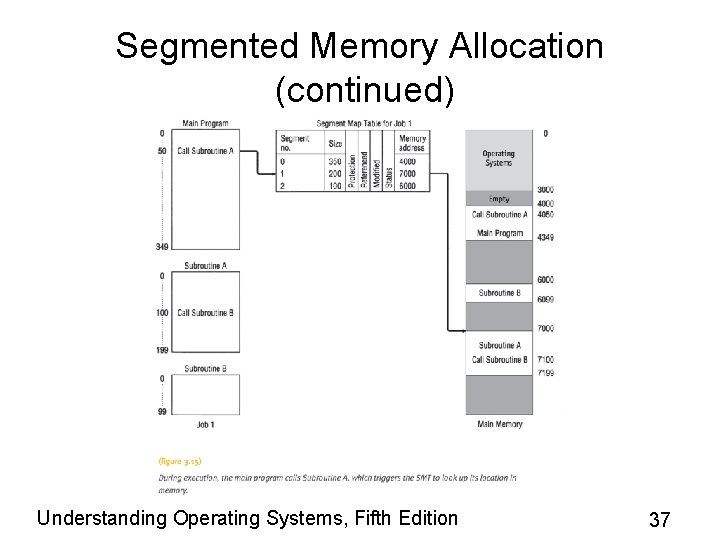
Segmented Memory Allocation • Each job divided into several segments – Segments are different sizes – One for each module containing related functions • Reduces page faults – Segment’s loops not split over two or more pages • Main memory no longer divided into page frames – Now allocated dynamically • Program’s structural modules determine segments – Each segment numbered when compiled/assembled – Segment Map Table (SMT) generated Understanding Operating Systems, Fifth Edition 34
Segmented Memory Allocation (continued) Understanding Operating Systems, Fifth Edition 35
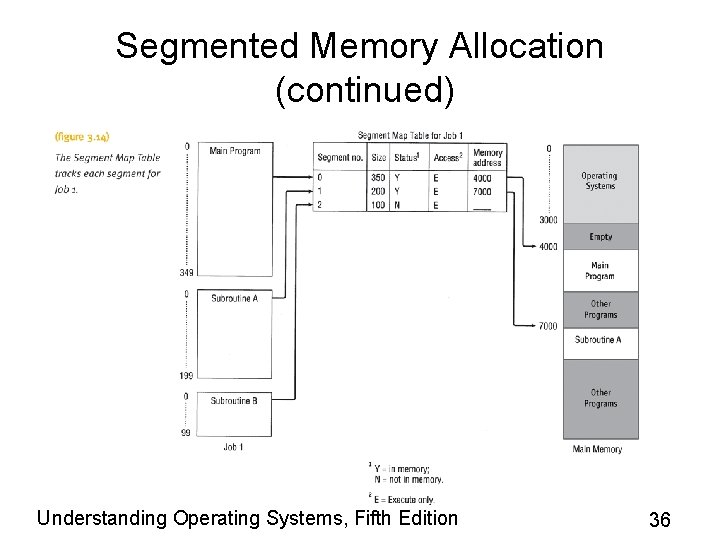
Segmented Memory Allocation (continued) Understanding Operating Systems, Fifth Edition 36
Segmented Memory Allocation (continued) Understanding Operating Systems, Fifth Edition 37
Segmented Memory Allocation (continued) • Memory Manager tracks segments using tables – Job Table • Lists every job in process (one for whole system) – Segment Map Table • Lists details about each segment (one for each job) – Memory Map Table • Monitors allocation of main memory (one for whole system) • Instructions with segments ordered sequentially • Segments not necessarily stored contiguously Understanding Operating Systems, Fifth Edition 38
Segmented Memory Allocation (continued) • Addressing scheme requirement – Segment number and displacement • Advantages – Internal fragmentation is removed – Memory allocated dynamically • Disadvantages – Difficulty managing variable-length segments in secondary storage – External fragmentation Understanding Operating Systems, Fifth Edition 39
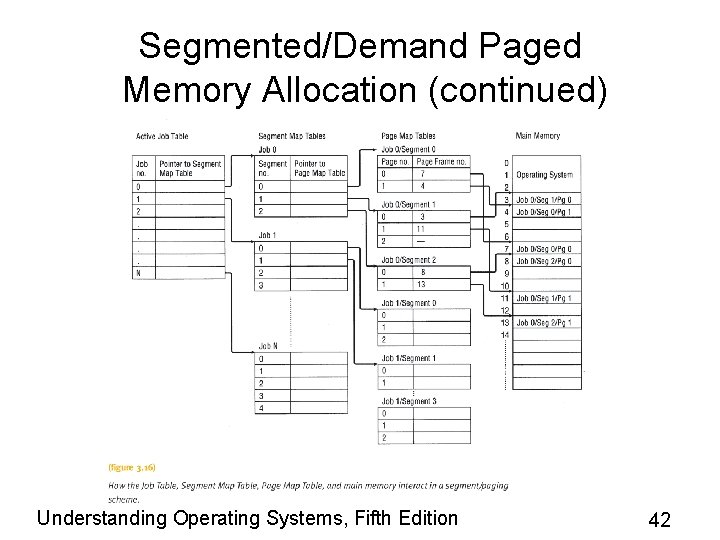
Segmented/Demand Paged Memory Allocation • Subdivides segments into pages of equal size – – Smaller than most segments More easily manipulated than whole segments Logical benefits of segmentation Physical benefits of paging • Segmentation problems removed – Compaction, external fragmentation, secondary storage handling • Addressing scheme requirements – Segment number, page number within that segment, and displacement within that page Understanding Operating Systems, Fifth Edition 40
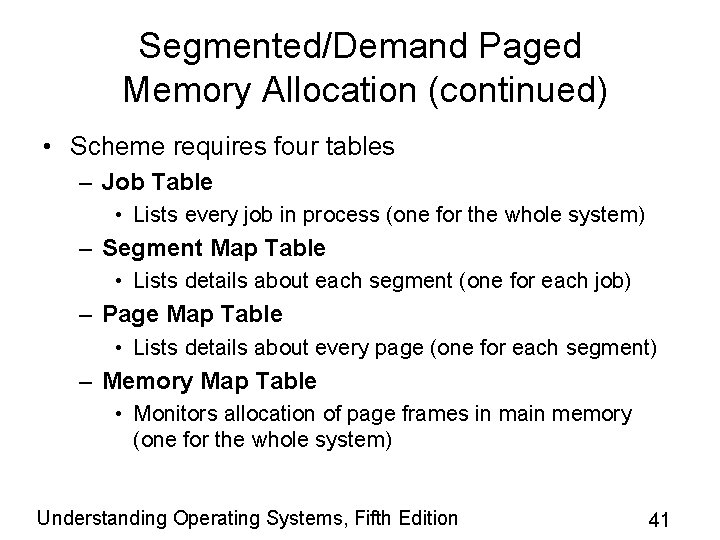
Segmented/Demand Paged Memory Allocation (continued) • Scheme requires four tables – Job Table • Lists every job in process (one for the whole system) – Segment Map Table • Lists details about each segment (one for each job) – Page Map Table • Lists details about every page (one for each segment) – Memory Map Table • Monitors allocation of page frames in main memory (one for the whole system) Understanding Operating Systems, Fifth Edition 41
Segmented/Demand Paged Memory Allocation (continued) Understanding Operating Systems, Fifth Edition 42
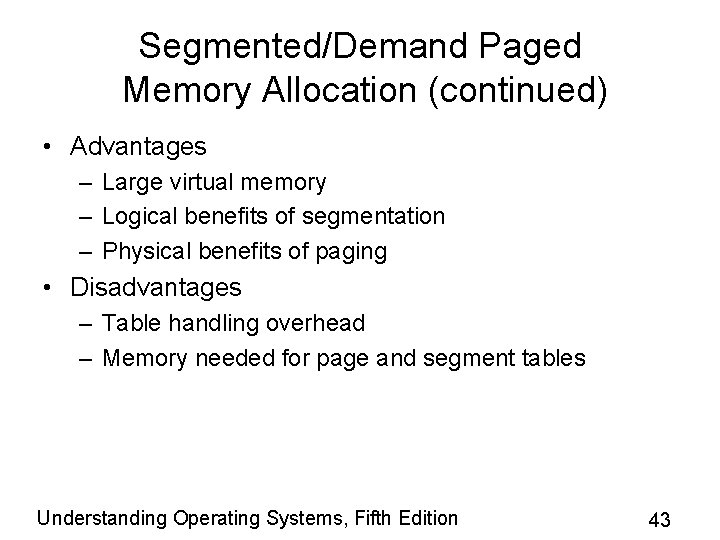
Segmented/Demand Paged Memory Allocation (continued) • Advantages – Large virtual memory – Logical benefits of segmentation – Physical benefits of paging • Disadvantages – Table handling overhead – Memory needed for page and segment tables Understanding Operating Systems, Fifth Edition 43
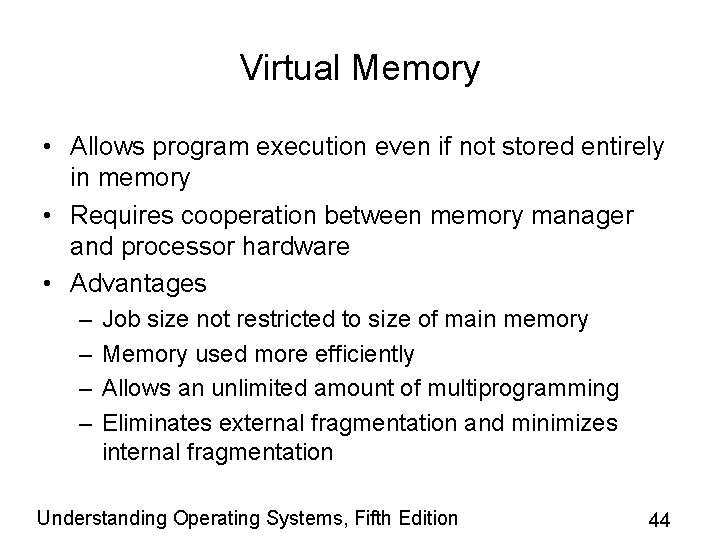
Virtual Memory • Allows program execution even if not stored entirely in memory • Requires cooperation between memory manager and processor hardware • Advantages – – Job size not restricted to size of main memory Memory used more efficiently Allows an unlimited amount of multiprogramming Eliminates external fragmentation and minimizes internal fragmentation Understanding Operating Systems, Fifth Edition 44
Virtual Memory (continued) • Disadvantages – Increased processor hardware costs – Increased overhead for handling paging interrupts – Increased software complexity to prevent thrashing Understanding Operating Systems, Fifth Edition 45
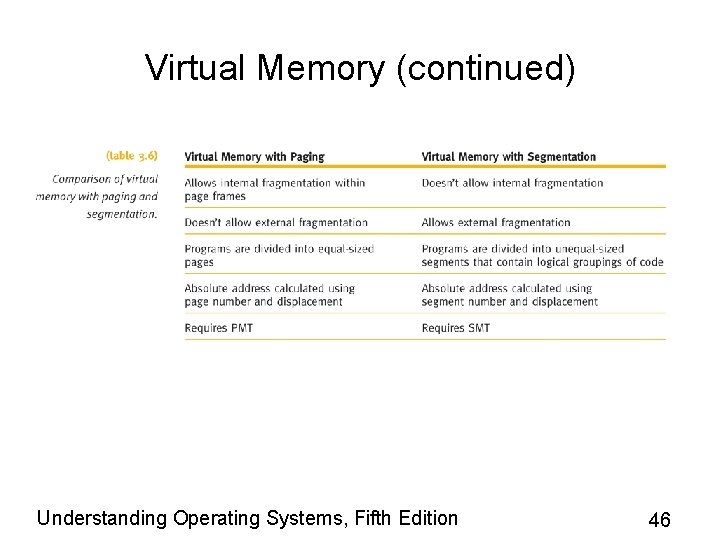
Virtual Memory (continued) Understanding Operating Systems, Fifth Edition 46
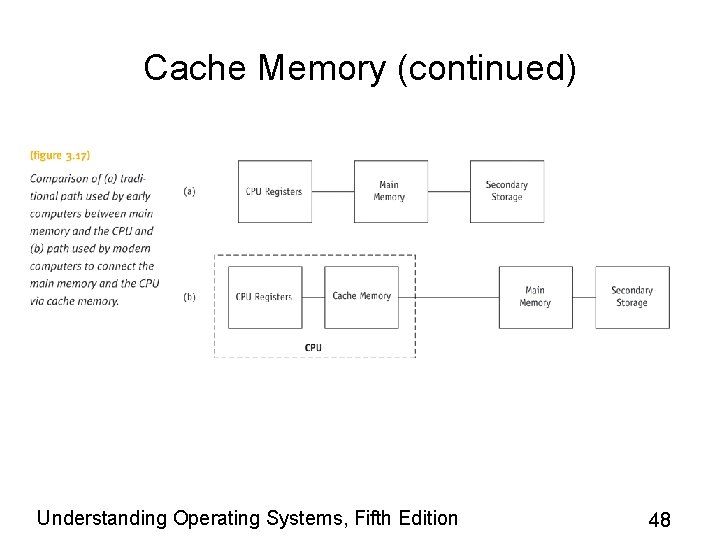
Cache Memory • Small high-speed intermediate memory unit • Performance of computer system increased – Memory access time significantly reduced – Faster processor access compared to main memory – Stores frequently used data and instructions • Two levels of cache – L 2: Connected to CPU; contains copy of bus data – L 1: Pair built into CPU; stores instructions and data • Data/instructions move from main memory to cache – Uses methods similar to paging algorithms Understanding Operating Systems, Fifth Edition 47
Cache Memory (continued) Understanding Operating Systems, Fifth Edition 48
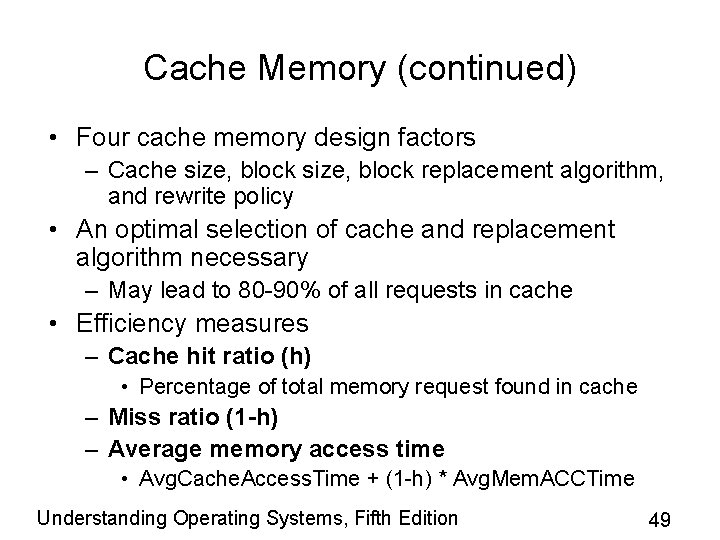
Cache Memory (continued) • Four cache memory design factors – Cache size, block replacement algorithm, and rewrite policy • An optimal selection of cache and replacement algorithm necessary – May lead to 80 -90% of all requests in cache • Efficiency measures – Cache hit ratio (h) • Percentage of total memory request found in cache – Miss ratio (1 -h) – Average memory access time • Avg. Cache. Access. Time + (1 -h) * Avg. Mem. ACCTime Understanding Operating Systems, Fifth Edition 49
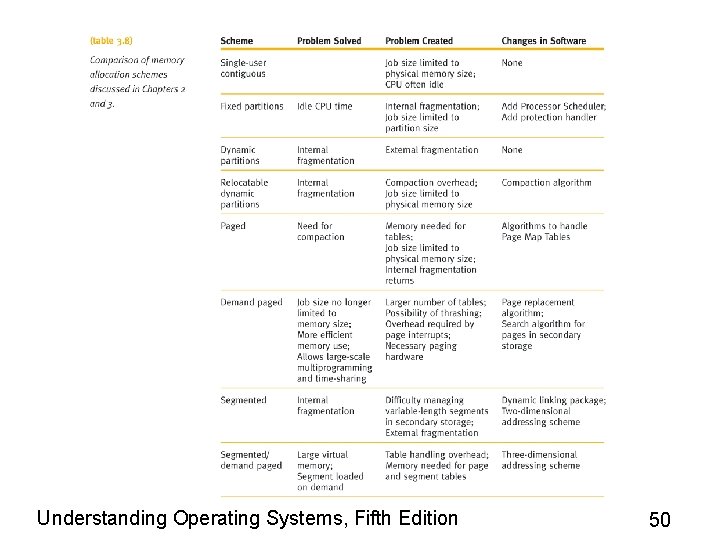
Understanding Operating Systems, Fifth Edition 50