
Understanding neutronrich environments by examining low energy fusion
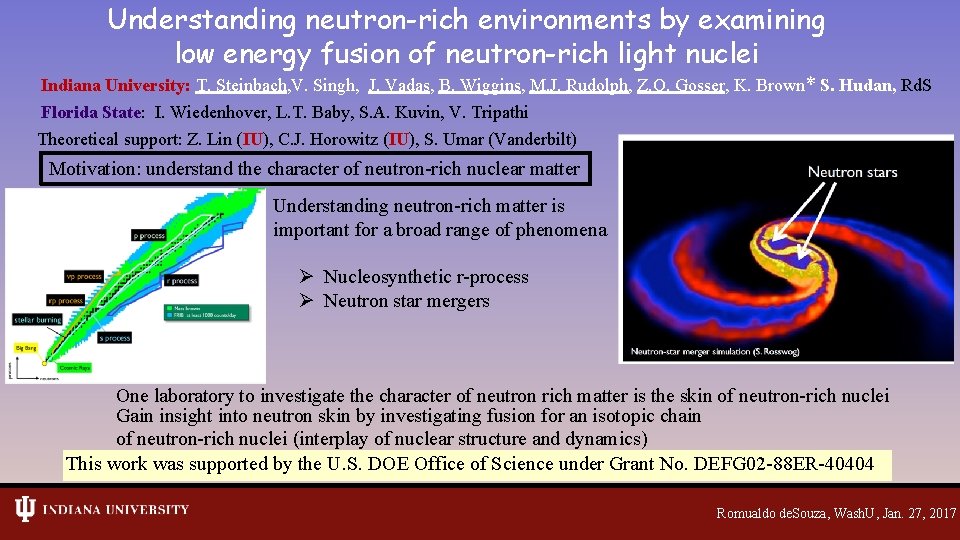
Understanding neutron-rich environments by examining low energy fusion of neutron-rich light nuclei Indiana University: T. Steinbach, V. Singh, J. Vadas, B. Wiggins, M. J. Rudolph, Z. Q. Gosser, K. Brown✼ S. Hudan, Rd. S Florida State: I. Wiedenhover, L. T. Baby, S. A. Kuvin, V. Tripathi Theoretical support: Z. Lin (IU), C. J. Horowitz (IU), S. Umar (Vanderbilt) Motivation: understand the character of neutron-rich nuclear matter Understanding neutron-rich matter is important for a broad range of phenomena Ø Nucleosynthetic r-process Ø Neutron star mergers One laboratory to investigate the character of neutron rich matter is the skin of neutron-rich nuclei Gain insight into neutron skin by investigating fusion for an isotopic chain of neutron-rich nuclei (interplay of nuclear structure and dynamics) This work was supported by the U. S. DOE Office of Science under Grant No. DEFG 02 -88 ER-40404 Romualdo de. Souza, Wash. U, Jan. 27, 2017
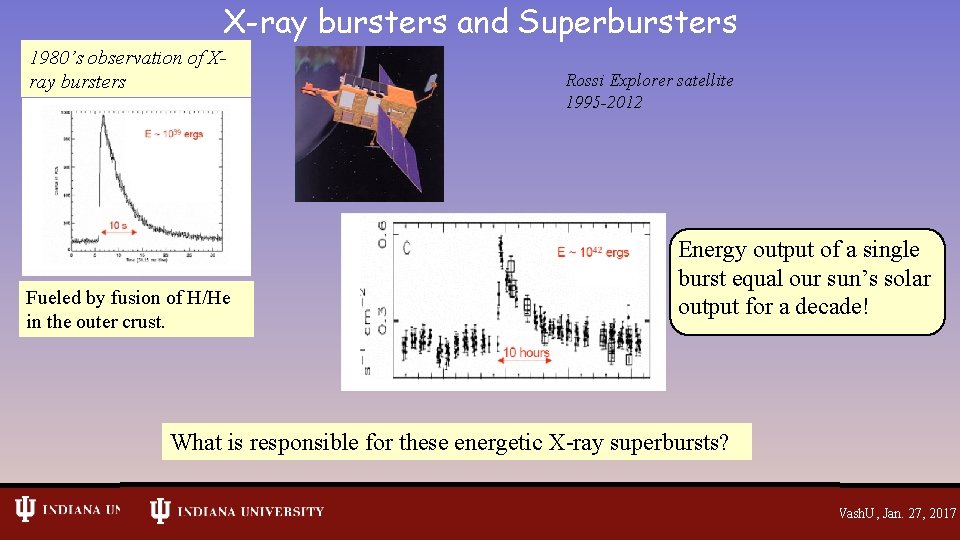
X-ray bursters and Superbursters 1980’s observation of Xray bursters Fueled by fusion of H/He in the outer crust. Rossi Explorer satellite 1995 -2012 Energy output of a single burst equal our sun’s solar output for a decade! What is responsible for these energetic X-ray superbursts? Romualdo de. Souza, Wash. U, Jan. 27, 2017
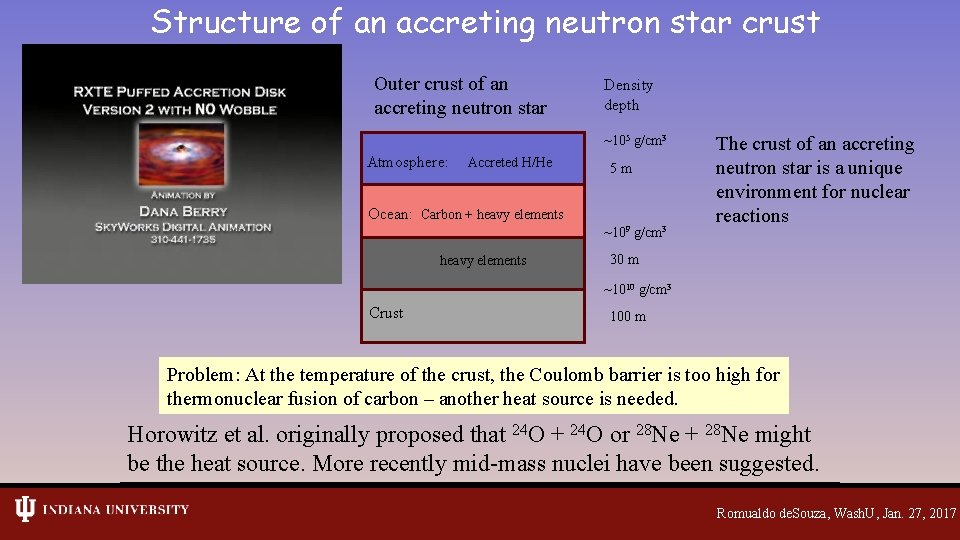
Structure of an accreting neutron star crust Outer crust of an accreting neutron star Density depth ~105 g/cm 3 Atmosphere: Accreted H/He 5 m Ocean: Carbon + heavy elements ~109 g/cm 3 heavy elements The crust of an accreting neutron star is a unique environment for nuclear reactions 30 m ~1010 g/cm 3 Crust 100 m Problem: At the temperature of the crust, the Coulomb barrier is too high for thermonuclear fusion of carbon – another heat source is needed. Horowitz et al. originally proposed that 24 O + 24 O or 28 Ne + 28 Ne might be the heat source. More recently mid-mass nuclei have been suggested. Romualdo de. Souza, Wash. U, Jan. 27, 2017
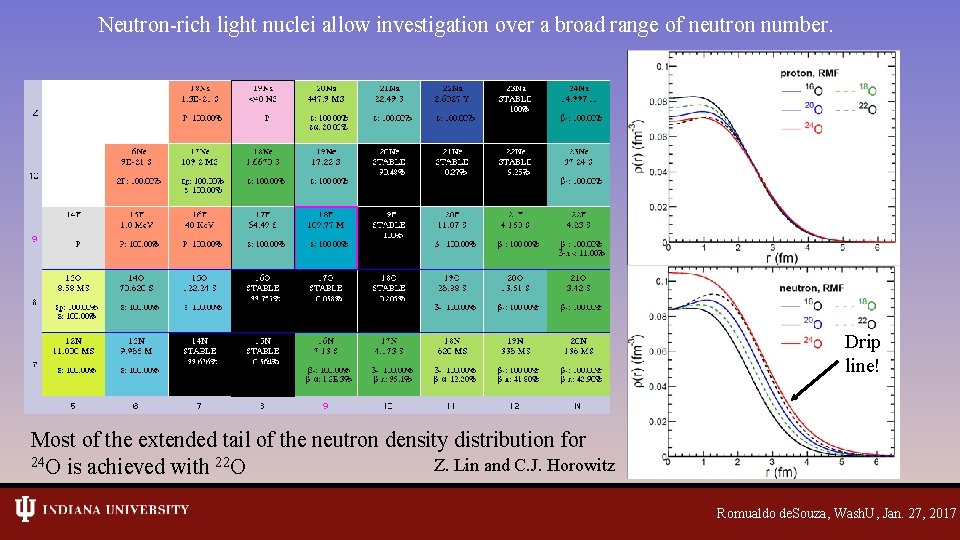
Neutron-rich light nuclei allow investigation over a broad range of neutron number. Drip line! Most of the extended tail of the neutron density distribution for 24 O is achieved with 22 O Z. Lin and C. J. Horowitz Romualdo de. Souza, Wash. U, Jan. 27, 2017
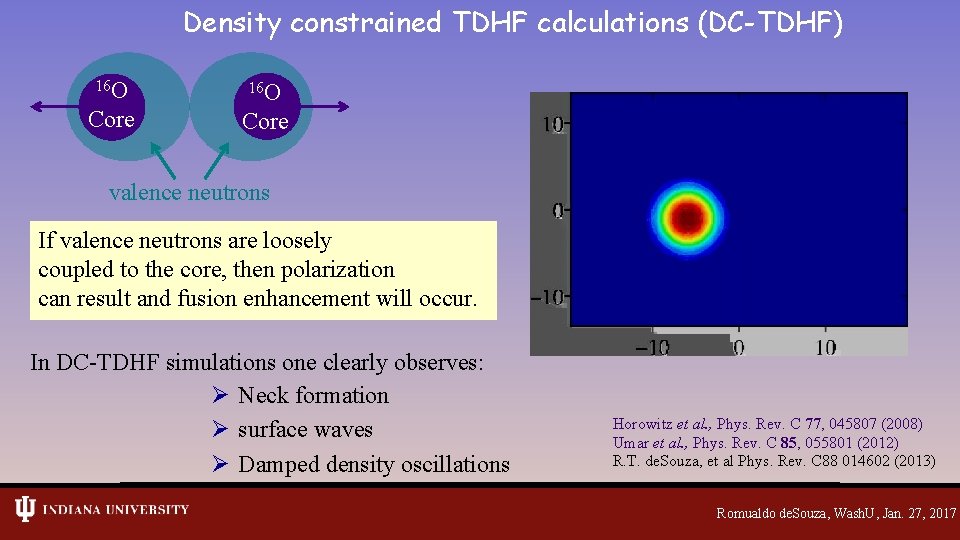
Density constrained TDHF calculations (DC-TDHF) 16 O Core valence neutrons If valence neutrons are loosely coupled to the core, then polarization can result and fusion enhancement will occur. In DC-TDHF simulations one clearly observes: Ø Neck formation Ø surface waves Ø Damped density oscillations Horowitz et al. , Phys. Rev. C 77, 045807 (2008) Umar et al. , Phys. Rev. C 85, 055801 (2012) R. T. de. Souza, et al Phys. Rev. C 88 014602 (2013) Romualdo de. Souza, Wash. U, Jan. 27, 2017
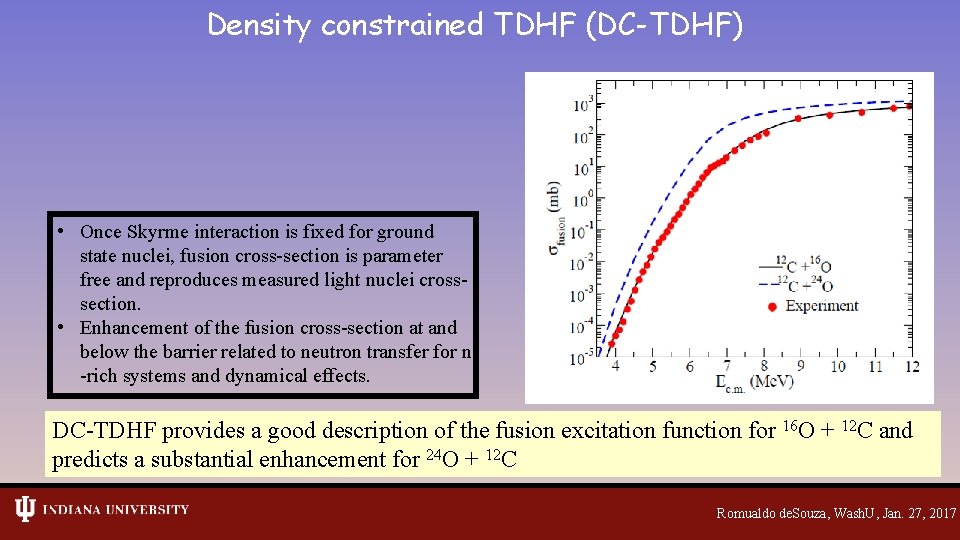
Density constrained TDHF (DC-TDHF) • Once Skyrme interaction is fixed for ground state nuclei, fusion cross-section is parameter free and reproduces measured light nuclei crosssection. • Enhancement of the fusion cross-section at and below the barrier related to neutron transfer for n -rich systems and dynamical effects. DC-TDHF provides a good description of the fusion excitation function for 16 O + 12 C and predicts a substantial enhancement for 24 O + 12 C Romualdo de. Souza, Wash. U, Jan. 27, 2017
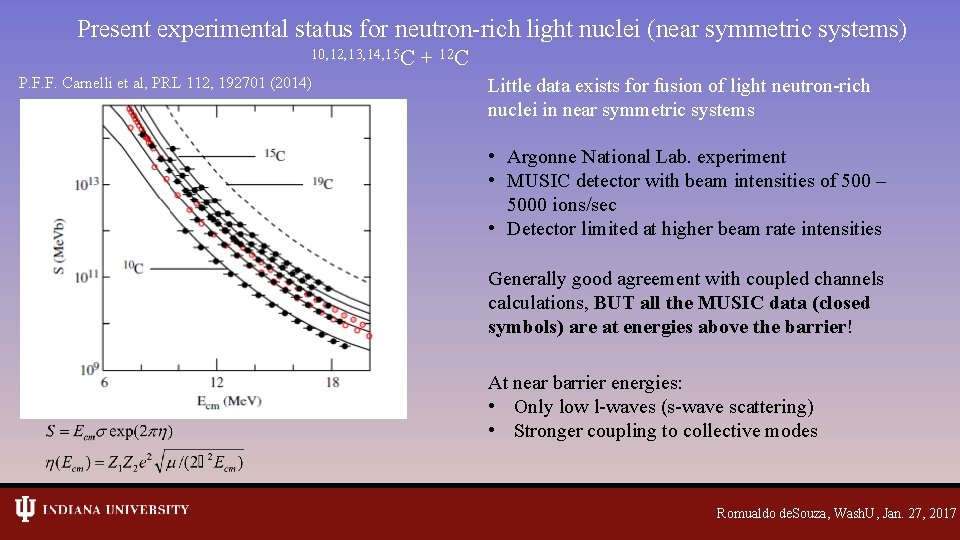
Present experimental status for neutron-rich light nuclei (near symmetric systems) 10, 12, 13, 14, 15 C P. F. F. Carnelli et al, PRL 112, 192701 (2014) + 12 C Little data exists for fusion of light neutron-rich nuclei in near symmetric systems • Argonne National Lab. experiment • MUSIC detector with beam intensities of 500 – 5000 ions/sec • Detector limited at higher beam rate intensities Generally good agreement with coupled channels calculations, BUT all the MUSIC data (closed symbols) are at energies above the barrier! At near barrier energies: • Only low l-waves (s-wave scattering) • Stronger coupling to collective modes Romualdo de. Souza, Wash. U, Jan. 27, 2017
Goal Develop a technique capable of directly measuring the fusion cross-section with a low intensity (103 – 106 ions/s) radioactive beam at near barrier energies (E/A = 1 -3 Me. V/A). Measure the dependence of the fusion cross-section on Ecm (fusion excitation function) Challenges Ø Separating the fusion products from beam (1 part in 107 – 108 at the lowest energy) Ø Low energy of the fusion products Ø Experimental setup should be compact and transportable to make use of different RIB facilities worldwide Approach 1) Develop a highly efficient setup to compensate for the low beam intensity. 2) Demonstrate technique by measuring a well known fusion excitation function : 18 O + 12 C 3) Apply technique to the measurement of more neutron-rich systems : 19, 20, 21 O + 12 C Romualdo de. Souza, Wash. U, Jan. 27, 2017
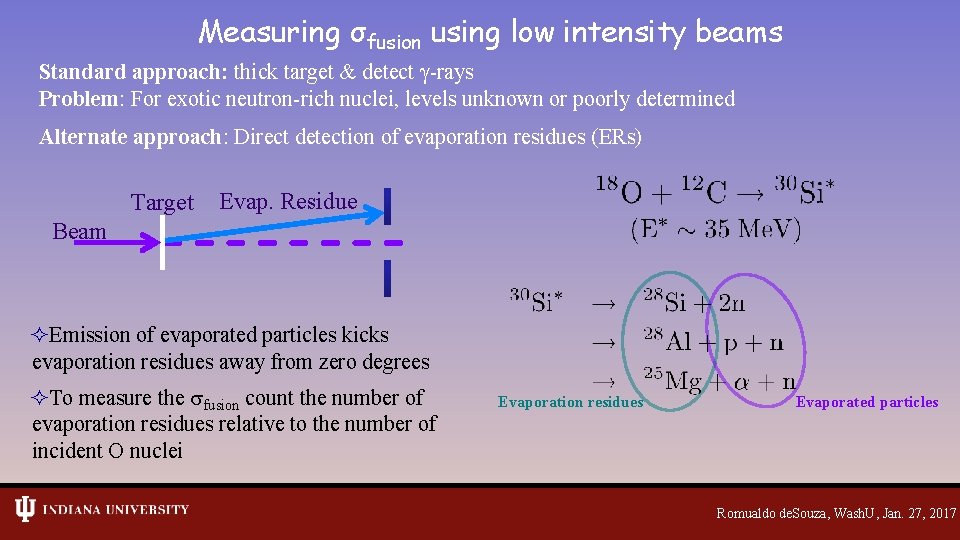
Measuring σfusion using low intensity beams Standard approach: thick target & detect γ-rays Problem: For exotic neutron-rich nuclei, levels unknown or poorly determined Alternate approach: Direct detection of evaporation residues (ERs) Target Evap. Residue Beam ²Emission of evaporated particles kicks evaporation residues away from zero degrees ²To measure the fusion count the number of evaporation residues relative to the number of incident O nuclei Evaporation residues Evaporated particles Romualdo de. Souza, Wash. U, Jan. 27, 2017
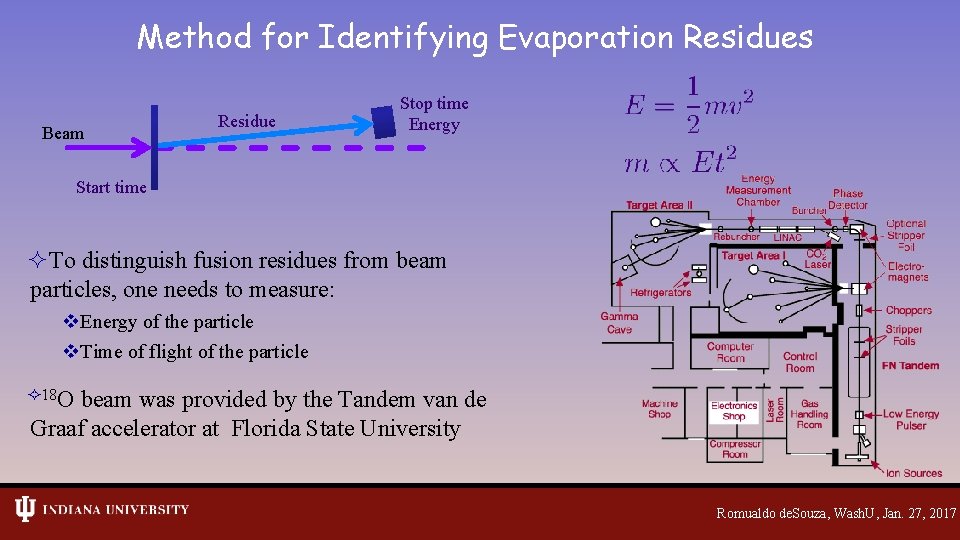
Method for Identifying Evaporation Residues Beam Residue Stop time Energy Start time ²To distinguish fusion residues from beam particles, one needs to measure: v. Energy of the particle v. Time of flight of the particle ² 18 O beam was provided by the Tandem van de Graaf accelerator at Florida State University Romualdo de. Souza, Wash. U, Jan. 27, 2017
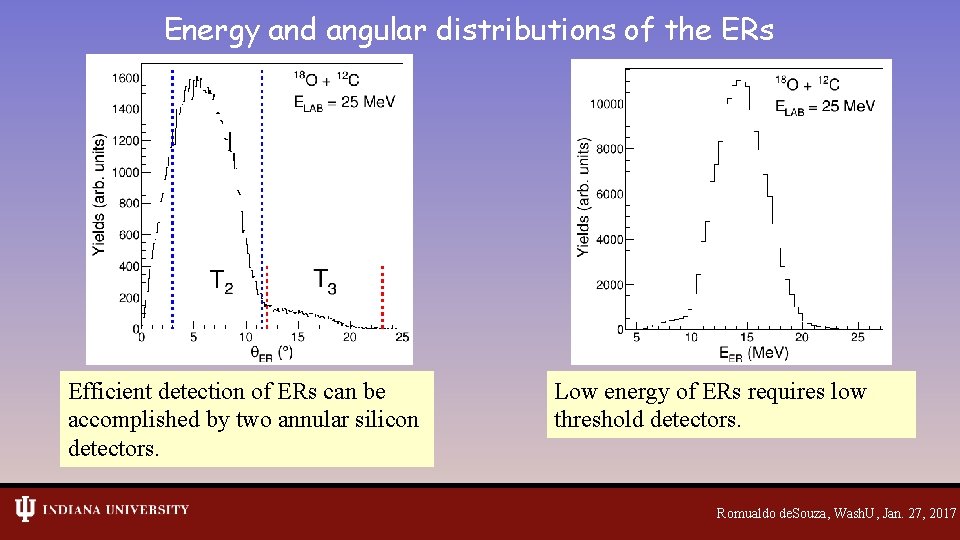
Energy and angular distributions of the ERs Efficient detection of ERs can be accomplished by two annular silicon detectors. Low energy of ERs requires low threshold detectors. Romualdo de. Souza, Wash. U, Jan. 27, 2017
Efficiency of ER detection Efficiency for detection of the ER is high between 75 -80%. Efficiency for detection of ER in coincidence with a proton or alpha particle is 3. 5 – 4% * Addition of coverage at zero degrees would raise efficiency to ~95%. Romualdo de. Souza, Wash. U, Jan. 27, 2017
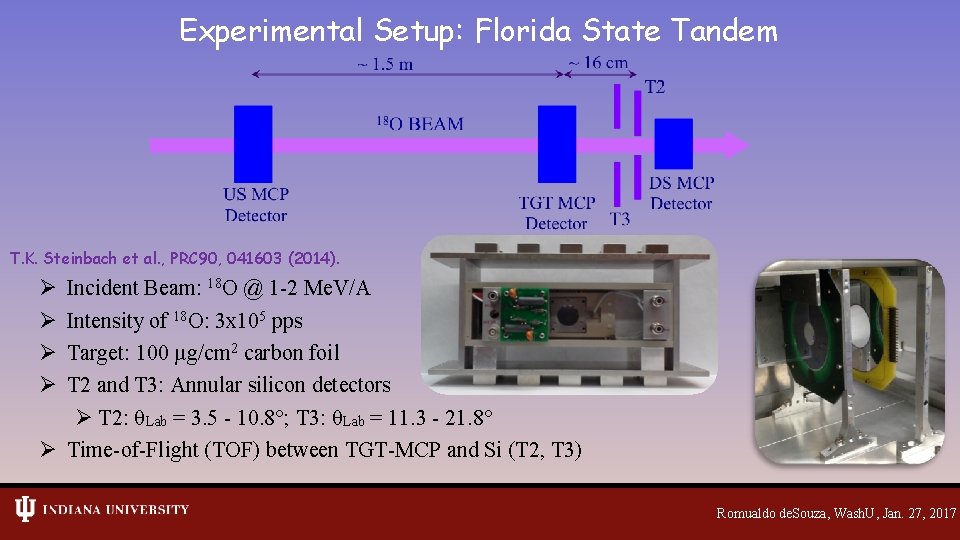
Experimental Setup: Florida State Tandem T. K. Steinbach et al. , PRC 90, 041603 (2014). Ø Ø Incident Beam: 18 O @ 1 -2 Me. V/A Intensity of 18 O: 3 x 10⁵ pps Target: 100 µg/cm 2 carbon foil T 2 and T 3: Annular silicon detectors Ø T 2: θLab = 3. 5 - 10. 8°; T 3: θLab = 11. 3 - 21. 8° Ø Time-of-Flight (TOF) between TGT-MCP and Si (T 2, T 3) Romualdo de. Souza, Wash. U, Jan. 27, 2017
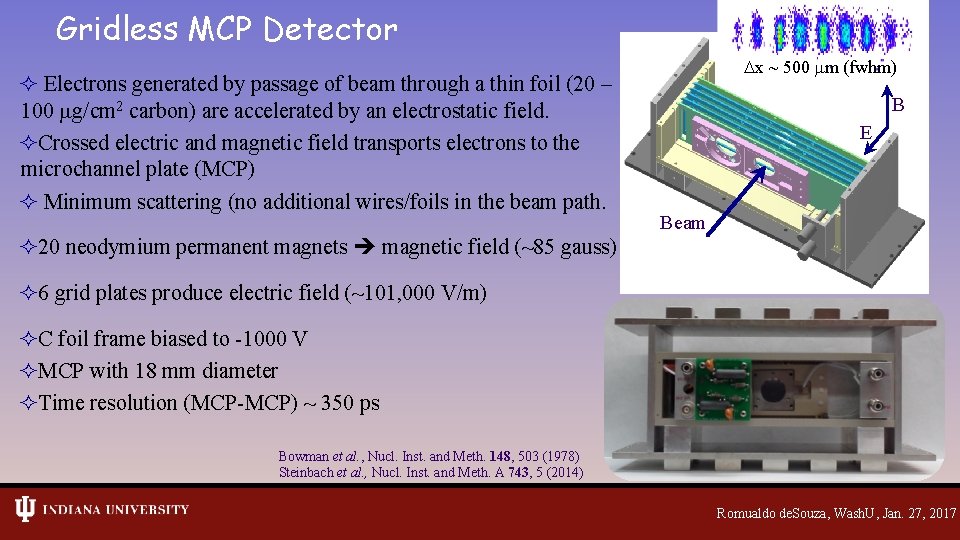
Gridless MCP Detector ² Electrons generated by passage of beam through a thin foil (20 – 100 g/cm 2 carbon) are accelerated by an electrostatic field. ²Crossed electric and magnetic field transports electrons to the microchannel plate (MCP) ² Minimum scattering (no additional wires/foils in the beam path. x ~ 500 m (fwhm) B E Beam ² 20 neodymium permanent magnets magnetic field (~85 gauss) ² 6 grid plates produce electric field (~101, 000 V/m) ²C foil frame biased to -1000 V ²MCP with 18 mm diameter ²Time resolution (MCP-MCP) ~ 350 ps Bowman et al. , Nucl. Inst. and Meth. 148, 503 (1978) Steinbach et al. , Nucl. Inst. and Meth. A 743, 5 (2014) Romualdo de. Souza, Wash. U, Jan. 27, 2017
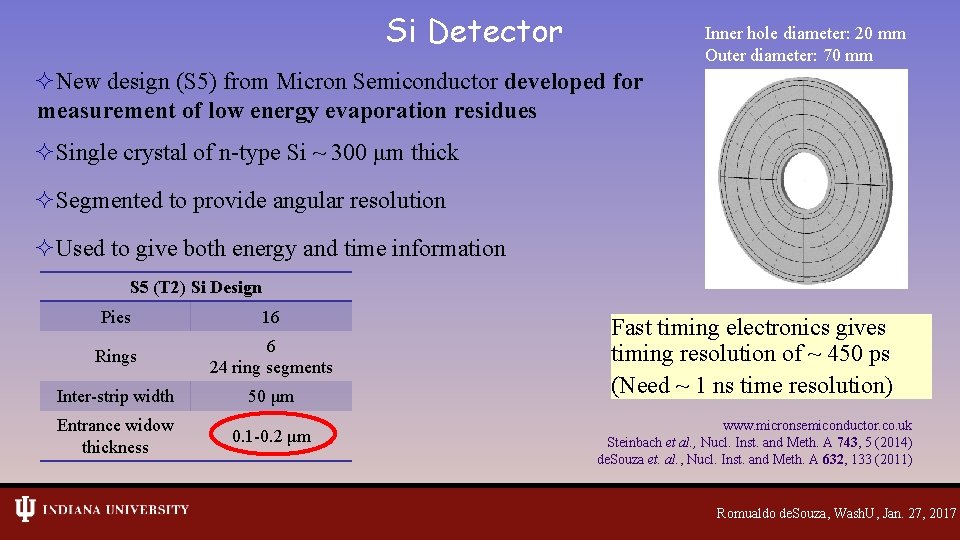
Si Detector Inner hole diameter: 20 mm Outer diameter: 70 mm ²New design (S 5) from Micron Semiconductor developed for measurement of low energy evaporation residues ²Single crystal of n-type Si ~ 300 μm thick ²Segmented to provide angular resolution ²Used to give both energy and time information S 5 (T 2) Si Design Pies 16 Rings 6 24 ring segments Inter-strip width 50 μm Entrance widow thickness 0. 1 -0. 2 μm Fast timing electronics gives timing resolution of ~ 450 ps (Need ~ 1 ns time resolution) www. micronsemiconductor. co. uk Steinbach et al. , Nucl. Inst. and Meth. A 743, 5 (2014) de. Souza et. al. , Nucl. Inst. and Meth. A 632, 133 (2011) Romualdo de. Souza, Wash. U, Jan. 27, 2017
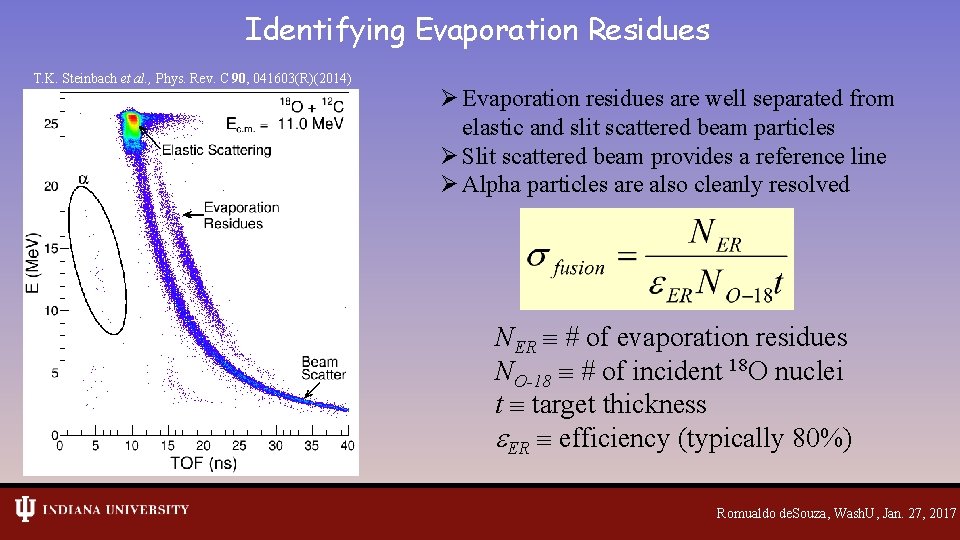
Identifying Evaporation Residues T. K. Steinbach et al. , Phys. Rev. C 90, 041603(R)(2014) Ø Evaporation residues are well separated from elastic and slit scattered beam particles Ø Slit scattered beam provides a reference line Ø Alpha particles are also cleanly resolved NER # of evaporation residues NO-18 # of incident 18 O nuclei t target thickness ER efficiency (typically 80%) Romualdo de. Souza, Wash. U, Jan. 27, 2017
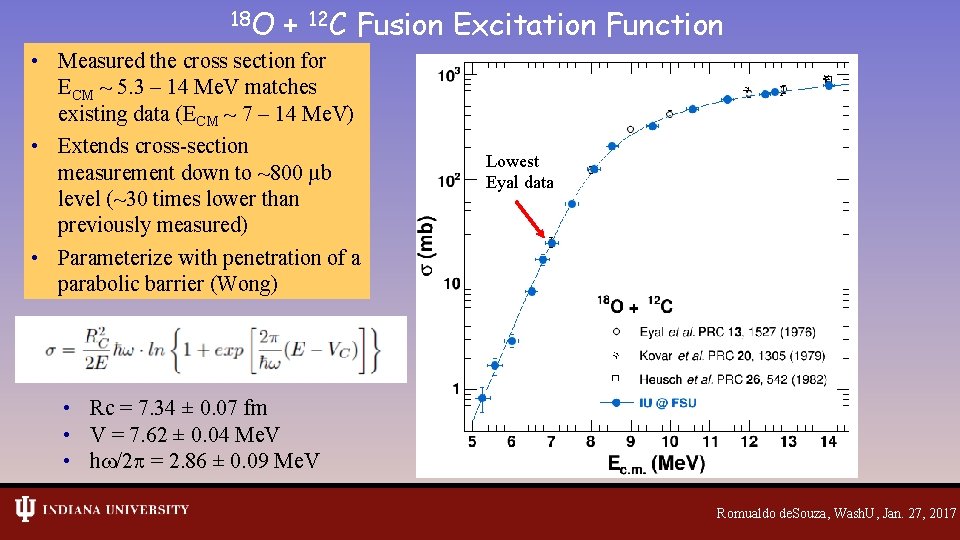
18 O + 12 C Fusion Excitation Function • Measured the cross section for ECM ~ 5. 3 – 14 Me. V matches existing data (ECM ~ 7 – 14 Me. V) • Extends cross-section measurement down to ~800 µb level (~30 times lower than previously measured) • Parameterize with penetration of a parabolic barrier (Wong) Lowest Eyal data • Rc = 7. 34 ± 0. 07 fm • V = 7. 62 ± 0. 04 Me. V • h /2 = 2. 86 ± 0. 09 Me. V Romualdo de. Souza, Wash. U, Jan. 27, 2017
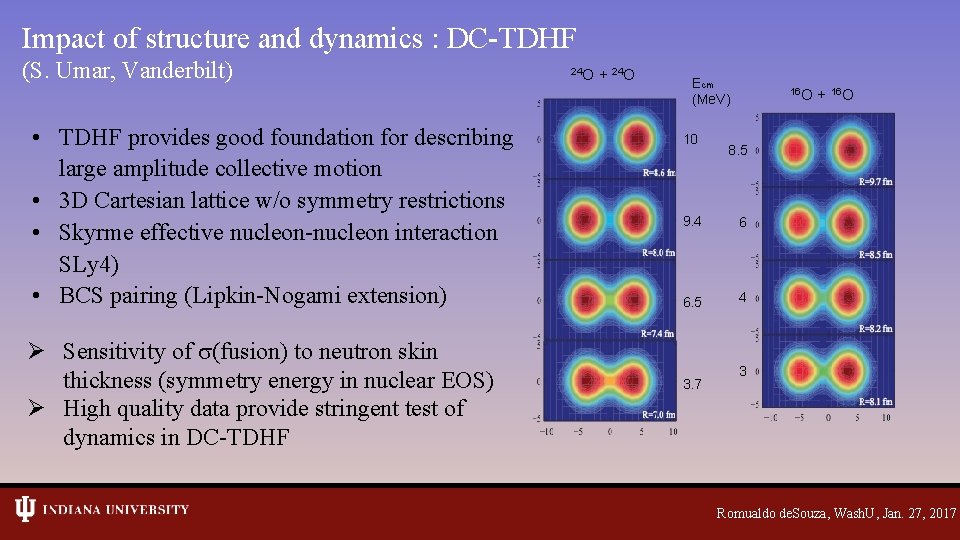
Impact of structure and dynamics : DC-TDHF (S. Umar, Vanderbilt) • TDHF provides good foundation for describing large amplitude collective motion • 3 D Cartesian lattice w/o symmetry restrictions • Skyrme effective nucleon-nucleon interaction SLy 4) • BCS pairing (Lipkin-Nogami extension) Ø Sensitivity of (fusion) to neutron skin thickness (symmetry energy in nuclear EOS) Ø High quality data provide stringent test of dynamics in DC-TDHF 24 O + 24 O Ecm (Me. V) 10 16 O 8. 5 9. 4 6 6. 5 4 3. 7 + 16 O 3 Romualdo de. Souza, Wash. U, Jan. 27, 2017
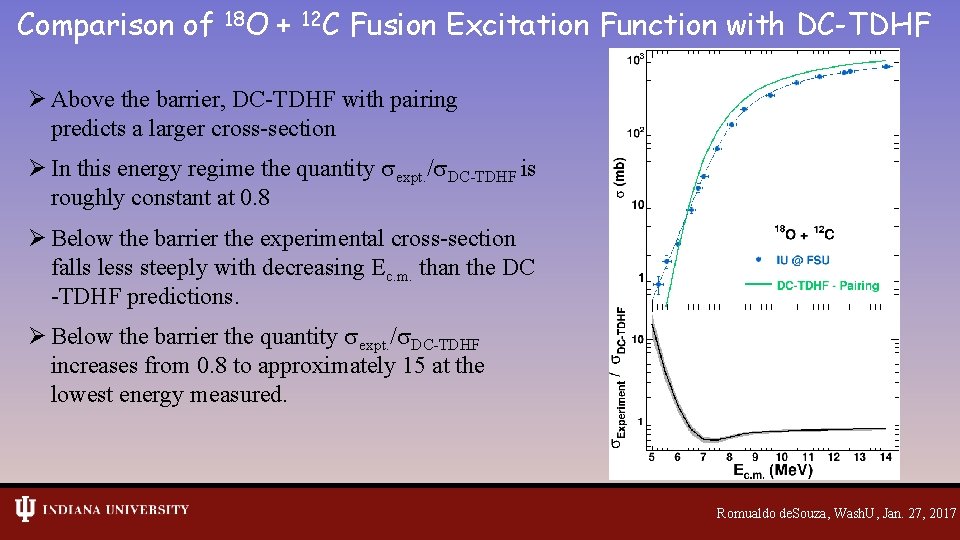
Comparison of 18 O + 12 C Fusion Excitation Function with DC-TDHF Ø Above the barrier, DC-TDHF with pairing predicts a larger cross-section Ø In this energy regime the quantity expt. / DC-TDHF is roughly constant at 0. 8 Ø Below the barrier the experimental cross-section falls less steeply with decreasing Ec. m. than the DC -TDHF predictions. Ø Below the barrier the quantity expt. / DC-TDHF increases from 0. 8 to approximately 15 at the lowest energy measured. Romualdo de. Souza, Wash. U, Jan. 27, 2017
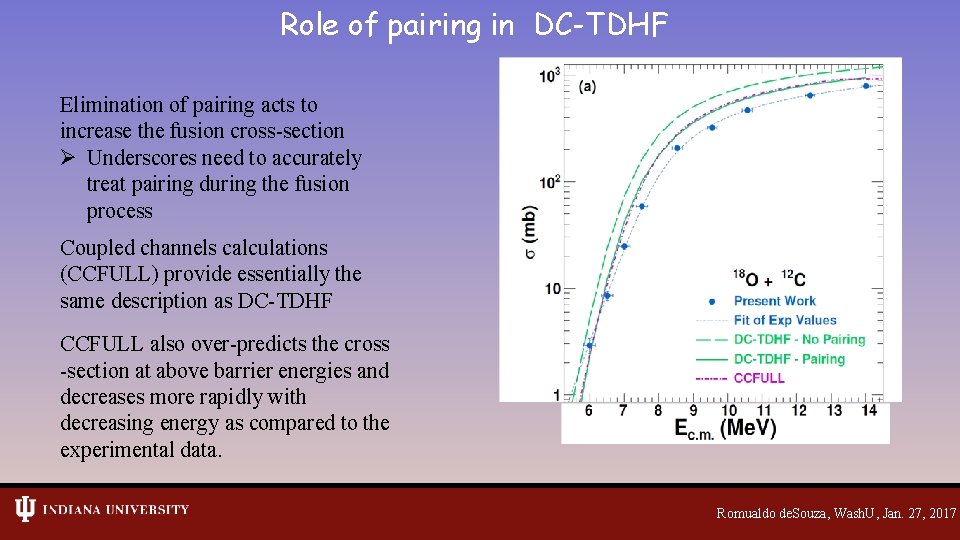
Role of pairing in DC-TDHF Elimination of pairing acts to increase the fusion cross-section Ø Underscores need to accurately treat pairing during the fusion process Coupled channels calculations (CCFULL) provide essentially the same description as DC-TDHF CCFULL also over-predicts the cross -section at above barrier energies and decreases more rapidly with decreasing energy as compared to the experimental data. Romualdo de. Souza, Wash. U, Jan. 27, 2017
What additional information is accessible in addition to the total fusion cross-section? …Decay channels Two independent measures of the decay channels: 1) From energy and angular distribution of ERs 2) From the emitted particles themselves Romualdo de. Souza, Wash. U, Jan. 27, 2017
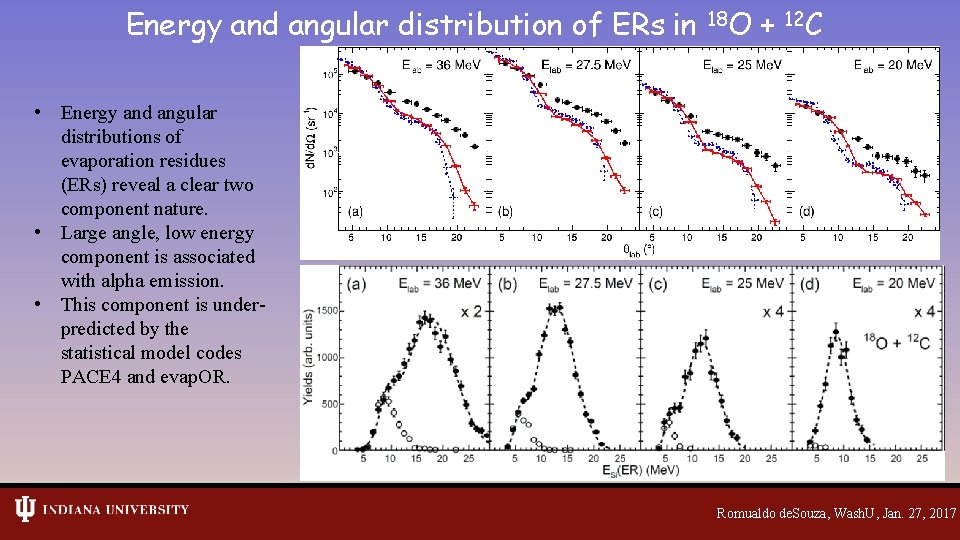
Energy and angular distribution of ERs in 18 O + 12 C • Energy and angular distributions of evaporation residues (ERs) reveal a clear two component nature. • Large angle, low energy component is associated with alpha emission. • This component is underpredicted by the statistical model codes PACE 4 and evap. OR. Romualdo de. Souza, Wash. U, Jan. 27, 2017
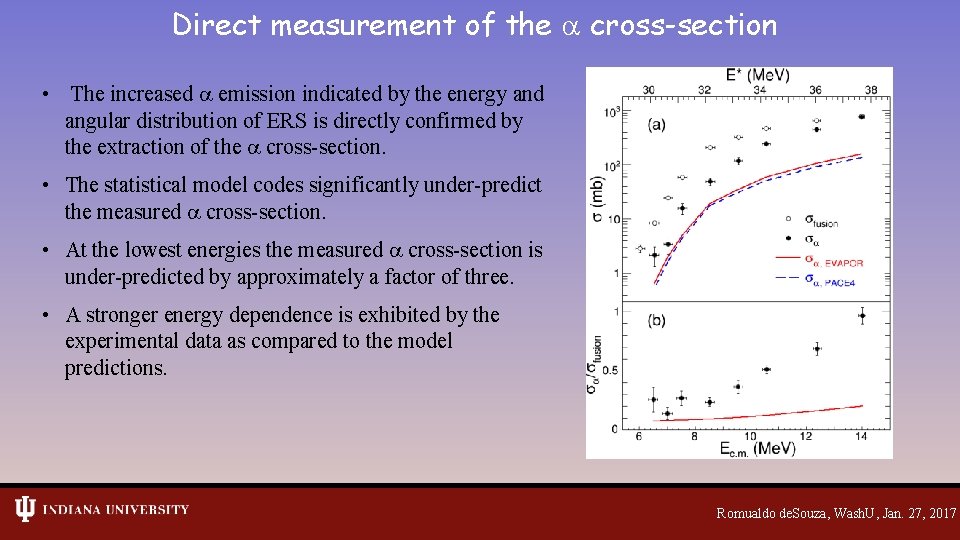
Direct measurement of the cross-section • The increased emission indicated by the energy and angular distribution of ERS is directly confirmed by the extraction of the cross-section. • The statistical model codes significantly under-predict the measured cross-section. • At the lowest energies the measured cross-section is under-predicted by approximately a factor of three. • A stronger energy dependence is exhibited by the experimental data as compared to the model predictions. Romualdo de. Souza, Wash. U, Jan. 27, 2017
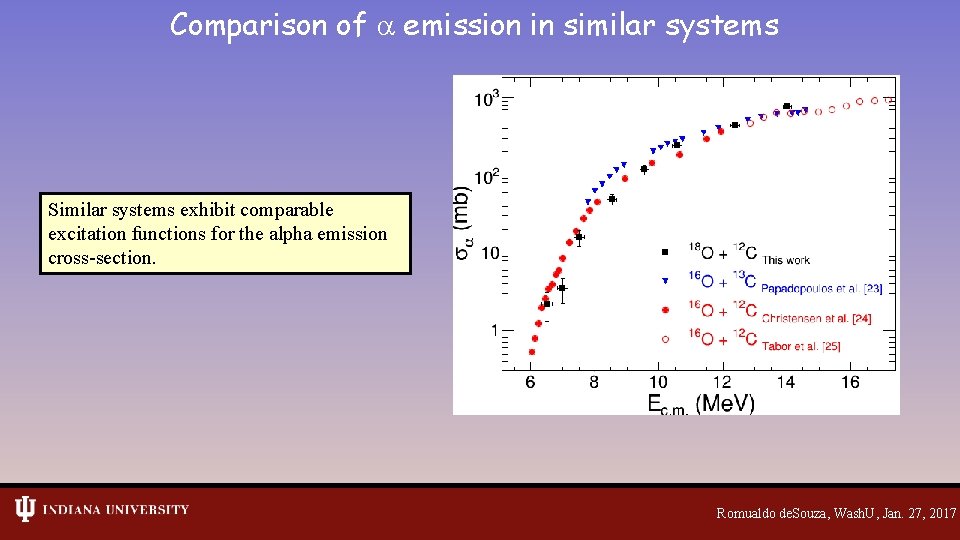
Comparison of emission in similar systems Similar systems exhibit comparable excitation functions for the alpha emission cross-section. Romualdo de. Souza, Wash. U, Jan. 27, 2017
Summary for stable beam experiment: 18 O + 12 C • Measured excitation function agrees well with existing data (extending it down by a factor of 30) • DC-TDHF under-predicts the fusion cross-section at near and sub-barrier energies. The experimental data exceeds the model calculations by a factor of 15 at the lowest energies measured. • Alpha emission is significantly under-predicted by the statistical decay codes evap. OR and PACE 4, a common feature for similar systems. With the experimental approach well established by measurement of 18 O + 12 C we turn to radioactive beams… Romualdo de. Souza, Wash. U, Jan. 27, 2017
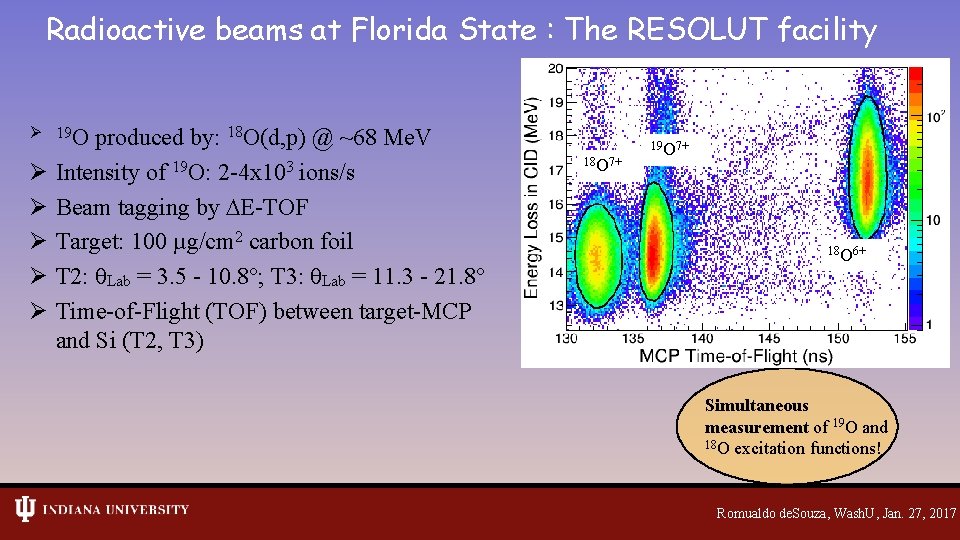
Radioactive beams at Florida State : The RESOLUT facility Ø 19 O Ø Ø Ø produced by: 18 O(d, p) @ ~68 Me. V Intensity of 19 O: 2 -4 x 10³ ions/s Beam tagging by E-TOF Target: 100 µg/cm 2 carbon foil T 2: θLab = 3. 5 - 10. 8°; T 3: θLab = 11. 3 - 21. 8° Time-of-Flight (TOF) between target-MCP and Si (T 2, T 3) 18 O 7+ 19 O 7+ 18 O 6+ Simultaneous measurement of 19 O and 18 O excitation functions! Romualdo de. Souza, Wash. U, Jan. 27, 2017
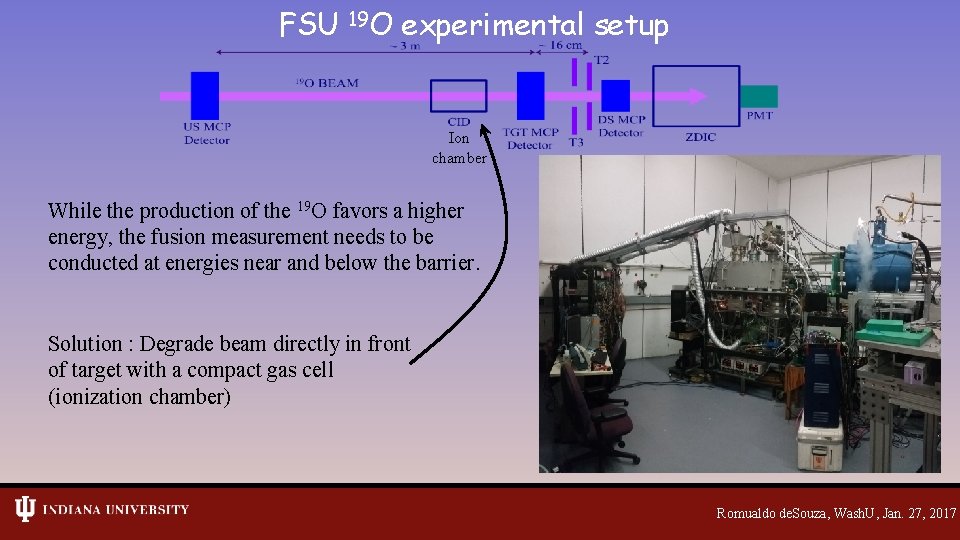
FSU 19 O experimental setup Ion chamber While the production of the 19 O favors a higher energy, the fusion measurement needs to be conducted at energies near and below the barrier. Solution : Degrade beam directly in front of target with a compact gas cell (ionization chamber) Romualdo de. Souza, Wash. U, Jan. 27, 2017
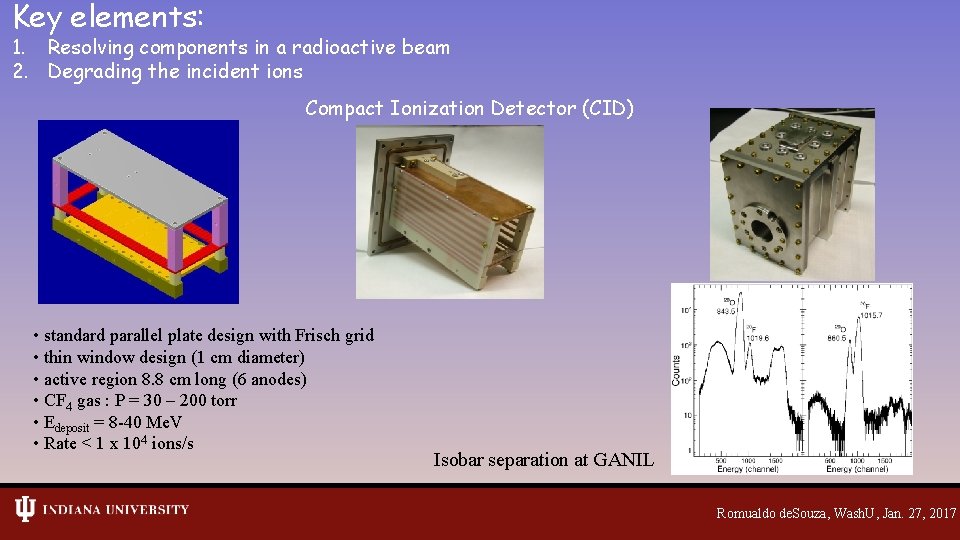
Key elements: 1. Resolving components in a radioactive beam 2. Degrading the incident ions Compact Ionization Detector (CID) • standard parallel plate design with Frisch grid • thin window design (1 cm diameter) • active region 8. 8 cm long (6 anodes) • CF 4 gas : P = 30 – 200 torr • Edeposit = 8 -40 Me. V • Rate < 1 x 10⁴ ions/s Isobar separation at GANIL Romualdo de. Souza, Wash. U, Jan. 27, 2017
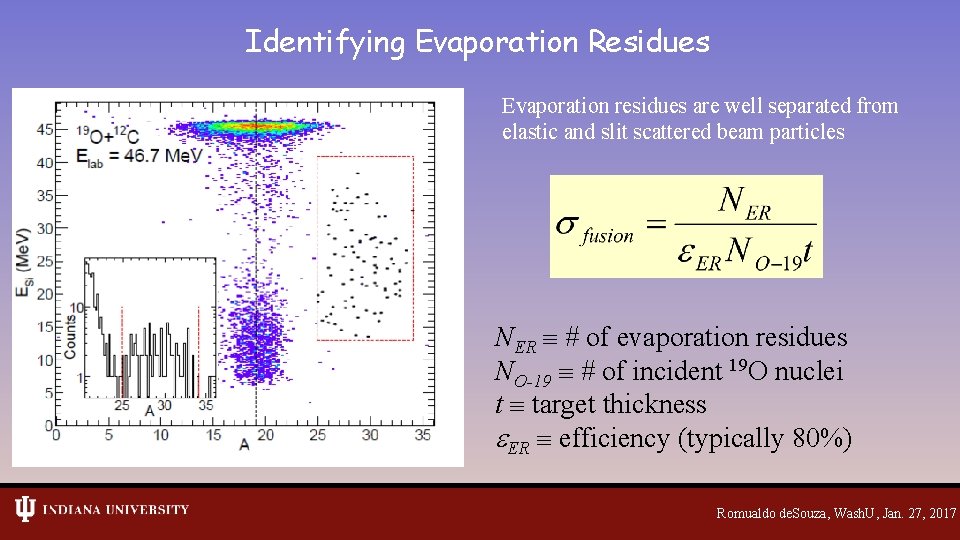
Identifying Evaporation Residues Evaporation residues are well separated from elastic and slit scattered beam particles NER # of evaporation residues NO-19 # of incident 19 O nuclei t target thickness ER efficiency (typically 80%) Romualdo de. Souza, Wash. U, Jan. 27, 2017
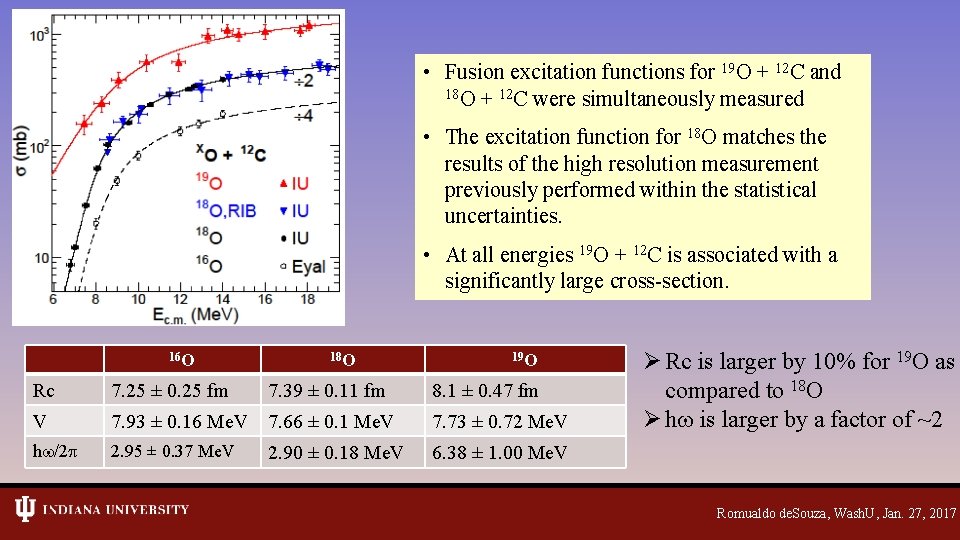
• Fusion excitation functions for 19 O + 12 C and 18 O + 12 C were simultaneously measured • The excitation function for 18 O matches the results of the high resolution measurement previously performed within the statistical uncertainties. • At all energies 19 O + 12 C is associated with a significantly large cross-section. 16 O 18 O 7. 39 ± 0. 11 fm 19 O Rc 7. 25 ± 0. 25 fm V 7. 93 ± 0. 16 Me. V 7. 66 ± 0. 1 Me. V 7. 73 ± 0. 72 Me. V h /2 2. 95 ± 0. 37 Me. V 6. 38 ± 1. 00 Me. V 2. 90 ± 0. 18 Me. V 8. 1 ± 0. 47 fm Ø Rc is larger by 10% for 19 O as compared to 18 O Ø h is larger by a factor of ~2 Romualdo de. Souza, Wash. U, Jan. 27, 2017
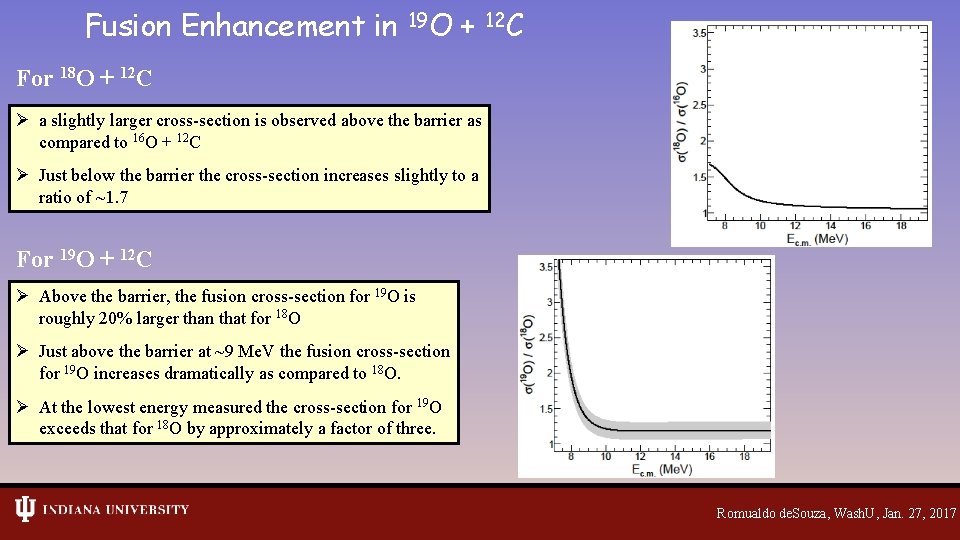
Fusion Enhancement in 19 O + 12 C For 18 O + 12 C Ø a slightly larger cross-section is observed above the barrier as compared to 16 O + 12 C Ø Just below the barrier the cross-section increases slightly to a ratio of ~1. 7 For 19 O + 12 C Ø Above the barrier, the fusion cross-section for 19 O is roughly 20% larger than that for 18 O Ø Just above the barrier at ~9 Me. V the fusion cross-section for 19 O increases dramatically as compared to 18 O. Ø At the lowest energy measured the cross-section for 19 O exceeds that for 18 O by approximately a factor of three. Romualdo de. Souza, Wash. U, Jan. 27, 2017
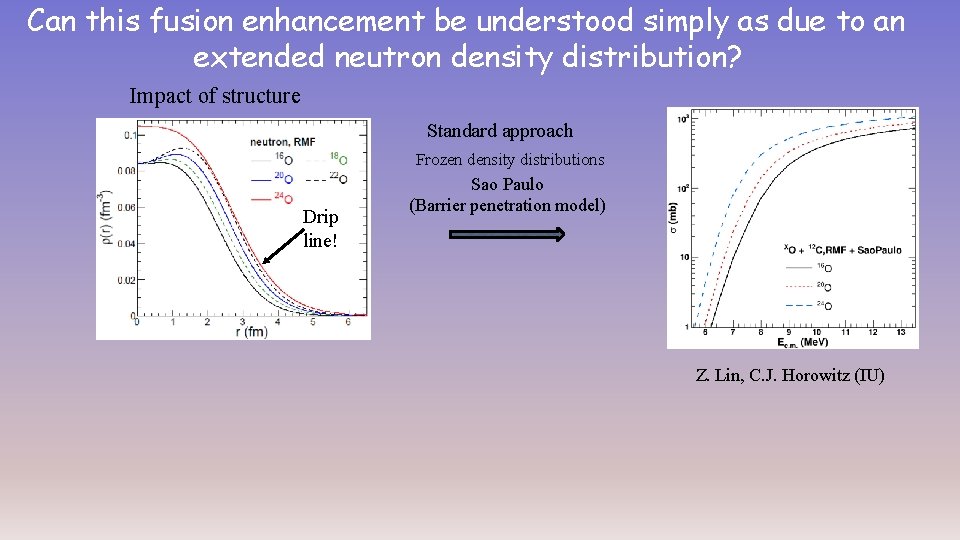
Can this fusion enhancement be understood simply as due to an extended neutron density distribution? Impact of structure Standard approach Frozen density distributions Drip line! Sao Paulo (Barrier penetration model) Z. Lin, C. J. Horowitz (IU)
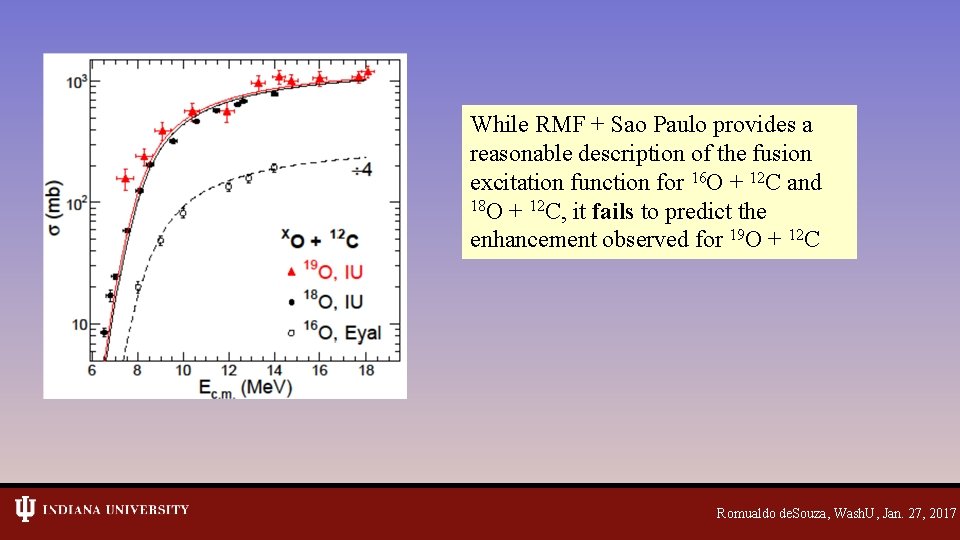
While RMF + Sao Paulo provides a reasonable description of the fusion excitation function for 16 O + 12 C and 18 O + 12 C, it fails to predict the enhancement observed for 19 O + 12 C Romualdo de. Souza, Wash. U, Jan. 27, 2017
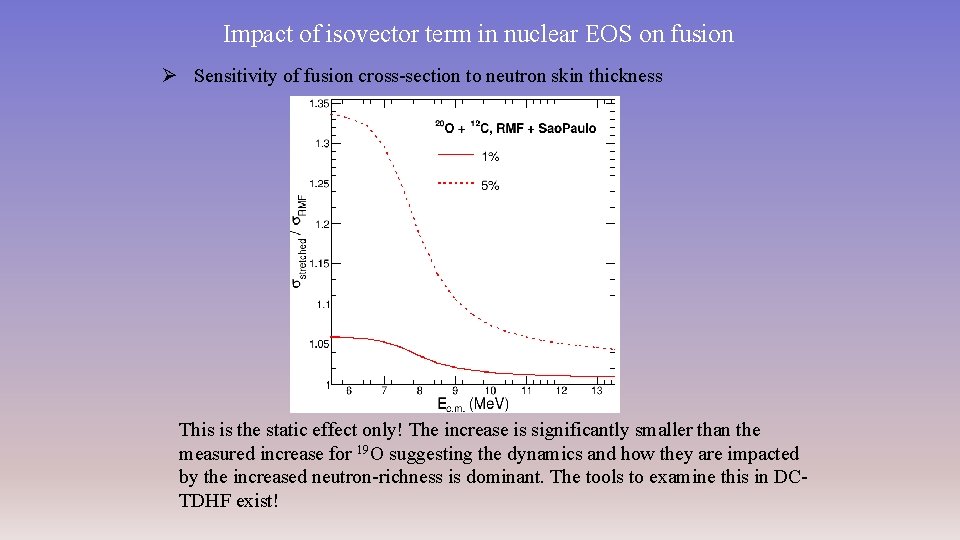
Impact of isovector term in nuclear EOS on fusion Ø Sensitivity of fusion cross-section to neutron skin thickness This is the static effect only! The increase is significantly smaller than the measured increase for 19 O suggesting the dynamics and how they are impacted by the increased neutron-richness is dominant. The tools to examine this in DCTDHF exist!
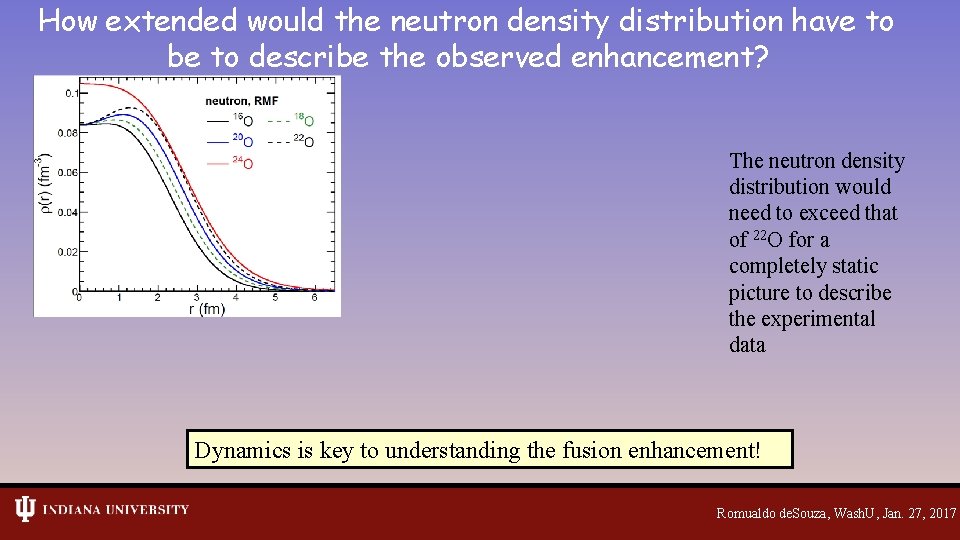
How extended would the neutron density distribution have to be to describe the observed enhancement? The neutron density distribution would need to exceed that of 22 O for a completely static picture to describe the experimental data Dynamics is key to understanding the fusion enhancement! Romualdo de. Souza, Wash. U, Jan. 27, 2017
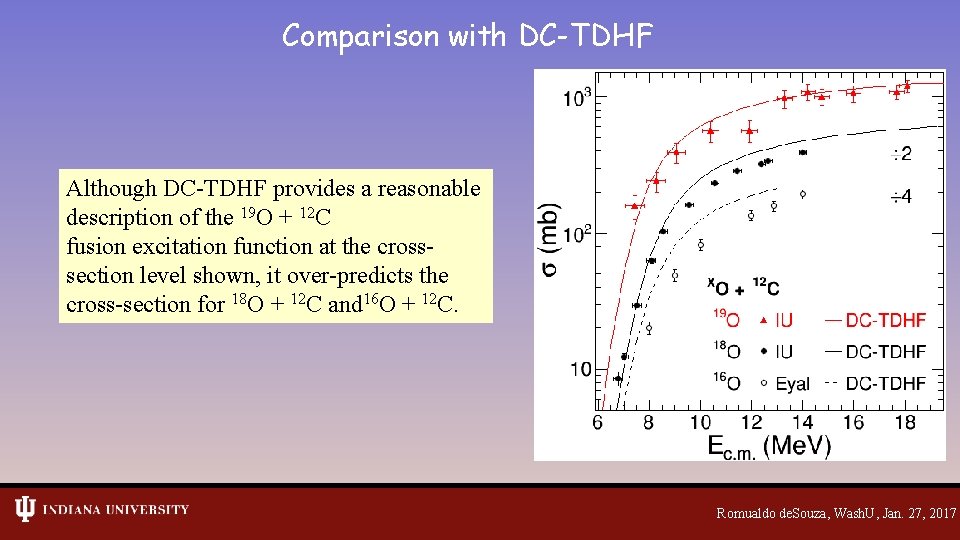
Comparison with DC-TDHF Although DC-TDHF provides a reasonable description of the 19 O + 12 C fusion excitation function at the crosssection level shown, it over-predicts the cross-section for 18 O + 12 C and 16 O + 12 C. Romualdo de. Souza, Wash. U, Jan. 27, 2017
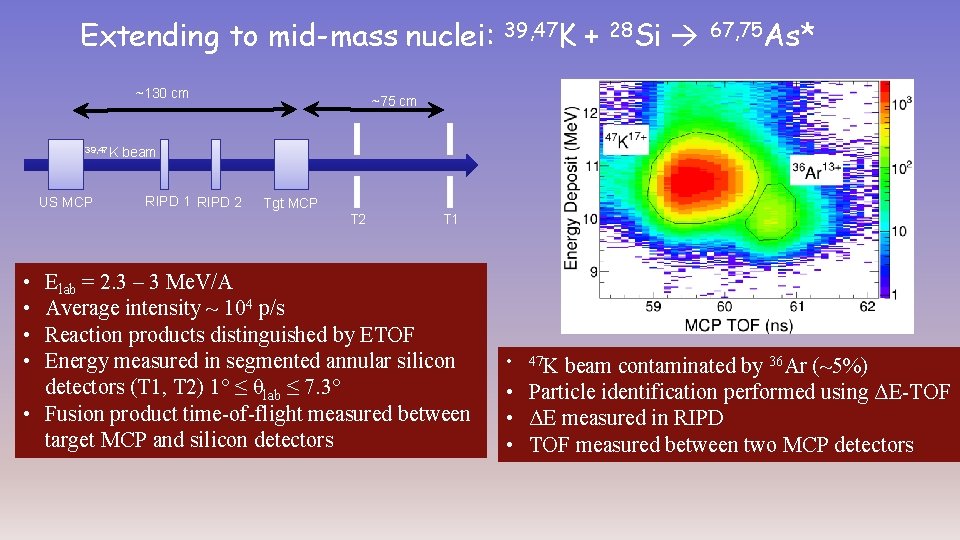
Extending to mid-mass nuclei: ~130 cm 39, 47 K US MCP + 28 Si 67, 75 As* ~75 cm beam RIPD 1 RIPD 2 Tgt MCP T 2 • • 39, 47 K T 1 Elab = 2. 3 – 3 Me. V/A Average intensity ~ 104 p/s Reaction products distinguished by ETOF Energy measured in segmented annular silicon detectors (T 1, T 2) 1° ≤ θlab ≤ 7. 3° • Fusion product time-of-flight measured between target MCP and silicon detectors • 47 K beam contaminated by 36 Ar (~5%) • Particle identification performed using ΔE-TOF • ΔE measured in RIPD • TOF measured between two MCP detectors
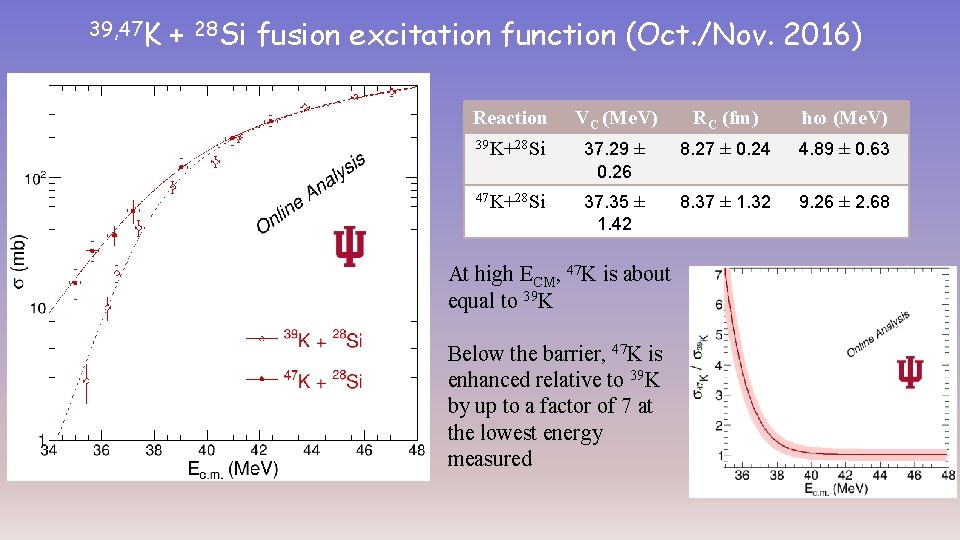
39, 47 K + 28 Si fusion excitation function (Oct. /Nov. 2016) Reaction VC (Me. V) RC (fm) ħω (Me. V) 39 K+28 Si 37. 29 ± 0. 26 8. 27 ± 0. 24 4. 89 ± 0. 63 47 K+28 Si 37. 35 ± 1. 42 8. 37 ± 1. 32 9. 26 ± 2. 68 At high ECM, 47 K is about equal to 39 K Below the barrier, 47 K is enhanced relative to 39 K by up to a factor of 7 at the lowest energy measured
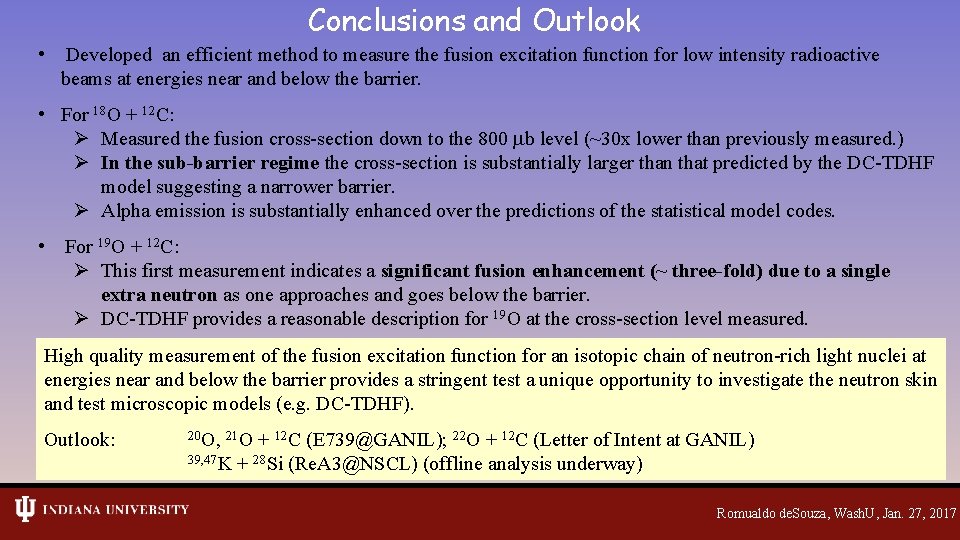
Conclusions and Outlook • Developed an efficient method to measure the fusion excitation function for low intensity radioactive beams at energies near and below the barrier. • For 18 O + 12 C: Ø Measured the fusion cross-section down to the 800 b level (~30 x lower than previously measured. ) Ø In the sub-barrier regime the cross-section is substantially larger than that predicted by the DC-TDHF model suggesting a narrower barrier. Ø Alpha emission is substantially enhanced over the predictions of the statistical model codes. • For 19 O + 12 C: Ø This first measurement indicates a significant fusion enhancement (~ three-fold) due to a single extra neutron as one approaches and goes below the barrier. Ø DC-TDHF provides a reasonable description for 19 O at the cross-section level measured. High quality measurement of the fusion excitation function for an isotopic chain of neutron-rich light nuclei at energies near and below the barrier provides a stringent test a unique opportunity to investigate the neutron skin and test microscopic models (e. g. DC-TDHF). Outlook: 20 O, 21 O + 12 C (E 739@GANIL); 22 O + 12 C (Letter of Intent at GANIL) 39, 47 K + 28 Si (Re. A 3@NSCL) (offline analysis underway) Romualdo de. Souza, Wash. U, Jan. 27, 2017
- Slides: 39