
Understanding NEC Article 409 UL 508 A ShortCircuit


- Slides: 28
Understanding NEC Article 409 & UL 508 A Short-Circuit Current Ratings Copyright © 2006 Rockwell Automation, Inc. All rights reserved. 1
UL 508 A & NEC 409 Topics Introduction Definitions UL 508 A Supplement SB RA Component Solutions RA Website & Database Copyright © 2006 Rockwell Automation, Inc. All rights reserved. 3
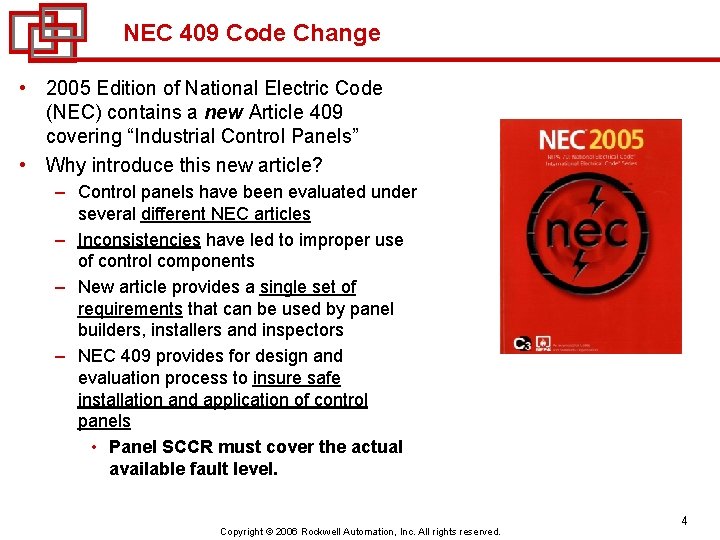
NEC 409 Code Change • 2005 Edition of National Electric Code (NEC) contains a new Article 409 covering “Industrial Control Panels” • Why introduce this new article? – Control panels have been evaluated under several different NEC articles – Inconsistencies have led to improper use of control components – New article provides a single set of requirements that can be used by panel builders, installers and inspectors – NEC 409 provides for design and evaluation process to insure safe installation and application of control panels • Panel SCCR must cover the actual available fault level. Copyright © 2006 Rockwell Automation, Inc. All rights reserved. 4
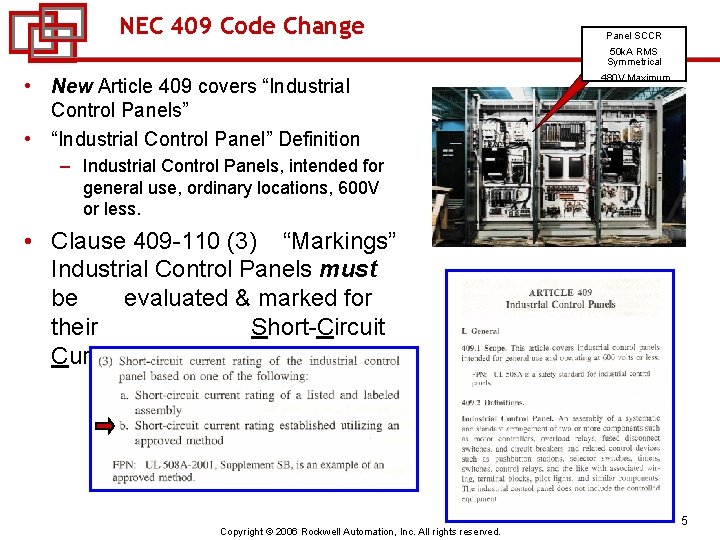
NEC 409 Code Change Panel SCCR 50 k. A RMS Symmetrical • New Article 409 covers “Industrial Control Panels” • “Industrial Control Panel” Definition 480 V Maximum – Industrial Control Panels, intended for general use, ordinary locations, 600 V or less. • Clause 409 -110 (3) “Markings” Industrial Control Panels must be evaluated & marked for their Short-Circuit Current Rating (SCCR) Copyright © 2006 Rockwell Automation, Inc. All rights reserved. 5
Definitions Copyright © 2006 Rockwell Automation, Inc. All rights reserved. 6
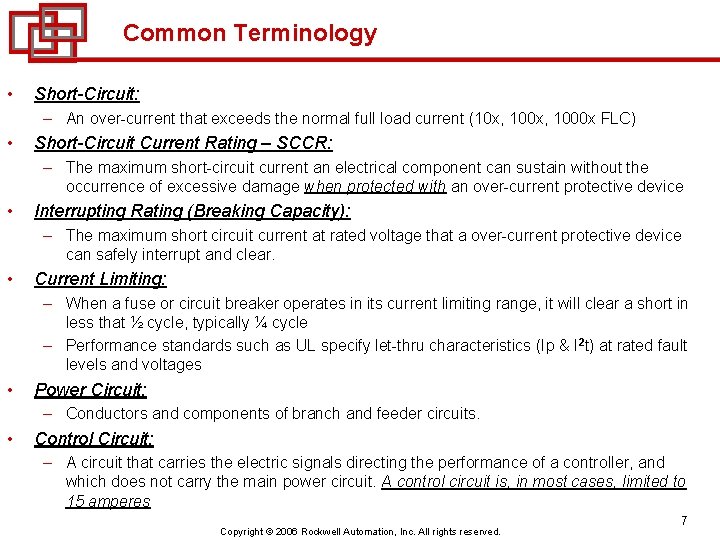
Common Terminology • Short-Circuit: – An over-current that exceeds the normal full load current (10 x, 1000 x FLC) • Short-Circuit Current Rating – SCCR: – The maximum short-circuit current an electrical component can sustain without the occurrence of excessive damage when protected with an over-current protective device • Interrupting Rating (Breaking Capacity): – The maximum short circuit current at rated voltage that a over-current protective device can safely interrupt and clear. • Current Limiting: – When a fuse or circuit breaker operates in its current limiting range, it will clear a short in less that ½ cycle, typically ¼ cycle – Performance standards such as UL specify let-thru characteristics (Ip & I 2 t) at rated fault levels and voltages • Power Circuit: – Conductors and components of branch and feeder circuits. • Control Circuit: – A circuit that carries the electric signals directing the performance of a controller, and which does not carry the main power circuit. A control circuit is, in most cases, limited to 15 amperes Copyright © 2006 Rockwell Automation, Inc. All rights reserved. 7
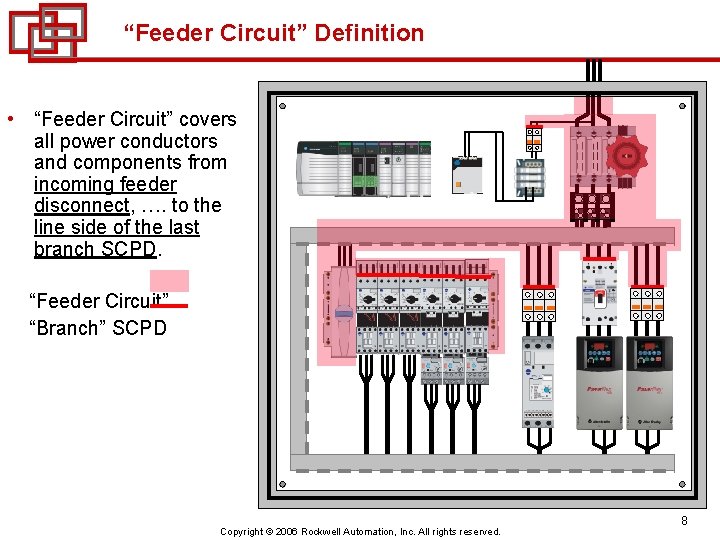
“Feeder Circuit” Definition • “Feeder Circuit” covers all power conductors and components from incoming feeder disconnect, …. to the line side of the last branch SCPD. “Feeder Circuit” “Branch” SCPD Copyright © 2006 Rockwell Automation, Inc. All rights reserved. 8
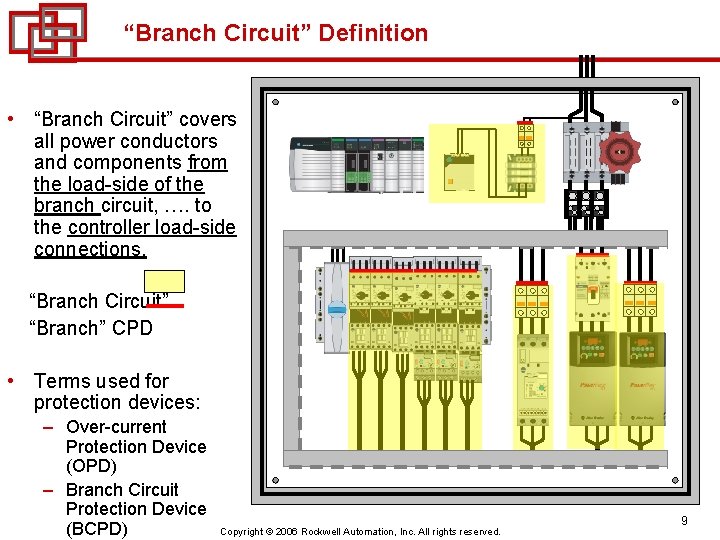
“Branch Circuit” Definition • “Branch Circuit” covers all power conductors and components from the load-side of the branch circuit, …. to the controller load-side connections. “Branch Circuit” “Branch” CPD • Terms used for protection devices: – Over-current Protection Device (OPD) – Branch Circuit Protection Device (BCPD) Copyright © 2006 Rockwell Automation, Inc. All rights reserved. 9
UL 508 A Supplement SB “How to Comply” Copyright © 2006 Rockwell Automation, Inc. All rights reserved. 10
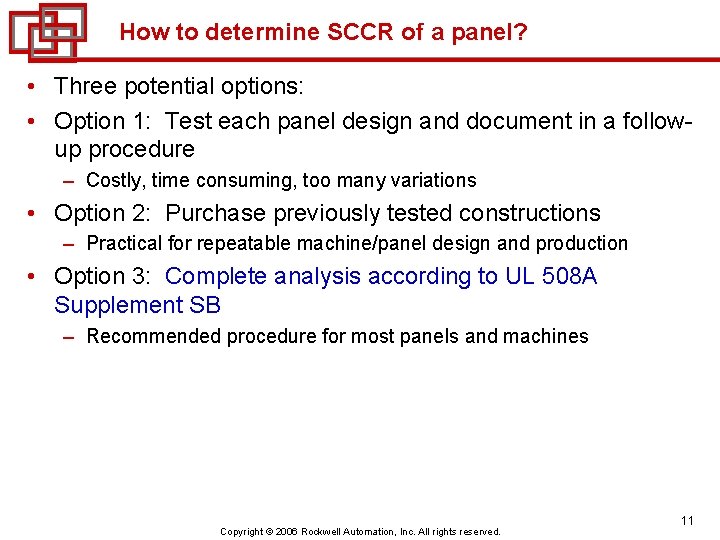
How to determine SCCR of a panel? • Three potential options: • Option 1: Test each panel design and document in a followup procedure – Costly, time consuming, too many variations • Option 2: Purchase previously tested constructions – Practical for repeatable machine/panel design and production • Option 3: Complete analysis according to UL 508 A Supplement SB – Recommended procedure for most panels and machines Copyright © 2006 Rockwell Automation, Inc. All rights reserved. 11
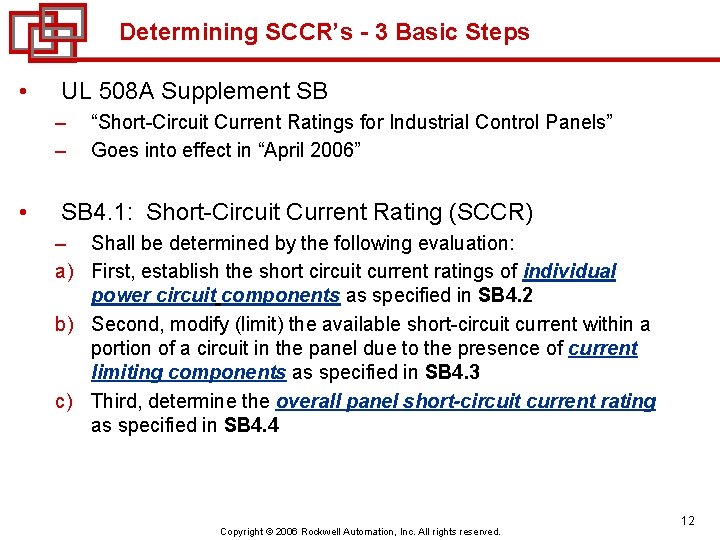
Determining SCCR’s - 3 Basic Steps • UL 508 A Supplement SB – – • “Short-Circuit Current Ratings for Industrial Control Panels” Goes into effect in “April 2006” SB 4. 1: Short-Circuit Current Rating (SCCR) – Shall be determined by the following evaluation: a) First, establish the short circuit current ratings of individual power circuit components as specified in SB 4. 2 b) Second, modify (limit) the available short-circuit current within a portion of a circuit in the panel due to the presence of current limiting components as specified in SB 4. 3 c) Third, determine the overall panel short-circuit current rating as specified in SB 4. 4 Copyright © 2006 Rockwell Automation, Inc. All rights reserved. 12
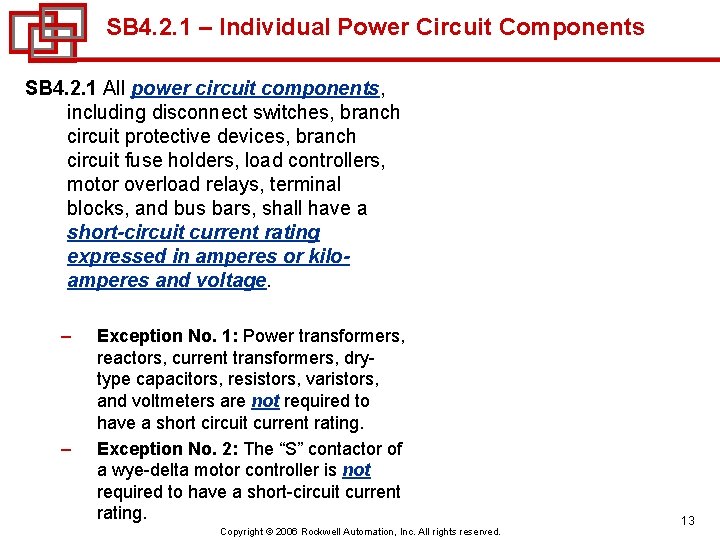
SB 4. 2. 1 – Individual Power Circuit Components SB 4. 2. 1 All power circuit components, including disconnect switches, branch circuit protective devices, branch circuit fuse holders, load controllers, motor overload relays, terminal blocks, and bus bars, shall have a short-circuit current rating expressed in amperes or kiloamperes and voltage. – – Exception No. 1: Power transformers, reactors, current transformers, drytype capacitors, resistors, varistors, and voltmeters are not required to have a short circuit current rating. Exception No. 2: The “S” contactor of a wye-delta motor controller is not required to have a short-circuit current rating. Copyright © 2006 Rockwell Automation, Inc. All rights reserved. 13
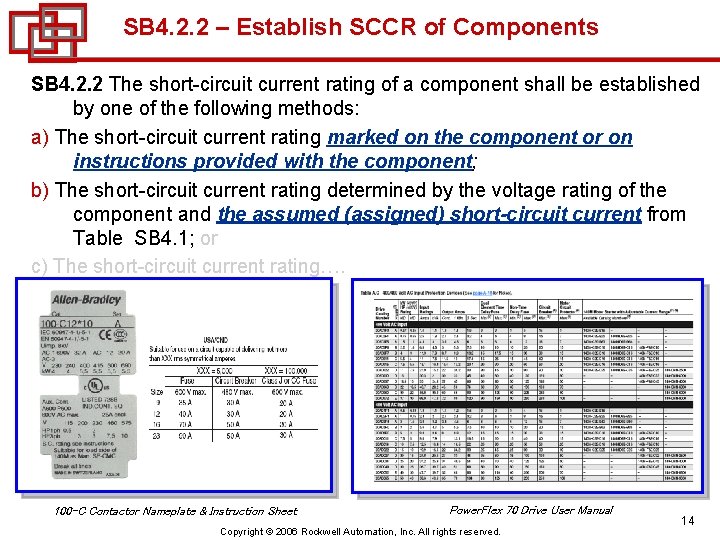
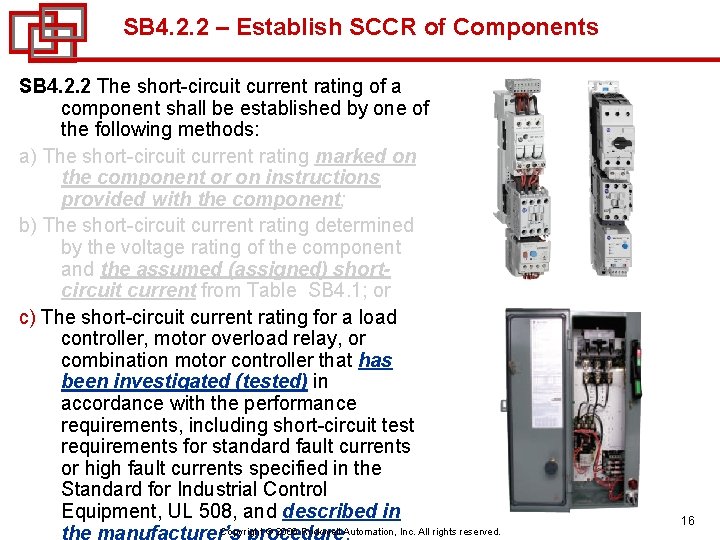
SB 4. 2. 2 – Establish SCCR of Components SB 4. 2. 2 The short-circuit current rating of a component shall be established by one of the following methods: a) The short-circuit current rating marked on the component or on instructions provided with the component; b) The short-circuit current rating determined by the voltage rating of the component and the assumed (assigned) short-circuit current from Table SB 4. 1; or c) The short-circuit current rating…. 100 -C Contactor Nameplate & Instruction Sheet Power. Flex 70 Drive User Manual Copyright © 2006 Rockwell Automation, Inc. All rights reserved. 14
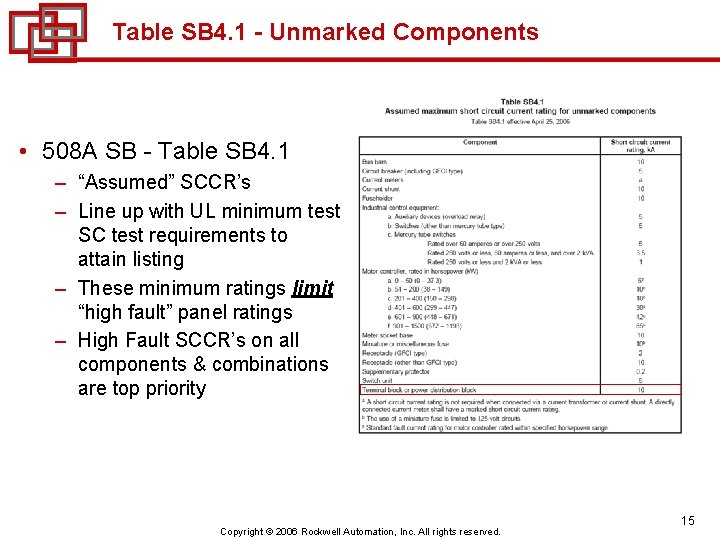
Table SB 4. 1 - Unmarked Components • 508 A SB - Table SB 4. 1 – “Assumed” SCCR’s – Line up with UL minimum test SC test requirements to attain listing – These minimum ratings limit “high fault” panel ratings – High Fault SCCR’s on all components & combinations are top priority Copyright © 2006 Rockwell Automation, Inc. All rights reserved. 15
SB 4. 2. 2 – Establish SCCR of Components SB 4. 2. 2 The short-circuit current rating of a component shall be established by one of the following methods: a) The short-circuit current rating marked on the component or on instructions provided with the component; b) The short-circuit current rating determined by the voltage rating of the component and the assumed (assigned) shortcircuit current from Table SB 4. 1; or c) The short-circuit current rating for a load controller, motor overload relay, or combination motor controller that has been investigated (tested) in accordance with the performance requirements, including short-circuit test requirements for standard fault currents or high fault currents specified in the Standard for Industrial Control Equipment, UL 508, and described in Copyright © 2006 Rockwell Automation, Inc. All rights reserved. the manufacturer’s procedure. 16
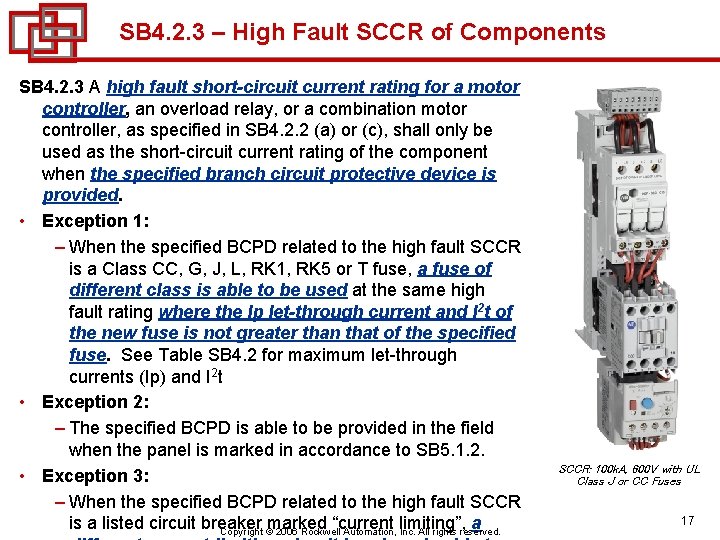
SB 4. 2. 3 – High Fault SCCR of Components SB 4. 2. 3 A high fault short-circuit current rating for a motor controller, an overload relay, or a combination motor controller, as specified in SB 4. 2. 2 (a) or (c), shall only be used as the short-circuit current rating of the component when the specified branch circuit protective device is provided. • Exception 1: – When the specified BCPD related to the high fault SCCR is a Class CC, G, J, L, RK 1, RK 5 or T fuse, a fuse of different class is able to be used at the same high fault rating where the Ip let-through current and I 2 t of the new fuse is not greater than that of the specified fuse. See Table SB 4. 2 for maximum let-through currents (Ip) and I 2 t • Exception 2: – The specified BCPD is able to be provided in the field when the panel is marked in accordance to SB 5. 1. 2. • Exception 3: – When the specified BCPD related to the high fault SCCR is a listed circuit breaker marked “current limiting”, a Copyright © 2006 Rockwell Automation, Inc. All rights reserved. SCCR: 100 k. A, 600 V with UL Class J or CC Fuses 17
SB 4. 3 - Feeder Components that Limit SCC SB 4. 3 – Feeder components that limit the short-circuit current available • SB 4. 3. 1 – For branch circuits supplied by a power transformer with an isolated secondary winding, the a power transformer with an isolated secondary… • SB 4. 3. 2 – For branch circuits supplied by a Listed circuit breaker marked “current limiting” in the feeder circuit, the short circuit current rating… • SB 4. 3. 3 – For branch circuits supplied by a Class CC, G, J, L, RK 1, RK 5, or T fuse in the feeder circuit, the short-circuit current rating… Copyright © 2006 Rockwell Automation, Inc. All rights reserved. 18
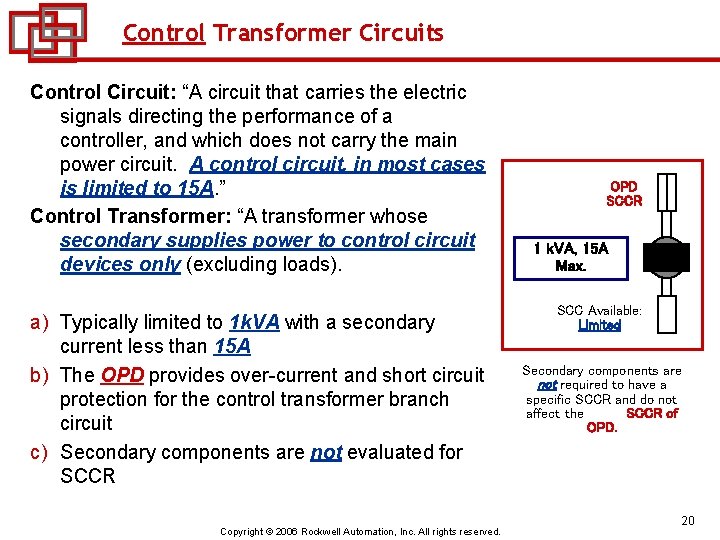
Control Transformer Circuits Control Circuit: “A circuit that carries the electric signals directing the performance of a controller, and which does not carry the main power circuit. A control circuit, in most cases is limited to 15 A. ” Control Transformer: “A transformer whose secondary supplies power to control circuit devices only (excluding loads). a) Typically limited to 1 k. VA with a secondary current less than 15 A b) The OPD provides over-current and short circuit protection for the control transformer branch circuit c) Secondary components are not evaluated for SCCR Copyright © 2006 Rockwell Automation, Inc. All rights reserved. OPD SCCR 1 k. VA, 15 A Max. SCC Available: Limited Secondary components are not required to have a specific SCCR and do not affect the SCCR of OPD. 20
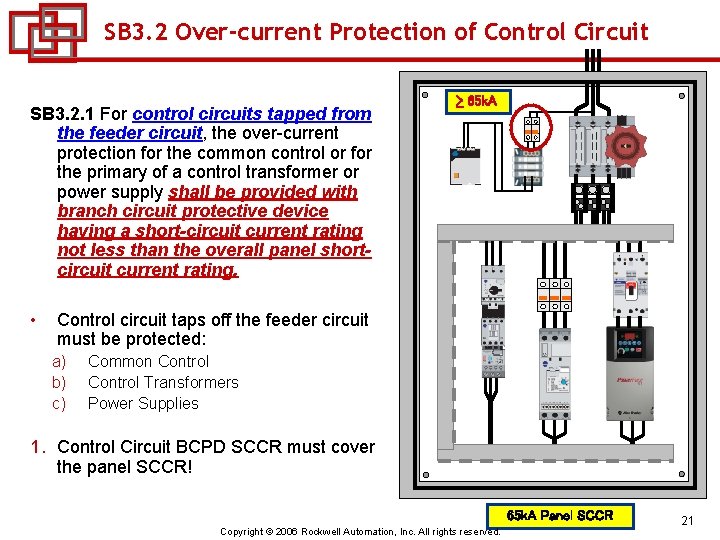
SB 3. 2 Over-current Protection of Control Circuit SB 3. 2. 1 For control circuits tapped from the feeder circuit, the over-current protection for the common control or for the primary of a control transformer or power supply shall be provided with branch circuit protective device having a short-circuit current rating not less than the overall panel shortcircuit current rating. • > 65 k. A Control circuit taps off the feeder circuit must be protected: a) b) c) Common Control Transformers Power Supplies 1. Control Circuit BCPD SCCR must cover the panel SCCR! 65 k. A Panel SCCR Copyright © 2006 Rockwell Automation, Inc. All rights reserved. 21
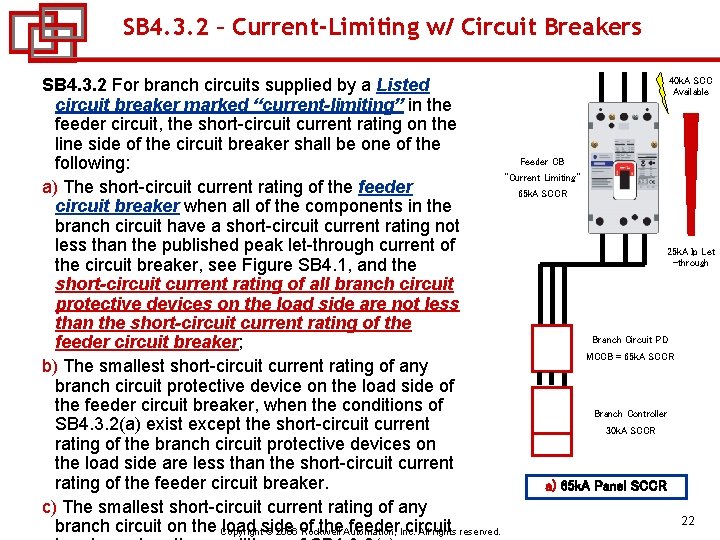
SB 4. 3. 2 – Current-Limiting w/ Circuit Breakers 40 k. A SCC SB 4. 3. 2 For branch circuits supplied by a Listed Available circuit breaker marked “current-limiting” in the feeder circuit, the short-circuit current rating on the line side of the circuit breaker shall be one of the Feeder CB following: “Current Limiting” a) The short-circuit current rating of the feeder 65 k. A SCCR circuit breaker when all of the components in the branch circuit have a short-circuit current rating not less than the published peak let-through current of 25 k. A Ip Let -through the circuit breaker, see Figure SB 4. 1, and the short-circuit current rating of all branch circuit protective devices on the load side are not less than the short-circuit current rating of the Branch Circuit PD feeder circuit breaker; MCCB = 65 k. A SCCR b) The smallest short-circuit current rating of any branch circuit protective device on the load side of the feeder circuit breaker, when the conditions of Branch Controller SB 4. 3. 2(a) exist except the short-circuit current 30 k. A SCCR rating of the branch circuit protective devices on the load side are less than the short-circuit current rating of the feeder circuit breaker. a) 65 k. A Panel SCCR c) The smallest short-circuit current rating of any 22 branch circuit on the Copyright load side the. Automation, feeder. Inc. circuit © 2006 of Rockwell All rights reserved.
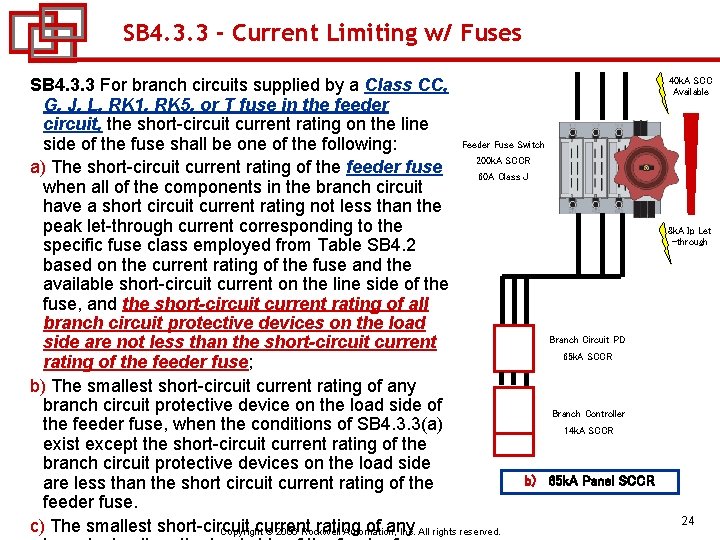
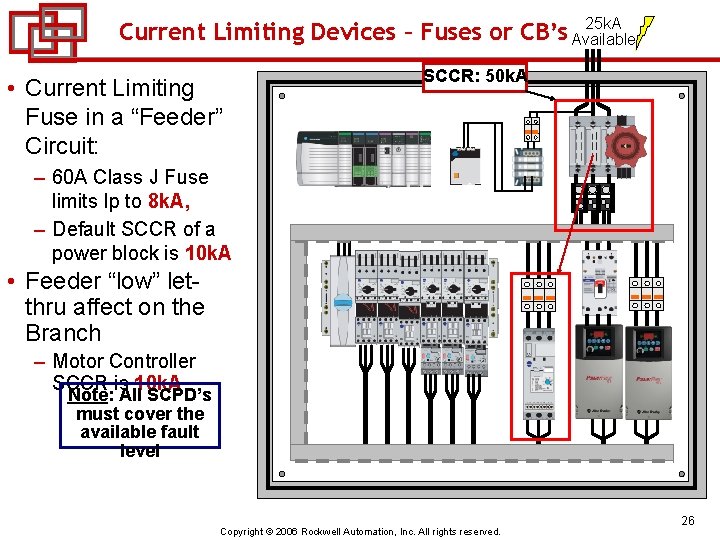
SB 4. 3. 3 - Current Limiting w/ Fuses SB 4. 3. 3 For branch circuits supplied by a Class CC, G, J, L, RK 1, RK 5, or T fuse in the feeder circuit, the short-circuit current rating on the line Feeder Fuse Switch side of the fuse shall be one of the following: 200 k. A SCCR a) The short-circuit current rating of the feeder fuse 60 A Class J when all of the components in the branch circuit have a short circuit current rating not less than the peak let-through current corresponding to the specific fuse class employed from Table SB 4. 2 based on the current rating of the fuse and the available short-circuit current on the line side of the fuse, and the short-circuit current rating of all branch circuit protective devices on the load Branch Circuit PD side are not less than the short-circuit current 65 k. A SCCR rating of the feeder fuse; b) The smallest short-circuit current rating of any branch circuit protective device on the load side of Branch Controller the feeder fuse, when the conditions of SB 4. 3. 3(a) 14 k. A SCCR exist except the short-circuit current rating of the branch circuit protective devices on the load side b) 65 k. A Panel SCCR are less than the short circuit current rating of the feeder fuse. c) The smallest short-circuit current rating of any Copyright © 2006 Rockwell Automation, Inc. All rights reserved. 40 k. A SCC Available 8 k. A Ip Let -through 24
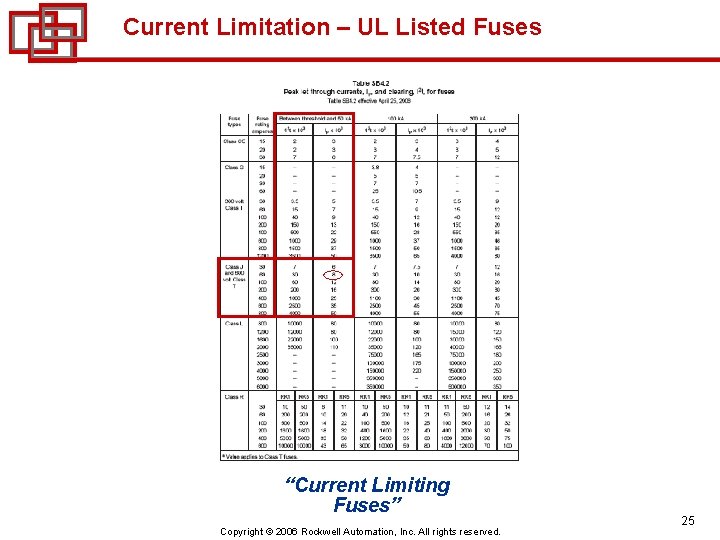
Current Limitation – UL Listed Fuses “Current Limiting Fuses” Copyright © 2006 Rockwell Automation, Inc. All rights reserved. 25
25 k. A Current Limiting Devices – Fuses or CB’s Available • Current Limiting Fuse in a “Feeder” Circuit: SCCR: 50 k. A – 60 A Class J Fuse limits Ip to 8 k. A, – Default SCCR of a power block is 10 k. A • Feeder “low” letthru affect on the Branch – Motor Controller SCCR is 10 k. A Note: All SCPD’s must cover the available fault level Copyright © 2006 Rockwell Automation, Inc. All rights reserved. 26
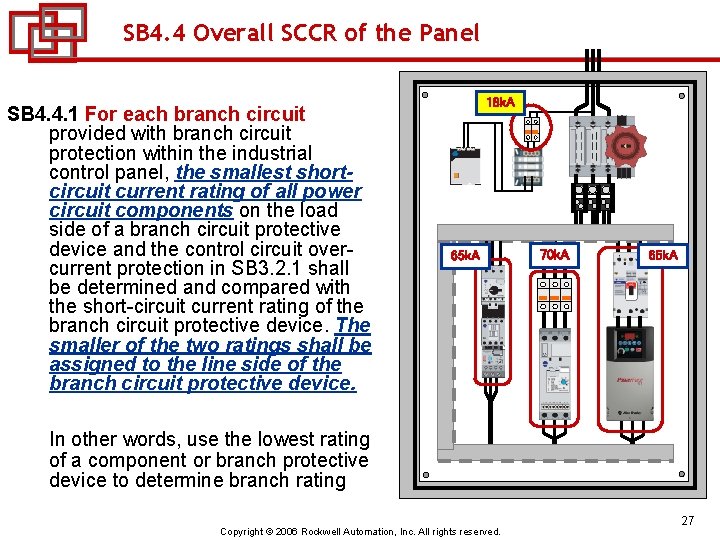
SB 4. 4 Overall SCCR of the Panel SB 4. 4. 1 For each branch circuit provided with branch circuit protection within the industrial control panel, the smallest shortcircuit current rating of all power circuit components on the load side of a branch circuit protective device and the control circuit overcurrent protection in SB 3. 2. 1 shall be determined and compared with the short-circuit current rating of the branch circuit protective device. The smaller of the two ratings shall be assigned to the line side of the branch circuit protective device. 18 k. A 65 k. A 70 k. A 65 k. A In other words, use the lowest rating of a component or branch protective device to determine branch rating Copyright © 2006 Rockwell Automation, Inc. All rights reserved. 27
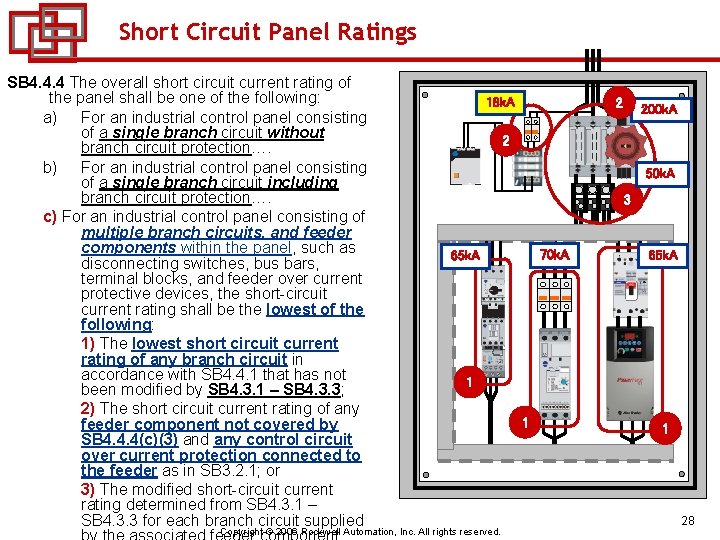
Short Circuit Panel Ratings SB 4. 4. 4 The overall short circuit current rating of the panel shall be one of the following: a) For an industrial control panel consisting of a single branch circuit without branch circuit protection…. b) For an industrial control panel consisting of a single branch circuit including branch circuit protection…. c) For an industrial control panel consisting of multiple branch circuits, and feeder components within the panel, such as disconnecting switches, bus bars, terminal blocks, and feeder over current protective devices, the short-circuit current rating shall be the lowest of the following: 1) The lowest short circuit current rating of any branch circuit in accordance with SB 4. 4. 1 that has not been modified by SB 4. 3. 1 – SB 4. 3. 3; 2) The short circuit current rating of any feeder component not covered by SB 4. 4. 4(c)(3) and any control circuit over current protection connected to the feeder as in SB 3. 2. 1; or 3) The modified short-circuit current rating determined from SB 4. 3. 1 – SB 4. 3. 3 for each branch circuit supplied 18 k. A 2 200 k. A 2 50 k. A 3 70 k. A 65 k. A 1 Copyright © 2006 Rockwell Automation, Inc. All rights reserved. 1 1 28
SB 5 Markings • SB 5. 1 General – SB 5. 1. 1 The nameplate rating of an industrial control panel shall include: “Short circuit current: ___k. A rms symmetrical, ___V maximum” or the equivalent. – SB 5. 1. 2 An industrial control panel marked with a high fault short circuit current rating and is not provided with the required branch circuit protective device as specified in the Exception to SB 4. 2. 3 shall be marked with the type and size of branch circuit protection required to be installed in the field. This marking shall be included as part of the marking in SB 5. 1. 1. • SB 5. 2 Cautionary markings – SB 5. 2. 1 An industrial control panel with a short circuit current rating based on the high fault short circuit current ratings of one or more components as specified in SB 4. 2. 3 shall be marked with the word “WARNING” and the following statement: “Risk of Fire or Electric Shock – The opening of the branch-circuit protective device may be an indication that a fault current has been interrupted. All current-carrying parts and other components protected by this 29 device should be. Copyright examined and replaced damaged. If burnout of © 2006 Rockwell Automation, Inc. All rights if reserved.
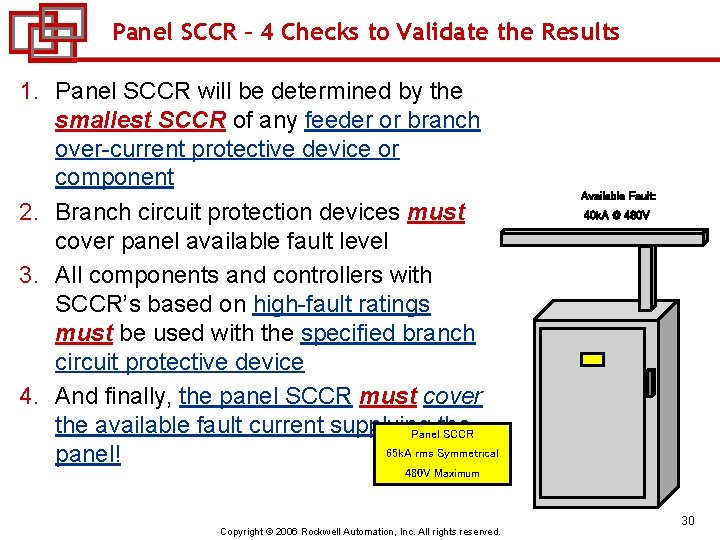
Panel SCCR – 4 Checks to Validate the Results 1. Panel SCCR will be determined by the smallest SCCR of any feeder or branch over-current protective device or component 2. Branch circuit protection devices must cover panel available fault level 3. All components and controllers with SCCR’s based on high-fault ratings must be used with the specified branch circuit protective device 4. And finally, the panel SCCR must cover the available fault current supplying Panelthe SCCR 65 k. A rms Symmetrical panel! Available Fault: 40 k. A @ 480 V Maximum Copyright © 2006 Rockwell Automation, Inc. All rights reserved. 30
Need Additional Assistance with Your Application? ? If there any questions or issues that were not addressed during this presentation, additional assistance can be attained via RA Technical Services Team. They can be contacted by the following means: 1. Contact by e-mail at raictechsupport@ra. rockwell. com 2. Contact by calling Rockwell Automation Technical Support Line at 1 -440 -646 -5800, select Allen-Bradley Brand, then select Industrial Control. Copyright © 2006 Rockwell Automation, Inc. All rights reserved. 31