
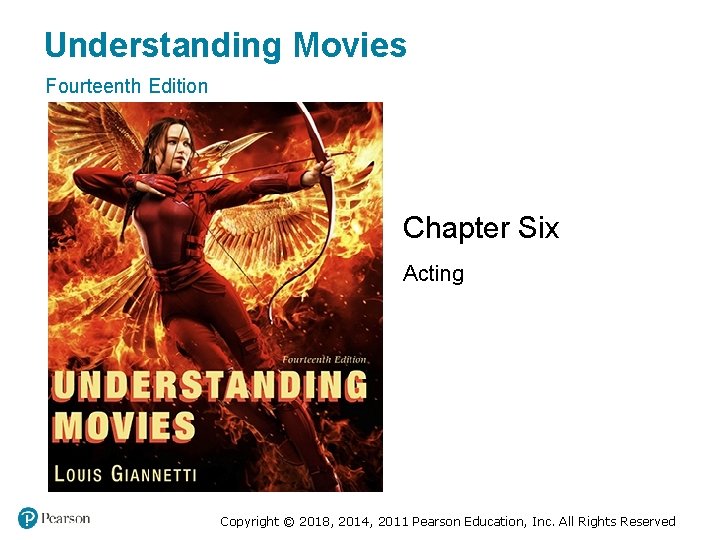
Understanding Movies Fourteenth Edition Chapter Six Acting Copyright



- Slides: 50
Understanding Movies Fourteenth Edition Chapter Six Acting Copyright © 2018, 2014, 2011 Pearson Education, Inc. All Rights Reserved
Learning Objectives (1 of 2) 6. 1 Identify the four categories of film acting and their purposes within film. 6. 2 Contrast the differences between stage and screen acting, and identify why those differences make film “the director’s medium. ” 6. 3 Summarize the history of the American star system, including the golden age of film stars, and list benefits and drawbacks to being a film star. 6. 4 Differentiate between personality stars and actor stars, and list examples of each. Copyright © 2018, 2014, 2011 Pearson Education, Inc. All Rights Reserved
Learning Objectives (2 of 2) 6. 5 Classify the various styles of acting through time and across national origins. 6. 6 Describe the importance of casting in film, and explain why some actors try to avoid typecasting. Copyright © 2018, 2014, 2011 Pearson Education, Inc. All Rights Reserved
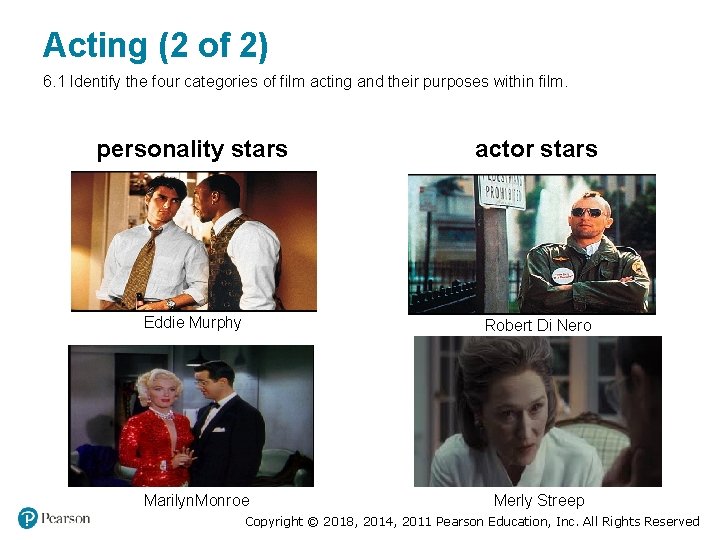
Acting (1 of 2) 6. 1 Identify the four categories of film acting and their purposes within film. Categories of film acting • Extras: Used primarily to provide a sense of crowd—used as camera material, like a landscape or a set. • Nonprofessional performers: Amateur players who are chosen because of their authentic appearance—they look right for a given part. • Trained professionals: Capable of playing a variety of roles in a variety of styles—majority of actors fall into this category. • Stars: Famous performers widely recognized—drawing power is main attraction of a film or stage play. − personality stars: play those roles that fit a preconceived public image (Eddie Murphy—Marilyn Monroe − actor stars: play roles of greater range and variety (Meryl Streep —Robert De Neiro) Copyright © 2018, 2014, 2011 Pearson Education, Inc. All Rights Reserved
Acting (2 of 2) 6. 1 Identify the four categories of film acting and their purposes within film. personality stars actor stars Eddie Murphy Robert Di Nero Marilyn. Monroe Merly Streep Copyright © 2018, 2014, 2011 Pearson Education, Inc. All Rights Reserved
Acting: The American star system (6 of 9) 6. 3 Summarize the history of the American star system, including the golden age of film stars, and list benefits and drawbacks to being a film star. Acting stars vs. personality stars • Personality stars − commonly refuse all parts that go against their type − top box-office attractions tend to be personality stars − Tom Hanks, Sandra Bullock, etc. Copyright © 2018, 2014, 2011 Pearson Education, Inc. All Rights Reserved
Acting: The American star system (7 of 9) 6. 3 Summarize the history of the American star system, including the golden age of film stars, and list benefits and drawbacks to being a film star. Acting stars vs. personality stars • Acting stars − refuse to be typecast − attempt the widest array of roles possible − undertake unpleasant character roles rather than conventional leads to expand their range − Daniel Day Lewis, Reese Witherspoon, etc. Copyright © 2018, 2014, 2011 Pearson Education, Inc. All Rights Reserved
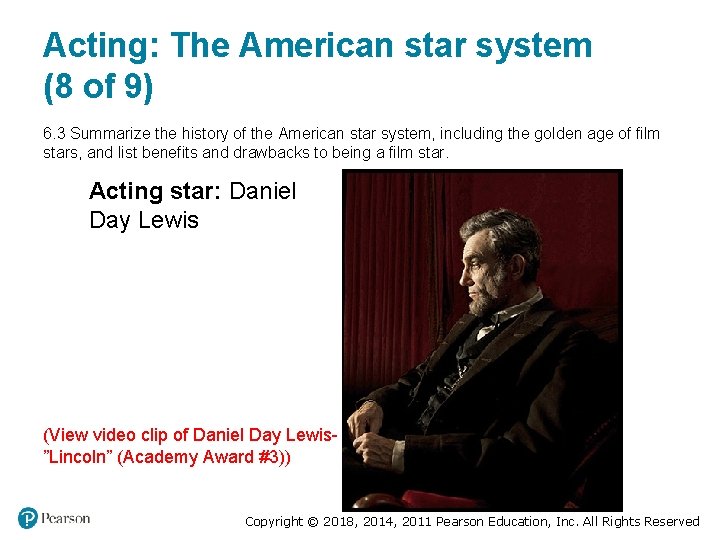
Acting: The American star system (8 of 9) 6. 3 Summarize the history of the American star system, including the golden age of film stars, and list benefits and drawbacks to being a film star. Acting star: Daniel Day Lewis (View video clip of Daniel Day Lewis”Lincoln” (Academy Award #3)) Copyright © 2018, 2014, 2011 Pearson Education, Inc. All Rights Reserved
Acting: The American star system (9 of 9) 6. 3 Summarize the history of the American star system, including the golden age of film stars, and list benefits and drawbacks to being a film star. Acting stars vs. personality stars • many stars fall somewhere between the two extremes • film theorist Richard Dyer has pointed out that stars are signifying entities • the distinction between a professional actor and a star is not based on technical skill, but on mass popularity • sophisticated filmmakers exploit the public’s affection for its stars by creating ambiguous tensions between a role as written, as acted, and as directed Copyright © 2018, 2014, 2011 Pearson Education, Inc. All Rights Reserved
Copyright © 2018, 2014, 2011 Pearson Education, Inc. All Rights Reserved
Acting: stage acting and screen acting (1 of 8) 6. 2 Contrast the differences between stage and screen acting, and identify why those difference make film “the director’s medium. ” Differences between stage acting and screen acting • largely determined by the differences in space and time in each medium − − in live theater the actor is the artist in films, it’s the director who is the artist Copyright © 2018, 2014, 2011 Pearson Education, Inc. All Rights Reserved
Acting: stage acting and screen acting (2 of 8) 6. 2 Contrast the differences between stage and screen acting, and identify why those difference make film “the director’s medium. ” The stage performer • must be seen and heard clearly • must have a flexible trained voice • must be believable, even when reciting dialogue that’s highly stylized and unnatural • helps to be tall—small actors tend to get lost on a large stage • helps to have large and regular features Copyright © 2018, 2014, 2011 Pearson Education, Inc. All Rights Reserved
Acting: stage acting and screen acting (3 of 8) 6. 2 Contrast the differences between stage and screen acting, and identify why those difference make film “the director’s medium. ” The stage performer (cont’d) • can play roles twenty years beyond their actual age • must be able to control body with some degree of precision • theatrical acting preserves real time so the performer must build—scene by scene—toward the climactic scene near the end of the play Copyright © 2018, 2014, 2011 Pearson Education, Inc. All Rights Reserved
Acting: stage acting and screen acting (4 of 8) 6. 2 Contrast the differences between stage and screen acting, and identify why those difference make film “the director’s medium. ” The screen actor • can get along quite well with a minimum of stage technique • essential requisite is “expressiveness”; that is, he or she must look interesting • almost totally dependent on the filmmaker’s approach to the story materials − the more realistic the director’s techniques, the more necessary it is to rely on the abilities of the players − the more formalistic the director, the less likely he or she is to value the actor’s contribution − through the art of editing, a director can construct a highly emotional “performance” by juxtaposing shots of actors with shots of objects Copyright © 2018, 2014, 2011 Pearson Education, Inc. All Rights Reserved
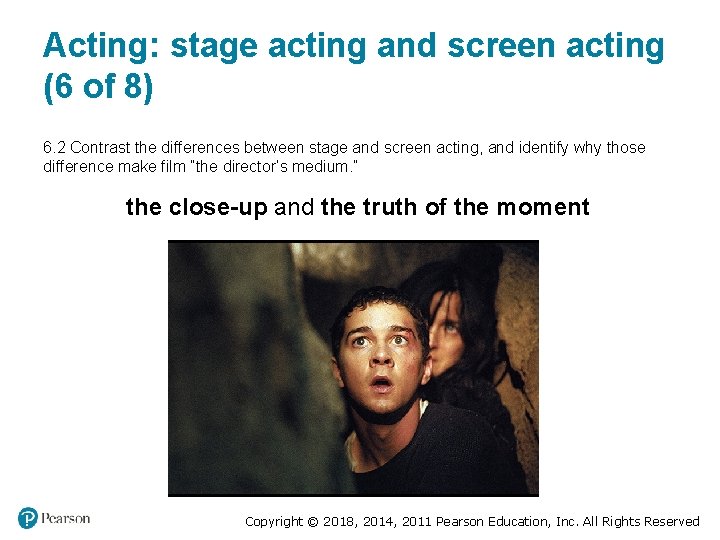
Acting: stage acting and screen acting (5 of 8) 6. 2 Contrast the differences between stage and screen acting, and identify why those difference make film “the director’s medium. ” The screen actor (cont’d) • the close-up allows the film actor to concentrate totally on the truth of the moment • not restricted by vocal requirements because sound volume is controlled electronically • doesn’t have to be tall • features don’t have to be large, only expressive • an actor who moves clumsily is not necessarily at a disadvantage in film Copyright © 2018, 2014, 2011 Pearson Education, Inc. All Rights Reserved
Acting: stage acting and screen acting (6 of 8) 6. 2 Contrast the differences between stage and screen acting, and identify why those difference make film “the director’s medium. ” the close-up and the truth of the moment Copyright © 2018, 2014, 2011 Pearson Education, Inc. All Rights Reserved
Acting: stage acting and screen acting (7 of 8) 6. 2 Contrast the differences between stage and screen acting, and identify why those difference make film “the director’s medium. ” The screen actor (cont’d) • because the shot is the basic building unit in film, the actor doesn’t have to sustain a performance for very long • the various sequences can be shot out of chronology • the screen actor doesn’t “build” emotionally as the stage actor must • must be capable of an intense degree of concentration —turning emotions on and off for very short periods of time Copyright © 2018, 2014, 2011 Pearson Education, Inc. All Rights Reserved
Acting: stage acting and screen acting (8 of 8) 6. 2 Contrast the differences between stage and screen acting, and identify why those difference make film “the director’s medium. ” The screen actor (cont’d) • most of the time, the player must seem totally natural, as if he or she weren’t acting at all • because acting in the cinema is confined to short segments of time and space, the film player doesn’t need a long rehearsal period • a film actor is expected to play even the most intimate scenes with dozens of technicians on the set Copyright © 2018, 2014, 2011 Pearson Education, Inc. All Rights Reserved
Acting: The American star system (1 of 9) 6. 3 Summarize the history of the American star system, including the golden age of film stars, and list benefits and drawbacks to being a film star. The backbone of the American film industry since the mid-1910 s • stars are the creation of the public, its reigning favorites • the public often fuses a star’s artistic persona with his or her private personality • audiences can be remarkably resistant to someone else’s notion of a star Copyright © 2018, 2014, 2011 Pearson Education, Inc. All Rights Reserved
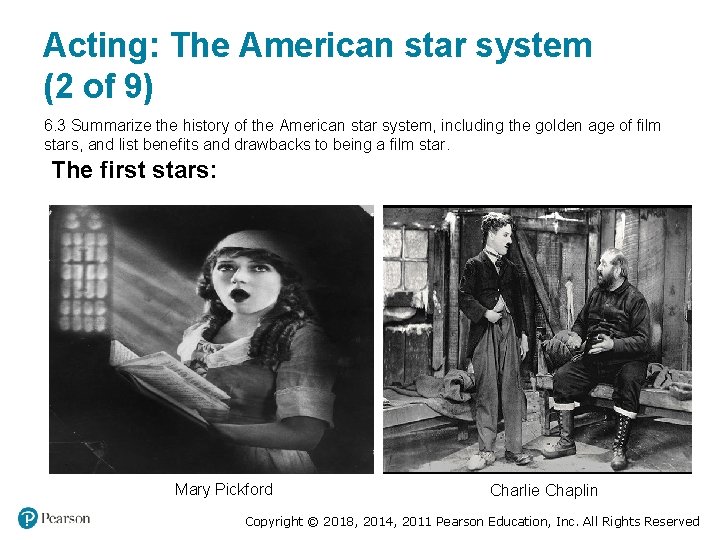
Acting: The American star system (2 of 9) 6. 3 Summarize the history of the American star system, including the golden age of film stars, and list benefits and drawbacks to being a film star. The first stars: Mary Pickford Charlie Chaplin Copyright © 2018, 2014, 2011 Pearson Education, Inc. All Rights Reserved
Acting: The American star system (3 of 9) 6. 3 Summarize the history of the American star system, including the golden age of film stars, and list benefits and drawbacks to being a film star. The golden age— 1930 s and 1940 s The “majors” (studios): • MGM • Warner Brothers • Twentieth Century Fox • Paramount • RKO Copyright © 2018, 2014, 2011 Pearson Education, Inc. All Rights Reserved
Acting: The American star system (4 of 9) 6. 3 Summarize the history of the American star system, including the golden age of film stars, and list benefits and drawbacks to being a film star. Stars as commodity • in their first years under studio contract, stars were given maximum exposure • after a particularly popular performance, a star was usually locked into the same type of role • demand for stars was the most predictable economic variable in the business • majors viewed their stars as valuable investments • promising neophytes served an apprenticeship as starlets • top stars attracted the loyalty of both men and women Copyright © 2018, 2014, 2011 Pearson Education, Inc. All Rights Reserved
Acting: The American star system (5 of 9) 6. 3 Summarize the history of the American star system, including the golden age of film stars, and list benefits and drawbacks to being a film star. Mythology and Iconography • mythology of stardom usually emphasizes glamour • critic Parker Tyler observed that stars fulfill an ancient need, almost religious in nature • contemporary film stars have become quite savvy in exploiting the public’s fascination with their lives • stars must pay a high price for their wealth and fame —treated like commodities with a price tag Copyright © 2018, 2014, 2011 Pearson Education, Inc. All Rights Reserved
Acting: Styles of acting (1 of 13) 6. 5 Classify the various styles of acting through time and across national origins. Acting styles differ radically depending on • period • genre • tone • national origins • directorial emphasis Copyright © 2018, 2014, 2011 Pearson Education, Inc. All Rights Reserved
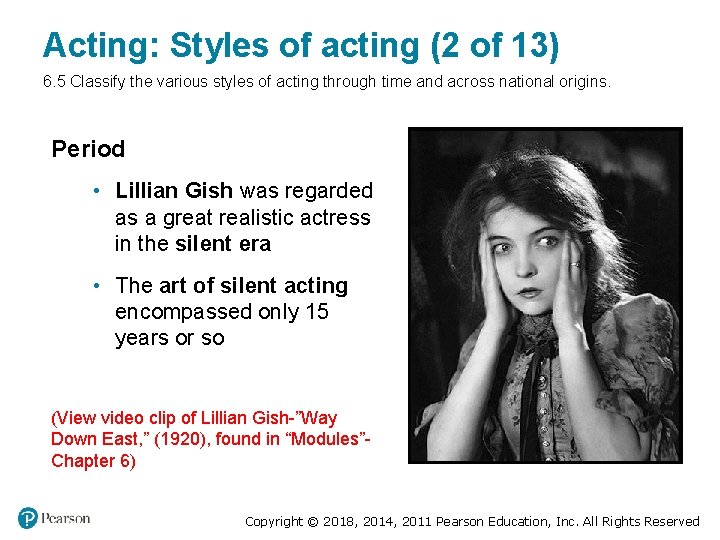
Acting: Styles of acting (2 of 13) 6. 5 Classify the various styles of acting through time and across national origins. Period • Lillian Gish was regarded as a great realistic actress in the silent era • The art of silent acting encompassed only 15 years or so (View video clip of Lillian Gish-”Way Down East, ” (1920), found in “Modules”Chapter 6) Copyright © 2018, 2014, 2011 Pearson Education, Inc. All Rights Reserved
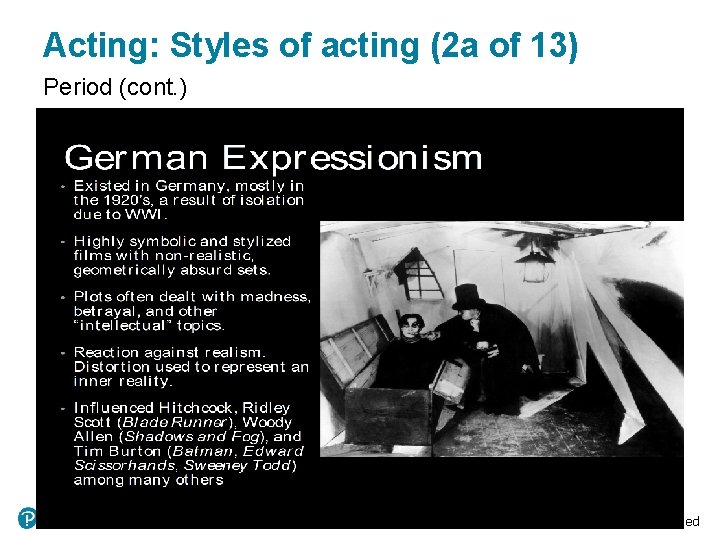
Acting: Styles of acting (2 a of 13) Period (cont. ) Copyright © 2018, 2014, 2011 Pearson Education, Inc. All Rights Reserved
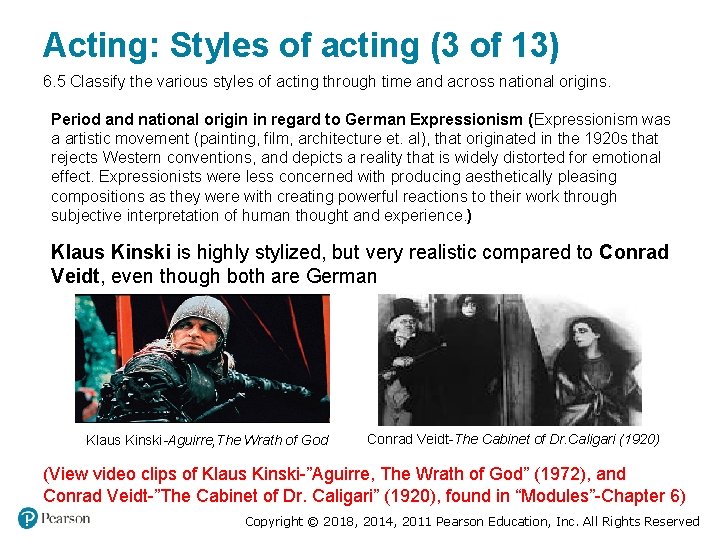
Acting: Styles of acting (3 of 13) 6. 5 Classify the various styles of acting through time and across national origins. Period and national origin in regard to German Expressionism (Expressionism was a artistic movement (painting, film, architecture et. al), that originated in the 1920 s that rejects Western conventions, and depicts a reality that is widely distorted for emotional effect. Expressionists were less concerned with producing aesthetically pleasing compositions as they were with creating powerful reactions to their work through subjective interpretation of human thought and experience. ) Klaus Kinski is highly stylized, but very realistic compared to Conrad Veidt, even though both are German Klaus Kinski-Aguirre, The Wrath of God Conrad Veidt-The Cabinet of Dr. Caligari (1920) (View video clips of Klaus Kinski-”Aguirre, The Wrath of God” (1972), and Conrad Veidt-”The Cabinet of Dr. Caligari” (1920), found in “Modules”-Chapter 6) Copyright © 2018, 2014, 2011 Pearson Education, Inc. All Rights Reserved
Acting: Styles of acting (4 of 13) 6. 5 Classify the various styles of acting through time and across national origins. Genre • stylized genres such as the samurai film • as opposed to realistic contemporary stories (View video clips of Toshiro Mifune-”Yojimbo” and “High and Low” found in ”Modules”-Chapter 6) Tone • Chaplin blended comedy with pathos • Greta Garbo perfected a romantic style of acting (View video clip of Garbo-”Camillie” (1936), found in “Modules”-Chapter 6) Copyright © 2018, 2014, 2011 Pearson Education, Inc. All Rights Reserved
Copyright © 2018, 2014, 2011 Pearson Education, Inc. All Rights Reserved
Copyright © 2018, 2014, 2011 Pearson Education, Inc. All Rights Reserved
Copyright © 2018, 2014, 2011 Pearson Education, Inc. All Rights Reserved
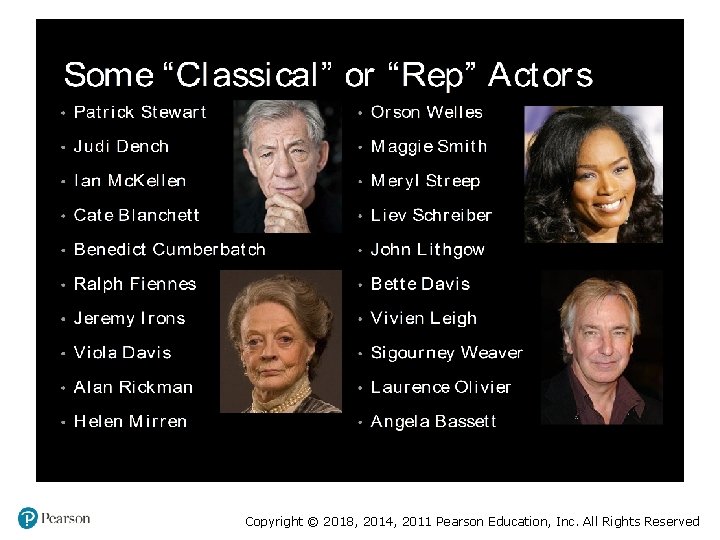
Acting: Styles of acting (5 of 13) 6. 5 Classify the various styles of acting through time and across national origins. The British tradition Most important British film actors are often also the most prominent in the live theater • British repertory system • almost every medium-sized city once had a resident drama company • where actors could learn their craft by playing a variety of roles from the classic repertory • especially the works of William Shakespeare Copyright © 2018, 2014, 2011 Pearson Education, Inc. All Rights Reserved
Acting: Styles of acting (6 of 13) 6. 5 Classify the various styles of acting through time and across national origins. • British repertory system (cont’d) • as players improved, they rose through the ranks, attempting more complex roles • the best migrated to the larger cities, where the most prestigious theater companies were found • finest were regularly employed in theaters of London • adjacent to the centers of film production in Britain Copyright © 2018, 2014, 2011 Pearson Education, Inc. All Rights Reserved
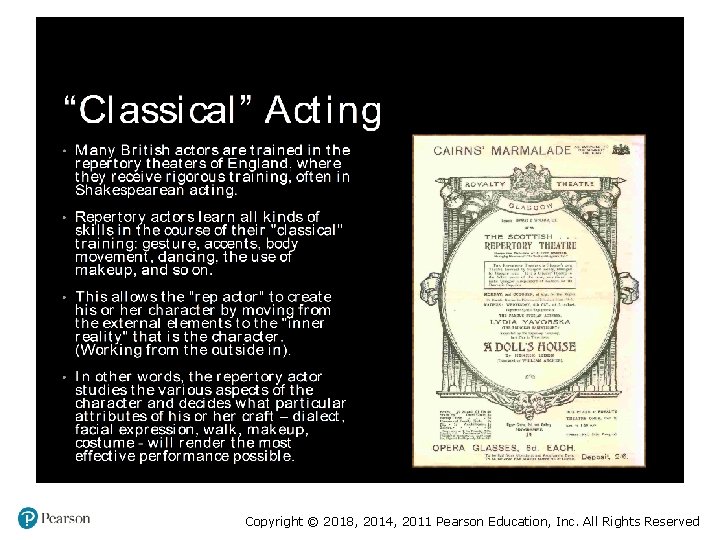
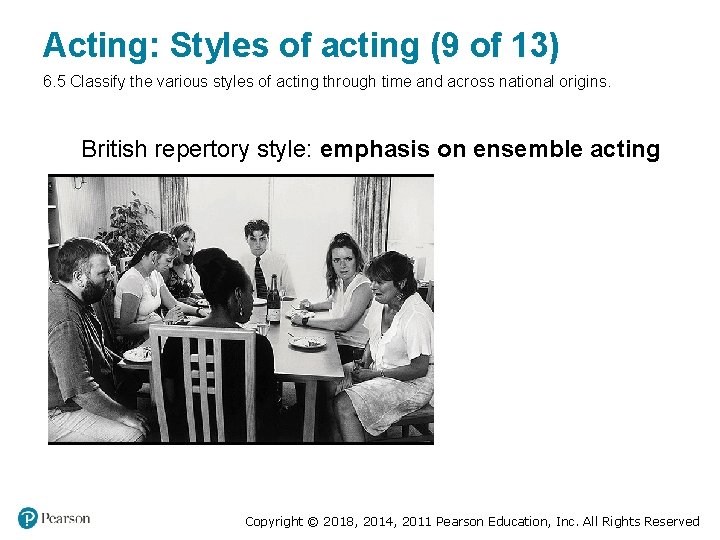
Acting: Styles of acting (8 of 13) 6. 5 Classify the various styles of acting through time and across national origins. British repertory style of acting • tended to favor a mastery of externals • based on close observation • players being trained in diction, movement, makeup, dialects, fencing, dancing, body control • ensemble acting Copyright © 2018, 2014, 2011 Pearson Education, Inc. All Rights Reserved
Acting: Styles of acting (9 of 13) 6. 5 Classify the various styles of acting through time and across national origins. British repertory style: emphasis on ensemble acting Copyright © 2018, 2014, 2011 Pearson Education, Inc. All Rights Reserved
Copyright © 2018, 2014, 2011 Pearson Education, Inc. All Rights Reserved
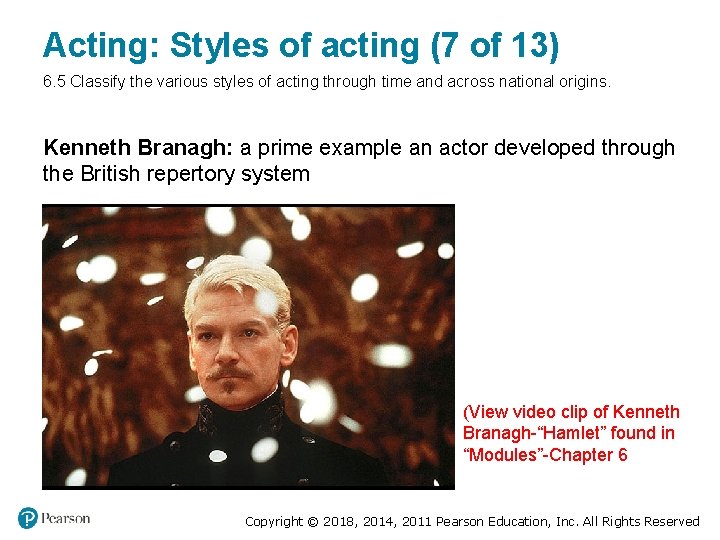
Acting: Styles of acting (7 of 13) 6. 5 Classify the various styles of acting through time and across national origins. Kenneth Branagh: a prime example an actor developed through the British repertory system (View video clip of Kenneth Branagh-“Hamlet” found in “Modules”-Chapter 6 Copyright © 2018, 2014, 2011 Pearson Education, Inc. All Rights Reserved
Copyright © 2018, 2014, 2011 Pearson Education, Inc. All Rights Reserved
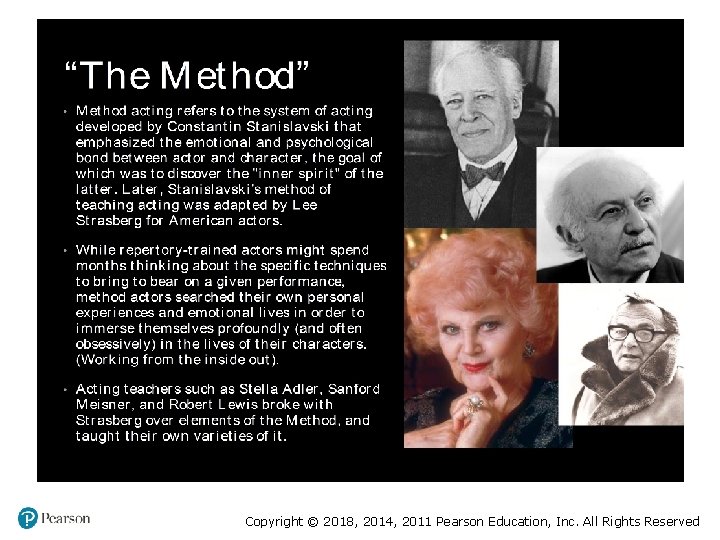
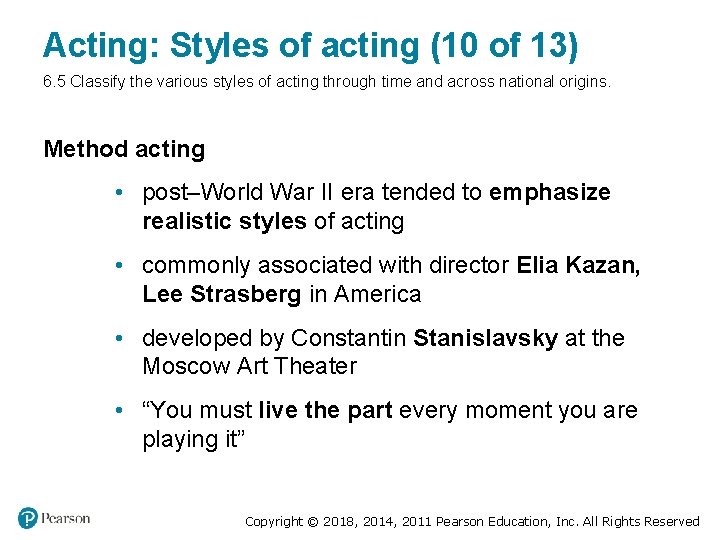
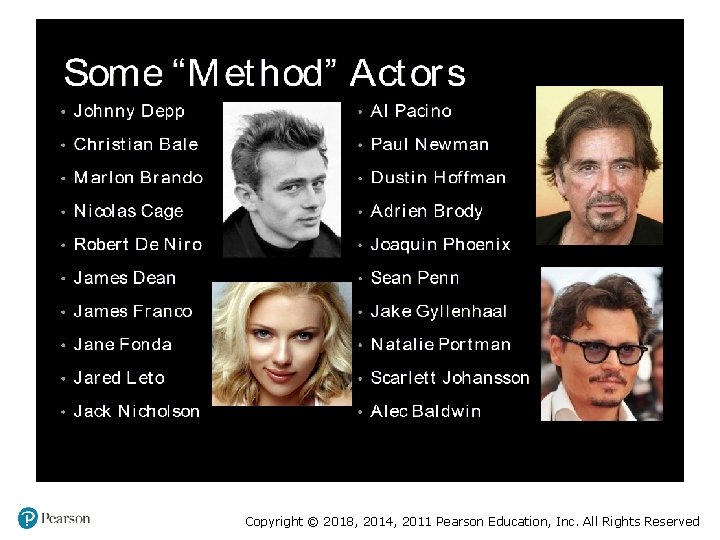
Acting: Styles of acting (10 of 13) 6. 5 Classify the various styles of acting through time and across national origins. Method acting • post–World War II era tended to emphasize realistic styles of acting • commonly associated with director Elia Kazan, Lee Strasberg in America • developed by Constantin Stanislavsky at the Moscow Art Theater • “You must live the part every moment you are playing it” Copyright © 2018, 2014, 2011 Pearson Education, Inc. All Rights Reserved
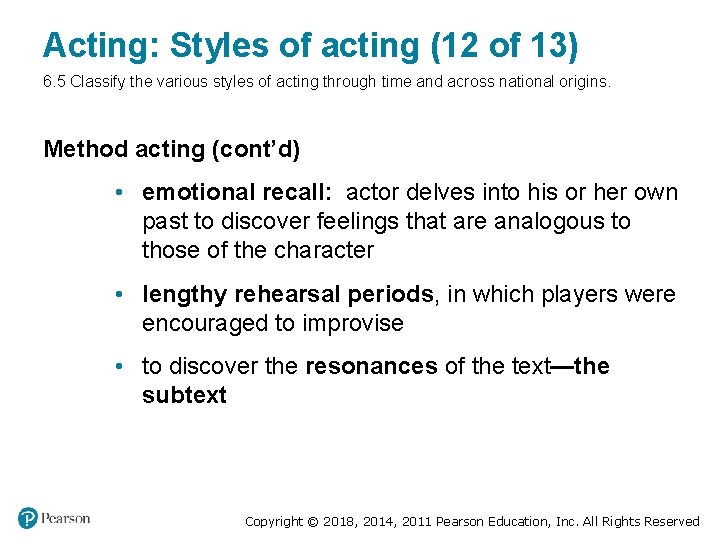
Acting: Styles of acting (12 of 13) 6. 5 Classify the various styles of acting through time and across national origins. Method acting (cont’d) • emotional recall: actor delves into his or her own past to discover feelings that are analogous to those of the character • lengthy rehearsal periods, in which players were encouraged to improvise • to discover the resonances of the text—the subtext Copyright © 2018, 2014, 2011 Pearson Education, Inc. All Rights Reserved
Copyright © 2018, 2014, 2011 Pearson Education, Inc. All Rights Reserved
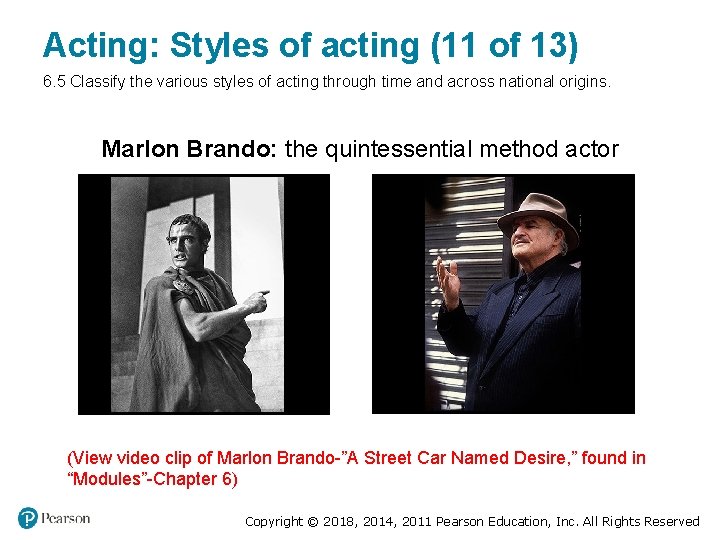
Acting: Styles of acting (11 of 13) 6. 5 Classify the various styles of acting through time and across national origins. Marlon Brando: the quintessential method actor (View video clip of Marlon Brando-”A Street Car Named Desire, ” found in “Modules”-Chapter 6) Copyright © 2018, 2014, 2011 Pearson Education, Inc. All Rights Reserved
Copyright © 2018, 2014, 2011 Pearson Education, Inc. All Rights Reserved
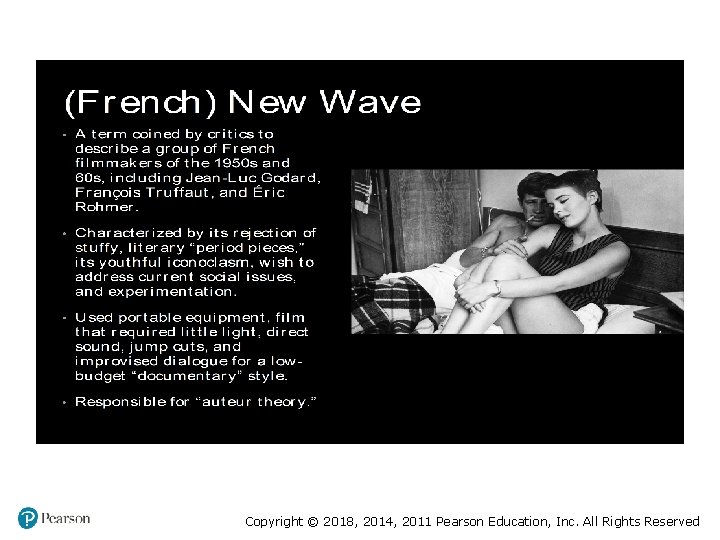
Acting: Styles of acting (13 of 13) 6. 5 Classify the various styles of acting through time and across national origins. The French New Wave influence: New Wave filmmakers desired to shoot current social issues on location, and experiment with the film form by engaging in radical experiments with editing, visual style and narrative form resulting in a general break with the conservative paradigm. • used portable equipment requiring little or no set up time • films exhibited direct sounds on film stock that required less light • used fragmented, discontinuous editing, and long takes. especially Jean-Luc Godard and Francois Truffaut • influenced by he documentary style of cinema verite • popularized the technique of improvisation while their players were on camera • resultant increase in realism was highly praised by critics • captured a greater sense of discovery and surprise (View video clip of Puppet Show-” 400 Blows” found in “Modules”-Chapter 6) Copyright © 2018, 2014, 2011 Pearson Education, Inc. All Rights Reserved
Acting: Casting (1 of 4) 6. 6 Describe the importance of casting in film, and explain why some actors try to avoid typecasting. Typecasting—an acute sensitivity to a player’s type • inherited from the live theater • stage and screen performers are classified according to role categories: • leading men, leading ladies, character actors, juveniles, villains, light comedians, tragedians, ingenues, singing actors, dancing actors, etc. • the rule in silent cinema • trained actors resent being typecast and often attempt to broaden their range Copyright © 2018, 2014, 2011 Pearson Education, Inc. All Rights Reserved
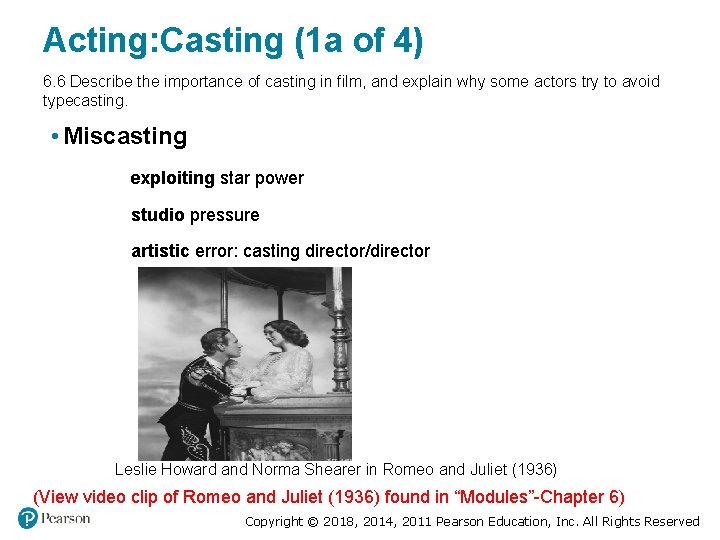
Acting: Casting (1 a of 4) 6. 6 Describe the importance of casting in film, and explain why some actors try to avoid typecasting. • Miscasting exploiting star power studio pressure artistic error: casting director/director Leslie Howard and Norma Shearer in Romeo and Juliet (1936) (View video clip of Romeo and Juliet (1936) found in “Modules”-Chapter 6) Copyright © 2018, 2014, 2011 Pearson Education, Inc. All Rights Reserved
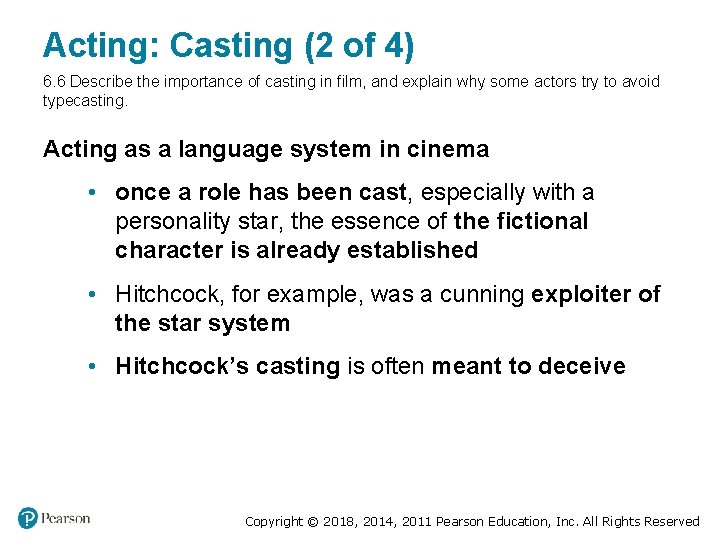
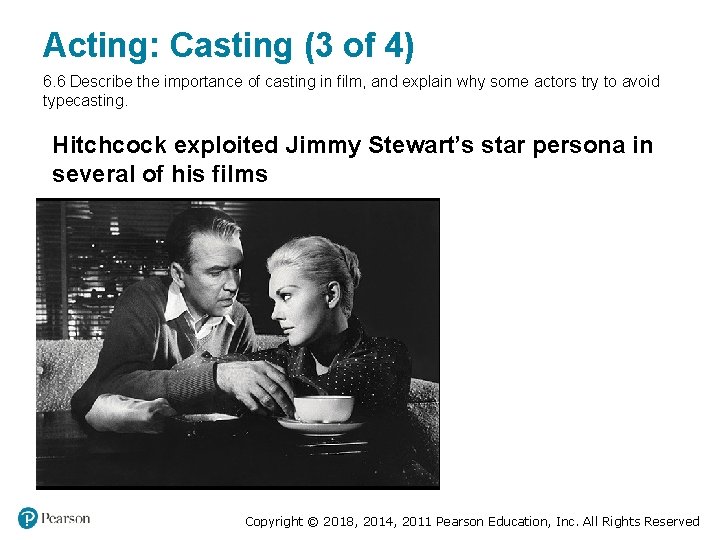
Acting: Casting (2 of 4) 6. 6 Describe the importance of casting in film, and explain why some actors try to avoid typecasting. Acting as a language system in cinema • once a role has been cast, especially with a personality star, the essence of the fictional character is already established • Hitchcock, for example, was a cunning exploiter of the star system • Hitchcock’s casting is often meant to deceive Copyright © 2018, 2014, 2011 Pearson Education, Inc. All Rights Reserved
Acting: Casting (3 of 4) 6. 6 Describe the importance of casting in film, and explain why some actors try to avoid typecasting. Hitchcock exploited Jimmy Stewart’s star persona in several of his films Copyright © 2018, 2014, 2011 Pearson Education, Inc. All Rights Reserved
Acting: Casting (4 of 4) 6. 6 Describe the importance of casting in film, and explain why some actors try to avoid typecasting. Acting as a language system in cinema (cont’d) • the filmmaker uses actors as a medium for communicating ideas and emotions • in analyzing the acting in a movie, we should consider what type of actors are featured and why Copyright © 2018, 2014, 2011 Pearson Education, Inc. All Rights Reserved
Finis Copyright © 2018, 2014, 2011 Pearson Education, Inc. All Rights Reserved