
Understanding Motivation What is Motivation Student Motivation in
- Slides: 31
Understanding Motivation What is Motivation?
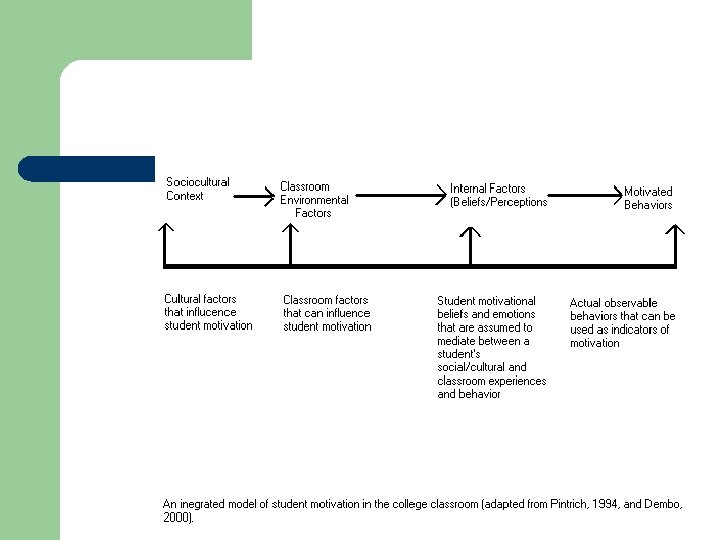
Student Motivation in the College Classroom What factors influence it? Sociocultural Context Classroom Environmental Factors Internal Factors (Beliefs/Perceptions) Motivated Behavior
Understanding Your Own Motivation l Evaluate your behaviors in three areas: – – – Choice of behavior Level of activity and involvement Persistence and management of effort
Sociocultural Context l Cultural Factors can influence your motivation Attitudes, beliefs, and experiences you bring to college based on your sociocultural experiences that influence motivation and behaviors.
Internal Factors l Goals you set: – – l Serve to Motivate Behavior Affect Mastery and Performance Ask yourself, what are my goals? Are they defined goals in Long and Short Terms? Are they clear and well defined? Are they set goals different life areas?
5 Major Ways Goals Enhance Your Performance l l l Effort Duration and Persistence Direction of Attention Strategic Planning Reference Point
Effects on Effort l Goals setting influences what you do and how hard you maximize your performance l The more difficult the goal—the harder you work towards attaining it.
Effects on Duration or Persistence l Without goals, it easy to be – – l Distracted Attention drifts More easily interrupted Stop work without task completion With goals, you have defined point of performance – Know when to quit the task
Effects on Attention l Goals direct your attention toward the task l Goals direct you attention away from distractions
Strategic Planning l To accomplish a goal, you need – – An action plan or strategic planning Goal setting encourages strategic planning and helps determine how you proceed
Reference Point l l l Identifies where you are headed Allows you to receive feedback from that point Determines any further actions that need taken
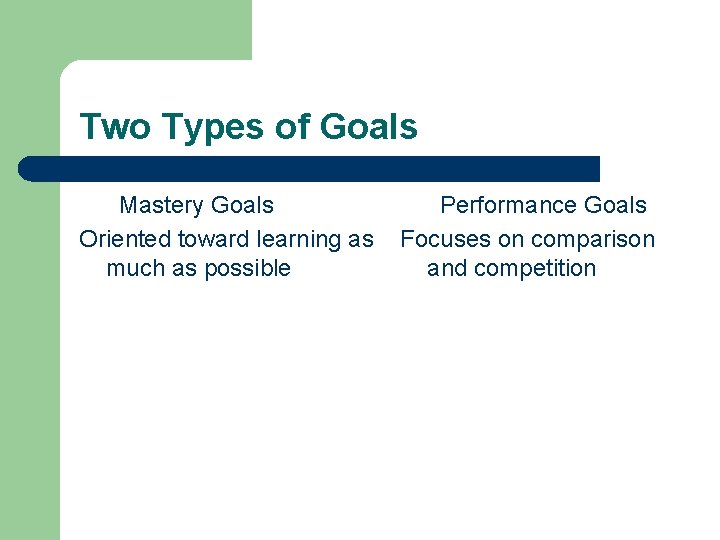
Two Types of Goals Mastery Goals Oriented toward learning as much as possible Performance Goals Focuses on comparison and competition
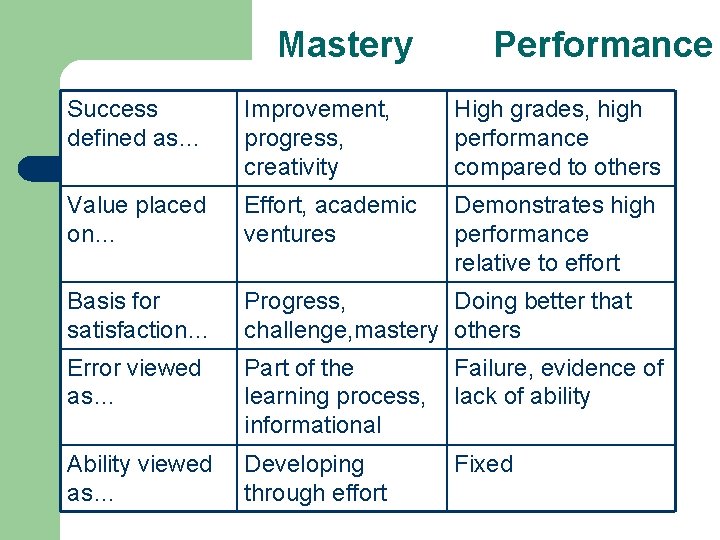
Mastery Performance Success defined as… Improvement, progress, creativity High grades, high performance compared to others Value placed on… Effort, academic ventures Demonstrates high performance relative to effort Basis for satisfaction… Progress, Doing better that challenge, mastery others Error viewed as… Part of the learning process, informational Failure, evidence of lack of ability Ability viewed as… Developing through effort Fixed
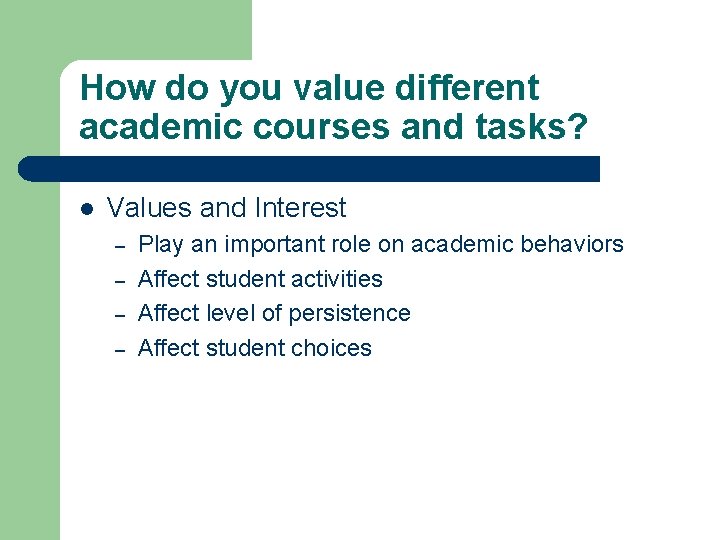
How do you value different academic courses and tasks? l Values and Interest – – Play an important role on academic behaviors Affect student activities Affect level of persistence Affect student choices
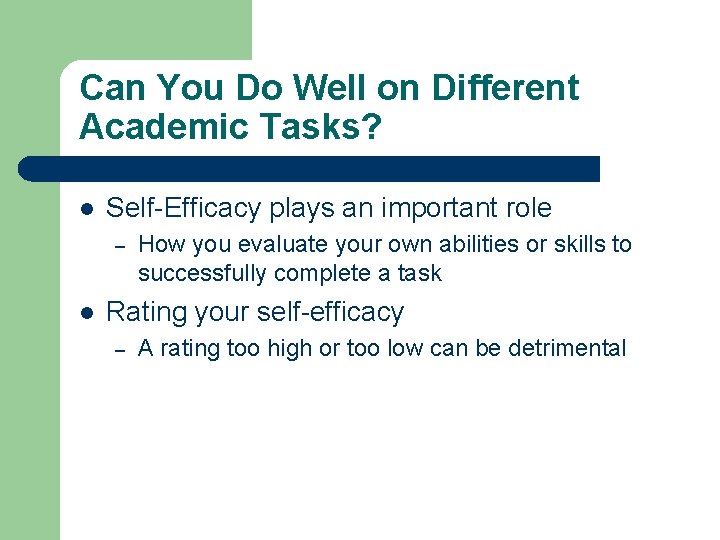
Can You Do Well on Different Academic Tasks? l Self-Efficacy plays an important role – l How you evaluate your own abilities or skills to successfully complete a task Rating your self-efficacy – A rating too high or too low can be detrimental
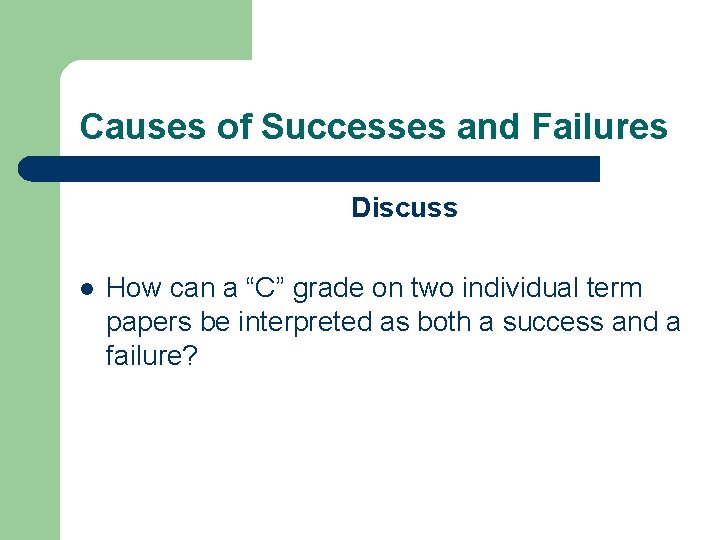
Causes of Successes and Failures Discuss l How can a “C” grade on two individual term papers be interpreted as both a success and a failure?
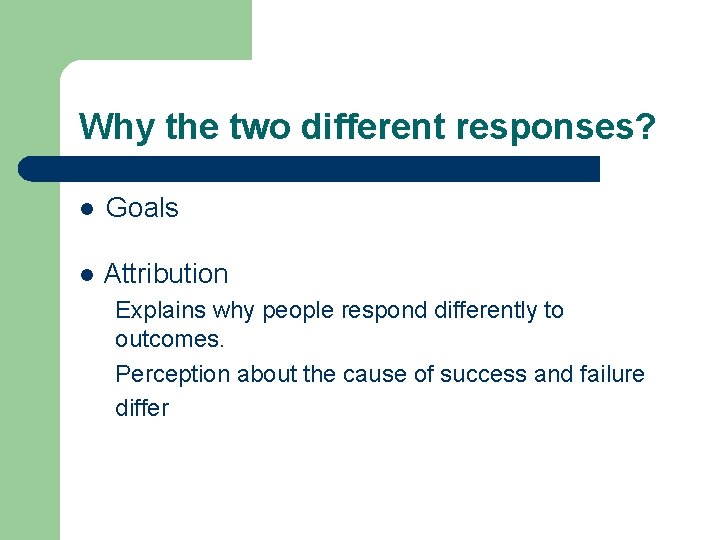
Why the two different responses? l Goals l Attribution Explains why people respond differently to outcomes. Perception about the cause of success and failure differ
l How students perceive prior successes and failures is an important determiner of how they approach their next tasks.
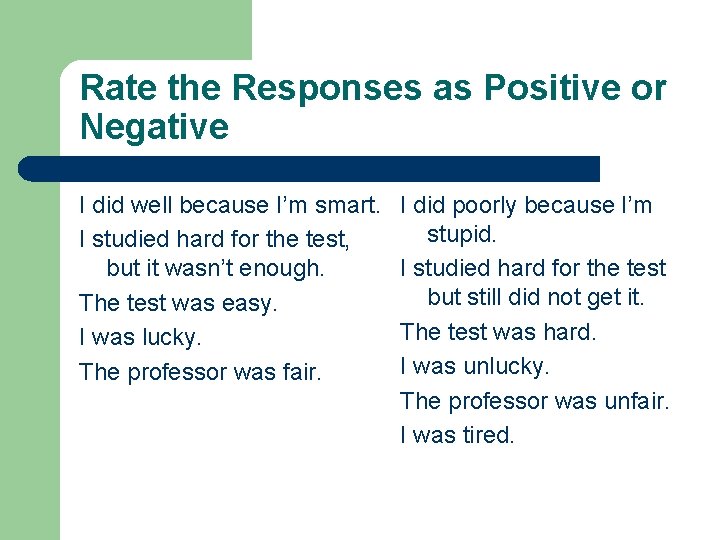
Rate the Responses as Positive or Negative I did well because I’m smart. I studied hard for the test, but it wasn’t enough. The test was easy. I was lucky. The professor was fair. I did poorly because I’m stupid. I studied hard for the test but still did not get it. The test was hard. I was unlucky. The professor was unfair. I was tired.
Respond to these questions l l When I perform poorly, do I attribute my performance to uncontrollable factors? Are there alternative explanations for the causes of my academic performances?
What are some factors that can negatively affect your performance? Boredom Anxiety Worry Self-Doubt
Negative Impacts on Performance l Boredom – – It is not a reason—it is an excuse!!! Often implies that the learner does not understand the material
Negative Impacts on Performance l Anxiety – Can negatively impact performance 4 ways: l l Disruption in mental activity Psychological distress Misdirected attention Inappropriate behaviors
Negative Impacts on Performance l Worrying can be a major factor – – Has a strong negative impact academic performance Negative beliefs Troubling thoughts Poor decisions
Negative Impacts on Performance l Psychological distress – – Emotionality This seems to diminish after a test begins; whereas, worry continues
Inappropriate Behaviors l l l Procrastination Test anxiety Lack of persistence until task completion
Covington’s Theory of Self-Worth Strategies that protect against inferences on an individual’s lack of ability Procrastination Unattainable Goals Underachievers Anxiety
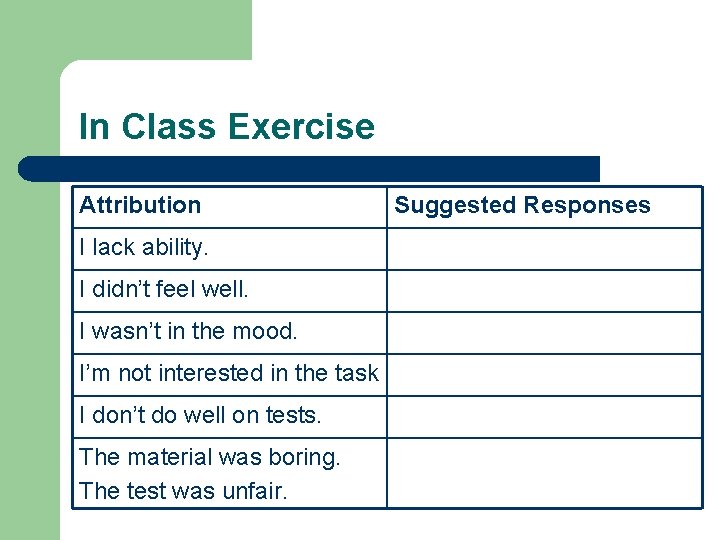
In Class Exercise Attribution I lack ability. I didn’t feel well. I wasn’t in the mood. I’m not interested in the task I don’t do well on tests. The material was boring. The test was unfair. Suggested Responses
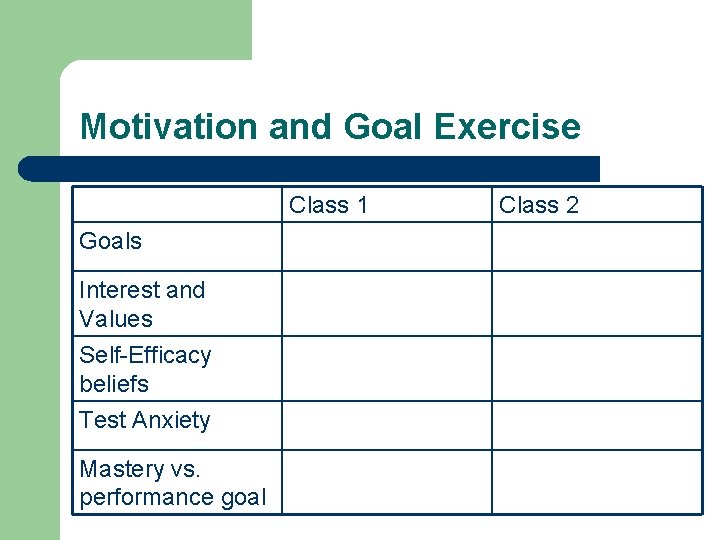
Assignment l l Select two (2) different courses you are currently taking—one difficult and one less challenging or one that you like and one that you don’t like. Analyze your motivation in the two classes by discussing IN DETAIL each of the following factors that determine your motivated behaviors. Use a graph like the example that follows:
Motivation and Goal Exercise Class 1 Goals Interest and Values Self-Efficacy beliefs Test Anxiety Mastery vs. performance goal Class 2