
Understanding Mortality Statistics The Importance of CauseofDeath Certification
- Slides: 46
Understanding Mortality Statistics: The Importance of Cause-of-Death Certification and Coding Robert N. Anderson, Ph. D Arialdi M. Miniño, MPH Mortality Statistics Branch Division of Vital Statistics Centers for Disease Control and Prevention National Center for Health Statistics
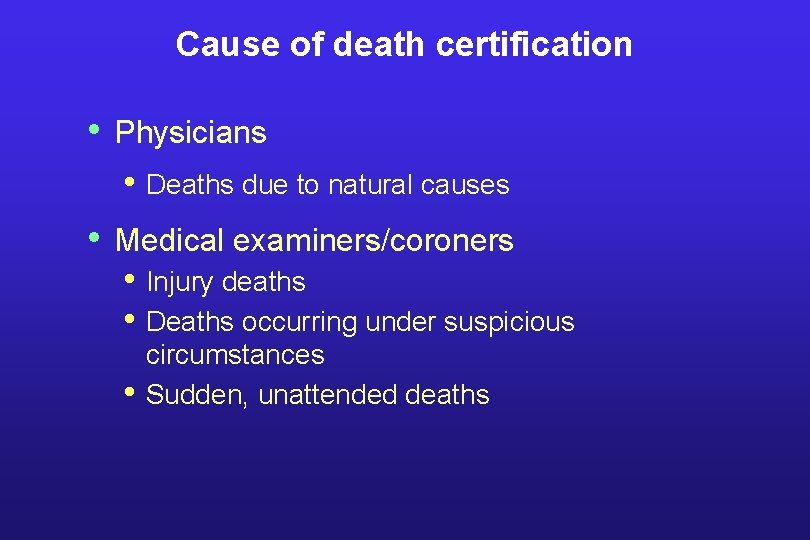
Cause of death certification • Physicians • Deaths due to natural causes • Medical examiners/coroners • Injury deaths • Deaths occurring under suspicious • circumstances Sudden, unattended deaths
Evaluating Cause of Death Statistics Accuracy of diagnosis vs Accuracy of certification
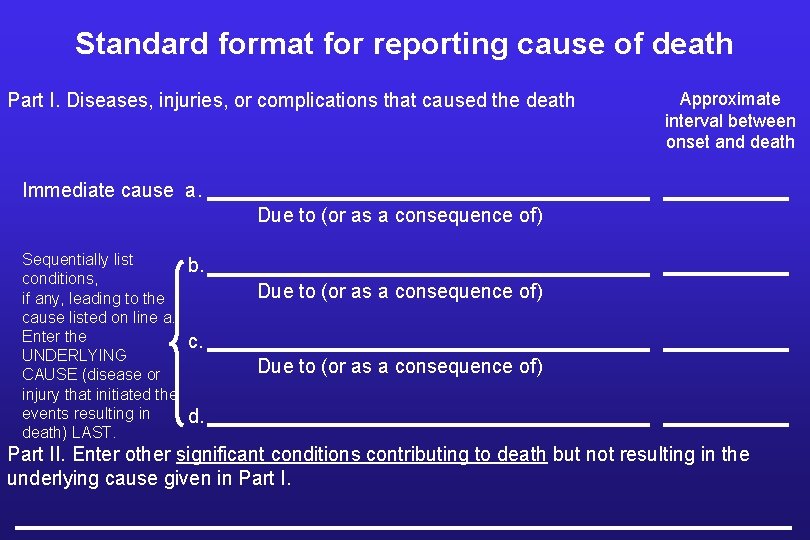
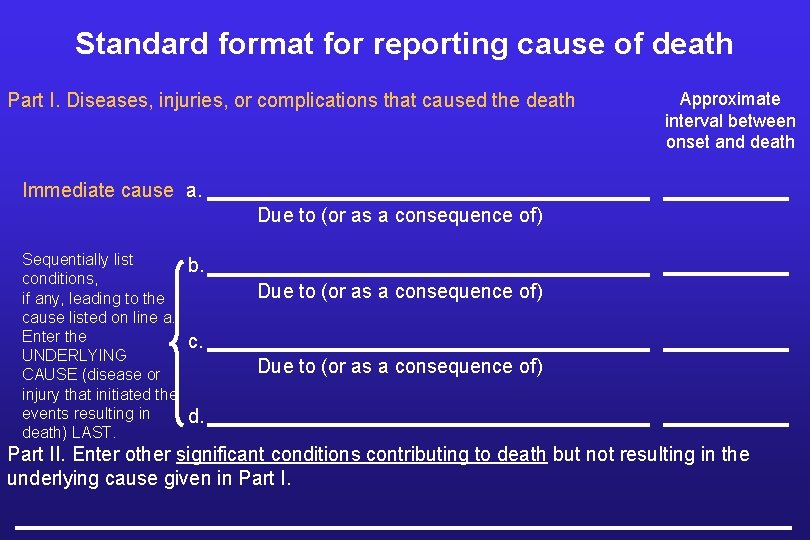
Standard format for reporting cause of death Part I. Diseases, injuries, or complications that caused the death Approximate interval between onset and death Immediate cause a. Due to (or as a consequence of) Sequentially list conditions, if any, leading to the cause listed on line a. Enter the UNDERLYING CAUSE (disease or injury that initiated the events resulting in death) LAST. b. Due to (or as a consequence of) c. Due to (or as a consequence of) d. Part II. Enter other significant conditions contributing to death but not resulting in the underlying cause given in Part I.
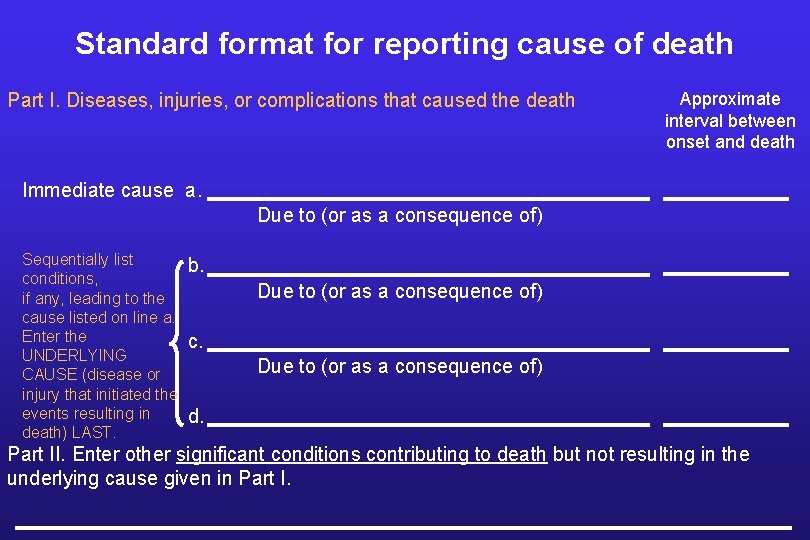
Standard format for reporting cause of death Part I. Diseases, injuries, or complications that caused the death Approximate interval between onset and death Immediate cause a. Due to (or as a consequence of) Sequentially list conditions, if any, leading to the cause listed on line a. Enter the UNDERLYING CAUSE (disease or injury that initiated the events resulting in death) LAST. b. Due to (or as a consequence of) c. Due to (or as a consequence of) d. Part II. Enter other significant conditions contributing to death but not resulting in the underlying cause given in Part I.
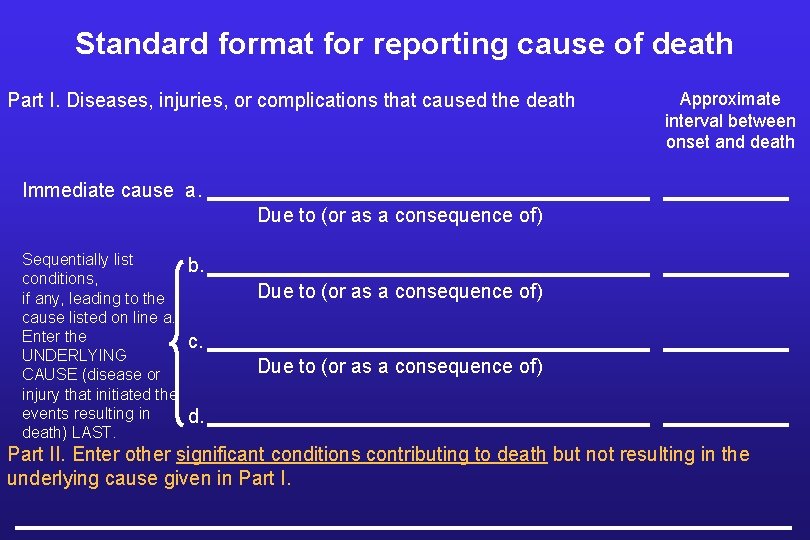
Standard format for reporting cause of death Part I. Diseases, injuries, or complications that caused the death Approximate interval between onset and death Immediate cause a. Due to (or as a consequence of) Sequentially list conditions, if any, leading to the cause listed on line a. Enter the UNDERLYING CAUSE (disease or injury that initiated the events resulting in death) LAST. b. Due to (or as a consequence of) c. Due to (or as a consequence of) d. Part II. Enter other significant conditions contributing to death but not resulting in the underlying cause given in Part I.
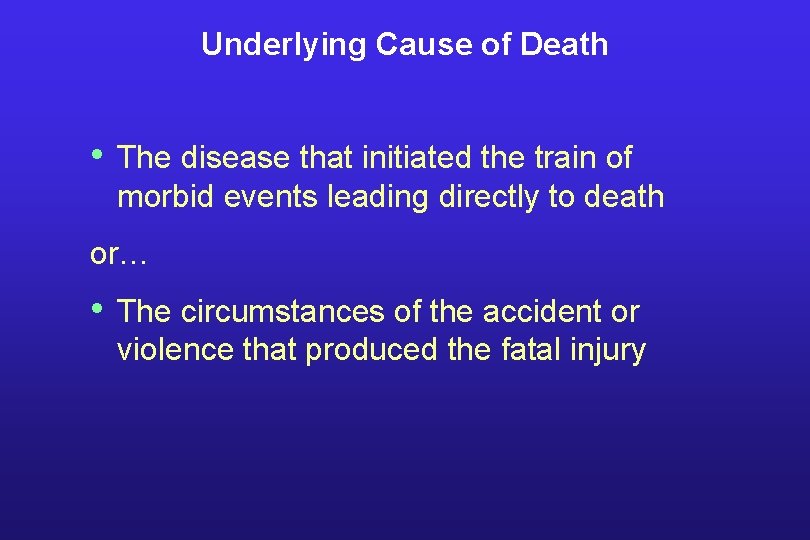
Underlying Cause of Death • The disease that initiated the train of morbid events leading directly to death or… • The circumstances of the accident or violence that produced the fatal injury
Standard format for reporting cause of death Part I. Diseases, injuries, or complications that caused the death Approximate interval between onset and death Immediate cause a. Due to (or as a consequence of) Sequentially list conditions, if any, leading to the cause listed on line a. Enter the UNDERLYING CAUSE (disease or injury that initiated the events resulting in death) LAST. b. Due to (or as a consequence of) c. Due to (or as a consequence of) d. Part II. Enter other significant conditions contributing to death but not resulting in the underlying cause given in Part I.
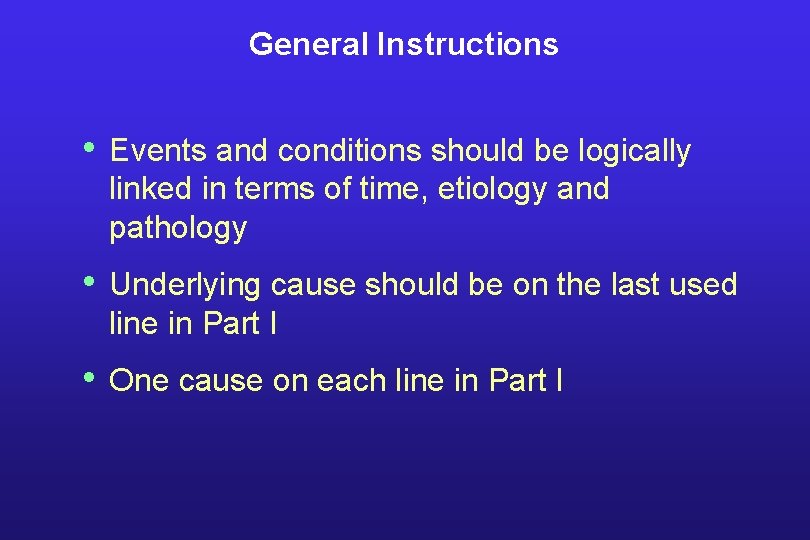
General Instructions • Events and conditions should be logically linked in terms of time, etiology and pathology • Underlying cause should be on the last used line in Part I • One cause on each line in Part I
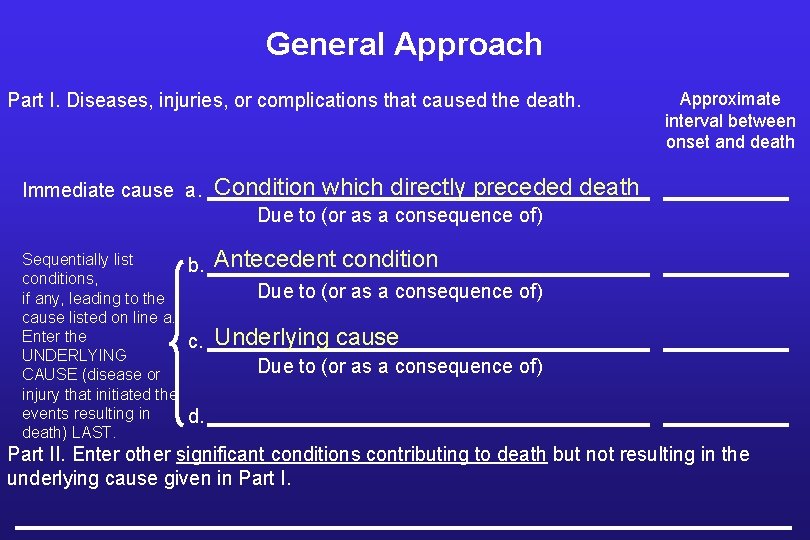
General Approach Part I. Diseases, injuries, or complications that caused the death. Immediate cause a. Approximate interval between onset and death Condition which directly preceded death Due to (or as a consequence of) Sequentially list conditions, if any, leading to the cause listed on line a. Enter the UNDERLYING CAUSE (disease or injury that initiated the events resulting in death) LAST. b. Antecedent condition Due to (or as a consequence of) c. Underlying cause Due to (or as a consequence of) d. Part II. Enter other significant conditions contributing to death but not resulting in the underlying cause given in Part I.
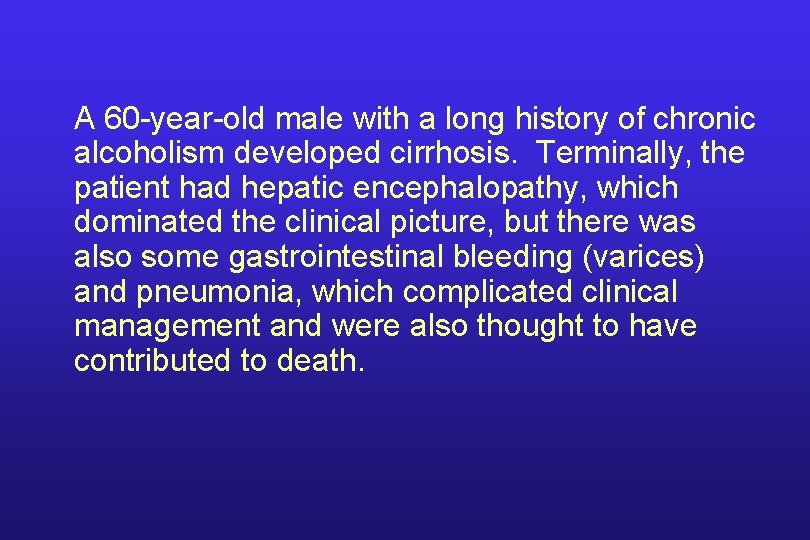
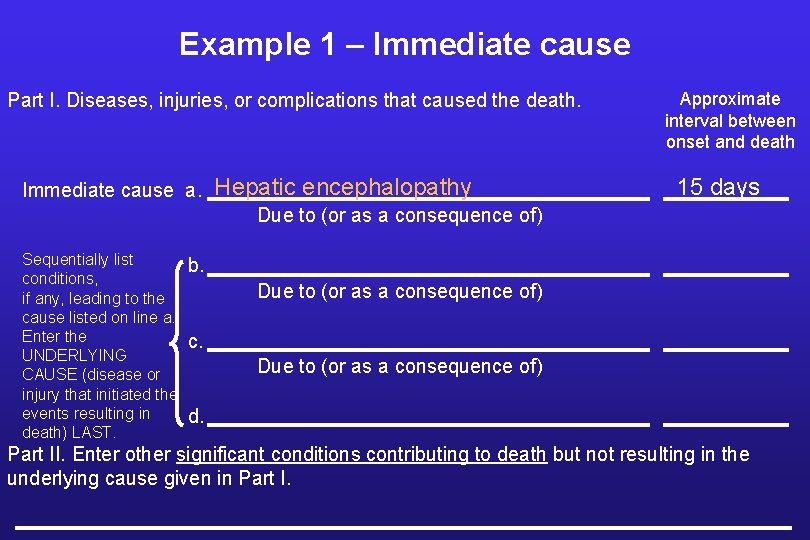
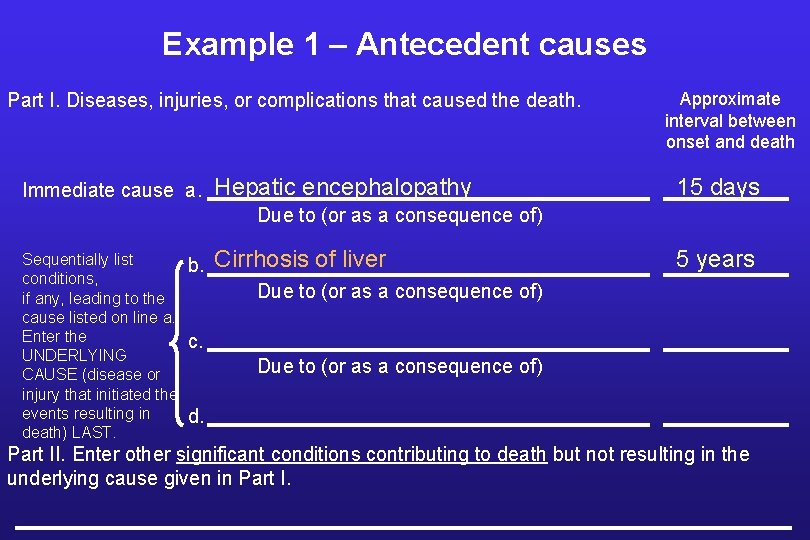
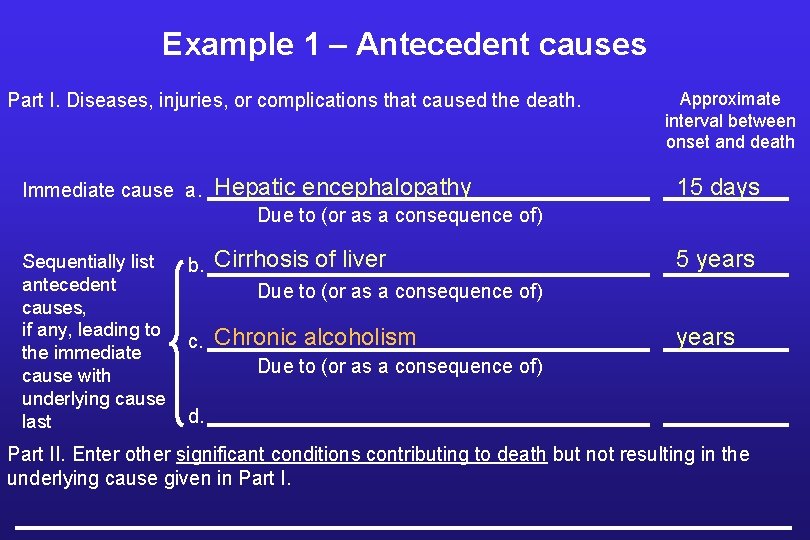
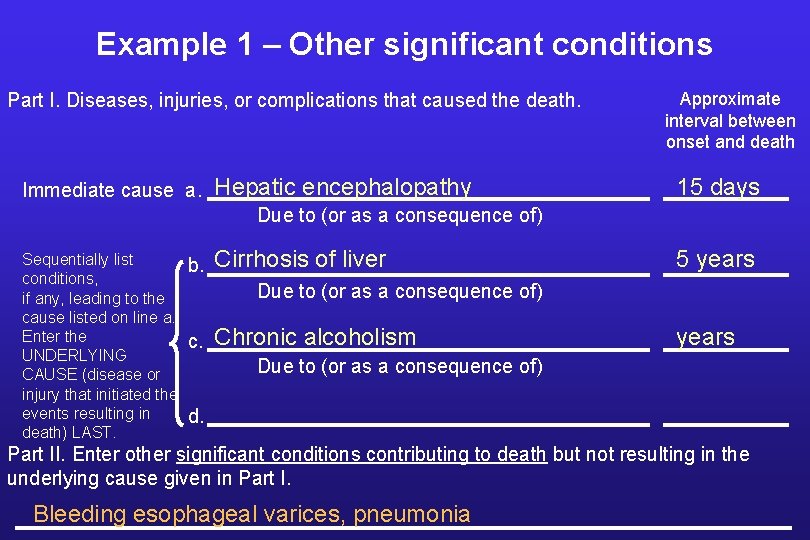
A 60 -year-old male with a long history of chronic alcoholism developed cirrhosis. Terminally, the patient had hepatic encephalopathy, which dominated the clinical picture, but there was also some gastrointestinal bleeding (varices) and pneumonia, which complicated clinical management and were also thought to have contributed to death.
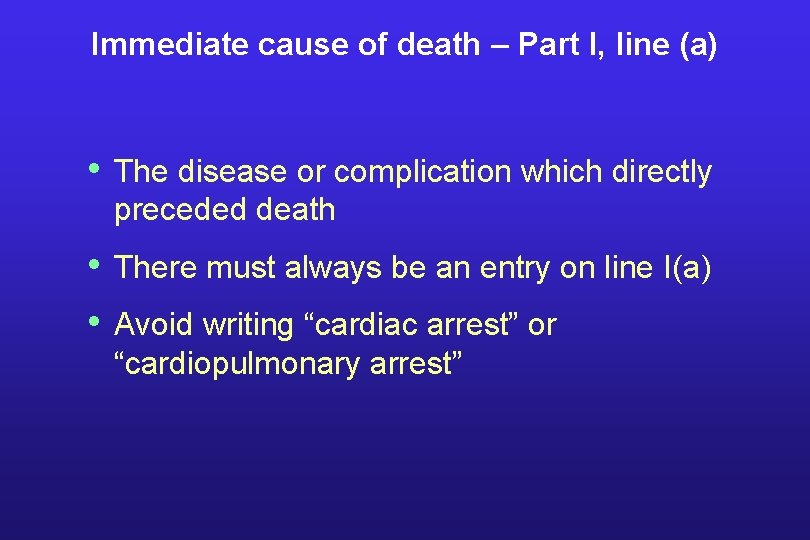
Immediate cause of death – Part I, line (a) • The disease or complication which directly preceded death • • There must always be an entry on line I(a) Avoid writing “cardiac arrest” or “cardiopulmonary arrest”
Example 1 – Immediate cause Part I. Diseases, injuries, or complications that caused the death. Immediate cause a. Hepatic encephalopathy Approximate interval between onset and death 15 days Due to (or as a consequence of) Sequentially list conditions, if any, leading to the cause listed on line a. Enter the UNDERLYING CAUSE (disease or injury that initiated the events resulting in death) LAST. b. Due to (or as a consequence of) c. Due to (or as a consequence of) d. Part II. Enter other significant conditions contributing to death but not resulting in the underlying cause given in Part I.
Antecedent causes – Part I, lines (b), (c) and (d) • Reported conditions should be in a logical sequence in terms of time, etiology and/or pathology • Terminate the sequence with the underlying cause of death – leave unused lines blank
Example 1 – Antecedent causes Part I. Diseases, injuries, or complications that caused the death. Immediate cause a. Hepatic encephalopathy Approximate interval between onset and death 15 days Due to (or as a consequence of) Sequentially list conditions, if any, leading to the cause listed on line a. Enter the UNDERLYING CAUSE (disease or injury that initiated the events resulting in death) LAST. b. Cirrhosis of liver 5 years Due to (or as a consequence of) c. Due to (or as a consequence of) d. Part II. Enter other significant conditions contributing to death but not resulting in the underlying cause given in Part I.
Example 1 – Antecedent causes Part I. Diseases, injuries, or complications that caused the death. Immediate cause a. Hepatic encephalopathy Approximate interval between onset and death 15 days Due to (or as a consequence of) Sequentially list antecedent causes, if any, leading to the immediate cause with underlying cause last b. Cirrhosis of liver 5 years Due to (or as a consequence of) c. Chronic alcoholism years Due to (or as a consequence of) d. Part II. Enter other significant conditions contributing to death but not resulting in the underlying cause given in Part I.
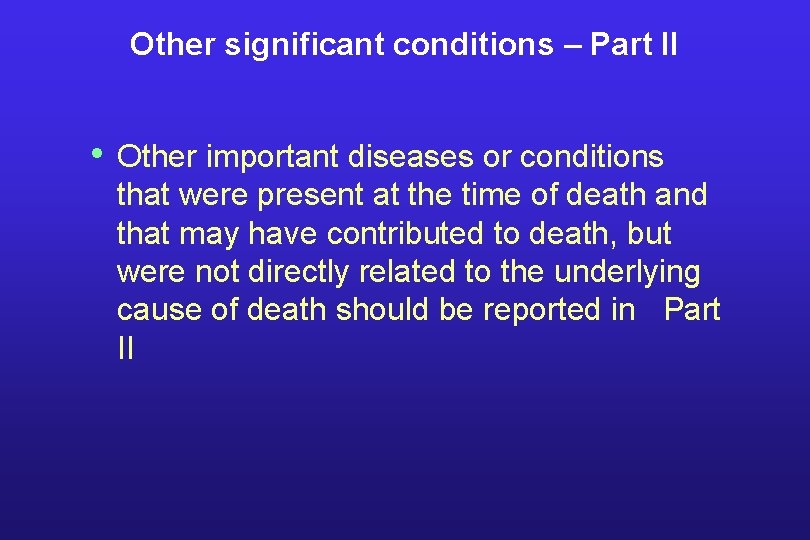
Other significant conditions – Part II • Other important diseases or conditions that were present at the time of death and that may have contributed to death, but were not directly related to the underlying cause of death should be reported in Part II
Example 1 – Other significant conditions Part I. Diseases, injuries, or complications that caused the death. Immediate cause a. Hepatic encephalopathy Approximate interval between onset and death 15 days Due to (or as a consequence of) Sequentially list conditions, if any, leading to the cause listed on line a. Enter the UNDERLYING CAUSE (disease or injury that initiated the events resulting in death) LAST. b. Cirrhosis of liver 5 years Due to (or as a consequence of) c. Chronic alcoholism years Due to (or as a consequence of) d. Part II. Enter other significant conditions contributing to death but not resulting in the underlying cause given in Part I. Bleeding esophageal varices, pneumonia
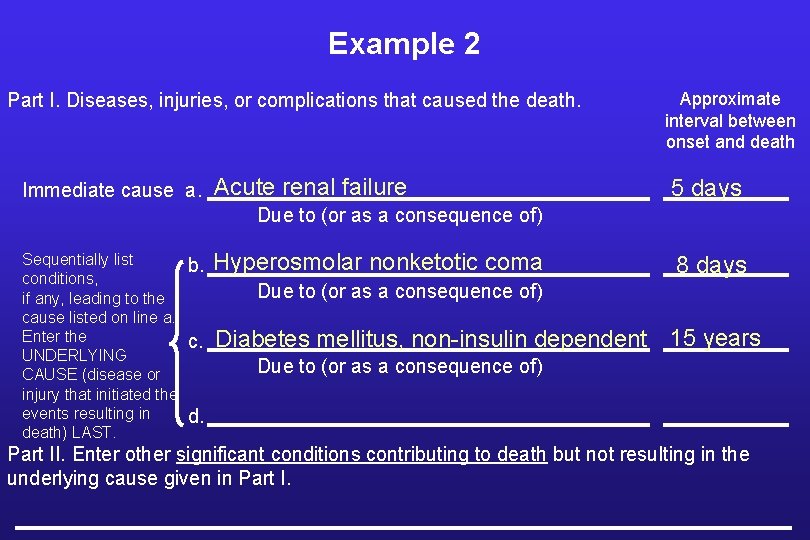
Example 2 Part I. Diseases, injuries, or complications that caused the death. Immediate cause a. Acute renal failure Approximate interval between onset and death 5 days Due to (or as a consequence of) Sequentially list conditions, if any, leading to the cause listed on line a. Enter the UNDERLYING CAUSE (disease or injury that initiated the events resulting in death) LAST. b. Hyperosmolar nonketotic coma 8 days Due to (or as a consequence of) c. Diabetes mellitus, non-insulin dependent 15 years Due to (or as a consequence of) d. Part II. Enter other significant conditions contributing to death but not resulting in the underlying cause given in Part I.
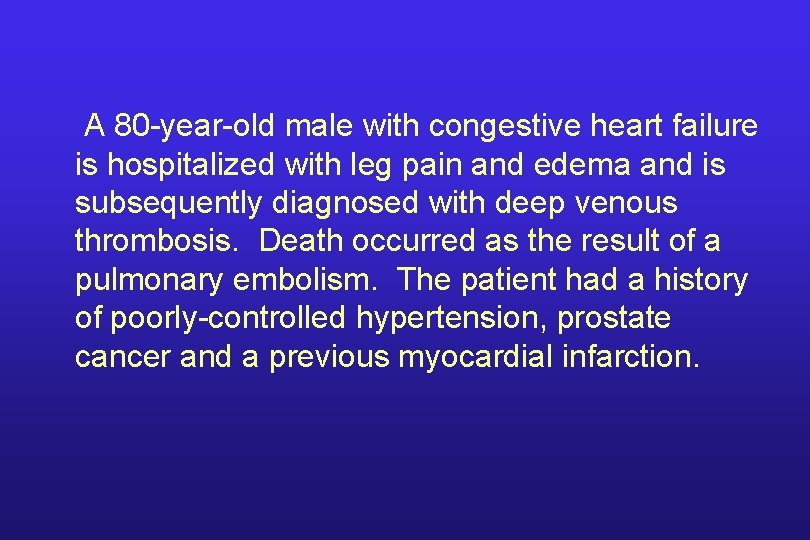
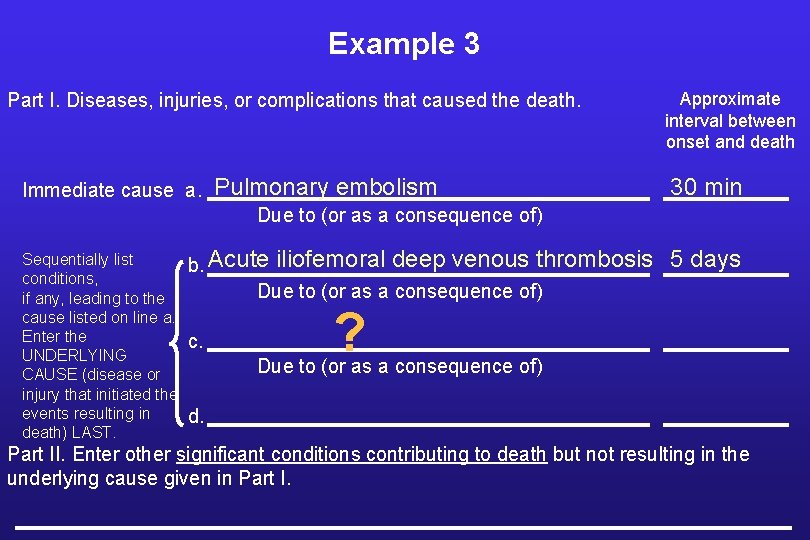
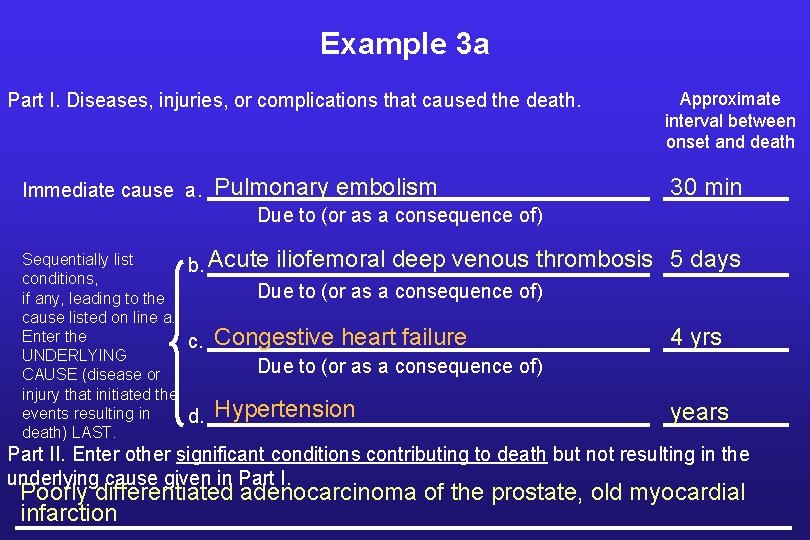
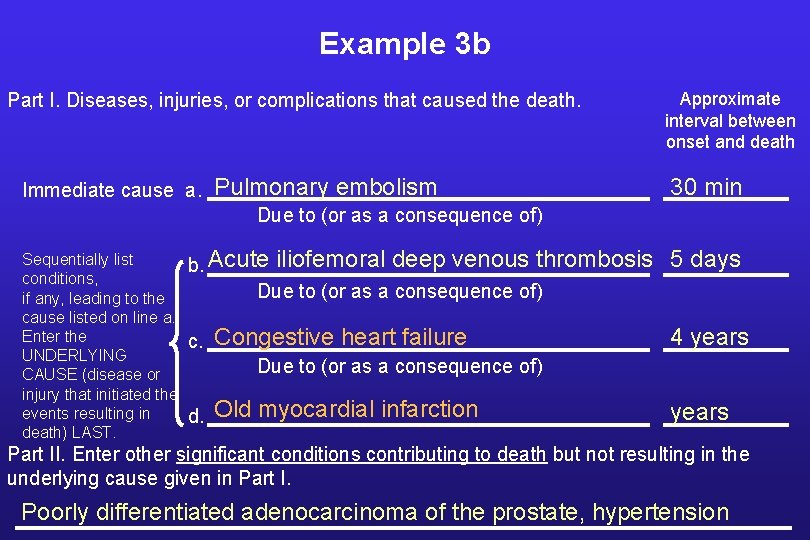
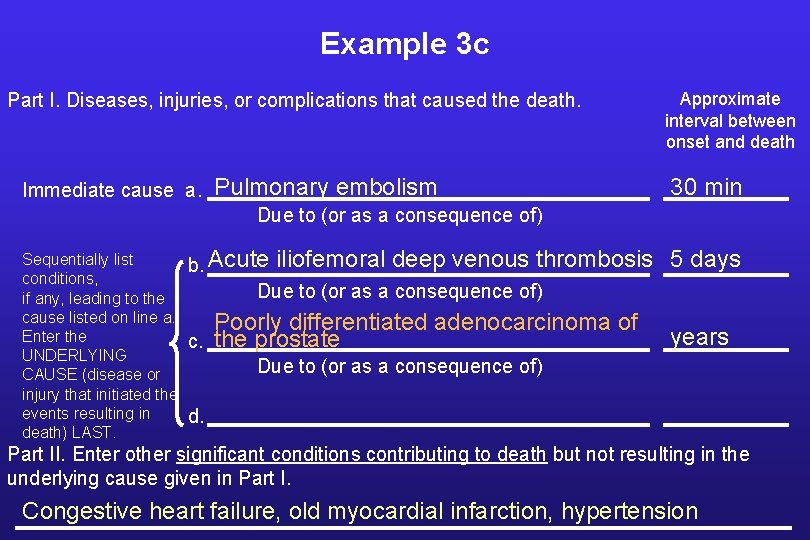
A 80 -year-old male with congestive heart failure is hospitalized with leg pain and edema and is subsequently diagnosed with deep venous thrombosis. Death occurred as the result of a pulmonary embolism. The patient had a history of poorly-controlled hypertension, prostate cancer and a previous myocardial infarction.
Example 3 Part I. Diseases, injuries, or complications that caused the death. Immediate cause a. Pulmonary embolism Approximate interval between onset and death 30 min Due to (or as a consequence of) Sequentially list conditions, if any, leading to the cause listed on line a. Enter the UNDERLYING CAUSE (disease or injury that initiated the events resulting in death) LAST. b. Acute iliofemoral deep venous thrombosis Due to (or as a consequence of) c. 5 days ? Due to (or as a consequence of) d. Part II. Enter other significant conditions contributing to death but not resulting in the underlying cause given in Part I.
Example 3 a Part I. Diseases, injuries, or complications that caused the death. Immediate cause a. Pulmonary embolism Approximate interval between onset and death 30 min Due to (or as a consequence of) Sequentially list conditions, if any, leading to the cause listed on line a. Enter the UNDERLYING CAUSE (disease or injury that initiated the events resulting in death) LAST. b. Acute iliofemoral deep venous thrombosis Due to (or as a consequence of) c. Congestive heart failure 5 days 4 yrs Due to (or as a consequence of) d. Hypertension years Part II. Enter other significant conditions contributing to death but not resulting in the underlying cause given in Part I. Poorly differentiated adenocarcinoma of the prostate, old myocardial infarction
Example 3 b Part I. Diseases, injuries, or complications that caused the death. Immediate cause a. Pulmonary embolism Approximate interval between onset and death 30 min Due to (or as a consequence of) Sequentially list conditions, if any, leading to the cause listed on line a. Enter the UNDERLYING CAUSE (disease or injury that initiated the events resulting in death) LAST. b. Acute iliofemoral deep venous thrombosis Due to (or as a consequence of) c. Congestive heart failure 5 days 4 years Due to (or as a consequence of) d. Old myocardial infarction years Part II. Enter other significant conditions contributing to death but not resulting in the underlying cause given in Part I. Poorly differentiated adenocarcinoma of the prostate, hypertension
Example 3 c Part I. Diseases, injuries, or complications that caused the death. Immediate cause a. Pulmonary embolism Approximate interval between onset and death 30 min Due to (or as a consequence of) Sequentially list conditions, if any, leading to the cause listed on line a. Enter the UNDERLYING CAUSE (disease or injury that initiated the events resulting in death) LAST. b. Acute iliofemoral deep venous thrombosis Due to (or as a consequence of) Poorly differentiated adenocarcinoma of c. the prostate 5 days years Due to (or as a consequence of) d. Part II. Enter other significant conditions contributing to death but not resulting in the underlying cause given in Part I. Congestive heart failure, old myocardial infarction, hypertension
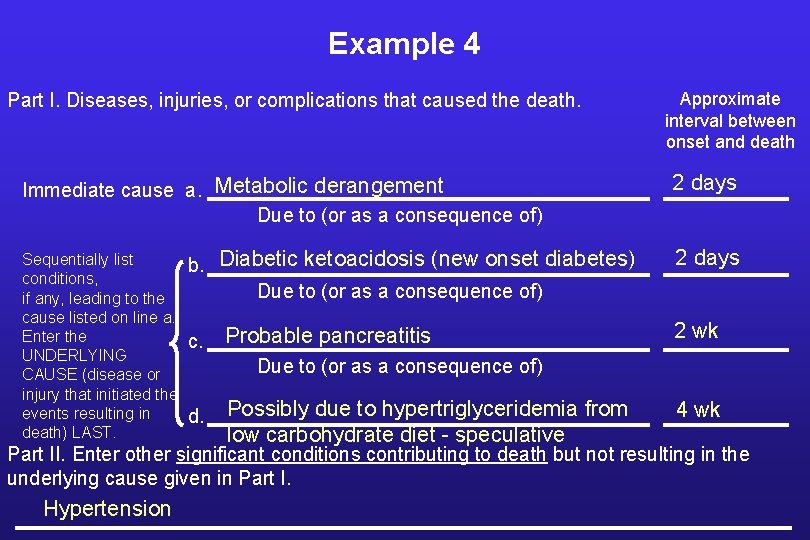
Example 4 Part I. Diseases, injuries, or complications that caused the death. Immediate cause a. Metabolic derangement Due to (or as a consequence of) Sequentially list conditions, if any, leading to the cause listed on line a. Enter the UNDERLYING CAUSE (disease or injury that initiated the events resulting in death) LAST. b. Diabetic ketoacidosis (new onset diabetes) Due to (or as a consequence of) c. Probable pancreatitis Approximate interval between onset and death 2 days 2 wk Due to (or as a consequence of) d. Possibly due to hypertriglyceridemia from low carbohydrate diet - speculative 4 wk Part II. Enter other significant conditions contributing to death but not resulting in the underlying cause given in Part I. Hypertension
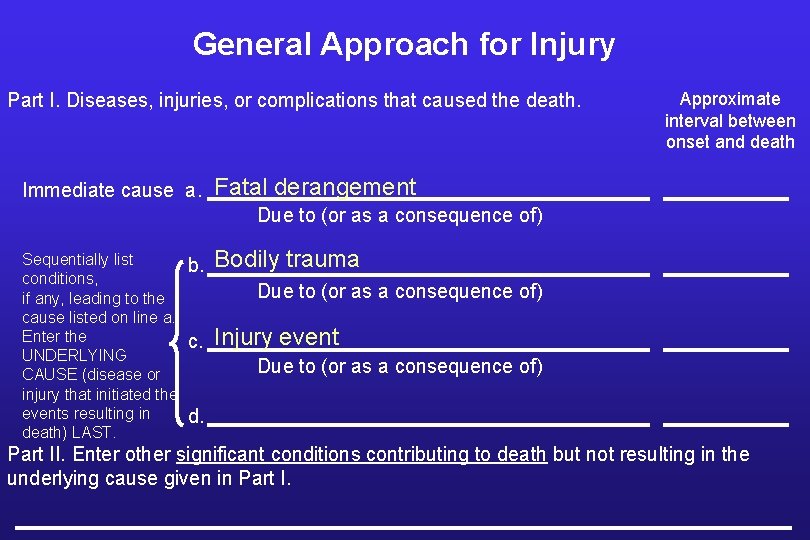
General Approach for Injury Part I. Diseases, injuries, or complications that caused the death. Immediate cause a. Approximate interval between onset and death Fatal derangement Due to (or as a consequence of) Sequentially list conditions, if any, leading to the cause listed on line a. Enter the UNDERLYING CAUSE (disease or injury that initiated the events resulting in death) LAST. b. Bodily trauma Due to (or as a consequence of) c. Injury event Due to (or as a consequence of) d. Part II. Enter other significant conditions contributing to death but not resulting in the underlying cause given in Part I.
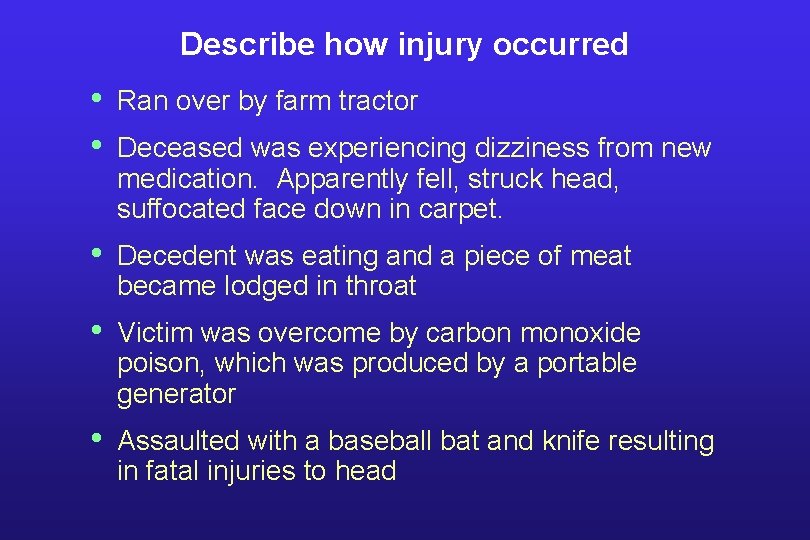
Describe how injury occurred • • Ran over by farm tractor • Decedent was eating and a piece of meat became lodged in throat • Victim was overcome by carbon monoxide poison, which was produced by a portable generator • Assaulted with a baseball bat and knife resulting in fatal injuries to head Deceased was experiencing dizziness from new medication. Apparently fell, struck head, suffocated face down in carpet.
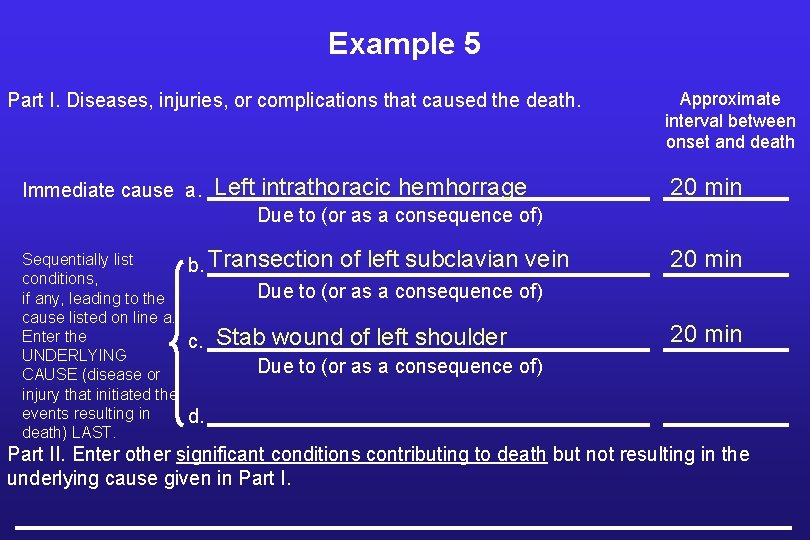
Example 5 Part I. Diseases, injuries, or complications that caused the death. Immediate cause a. Left intrathoracic hemhorrage Approximate interval between onset and death 20 min Due to (or as a consequence of) Sequentially list conditions, if any, leading to the cause listed on line a. Enter the UNDERLYING CAUSE (disease or injury that initiated the events resulting in death) LAST. b. Transection of left subclavian vein Due to (or as a consequence of) c. Stab wound of left shoulder 20 min Due to (or as a consequence of) d. Part II. Enter other significant conditions contributing to death but not resulting in the underlying cause given in Part I.
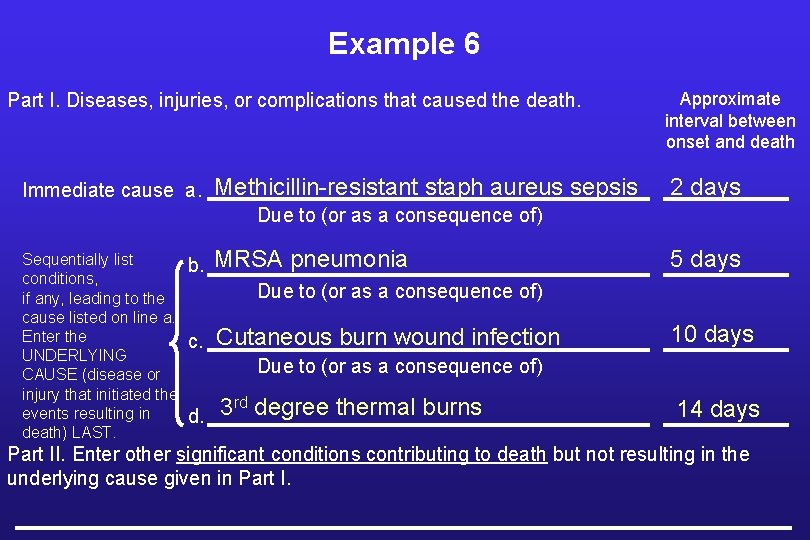
Example 6 Part I. Diseases, injuries, or complications that caused the death. Immediate cause a. Methicillin-resistant staph aureus sepsis Approximate interval between onset and death 2 days Due to (or as a consequence of) Sequentially list conditions, if any, leading to the cause listed on line a. Enter the UNDERLYING CAUSE (disease or injury that initiated the events resulting in death) LAST. b. MRSA pneumonia 5 days Due to (or as a consequence of) c. Cutaneous burn wound infection 10 days Due to (or as a consequence of) rd degree thermal burns 3 d. 14 days Part II. Enter other significant conditions contributing to death but not resulting in the underlying cause given in Part I.
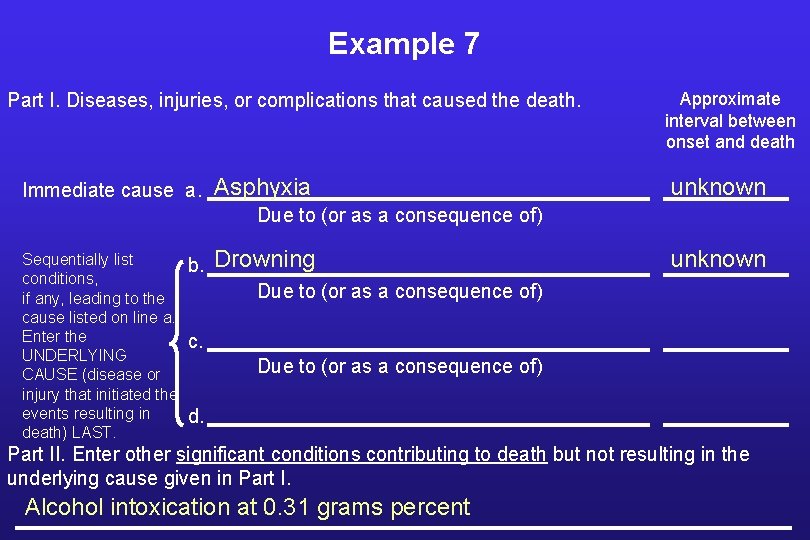
Example 7 Part I. Diseases, injuries, or complications that caused the death. Immediate cause a. Asphyxia Approximate interval between onset and death unknown Due to (or as a consequence of) Sequentially list conditions, if any, leading to the cause listed on line a. Enter the UNDERLYING CAUSE (disease or injury that initiated the events resulting in death) LAST. b. Drowning unknown Due to (or as a consequence of) c. Due to (or as a consequence of) d. Part II. Enter other significant conditions contributing to death but not resulting in the underlying cause given in Part I. Alcohol intoxication at 0. 31 grams percent
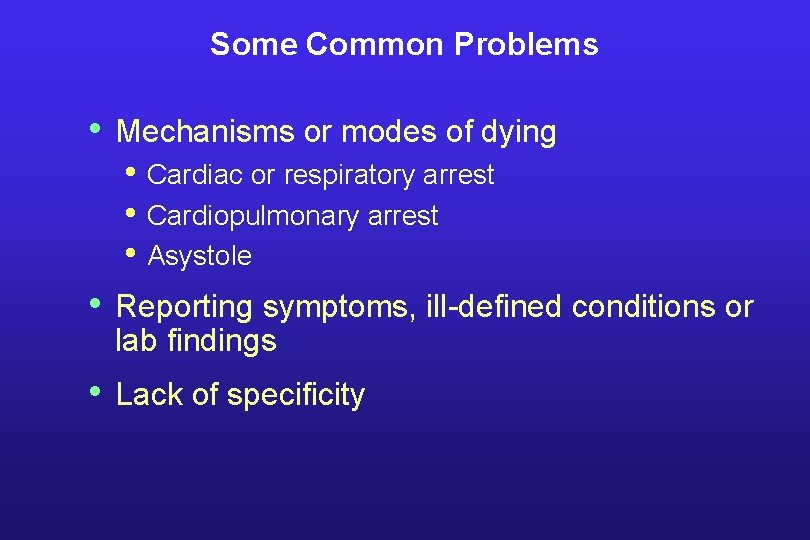
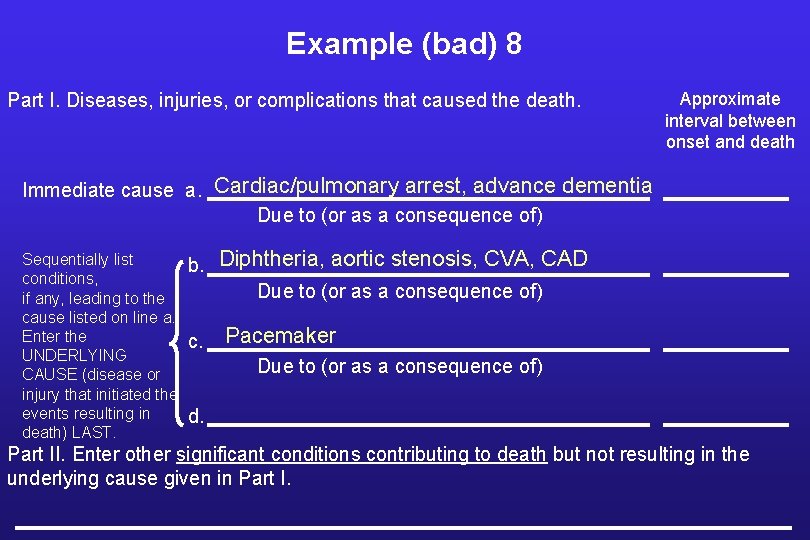
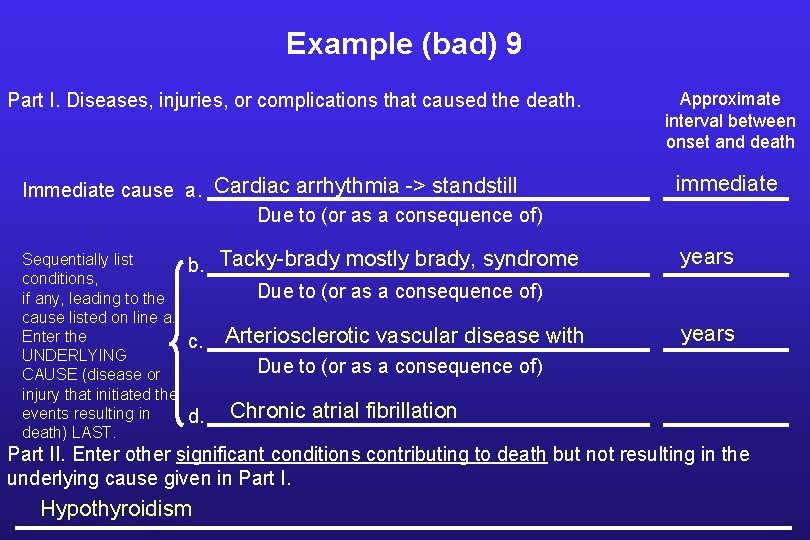
Some Common Problems • Mechanisms or modes of dying • Cardiac or respiratory arrest • Cardiopulmonary arrest • Asystole • Reporting symptoms, ill-defined conditions or lab findings • Lack of specificity
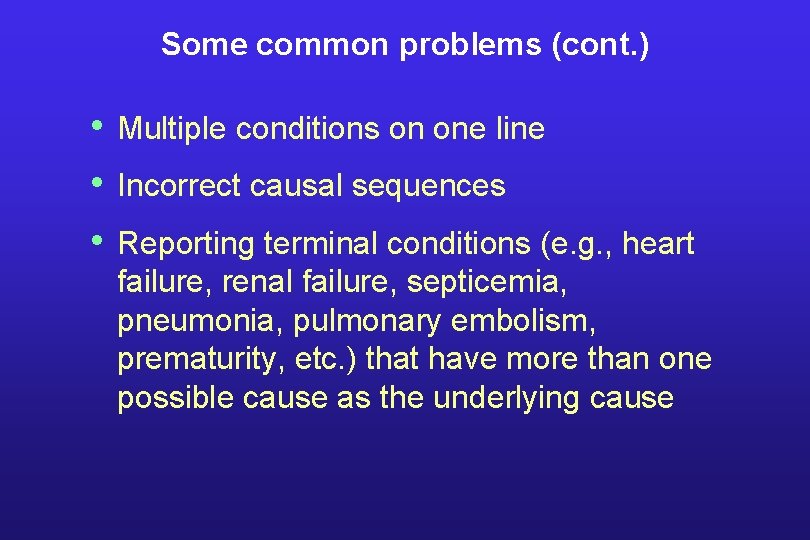
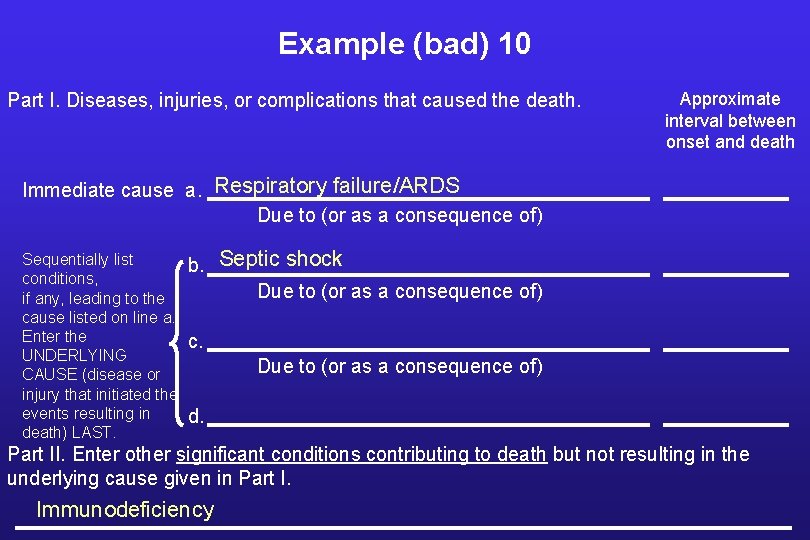
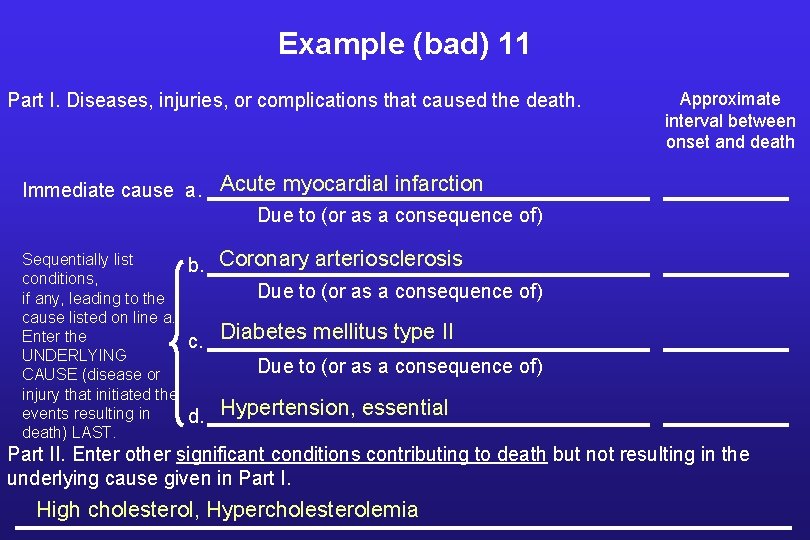
Some common problems (cont. ) • • • Multiple conditions on one line Incorrect causal sequences Reporting terminal conditions (e. g. , heart failure, renal failure, septicemia, pneumonia, pulmonary embolism, prematurity, etc. ) that have more than one possible cause as the underlying cause
Example (bad) 8 Part I. Diseases, injuries, or complications that caused the death. Approximate interval between onset and death Immediate cause a. Cardiac/pulmonary arrest, advance dementia Due to (or as a consequence of) Sequentially list conditions, if any, leading to the cause listed on line a. Enter the UNDERLYING CAUSE (disease or injury that initiated the events resulting in death) LAST. b. Diphtheria, aortic stenosis, CVA, CAD Due to (or as a consequence of) c. Pacemaker Due to (or as a consequence of) d. Part II. Enter other significant conditions contributing to death but not resulting in the underlying cause given in Part I.
Example (bad) 9 Part I. Diseases, injuries, or complications that caused the death. Immediate cause a. Cardiac arrhythmia -> standstill Due to (or as a consequence of) Sequentially list conditions, if any, leading to the cause listed on line a. Enter the UNDERLYING CAUSE (disease or injury that initiated the events resulting in death) LAST. b. Tacky-brady mostly brady, syndrome Due to (or as a consequence of) c. Arteriosclerotic vascular disease with Approximate interval between onset and death immediate years Due to (or as a consequence of) d. Chronic atrial fibrillation Part II. Enter other significant conditions contributing to death but not resulting in the underlying cause given in Part I. Hypothyroidism
Example (bad) 10 Part I. Diseases, injuries, or complications that caused the death. Approximate interval between onset and death Immediate cause a. Respiratory failure/ARDS Due to (or as a consequence of) Sequentially list conditions, if any, leading to the cause listed on line a. Enter the UNDERLYING CAUSE (disease or injury that initiated the events resulting in death) LAST. b. Septic shock Due to (or as a consequence of) c. Due to (or as a consequence of) d. Part II. Enter other significant conditions contributing to death but not resulting in the underlying cause given in Part I. Immunodeficiency
Example (bad) 11 Part I. Diseases, injuries, or complications that caused the death. Approximate interval between onset and death Immediate cause a. Acute myocardial infarction Due to (or as a consequence of) Sequentially list conditions, if any, leading to the cause listed on line a. Enter the UNDERLYING CAUSE (disease or injury that initiated the events resulting in death) LAST. b. Coronary arteriosclerosis Due to (or as a consequence of) c. Diabetes mellitus type II Due to (or as a consequence of) d. Hypertension, essential Part II. Enter other significant conditions contributing to death but not resulting in the underlying cause given in Part I. High cholesterol, Hypercholesterolemia
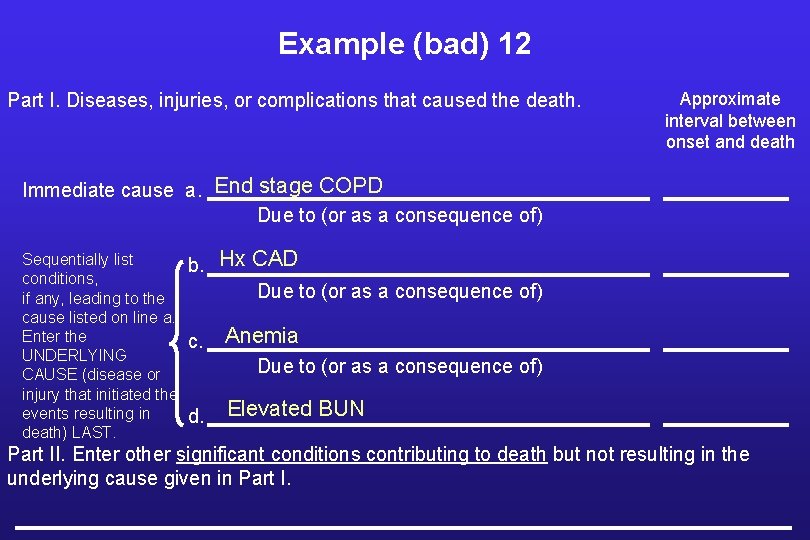
Example (bad) 12 Part I. Diseases, injuries, or complications that caused the death. Approximate interval between onset and death Immediate cause a. End stage COPD Due to (or as a consequence of) Sequentially list conditions, if any, leading to the cause listed on line a. Enter the UNDERLYING CAUSE (disease or injury that initiated the events resulting in death) LAST. b. Hx CAD Due to (or as a consequence of) c. Anemia Due to (or as a consequence of) d. Elevated BUN Part II. Enter other significant conditions contributing to death but not resulting in the underlying cause given in Part I.
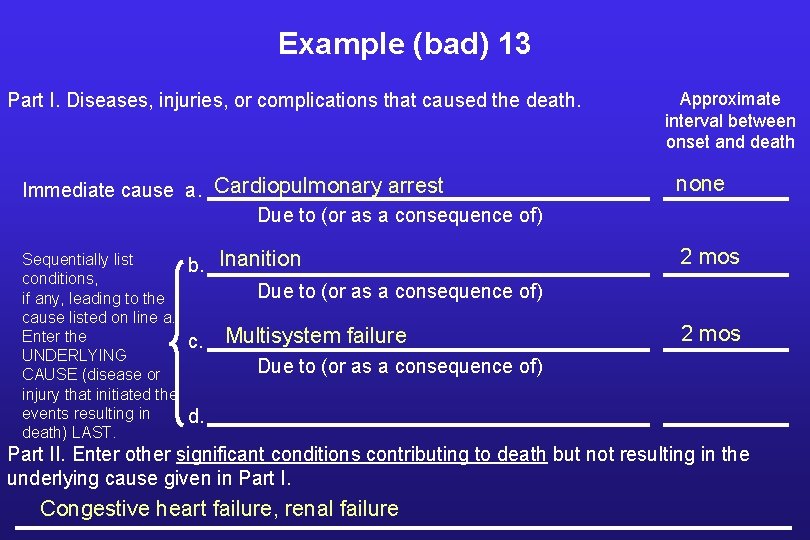
Example (bad) 13 Part I. Diseases, injuries, or complications that caused the death. Immediate cause a. Cardiopulmonary arrest Due to (or as a consequence of) Sequentially list conditions, if any, leading to the cause listed on line a. Enter the UNDERLYING CAUSE (disease or injury that initiated the events resulting in death) LAST. b. Inanition Due to (or as a consequence of) c. Multisystem failure Approximate interval between onset and death none 2 mos Due to (or as a consequence of) d. Part II. Enter other significant conditions contributing to death but not resulting in the underlying cause given in Part I. Congestive heart failure, renal failure
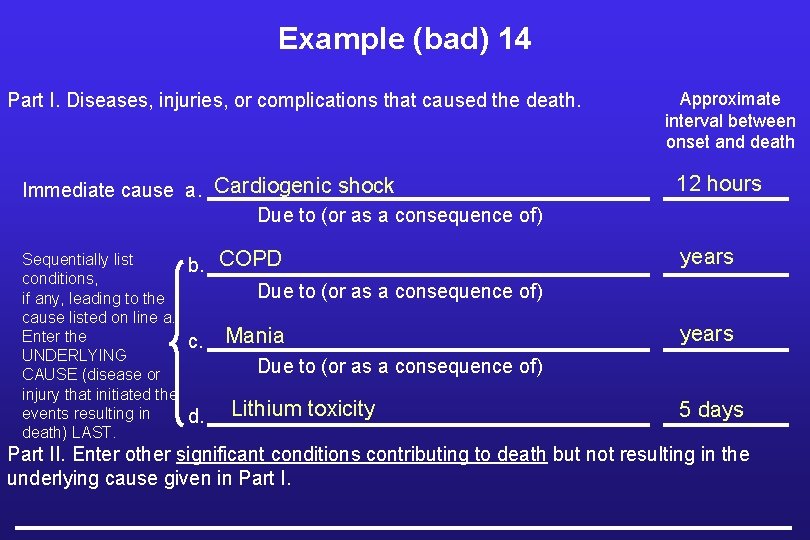
Example (bad) 14 Part I. Diseases, injuries, or complications that caused the death. Immediate cause a. Cardiogenic shock Due to (or as a consequence of) Sequentially list conditions, if any, leading to the cause listed on line a. Enter the UNDERLYING CAUSE (disease or injury that initiated the events resulting in death) LAST. b. COPD Due to (or as a consequence of) c. Mania Approximate interval between onset and death 12 hours years Due to (or as a consequence of) d. Lithium toxicity 5 days Part II. Enter other significant conditions contributing to death but not resulting in the underlying cause given in Part I.
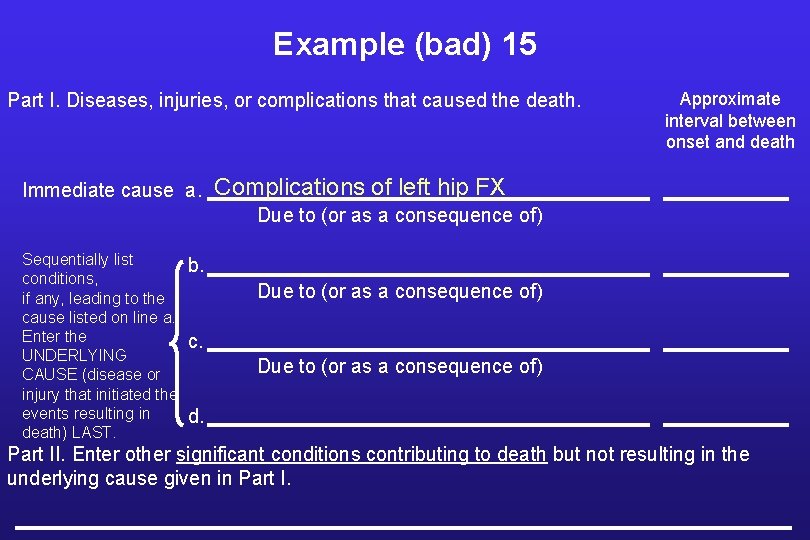
Example (bad) 15 Part I. Diseases, injuries, or complications that caused the death. Immediate cause a. Approximate interval between onset and death Complications of left hip FX Due to (or as a consequence of) Sequentially list conditions, if any, leading to the cause listed on line a. Enter the UNDERLYING CAUSE (disease or injury that initiated the events resulting in death) LAST. b. Due to (or as a consequence of) c. Due to (or as a consequence of) d. Part II. Enter other significant conditions contributing to death but not resulting in the underlying cause given in Part I.
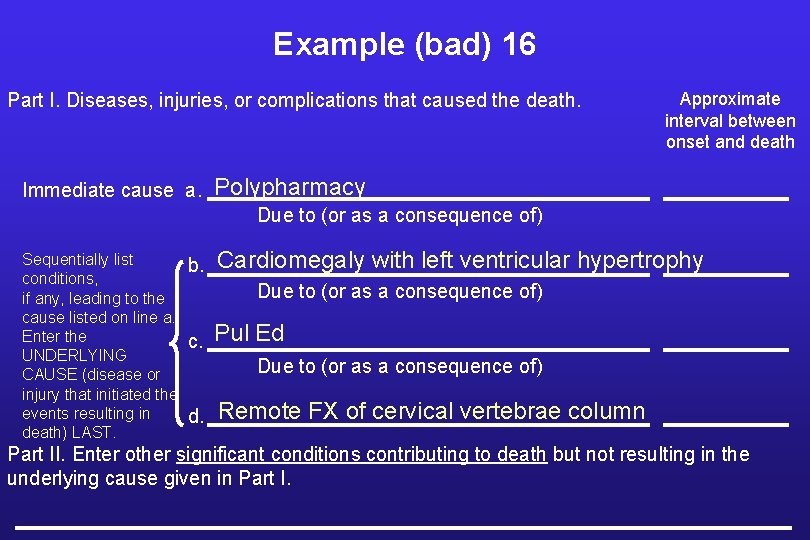
Example (bad) 16 Part I. Diseases, injuries, or complications that caused the death. Immediate cause a. Approximate interval between onset and death Polypharmacy Due to (or as a consequence of) Sequentially list conditions, if any, leading to the cause listed on line a. Enter the UNDERLYING CAUSE (disease or injury that initiated the events resulting in death) LAST. b. Cardiomegaly with left ventricular hypertrophy Due to (or as a consequence of) c. Pul Ed Due to (or as a consequence of) d. Remote FX of cervical vertebrae column Part II. Enter other significant conditions contributing to death but not resulting in the underlying cause given in Part I.
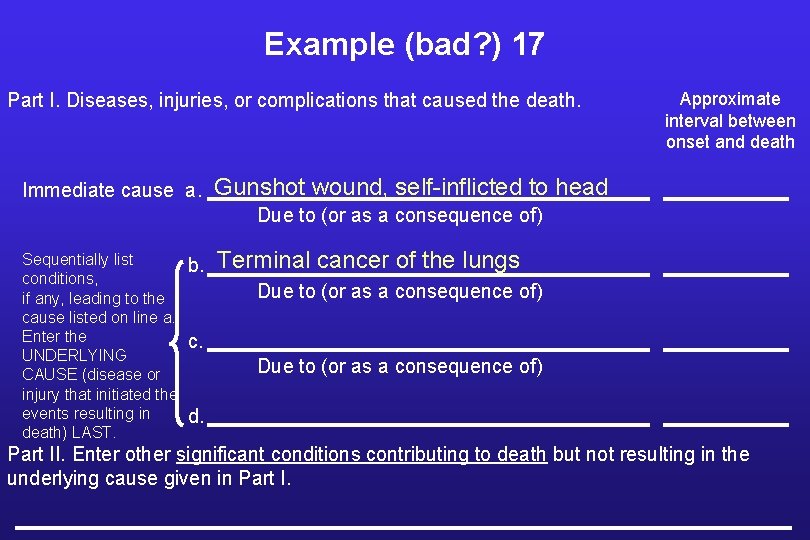
Example (bad? ) 17 Part I. Diseases, injuries, or complications that caused the death. Immediate cause a. Approximate interval between onset and death Gunshot wound, self-inflicted to head Due to (or as a consequence of) Sequentially list conditions, if any, leading to the cause listed on line a. Enter the UNDERLYING CAUSE (disease or injury that initiated the events resulting in death) LAST. b. Terminal cancer of the lungs Due to (or as a consequence of) c. Due to (or as a consequence of) d. Part II. Enter other significant conditions contributing to death but not resulting in the underlying cause given in Part I.
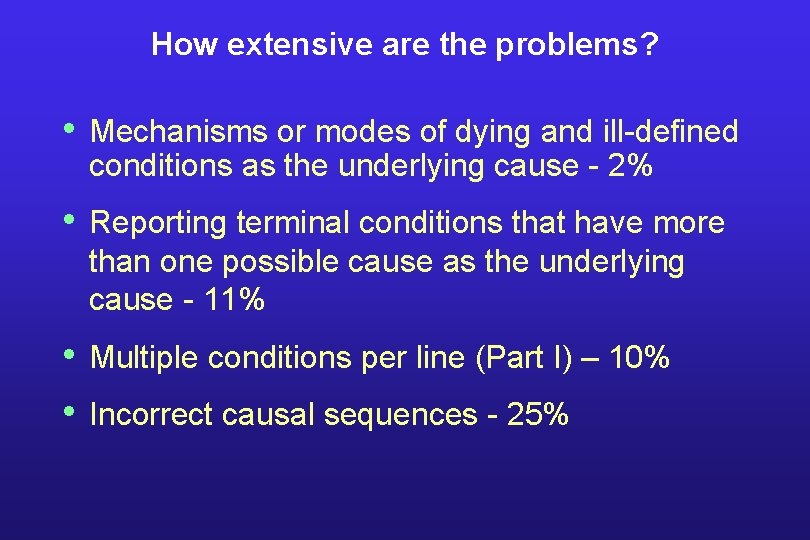
How extensive are the problems? • Mechanisms or modes of dying and ill-defined conditions as the underlying cause - 2% • Reporting terminal conditions that have more than one possible cause as the underlying cause - 11% • • Multiple conditions per line (Part I) – 10% Incorrect causal sequences - 25%
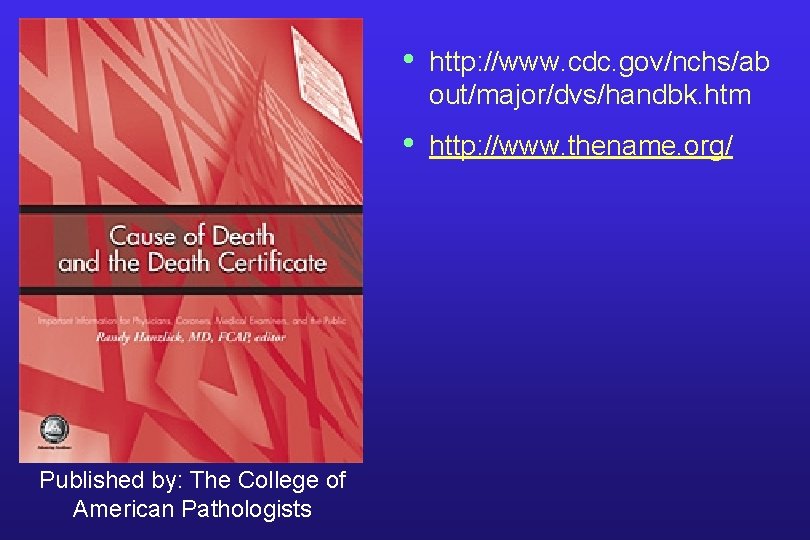
Published by: The College of American Pathologists • http: //www. cdc. gov/nchs/ab out/major/dvs/handbk. htm • http: //www. thename. org/
http: //www. cdc. gov/nchs/deaths. htm Robert N. Anderson 301 -458 -4073 RNAnderson@cdc. gov