
Understanding Modern Device Drivers Asim Kadav and Michael



- Slides: 53
Understanding Modern Device Drivers Asim Kadav and Michael M. Swift University of Wisconsin-Madison
Why study device drivers? » Linux drivers constitute ~5 million LOC and 70% of kernel » Little exposure to this breadth of driver code from research » Better understanding of drivers can lead to better driver model » Large code base discourages major changes » Hard to generalize about driver properties » Slow architectural innovation in driver subsystems » Existing architecture: Error prone drivers » Many developers, privileged execution, C language » Recipe for complex system with reliability problems 2
Our view of drivers is narrow » Driver research is focused on reliability » Focus limited to fault/bug detection and tolerance » Little attention to architecture/structure » Driver research only explores a small set of drivers » Systems evaluate with mature drivers » Volume of driver code limits breadth » Necessary to review current drivers in modern settings 3
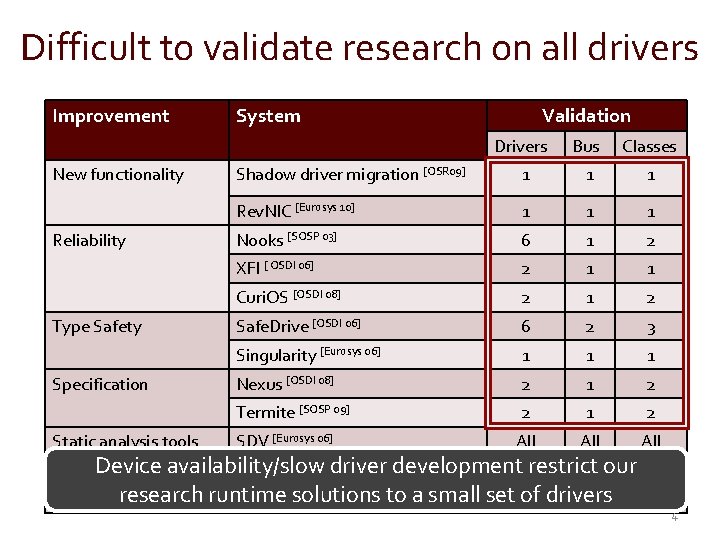
Difficult to validate research on all drivers Improvement New functionality Reliability Type Safety Specification Static analysis tools System Validation Drivers Bus Classes Shadow driver migration [OSR 09] 1 1 1 Rev. NIC [Eurosys 10] 1 1 1 Nooks [SOSP 03] 6 1 2 XFI [ OSDI 06] 2 1 1 Curi. OS [OSDI 08] 2 1 2 Safe. Drive [OSDI 06] 6 2 3 Singularity [Eurosys 06] 1 1 1 Nexus [OSDI 08] 2 1 2 Termite [SOSP 09] 2 1 2 SDV [Eurosys 06] All All 09] Device availability/slow driver development restrict Carburizer [SOSP All/1 All our All [Eurosys 08] research runtime to a small set. All of drivers Cocinellesolutions All 4
Difficult to validate research on all drivers Improvement System Validation Drivers Bus Classes “. . . Please do not misuse these New functionality Shadow driver migration [OSR 09] 1 1 1 tools!(Coverity). . If you focus too Rev. NIC [Eurosys 10] 1 1 1 much on fixing the problems quickly Reliability Nooks [SOSP 03] 6 1 2 rather than fixing them cleanly, then we XFI [ OSDI 06] 2 1 1 forever lose. Curi. OS the clean [OSDI 08]opportunity 2 to 1 2 06] our. Safety code, because the problems 6 will 2 then Type Safe. Drive [OSDI 3 be hidden. ” Singularity [Eurosys 06] 1 1 1 Specification Static analysis tools Nexus [OSDI 08] 2 1 2 LKML mailing list http: //lkml. org/lkml/2005/3/27/131 Termite [SOSP 09] 2 1 2 SDV [Eurosys 06] Carburizer [SOSP 09] Cocinelle [Eurosys 08] All All/1 All All All 5
Understanding Modern Device Drivers » Study source of all Linux drivers for x 86 (~3200 drivers) » Understand properties of driver code » What are common code characteristics? » Do driver research assumptions generalize? » Understand driver interactions with outside world » Can drivers be easily re-architected or migrated ? » Can we develop more efficient fault-isolation mechanisms? » Understand driver code similarity » Do we really need all 5 million lines of code? » Can we build better abstractions? 6
Outline Methodology Driver code characteristics Driver interactions Driver redundancy 7
Methodology of our study » Target Linux 2. 6. 37. 6 (May 2011) kernel » Use static source analyses to gather information » Perform multiple dataflow/control-flow analyses » Detect driver properties of the drive code » Detect driver code interactions with environment » Detect driver code similarities within classes 8
Extract driver wide properties for individual drivers Step 1: Determine driver code characteristics for each driver from driver data structures registered with the kernel 9
Determine code characteristics of each driver function Step 2: Propagate the required information to driver functions and collect information about each function 10
Determining interactions of each driver function Step 3: Determine driver interactions from I/O operations and calls to kernel and bus for each function and propagate to entry points 11
Outline Methodology Driver code characteristics Driver interactions Driver redundancy 12
Part 1: Driver Code Behavior A device driver can be thought of as a translator. Its input consists of high level commands such as “retrieve block 123”. Its output consists of low level, hardware specific instructions that are used by the hardware controller, which interfaces the I/O device to the rest of the system. -- Operating System Concepts VIII edition Driver code complexity and size is assumed to be a result of its I/O function. 13
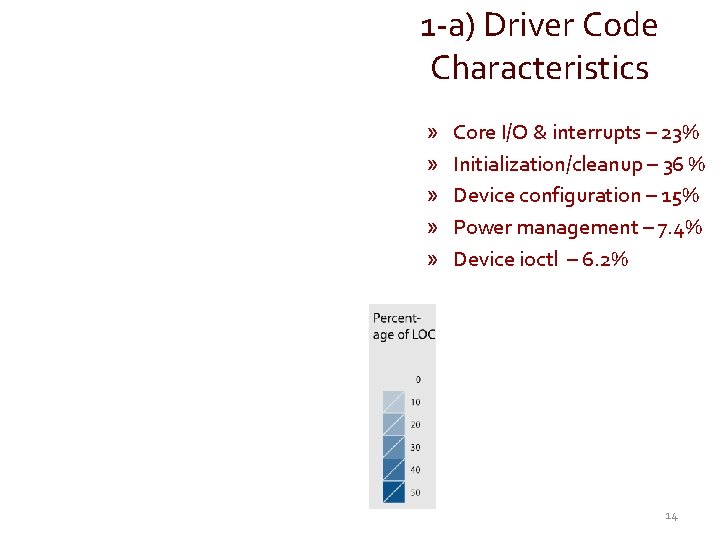
1 -a) Driver Code Characteristics » » » Core I/O & interrupts – 23% Initialization/cleanup – 36 % Device configuration – 15% Power management – 7. 4% Device ioctl – 6. 2% 14
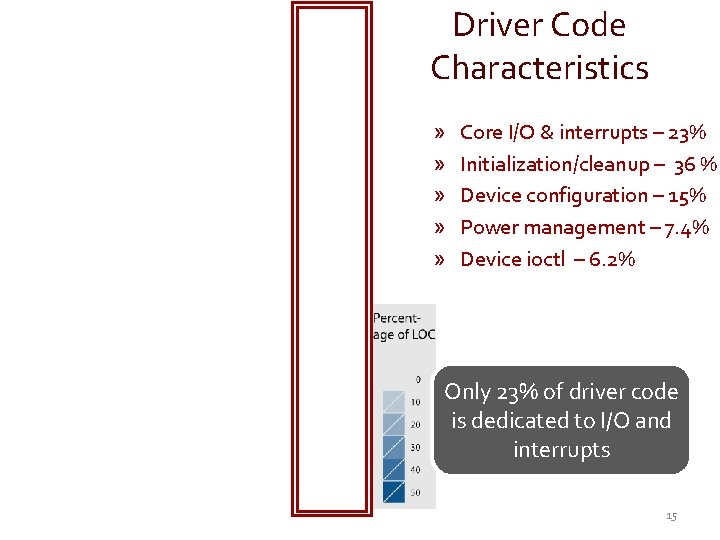
Driver Code Characteristics » » » Core I/O & interrupts – 23% Initialization/cleanup – 36 % Device configuration – 15% Power management – 7. 4% Device ioctl – 6. 2% Only 23% of driver code is dedicated to I/O and interrupts 15
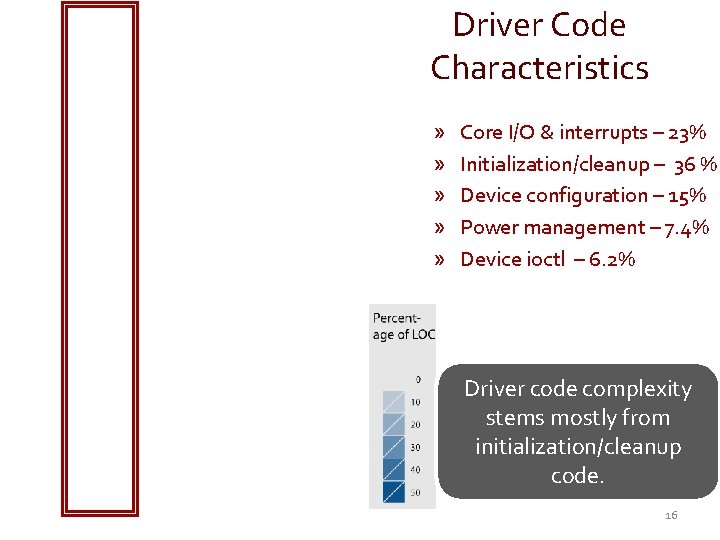
Driver Code Characteristics » » » Core I/O & interrupts – 23% Initialization/cleanup – 36 % Device configuration – 15% Power management – 7. 4% Device ioctl – 6. 2% Driver code complexity stems mostly from initialization/cleanup code. 16
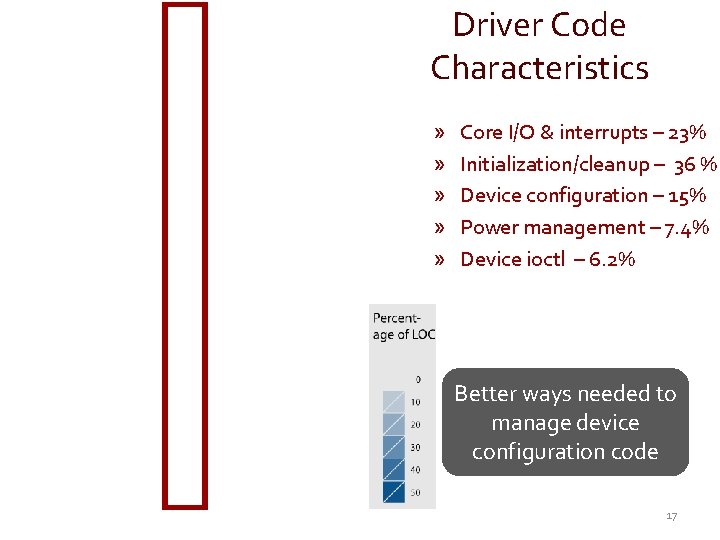
Driver Code Characteristics » » » Core I/O & interrupts – 23% Initialization/cleanup – 36 % Device configuration – 15% Power management – 7. 4% Device ioctl – 6. 2% Better ways needed to manage device configuration code 17
1 -b) Do drivers belong to classes? » Drivers registers a class interface with kernel » Example: Ethernet drivers register with bus and net device library » Class definition includes: » Callbacks registered with the bus, device and kernel subsystem » Exported APIs of the kernel to use kernel resources and services » Most research assumes drivers obey class behavior 18
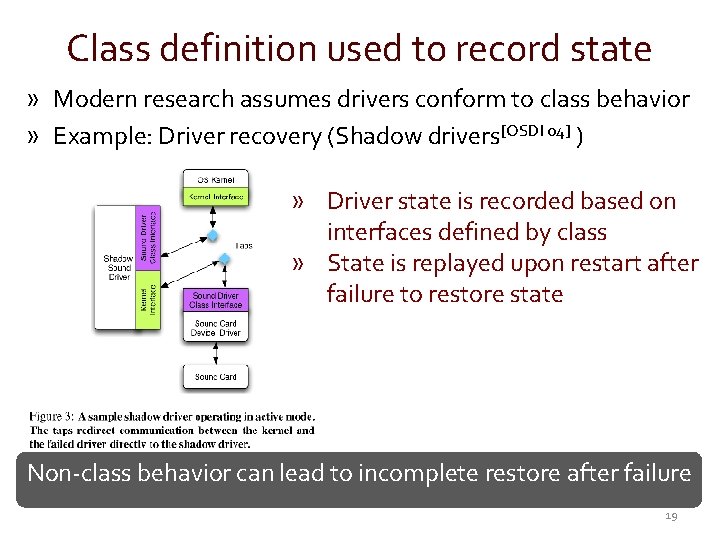
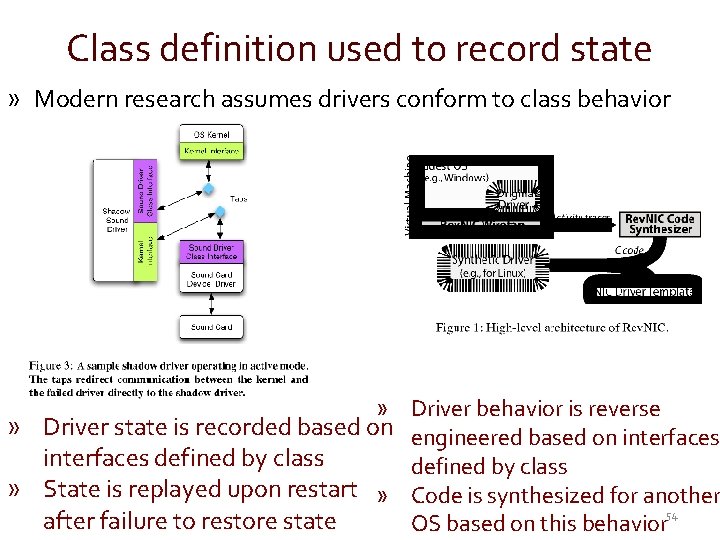
Class definition used to record state » Modern research assumes drivers conform to class behavior » Example: Driver recovery (Shadow drivers[OSDI 04] ) » Driver state is recorded based on interfaces defined by class » State is replayed upon restart after failure to restore state Non-class behavior can lead to incomplete restore after failure Figure from Shadow drivers paper 19
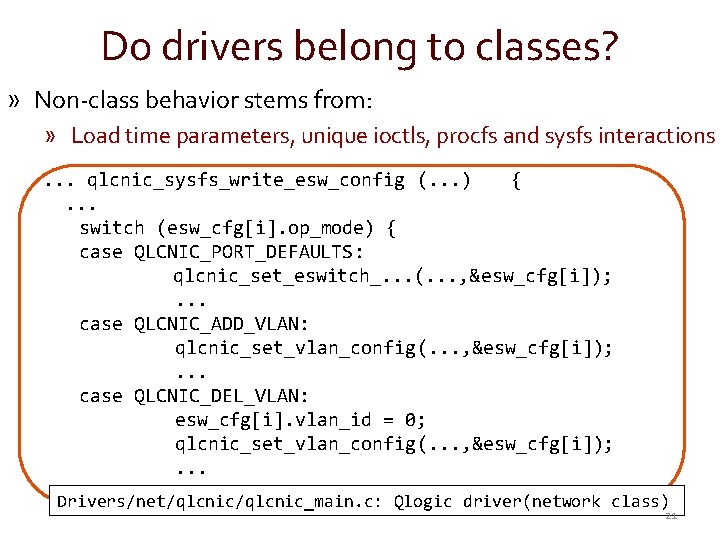
Do drivers belong to classes? » Non-class behavior stems from: » Load time parameters, unique ioctls, procfs and sysfs interactions. . . qlcnic_sysfs_write_esw_config (. . . ) {. . . switch (esw_cfg[i]. op_mode) { case QLCNIC_PORT_DEFAULTS: qlcnic_set_eswitch_. . . (. . . , &esw_cfg[i]); . . . case QLCNIC_ADD_VLAN: qlcnic_set_vlan_config(. . . , &esw_cfg[i]); . . . case QLCNIC_DEL_VLAN: esw_cfg[i]. vlan_id = 0; qlcnic_set_vlan_config(. . . , &esw_cfg[i]); . . . Drivers/net/qlcnic_main. c: Qlogic driver(network class) 21
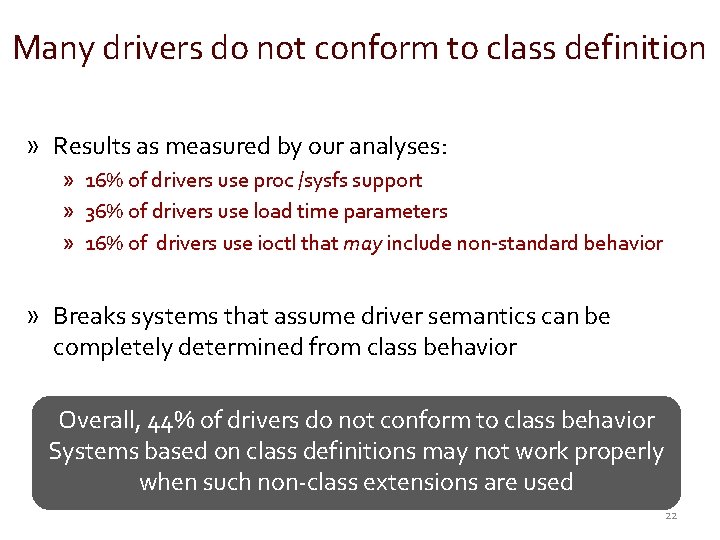
Many drivers do not conform to class definition » Results as measured by our analyses: » 16% of drivers use proc /sysfs support » 36% of drivers use load time parameters » 16% of drivers use ioctl that may include non-standard behavior » Breaks systems that assume driver semantics can be completely determined from class behavior Overall, 44% of drivers do not conform to class behavior Systems based on class definitions may not work properly when such non-class extensions are used 22
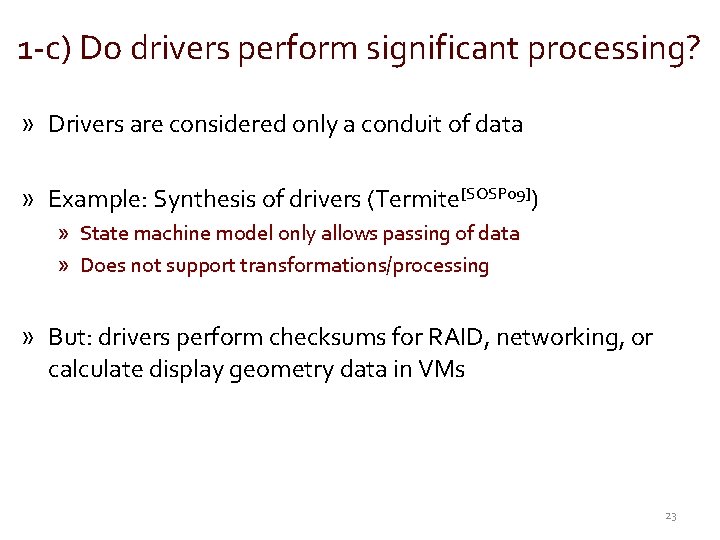
1 -c) Do drivers perform significant processing? » Drivers are considered only a conduit of data » Example: Synthesis of drivers (Termite[SOSP 09]) » State machine model only allows passing of data » Does not support transformations/processing » But: drivers perform checksums for RAID, networking, or calculate display geometry data in VMs 23
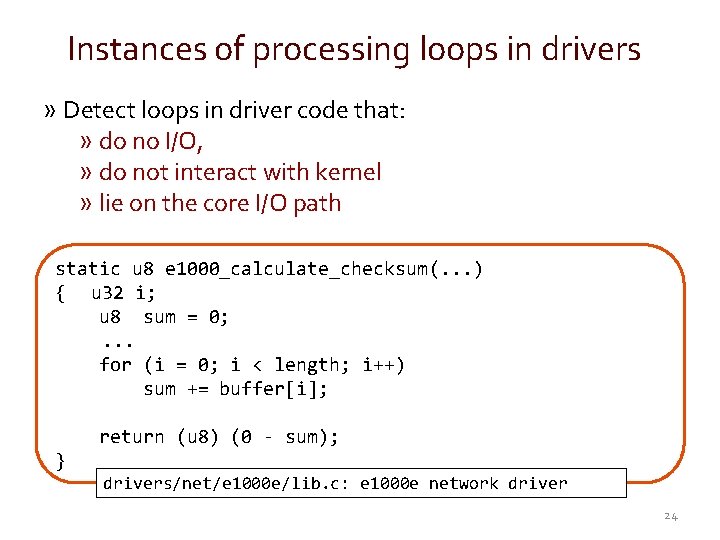
Instances of processing loops in drivers » Detect loops in driver code that: » do no I/O, » do not interact with kernel » lie on the core I/O path static u 8 e 1000_calculate_checksum(. . . ) { u 32 i; u 8 sum = 0; . . . for (i = 0; i < length; i++) sum += buffer[i]; return (u 8) (0 - sum); } drivers/net/e 1000 e/lib. c: e 1000 e network driver 24
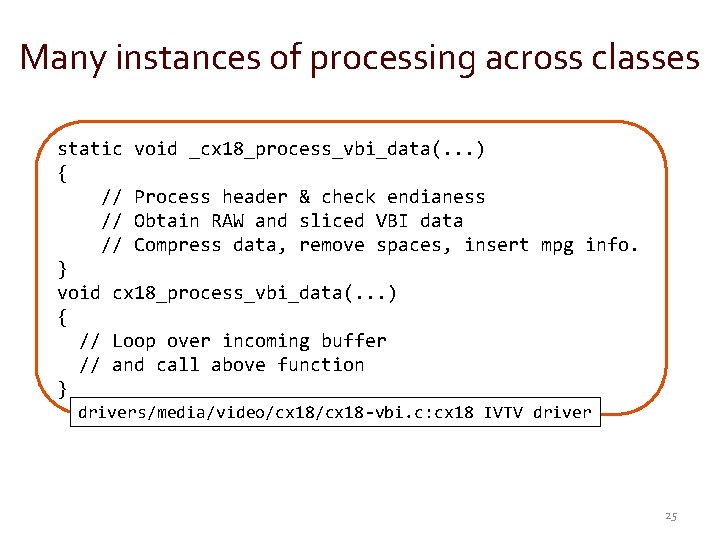
Many instances of processing across classes static void _cx 18_process_vbi_data(. . . ) { // Process header & check endianess // Obtain RAW and sliced VBI data // Compress data, remove spaces, insert mpg info. } void cx 18_process_vbi_data(. . . ) { // Loop over incoming buffer // and call above function } drivers/media/video/cx 18 -vbi. c: cx 18 IVTV driver 25
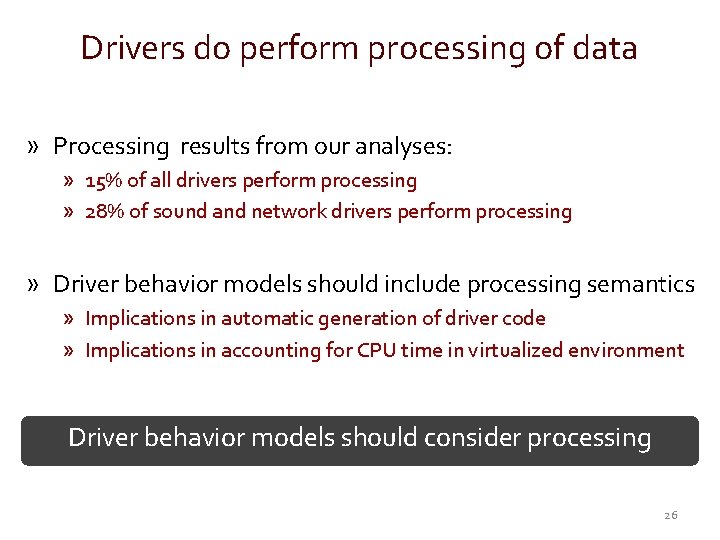
Drivers do perform processing of data » Processing results from our analyses: » 15% of all drivers perform processing » 28% of sound and network drivers perform processing » Driver behavior models should include processing semantics » Implications in automatic generation of driver code » Implications in accounting for CPU time in virtualized environment Driver behavior models should consider processing 26
Outline Methodology Driver code characteristics Driver interactions Driver redundancy 27
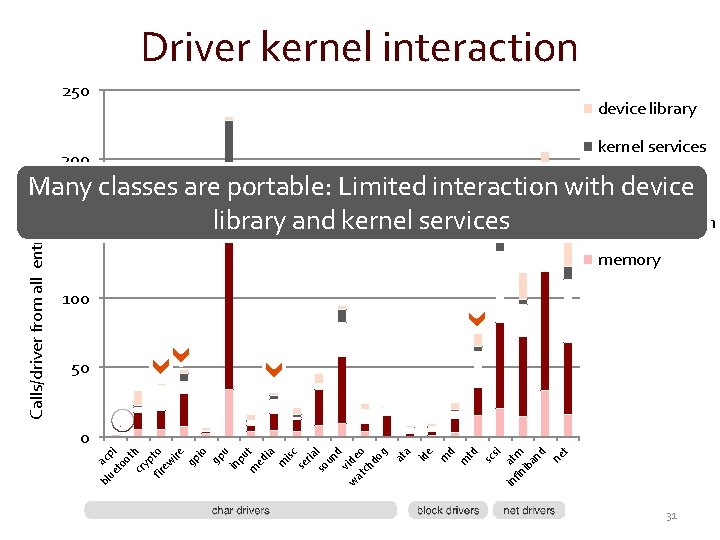
Part 2: Driver interactions a) What are the opportunities to redesign drivers? » Can we learn from drivers that communicate efficiently? » Can driver code be moved to user mode, a VM, or the device for improved performance/reliability? b) How portable are modern device drivers? » What are the kernel services drivers most rely on? c) Can we develop more efficient fault-tolerance mechanisms? » Study drivers interaction with kernel, bus, device, concurrency 28
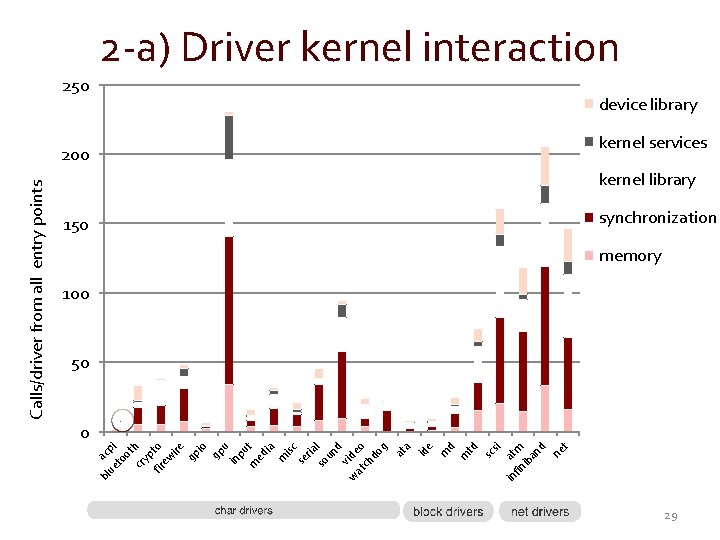
a ue cpi to ot cr h yp fir to ew ire gp io gp u in pu m t ed ia m isc se ria so l un d vid w at eo ch do g at a id e m d m td sc si in atm fin ib an d ne t bl Calls/driver from all entry points 2 -a) Driver kernel interaction 250 device library 200 kernel services kernel library 150 synchronization memory 100 50 0 29
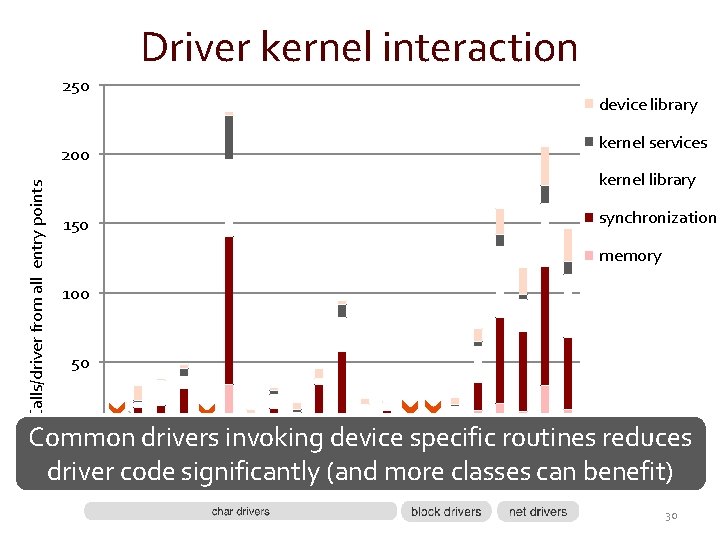
Driver kernel interaction 250 device library kernel services Calls/driver from all entry points 200 kernel library synchronization 150 memory 100 50 bl a ue cpi to ot cr h yp fir to ew ire gp io gp u in pu m t ed ia m isc se ria so l un d vid w at eo ch do g at a id e m d m td sc si in atm fin ib an d ne t 0 Common drivers invoking device specific routines reduces driver code significantly (and more classes can benefit) 30
Driver kernel interaction 250 device library kernel services 200 memory 100 50 a ue cpi to ot cr h yp fir to ew ire gp io gp u in pu m t ed ia m isc se ria so l un d vid w at eo ch do g at a id e m d m td sc si in atm fin ib an d ne t 0 bl Calls/driver from all entry points kernel library Many classes are portable: Limited interaction with device synchronization library and kernel services 150 31
2 -b) Driver-bus interaction » Compare driver structure across buses » Look for lessons in driver simplicity and performance » Can they support new architectures to move drivers out of kernel? » Efficiency of bus interfaces (higher devices/driver) § Interface standardization helps move code away from kernel » Granularity of interaction with kernel/device when using a bus § Coarse grained interface helps move code away from kernel 32
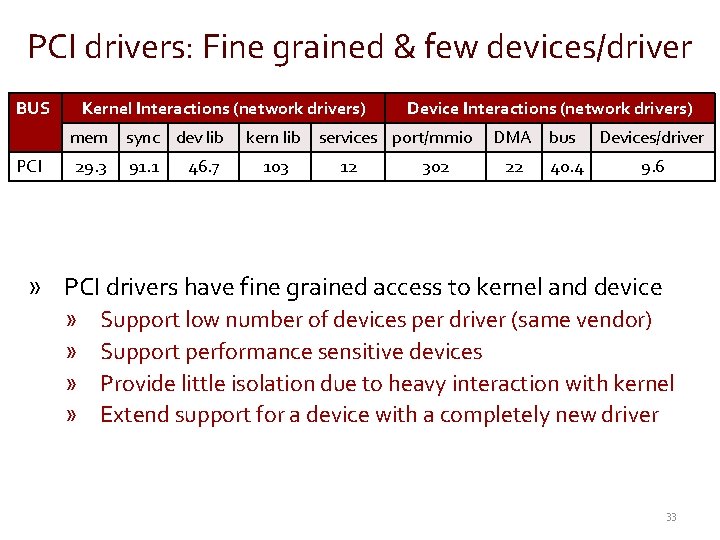
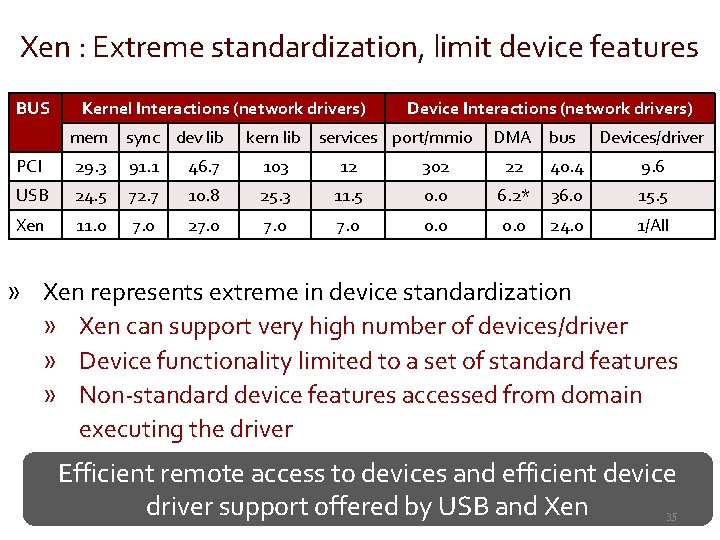
PCI drivers: Fine grained & few devices/driver BUS Kernel Interactions (network drivers) mem sync dev lib PCI 29. 3 91. 1 46. 7 Device Interactions (network drivers) kern lib services port/mmio 103 12 302 DMA bus 22 40. 4 Devices/driver 9. 6 » PCI drivers have fine grained access to kernel and device » » Support low number of devices per driver (same vendor) Support performance sensitive devices Provide little isolation due to heavy interaction with kernel Extend support for a device with a completely new driver 33
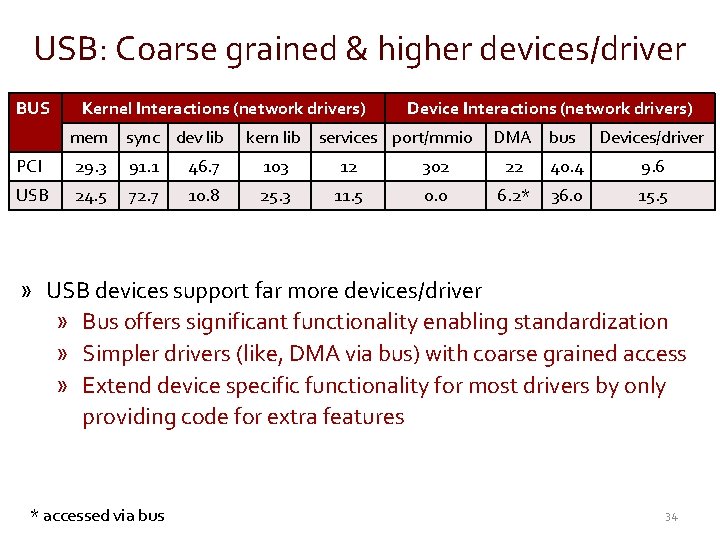
USB: Coarse grained & higher devices/driver BUS Kernel Interactions (network drivers) mem sync dev lib Device Interactions (network drivers) kern lib services port/mmio DMA bus Devices/driver PCI 29. 3 91. 1 46. 7 103 12 302 22 40. 4 9. 6 USB 24. 5 72. 7 10. 8 25. 3 11. 5 0. 0 6. 2* 36. 0 15. 5 » USB devices support far more devices/driver » Bus offers significant functionality enabling standardization » Simpler drivers (like, DMA via bus) with coarse grained access » Extend device specific functionality for most drivers by only providing code for extra features * accessed via bus 34
Xen : Extreme standardization, limit device features BUS Kernel Interactions (network drivers) mem sync dev lib Device Interactions (network drivers) kern lib services port/mmio DMA bus Devices/driver PCI 29. 3 91. 1 46. 7 103 12 302 22 40. 4 9. 6 USB 24. 5 72. 7 10. 8 25. 3 11. 5 0. 0 6. 2* 36. 0 15. 5 Xen 11. 0 7. 0 27. 0 0. 0 24. 0 1/All » Xen represents extreme in device standardization » Xen can support very high number of devices/driver » Device functionality limited to a set of standard features » Non-standard device features accessed from domain executing the driver Efficient remote access to devices and efficient device driver support offered by USB and Xen 35
Outline Methodology Driver code characteristics Driver interactions Driver redundancy 36
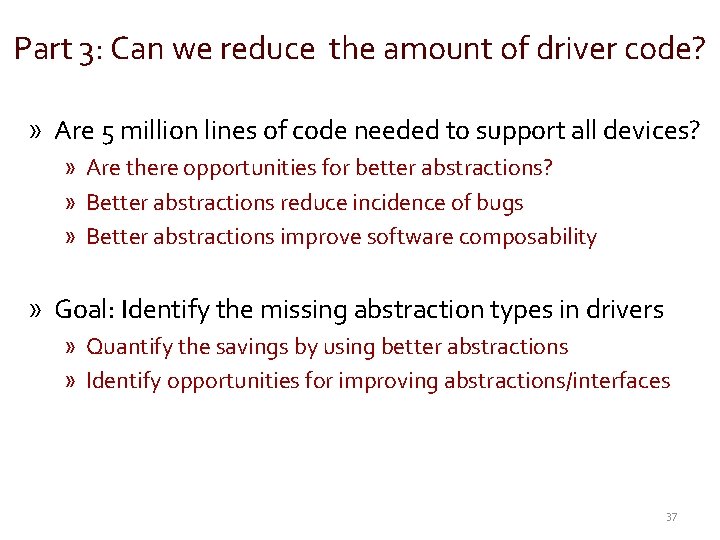
Part 3: Can we reduce the amount of driver code? » Are 5 million lines of code needed to support all devices? » Are there opportunities for better abstractions? » Better abstractions reduce incidence of bugs » Better abstractions improve software composability » Goal: Identify the missing abstraction types in drivers » Quantify the savings by using better abstractions » Identify opportunities for improving abstractions/interfaces 37
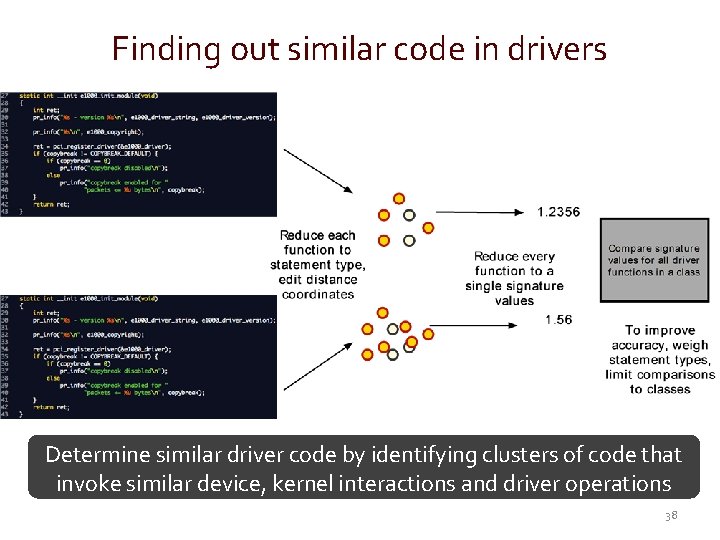
Finding out similar code in drivers Determine similar driver code by identifying clusters of code that invoke similar device, kernel interactions and driver operations 38
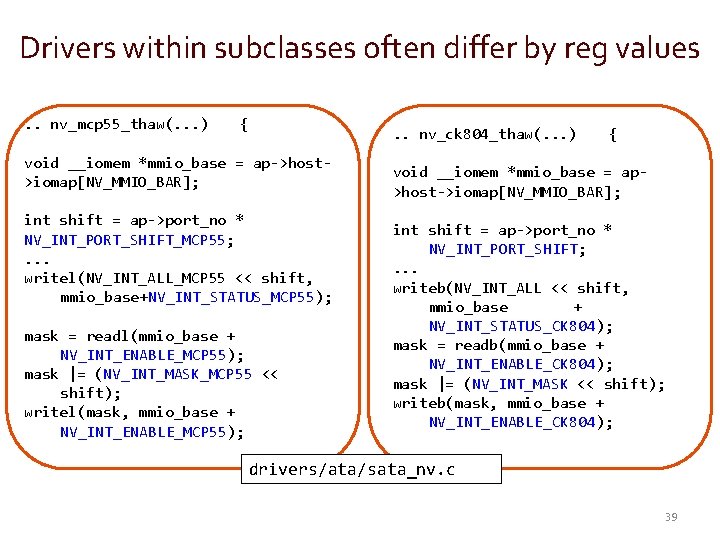
Drivers within subclasses often differ by reg values. . nv_mcp 55_thaw(. . . ) { void __iomem *mmio_base = ap->host>iomap[NV_MMIO_BAR]; int shift = ap->port_no * NV_INT_PORT_SHIFT_MCP 55; . . . writel(NV_INT_ALL_MCP 55 << shift, mmio_base+NV_INT_STATUS_MCP 55); mask = readl(mmio_base + NV_INT_ENABLE_MCP 55); mask |= (NV_INT_MASK_MCP 55 << shift); writel(mask, mmio_base + NV_INT_ENABLE_MCP 55); . . nv_ck 804_thaw(. . . ) { void __iomem *mmio_base = ap>host->iomap[NV_MMIO_BAR]; int shift = ap->port_no * NV_INT_PORT_SHIFT; . . . writeb(NV_INT_ALL << shift, mmio_base + NV_INT_STATUS_CK 804); mask = readb(mmio_base + NV_INT_ENABLE_CK 804); mask |= (NV_INT_MASK << shift); writeb(mask, mmio_base + NV_INT_ENABLE_CK 804); drivers/ata/sata_nv. c 39
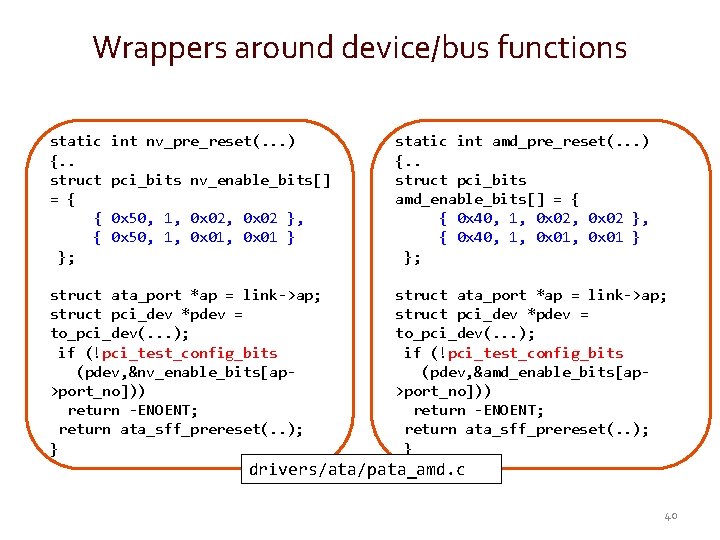
Wrappers around device/bus functions static {. . struct = { { { }; int nv_pre_reset(. . . ) pci_bits nv_enable_bits[] 0 x 50, 1, 0 x 02 }, 0 x 50, 1, 0 x 01 } struct ata_port *ap = link->ap; struct pci_dev *pdev = to_pci_dev(. . . ); if (!pci_test_config_bits (pdev, &nv_enable_bits[ap>port_no])) return -ENOENT; return ata_sff_prereset(. . ); } static int amd_pre_reset(. . . ) {. . struct pci_bits amd_enable_bits[] = { { 0 x 40, 1, 0 x 02 }, { 0 x 40, 1, 0 x 01 } }; struct ata_port *ap = link->ap; struct pci_dev *pdev = to_pci_dev(. . . ); if (!pci_test_config_bits (pdev, &amd_enable_bits[ap>port_no])) return -ENOENT; return ata_sff_prereset(. . ); } drivers/ata/pata_amd. c 40
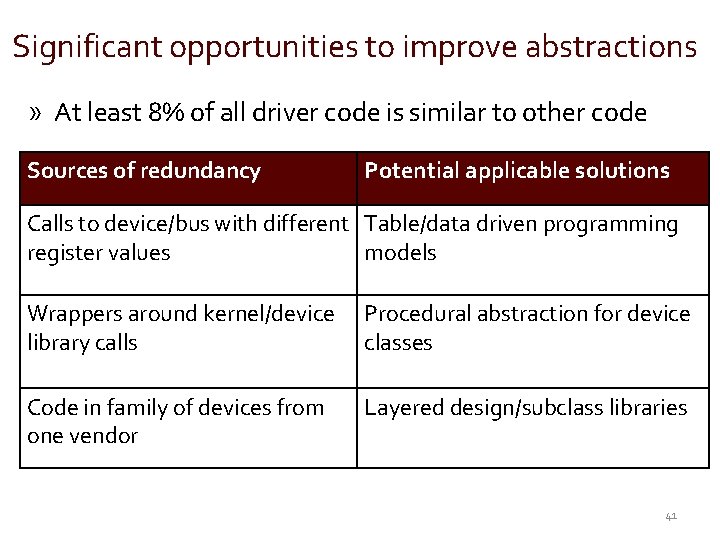
Significant opportunities to improve abstractions » At least 8% of all driver code is similar to other code Sources of redundancy Potential applicable solutions Calls to device/bus with different Table/data driven programming register values models Wrappers around kernel/device library calls Procedural abstraction for device classes Code in family of devices from one vendor Layered design/subclass libraries 41
Conclusions » Many driver assumptions do not hold » Bulk of driver code dedicated to initialization/cleanup » 44% of drivers have behavior outside class definition » 15% of drivers perform computation over drivers » USB/Xen drivers can be offered as services away from kernel » 8% of driver code can be reduced by better abstractions » More results in the paper! 42
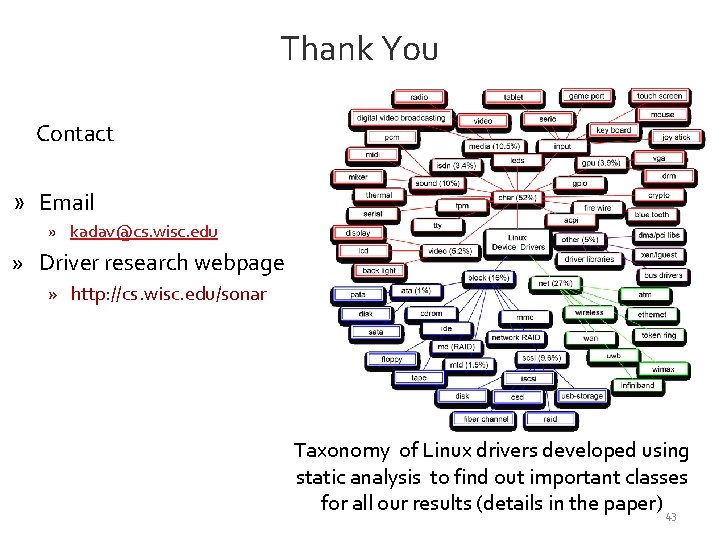
Thank You Contact » Email » kadav@cs. wisc. edu » Driver research webpage » http: //cs. wisc. edu/sonar Taxonomy of Linux drivers developed using static analysis to find out important classes for all our results (details in the paper) 43
Extra slides 44
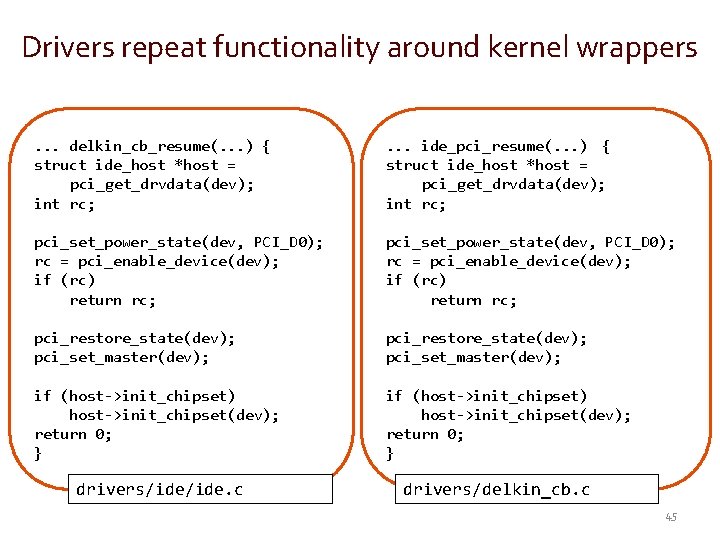
Drivers repeat functionality around kernel wrappers. . . delkin_cb_resume(. . . ) { struct ide_host *host = pci_get_drvdata(dev); int rc; . . . ide_pci_resume(. . . ) { struct ide_host *host = pci_get_drvdata(dev); int rc; pci_set_power_state(dev, PCI_D 0); rc = pci_enable_device(dev); if (rc) return rc; pci_restore_state(dev); pci_set_master(dev); if (host->init_chipset) host->init_chipset(dev); return 0; } drivers/ide. c drivers/delkin_cb. c 45
Drivers covered by our analysis • All drivers that compile on x 86 platform in Linux 2. 6. 37. 6 • Consider driver, bus and virtual drivers • Skip drivers/staging directory – Incomplete/buggy drivers may skew analysis • Non x 86 drivers may have similar kernel interactions • Windows drivers may have similar device interactions – New driver model introduced (WDM), improvement over vxd 46
Limitations of our analyses • Hard to be sound/complete over ALL Linux drivers • Examples of incomplete/unsound behavior – Driver maintains private structures to perform tasks and exposes opaque operations to the kernel 47
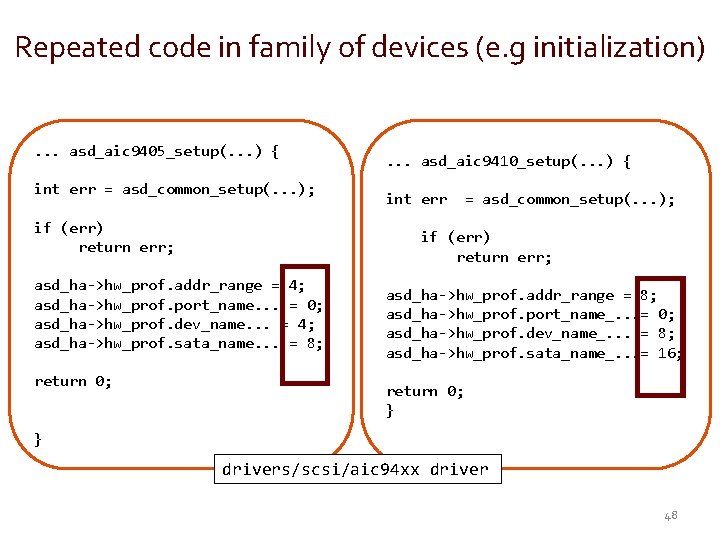
Repeated code in family of devices (e. g initialization). . . asd_aic 9405_setup(. . . ) { int err = asd_common_setup(. . . ); if (err) return err; int err = asd_common_setup(. . . ); if (err) return err; asd_ha->hw_prof. addr_range = 4; asd_ha->hw_prof. port_name. . . = 0; asd_ha->hw_prof. dev_name. . . = 4; asd_ha->hw_prof. sata_name. . . = 8; return 0; . . . asd_aic 9410_setup(. . . ) { asd_ha->hw_prof. addr_range = 8; asd_ha->hw_prof. port_name_. . . = 0; asd_ha->hw_prof. dev_name_. . . = 8; asd_ha->hw_prof. sata_name_. . . = 16; return 0; } } drivers/scsi/aic 94 xx driver 48
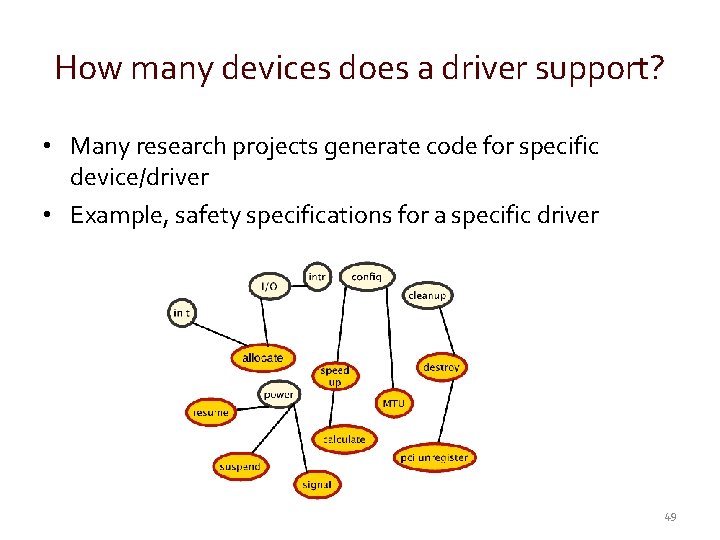
How many devices does a driver support? • Many research projects generate code for specific device/driver • Example, safety specifications for a specific driver 49
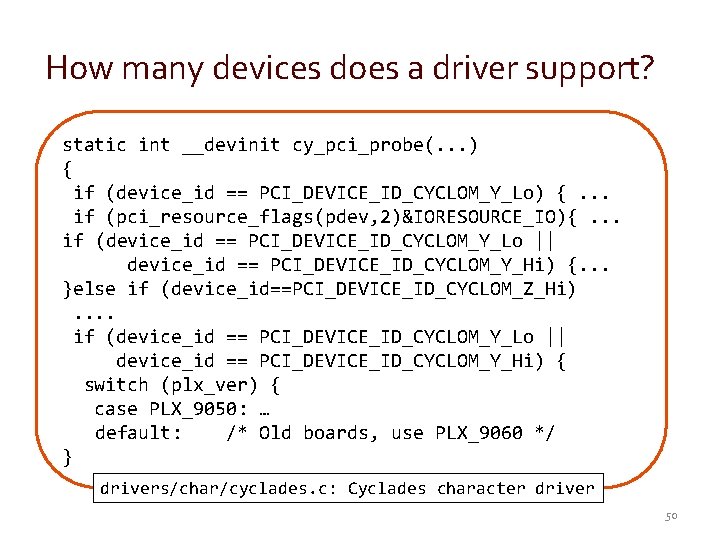
How many devices does a driver support? static int __devinit cy_pci_probe(. . . ) { if (device_id == PCI_DEVICE_ID_CYCLOM_Y_Lo) {. . . if (pci_resource_flags(pdev, 2)&IORESOURCE_IO){. . . if (device_id == PCI_DEVICE_ID_CYCLOM_Y_Lo || device_id == PCI_DEVICE_ID_CYCLOM_Y_Hi) {. . . }else if (device_id==PCI_DEVICE_ID_CYCLOM_Z_Hi). . if (device_id == PCI_DEVICE_ID_CYCLOM_Y_Lo || device_id == PCI_DEVICE_ID_CYCLOM_Y_Hi) { switch (plx_ver) { case PLX_9050: … default: /* Old boards, use PLX_9060 */ } drivers/char/cyclades. c: Cyclades character driver 50
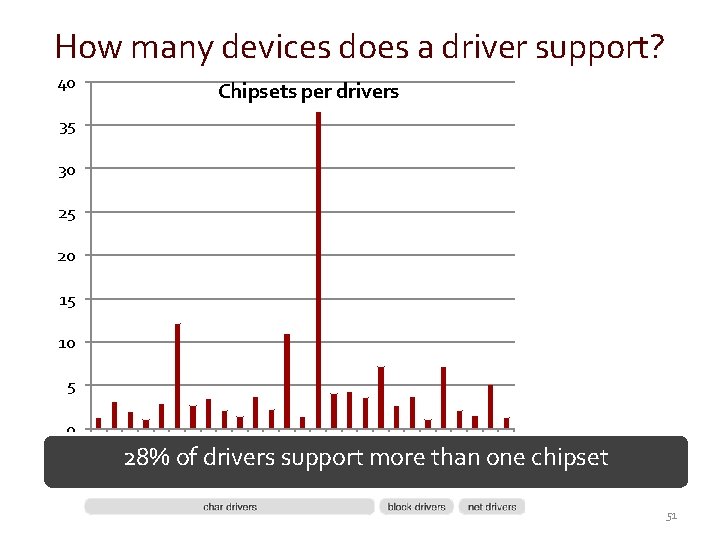
40 0 acpi bluetooth crypto firewire gpio gpu hwmon input isdn leds media misc parport pnp serial sound video watchdog ata ide md mtd scsi atm infiniband net uwb How many devices does a driver support? Chipsets per drivers 35 30 25 20 15 10 5 28% of drivers support more than one chipset 51
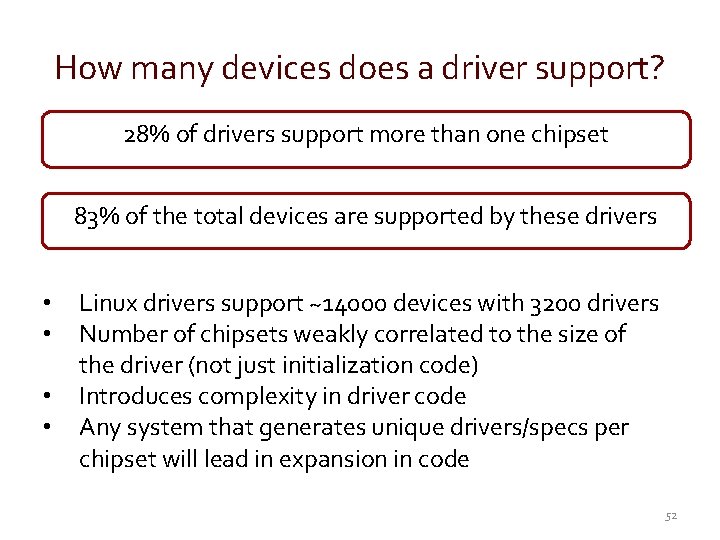
How many devices does a driver support? 28% of drivers support more than one chipset 83% of the total devices are supported by these drivers • • Linux drivers support ~14000 devices with 3200 drivers Number of chipsets weakly correlated to the size of the driver (not just initialization code) Introduces complexity in driver code Any system that generates unique drivers/specs per chipset will lead in expansion in code 52
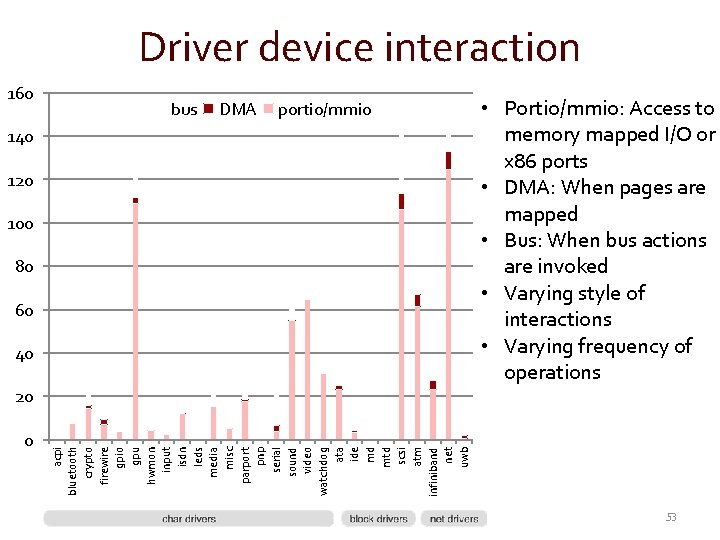
Driver device interaction 160 bus DMA portio/mmio 140 120 100 80 60 40 • Portio/mmio: Access to memory mapped I/O or x 86 ports • DMA: When pages are mapped • Bus: When bus actions are invoked • Varying style of interactions • Varying frequency of operations 0 acpi bluetooth crypto firewire gpio gpu hwmon input isdn leds media misc parport pnp serial sound video watchdog ata ide md mtd scsi atm infiniband net uwb 20 53
Class definition used to record state » Modern research assumes drivers conform to class behavior » Driver behavior is reverse » Driver state is recorded based on engineered based on interfaces defined by class » State is replayed upon restart » Code is synthesized for another 54 after failure to restore state OS based on this behavior