
Understanding migration Understandingmigration What is migration Migration means

- Slides: 8
Understanding migration
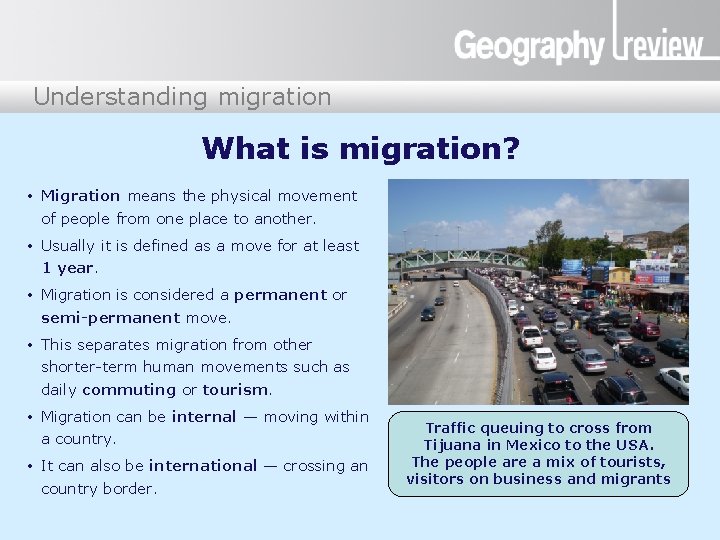
Understandingmigration What is migration? • Migration means the physical movement of people from one place to another. • Usually it is defined as a move for at least 1 year. • Migration is considered a permanent or semi-permanent move. • This separates migration from other shorter-term human movements such as daily commuting or tourism. • Migration can be internal — moving within a country. • It can also be international — crossing an country border. Traffic queuing to cross from Tijuana in Mexico to the USA. The people are a mix of tourists, visitors on business and migrants
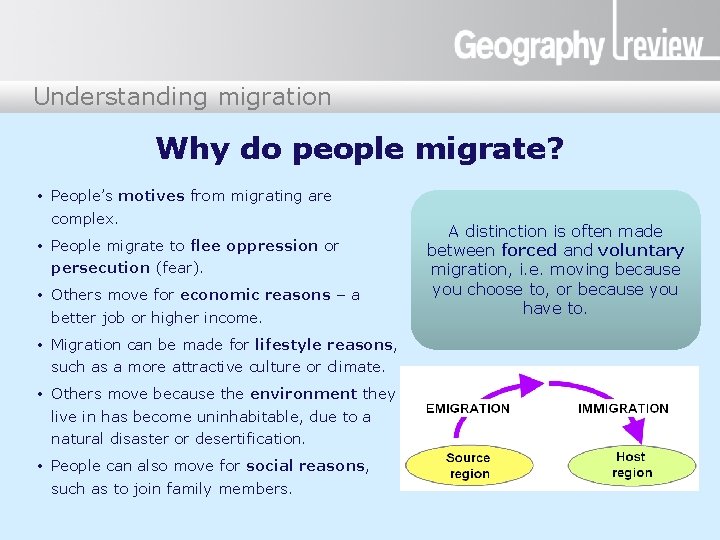
Understandingmigration Why do people migrate? • People’s motives from migrating are complex. • People migrate to flee oppression or persecution (fear). • Others move for economic reasons – a better job or higher income. • Migration can be made for lifestyle reasons, such as a more attractive culture or climate. • Others move because the environment they live in has become uninhabitable, due to a natural disaster or desertification. • People can also move for social reasons, such as to join family members. A distinction is often made between forced and voluntary migration, i. e. moving because you choose to, or because you have to.
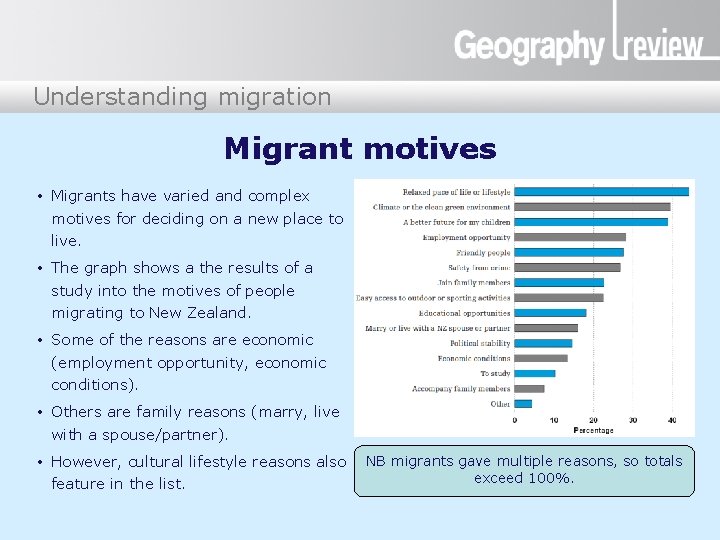
Understandingmigration Migrant motives • Migrants have varied and complex motives for deciding on a new place to live. • The graph shows a the results of a study into the motives of people migrating to New Zealand. • Some of the reasons are economic (employment opportunity, economic conditions). • Others are family reasons (marry, live with a spouse/partner). • However, cultural lifestyle reasons also feature in the list. NB migrants gave multiple reasons, so totals exceed 100%.
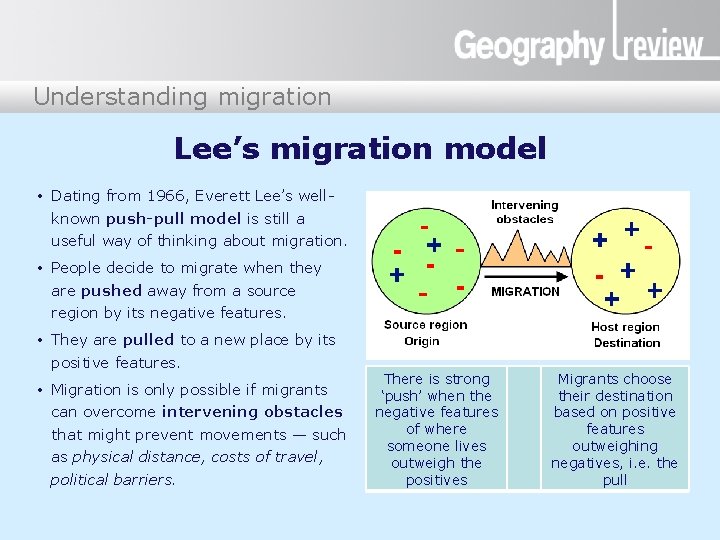
Understandingmigration Lee’s migration model • Dating from 1966, Everett Lee’s wellknown push-pull model is still a useful way of thinking about migration. • People decide to migrate when they are pushed away from a source region by its negative features. • They are pulled to a new place by its positive features. • Migration is only possible if migrants can overcome intervening obstacles that might prevent movements — such as physical distance, costs of travel, political barriers. There is strong ‘push’ when the negative features of where someone lives outweigh the positives Migrants choose their destination based on positive features outweighing negatives, i. e. the pull
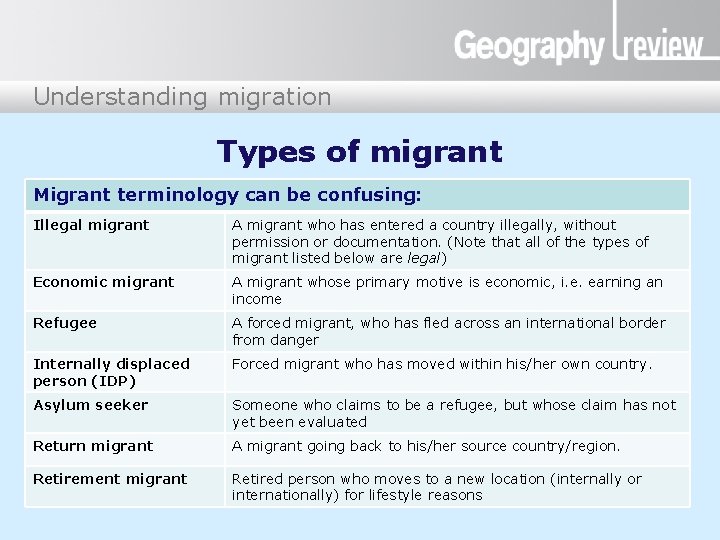
Understandingmigration Types of migrant Migrant terminology can be confusing: Illegal migrant A migrant who has entered a country illegally, without permission or documentation. (Note that all of the types of migrant listed below are legal) Economic migrant A migrant whose primary motive is economic, i. e. earning an income Refugee A forced migrant, who has fled across an international border from danger Internally displaced person (IDP) Forced migrant who has moved within his/her own country. Asylum seeker Someone who claims to be a refugee, but whose claim has not yet been evaluated Return migrant A migrant going back to his/her source country/region. Retirement migrant Retired person who moves to a new location (internally or internationally) for lifestyle reasons
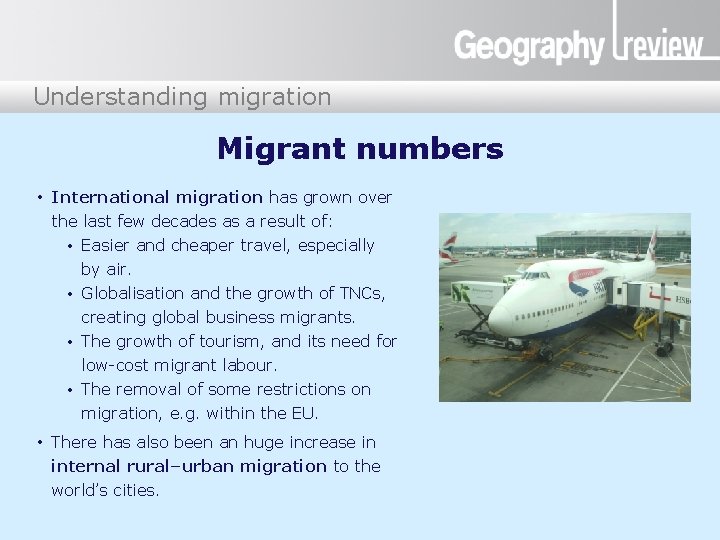
Understandingmigration Migrant numbers • International migration has grown over the last few decades as a result of: • Easier and cheaper travel, especially by air. • Globalisation and the growth of TNCs, creating global business migrants. • The growth of tourism, and its need for low-cost migrant labour. • The removal of some restrictions on migration, e. g. within the EU. • There has also been an huge increase in internal rural–urban migration to the world’s cities.
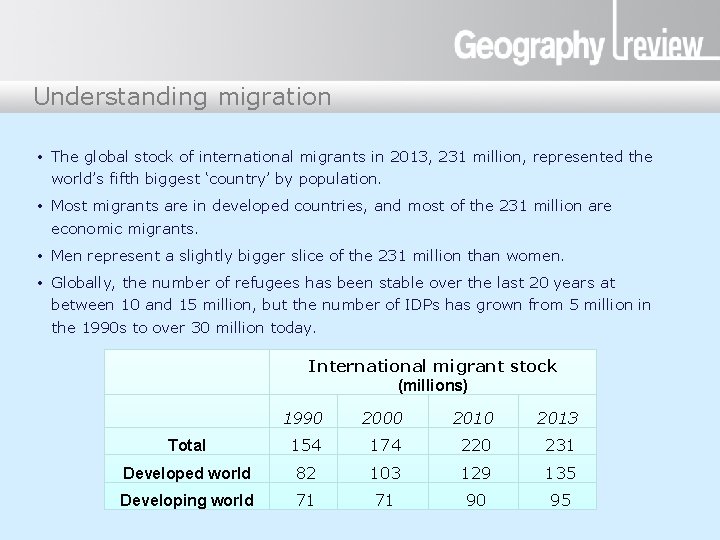
Understandingmigration • The global stock of international migrants in 2013, 231 million, represented the world’s fifth biggest ‘country’ by population. • Most migrants are in developed countries, and most of the 231 million are economic migrants. • Men represent a slightly bigger slice of the 231 million than women. • Globally, the number of refugees has been stable over the last 20 years at between 10 and 15 million, but the number of IDPs has grown from 5 million in the 1990 s to over 30 million today. International migrant stock (millions) 1990 2000 2013 Total 154 174 220 231 Developed world 82 103 129 135 Developing world 71 71 90 95