
Understanding Martian Subsurface Geochemistry using the Dynamic Albedo
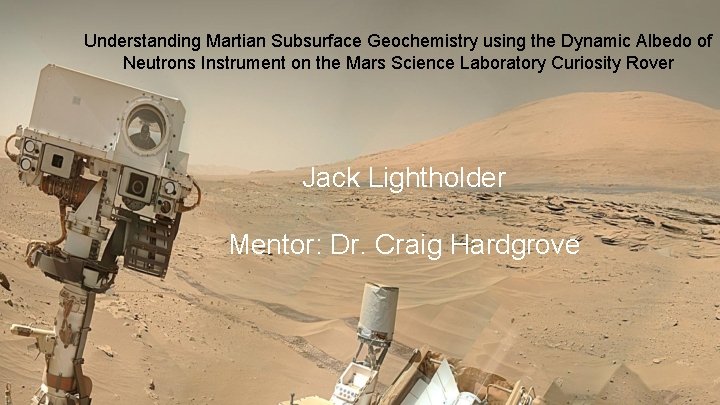
Understanding Martian Subsurface Geochemistry using the Dynamic Albedo of Neutrons Instrument on the Mars Science Laboratory Curiosity Rover Jack Lightholder Mentor: Dr. Craig Hardgrove
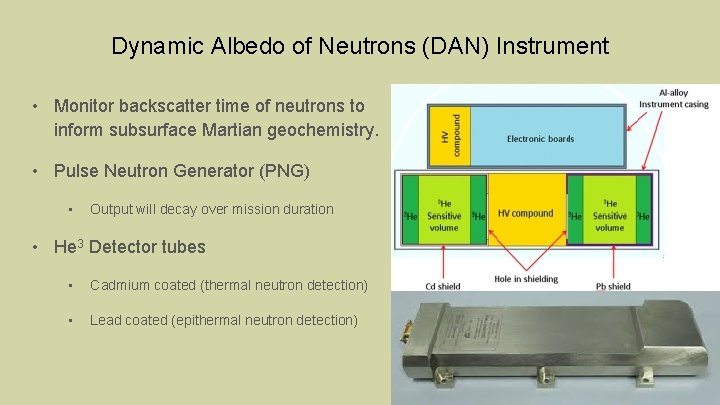
Dynamic Albedo of Neutrons (DAN) Instrument • Monitor backscatter time of neutrons to inform subsurface Martian geochemistry. • Pulse Neutron Generator (PNG) • Output will decay over mission duration • He 3 Detector tubes • Cadmium coated (thermal neutron detection) • Lead coated (epithermal neutron detection)
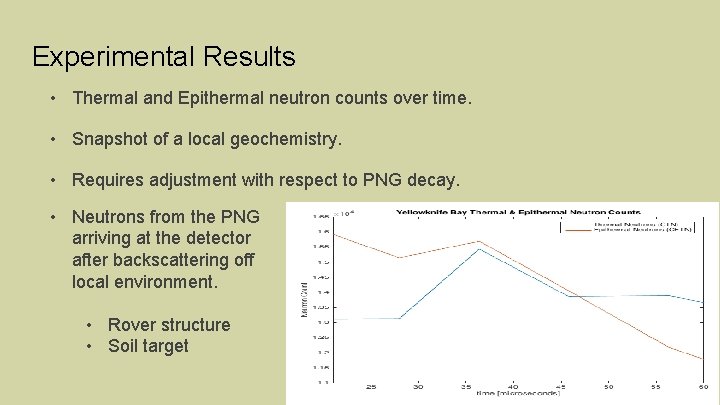
Experimental Results • Thermal and Epithermal neutron counts over time. • Snapshot of a local geochemistry. • Requires adjustment with respect to PNG decay. • Neutrons from the PNG arriving at the detector after backscattering off local environment. • Rover structure • Soil target
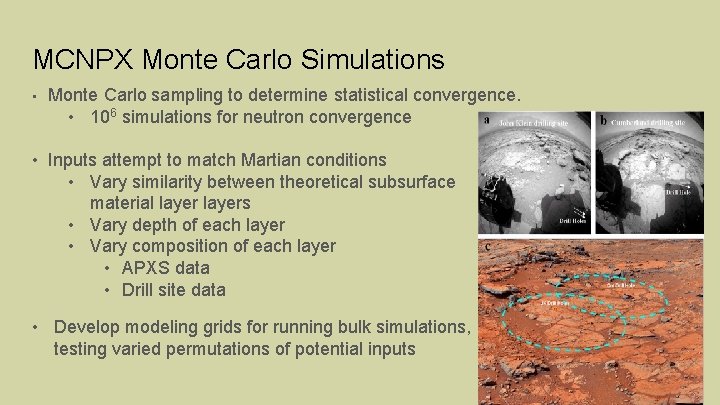
MCNPX Monte Carlo Simulations • Monte Carlo sampling to determine statistical convergence. • 106 simulations for neutron convergence • Inputs attempt to match Martian conditions • Vary similarity between theoretical subsurface material layers • Vary depth of each layer • Vary composition of each layer • APXS data • Drill site data • Develop modeling grids for running bulk simulations, testing varied permutations of potential inputs
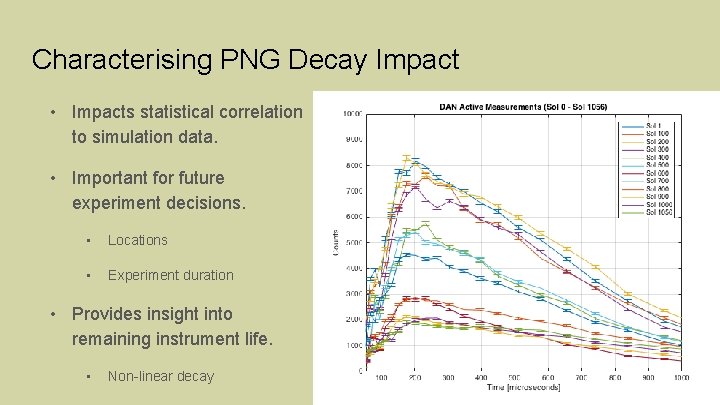
Characterising PNG Decay Impact • Impacts statistical correlation to simulation data. • Important for future experiment decisions. • Locations • Experiment duration • Provides insight into remaining instrument life. • Non-linear decay
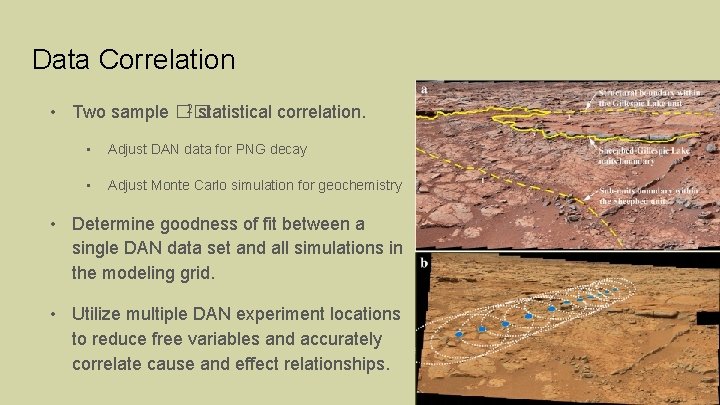
Data Correlation 2 statistical correlation. • Two sample �� • Adjust DAN data for PNG decay • Adjust Monte Carlo simulation for geochemistry • Determine goodness of fit between a single DAN data set and all simulations in the modeling grid. • Utilize multiple DAN experiment locations to reduce free variables and accurately correlate cause and effect relationships.
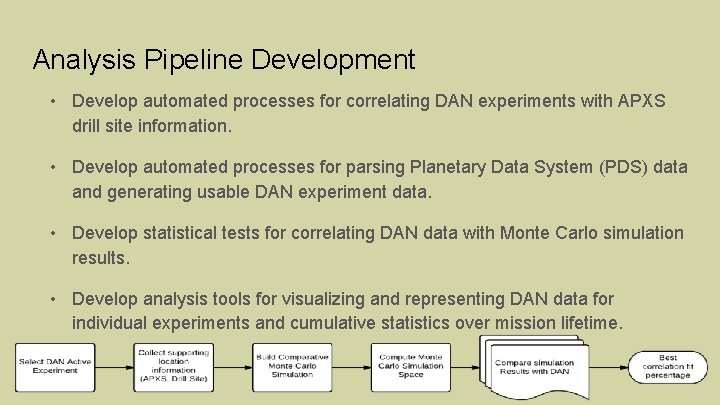
Analysis Pipeline Development • Develop automated processes for correlating DAN experiments with APXS drill site information. • Develop automated processes for parsing Planetary Data System (PDS) data and generating usable DAN experiment data. • Develop statistical tests for correlating DAN data with Monte Carlo simulation results. • Develop analysis tools for visualizing and representing DAN data for individual experiments and cumulative statistics over mission lifetime.
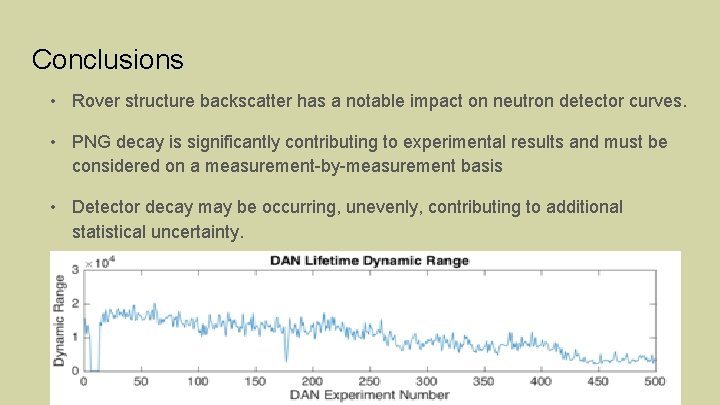
Conclusions • Rover structure backscatter has a notable impact on neutron detector curves. • PNG decay is significantly contributing to experimental results and must be considered on a measurement-by-measurement basis • Detector decay may be occurring, unevenly, contributing to additional statistical uncertainty.

Questions?
- Slides: 9