
Understanding marine sand properties and its usage as
- Slides: 13
Understanding marine sand properties and its usage as construction material BY: ANDRAE HARRIS SUPERVISOR: DR. BEHERA, P. E.
Acknowledgement Special acknowledgement to Lockheed Martin Fellowship – Research for this opportunity to learn more about concrete and to be under the tutelage of Dr. P. Behera who is an encyclopedia of knowledge on this topic. I also want to express gratitude to Mr. Pablo Sanchez who was of huge help throughout my research.
Statement of the problem • Climate change has been having an impact on the sea-level rise and extreme weather events such as hurricanes and large rainfall events. The rising sea-level will have significant impacts on lives and properties of our coastal communities, infrastructures, ecosystems, energy and water resources related sectors such as water availability, flooding, water quality etc. .
Need for the study • There is an increase in the need for construction material (sand) and river sand is becoming increasingly scarce due to the high demand globally. Marine sand is being considered as an alternative but it is not typically used in construction due to the sodium chloride (salt) contents which is corrosive and would weaken metal in contact with it.
Limitation of study This research does not account for all the marine sand as the sand used in this research was taken from the Atlantic Coast. The most recent limitation is the outbreak of the Coronavirus which has caused for the University to be closed, along with the labs which has put a pause on the experiment.
Recap • According to Seth Shulman, from The Union Of Concerned Scientists, Global warming is the primary cause of sea level rise. • Due to the increase in temperature the large ice glaciers are melting and that large volume of water is being add to the oceans. • Major cities and towns will be affected if not completely destroyed as a result • In order to combat the effects we propose the construction of a wall using marine sand to prevent immediate damage to these cities.
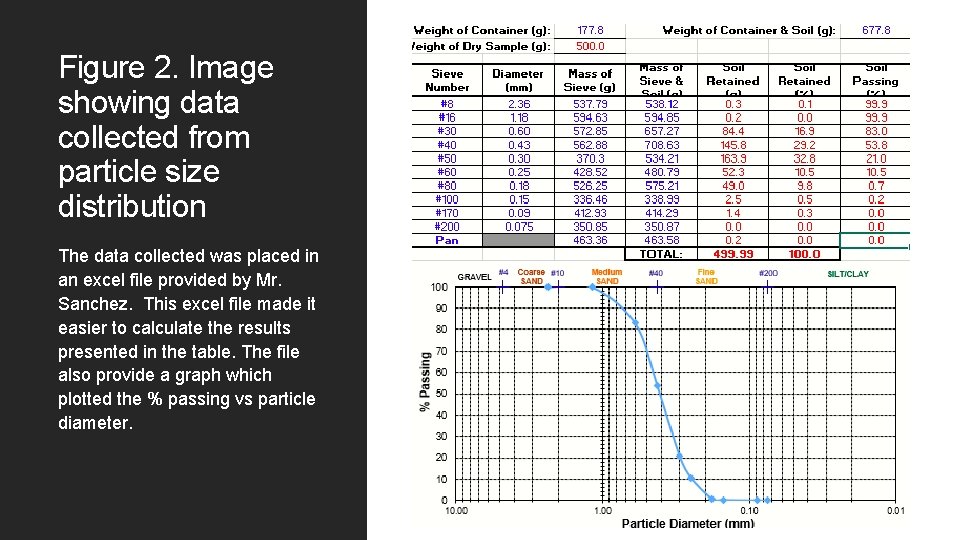
What have I done so far • Retrieve soil sample. • Thoroughly wash marine soil to remove salt and dry in over a 48 hour period. • The ASTM standards will be used to obtain accurate and precise results. -C 136 Standard Test Method for Sieve Analysis of Fine and Coarse Aggregates • Plot graph with data collected.
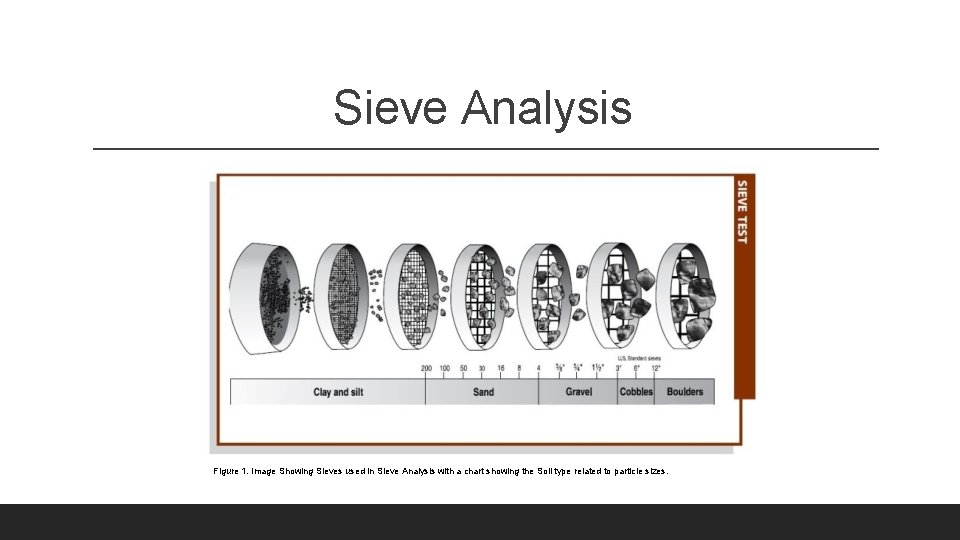
The standard mentioned above was to: • Oven dry samples • Clean a set of ASTM sieves. Check that the sieves are not damaged. • Weigh each sieve and bottom pan separately to get their initial weight. • Prepare oven dried samples by breaking the soil lumps into individual particles using fingers. • Weigh approximately 500 g of oven dried sample. • Stack the sieves, starting with the bottom pan, placing them in descending. • Pour 500 g of soil in the top and cover it. • Place in Mechanical shaker for 10 minutes. • Carefully separate sieves. • Weigh each sieve again including bottom pan. The materials and equipment needed for the sieve analysis were: • Set of ASTM sieves. 10 sieves of sizes 8, 16, 30, 40, 50, 60, 80, 100, 170 and 200. • Mechanical Sieve shaker • Electric balance with minimum capacity of 2000 g and readability of 0. 1 g. • Drying oven able to maintain temperature of 110 + 5 degrees Celsius. • Brush, paper towels and scoop.
Sieve Analysis Figure 1. Image Showing Sieves used in Sieve Analysis with a chart showing the Soil type related to particle sizes.
Figure 2. Image showing data collected from particle size distribution The data collected was placed in an excel file provided by Mr. Sanchez. This excel file made it easier to calculate the results presented in the table. The file also provide a graph which plotted the % passing vs particle diameter.
Conclusion Marine Sample 1, was extracted from the waterline and this was proven by the fact that it had the coarsest grains. Marine Samples 2, 3, and 4 followed respectively. It was noted that Marine sample 1 was the closest thing to the Riverine Sand hence it would be the best alternative of all the samples. Riverine Sand was less coarse than Marine Sample 1 and coarser than Marine Sample 2. The research is also not completed as the C 109 Standard Test Method for Compressive Strength of Hydraulic Cement Mortars was not carried out due to the outbreak of the Coronavirus and the shutting down of the University Campus.
Future Research As I continue this research I aim to compare the strength of the of concrete made with river sand concrete made with marine sand, analyze the physical characteristics of marine sand, such as grain shape, as well as to test different methods to wash the marine sand to remove salt.
References Shulman Seth and et al. “Causes of Sea Level Rise, ” Union of Concerned Scientist, Island Press. 2012 ASTM C 136 / C 136 M-19, Standard Test Method for Sieve Analysis of Fine and Coarse Aggregates, ASTM International, West Conshohocken, PA, 2019, www. astm. org