
Understanding Management and Managerial Roles Tarak Bahadur KC
Understanding Management and Managerial Roles Tarak Bahadur KC, Ph. D tarakbkc@gmail. com
Session outline �Management and manager �Managerial roles and skills �Key competencies and personal qualities of a manager �Managerial issues �Work assignment and delegation
Let us workout � You are posted in a newly formed municipality. You have to establish new NP Post. Prepare to do list in five minutes. � What comes in your mind when you think about management and managers? Please express in the form of picture or diagram in the flip chart. You have five minutes. 3
Management is the art of getting things done effectively and efficiently through people using organizational resources human, finance, material, method and information- in a dynamic environment. 4
Management ensures that these resources are combined into a total system to accomplish an objective. It is a process of deciding: �How many people are to be economically employed, �What kinds of people to assign to what jobs, �How much money to spend on specific problems, �What kinds of activities to perform first and what to perform last in what way, �How much time should be spent on one activity, and �Who are the customers and whether they 5 are satisfied with its products and services?
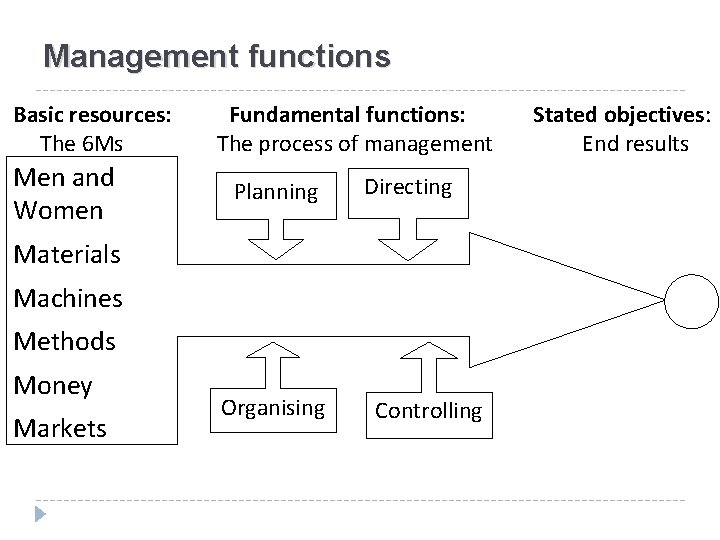
Management functions Basic resources: The 6 Ms Men and Women Fundamental functions: The process of management Planning Directing Materials Machines Methods Money Markets Organising Controlling Stated objectives: End results
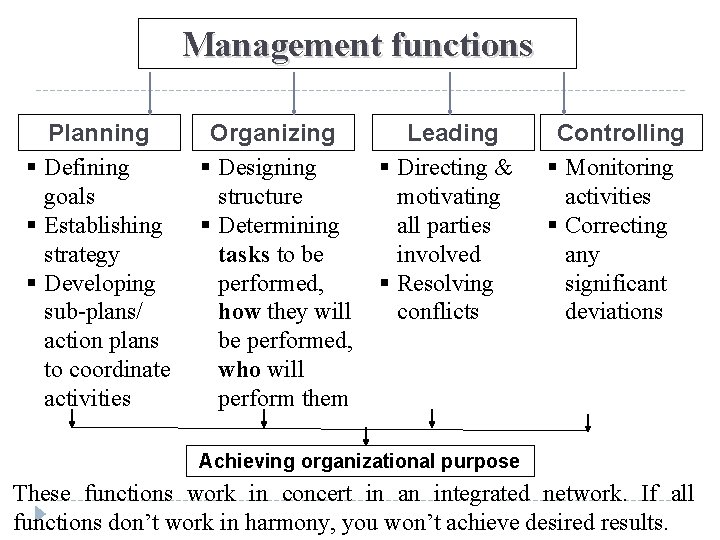
Management functions Planning § Defining goals § Establishing strategy § Developing sub-plans/ action plans to coordinate activities Organizing § Designing structure § Determining tasks to be performed, how they will be performed, who will perform them Leading § Directing & motivating all parties involved § Resolving conflicts Controlling § Monitoring activities § Correcting any significant deviations Achieving organizational purpose These functions work in concert in an integrated network. If all functions don’t work in harmony, you won’t achieve desired results.
Evolution of management Management thought developed gradually, from past to present and passed through various distinct phases. 1. The classical theory �Bureaucratic theory – Max Weber �Scientific management theory- FW Taylor �Administrative theory – Henry Fayol Concerned with production of efficiency and productivity through the one best way. Scientific method should be used to define the best way. There should be standardization.
2. The neoclassical theory �Human relations / Behavioral theory Elton Mayo, Abraham Maslow, Douglas Mc. Gregor Concerned with importance of human element in management. The theory emphasizes importance of individual within the organization. Productivity is not only technical but also a social phenomenon. Workers are motivated by social need. Money is not the only –

3. The modern theory system theory- Daniel Katz and Robert Kahn - concerned with total picture of interdependence and environmental influences. (Input, Process, Output) �The contingency theory - Lawrence and Lorsch - concerned with inquires of each situation for managerial practice. No ‘best way’. ‘It all depends’. �Japanese management style, Theory Z, William Ouchi- Humanistic approach, e. g. lifetime employment. �The
�The modern organizational theory represents integrative approach to management. There is no one best way of doing things under all conditions. Methods and techniques which are highly effective in one situation may not work in other situations. Situation plays an important role in application of management functions. Functions are universal but their application is situational. Management takes a situational
New management concept in practice �Competitiveness �Performance �Delivery �Price Recently, the important trend for the organization is the quality control management. This is because the competitiveness in the business world, in which the performance of the employee is in reliability and the process of delivery should be speedy. However, the expect price should
Emerging challenges for management 1. 2. 3. 4. 5. Globalilization: Managers need to think globally and act locally. Technology (IT and e-governance): The development in IT will provide greater access to management. Management will need to manage changing technology effectively. Quality: Quality assurance is getting important. Social responsibility: Management will pursue long term goals that are good for society. Maintaining ethical and socially responsible standards. Human resource management: Management needs to deal with diversified work force,
7. Empowerment: To empower worker is a challenge to management. 8. Cultural sensitivity: Cultural value will change cross cultural influences. Organizations are emerging as cultural systems. 9. Manager will face the challenge of managing change. They will need to aware specific changes and their likely impact on the practice of management. 10. Organization design: Organization will be lean flat and less hierarchical. 11. Learning organization: Management needs to create learning environment. Organization of future will be predominantly knowledge based.
Manager People who manage other people and resources are called managers. A manager is a person who is responsible for running a particular section, or a business or an organization. Without his leadership ‘the resources of production’ remain resources and never become production. A manager has: � Targets to achieve, � People to manage, � Tasks to perform, � An organisation to liaise with, and � A distinct shortage of time. 15 Basically, there are two types of managers: ‘doer’
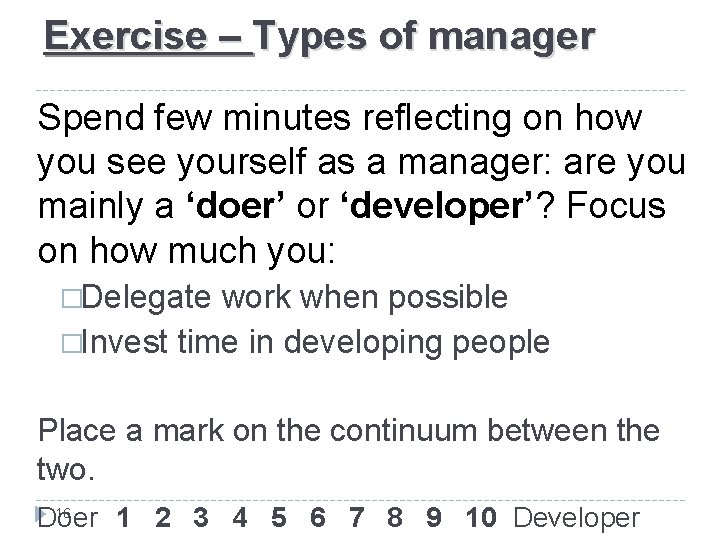
Exercise – Types of manager Spend few minutes reflecting on how you see yourself as a manager: are you mainly a ‘doer’ or ‘developer’? Focus on how much you: �Delegate work when possible �Invest time in developing people Place a mark on the continuum between the two. 16 Doer 1 2 3 4 5 6 7 8 9 10 Developer
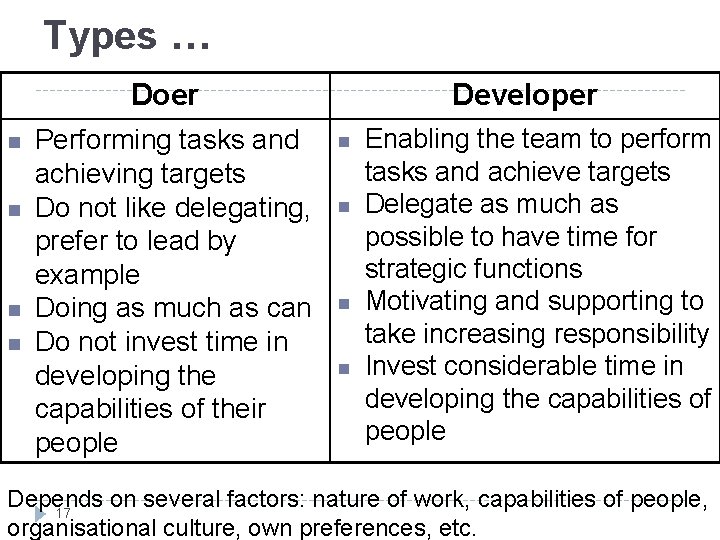
Types … Doer n n Performing tasks and achieving targets Do not like delegating, prefer to lead by example Doing as much as can Do not invest time in developing the capabilities of their people Developer n n Enabling the team to perform tasks and achieve targets Delegate as much as possible to have time for strategic functions Motivating and supporting to take increasing responsibility Invest considerable time in developing the capabilities of people Depends on several factors: nature of work, capabilities of people, 17 organisational culture, own preferences, etc.
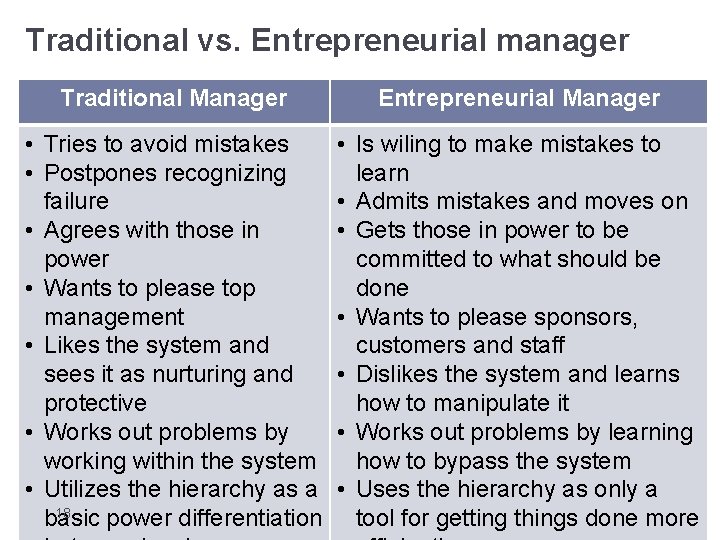
Traditional vs. Entrepreneurial manager Traditional Manager Entrepreneurial Manager • Tries to avoid mistakes • Postpones recognizing failure • Agrees with those in power • Wants to please top management • Likes the system and sees it as nurturing and protective • Works out problems by working within the system • Utilizes the hierarchy as a 18 basic power differentiation • Is wiling to make mistakes to learn • Admits mistakes and moves on • Gets those in power to be committed to what should be done • Wants to please sponsors, customers and staff • Dislikes the system and learns how to manipulate it • Works out problems by learning how to bypass the system • Uses the hierarchy as only a tool for getting things done more
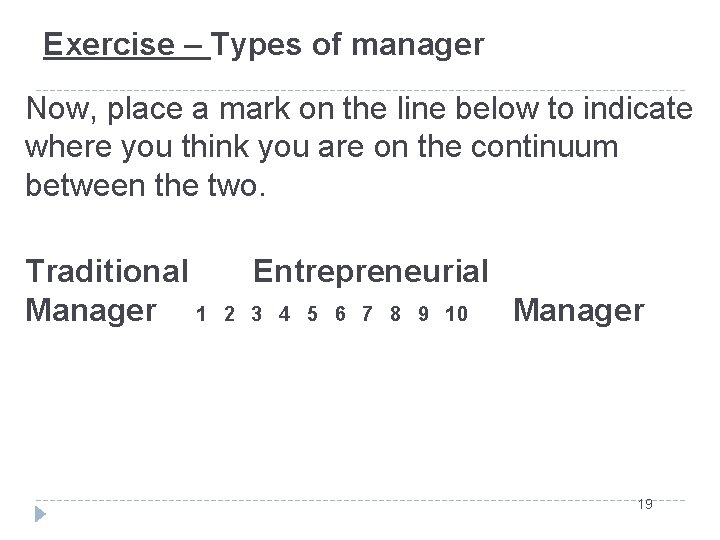
Exercise – Types of manager Now, place a mark on the line below to indicate where you think you are on the continuum between the two. Traditional Manager 1 Entrepreneurial 2 3 4 5 6 7 8 9 10 Manager 19
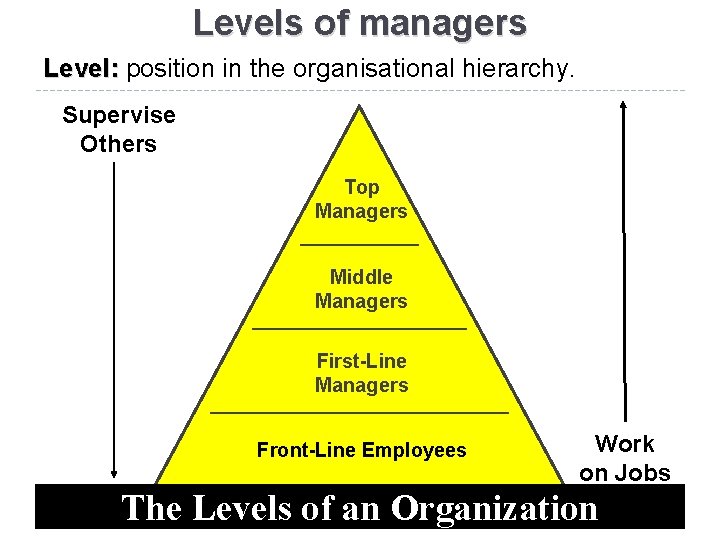
Levels of managers Level: position in the organisational hierarchy. Supervise Others Top Managers Middle Managers First-Line Managers Front-Line Employees 20 Work on Jobs The Levels of an Organization
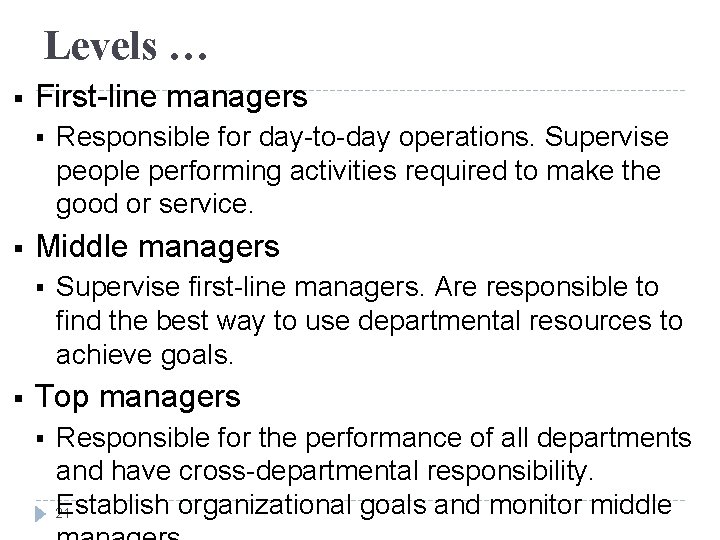
Levels … § First-line managers § § Middle managers § § Responsible for day-to-day operations. Supervise people performing activities required to make the good or service. Supervise first-line managers. Are responsible to find the best way to use departmental resources to achieve goals. Top managers § Responsible for the performance of all departments and have cross-departmental responsibility. Establish organizational goals and monitor middle 21
What is a role? A role is a set of responsibilities organised (or a pattern of behaviours used) to produce specific outputs related to a specific function / position. Exercise: Managerial roles What are your roles as a manager? 22
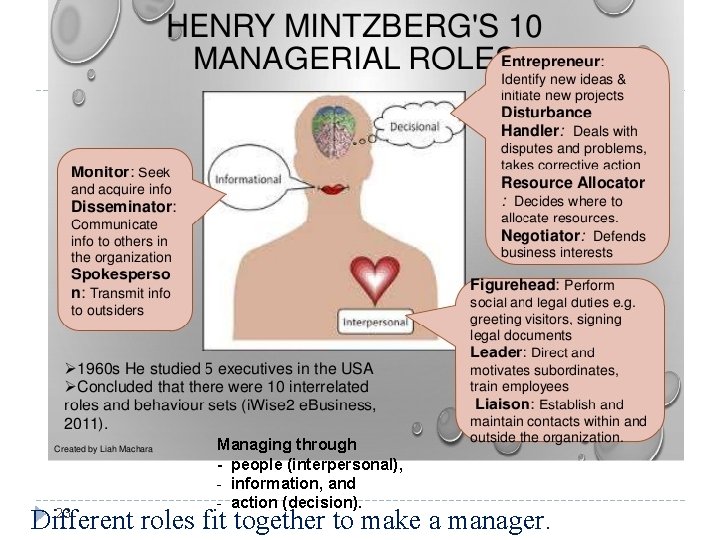
Managing through - people (interpersonal), - information, and - action (decision). 23 Different roles fit together to make a manager.
Areas of involvement In order to manage people, a manager has to be involved in the following areas: �Activity – what people do. �Performance – how well people do. �Career – planning of career development. �Life – non-work issues (personal). 24
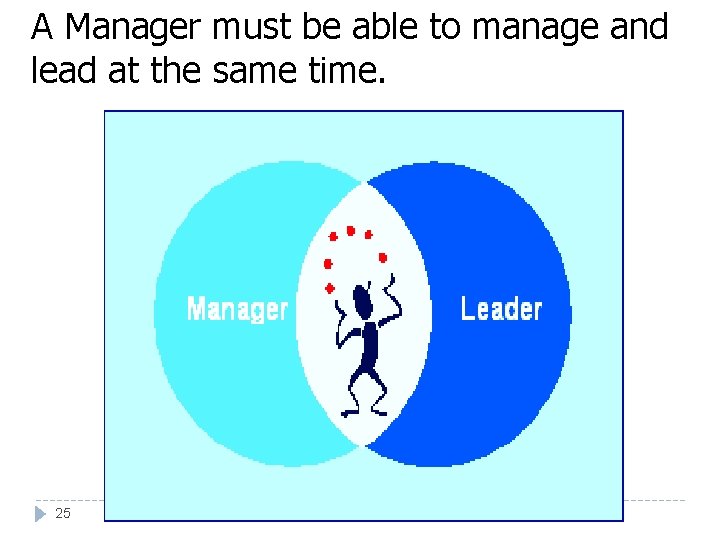
A Manager must be able to manage and lead at the same time. 25
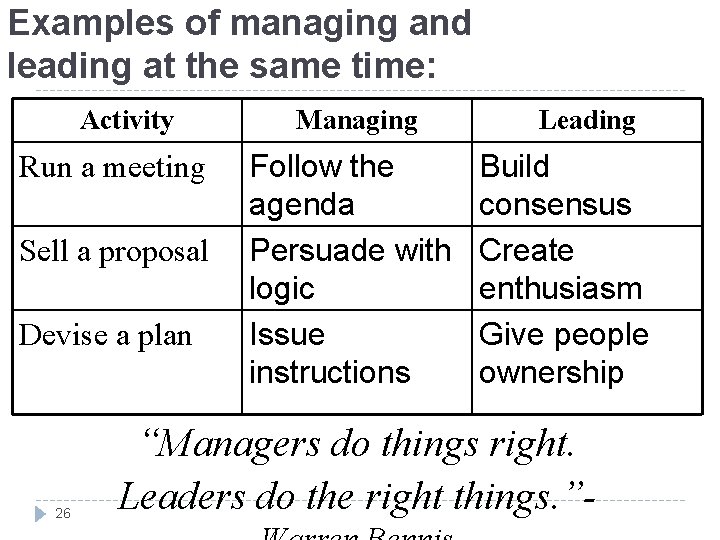
Examples of managing and leading at the same time: Activity Run a meeting Sell a proposal Devise a plan 26 Managing Follow the agenda Persuade with logic Issue instructions Leading Build consensus Create enthusiasm Give people ownership “Managers do things right. Leaders do the right things. ”-
Managerial skills � Skill is the knowledge and ability that enables one to do a job very well. � Managers need to develop different skills in order to perform their duties effectively. There are some basic skills, which all Exercise: managers What skills youshould need topossess. perform the role of a manager? 27
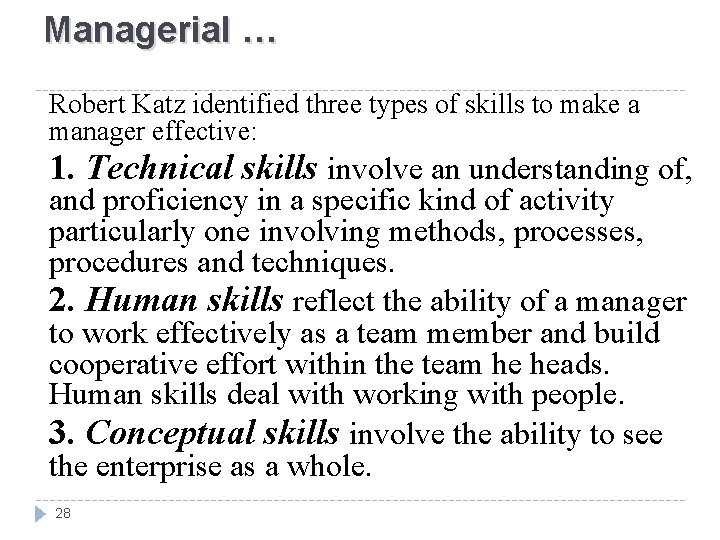
Managerial … Robert Katz identified three types of skills to make a manager effective: 1. Technical skills involve an understanding of, and proficiency in a specific kind of activity particularly one involving methods, processes, procedures and techniques. 2. Human skills reflect the ability of a manager to work effectively as a team member and build cooperative effort within the team he heads. Human skills deal with working with people. 3. Conceptual skills involve the ability to see the enterprise as a whole. 28
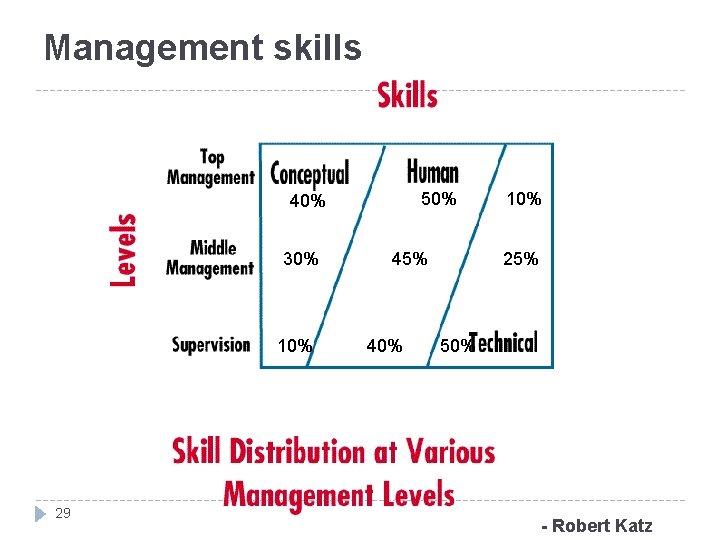
Management skills 50% 40% 30% 10% 29 45% 40% 10% 25% 50% - Robert Katz
Competencies �A competency is more than just knowledge and skill. It involves creative abilities to meet complex demands of society and organisations by drawing on and mobilising psychosocial resources including attitudes, motivation and values which an individual must possess in order to produce the outputs for his/her roles in a particular context. �Job competency describes the underlying characteristics of an individual that drive behaviour leading to superior performance 30
Exercise: Key competencies What are key competencies of a manager? 31
�A competency is a generic knowledge, motive, trait, value, bahaviour, selfimage, social role or skill of a person, such as: �Leadership / Self Management �Decision making �Personal effectiveness- Integrity, Interpersonal skills / Communication, Adaptive, Innovative, Creative, Self-directed, Trustworthy and Self-motivated �Strategic planning �Change management 32 �Learning and achievement orientation
Personal qualities �A quality is a characteristic like honesty that is part of the nature of a person. � Among other things, those who want to lead people and manage events must bring with them a set of qualities that can’t always be taught but can be learned: � Will: Desire to make a difference, influence others, and gain satisfaction from doing so -in sum, the "will to manage. " � Power: Healthy desire for power. Enjoy it but don’t abuse it. � Empathy: Able to understand feelings and 33
Great managers: �Select people based on talent �When setting expectations for employees, establish the right outcomes �When motivating an individual, focus on strengths �Find the right job fit for the person
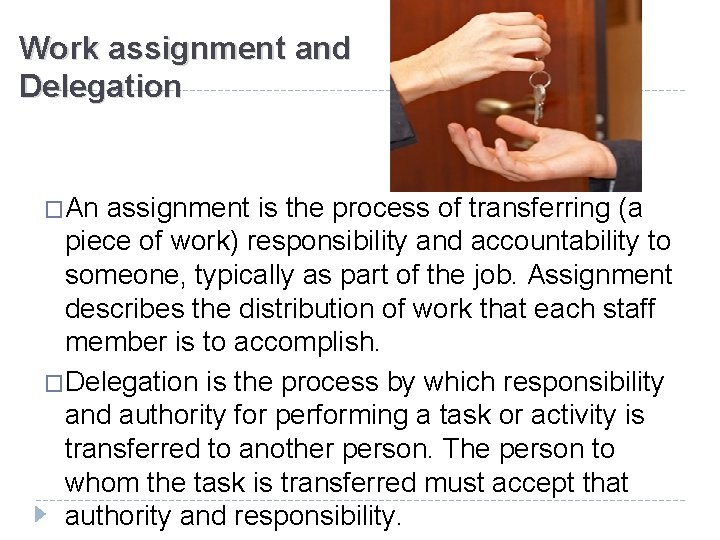
Work assignment and Delegation �An assignment is the process of transferring (a piece of work) responsibility and accountability to someone, typically as part of the job. Assignment describes the distribution of work that each staff member is to accomplish. �Delegation is the process by which responsibility and authority for performing a task or activity is transferred to another person. The person to whom the task is transferred must accept that authority and responsibility.
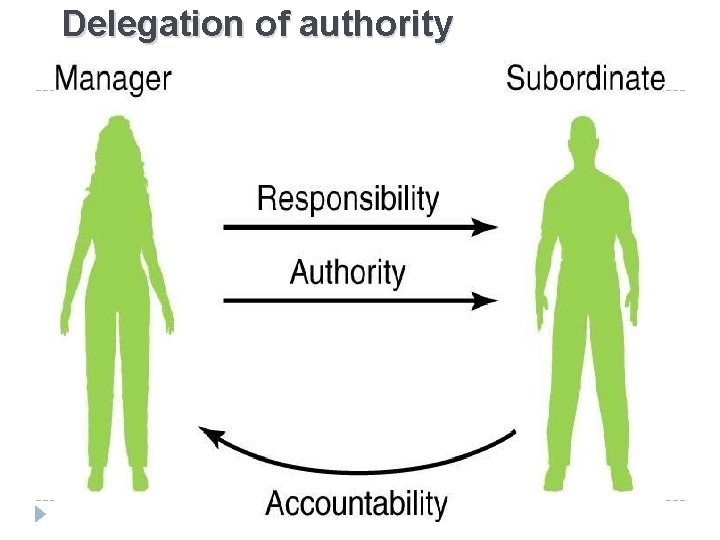
Delegation of authority
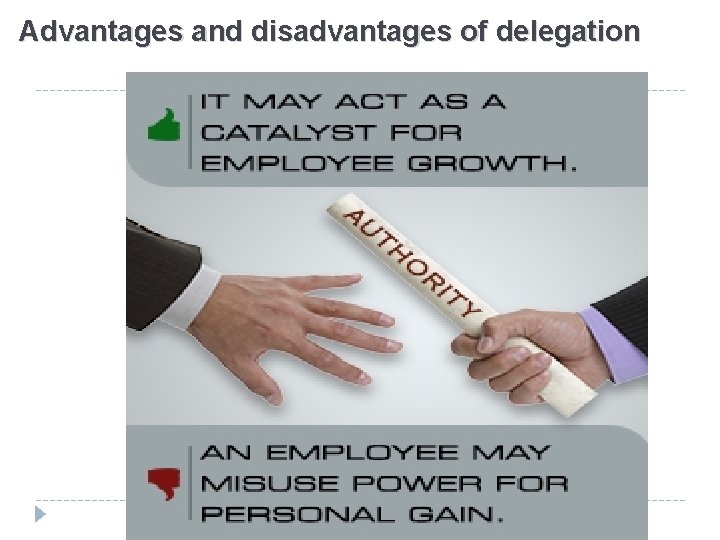
Advantages and disadvantages of delegation
Delegation strategies 1. Identify key opportunities for delegation 2. Establish a clear set of objectives for each task 3. Play to your coworker's strengths 4. Construct a timeline 5. Use follow-up tasks to keep your workers on point 6. Establish authority and respect 7. Use a feedback loop to make future delegation easier.
Managing resources and priorities: Do more with less (DMWL) Organisational resources: 4 M I �Define what "more" and "less" mean to you - now and in the future. �Brush up on the key "trio" of strategic management skills - analysis, communication and negotiation. �Know your stakeholders. �Identify your DMWL targets.
Managing … �Set realistic priorities. �Put all plans and commitments in writing. �Communicate, communicate, and communicate again. �Set realistic expectations. �Get visible, recorded buy-in and acceptance. �Monitor and review DMWL results and
Resource allocation plan It might include: �Resource allocation decisions � Prioritizing tasks � Allocating resources to those tasks � Making business decisions around why resources aren’t allocated to other tasks � Identifying tasks that need funding � identifying tasks that don’t need funding �Contingencies � Ranking (aka, “Plan B”) prioritized tasks � Identifying must-have staff for a given task � identifying tasks that are transferable to other team members
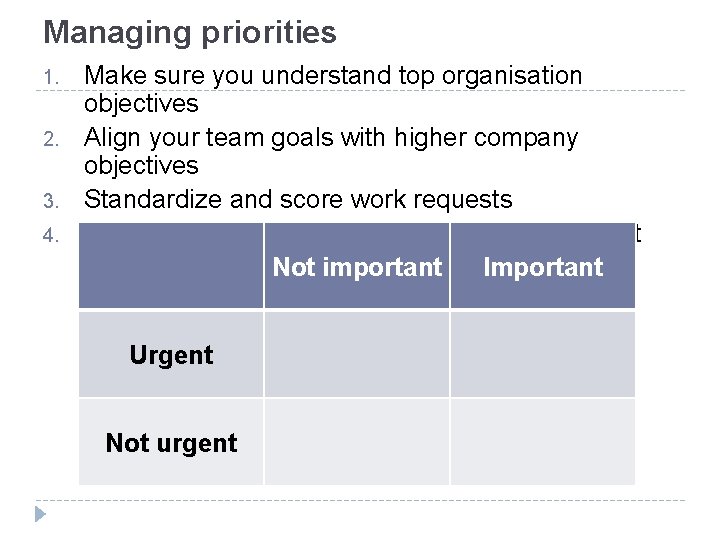
Managing priorities 1. 2. 3. 4. Make sure you understand top organisation objectives Align your team goals with higher company objectives Standardize and score work requests Encourage your team to make time for important but Not urgent work Not important Important Urgent Not urgent
Conclusion People want to be guided by those they respect and who have a clear sense of direction. To gain respect, they must be ethical. A sense of direction is achieved by conveying a strong vision of the future. For this, follow Blue ocean strategy- Success principle: Knowledge Principle Value Integrity Character Morality Guidance 43 - Bhagavat Gita
Good Luck
Management in Nepal is in a developing stage. The following points characterize it: 1. Concept of management: Nepali management is based on process concept, which regards management as functions of planning, organizing, staffing, directing and controlling. Functions are performed to get the jobs done effectively. The people aspect of management has remained neglected. Systems concept is lacking.
2. Principles of management: • Tradition-bound with deep rooted paternalism • Division of work is prevalent, but integration is weak • Authority remains centralized while responsibility delegated • Lack of job descriptions to employees • Unity of direction unclear (one activity directed by various managers and one employee reports various bosses)
• Hierarchy is important • Individual goals do not get internalized with organizational goals • Interpersonal relationships are dominated by conflicts and personality clashes • Discipline is poor • Politicized multiple unions • Mistrust characterizes the organizational climate
3. Functions of management: Planning: Long-term planning generally lacking. The annual budget represents the plan. Implementers are not involved in the planning process. Organising: Organising function is found, but authority -responsibility relations are not clear. Staffing: Informal relations influence human resource management. Directing: There is generally one-way communication from top to bottom. Lack of participative orientation and coordination leading to mismanagement of scarce resources. Motivation is generally money based. Controlling: Control is generally for threat and punishment rather than correction of performance to set future standards.
4. Professionalism: Nepali management is feudocratic and lacks professionalism. Growing private sector (family owned) prefer friends and relatives. Public sector has become the victim of political interference. Lack of accountability for performance and results. Managers concerned about their own survival rather than results or organizational effectiveness. 5. Future perspective: Globalization, technology transfer, competition increasing. This will lead to professionalism- this is emerging.
- Slides: 49