
Understanding LS 02 01 20 and locking requirements
- Slides: 13
Understanding LS. 02. 01. 20 and locking requirements © 2015 American Society for Healthcare Engineering, a personal membership group of the American Hospital Association 155 N. Wacker Drive, Suite 400 | Chicago, IL 60606 ashe. org | ashe@aha. org | 312 -422 -3800 1
Door locking • Because there are so many findings for non-code compliant locking, please review the following excerpts from NFPA 101: Life Safety Code® 2000 Edition regarding the proper method of door locking in health care occupancies. Often, surveyors find that not all requirements are met by organizations. • Note that the code has both absolute and conditional requirements. © 2015 American Society for Healthcare Engineering 2
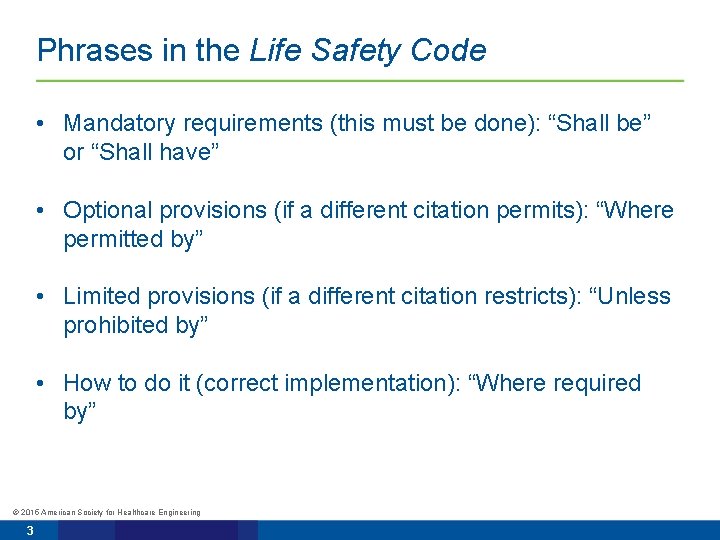
Phrases in the Life Safety Code • Mandatory requirements (this must be done): “Shall be” or “Shall have” • Optional provisions (if a different citation permits): “Where permitted by” • Limited provisions (if a different citation restricts): “Unless prohibited by” • How to do it (correct implementation): “Where required by” © 2015 American Society for Healthcare Engineering 3
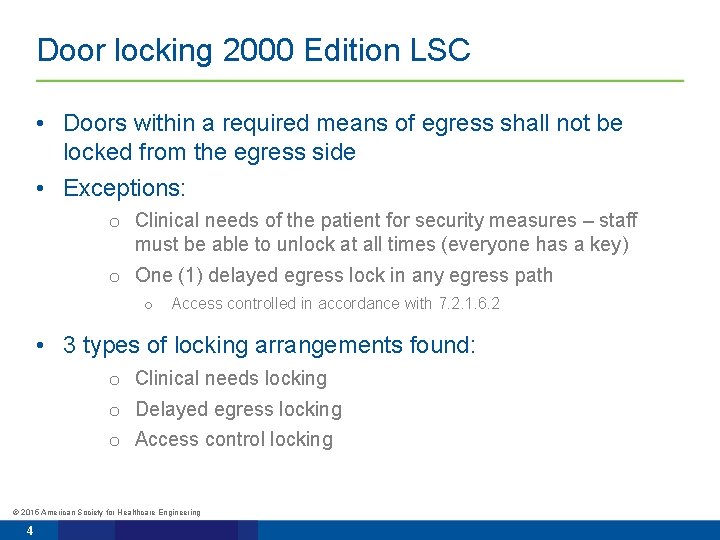
Door locking 2000 Edition LSC • Doors within a required means of egress shall not be locked from the egress side • Exceptions: o Clinical needs of the patient for security measures – staff must be able to unlock at all times (everyone has a key) o One (1) delayed egress lock in any egress path o Access controlled in accordance with 7. 2. 1. 6. 2 • 3 types of locking arrangements found: o Clinical needs locking o Delayed egress locking o Access control locking © 2015 American Society for Healthcare Engineering 4
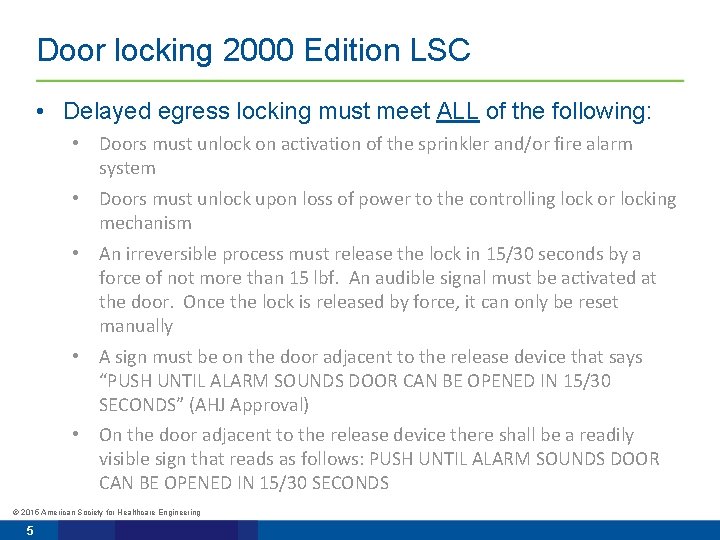
Door locking 2000 Edition LSC • Delayed egress locking must meet ALL of the following: • Doors must unlock on activation of the sprinkler and/or fire alarm system • Doors must unlock upon loss of power to the controlling lock or locking mechanism • An irreversible process must release the lock in 15/30 seconds by a force of not more than 15 lbf. An audible signal must be activated at the door. Once the lock is released by force, it can only be reset manually • A sign must be on the door adjacent to the release device that says “PUSH UNTIL ALARM SOUNDS DOOR CAN BE OPENED IN 15/30 SECONDS” (AHJ Approval) • On the door adjacent to the release device there shall be a readily visible sign that reads as follows: PUSH UNTIL ALARM SOUNDS DOOR CAN BE OPENED IN 15/30 SECONDS © 2015 American Society for Healthcare Engineering 5
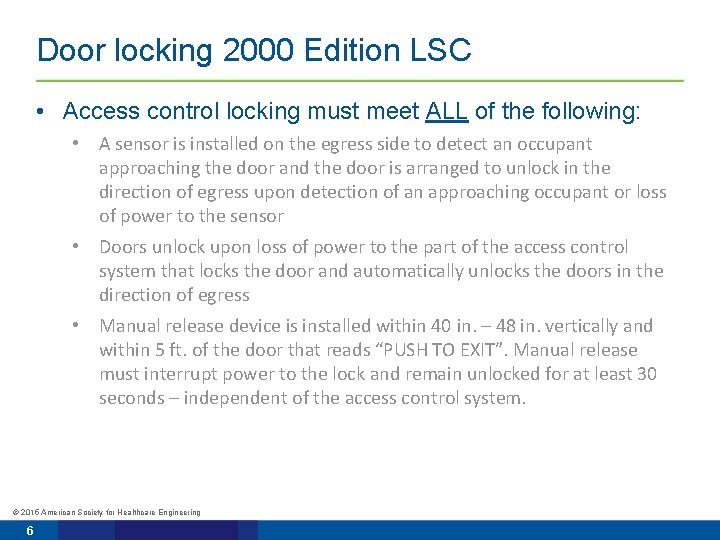
Door locking 2000 Edition LSC • Access control locking must meet ALL of the following: • A sensor is installed on the egress side to detect an occupant approaching the door and the door is arranged to unlock in the direction of egress upon detection of an approaching occupant or loss of power to the sensor • Doors unlock upon loss of power to the part of the access control system that locks the door and automatically unlocks the doors in the direction of egress • Manual release device is installed within 40 in. – 48 in. vertically and within 5 ft. of the door that reads “PUSH TO EXIT”. Manual release must interrupt power to the lock and remain unlocked for at least 30 seconds – independent of the access control system. © 2015 American Society for Healthcare Engineering 6
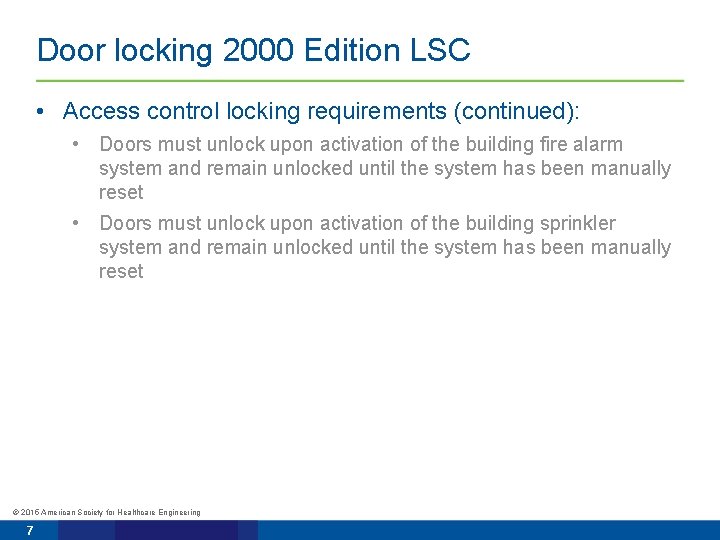
Door locking 2000 Edition LSC • Access control locking requirements (continued): • Doors must unlock upon activation of the building fire alarm system and remain unlocked until the system has been manually reset • Doors must unlock upon activation of the building sprinkler system and remain unlocked until the system has been manually reset © 2015 American Society for Healthcare Engineering 7
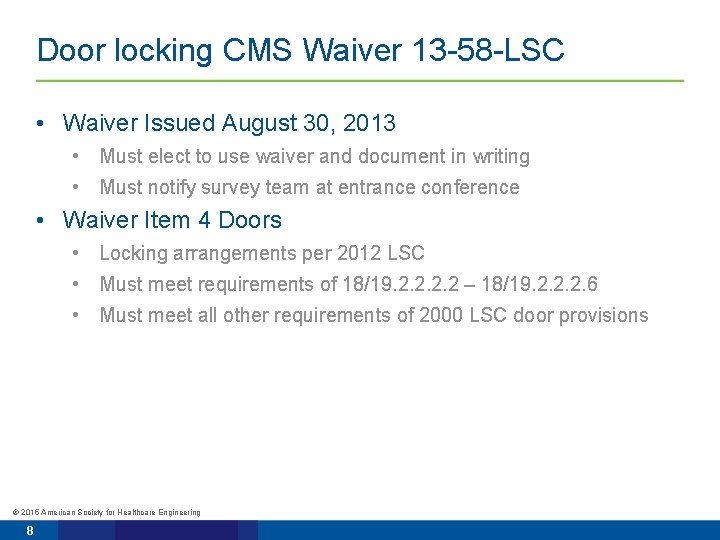
Door locking CMS Waiver 13 -58 -LSC • Waiver Issued August 30, 2013 • Must elect to use waiver and document in writing • Must notify survey team at entrance conference • Waiver Item 4 Doors • Locking arrangements per 2012 LSC • Must meet requirements of 18/19. 2. 2 – 18/19. 2. 2. 2. 6 • Must meet all other requirements of 2000 LSC door provisions © 2015 American Society for Healthcare Engineering 8
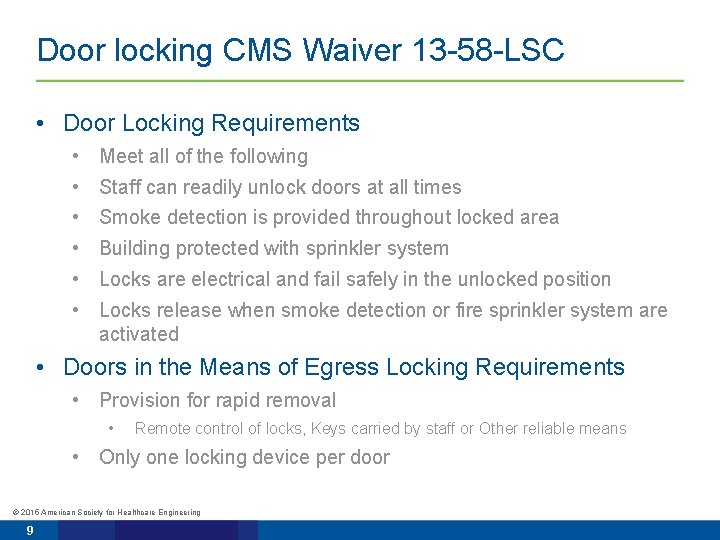
Door locking CMS Waiver 13 -58 -LSC • Door Locking Requirements • • • Meet all of the following Staff can readily unlock doors at all times Smoke detection is provided throughout locked area Building protected with sprinkler system Locks are electrical and fail safely in the unlocked position Locks release when smoke detection or fire sprinkler system are activated • Doors in the Means of Egress Locking Requirements • Provision for rapid removal • Remote control of locks, Keys carried by staff or Other reliable means • Only one locking device per door © 2015 American Society for Healthcare Engineering 9
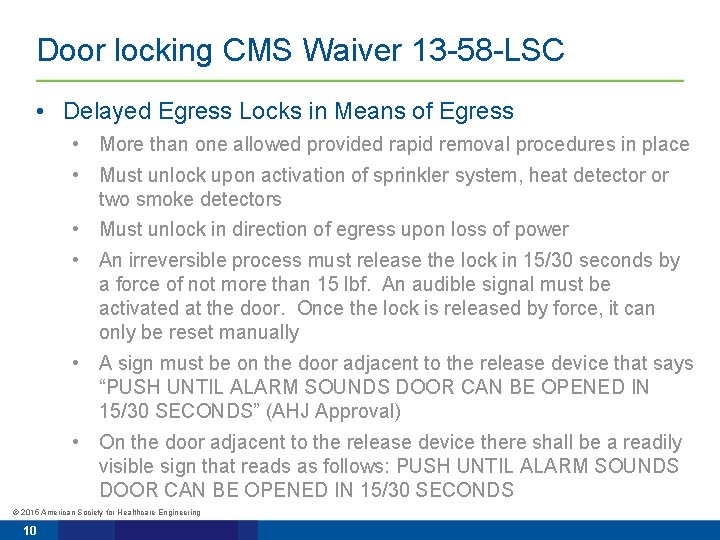
Door locking CMS Waiver 13 -58 -LSC • Delayed Egress Locks in Means of Egress • More than one allowed provided rapid removal procedures in place • Must unlock upon activation of sprinkler system, heat detector or two smoke detectors • Must unlock in direction of egress upon loss of power • An irreversible process must release the lock in 15/30 seconds by a force of not more than 15 lbf. An audible signal must be activated at the door. Once the lock is released by force, it can only be reset manually • A sign must be on the door adjacent to the release device that says “PUSH UNTIL ALARM SOUNDS DOOR CAN BE OPENED IN 15/30 SECONDS” (AHJ Approval) • On the door adjacent to the release device there shall be a readily visible sign that reads as follows: PUSH UNTIL ALARM SOUNDS DOOR CAN BE OPENED IN 15/30 SECONDS © 2015 American Society for Healthcare Engineering 10
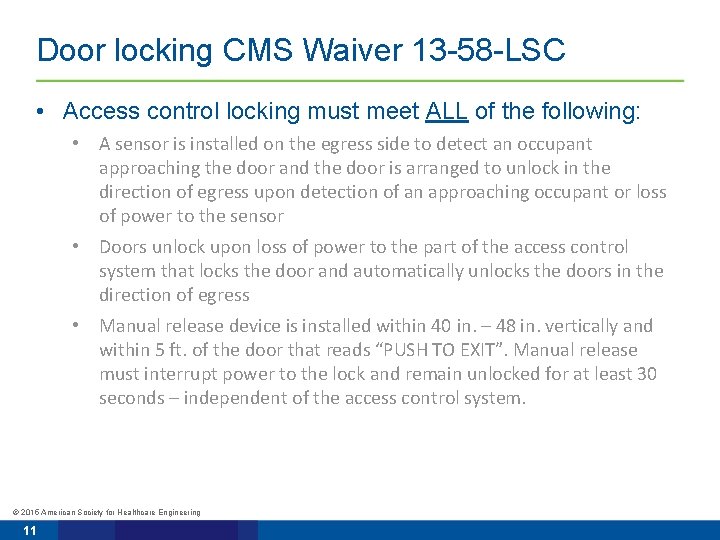
Door locking CMS Waiver 13 -58 -LSC • Access control locking must meet ALL of the following: • A sensor is installed on the egress side to detect an occupant approaching the door and the door is arranged to unlock in the direction of egress upon detection of an approaching occupant or loss of power to the sensor • Doors unlock upon loss of power to the part of the access control system that locks the door and automatically unlocks the doors in the direction of egress • Manual release device is installed within 40 in. – 48 in. vertically and within 5 ft. of the door that reads “PUSH TO EXIT”. Manual release must interrupt power to the lock and remain unlocked for at least 30 seconds – independent of the access control system. © 2015 American Society for Healthcare Engineering 11
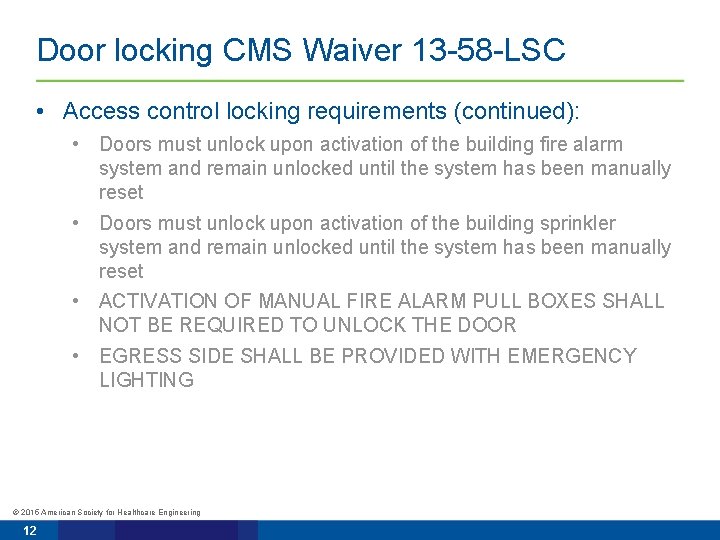
Door locking CMS Waiver 13 -58 -LSC • Access control locking requirements (continued): • Doors must unlock upon activation of the building fire alarm system and remain unlocked until the system has been manually reset • Doors must unlock upon activation of the building sprinkler system and remain unlocked until the system has been manually reset • ACTIVATION OF MANUAL FIRE ALARM PULL BOXES SHALL NOT BE REQUIRED TO UNLOCK THE DOOR • EGRESS SIDE SHALL BE PROVIDED WITH EMERGENCY LIGHTING © 2015 American Society for Healthcare Engineering 12
© 2015 American Society for Healthcare Engineering, a personal membership group of the American Hospital Association 155 N. Wacker Drive, Suite 400 | Chicago, IL 60606 ashe. org | ashe@aha. org | 312 -422 -3800 13