
Understanding Loss Coefficient Based in the latest results
Understanding Loss Coefficient Based in the latest results of measurements of the garnet ring assembly in the test setup 9/28/2017 2 -nd Harmonic Booster Cavity Meeting 1
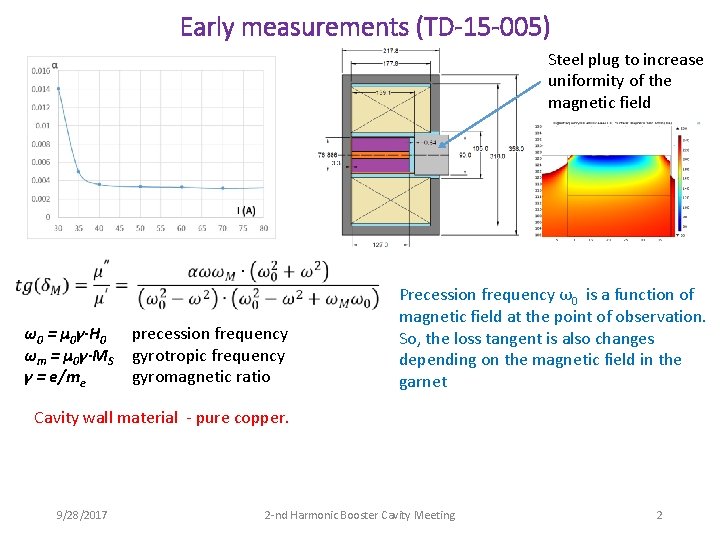
Early measurements (TD-15 -005) Steel plug to increase uniformity of the magnetic field ω0 = µ 0γ·H 0 ωm = µ 0γ·MS γ = e/me precession frequency gyrotropic frequency gyromagnetic ratio Precession frequency ω0 is a function of magnetic field at the point of observation. So, the loss tangent is also changes depending on the magnetic field in the garnet Cavity wall material - pure copper. 9/28/2017 2 -nd Harmonic Booster Cavity Meeting 2
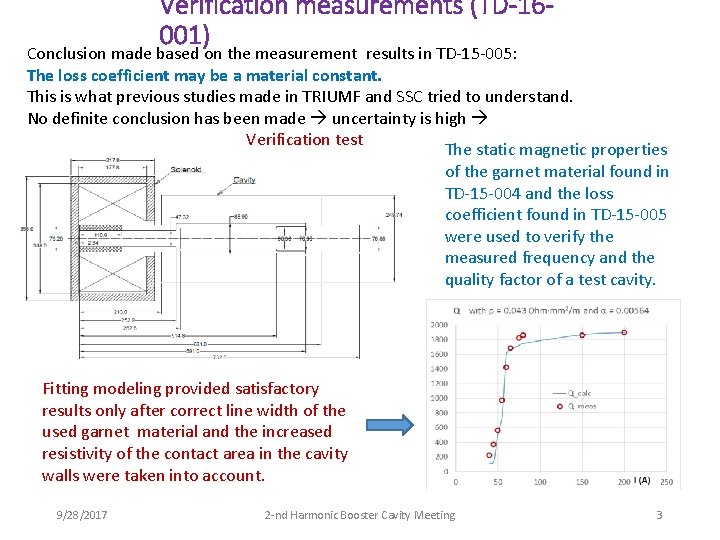
Verification measurements (TD-16001) Conclusion made based on the measurement results in TD-15 -005: The loss coefficient may be a material constant. This is what previous studies made in TRIUMF and SSC tried to understand. No definite conclusion has been made uncertainty is high Verification test The static magnetic properties of the garnet material found in TD-15 -004 and the loss coefficient found in TD-15 -005 were used to verify the measured frequency and the quality factor of a test cavity. Fitting modeling provided satisfactory results only after correct line width of the used garnet material and the increased resistivity of the contact area in the cavity walls were taken into account. 9/28/2017 2 -nd Harmonic Booster Cavity Meeting 3
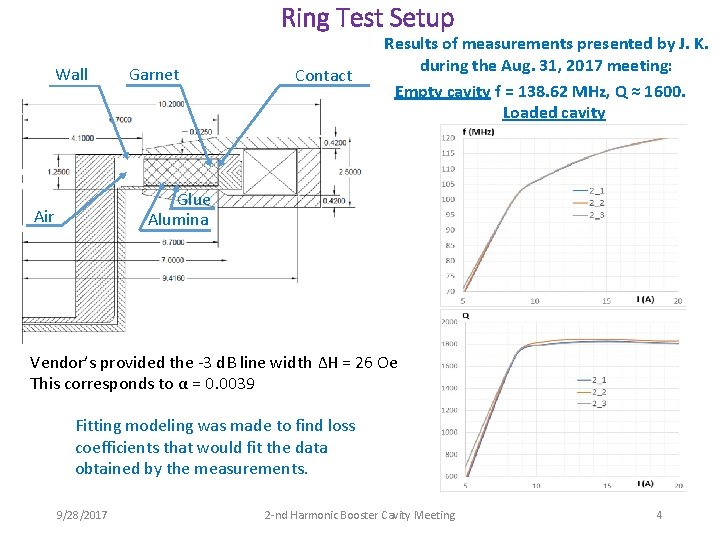
Ring Test Setup Wall Garnet Contact Results of measurements presented by J. K. during the Aug. 31, 2017 meeting: Empty cavity f = 138. 62 MHz, Q ≈ 1600. Loaded cavity Glue Alumina Air Vendor’s provided the -3 d. B line width ΔH = 26 Oe This corresponds to α = 0. 0039 Fitting modeling was made to find loss coefficients that would fit the data obtained by the measurements. 9/28/2017 2 -nd Harmonic Booster Cavity Meeting 4

Fitting results for the case when the resistive losses are mainly due to the imperfect contact Cavity walls: σ = 5 E 7 S/m; Contact area: σ = 7 E 5 S/m; Empty Cavity: F = 139. 67 MHz; Q = 1606 At each current level, the loss coefficient was found that results in the quality factor that fits the measurements Vendor’s provided the -3 d. B line width ΔH = 26 Oe This corresponds to α = 0. 0039 9/28/2017 2 -nd Harmonic Booster Cavity Meeting 5
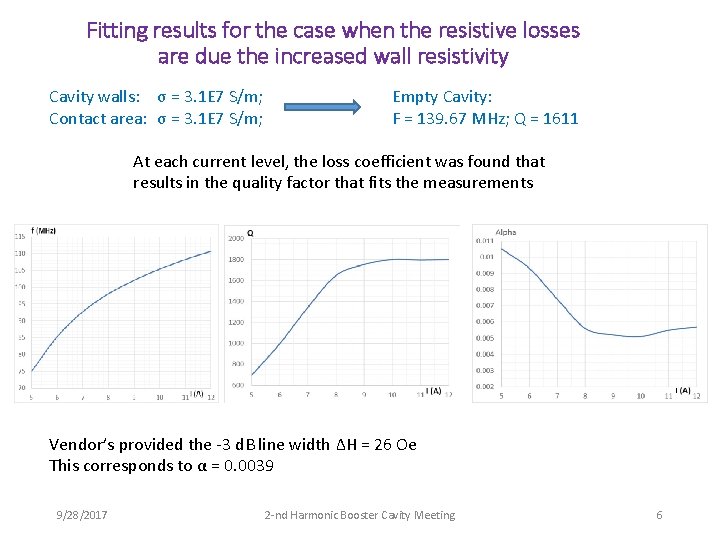
Fitting results for the case when the resistive losses are due the increased wall resistivity Cavity walls: σ = 3. 1 E 7 S/m; Contact area: σ = 3. 1 E 7 S/m; Empty Cavity: F = 139. 67 MHz; Q = 1611 At each current level, the loss coefficient was found that results in the quality factor that fits the measurements Vendor’s provided the -3 d. B line width ΔH = 26 Oe This corresponds to α = 0. 0039 9/28/2017 2 -nd Harmonic Booster Cavity Meeting 6
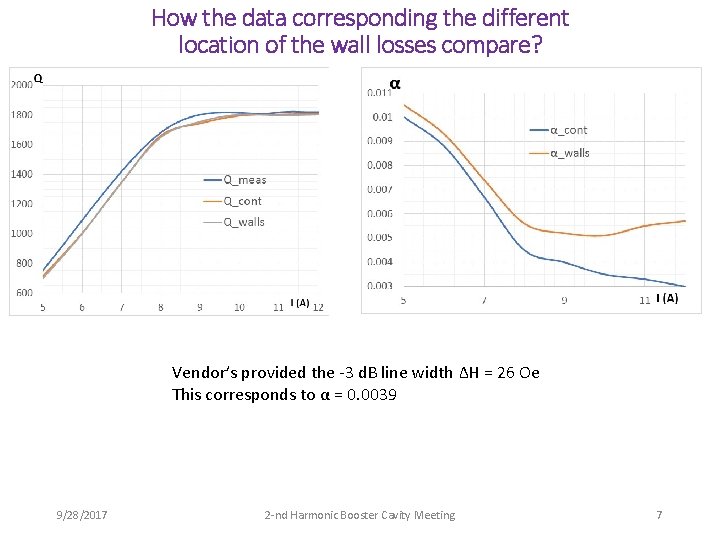
How the data corresponding the different location of the wall losses compare? Vendor’s provided the -3 d. B line width ΔH = 26 Oe This corresponds to α = 0. 0039 9/28/2017 2 -nd Harmonic Booster Cavity Meeting 7
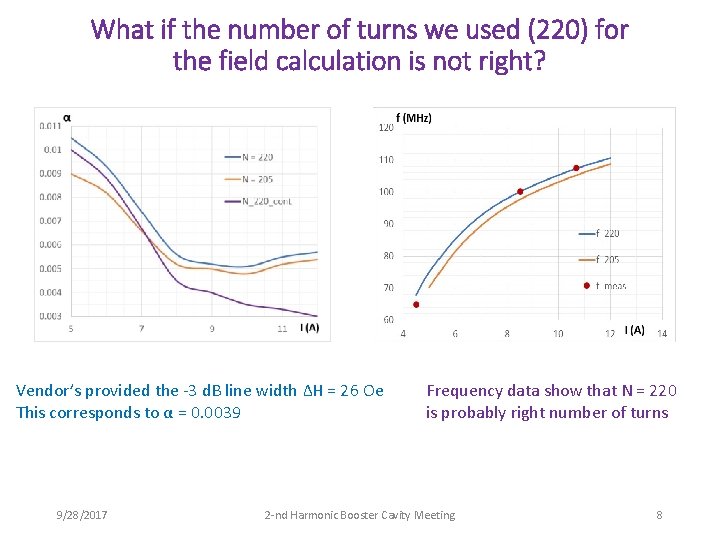
What if the number of turns we used (220) for the field calculation is not right? Vendor’s provided the -3 d. B line width ΔH = 26 Oe This corresponds to α = 0. 0039 9/28/2017 Frequency data show that N = 220 is probably right number of turns 2 -nd Harmonic Booster Cavity Meeting 8
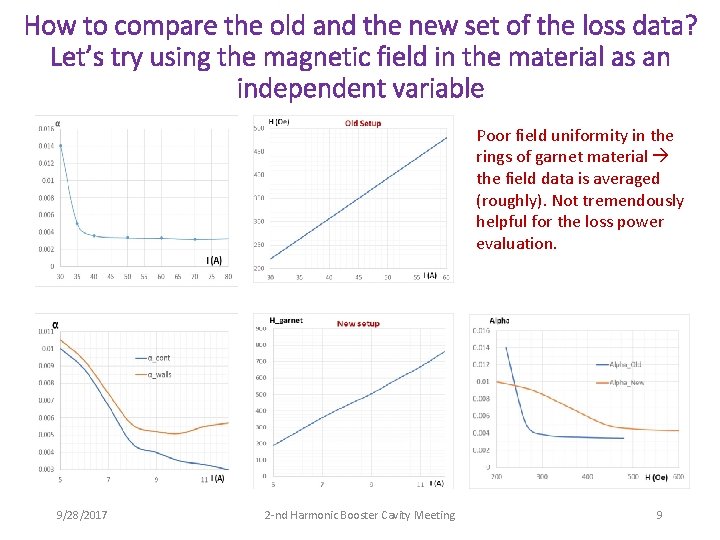
How to compare the old and the new set of the loss data? Let’s try using the magnetic field in the material as an independent variable Poor field uniformity in the rings of garnet material the field data is averaged (roughly). Not tremendously helpful for the loss power evaluation. 9/28/2017 2 -nd Harmonic Booster Cavity Meeting 9
Conclusion Still have little idea why the measurement data cannot be fitted by adjusting parameters of the model, like it was possible to make long time ago. Next (maybe not last) resort is to improve the test cavity. 9/28/2017 2 -nd Harmonic Booster Cavity Meeting 10
- Slides: 10