
Understanding Line From simple to complex What is
- Slides: 35
Understanding Line From simple to complex. . .
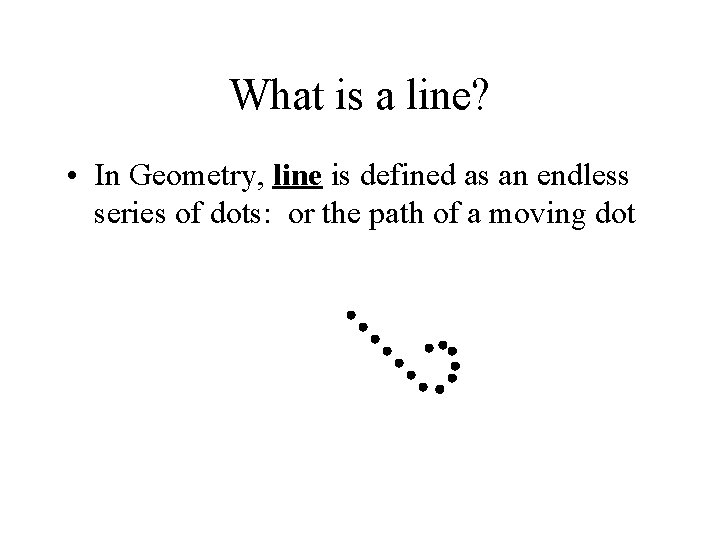
What is a line? • In Geometry, line is defined as an endless series of dots: or the path of a moving dot
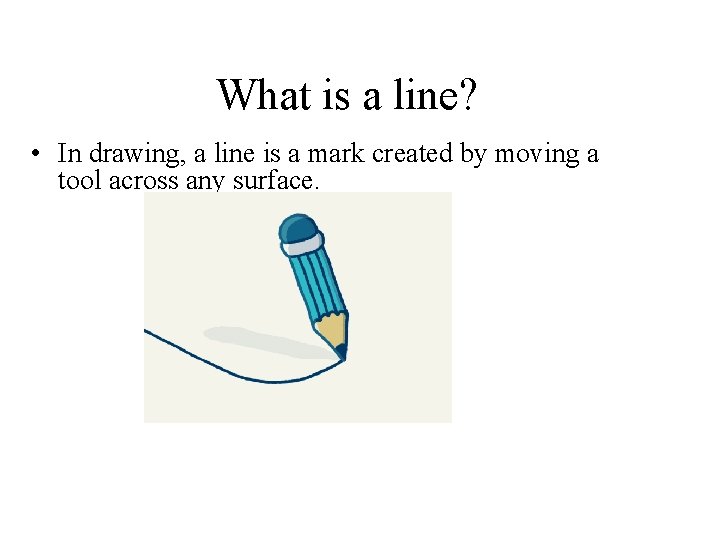
What is a line? • In drawing, a line is a mark created by moving a tool across any surface.
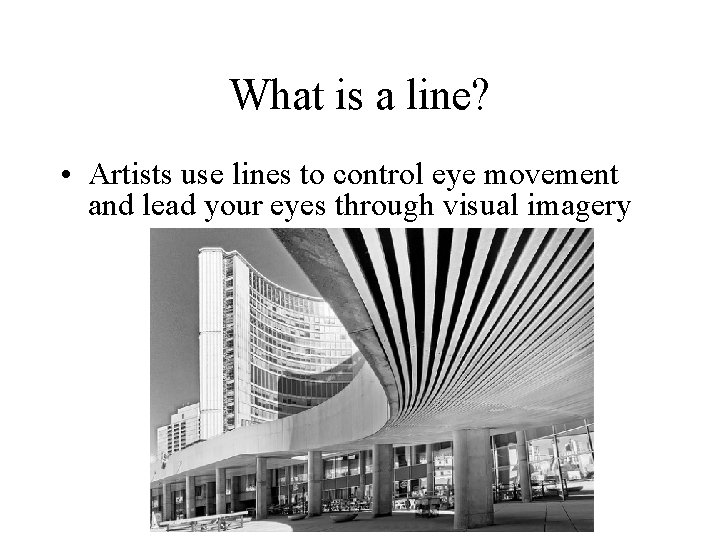
What is a line? • Artists use lines to control eye movement and lead your eyes through visual imagery
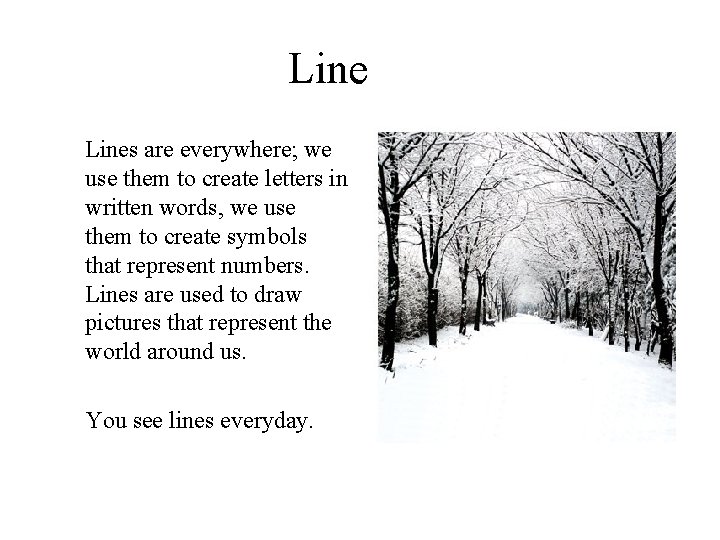
Lines are everywhere; we use them to create letters in written words, we use them to create symbols that represent numbers. Lines are used to draw pictures that represent the world around us. You see lines everyday.
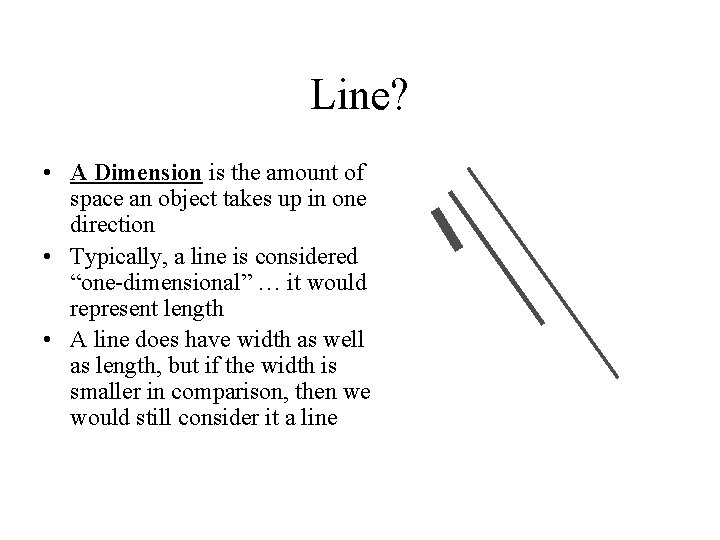
Line? • A Dimension is the amount of space an object takes up in one direction • Typically, a line is considered “one-dimensional” … it would represent length • A line does have width as well as length, but if the width is smaller in comparison, then we would still consider it a line
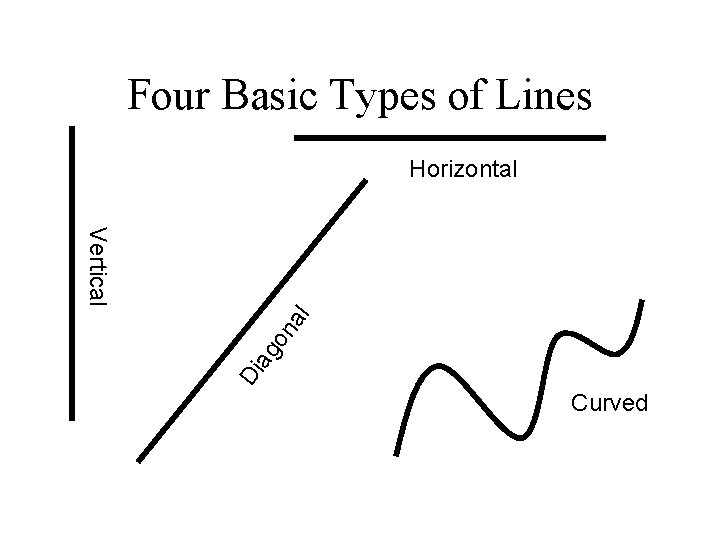
Four Basic Types of Lines Horizontal Di ag on al Vertical Curved
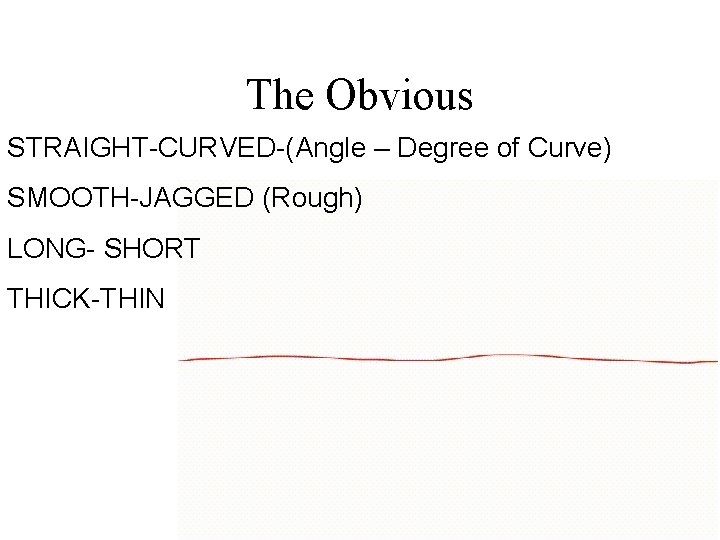
The Obvious STRAIGHT-CURVED-(Angle – Degree of Curve) SMOOTH-JAGGED (Rough) LONG- SHORT THICK-THIN
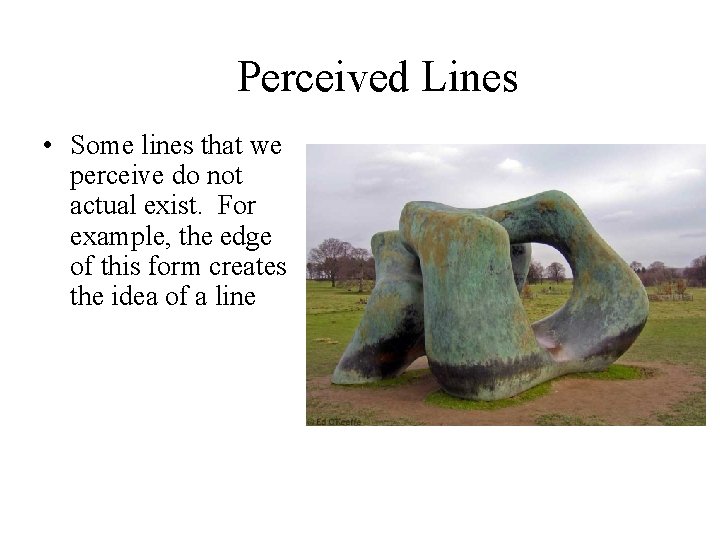
Perceived Lines • Some lines that we perceive do not actual exist. For example, the edge of this form creates the idea of a line
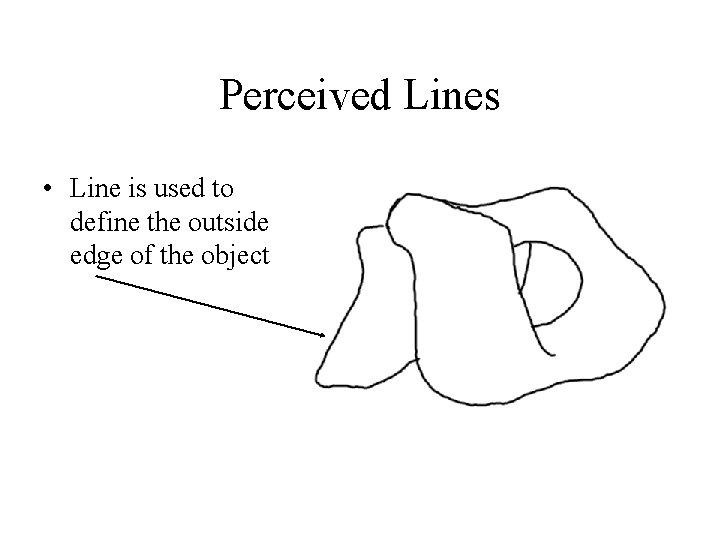
Perceived Lines • Line is used to define the outside edge of the object
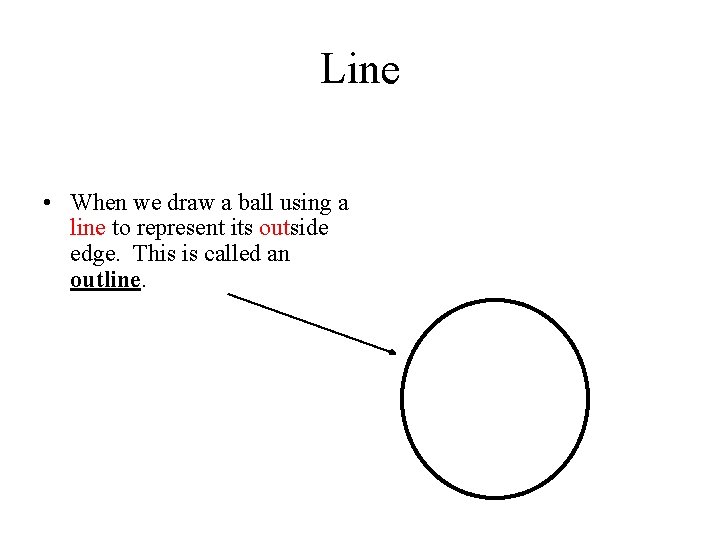
Line • When we draw a ball using a line to represent its outside edge. This is called an outline.
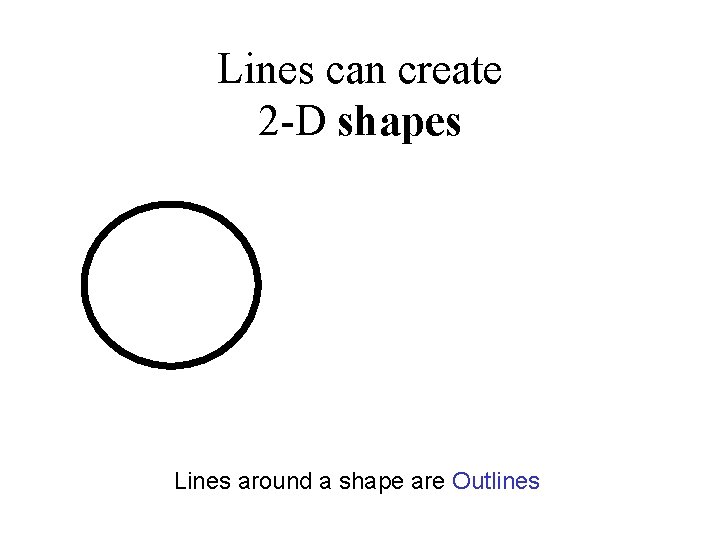
Lines can create 2 -D shapes Lines around a shape are Outlines
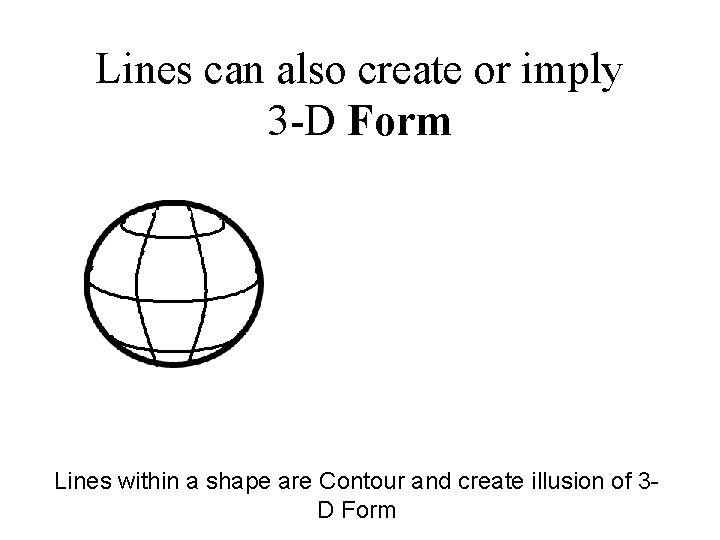
Lines can also create or imply 3 -D Form Lines within a shape are Contour and create illusion of 3 D Form
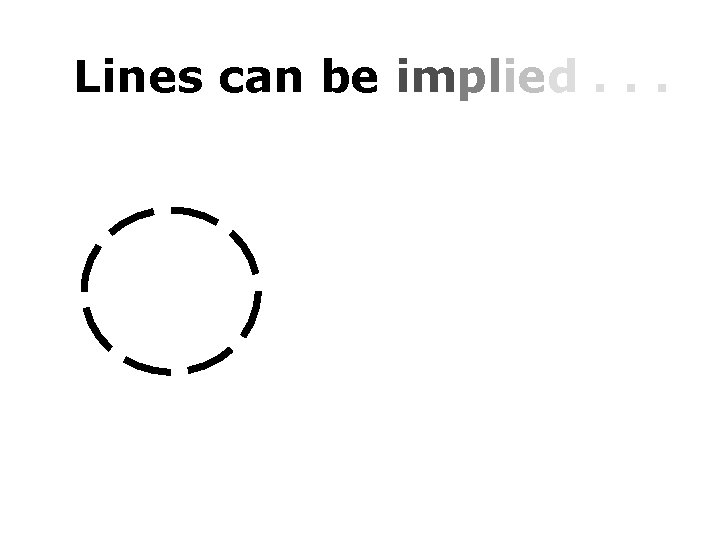
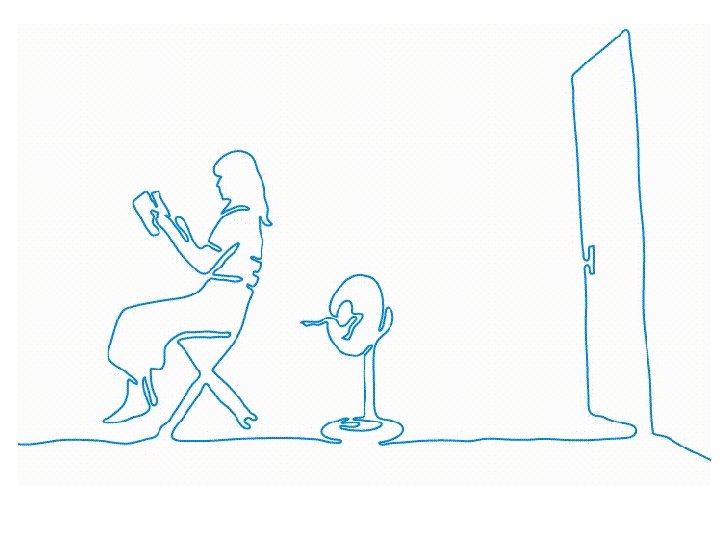
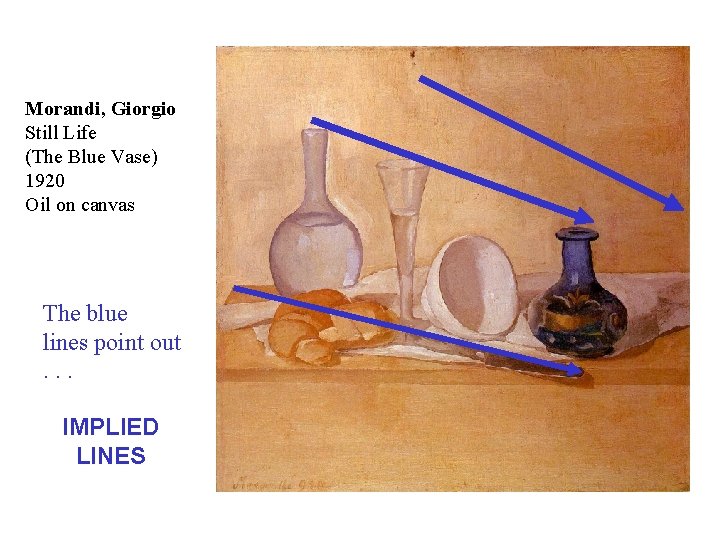
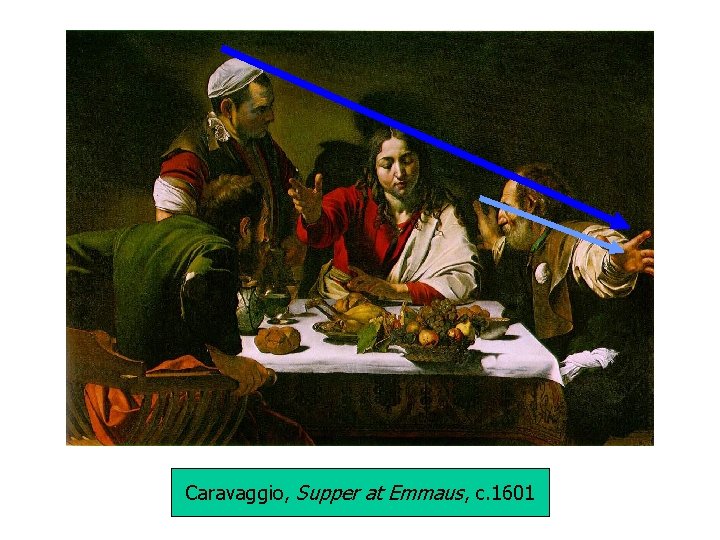
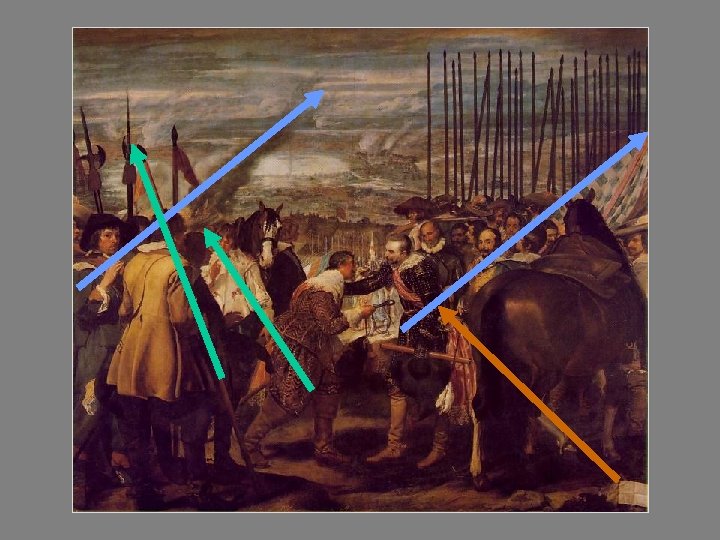
Lines can be implied. . .
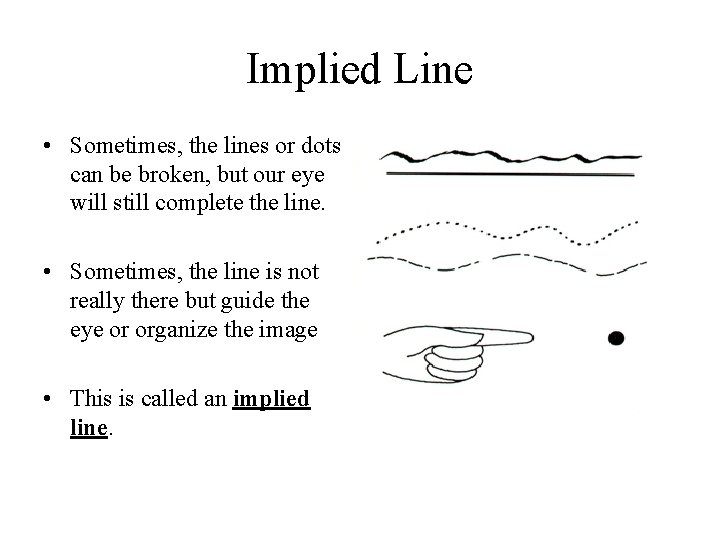
Implied Line • Sometimes, the lines or dots can be broken, but our eye will still complete the line. • Sometimes, the line is not really there but guide the eye or organize the image • This is called an implied line.
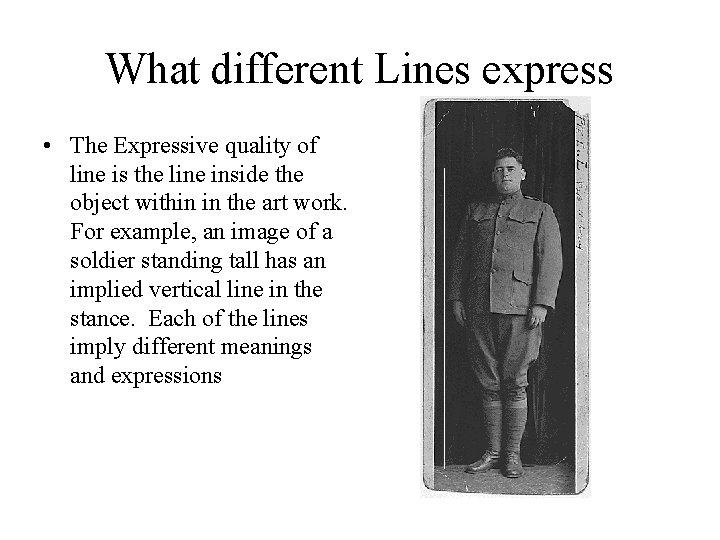
What different Lines express • The Expressive quality of line is the line inside the object within in the art work. For example, an image of a soldier standing tall has an implied vertical line in the stance. Each of the lines imply different meanings and expressions
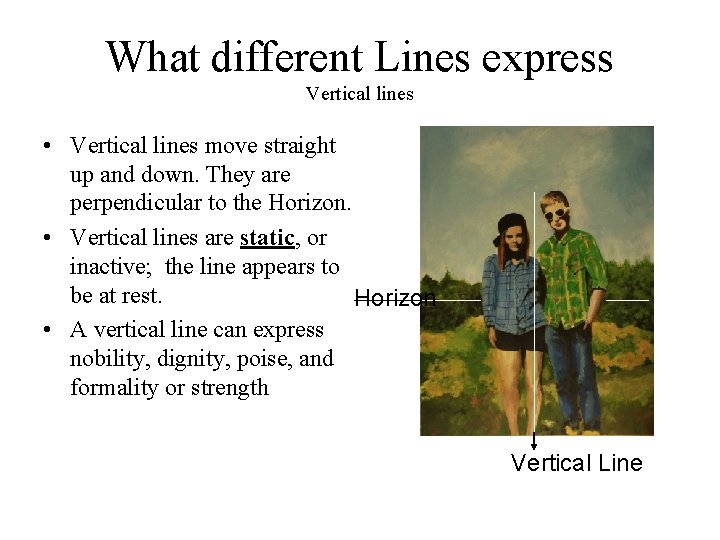
What different Lines express Vertical lines • Vertical lines move straight up and down. They are perpendicular to the Horizon. • Vertical lines are static, or inactive; the line appears to be at rest. Horizon • A vertical line can express nobility, dignity, poise, and formality or strength Vertical Line
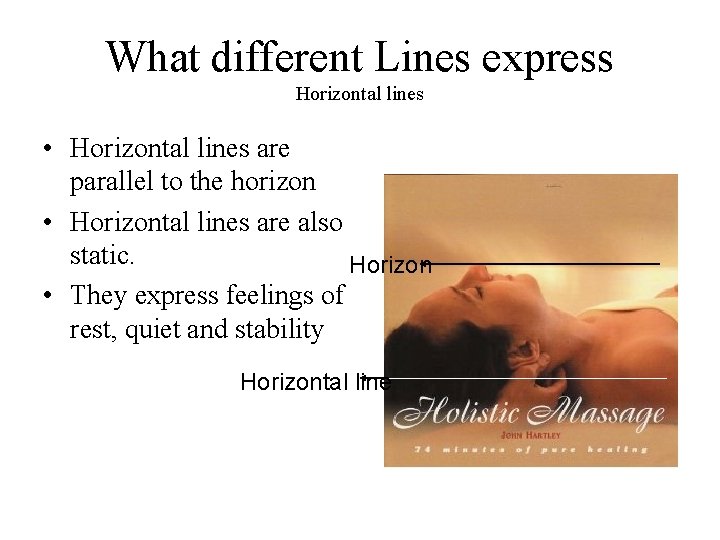
What different Lines express Horizontal lines • Horizontal lines are parallel to the horizon • Horizontal lines are also static. Horizon • They express feelings of rest, quiet and stability Horizontal line
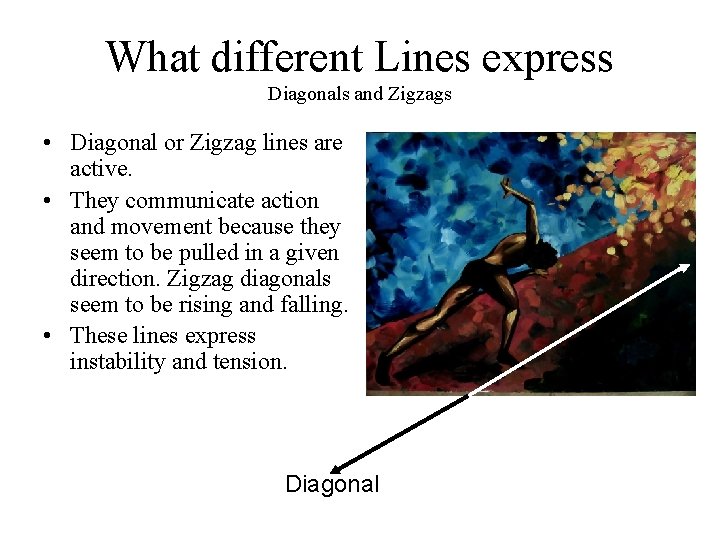
What different Lines express Diagonals and Zigzags • Diagonal or Zigzag lines are active. • They communicate action and movement because they seem to be pulled in a given direction. Zigzag diagonals seem to be rising and falling. • These lines express instability and tension. Diagonal
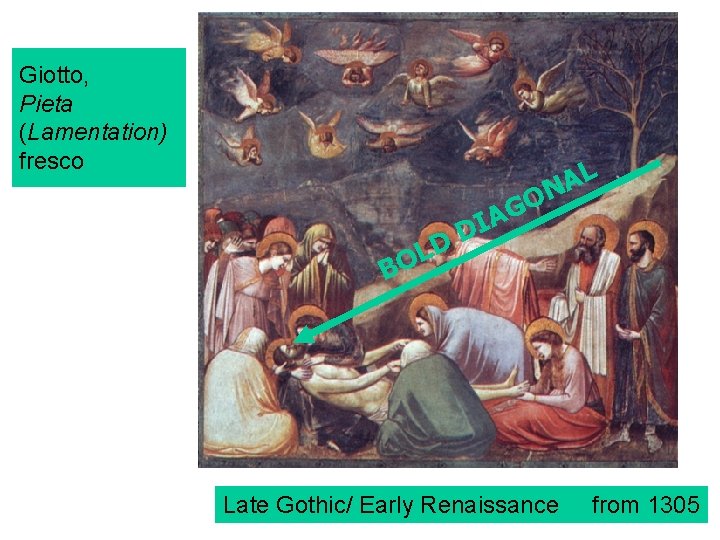
Giotto, Pieta (Lamentation) fresco L A N O G A I D D L O B Late Gothic/ Early Renaissance from 1305
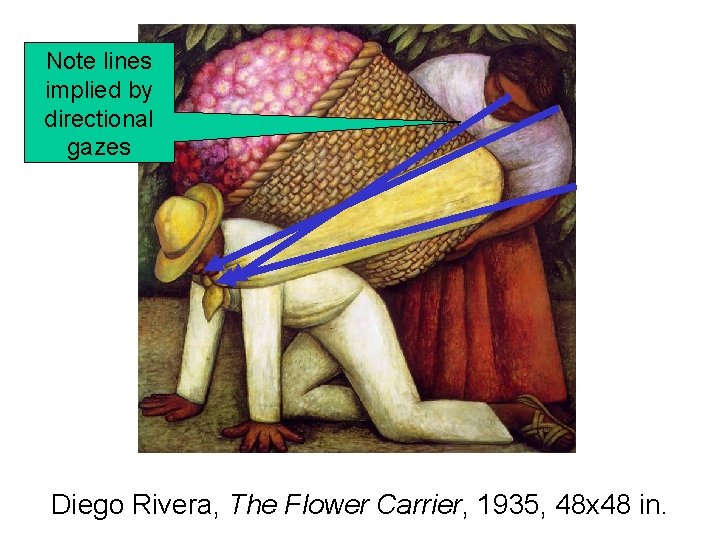
Note lines implied by directional gazes Diego Rivera, The Flower Carrier, 1935, 48 x 48 in.
Morandi, Giorgio Still Life (The Blue Vase) 1920 Oil on canvas The blue lines point out. . . IMPLIED LINES
Caravaggio, Supper at Emmaus, c. 1601
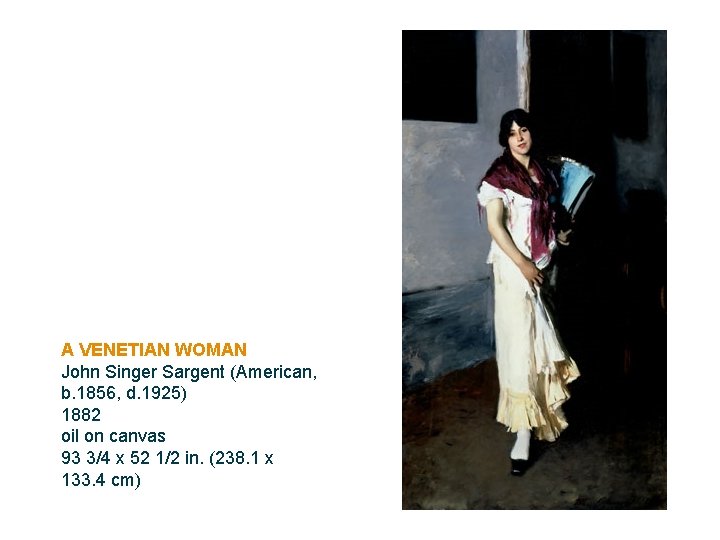
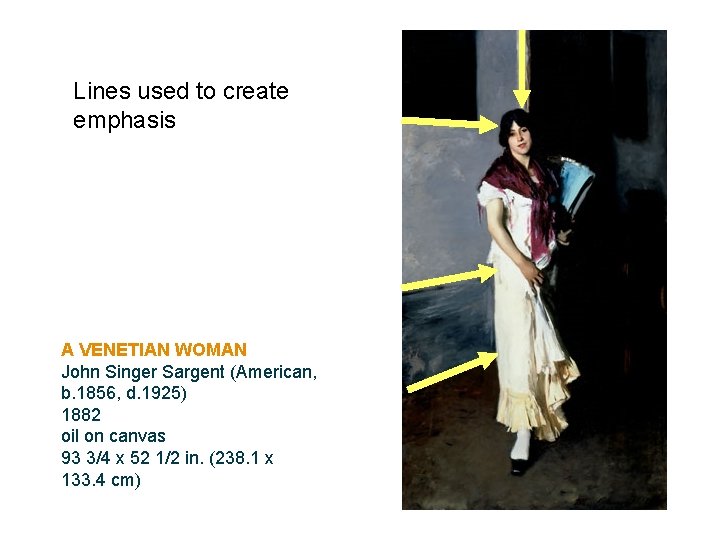
A VENETIAN WOMAN John Singer Sargent (American, b. 1856, d. 1925) 1882 oil on canvas 93 3/4 x 52 1/2 in. (238. 1 x 133. 4 cm)
Lines used to create emphasis A VENETIAN WOMAN John Singer Sargent (American, b. 1856, d. 1925) 1882 oil on canvas 93 3/4 x 52 1/2 in. (238. 1 x 133. 4 cm)
Lines can curve. . .
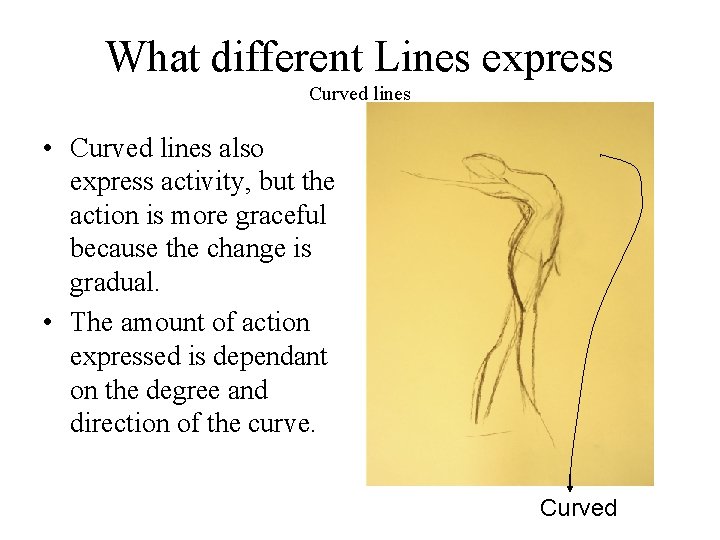
What different Lines express Curved lines • Curved lines also express activity, but the action is more graceful because the change is gradual. • The amount of action expressed is dependant on the degree and direction of the curve. Curved
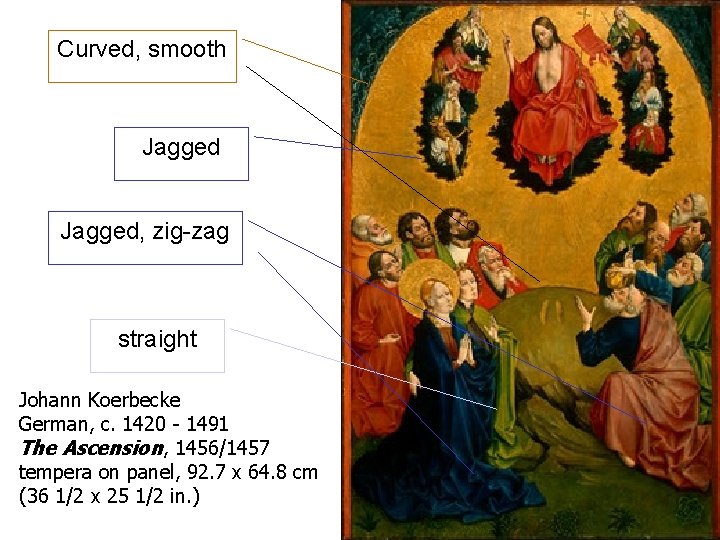
The Obvious Again STRAIGHT-CURVED-(Angle – Degree of Curve) SMOOTH-JAGGED (Rough) LONG- SHORT THICK-THIN
Curved, smooth Jagged, zig-zag straight Johann Koerbecke German, c. 1420 - 1491 The Ascension, 1456/1457 tempera on panel, 92. 7 x 64. 8 cm (36 1/2 x 25 1/2 in. )
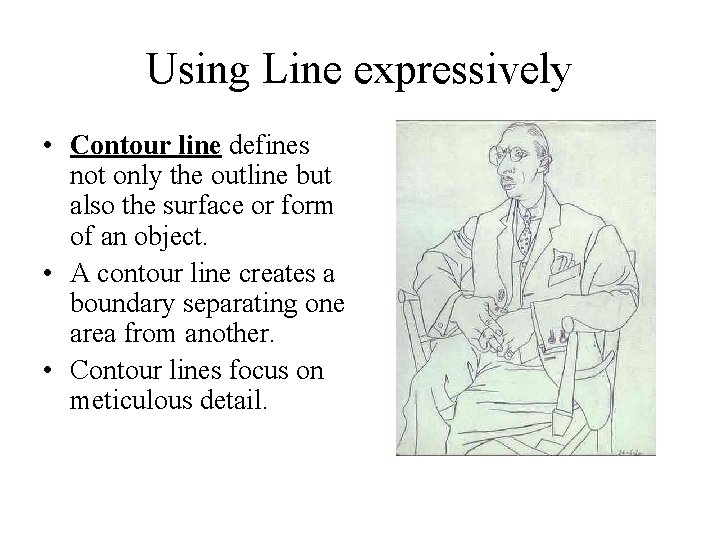
Using Line expressively • Contour line defines not only the outline but also the surface or form of an object. • A contour line creates a boundary separating one area from another. • Contour lines focus on meticulous detail.
LINE ON HANDOUT What is a line in Art? Line – a series of points; an area whose length is considerably greater than its width; an indication of direction, an apparent movement. A line is a point moved or moving through space. This applies to drawing, painting, printmaking, sculpture, clay/pottery, and architecture. Characteristics of lines: lines can be actual or implied; a line which defines an outside edge of an object is a Outline. A line which defines the surface of a form is a Contour Line. A directional line points or moves the eye in a particular direction. Horizontal: rest, quiet and stability. Vertical: nobility, dignity, poise, and formality or strength. Lines can be interpreted as having expressive qualities; particular qualities – thick or thin, weighty or straight, hard-edged or soft – can indicate moods or feelings.