
Understanding life science majors ideas about diffusion Samuel
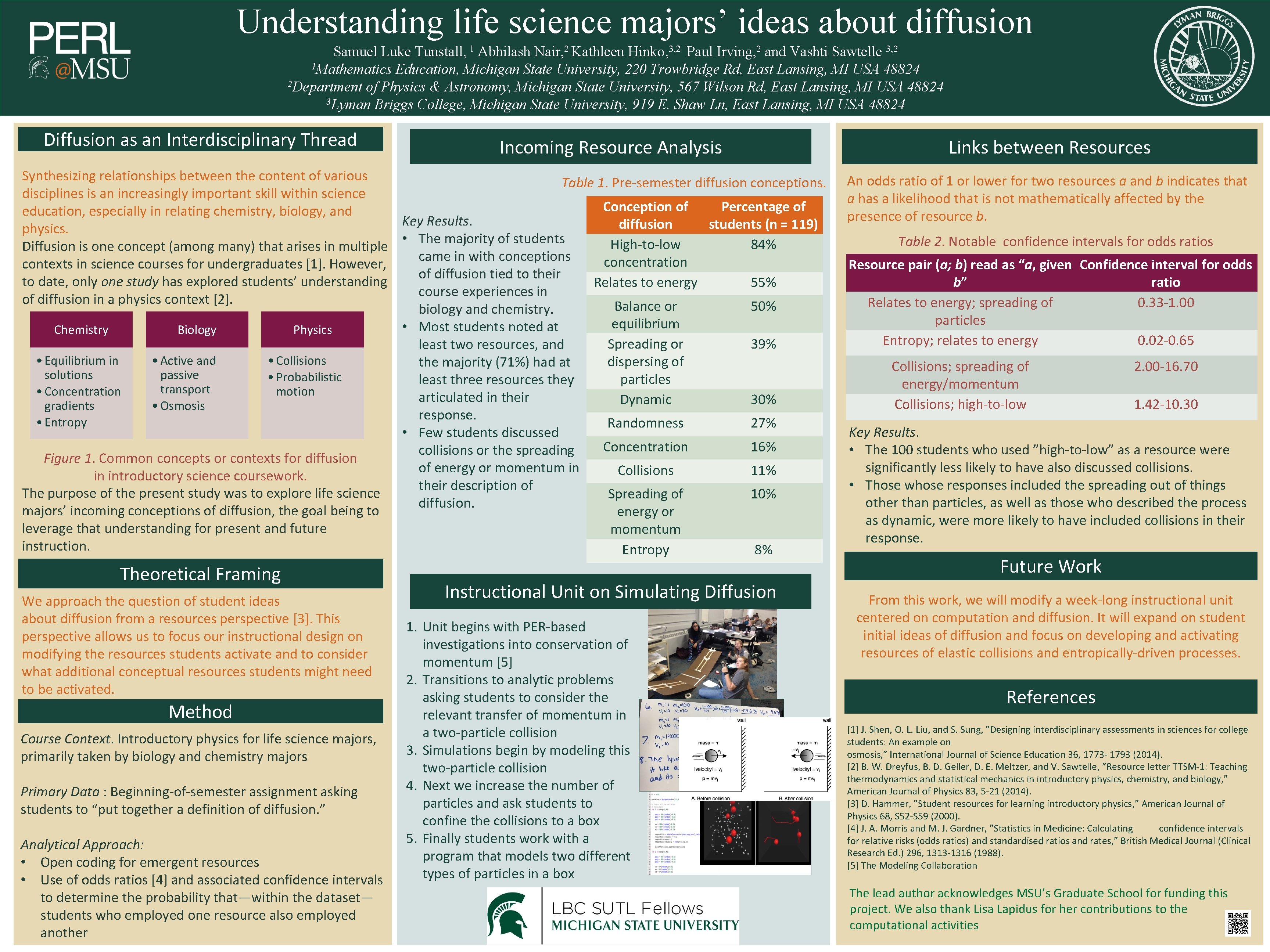
Understanding life science majors’ ideas about diffusion Samuel Luke Tunstall, 1 Abhilash Nair, 2 Kathleen Hinko, 3, 2 Paul Irving, 2 and Vashti Sawtelle 3, 2 1 Mathematics Education, Michigan State University, 220 Trowbridge Rd, East Lansing, MI USA 48824 2 Department of Physics & Astronomy, Michigan State University, 567 Wilson Rd, East Lansing, MI USA 48824 3 Lyman Briggs College, Michigan State University, 919 E. Shaw Ln, East Lansing, MI USA 48824 Diffusion as an Interdisciplinary Thread Incoming Resource Analysis Synthesizing relationships between the content of various Table 1. Pre-semester diffusion conceptions. disciplines is an increasingly important skill within science Conception of Percentage of education, especially in relating chemistry, biology, and Key Results. diffusion students (n = 119) physics. • The majority of students High-to-low 84% Diffusion is one concept (among many) that arises in multiple came in with conceptions concentration contexts in science courses for undergraduates [1]. However, of diffusion tied to their to date, only one study has explored students’ understanding Relates to energy 55% course experiences in of diffusion in a physics context [2]. Balance or 50% biology and chemistry. equilibrium • Most students noted at Chemistry Biology Physics Spreading or 39% least two resources, and • Equilibrium in • Active and • Collisions dispersing of the majority (71%) had at solutions passive • Probabilistic particles least three resources they transport • Concentration motion articulated in their Dynamic 30% • Osmosis gradients response. • Entropy Randomness 27% • Few students discussed Concentration 16% collisions or the spreading Figure 1. Common concepts or contexts for diffusion of energy or momentum in Collisions 11% in introductory science coursework. their description of The purpose of the present study was to explore life science Spreading of 10% diffusion. majors’ incoming conceptions of diffusion, the goal being to energy or leverage that understanding for present and future momentum instruction. Entropy 8% Theoretical Framing We approach the question of student ideas about diffusion from a resources perspective [3]. This perspective allows us to focus our instructional design on modifying the resources students activate and to consider what additional conceptual resources students might need to be activated. Method Course Context. Introductory physics for life science majors, primarily taken by biology and chemistry majors Primary Data : Beginning-of-semester assignment asking students to “put together a definition of diffusion. ” Analytical Approach: • Open coding for emergent resources • Use of odds ratios [4] and associated confidence intervals to determine the probability that—within the dataset— students who employed one resource also employed another Instructional Unit on Simulating Diffusion 1. Unit begins with PER-based investigations into conservation of momentum [5] 2. Transitions to analytic problems asking students to consider the relevant transfer of momentum in a two-particle collision 3. Simulations begin by modeling this two-particle collision 4. Next we increase the number of particles and ask students to confine the collisions to a box 5. Finally students work with a program that models two different types of particles in a box Links between Resources An odds ratio of 1 or lower for two resources a and b indicates that a has a likelihood that is not mathematically affected by the presence of resource b. Table 2. Notable confidence intervals for odds ratios Resource pair (a; b) read as “a, given Confidence interval for odds b” ratio Relates to energy; spreading of 0. 33 -1. 00 particles Entropy; relates to energy 0. 02 -0. 65 Collisions; spreading of energy/momentum Collisions; high-to-low 2. 00 -16. 70 1. 42 -10. 30 Key Results. • The 100 students who used ”high-to-low” as a resource were significantly less likely to have also discussed collisions. • Those whose responses included the spreading out of things other than particles, as well as those who described the process as dynamic, were more likely to have included collisions in their response. Future Work From this work, we will modify a week-long instructional unit centered on computation and diffusion. It will expand on student initial ideas of diffusion and focus on developing and activating resources of elastic collisions and entropically-driven processes. References [1] J. Shen, O. L. Liu, and S. Sung, ”Designing interdisciplinary assessments in sciences for college students: An example on osmosis, ” International Journal of Science Education 36, 1773 - 1793 (2014). [2] B. W. Dreyfus, B. D. Geller, D. E. Meltzer, and V. Sawtelle, ”Resource letter TTSM-1: Teaching thermodynamics and statistical mechanics in introductory physics, chemistry, and biology, ” American Journal of Physics 83, 5 -21 (2014). [3] D. Hammer, ”Student resources for learning introductory physics, ” American Journal of Physics 68, S 52 -S 59 (2000). [4] J. A. Morris and M. J. Gardner, ”Statistics in Medicine: Calculating confidence intervals for relative risks (odds ratios) and standardised ratios and rates, ” British Medical Journal (Clinical Research Ed. ) 296, 1313 -1316 (1988). [5] The Modeling Collaboration The lead author acknowledges MSU’s Graduate School for funding this project. We also thank Lisa Lapidus for her contributions to the computational activities
- Slides: 1