
Understanding Intracardiac Shunts Denise Joffe MD Objectives To
Understanding Intracardiac Shunts Denise Joffe, MD
Objectives • To explain intracardiac shunting using illustrations • To describe the hemodynamic and physiologic consequences of intracardiac shunting
Outline • Describe simple (unidirectional) shunts • Describe complex (bidirectional) shunts • Describe the pathological consequences of shunting • Describe how anesthetic management is effected by intracardiac shunts • Case presentations
Qp/Qs • Differs from Qs/Qt (intrapulmonary shunt) • Is a result of abnormal intracardiac communications (see below for exception) • What’s yours?
In order to understand intracardiac shunts you must understand Qp/Qs (ratio of pulmonary to systemic blood flow)…
Understanding Simple Intracardiac Shunts • Lesions with isolated L →R or R →L shunts • Eg. atrial septal defect (ASD), ventricular septal defect (VSD), atrioventricular canal (AVC), PDA (patent ductus arteriosus) tetralogy of Fallot (TOF)
In the following diagrams the arrows represents blood flow. � represents deoxygenated systemic venous blood flow (normal saturation about 65 -75%) � represents oxygenated pulmonary venous blood flow (normal saturation about 97 -100%) � represents an admixture of deoxygenated and oxygenated blood flow (saturation approx between 80 -95%) � The size of the arrow represents the relative amount of flow in (Liters/min)
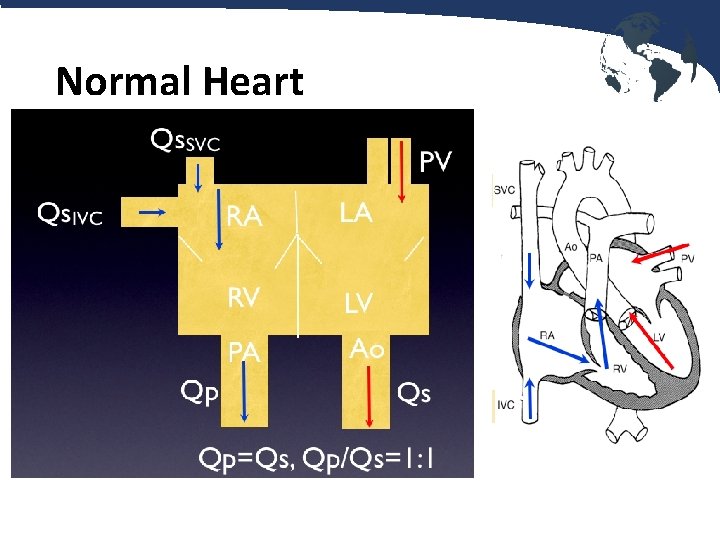
Normal Heart
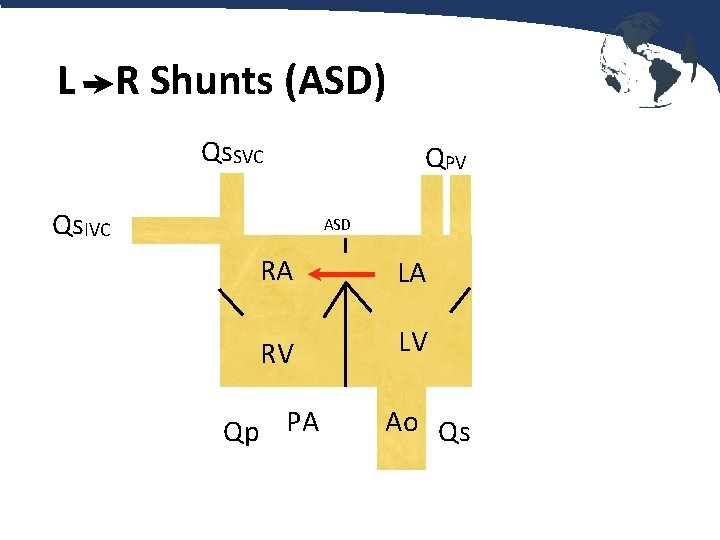
L R Shunts (ASD) Qs. SVC Qs. IVC QPV ASD RA LA RV LV Qp PA Ao Qs
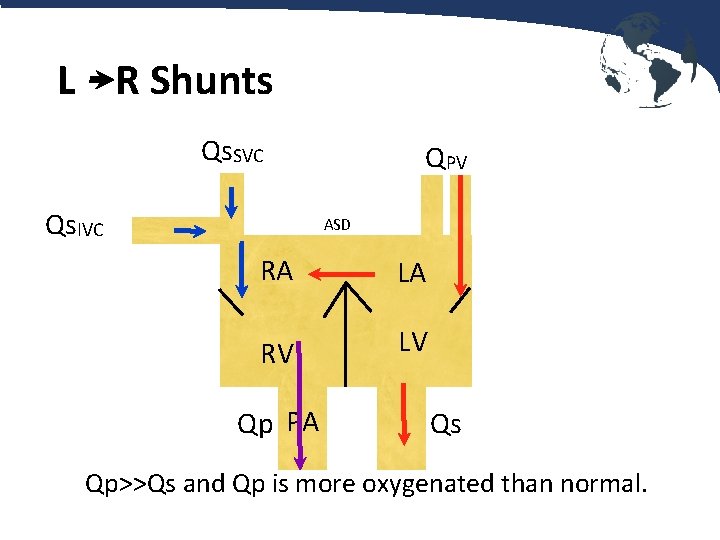
L R Shunts Qs. SVC Qs. IVC QPV ASD RA LA RV LV Qp PA Qs Qp>>Qs and Qp is more oxygenated than normal.

Effective pulmonary blood flow (PBF), recirculated PBF and total PBF Qs. SVC Q PV Qs. IVC Effective PBF = systemic (blue) blood that goes to the lungs (a) Recirculated PBF= PV (red) blood that goes back to the lungs i. e. L -> R shunt (b) RA RV b LA a+b PA Ao Qp Qs Qp>>>Qs Qp total=PBFeffective+PBFrecirc OR Qp total=PBFeffective+L -> R shunt
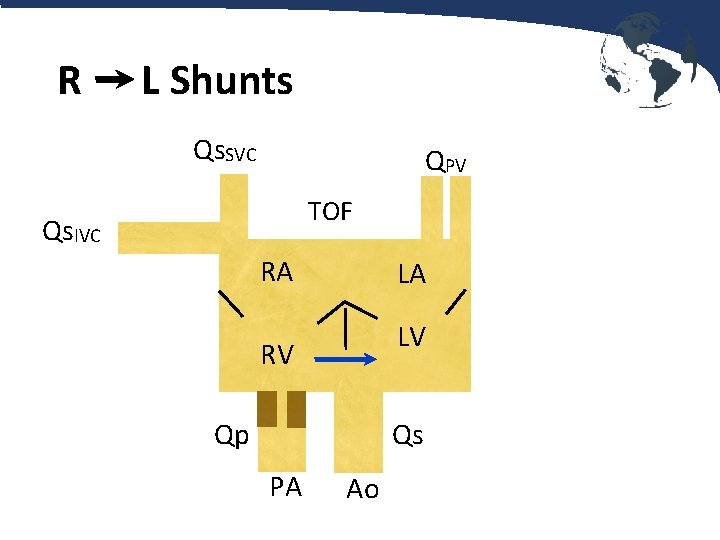
R L Shunts Qs. SVC QPV TOF Qs. IVC RA LA LV RV Qp Qs PA Ao
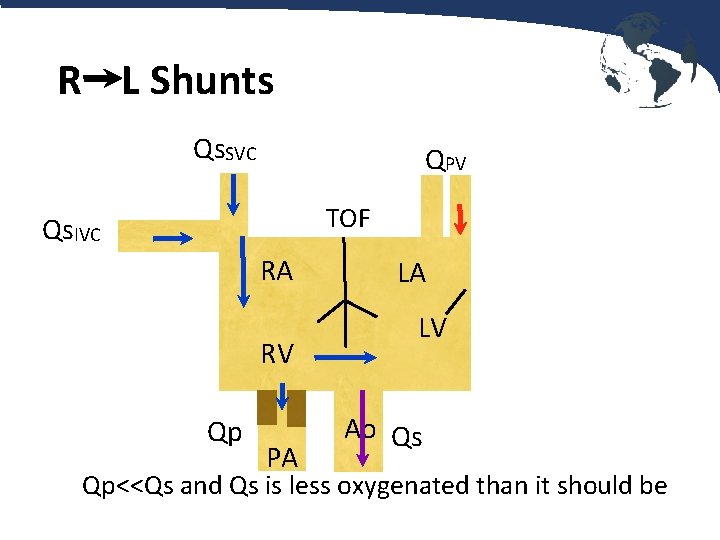
R L Shunts Qs. SVC QPV TOF Qs. IVC RA RV Qp PA LA LV Ao Qs Qp<<Qs and Qs is less oxygenated than it should be
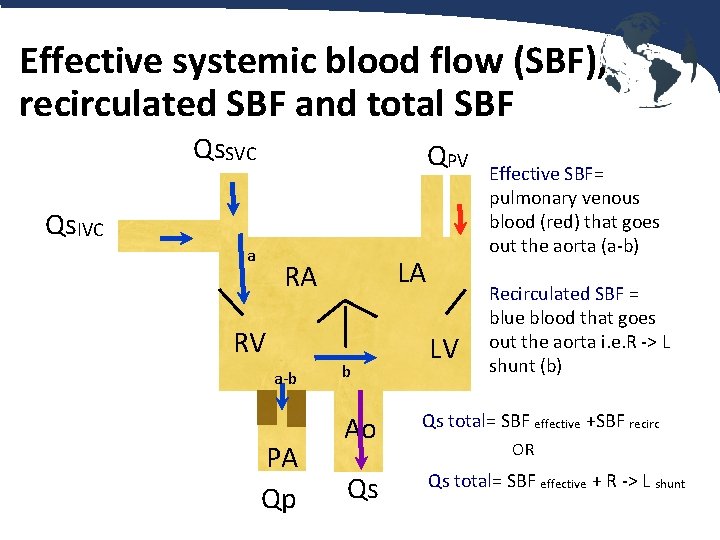
Effective systemic blood flow (SBF), recirculated SBF and total SBF Qs. SVC QPV Qs. IVC a LA RA RV a-b PA Qp b LV Effective SBF= pulmonary venous blood (red) that goes out the aorta (a-b) Recirculated SBF = blue blood that goes out the aorta i. e. R -> L shunt (b) Ao Qs total= SBF effective +SBF recirc Qs Qs total= SBF effective + R -> L shunt OR
Understanding Complex (Bidirectional) Intracardiac Shunts • Due to “crossover” of flow, Sa. O 2 is lower than expected and Spa. O 2 is higher than expected. • Eg. transposition of the great arteries (TGA), single ventricle, total anomalous pulmonary venous drainage (TAPVD), truncus arteriosus
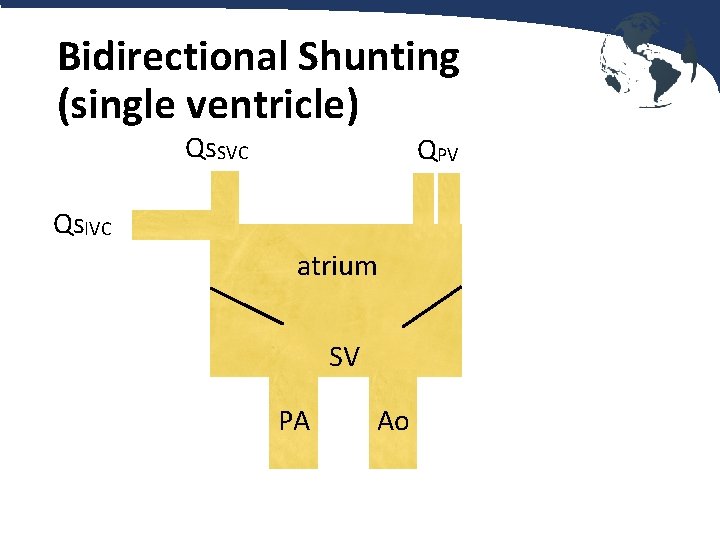
Bidirectional Shunting (single ventricle) Qs. SVC QPV Qs. IVC atrium SV PA Ao
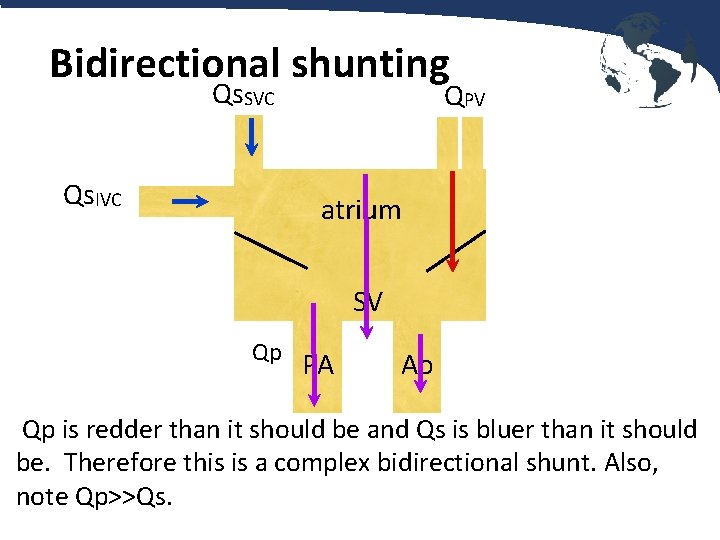
Bidirectional shunting Qs. SVC Qs. IVC QPV atrium SV Qp PA Ao Qp is redder than it should be and Qs is bluer than it should be. Therefore this is a complex bidirectional shunt. Also, note Qp>>Qs.
Consequences of Shunts Depending on the direction and amount of the shunt: • Pulmonary overcirculation resulting in CHF, pulmonary hypertension, pulmonary vascular disease • Ventricular volume overload and increased myocardial work which can lead to cardiogenic shock • Hypoxia
Anesthesia and Cardiac Shunting • Ventilation and acid/base management can alter PVR and increase or decrease PBF. • In the OR, Fi. O 2, p. H (via p. CO 2), and medication (narcotic, milrinone, nitric oxide) are used most frequently to alter PVR. • SVR can be altered with vasopressors/vasodilators. • It is crucial to de-air lines and be vigilant for emboli in the presence of any shunt.
Ready for some numbers? �Due to intracardiac shunts, systemic and pulmonary flows cannot be calculated with thermodilution techniques. �Systemic and pulmonary cardiac outputs are calculated with the Fick equation: Qs=VO 2/Ca. O 2 -Cv. O 2 Qp=VO 2/Cpv. O 2 -Cpa. O 2
�VO 2 is oxygen consumption. �Ca. O 2 is the oxygen content of arterial blood: Hg(gm) X 1. 36(ml. O 2/gm Hg) X arterial saturation+dissolved oxygen �Use the same formula to calculate mixed venous, pulmonary venous and pulmonary artery oxygen contents, by substituting their saturation value.
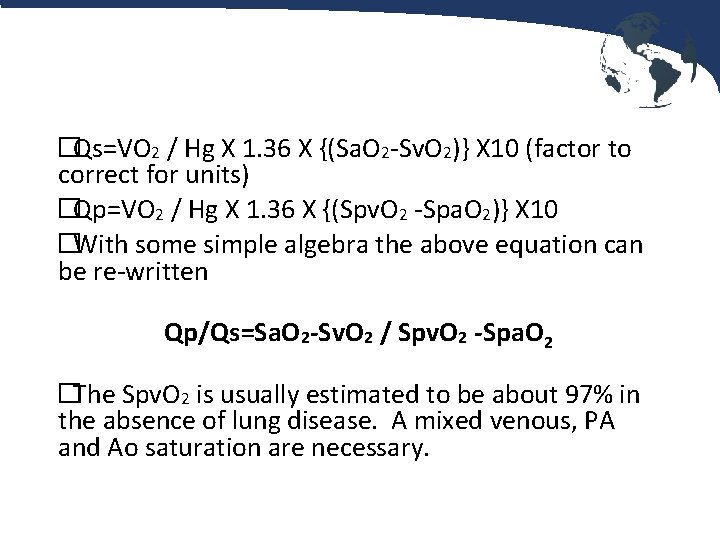
�Qs=VO 2 / Hg X 1. 36 X {(Sa. O 2 -Sv. O 2)} X 10 (factor to correct for units) �Qp=VO 2 / Hg X 1. 36 X {(Spv. O 2 -Spa. O 2)} X 10 �With some simple algebra the above equation can be re-written Qp/Qs=Sa. O 2 -Sv. O 2 / Spv. O 2 -Spa. O 2 �The Spv. O 2 is usually estimated to be about 97% in the absence of lung disease. A mixed venous, PA and Ao saturation are necessary.
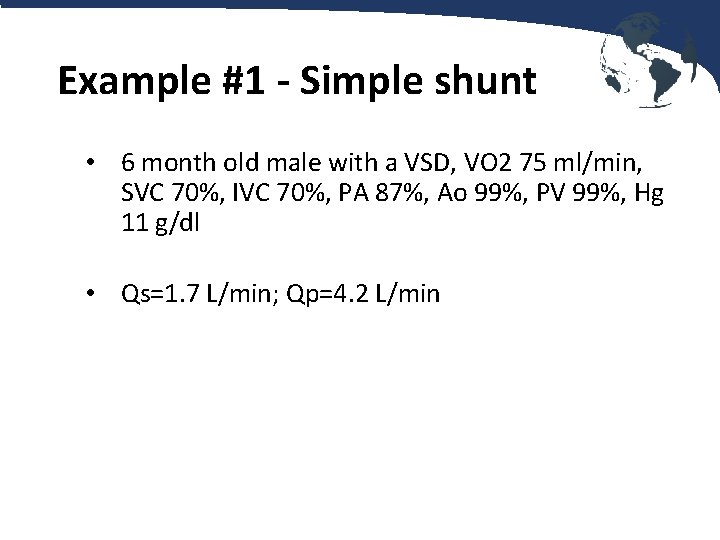
Example #1 - Simple shunt • 6 month old male with a VSD, VO 2 75 ml/min, SVC 70%, IVC 70%, PA 87%, Ao 99%, PV 99%, Hg 11 g/dl • Qs=1. 7 L/min; Qp=4. 2 L/min
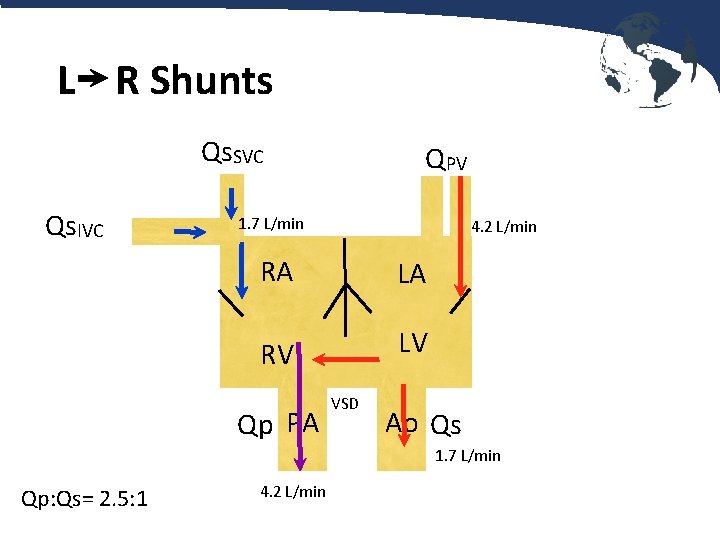
L R Shunts Qs. SVC Qs. IVC QPV 1. 7 L/min 4. 2 L/min RA LA RV LV Qp PA VSD Ao Qs 1. 7 L/min Qp: Qs= 2. 5: 1 4. 2 L/min
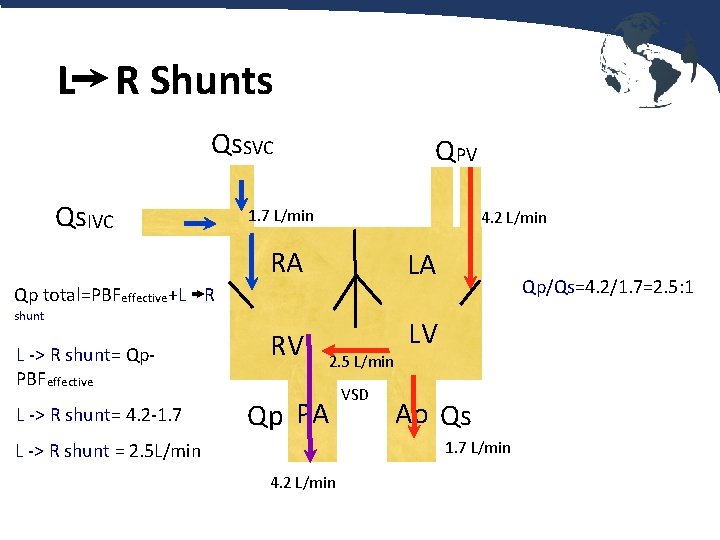
L R Shunts Qs. SVC Qs. IVC QPV 1. 7 L/min 4. 2 L/min RA LA RV LV Qp total=PBFeffective+L R shunt L -> R shunt= Qp. PBFeffective L -> R shunt= 4. 2 -1. 7 2. 5 L/min Qp PA VSD Qp/Qs=4. 2/1. 7=2. 5: 1 Ao Qs 1. 7 L/min L -> R shunt = 2. 5 L/min 4. 2 L/min
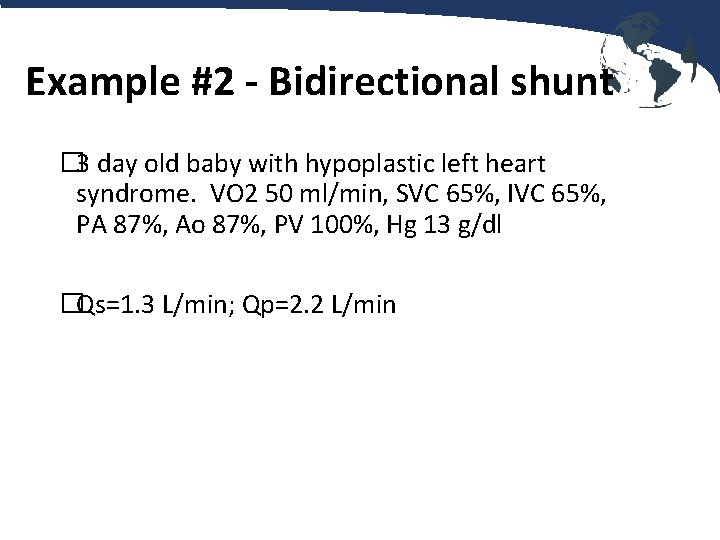
Example #2 - Bidirectional shunt � 3 day old baby with hypoplastic left heart syndrome. VO 2 50 ml/min, SVC 65%, IVC 65%, PA 87%, Ao 87%, PV 100%, Hg 13 g/dl �Qs=1. 3 L/min; Qp=2. 2 L/min

Bidirectional shunting - calculating effective PBF and R L shunt Qs. SVC QPV 1. 3 L/min Qs. IVC atrium Q QR QR QR = Qs-QPBF effective L =1. 3 -0. 8 L =0. 5 L/min L PBF effective 0. 8 L/min 2. 2 L/min SV PA Ao 1. 3 L/min A new equation is used to calculate effective PBF in patients with bidirectional shunting. Q PBF effective = VO 2/Cpv. O 2 -Cv. O 2
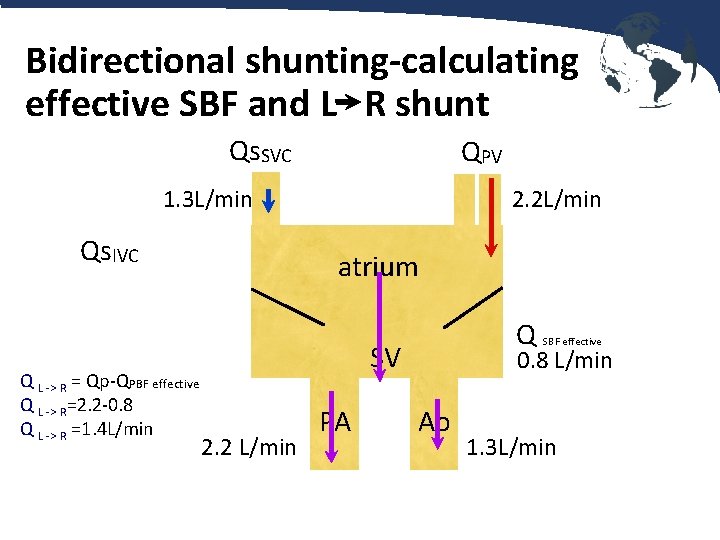
Bidirectional shunting-calculating effective SBF and L R shunt Qs. SVC QPV 1. 3 L/min Qs. IVC Q L -> R = Qp-QPBF effective Q L -> R=2. 2 -0. 8 Q L -> R =1. 4 L/min 2. 2 L/min atrium Q SV 2. 2 L/min PA SBF effective 0. 8 L/min Ao 1. 3 L/min

Bidirectional shunting Qs. SVC 1. 3 L/min QR QR QR Qs. IVC QPV = Qs-QPBF effective L =1. 3 -0. 8 L =0. 5 L/min L atrium Q 2. 2 L/min SV PA Q L -> R = Qp-QPBF effective Q L -> R=2. 2 -0. 8 Q L -> R =1. 4 L/min Q PBF effective 0. 8 L/min 2. 2 L/min SBF effective 0. 8 L/min Ao 1. 3 L/min Note that Q PBF effective always equals Q SBF effective. The SV has a cardiac output 3. 5 L/min (Qp+Qs) but only 1. 6 L/min is going to the correct place (effective blood flows)
Objectives • To explain intracardiac shunting using illustrations • To describe the hemodynamic and physiologic consequences of intracardiac shunting
- Slides: 30