
Understanding Internet Protocol Module 4 Objectives SkillsConcepts Objective
Understanding Internet Protocol Module 4
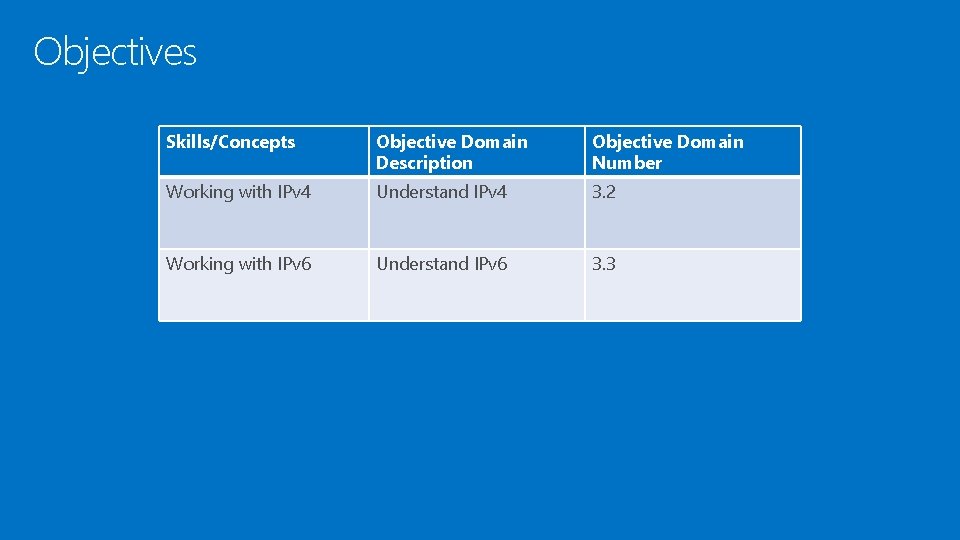
Objectives Skills/Concepts Objective Domain Description Objective Domain Number Working with IPv 4 Understand IPv 4 3. 2 Working with IPv 6 Understand IPv 6 3. 3
IPv 4 • Internet Protocol version 4 (IPv 4) is the fourth version of the Internet Protocol and the first version to be widely deployed • IPv 4 is a frequently used communications protocol and is one of the core protocols for the Internet • IP resides on the network layer of the OSI model
IP Addresses • IP addresses consist of four octets (8 -bits), each between 0 and 255. • Examples include: • • 12. 5. 24. 2 127. 0. 0. 1 192. 168. 3. 54 208. 32. 56. 232 • In order for an IP address to function, there must be a properly configured IP address and compatible subnet mask • To connect to the Internet (or any remote network), you will also need a gateway address and – optionally – a DNS server address
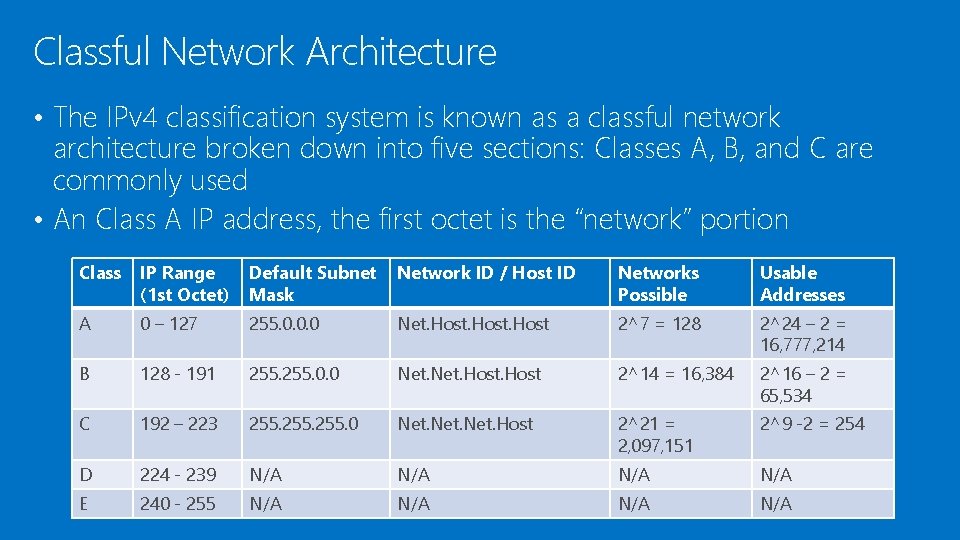
Classful Network Architecture • The IPv 4 classification system is known as a classful network architecture broken down into five sections: Classes A, B, and C are commonly used • An Class A IP address, the first octet is the “network” portion Class IP Range (1 st Octet) Default Subnet Mask Network ID / Host ID Networks Possible Usable Addresses A 0 – 127 255. 0. 0. 0 Net. Host 2^7 = 128 2^24 – 2 = 16, 777, 214 B 128 - 191 255. 0. 0 Net. Host 2^14 = 16, 384 2^16 – 2 = 65, 534 C 192 – 223 255. 0 Net. Host 2^21 = 2, 097, 151 2^9 -2 = 254 D 224 - 239 N/A N/A E 240 - 255 N/A N/A
Loopback Testing • The range for Class A is 0– 127 • The 127 network number isn’t used by hosts as a logical IP address Instead, this network is used for loopback IP addresses, allowing for testing
Usable Addresses • Usable addresses are always going to be two less than the mathematical amount. • The first and last addresses cannot be used • For network 172. 24. 3. X • The 0 (in binary) for the host address is the entire network • 172. 24. 3. 0 • The 1 s (in binary) for the host address is the broadcast address • 172. 24. 3. 255 • Class D and Class E are not used by regular hosts • Class D is used for what is known as multicasting—transmitting data to multiple computers (or routers) • Class E was reserved for future use, but this has given way to IPv 6 instead
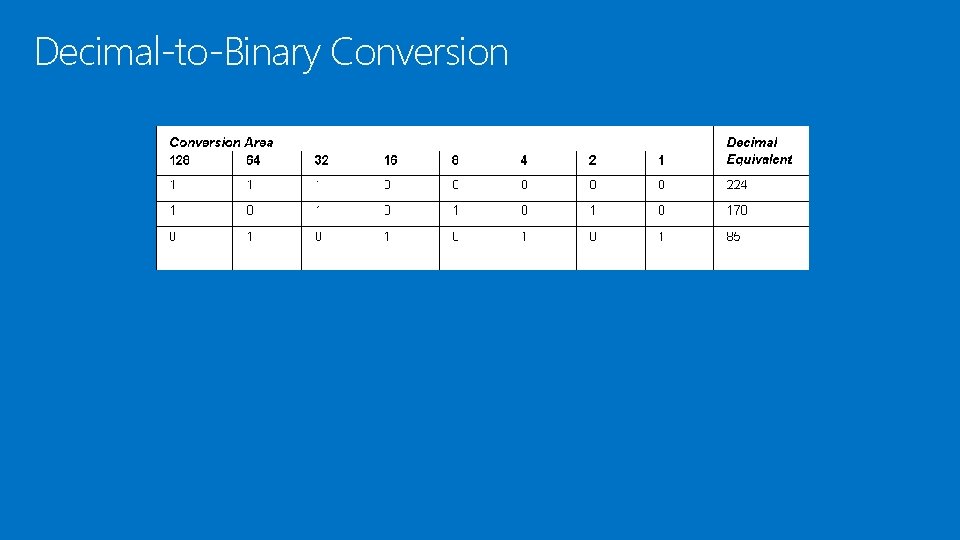
Decimal-to-Binary Conversion
DEMO: Using Calculator to convert base numbering systems
IP Conflict • IP conflicts occur when two devices have been assigned the same IP address • Windows Error: There is an IP address conflict with another system on the network • If there is an IP address conflict, the devices will have problems sending and receiving data
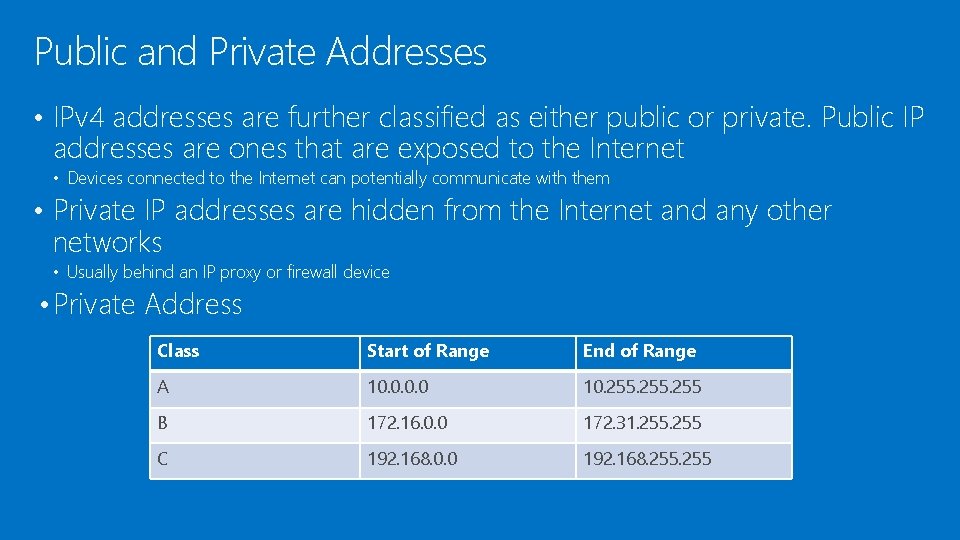
Public and Private Addresses • IPv 4 addresses are further classified as either public or private. Public IP addresses are ones that are exposed to the Internet • Devices connected to the Internet can potentially communicate with them • Private IP addresses are hidden from the Internet and any other networks • Usually behind an IP proxy or firewall device • Private Address Class Start of Range End of Range A 10. 0 10. 255 B 172. 16. 0. 0 172. 31. 255 C 192. 168. 0. 0 192. 168. 255
Static and Dynamic Addresses • Static IP address are addresses that are manually assigned to a host • Dynamic IP addresses are more common than static IP addresses, whereas they automatically obtain an IP address (and other IP information)
APIPA • APIPA is an acronym for Automatic Private IP Addressing • It uses a single Class B network number: 169. 254. 0. 0 • If a Windows client cannot get an IP address from a DHCP server and has not been configured statically, it will auto-assign a number on this network
Default Gateway and DNS Server • For a device to communicate on the Internet, a default gateway and DNS server must be assigned • Default gateway – Provides a default route for TCP/IP hosts to use when communicating with hosts on remote networks The first IP address of the device that a client computer will look for when attempting to gain access outside the local network • DNS Server – The server that provides name resolution of domain names to IP addresses
DEMO: IP Address Properties, Default Gateway and DNS Server
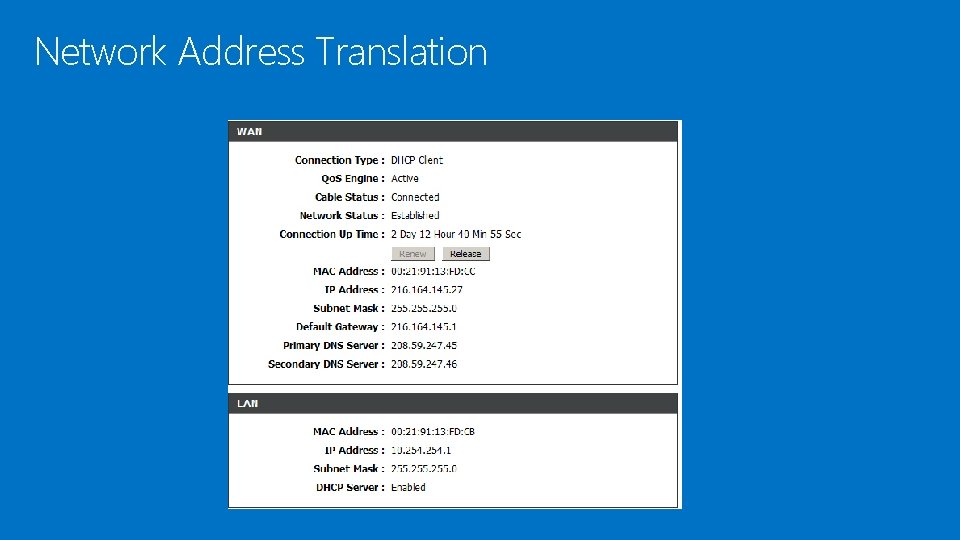
Network Address Translation • Network address translation (NAT) provides a method for translating IPv 4 addresses of devices on one network into IPv 4 addresses of devices on a different network • NAT was developed to provide a temporary solution to the IPv 4 address issue • Enables one address space (private) to be re-mapped to another address space, or perhaps re-mapped to a single public IP address
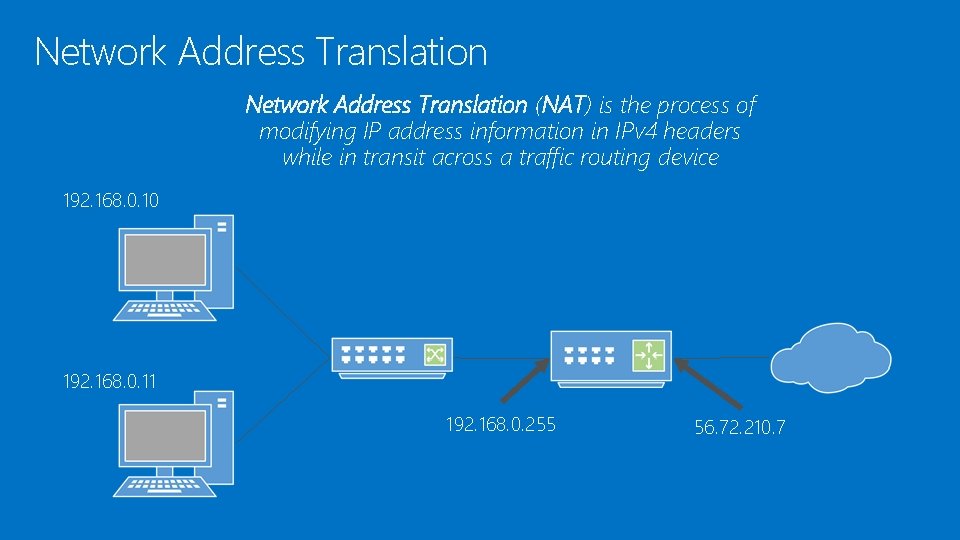
Network Address Translation (NAT) is the process of modifying IP address information in IPv 4 headers while in transit across a traffic routing device 192. 168. 0. 10 192. 168. 0. 11 192. 168. 0. 255 56. 72. 210. 7
Network Address Translation
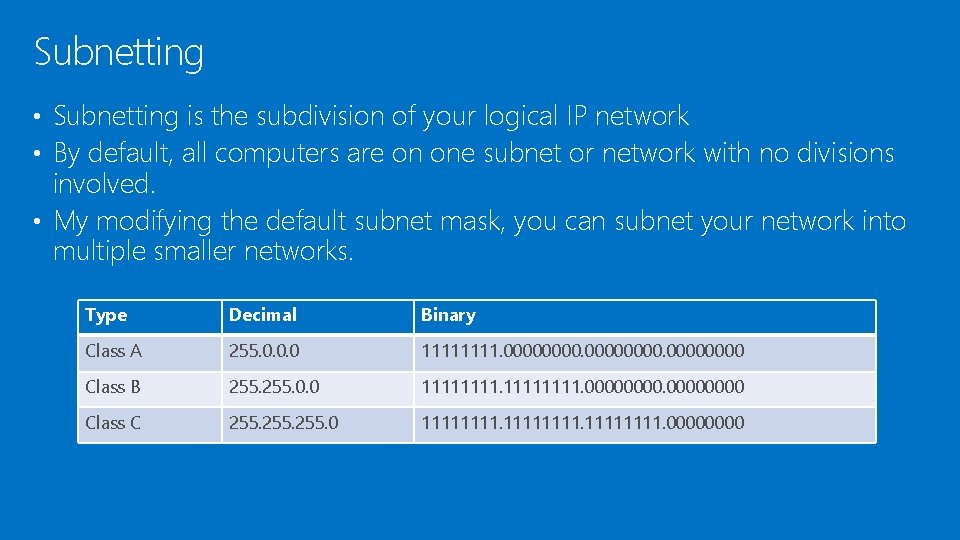
Subnetting • Subnetting is the subdivision of your logical IP network • By default, all computers are on one subnet or network with no divisions involved. • My modifying the default subnet mask, you can subnet your network into multiple smaller networks. Type Decimal Binary Class A 255. 0. 0. 0 1111. 00000000 Class B 255. 0. 0 11111111. 0000 Class C 255. 0 11111111. 0000
Subnet IDs
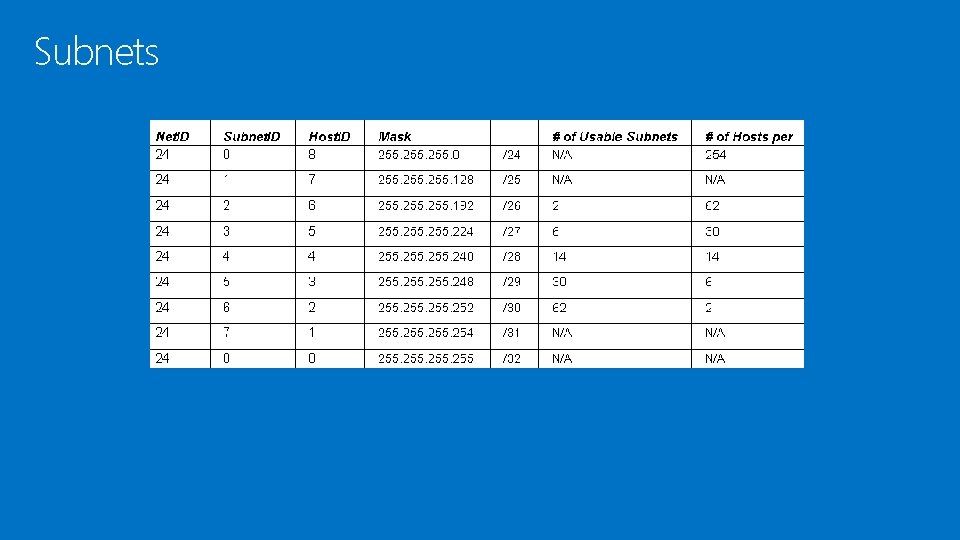
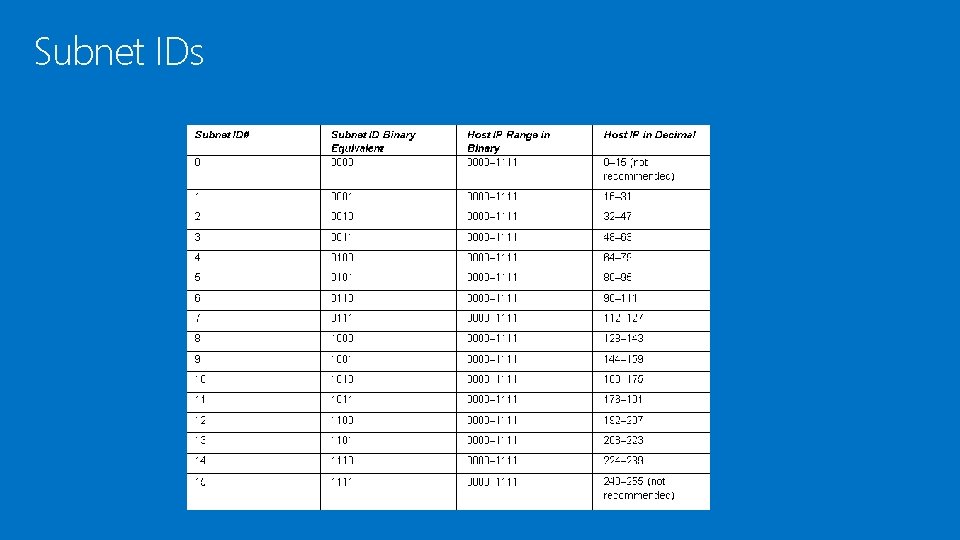
Subnets
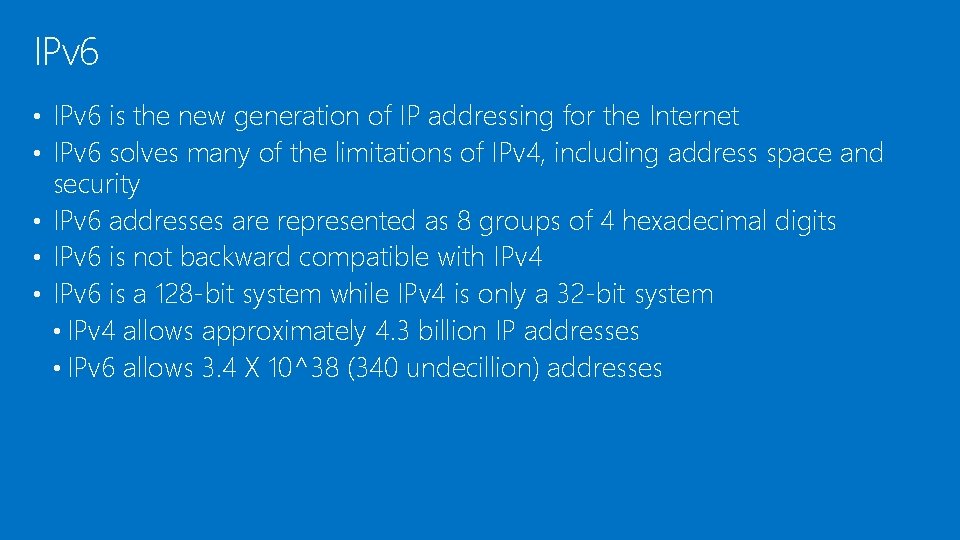
IPv 6 • IPv 6 is the new generation of IP addressing for the Internet • IPv 6 solves many of the limitations of IPv 4, including address space and security • IPv 6 addresses are represented as 8 groups of 4 hexadecimal digits • IPv 6 is not backward compatible with IPv 4 • IPv 6 is a 128 -bit system while IPv 4 is only a 32 -bit system • IPv 4 allows approximately 4. 3 billion IP addresses • IPv 6 allows 3. 4 X 10^38 (340 undecillion) addresses
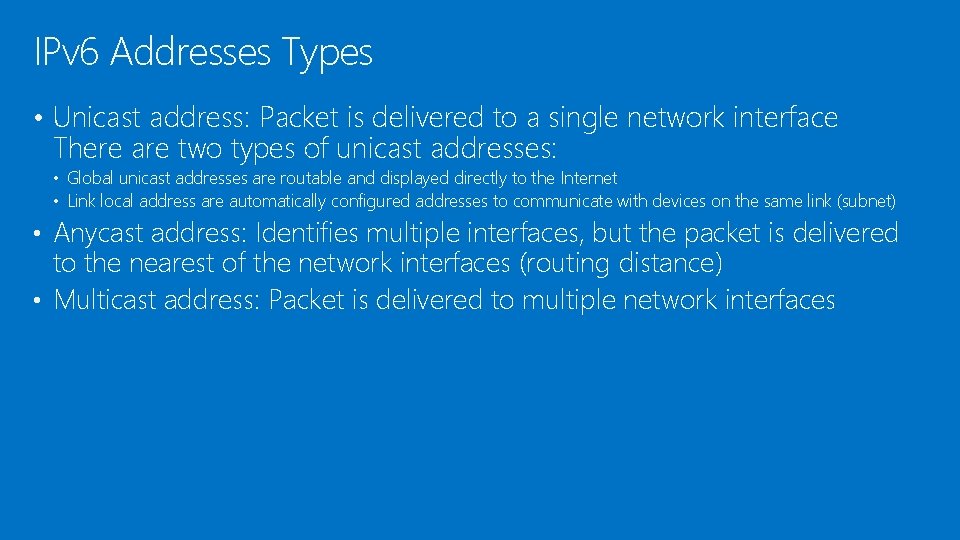
IPv 6 Addresses Types • Unicast address: Packet is delivered to a single network interface There are two types of unicast addresses: • Global unicast addresses are routable and displayed directly to the Internet • Link local address are automatically configured addresses to communicate with devices on the same link (subnet) • Anycast address: Identifies multiple interfaces, but the packet is delivered to the nearest of the network interfaces (routing distance) • Multicast address: Packet is delivered to multiple network interfaces
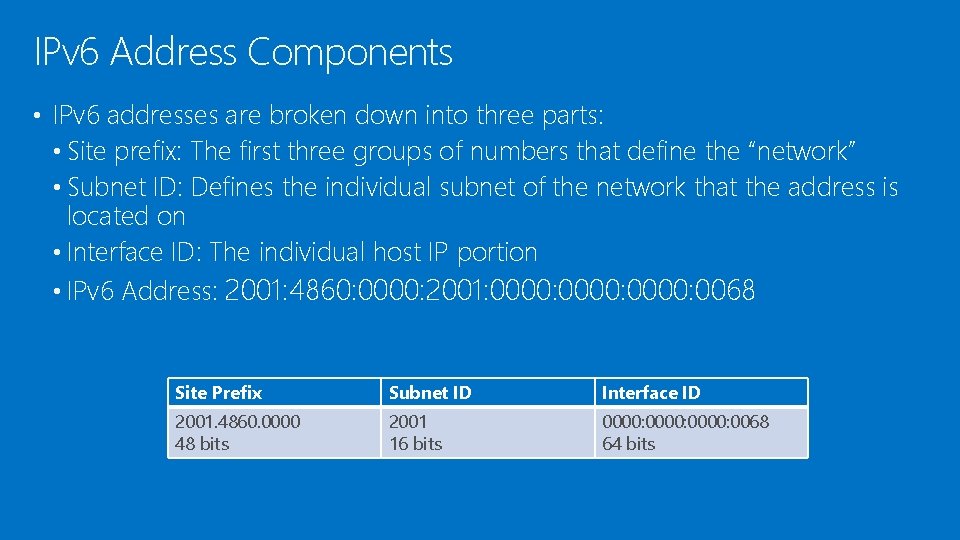
IPv 6 Address Components • IPv 6 addresses are broken down into three parts: • Site prefix: The first three groups of numbers that define the “network” • Subnet ID: Defines the individual subnet of the network that the address is located on • Interface ID: The individual host IP portion • IPv 6 Address: 2001: 4860: 0000: 2001: 0000: 0068 Site Prefix Subnet ID Interface ID 2001. 4860. 0000 48 bits 2001 16 bits 0000: 0068 64 bits
DEMO: IPv 6
Dual IP Stack • A dual IP stack exists when there are two Internet Protocol software implementations in an operating system, one for IPv 4 and another for IPv 6 • Dual stack IP hosts can run IPv 4 and IPv 6 independently, or they can use a hybrid implementation, which is the most commonly used method for modern operating systems
IPv 4 -Mapped Addresses • IPv 4 -mapped addresses have the first 80 bits set to 0 (note the double colon), the next 16 set to 1 (shown as ffff), and the last 32 bits populated by the IPv 4 address • These addresses look like IPv 6 addresses, other than the last 32 bits, which are written in the customary dot-decimal notation. • IPv 4 -mapped IPv 6 address for address 10. 254. 1 is : : ffff: 10. 254. 1
IPv 4 to IPv 6 Tunneling • IPv 6 packets can be encapsulated inside IPv 4 datagrams. • In Microsoft operating systems, this is generally done with the Teredo adapter, which is a virtual adapter or “pseudo-interface, ” not a physical network adapter. An example of one of these addresses would be: Fe 80: : 5 efe: 10. 0. 0. 2%2
Summary • Be able to categorize IPv 4 addresses using classifications such as Class A, • • B, and C You have learned the default gateway and DNS server are and how to configure them within a network adapter’s TCP/IP properties dialog box. Be able to define advanced TCP/IP concepts, such as NAT and subnetting, and how to create network subnets. You have learned the basics of IPv 6 and how to configure IPv 6 by using the command line You have learned how to define IPv 6 dual stack and tunneling technologies
Additional Resources & Next Steps Instructor-Led Courses • 40033 A: Windows Operating System and Windows Books Server Fundamentals: Training 2 -Pack for MTA Exams 98 -349 and 98 -365 (5 Days) • 40349 A: Windows Operating System Fundamentals: MTA Exam 98 -349 (3 Days) • 40032 A: Networking and Security Fundamentals: Training 2 -Pack for MTA Exams 98 -366 and 98 -367 (5 Days) • 40366 A: Networking Fundamentals: MTA Exam 98366 • Exam 98 -366: MTA Networking Fundamentals (Microsoft Official Academic Course) Exams & Certifications • Exam 98 -366: Networking Fundamentals

- Slides: 31