
Understanding Intelligence IQ EI and MI Restructuring our
- Slides: 33
Understanding Intelligence: IQ, EI, and MI Restructuring our notions of Learning and Intelligence
Intelligence 4 Characteristics: 1. Adaptive – modifying behavior to accomplish new tasks successfully 2. Learning Ability – Learn new info quickly & easily 3. Use of Prior Knowledge – to analyze & understand new situations 4. Culture Specific - intelligence in one culture isn’t always same in another
Intelligence & Culture l Intelligence ¡ Must is adaptive help learner survive & thrive in their particular culture ¡ Since cultures differ, intelligence must be different in various cultures
Intelligence l Not a measure of what a person has learned (i. e. school achievement) ¡ Often thought of as innate l But intelligence depends on prior knowledge l Not necessarily a permanent, unchanging characteristic ¡ Can be modified through experience & learning
Measuring Intelligence l Hard to measure & define l Lead to creation of an Intelligence Test to measure: ¡ General knowledge ¡ Vocabulary ¡ Perception ¡ Memory ¡ Abstract Thought
I. Q. – Intelligence Quotient l Traditionally thought of as a ‘fixed’ trait, but some research shows some gains are possible. ¡ Especially if child was in inadequate environmental conditions (malnourished, no school, etc. ) l Largely predictive of school success
IQ History – Early 1900’s l Developed when mass education became the norm. l Originally designed to identify and help “slower” students in France. l Tested many children of the same age & identified patterns.
Sample IQ Test Questions l What l How does the word quarrel mean? are a goat and beetle alike? l What should you do if you get separated from your family in a large department store?
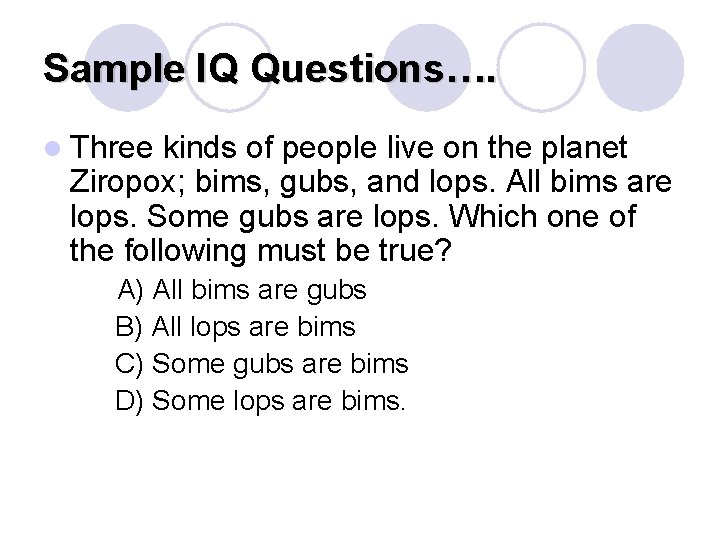
Sample IQ Questions…. l Three kinds of people live on the planet Ziropox; bims, gubs, and lops. All bims are lops. Some gubs are lops. Which one of the following must be true? A) All bims are gubs B) All lops are bims C) Some gubs are bims D) Some lops are bims.
IQ Continued… l IQ tests are age specific – only compared to others of your age l Tests are different depending on age
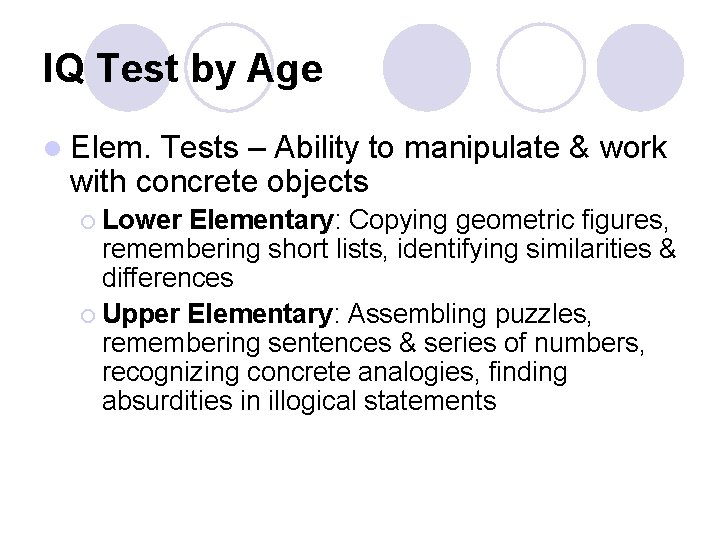
IQ Test by Age l Elem. Tests – Ability to manipulate & work with concrete objects ¡ Lower Elementary: Copying geometric figures, remembering short lists, identifying similarities & differences ¡ Upper Elementary: Assembling puzzles, remembering sentences & series of numbers, recognizing concrete analogies, finding absurdities in illogical statements
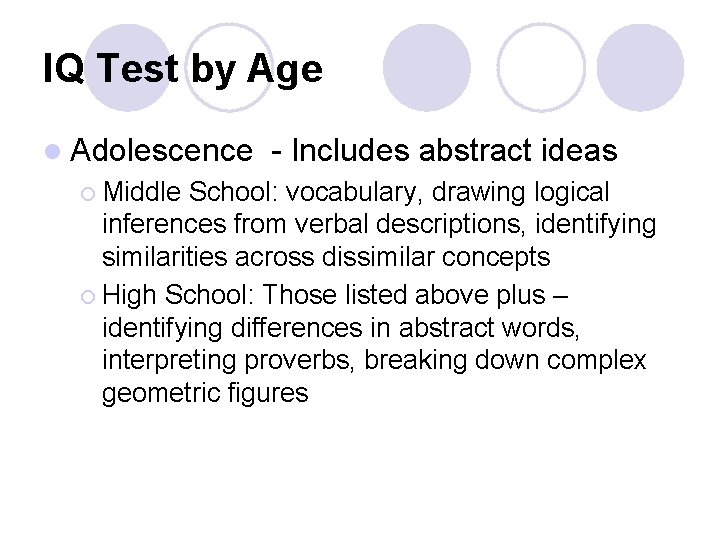
IQ Test by Age l Adolescence ¡ Middle - Includes abstract ideas School: vocabulary, drawing logical inferences from verbal descriptions, identifying similarities across dissimilar concepts ¡ High School: Those listed above plus – identifying differences in abstract words, interpreting proverbs, breaking down complex geometric figures
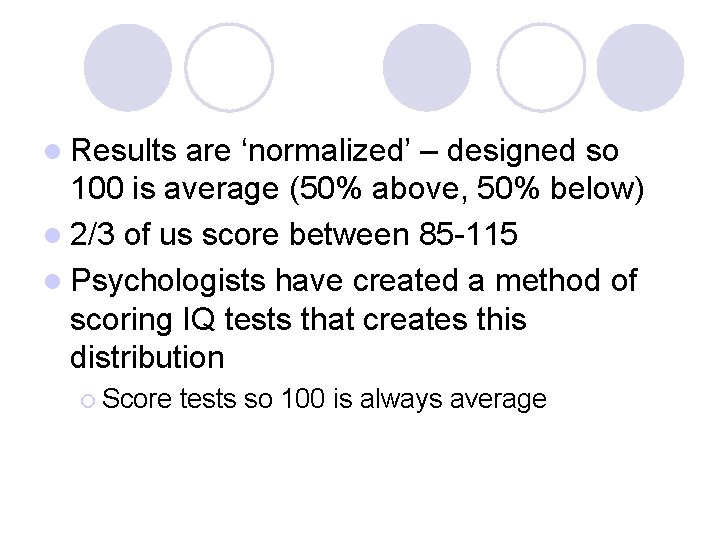
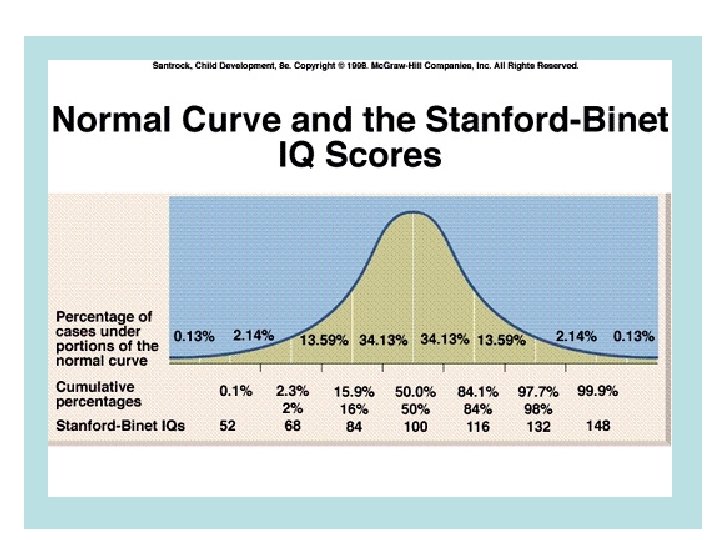
l Results are ‘normalized’ – designed so 100 is average (50% above, 50% below) l 2/3 of us score between 85 -115 l Psychologists have created a method of scoring IQ tests that creates this distribution ¡ Score tests so 100 is always average
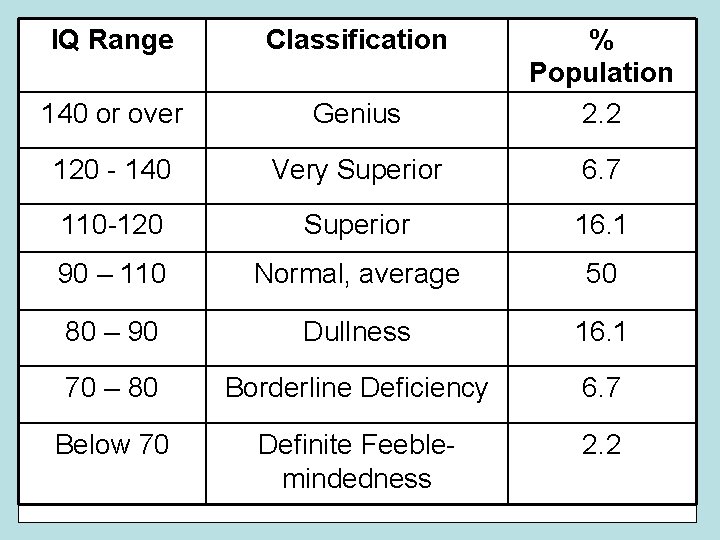
IQ Range Classification 140 or over Genius % Population 2. 2 120 - 140 Very Superior 6. 7 110 -120 Superior 16. 1 90 – 110 Normal, average 50 80 – 90 Dullness 16. 1 70 – 80 Borderline Deficiency 6. 7 Below 70 Definite Feeblemindedness 2. 2
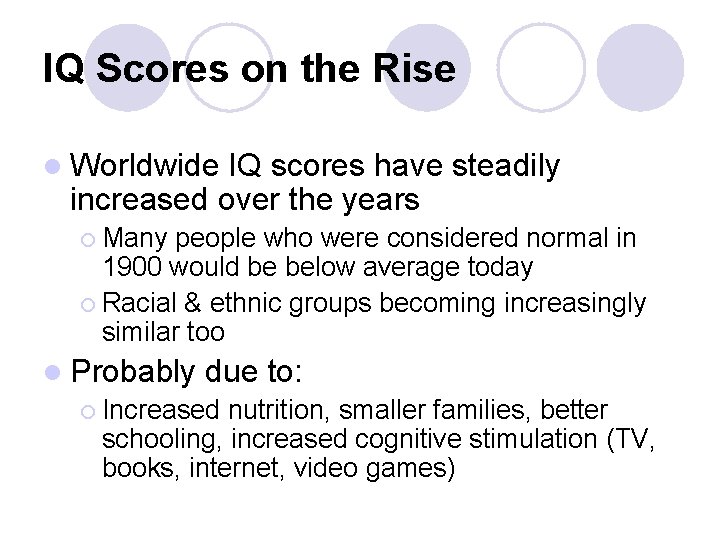
IQ Scores on the Rise l Worldwide IQ scores have steadily increased over the years ¡ Many people who were considered normal in 1900 would be below average today ¡ Racial & ethnic groups becoming increasingly similar too l Probably due to: ¡ Increased nutrition, smaller families, better schooling, increased cognitive stimulation (TV, books, internet, video games)
Practice IQ Test l MENSA – “welcomes people from every walk of life whose IQ is in the top 2% of the population” l http: //www. mensa. org/workout. html
World’s Smartest Person …. l According to the High IQ Society, the world’s smartest person is a graduate student at the University of Michigan. l “there's a little bit of difference between being the world's smartest person and winning this contest – the smartest person in the world probably wouldn't bother entering this contest. I just thought it would be fun. ” – Andrew Nierman
I. Q. Score Cautions l Questions ¡ Ex: may be culturally biased. What is a toboggan? l Environmental ¡ Poor l Test Conditions nutrition, lack of books, toys, schooling, etc Anxiety l Predicative of school success – not necessarily life success
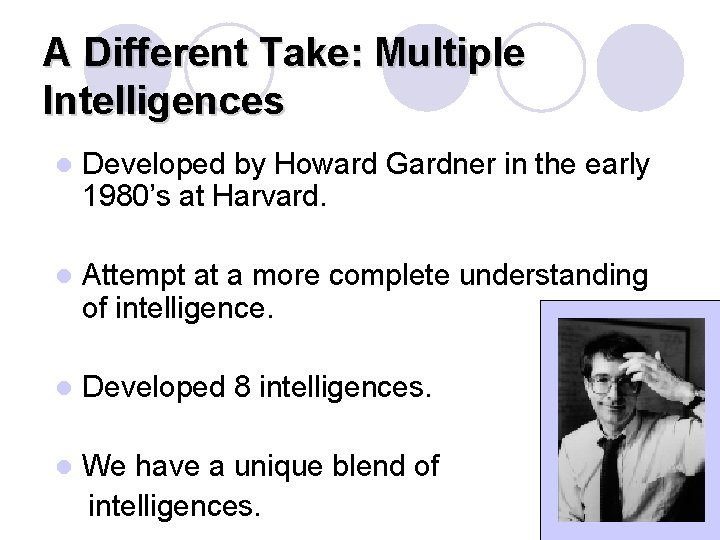
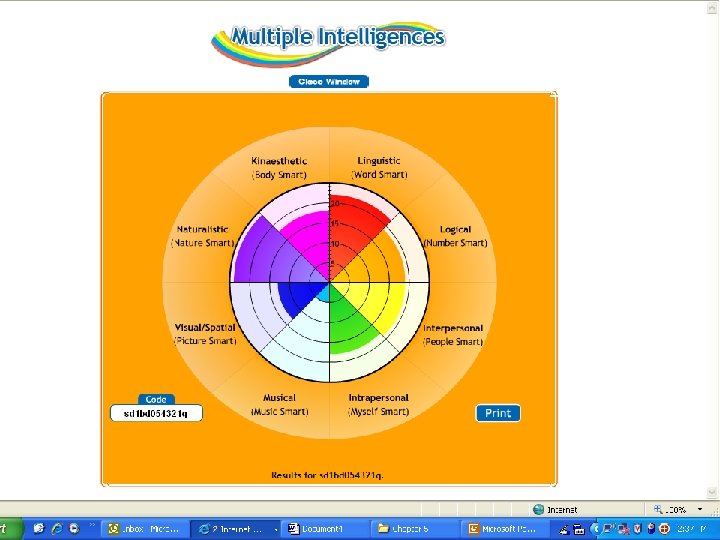
A Different Take: Multiple Intelligences l Developed by Howard Gardner in the early 1980’s at Harvard. l Attempt at a more complete understanding of intelligence. l Developed 8 intelligences. l We have a unique blend of intelligences.
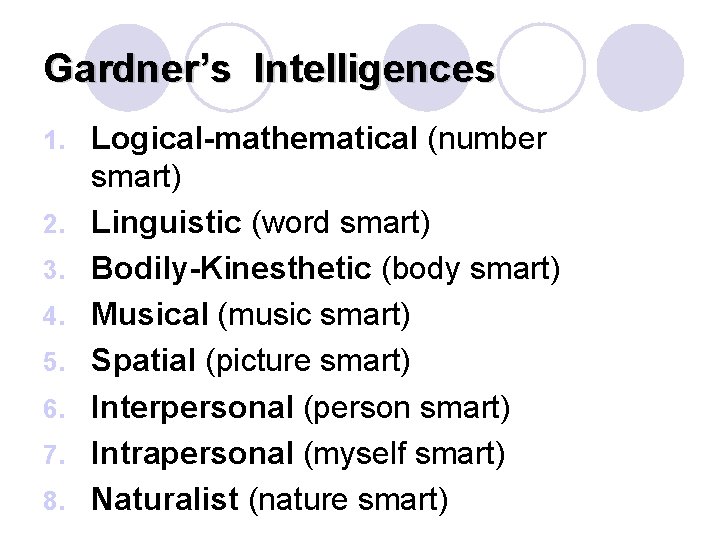
Gardner’s Intelligences 1. 2. 3. 4. 5. 6. 7. 8. Logical-mathematical (number smart) Linguistic (word smart) Bodily-Kinesthetic (body smart) Musical (music smart) Spatial (picture smart) Interpersonal (person smart) Intrapersonal (myself smart) Naturalist (nature smart)
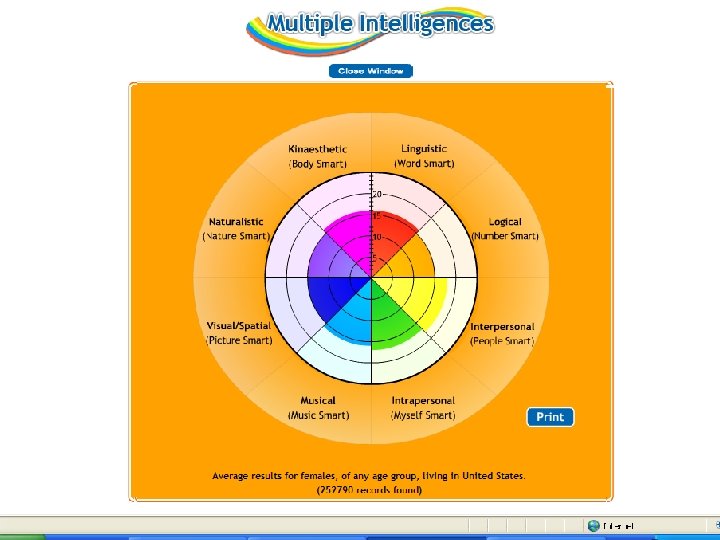
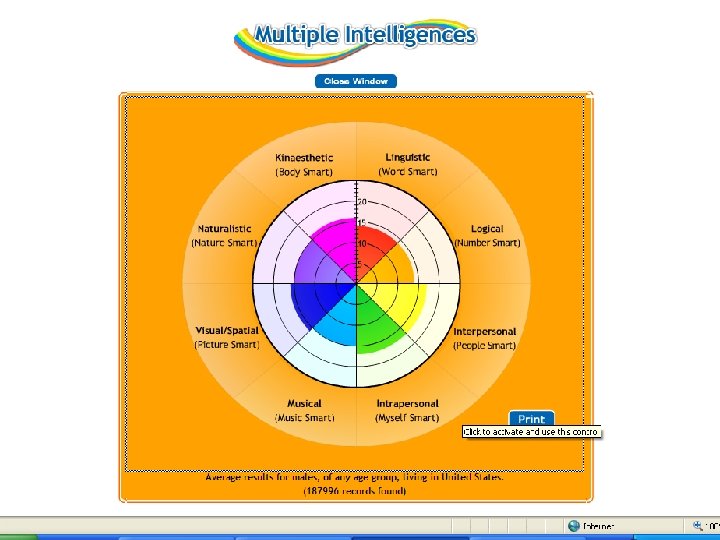
Take a MI Test l http: //www. bgfl. org/bgfl/custom/resources_ ftp/client_ftp/ks 3/ict/multiple_int/questions/ questions. cfm l What do the average American female and male results look like (according to this particular test)?
Multiple Intelligences …. l Not readily accepted within academic psychology, but embraced by educators. l MI rings true for teachers – matches their experiences with students. l New approaches to better meet the needs of a larger range of students.
Multiple Intelligences …. l Importance of portfolio assessment. l Not feasible to teach to all intelligences all the time. ¡ With understanding of MI, teachers can create more balanced setting to enhance success of all students. l Possible inclusion of other intelligences.
Another Take: Emotional Intelligence l A type of social intelligence that involves the ability to: 1. Monitor one’s own and others’ emotions 2. To discriminate among them 3. To use the information to guide one’s own thinking and actions
Emotional Intelligence …. l Based on a study from the 60’s - the marshmallow experiment ¡ 4 year olds and their self-control l Children ¡ What were followed up 12 years later do you think researchers found?
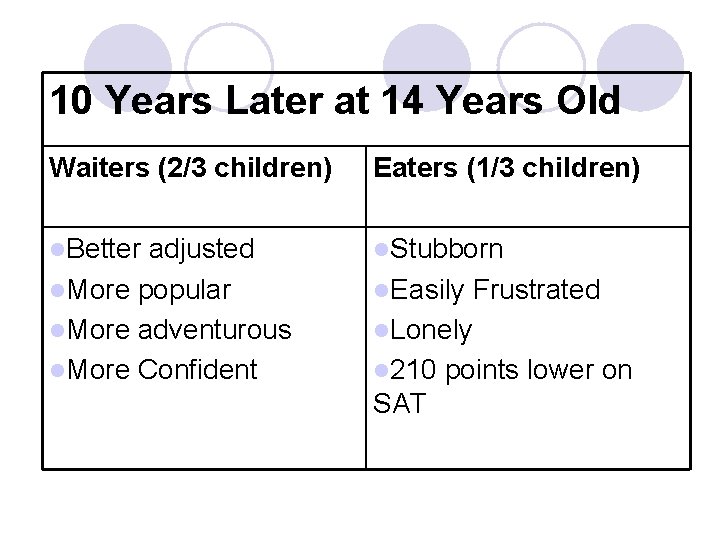
10 Years Later at 14 Years Old Waiters (2/3 children) Eaters (1/3 children) l. Better l. Stubborn adjusted l. More popular l. More adventurous l. More Confident l. Easily Frustrated l. Lonely l 210 points lower on SAT
Emotional Intelligence …. l May be a better predictor of success in life than IQ. l Can Emotional Intelligence be taught? ¡ What do you think?
Summing Up … l New ways of understanding learning and intelligence. l Multiple Intelligences – a unique blend of intelligences l IQ vs. EQ ¡ Success in school; success in life
Questions to ponder… l So is intelligence a useful concept? If so, in what ways? If not, why not? l In particular, is intelligence useful for teachers and for our system of education? l Identify an outcome and then authentic assessments from 5 of the 8 multiple intelligences…