
Understanding Human Cognition through Experimental and Computational Methods














- Slides: 32
Understanding Human Cognition through Experimental and Computational Methods Jay Mc. Clelland Symbolic Systems 100 Spring, 2011
Early History of the Study of Human Mental Processes • Introspectionism (Wundt, Titchener) – Thought as conscious content, but two problems: • Suggestibility • Gaps • Freud suggests that mental processes are not all conscious • Behaviorists (Watson, Skinner) eschew talk of mental processes altogether
Can Experiments Teach Us About the Contents of the Mind? • Conrad: Verbal coding in short-term memory • Sachs: Representation of meaning in longterm memory
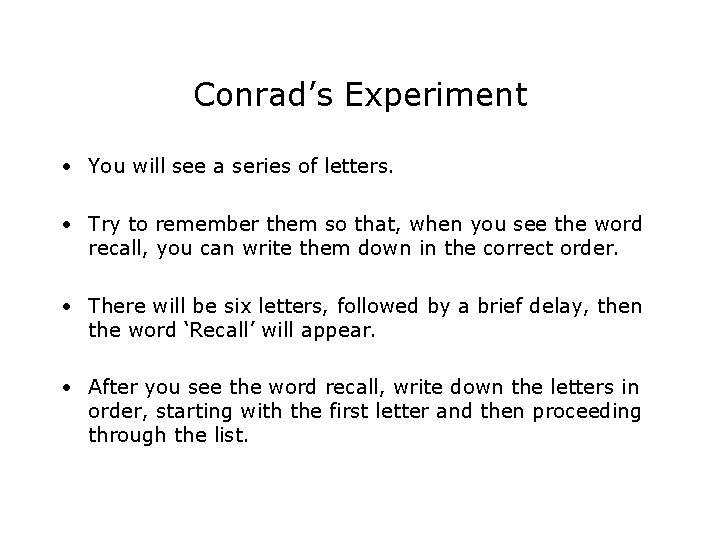
Conrad’s Experiment • You will see a series of letters. • Try to remember them so that, when you see the word recall, you can write them down in the correct order. • There will be six letters, followed by a brief delay, then the word ‘Recall’ will appear. • After you see the word recall, write down the letters in order, starting with the first letter and then proceeding through the list.
B
M
S
F
X
T
V
N
Recall
BMSFXTVN
Sachs’ Experiment • Participants heard a story containing a sentence such as: – He sent Galileo, the great Italian Scientist, a letter about it. • Either immediately, or after reading a few more sentences, the participants were asked which of the following sentences they had heard: – He sent Galileo, the great Italian Scientist, a letter about it. – He sent a letter about it to Galileo, the great Italian Scientist. – Galileo, the great Italian Scientist, sent him a letter about it. • When tested immediately, nearly all participants chose the correct sentence. After a delay, many participants chose the second sentence, but no one chose third. •
A Question: • What sort of a mechanism should we use to capture the processes that underlie human thought? – A mechanism like the brain? – Or a mechanism like a computer?
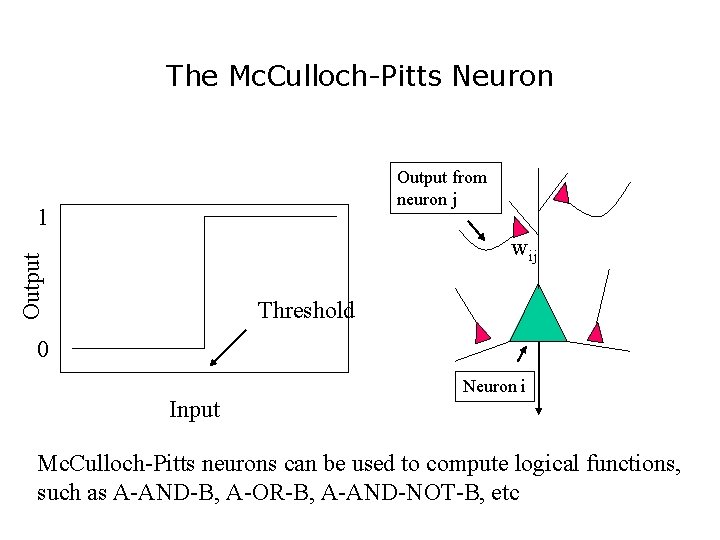
The Mc. Culloch-Pitts Neuron Output from neuron j 1 Output wij Threshold 0 Input Neuron i Mc. Culloch-Pitts neurons can be used to compute logical functions, such as A-AND-B, A-OR-B, A-AND-NOT-B, etc
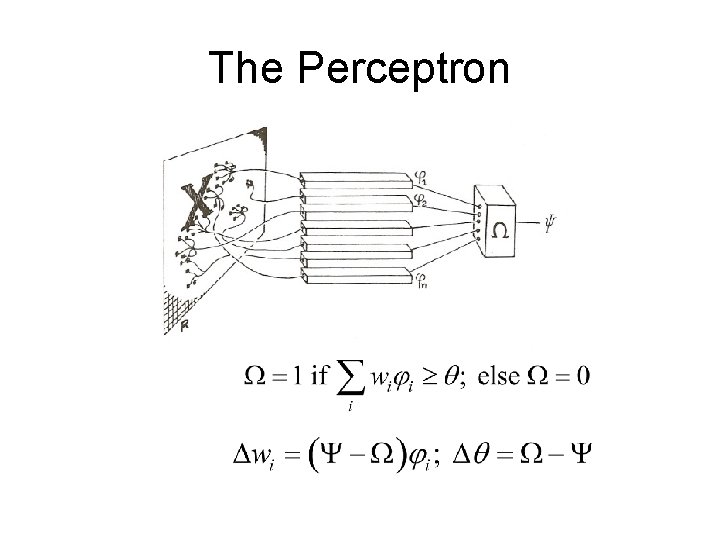
The Perceptron
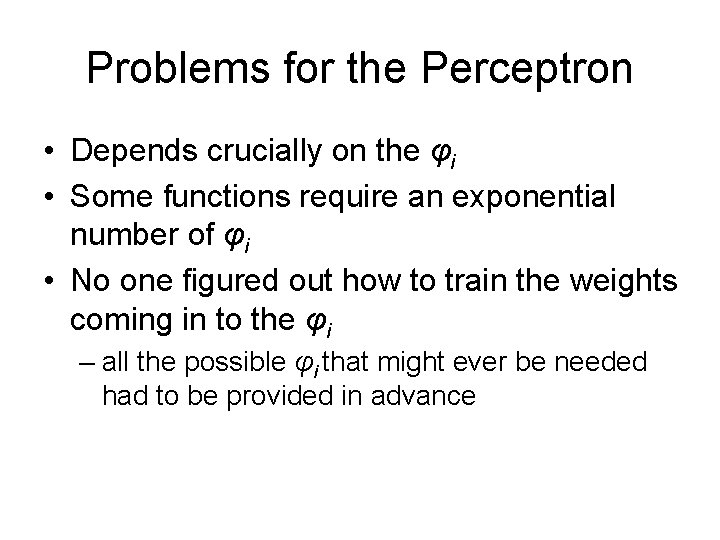
Problems for the Perceptron • Depends crucially on the φi • Some functions require an exponential number of φi • No one figured out how to train the weights coming in to the φi – all the possible φi that might ever be needed had to be provided in advance
The Rise of Symbolic Computation • Mathematics and logic grew up around the use of symbols: – Marks on paper that stand for things. • Computer programs that do math and logic make use of symbols too. • Rules of mathematics and logic can be expressed in terms of statements about symbols. – ‘If p then q’ and ‘p’ implies ‘q’ • So symbolic models seemed like they might be effective ways of using computers to model human reasoning.
But AI Didn’t Live Up to It’s Promise Either • Computers could do math and logic, but they couldn’t: – – Recognize objects Recognize speech Understand sentences Retrieve relevant information from memory • Was there something wrong with the specific models or languages people were using or was there something wrong with the whole approach?
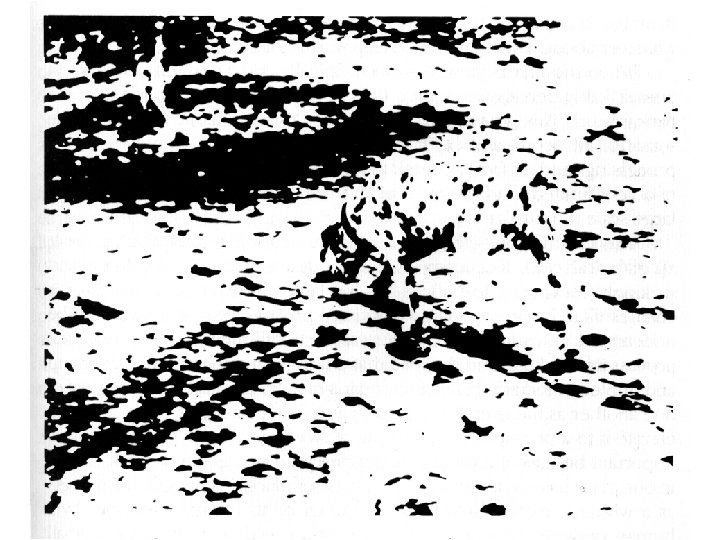
Ubiquity of the Constraint Satisfaction Problem • In sentence processing – I saw the grand canyon flying to New York – I saw the sheep grazing in the field • In comprehension – Margie was sitting on the front steps when she heard the familiar jingle of the “Good Humor” truck. She remembered her birthday money and ran into the house. • In reaching, grasping, typing…
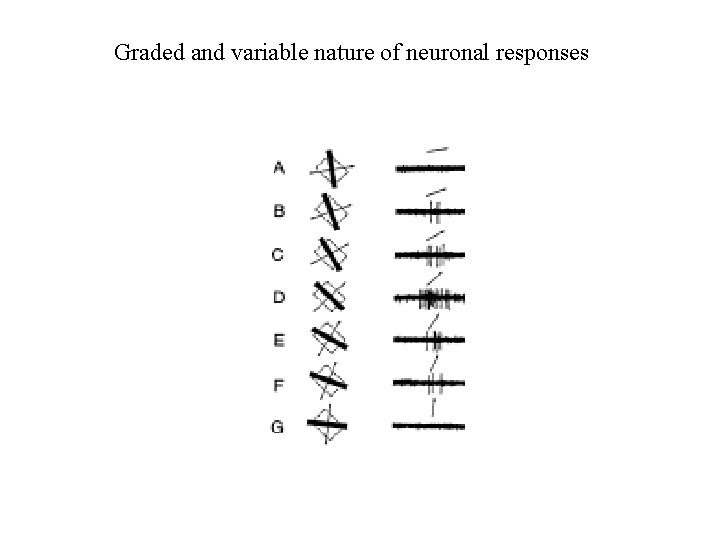
Graded and variable nature of neuronal responses
Lateral Inhibition in Eye of Limulus (Horseshoe Crab)
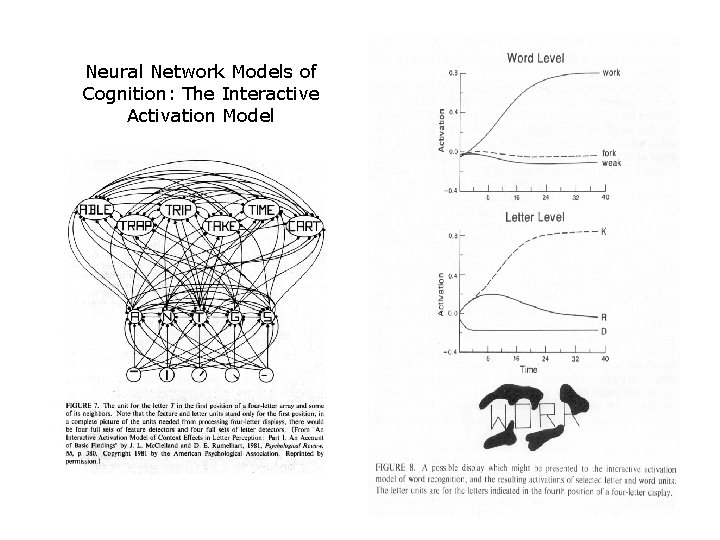
Neural Network Models of Cognition: The Interactive Activation Model
Newer Directions • Cognitive Neuroscience: – Using measurements of human brain activity to learn more about mental processing • Reasoning with uncertain information: – Probabilistic models of cognition • Cognition as an embodied process, tied to experience and action.