
Understanding how to increase loyalty among your prepaid
- Slides: 20
Understanding how to increase loyalty among your prepaid subscribers Budapest, September 27, 2004 Prepared by: Andras Kondor VP CRM, T-Mobile International !"§==Mobile=
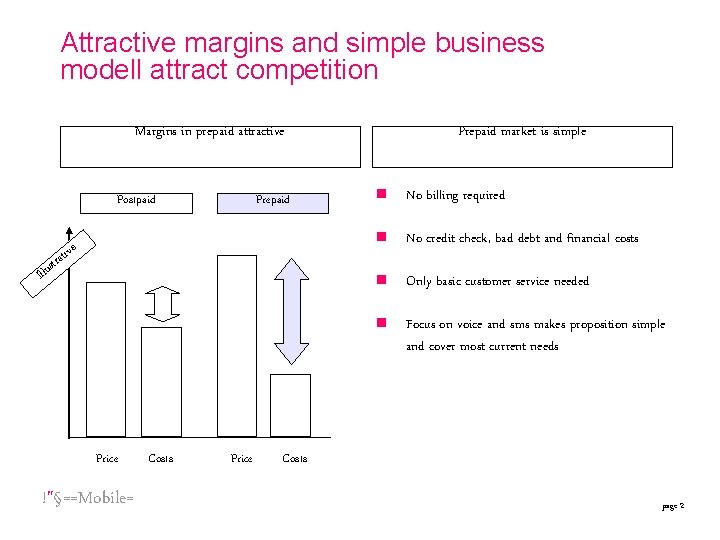
Attractive margins and simple business modell attract competition Margins in prepaid attractive Postpaid Prepaid ve i t a str Illu Price !"§==Mobile= Costs Price Prepaid market is simple n No billing required n No credit check, bad debt and financial costs n Only basic customer service needed n Focus on voice and sms makes proposition simple and cover most current needs Costs page 2
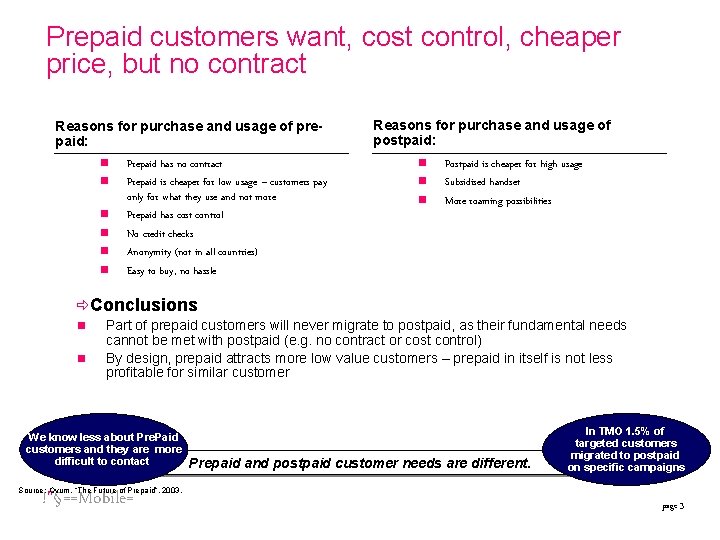
Prepaid customers want, cost control, cheaper price, but no contract Reasons for purchase and usage of prepaid: n Prepaid has no contract n Prepaid is cheaper for low usage – customers pay only for what they use and not more n Prepaid has cost control n No credit checks n Anonymity (not in all countries) n Easy to buy, no hassle Reasons for purchase and usage of postpaid: n n n Postpaid is cheaper for high usage Subsidised handset More roaming possibilities ðConclusions n n Part of prepaid customers will never migrate to postpaid, as their fundamental needs cannot be met with postpaid (e. g. no contract or cost control) By design, prepaid attracts more low value customers – prepaid in itself is not less profitable for similar customer We know less about Pre. Paid customers and they are more difficult to contact Prepaid and postpaid customer needs are different. In TMO 1. 5% of targeted customers migrated to postpaid on specific campaigns Source: Ovum, “The Future of Prepaid”, 2003. !"§==Mobile= page 3
Prepaid market is challenging for incumbent operators n How to compete with new and/or prepaid focus operators? n How to operate in a less traditional, less information rich environment? !"§==Mobile= page 4
Prepaid market is challenging for incumbent operators n How to compete with new and/or prepaid focus operators? n How to operate in a less traditional, less information rich environment? !"§==Mobile= page 5
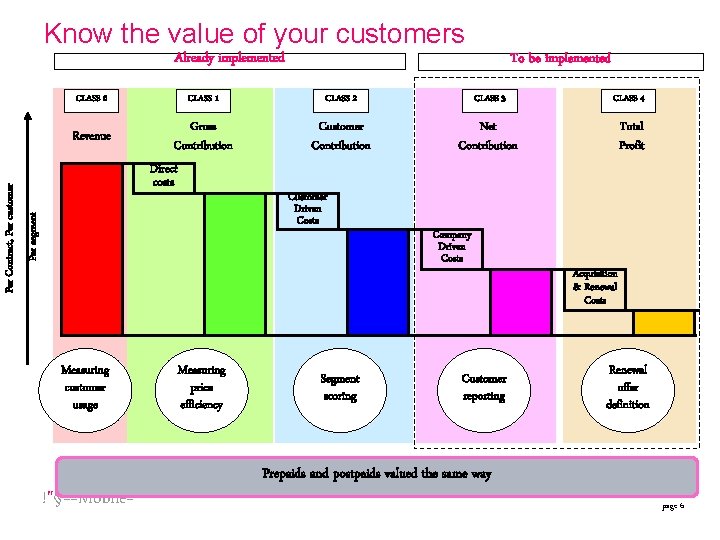
Know the value of your customers Already implemented CLASS 0 Gross Contribution Direct costs Per segment Per Contract, Per customer Revenue CLASS 1 Measuring customer usage !"§==Mobile= Measuring price efficiency To be implemented CLASS 2 CLASS 3 CLASS 4 Customer Contribution Net Contribution Total Profit Customer Driven Costs Segment scoring Company Driven Costs Customer reporting Acquisition & Renewal Costs Renewal offer definition Prepaids and postpaids valued the same way page 6
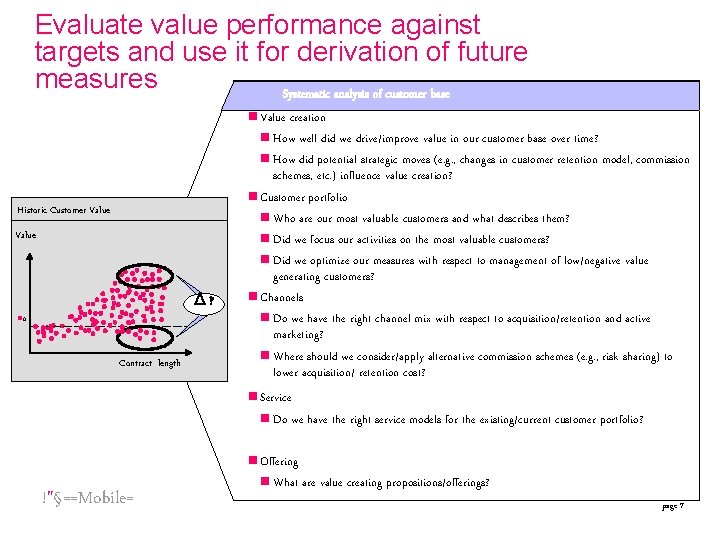
Evaluate value performance against targets and use it for derivation of future measures Systematic analysis of customer base n Value creation n How well did we drive/improve value in our customer base over time? n How did potential strategic moves (e. g. , changes in customer retention model, commission Historic Customer Value ? n 0 Contract length schemes, etc. ) influence value creation? n Customer portfolio n Who are our most valuable customers and what describes them? n Did we focus our activities on the most valuable customers? n Did we optimize our measures with respect to management of low/negative value generating customers? n Channels n Do we have the right channel mix with respect to acquisition/retention and active marketing? n Where should we consider/apply alternative commission schemes (e. g. , risk sharing) to lower acquisition/ retention cost? n Service n Do we have the right service models for the existing/current customer portfolio? n Offering !"§==Mobile= n What are value creating propositions/offerings? page 7
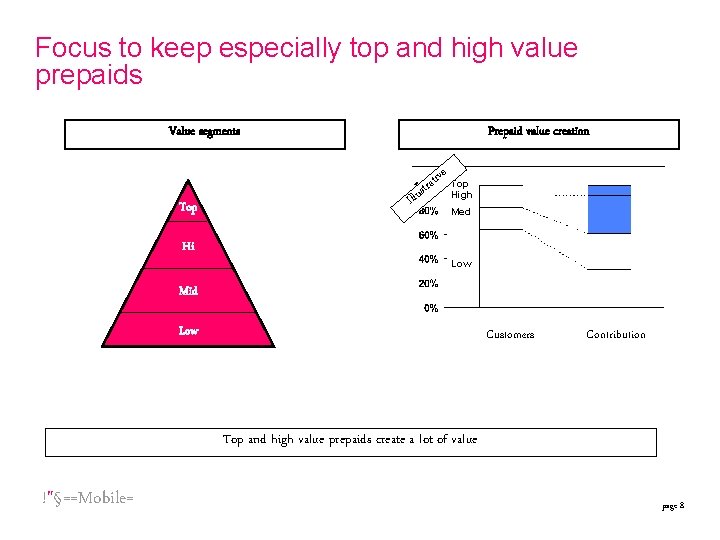
Focus to keep especially top and high value prepaids Value segments Top Hi Prepaid value creation tive Top a r t High us Ill Med Low Mid Low Customers Contribution Top and high value prepaids create a lot of value !"§==Mobile= page 8
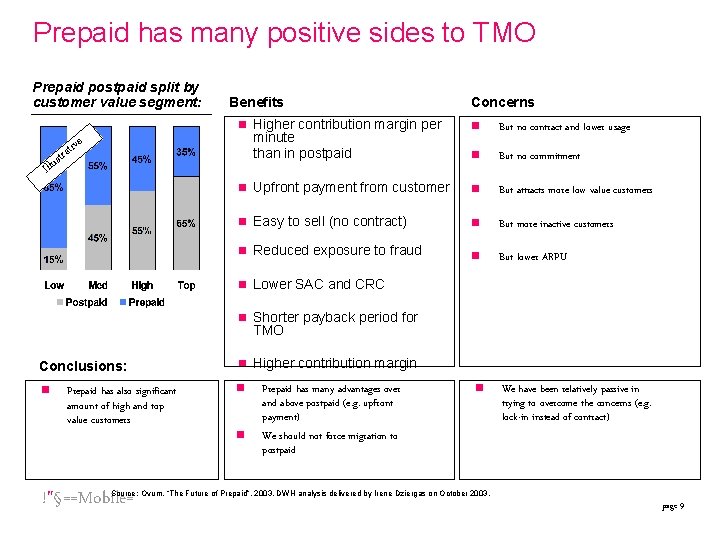
Prepaid has many positive sides to TMO Prepaid postpaid split by customer value segment: Benefits n Higher contribution margin per tiv stra n But no contract and lower usage n But no commitment n Upfront payment from customer n But attracts more low value customers n Easy to sell (no contract) n But more inactive customers n Reduced exposure to fraud n But lower ARPU minute than in postpaid e Illu Concerns n Lower SAC and CRC n Shorter payback period for TMO Conclusions: n Higher contribution margin n n Prepaid has also significant amount of high and top value customers !"§==Mobile= n Prepaid has many advantages over and above postpaid (e. g. upfront payment) We should not force migration to postpaid n We have been relatively passive in trying to overcome the concerns (e. g. lock-in instead of contract) Source: Ovum, “The Future of Prepaid”, 2003. DWH analysis delivered by Irene Dziergas on October 2003. page 9
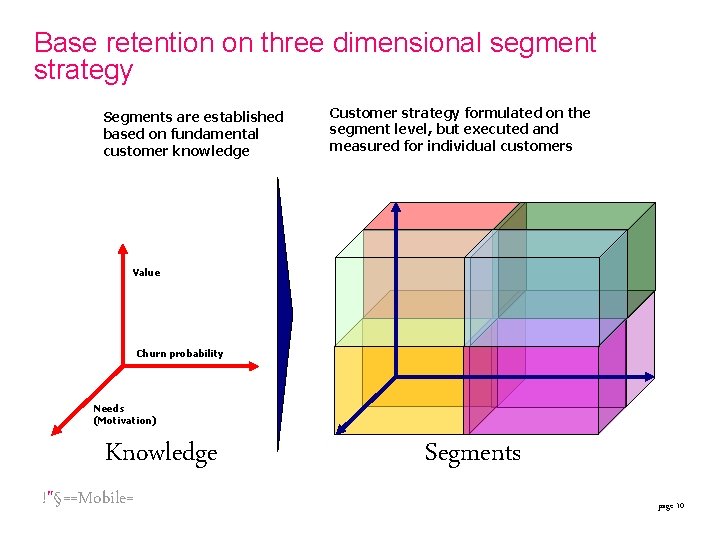
Base retention on three dimensional segment strategy Segments are established based on fundamental customer knowledge Customer strategy formulated on the segment level, but executed and measured for individual customers Value Churn probability Needs (Motivation) Knowledge !"§==Mobile= Segments page 10
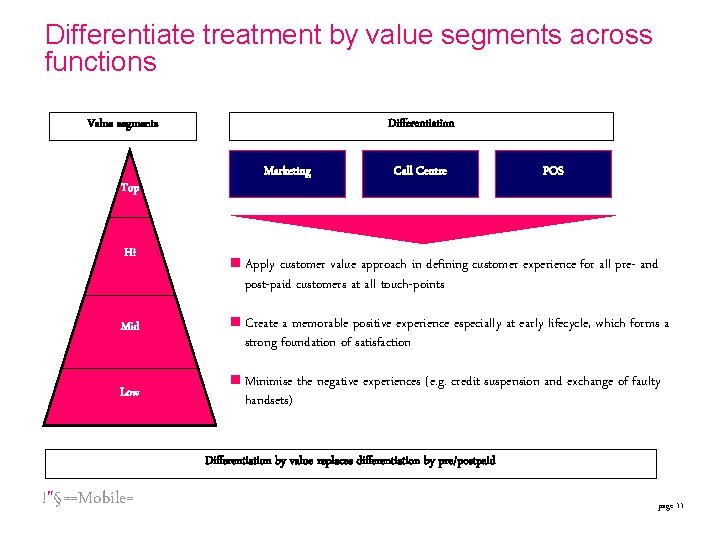
Differentiate treatment by value segments across functions Differentiation Value segments Top Hi Marketing Call Centre POS n Apply customer value approach in defining customer experience for all pre- and post-paid customers at all touch-points Mid Low n Create a memorable positive experience especially at early lifecycle, which forms a strong foundation of satisfaction n Minimise the negative experiences (e. g. credit suspension and exchange of faulty handsets) Differentiation by value replaces differentiation by pre/postpaid !"§==Mobile= page 11
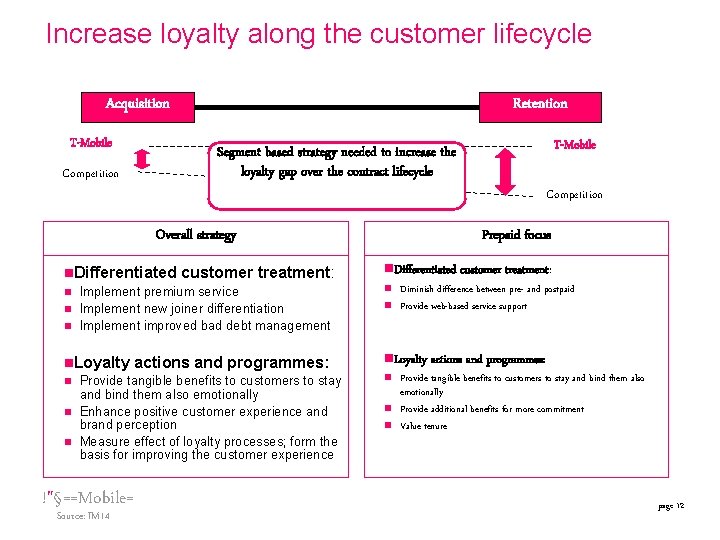
Increase loyalty along the customer lifecycle Acquisition T-Mobile Competition Retention T-Mobile Segment based strategy needed to increase the loyalty gap over the contract lifecycle Competition Overall strategy Prepaid focus n. Differentiated customer treatment: n Implement premium service n Implement new joiner differentiation n Implement improved bad debt management n. Differentiated customer treatment: n Diminish difference between pre- and postpaid n Provide web-based service support n. Loyalty actions and programmes: n Provide tangible benefits to customers to stay and bind them also emotionally n Enhance positive customer experience and brand perception n Measure effect of loyalty processes; form the basis for improving the customer experience n. Loyalty actions and programmes: n Provide tangible benefits to customers to stay and bind them also emotionally n Provide additional benefits for more commitment n Value tenure !"§==Mobile= Source: IM 14 page 12
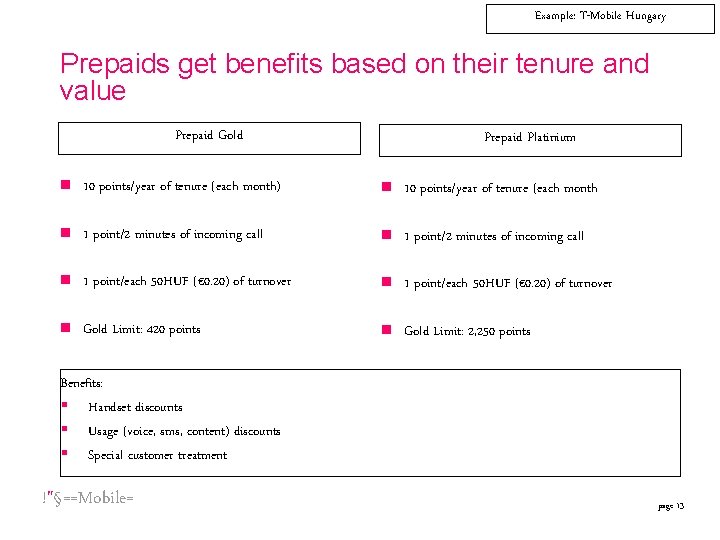
Example: T-Mobile Hungary Prepaids get benefits based on their tenure and value Prepaid Gold Prepaid Platinium n 10 points/year of tenure (each month) n 10 points/year of tenure (each month n 1 point/2 minutes of incoming call n 1 point/each 50 HUF (€ 0. 20) of turnover n Gold Limit: 420 points n Gold Limit: 2, 250 points Benefits: § Handset discounts § Usage (voice, sms, content) discounts § Special customer treatment !"§==Mobile= page 13
Prepaid market is challenging for incumbent operators n How to compete with new and/or prepaid focus operators? n How to operate in a less traditional, less information rich environment? !"§==Mobile= page 14
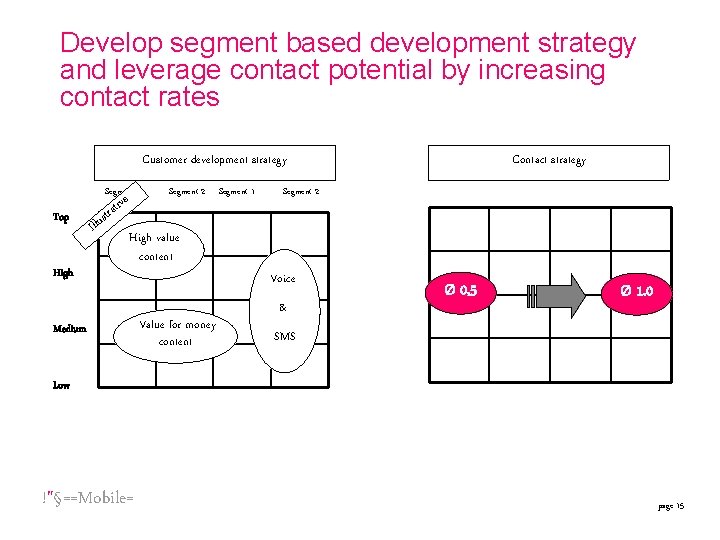
Develop segment based development strategy and leverage contact potential by increasing contact rates Customer development strategy Segment 1 Top High Illu ve i t a str Segment 2 Segment 1 Contact strategy Segment 2 High value content Medium Voice Value for money content & Ø 0, 5 Ø 1. 0 SMS Low !"§==Mobile= page 15
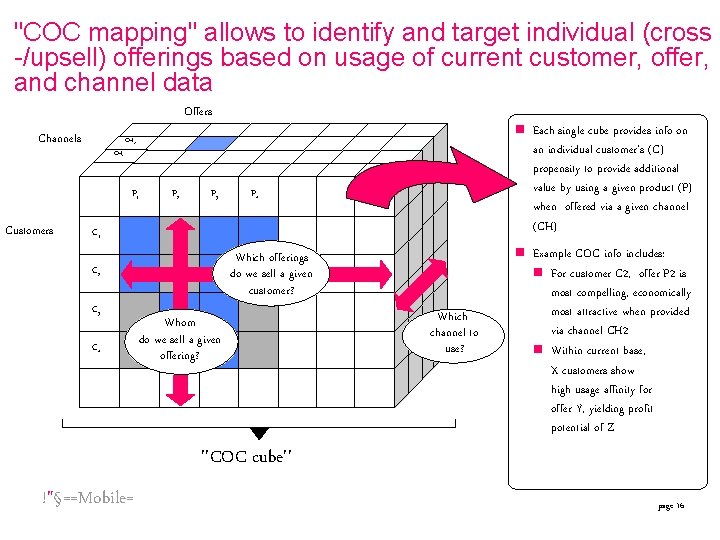
"COC mapping" allows to identify and target individual (cross -/upsell) offerings based on usage of current customer, offer, and channel data Offers Channels CH 2 Each single cube provides info on an individual customer's (C) propensity to provide additional value by using a given product (P) when offered via a given channel (CH) n Example COC info includes: n For customer C 2, offer P 2 is most compelling, economically most attractive when provided via channel CH 2 n Within current base, X customers show high usage affinity for offer Y, yielding profit potential of Z CH 1 P 1 Customers n P 2 P 3 P 4 C 1 CH 1 Which offerings do we sell a given customer? C 2 C 3 C 4 Whom do we sell a given offering? Which channel to use? ''COC cube'' !"§==Mobile= page 16
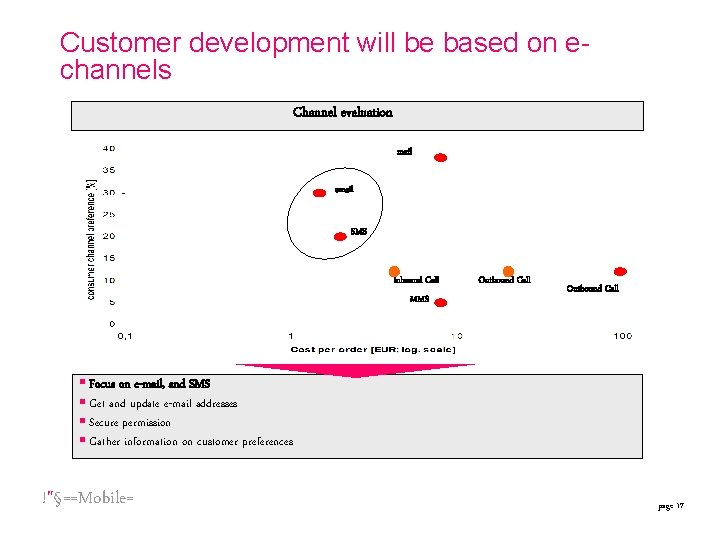
Customer development will be based on echannels Channel evaluation mail email SMS inbound Call MMS Outbound Call § Focus on e-mail, and SMS § Get and update e-mail addresses § Secure permission § Gather information on customer preferences !"§==Mobile= page 17
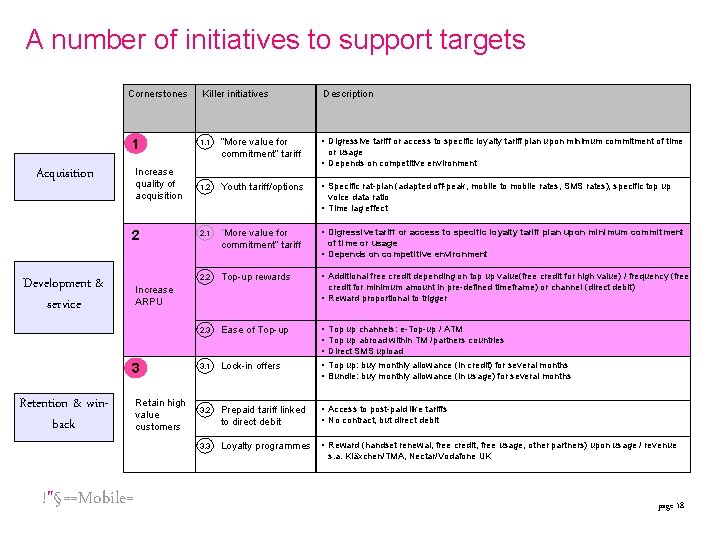
A number of initiatives to support targets Cornerstones 1 Acquisition Increase quality of acquisition Killer initiatives 1. 1 1. 2 Description “More value for commitment” tariff • Digressive tariff or access to specific loyalty tariff plan upon minimum commitment of time Youth tariff/options • Specific rat-plan (adapted off-peak, mobile to mobile rates, SMS rates), specific top up or usage • Depends on competitive environment voice data ratio • Time lag effect 2 2. 1 2. 2 Development & service “More value for commitment” tariff • Digressive tariff or access to specific loyalty tariff plan upon minimum commitment Top-up rewards • Additional free credit depending on top up value(free credit for high value) / frequency (free Increase ARPU 3 Retention & winback Retain high value customers of time or usage • Depends on competitive environment credit for minimum amount in pre-defined timeframe) or channel (direct debit) • Reward proportional to trigger 2. 3 Ease of Top-up • Top up channels: e-Top-up / ATM • Top up abroad within TM /partners countries • Direct SMS upload 3. 1 Lock-in offers • Top up: buy monthly allowance (in credit) for several months • Bundle: buy monthly allowance (in usage) for several months 3. 2 Prepaid tariff linked to direct debit • Access to post-paid like tariffs • No contract, but direct debit 3. 3 Loyalty programmes • Reward (handset renewal, free credit, free usage, other partners) upon usage / revenue s. a. Kläxchen/TMA, Nectar/Vodafone UK !"§==Mobile= page 18
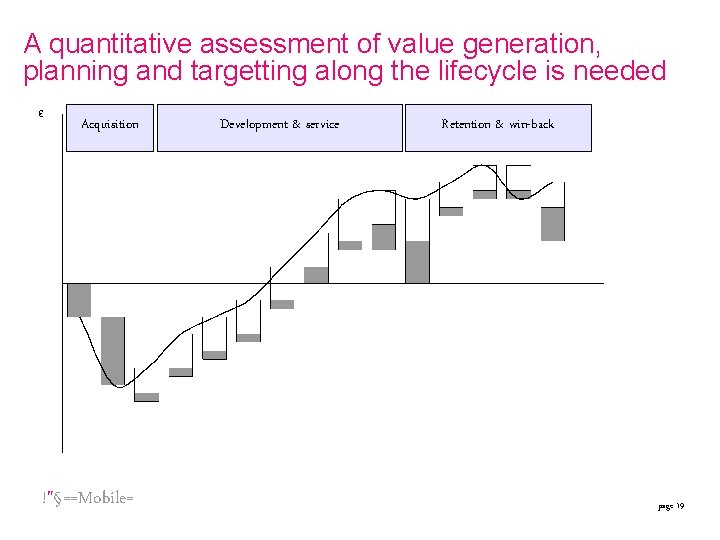
A quantitative assessment of value generation, planning and targetting along the lifecycle is needed € Acquisition !"§==Mobile= Development & service Retention & win-back page 19
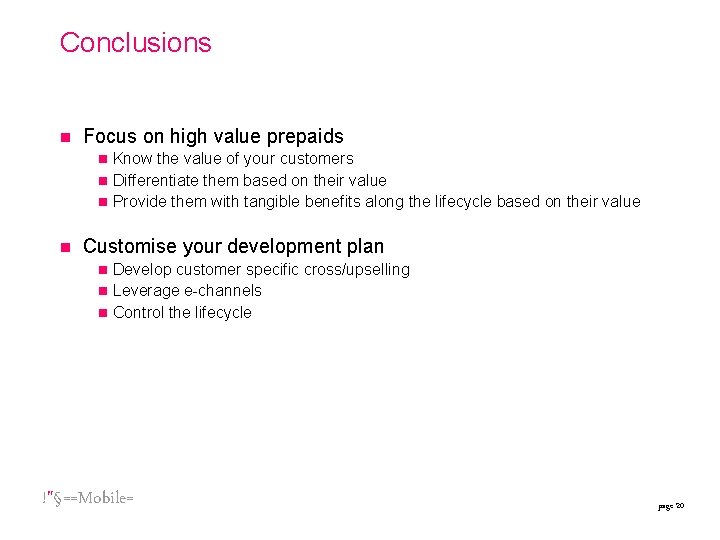
Conclusions n Focus on high value prepaids Know the value of your customers n Differentiate them based on their value n Provide them with tangible benefits along the lifecycle based on their value n n Customise your development plan Develop customer specific cross/upselling n Leverage e-channels n Control the lifecycle n !"§==Mobile= page 20