
Understanding How Cells Work Standard Set 1 Cell
- Slides: 17
Understanding How Cells Work Standard Set 1 – Cell Biology 1 c, 1 e, 1 a
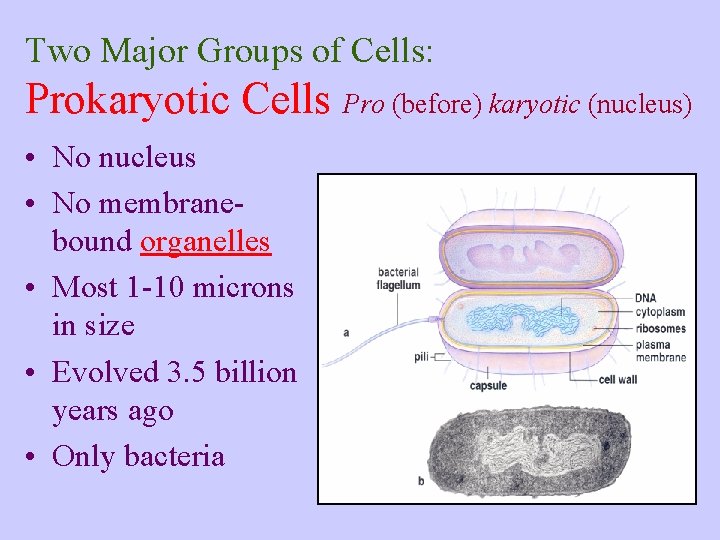
Two Major Groups of Cells: Prokaryotic Cells Pro (before) karyotic (nucleus) • No nucleus • No membranebound organelles • Most 1 -10 microns in size • Evolved 3. 5 billion years ago • Only bacteria
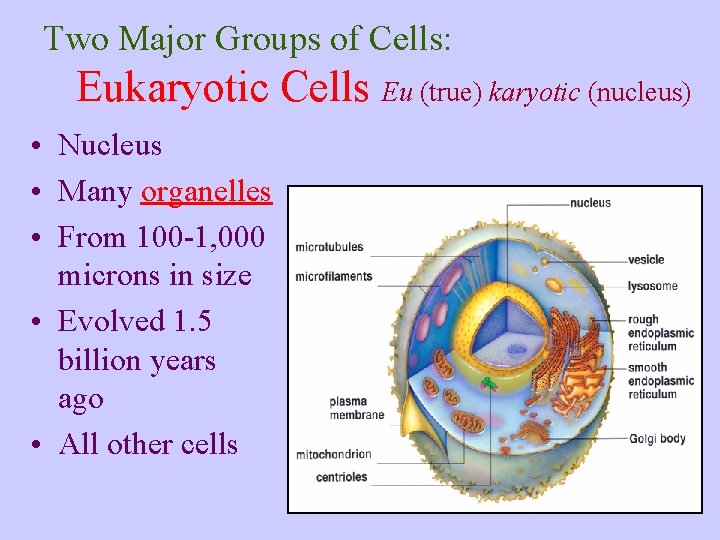
Two Major Groups of Cells: Eukaryotic Cells Eu (true) karyotic (nucleus) • Nucleus • Many organelles • From 100 -1, 000 microns in size • Evolved 1. 5 billion years ago • All other cells
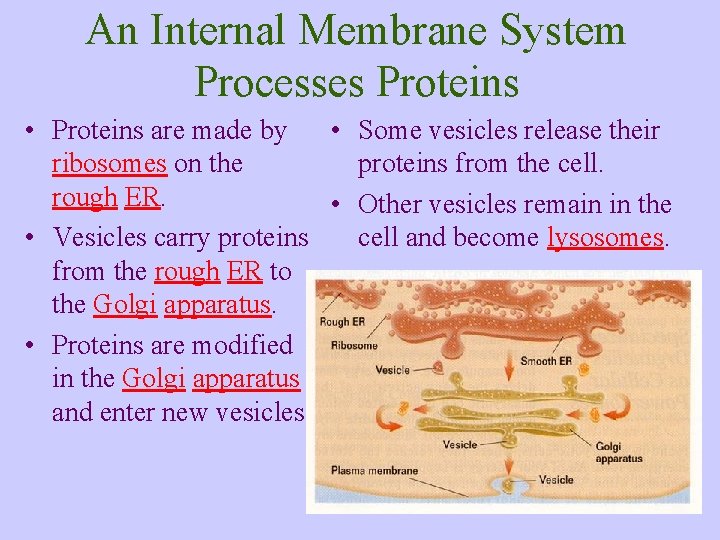
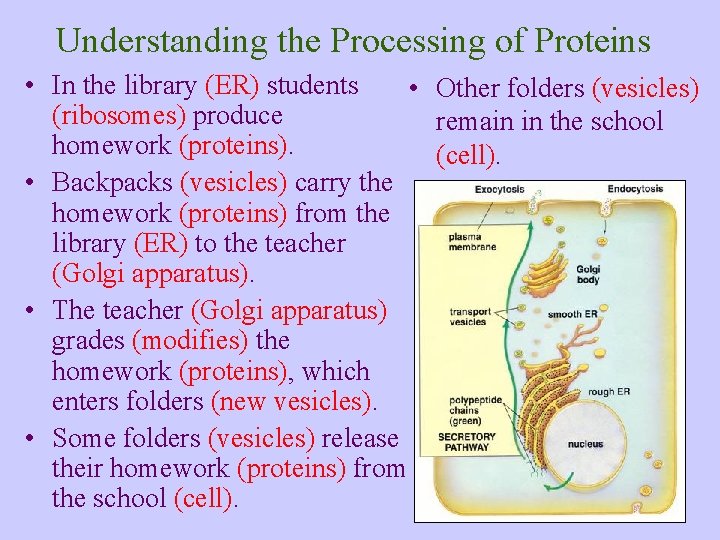
An Internal Membrane System Processes Proteins • Some vesicles release their • Proteins are made by proteins from the cell. ribosomes on the rough ER. • Other vesicles remain in the cell and become lysosomes. • Vesicles carry proteins from the rough ER to the Golgi apparatus. • Proteins are modified in the Golgi apparatus and enter new vesicles.
Understanding the Processing of Proteins • In the library (ER) students • Other folders (vesicles) (ribosomes) produce remain in the school homework (proteins). (cell). • Backpacks (vesicles) carry the homework (proteins) from the library (ER) to the teacher (Golgi apparatus). • The teacher (Golgi apparatus) grades (modifies) the homework (proteins), which enters folders (new vesicles). • Some folders (vesicles) release their homework (proteins) from the school (cell).
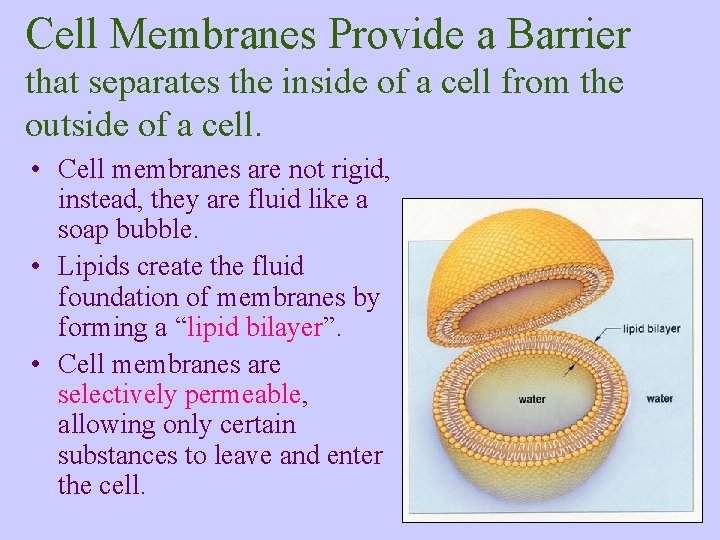
Cell Membranes Provide a Barrier that separates the inside of a cell from the outside of a cell. • Cell membranes are not rigid, instead, they are fluid like a soap bubble. • Lipids create the fluid foundation of membranes by forming a “lipid bilayer”. • Cell membranes are selectively permeable, allowing only certain substances to leave and enter the cell.
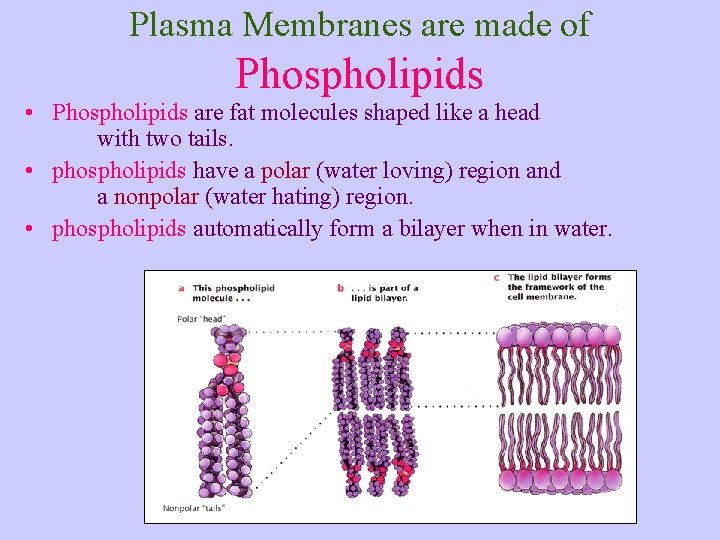
Plasma Membranes are made of Phospholipids • Phospholipids are fat molecules shaped like a head with two tails. • phospholipids have a polar (water loving) region and a nonpolar (water hating) region. • phospholipids automatically form a bilayer when in water.
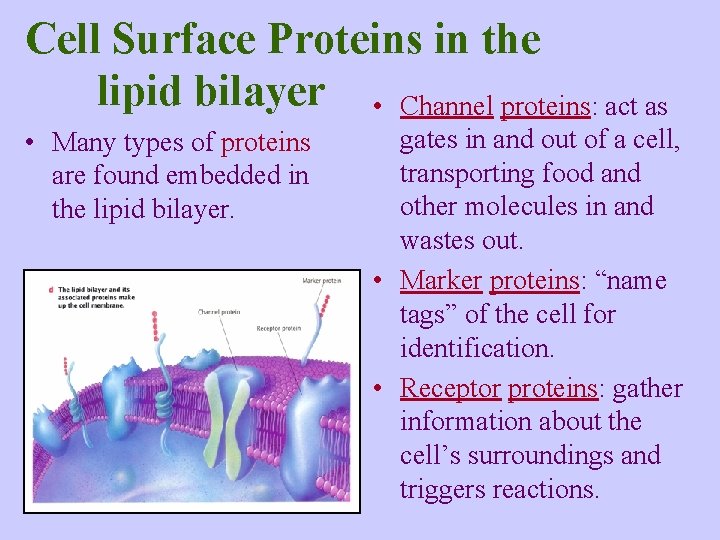
Cell Surface Proteins in the lipid bilayer • Channel proteins: act as • Many types of proteins are found embedded in the lipid bilayer. gates in and out of a cell, transporting food and other molecules in and wastes out. • Marker proteins: “name tags” of the cell for identification. • Receptor proteins: gather information about the cell’s surroundings and triggers reactions.
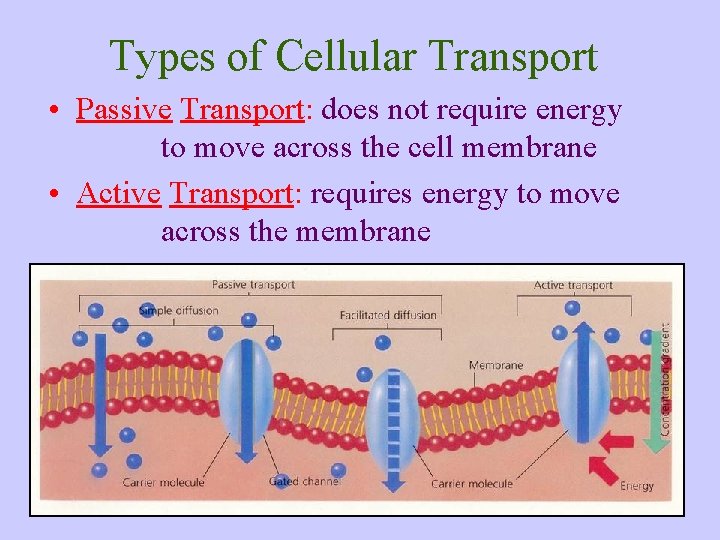
Types of Cellular Transport • Passive Transport: does not require energy to move across the cell membrane • Active Transport: requires energy to move across the membrane
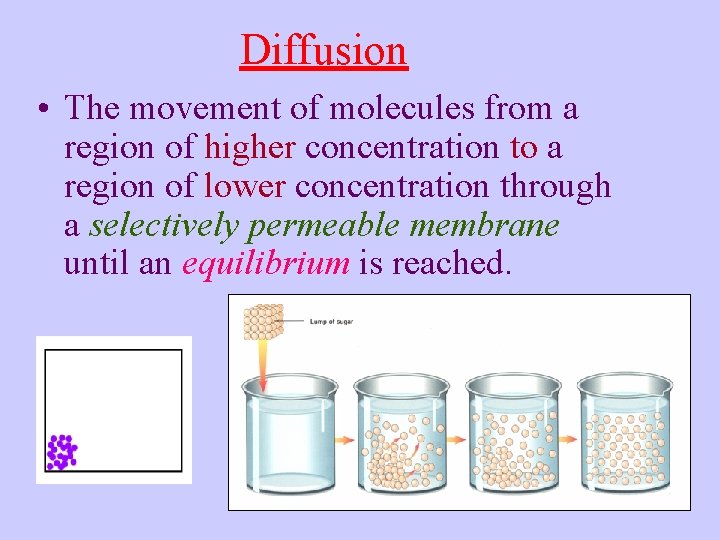
Diffusion • The movement of molecules from a region of higher concentration to a region of lower concentration through a selectively permeable membrane until an equilibrium is reached.
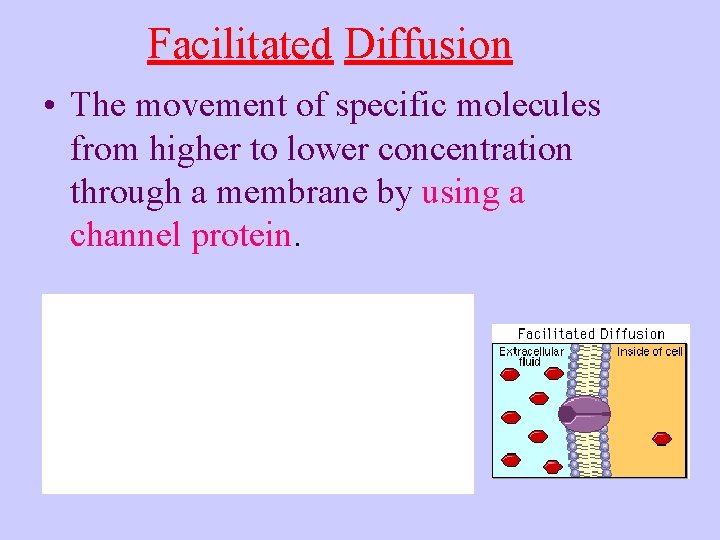
Facilitated Diffusion • The movement of specific molecules from higher to lower concentration through a membrane by using a channel protein.
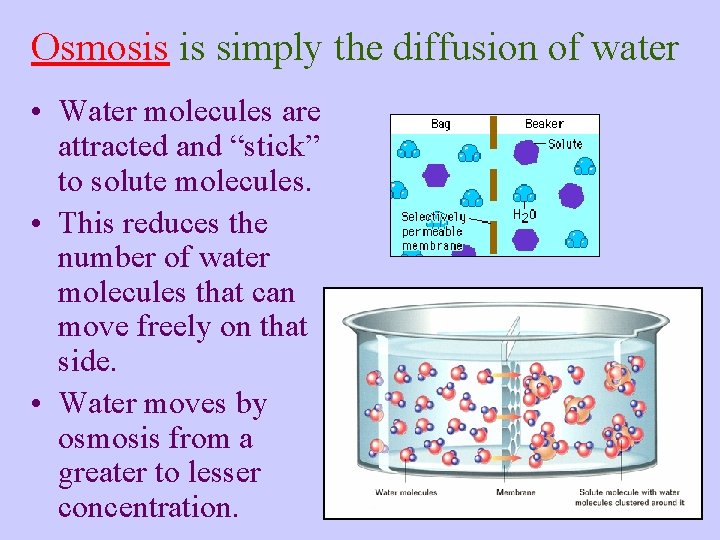
Osmosis is simply the diffusion of water • Water molecules are attracted and “stick” to solute molecules. • This reduces the number of water molecules that can move freely on that side. • Water moves by osmosis from a greater to lesser concentration.
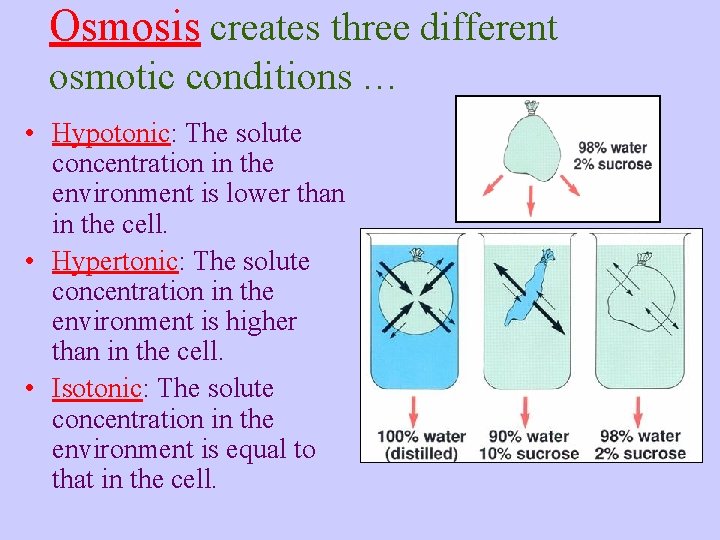
Osmosis creates three different osmotic conditions … • Hypotonic: The solute concentration in the environment is lower than in the cell. • Hypertonic: The solute concentration in the environment is higher than in the cell. • Isotonic: The solute concentration in the environment is equal to that in the cell.
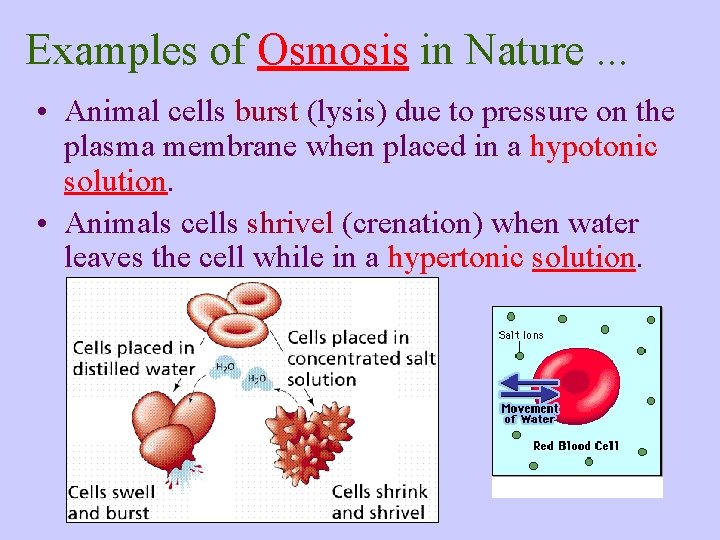
Examples of Osmosis in Nature. . . • Animal cells burst (lysis) due to pressure on the plasma membrane when placed in a hypotonic solution. • Animals cells shrivel (crenation) when water leaves the cell while in a hypertonic solution.
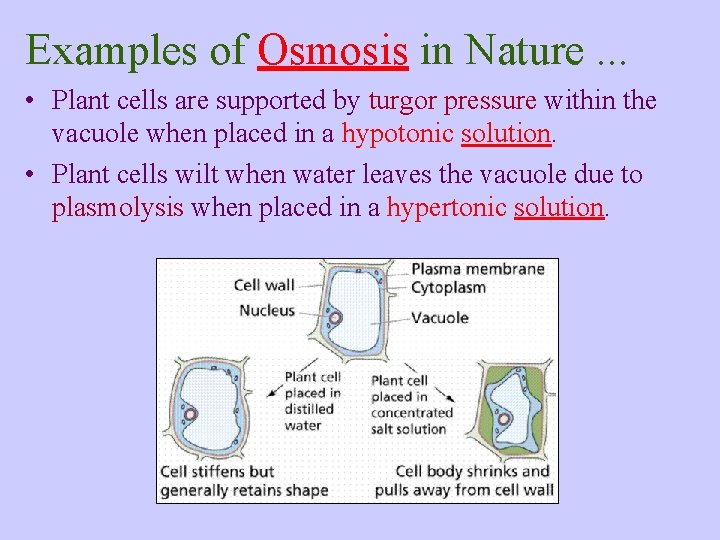
Examples of Osmosis in Nature. . . • Plant cells are supported by turgor pressure within the vacuole when placed in a hypotonic solution. • Plant cells wilt when water leaves the vacuole due to plasmolysis when placed in a hypertonic solution.
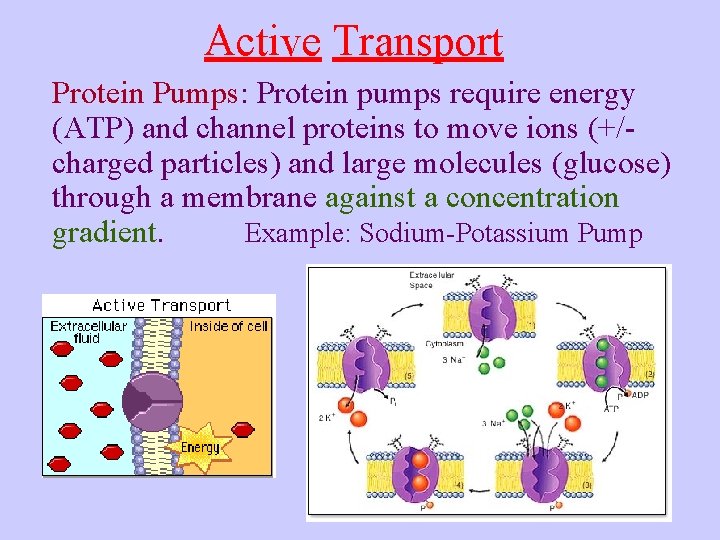
Active Transport Protein Pumps: Protein pumps require energy (ATP) and channel proteins to move ions (+/charged particles) and large molecules (glucose) through a membrane against a concentration gradient. Example: Sodium-Potassium Pump
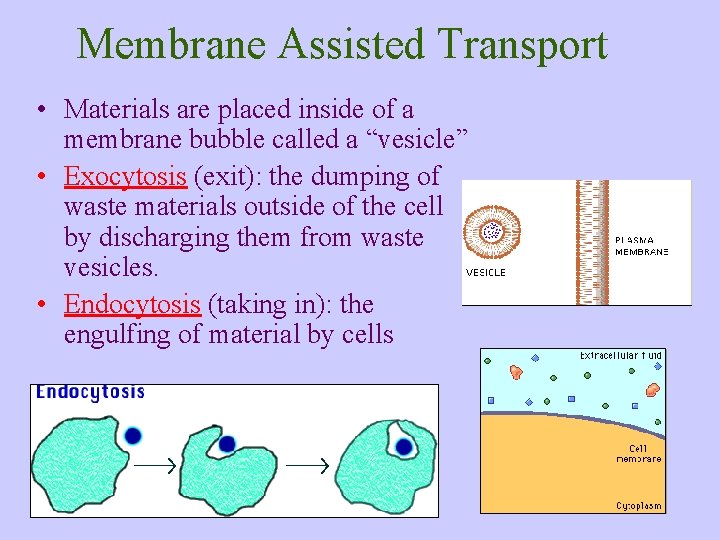
Membrane Assisted Transport • Materials are placed inside of a membrane bubble called a “vesicle” • Exocytosis (exit): the dumping of waste materials outside of the cell by discharging them from waste vesicles. • Endocytosis (taking in): the engulfing of material by cells