
Understanding Health Economics Edina Sinanovic Health Economics Unit
- Slides: 27
Understanding Health Economics Edina Sinanovic Health Economics Unit University of Cape Town May 2011 Copyright: Dr Edina Sinanovic
Outline The scope of health economics n Health Economics Unit, UCT n – research – teaching n Economic evaluation studies Copyright: Dr Edina Sinanovic
Definition of economics n Economics is the study of how people and society end up choosing, with or without the use of money, to employ scarce productive resources that could have alternative uses, to produce various commodities and distribute them for consumption, now or in the future, among various persons and groups in society. It analyses the costs and benefits of improving patterns of resource allocation (Samuelson 1947) Copyright: Dr Edina Sinanovic
Definition of health economics n Health economics can be defined broadly as the application of theories, concepts and techniques of economics to the health sector (Williams 1987) Copyright: Dr Edina Sinanovic
Nature of the market for health care What is a market? n Theory of perfect competition n Many of the conditions for perfect competition are not met in the market for health care, i. e. there are “market imperfections” (or areas where market fails to operate efficiently in allocating health care resources) n Copyright: Dr Edina Sinanovic
Imperfections in the health care market Externalities n Public goods n Consumer rationality and merit goods n Barriers to entry and exit n Economies of scale and monopolies n Imperfect information n Risk and uncertainty n Copyright: Dr Edina Sinanovic
Concerns of health economics n n n The allocation of resources between various health-promoting activities The quantity of resources used in health delivery The organisation and funding of health institutions The efficiency with which resources are allocated and used for health purposes The effects of preventive, curative and rehabilitative health services on individuals and society Copyright: Dr Edina Sinanovic
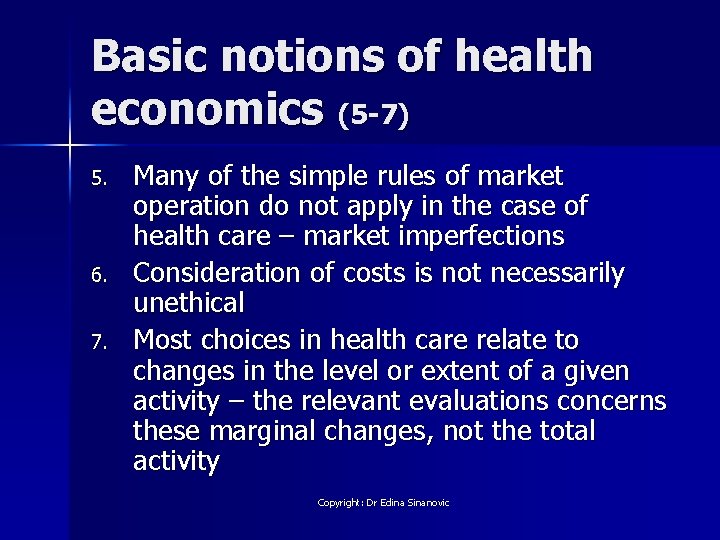
Basic notions of health economics (1 -4) 1. 2. 3. 4. Human wants are unlimited but resources are scarce Economics is as much about benefits as it is about costs The costs of health care not restricted to the health sector (community care, cost of patient time) Choices in health care (i. e. health planning and treatment) inescapably involve value judgments Copyright: Dr Edina Sinanovic
Basic notions of health economics (5 -7) 5. 6. 7. Many of the simple rules of market operation do not apply in the case of health care – market imperfections Consideration of costs is not necessarily unethical Most choices in health care relate to changes in the level or extent of a given activity – the relevant evaluations concerns these marginal changes, not the total activity Copyright: Dr Edina Sinanovic
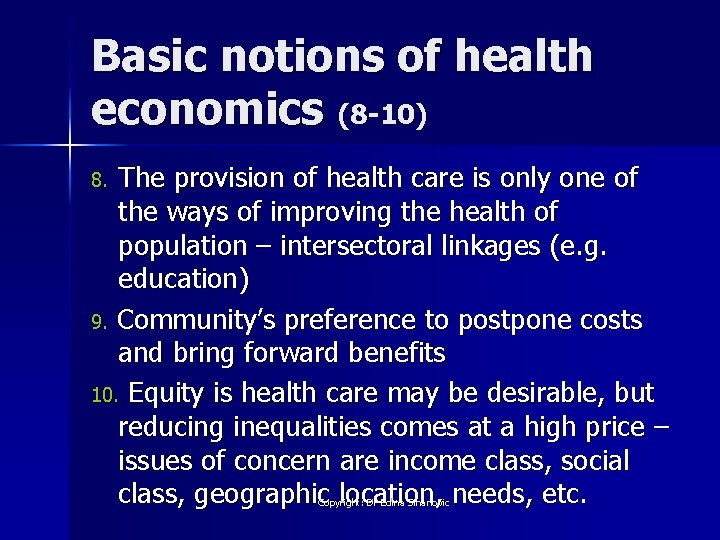
Basic notions of health economics (8 -10) The provision of health care is only one of the ways of improving the health of population – intersectoral linkages (e. g. education) 9. Community’s preference to postpone costs and bring forward benefits 10. Equity is health care may be desirable, but reducing inequalities comes at a high price – issues of concern are income class, social class, geographic location, needs, etc. 8. Copyright: Dr Edina Sinanovic
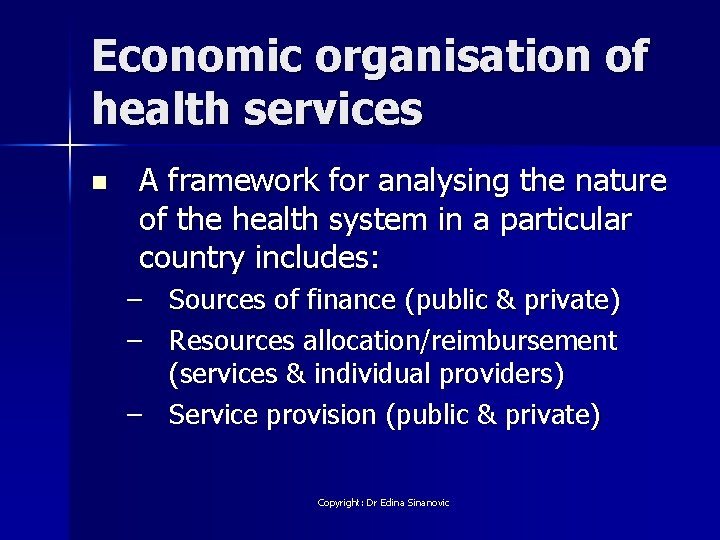
Economic organisation of health services n A framework for analysing the nature of the health system in a particular country includes: – Sources of finance (public & private) – Resources allocation/reimbursement (services & individual providers) – Service provision (public & private) Copyright: Dr Edina Sinanovic
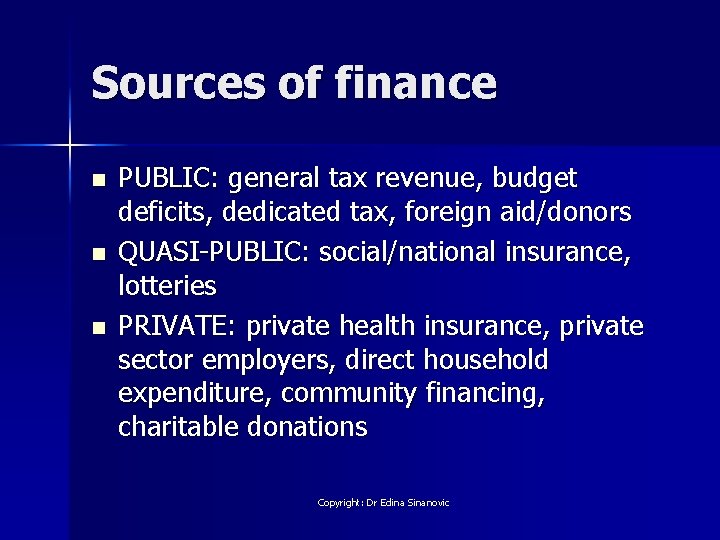
Sources of finance n n n PUBLIC: general tax revenue, budget deficits, dedicated tax, foreign aid/donors QUASI-PUBLIC: social/national insurance, lotteries PRIVATE: private health insurance, private sector employers, direct household expenditure, community financing, charitable donations Copyright: Dr Edina Sinanovic
Health care policy objectives Cost containment (macro-economic cost control) n Efficiency (micro-economic cost control) n Equity (distributional objectives) n Copyright: Dr Edina Sinanovic
Service provision n n PUBLIC: hospitals, primary care (clinics, community health centres, environmental services, school health services, etc), other health services PRIVATE: private hospitals, industry-specific services, independent practitioners, managed care groups, retail pharmacies, NGOs, church related facilities, traditional healers Copyright: Dr Edina Sinanovic
Public/private mix debate n n Public/private mix in health care financing and provision (a conceptual framework) Two key reasons for public/private mix: – The general trend in economic policies towards increasing the role of the private sector (international organizations’ influence in developing countries) – Economic difficulties in many countries with limited resources available to government for financing and providing health services Copyright: Dr Edina Sinanovic
Regulation vs. incentives n n n Regulation of price Regulation of quantity and distribution Regulation of quality of health services n n Free or subsidised continuing education Free provision of supplies such as vaccines, condoms… Access to drugs at state tender prices Capitation vs. FFS Contracting out Copyright: Dr Edina Sinanovic n
Public/private interactions (some examples) n n n Private sector providers operating out of spare facilities in the public sector Medical schemes contracting with public providers at special fee for service rates Provincial administrations contracting with private providers for the delivery of specific services to the public sector patients Contracts for sessional work Public-private partnerships with NGOs in the provision of TB treatment Copyright: Dr Edina Sinanovic
Summary (1) n n n Health economics is a sub discipline of economics applied in health sector It is not only important to consider sources of finance for health care but also how services are provided and the methods of financial allocation and reimbursement Choice of payment has implications for equity, efficiency and cost containment, and incentives for providers Copyright: Dr Edina Sinanovic
Summary (2) n n n Private sector regarded as a resource for meeting the health needs of the population Important to determine the extent and role of the existing private sector Appropriate regulation and incentive mechanisms (the international trend is to pursue incentives rather than regulation) Copyright: Dr Edina Sinanovic
Health Economics Unit, UCT Established in 1990 n Key research focuses on three themes: n – Health systems and health equity research – Health financing – Economic evaluation of disease-priority areas n Teaching Copyright: Dr Edina Sinanovic
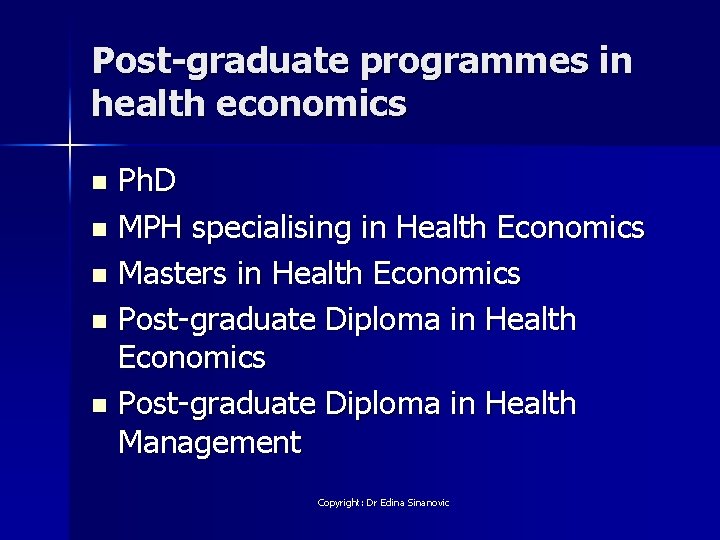
Post-graduate programmes in health economics Ph. D n MPH specialising in Health Economics n Masters in Health Economics n Post-graduate Diploma in Health Management n Copyright: Dr Edina Sinanovic
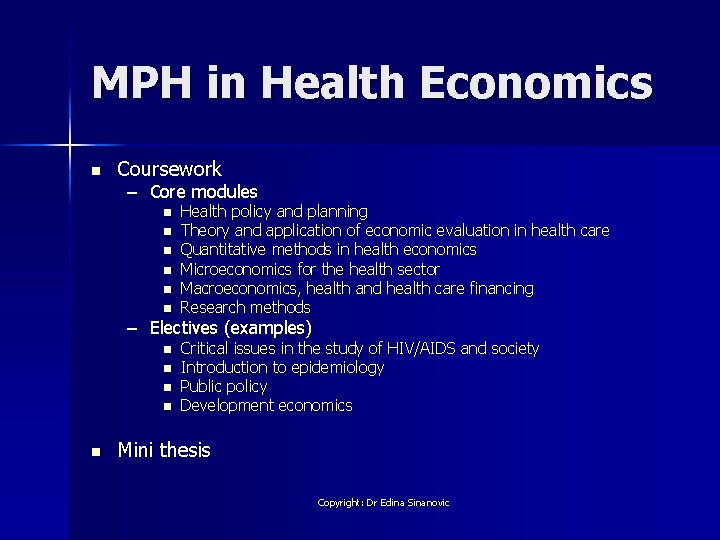
MPH in Health Economics n Coursework – Core modules n n n Health policy and planning Theory and application of economic evaluation in health care Quantitative methods in health economics Microeconomics for the health sector Macroeconomics, health and health care financing Research methods – Electives (examples) n n n Critical issues in the study of HIV/AIDS and society Introduction to epidemiology Public policy Development economics Mini thesis Copyright: Dr Edina Sinanovic
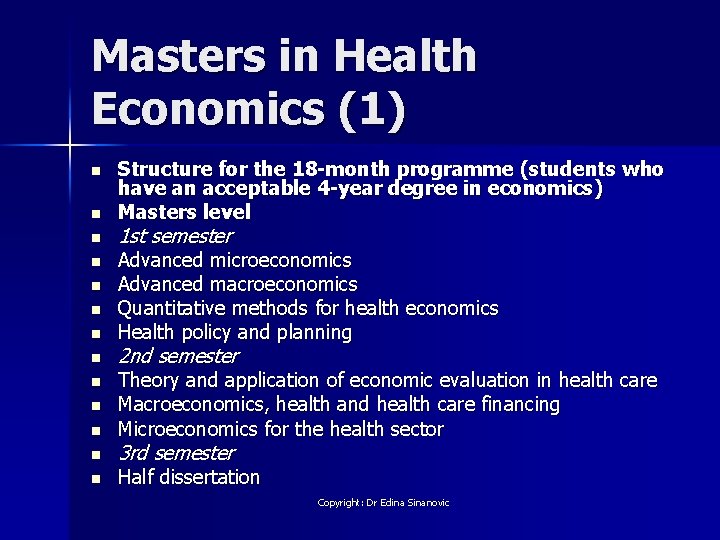
Masters in Health Economics (1) n n n n Structure for the 18 -month programme (students who have an acceptable 4 -year degree in economics) Masters level 1 st semester Advanced microeconomics Advanced macroeconomics Quantitative methods for health economics Health policy and planning 2 nd semester Theory and application of economic evaluation in health care Macroeconomics, health and health care financing Microeconomics for the health sector 3 rd semester Half dissertation Copyright: Dr Edina Sinanovic
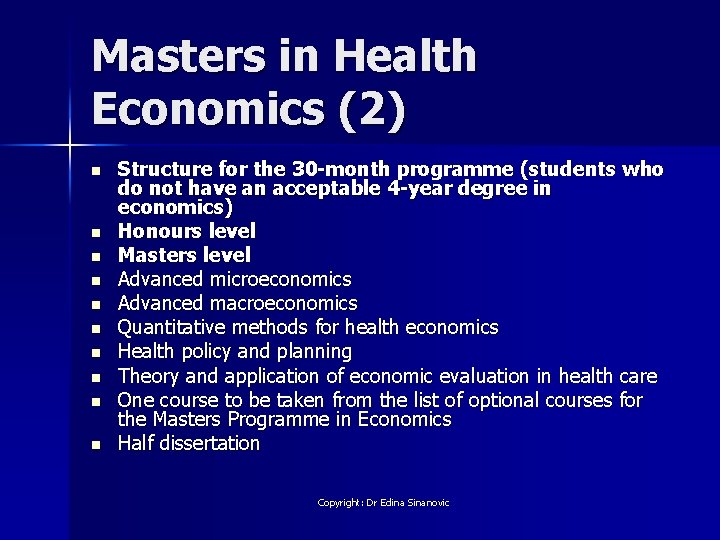
Masters in Health Economics (2) n n n n n Structure for the 30 -month programme (students who do not have an acceptable 4 -year degree in economics) Honours level Masters level Advanced microeconomics Advanced macroeconomics Quantitative methods for health economics Health policy and planning Theory and application of economic evaluation in health care One course to be taken from the list of optional courses for the Masters Programme in Economics Half dissertation Copyright: Dr Edina Sinanovic
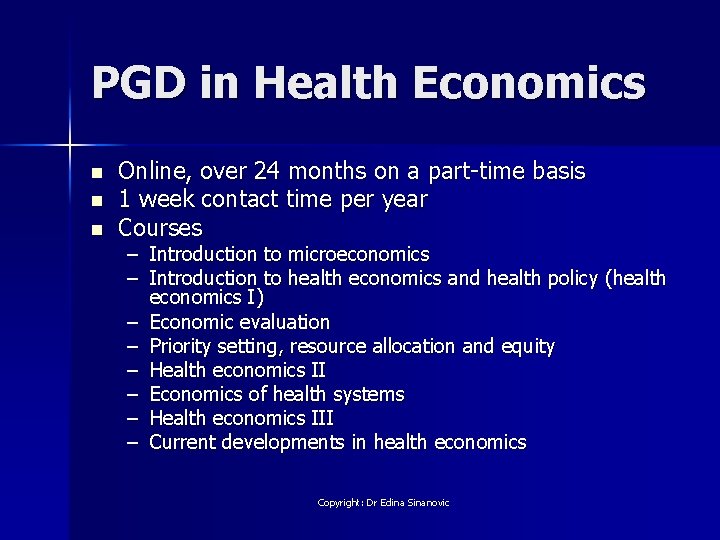
PGD in Health Economics n n n Online, over 24 months on a part-time basis 1 week contact time per year Courses – Introduction to microeconomics – Introduction to health economics and health policy (health economics I) – Economic evaluation – Priority setting, resource allocation and equity – Health economics II – Economics of health systems – Health economics III – Current developments in health economics Copyright: Dr Edina Sinanovic
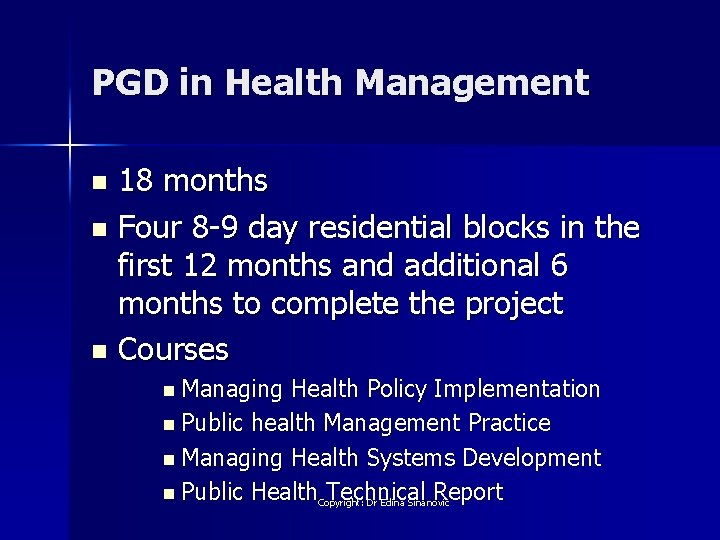
PGD in Health Management 18 months n Four 8 -9 day residential blocks in the first 12 months and additional 6 months to complete the project n Courses n n Managing Health Policy Implementation n Public health Management Practice n Managing Health Systems Development n Public Health. Copyright: Technical Report Dr Edina Sinanovic
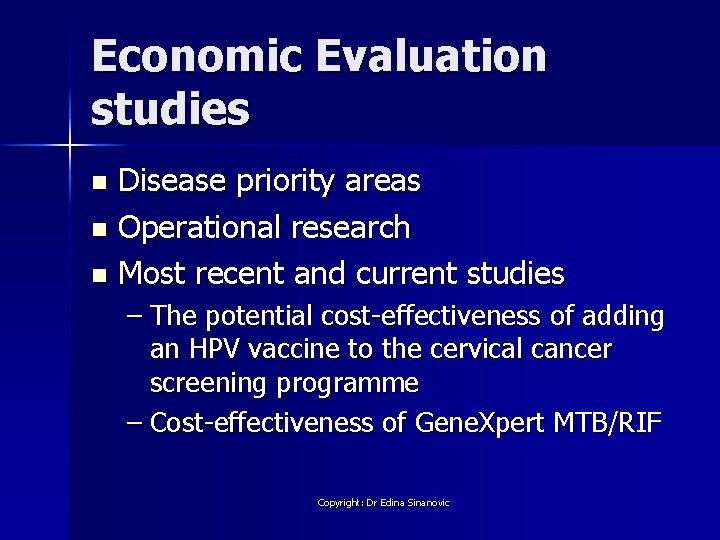
Economic Evaluation studies Disease priority areas n Operational research n Most recent and current studies n – The potential cost-effectiveness of adding an HPV vaccine to the cervical cancer screening programme – Cost-effectiveness of Gene. Xpert MTB/RIF Copyright: Dr Edina Sinanovic