
UNDERSTANDING GROUP BEHAVIOUR IN TEAM BUILDING Imokhede Dotun
UNDERSTANDING GROUP BEHAVIOUR IN TEAM BUILDING Imokhede Dotun Agbi NDIC 2016 1
PART 1 • • Introduction Definition of a Group Stages of Group Development Why do People join Groups Common attitudes and Values Characteristics of Groups Types of Groups 2
Part Two • Team Building • Types of Teams • Team Dynamics • Team Goals • Leadership Roles • Building an Effective Team • Conclusion 3
INTRODUCTION • The terms ‘Groups’ and ‘Teams’ are generally used interchangeably, even though there are differences. A team can be regarded as a group of people who come together for a defined task, while a Group usually is made up of a larger number of people who interacts for a purpose. A team is a small group of people with complementary skills who work actively together to achieve a common purpose for which they hold themselves collectively accountable. • One of the major challenges in any organization is to turn a Group into a high-performance Team that can function well in any setting, hence the subject matter ‘’Understanding Group Behaviour in Team Building’’. 4

• This session will discuss Group behaviour, Structures and Characteristic which could enable us to build effective Teams. • Team Building is a managerial tool for job design in which employees are viewed as members of interdependent teams instead as individual workers. • Diversity within Groups and Teams can be used to build an effective and high performing Team that will be able to successfully complete any given task. • The importance of Groups and the inevitability of being in them make Groups one of the most important factors in an Organization. All day long we interact first in one Group and then in another. We learn in Groups formed in the same classroom, we work in Groups, we interact with friends in Groups, and we spend much of our leisure time in Groups. 5
• In fact, if a being from outer space conducted a study of the people of the Earth, Group membership would probably be the dominant characteristic noted. ” • For this reason, understanding Group Dynamics is a measure to better understand individual behaviours in building an effective teams. 6
DEFINITION OF A GROUP • Currently there is no universal definition of what constitutes a Groups can have varying numbers of members, communication styles, and structures. Research has identified few common requirements contributing to the recognition of individuals working in a collaborative environment to be considered a “Group“ • Our approach to describing a Group for the purpose of understanding Group behaviour in Team Building will be that, a Group i: a set of people who: • are engaged in frequent interactions 7
• are defined by others as a “Group” • share beliefs, values, and norms about areas of common interest, • define themselves as a Group, and • come together to work on common tasks and for agreed purposes. In summary, a Group is a collection of individuals who have relationship with one another that make them interdependent to some significant extent. 8
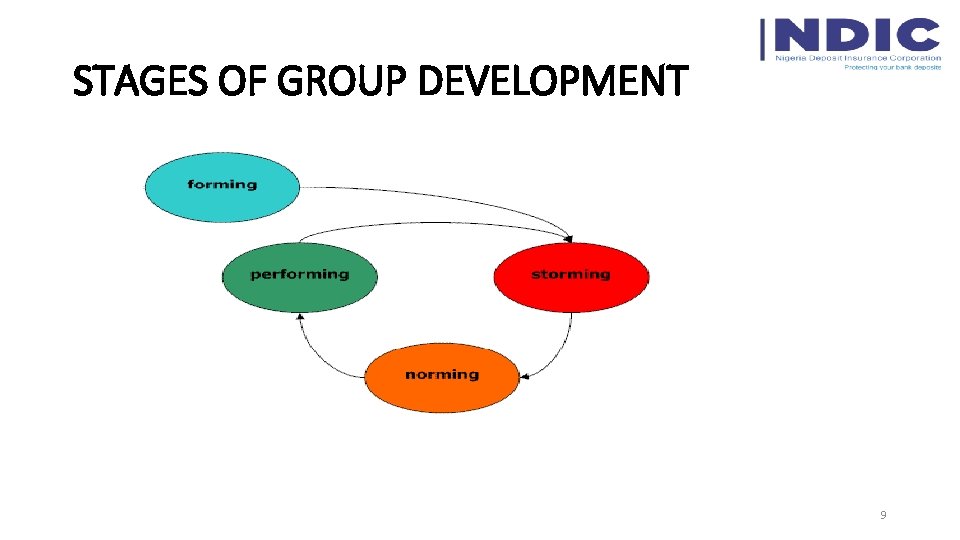
STAGES OF GROUP DEVELOPMENT 9

10
4. Performing. This is the stage where the group is fully functioning and devoted to effectively accomplishing the tasks agreed on in the norming stage. 5. Adjourning. This represents the end of the group, which in ongoing, permanent groups will never be reached. However, for project teams or task forces with a specific objective, once the objective is accomplished, the group will disband or have a new composition, and the stages will start over again. 11
WHY DO PEOPLE JOIN GROUPS • People join Groups for many reasons. One major reason is that Group membership often results in some form of need satisfaction on the part of an individual, such as; • Companionship – groups provide members with the opportunity of simply being in the company of other people. • Survival and Security – From an historic or evolutionary perspective our ancestors would partake in group experiences for hunting and defence. 12
• Affiliation and Status – membership into various Groups can provide individuals with certain social status' or security. • Power and Control – with Group membership, comes the opportunity for leadership roles; individuals who feel they need to exert their power and opinions over others can have such experiences within group settings. • Achievement – Groups have the capability to achieve more than individuals acting alone. • Organizations typically form Groups in order to accomplish work related tasks; however, as a member of a work Group you may unintentionally reap the numerous benefits independent of the original Group put up. 13
GROUP CHARACTERISTICS Common requirements contributing to the recognition of individuals working in a collaborative environment considered to be a “Group" • Interdependence: In order for an individual of the collective to accomplish his or her part in the assigned task he/she depends to some degree on the outputs of other members of the Group. • Social interaction: In order to accomplish the goal some form of verbal or nonverbal communication is required to take place amongst the members of the collective. 14
• Perception of a Group: All members of the collective must agree they are, in fact, part of the Group. • Commonality of Purpose: All the members of the collective come together to serve or attain a common goal. • Favouritism: Members of the same group tend to be positively prejudiced toward other members and tend to discriminate in their favour. Additional characteristics need to be identified in order for a collective of individuals to be categorized as a Group includes: working the same shifts, shared physical work locations and reporting to the same manager. However the commonalities of the multiple definitions reviewed suggest that the definition of a group is based on the interdependence of people who come together to accomplish a common goal. 15
TYPE OF GROUPS Types of groups are routinely distinguished by the work that the group does: • Production Groups consist of front line employees who produce some tangible output. Autonomous production Groups are self-directed or selfmanaging while semi-autonomous production groups typically have a dedicated supervisor who oversees all operations. • Service Groups consist of employees that work with customers on a repeated basis, such as airline teams, maintenance groups, sales groups, call centres, etc. • Management Groups consist of an executive or senior manager along with managers that report directly to him/her. Management groups are often able to organize themselves towards goals such as policy making, budgeting, staffing, and planning. 16
• Project Groups are generally cross-function Group of individuals who are brought together for the duration of a specific time-limited project. Project Groups are usually disbanded once the project is completed. • Advisory Groups consist of employees that work outside of, but parallel with, production processes. Examples include quality circles, selection committees, or other advisory groups pulled together to make recommendations to an organization. 17
Part Two • People in every workplace talk about building the Team, working as a Team but few understand how to create the experience of Team work or how to develop an effective Team. Belonging to a Team, in the broadest sense, is a result of feeling being part of something larger than yourself. It has a lot to do with your understanding of the mission and objective of your organization. • In a team-oriented environment, members contribute to the overall success of the organization. You work with fellow members of the organization to produce these results. Even though you have a specific job function and you belong to a specific department, you are unified with other organization members to accomplish the overall objectives. The bigger picture drives your actions; your function exists to serve the bigger picture. 18
CLASSES OF TEAMS The two classes of Teams are • Independent and • Interdependent Teams A distinction is usually drawn between “Independent" and “Interdependent“ • Independent Teams are the most common form of work groups on the business scene. Like a dependent Team each person is responsible for his or her own main area. But unlike the dependent level, the supervisor or manager tends not to function like the controlling boss. Instead, staff members work on their own assignments with general direction and minimal supervision. However, in sports, a Rugby Team is clearly an interdependent team, no significant task can be accomplished without the help and cooperation of any of the members. No rugby player, no matter how talented, has ever won a game by playing alone. 19
TEAM DYNAMICS When assembling a Team it is very important to consider the overall dynamic of the Team. Five dynamics are fundamental to Team success: 1. The Team Member: Successful teams are made up of a collection of effective individuals. These are people who are experienced, have problem solving ability, are open to addressing the problem, and are action oriented. 2. Team Relationships: For a team to be successful the members of the Team must be able to give and receive feedback. 3. Team Problem Solving: An effective Team depends on how focused and clear the goal of the team is. A relaxed, comfortable and accepting environment and finally, open and honest communication are required. 4. Team Leadership: Effective team leadership depends on leadership competencies. A competent leader is: focused on the goal, ensures a collaborative climate, builds confidence of team members, sets priorities, demonstrates sufficient “know-how” and manages performance through feedback. 5. Organizational Environment: The climate and culture of the organization must be conducive to team behavior. 20
TEAM GOALS • The overall goals of Team building are to increase the Teams’ understanding of Team dynamics and improve how the team works together. • Unlike working as a group, working as a team incorporates group accountability rather than individual accountability and results in a collective work product. • Team building encourages the team approach to working on a project. There are many advantages to this approach. These advantages include the following: üIncreased flexibility in skills and abilities üMore productive than work groups with individual mindsets üMore beneficial in times of organizational change üEncourage both individual and team development and improvement üFocuses on group goals to accomplish more beneficial tasks üImproved range of team building objectives such as collaboration, communication and increased creative or flexible thinking. 21
LEADERSHIP ROLES Successful Team leaders frequently contain six of the same leadership abilities: • A team leader is usually goal-oriented to keep the team on track. • They must promote a safe environment where members can openly discuss issues. • A leader must build confidence amongst members by building and maintaining trust and offering the members responsibilities. • A leader should be technically competent in matters relating to team tasks and goals. • It is important for a team leader to set a manageable list of priorities for the team to keep members focused. • Finally, leaders should offer clear performance expectations by recognizing and rewarding excellent performance, and provide feedback to others. 22
BUILDING AN EFFECTIVE TEAM The most important Team characteristics are the Team goals and members capabilities. For effective Team Building, you must; • Define your Goals. The first step toward achieving the results you want is to make your objectives as concrete as possible. Get clear about exactly what you want before you set your team loose. • Assign Roles based on Strengths. Once you've articulated the job to be carried out, determine what type of skills needed to achieve it; then identify team members who can provide the support you need. • Get Feedback. After you've assembled your team, define everyone's responsibilities, give them a road map for success and ask for their feedbacks. Does each person understand the ultimate goal of the project and their individual roles? To assure that everyone is on the same page, address any confusion before putting your plan into action. 23
• Confirm buy-in. Now that you've articulated your goals and communicated the task, make sure everyone is on board. If you encounter resistance from the entire team, you'll need to revisit your game plan before proceeding. • Communicate results. Regardless of how carefully constructed your plan is, you are bound to encounter some problems when initially trying to implement it, so do not forget to do regular progress checks. Find out if there any impediments to success. This is where you start learning where the gaps are and begin paving the way for success. 24
CONCLUSION 1. A team is a group whose members work intensively with each other to achieve a specific goal while in a group, the dominant feature is that of interaction for a purpose. 2. Membership of most Groups are based on interest for a purpose while Teams are constituted based on the skills of members. 3. Group adjournment or dissolution is not defined but Teams are disbanded at the end of their tasks. 4. Teams are cohesive, productive and efficient. They do not happen by accident. 25
5. Teams are efficient because tasks are assigned in a way that makes each member responsible for task assigned. 6. Groups are dominated by most vocal, most aggressive or most popular personality. 7. Managers play an essential role in developing and leading teams in an organization. 26

Thank you for listening. 27
- Slides: 27