
Understanding Greenhouse Gas Emissions from Unconventional Natural Gas
- Slides: 18
Understanding Greenhouse Gas Emissions from Unconventional Natural Gas Production Karin Ritter and Amy Emmert, American Petroleum Institute Miriam Lev-On, The LEVON Group, LLC Terri Shires, URS Corporation 20 th International Emissions Inventory Conference 14 -16 August 2012, Tampa, Florida
Emerging Role of New Natural Gas Production Techniques Natural gas produced from shale formations is a “paradigm shift” for U. S. energy supplies In 2005, shale gas accounted for only 4% of U. S. natural gas production By 2035, EIA projects that shale and tight gas production combined will account for over 70% Shale gas and tight gas produced through hydraulic fracturing is essential to the growth of U. S. energy supplies 2
U. S. Natural Gas Production History and Projection Estimates 3
Methane Emissions Estimate in National GHG Inventory In 2011 EPA published the 2009 national GHG inventory, which included revised methods for methane emissions estimates from natural gas The revised methods focused on methane emissions estimate for unconventional natural gas production The revised estimate was based on data from four sources representing approximately 8, 800 wells 4
Impact of Methane Emissions Recalculations on Natural Gas Systems Emissions Estimates 5
Impact of EPA’s Revised Emission Factors For the 2009 inventory, EPA split the estimation of emissions from producing gas wells into conventional (i. e. without fracturing), and unconventional (i. e. , with hydraulic fracturing). Based on the limited data available to EPA, gas wells with hydraulic fracturing activities were assigned an emission factor that is over 3, 000 times higher than the one used for gas wells without hydraulic fracturing. The new data led many researchers to reassess the lifecycle GHG emissions of natural gas produced by unconventional techniques such as hydraulic fracturing 6
API/ANGA Survey Objective: Ø Enhance data availability for LCA studies, inventories and other assessments that support national policy development Timeframe Ø Data collection (Aug. – Nov, 2011); Analysis (Jan April 2012) Approach Ø Gather activity data from unconventional natural gas production to improve its characterization in nationwide GHG inventory 7
Gas Well Data API/ANGA survey activity data • over 20 companies covering nearly 91, 000 wells and 19 of the 21 producing geological basins. Represents the most comprehensive data set ever compiled for natural gas operations • A much more accurate picture of operations and emissions 8
Comparison of EPA to API/ANGA Gas Well Count Data by AAPG Basin 9
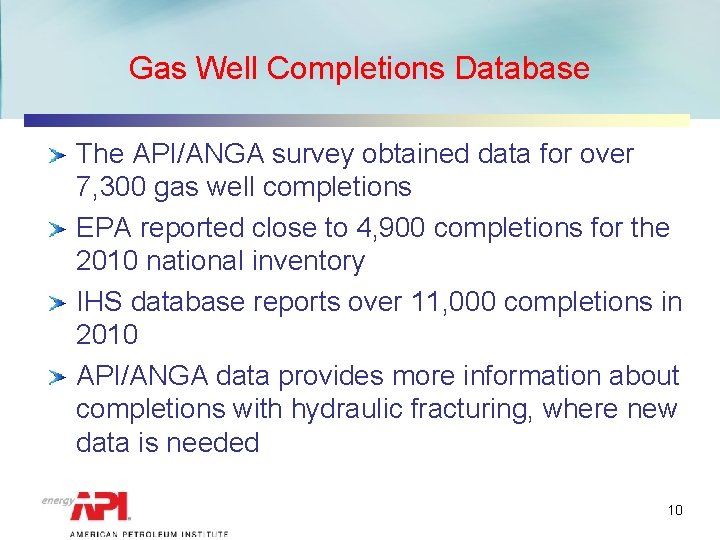
Gas Well Completions Database The API/ANGA survey obtained data for over 7, 300 gas well completions EPA reported close to 4, 900 completions for the 2010 national inventory IHS database reports over 11, 000 completions in 2010 API/ANGA data provides more information about completions with hydraulic fracturing, where new data is needed 10
Comparisons of Gas Well Completions Counts Differences highlight need for consistency of well completions accounting 11
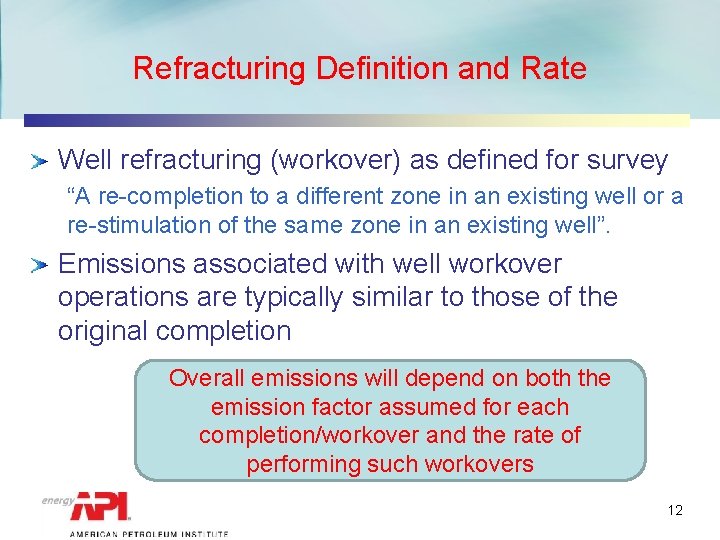
Refracturing Definition and Rate Well refracturing (workover) as defined for survey “A re-completion to a different zone in an existing well or a re-stimulation of the same zone in an existing well”. Emissions associated with well workover operations are typically similar to those of the original completion Overall emissions will depend on both the emission factor assumed for each completion/workover and the rate of performing such workovers 12
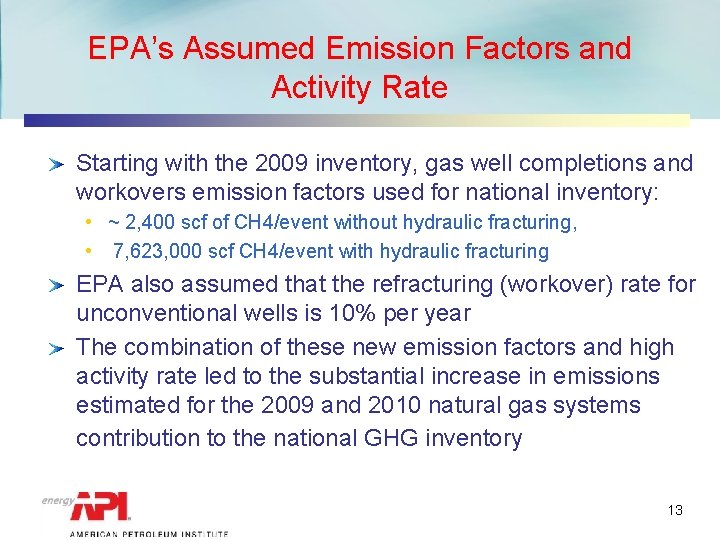
EPA’s Assumed Emission Factors and Activity Rate Starting with the 2009 inventory, gas well completions and workovers emission factors used for national inventory: • ~ 2, 400 scf of CH 4/event without hydraulic fracturing, • 7, 623, 000 scf CH 4/event with hydraulic fracturing EPA also assumed that the refracturing (workover) rate for unconventional wells is 10% per year The combination of these new emission factors and high activity rate led to the substantial increase in emissions estimated for the 2009 and 2010 natural gas systems contribution to the national GHG inventory 13
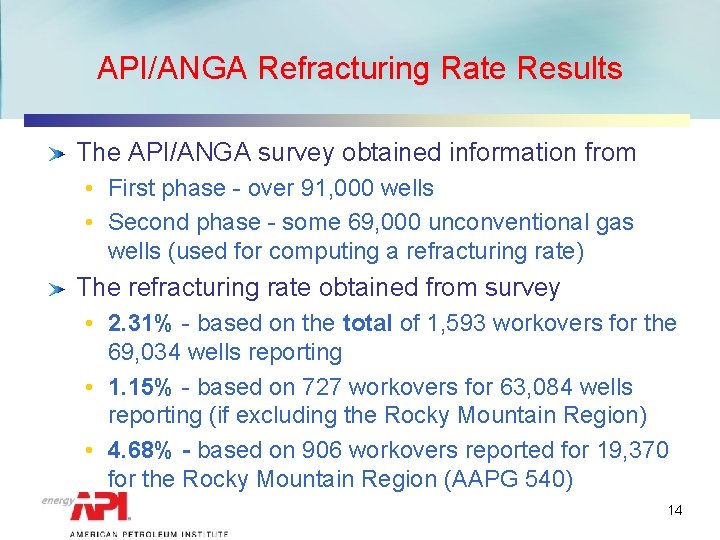
API/ANGA Refracturing Rate Results The API/ANGA survey obtained information from • First phase - over 91, 000 wells • Second phase - some 69, 000 unconventional gas wells (used for computing a refracturing rate) The refracturing rate obtained from survey • 2. 31% - based on the total of 1, 593 workovers for the 69, 034 wells reporting • 1. 15% - based on 727 workovers for 63, 084 wells reporting (if excluding the Rocky Mountain Region) • 4. 68% - based on 906 workovers reported for 19, 370 for the Rocky Mountain Region (AAPG 540) 14
GAS WELL WORKOVER EMISSIONS COMPARISON 15
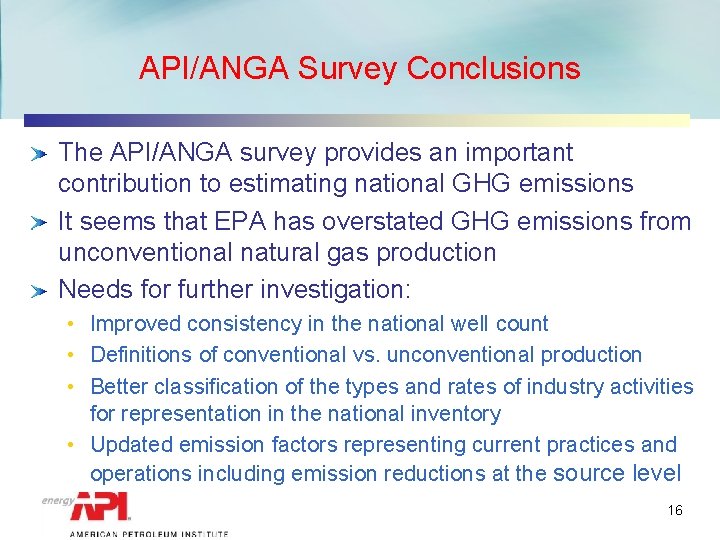
API/ANGA Survey Conclusions The API/ANGA survey provides an important contribution to estimating national GHG emissions It seems that EPA has overstated GHG emissions from unconventional natural gas production Needs for further investigation: • Improved consistency in the national well count • Definitions of conventional vs. unconventional production • Better classification of the types and rates of industry activities for representation in the national inventory • Updated emission factors representing current practices and operations including emission reductions at the source level 16
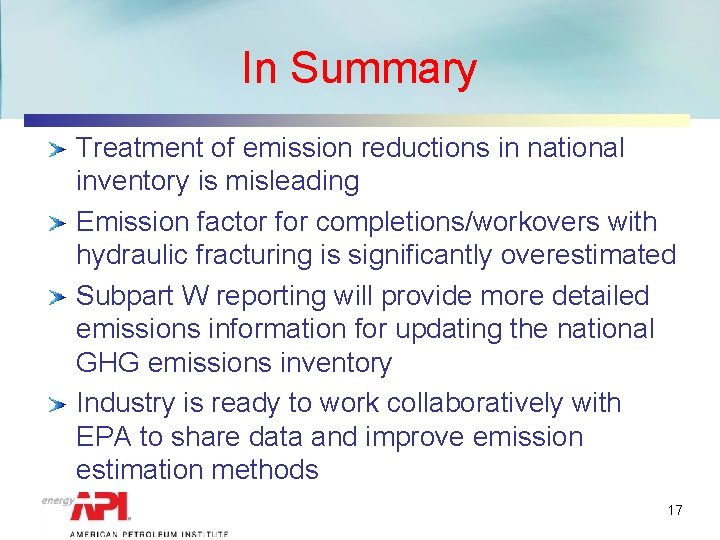
In Summary Treatment of emission reductions in national inventory is misleading Emission factor for completions/workovers with hydraulic fracturing is significantly overestimated Subpart W reporting will provide more detailed emissions information for updating the national GHG emissions inventory Industry is ready to work collaboratively with EPA to share data and improve emission estimation methods 17
Thanks for your attention Further details: Karin Ritter 202 -682 -8472 ritterk@api. org 18