
Understanding Giftedness Elizabeth ShaunessyDedrick Types of Giftedness Screening
Understanding Giftedness Elizabeth Shaunessy-Dedrick • Types of Giftedness • Screening to Identification of Giftedness • Differentiating Instruction for Gifted Learners
Independent Thinking Activity Think of someone who you believe is gifted. List some of the characteristics and behaviors that this person exhibits that you believe are a sign of his/her giftedness.

Areas of Giftedness Intellectual Academic Aptitude Leadership Creative Thinking and Production Visual and Performing arts
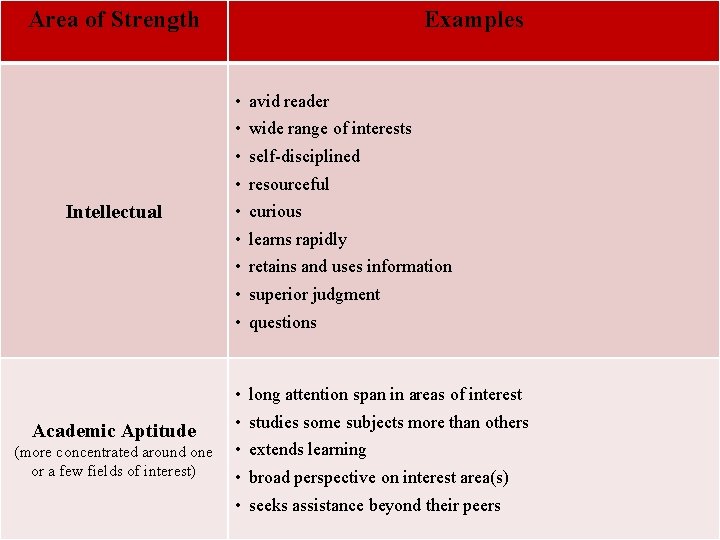
Area of Strength Intellectual Academic Aptitude (more concentrated around one or a few fields of interest) Examples • • • avid reader • • • long attention span in areas of interest wide range of interests self-disciplined resourceful curious learns rapidly retains and uses information superior judgment questions studies some subjects more than others extends learning broad perspective on interest area(s) seeks assistance beyond their peers
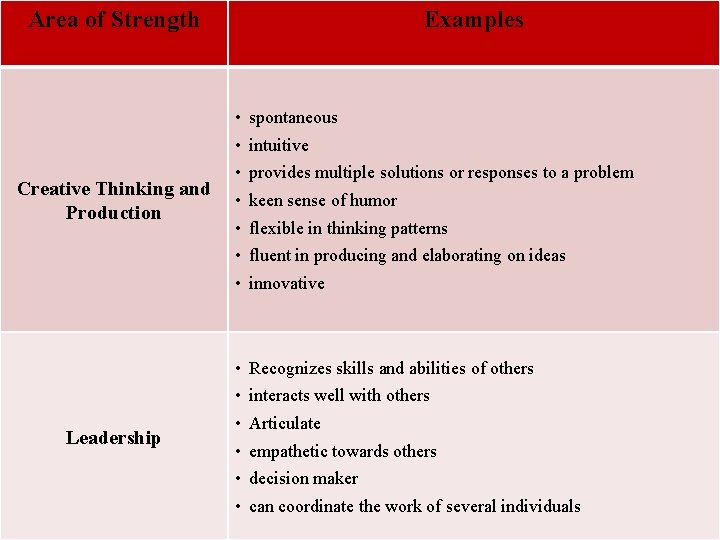
Area of Strength Creative Thinking and Production Leadership Examples • • spontaneous • • • Recognizes skills and abilities of others intuitive provides multiple solutions or responses to a problem keen sense of humor flexible in thinking patterns fluent in producing and elaborating on ideas innovative interacts well with others Articulate empathetic towards others decision maker can coordinate the work of several individuals
What is Gifted in Florida?
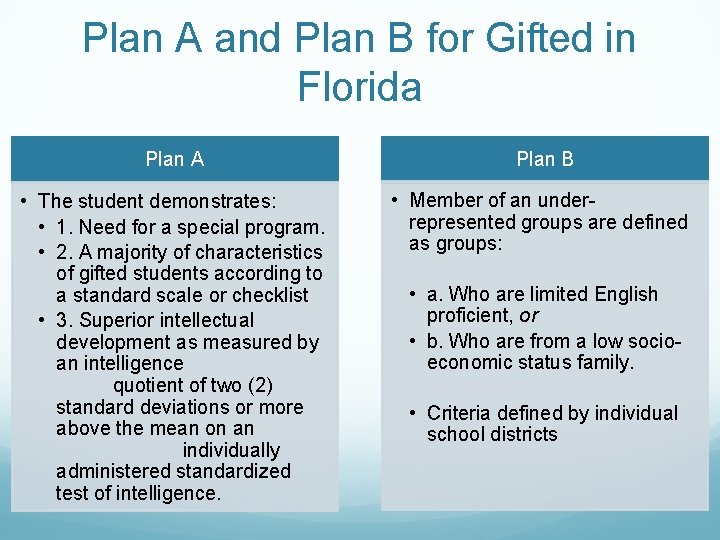
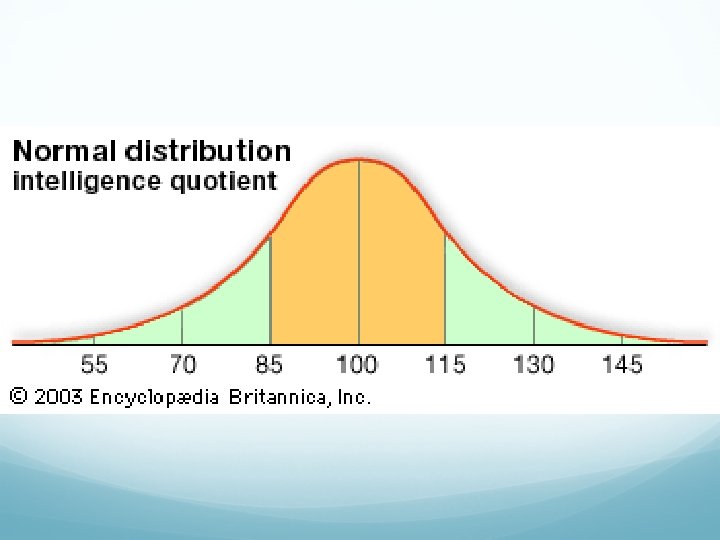
Plan A and Plan B for Gifted in Florida Plan A Plan B • The student demonstrates: • 1. Need for a special program. • 2. A majority of characteristics of gifted students according to a standard scale or checklist • 3. Superior intellectual development as measured by an intelligence quotient of two (2) standard deviations or more above the mean on an individually administered standardized test of intelligence. • Member of an under represented groups are defined as groups: • a. Who are limited English proficient, or • b. Who are from a low socio economic status family. • Criteria defined by individual school districts
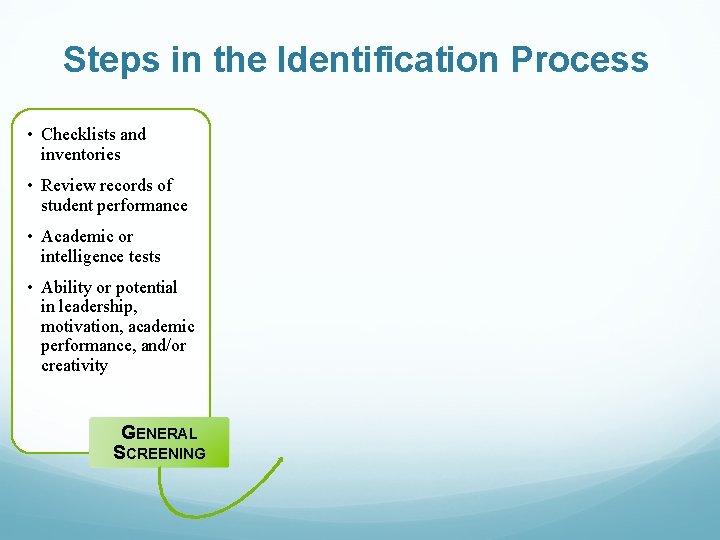
Steps in the Identification Process • Checklists and inventories • Review records of student performance • Academic or intelligence tests • Ability or potential in leadership, motivation, academic performance, and/or creativity GENERAL SCREENING

Examples of Individual Screening Assessments for Identifying Gifted Learners Assessment Purpose Raven’s Standard Progressive Matrices A non verbal assessment tool measuring ability to form perceptual relations. The Renzulli Scale Identify student strengths in the areas of learning, motivation, creativity, leadership Identify student (preschool and K) strengths and giftedness in the areas of intellectual, academic readiness, motivation, creativity, artistic talent Gifted Rating Scale Kaufman Brief Intelligence Test (K BIT) Identify student (grades 1 8) strengths and giftedness in the areas of intellectual, academic, motivation, creativity, leadership, and artistic talent Assesses verbal and nonverbal intelligence.
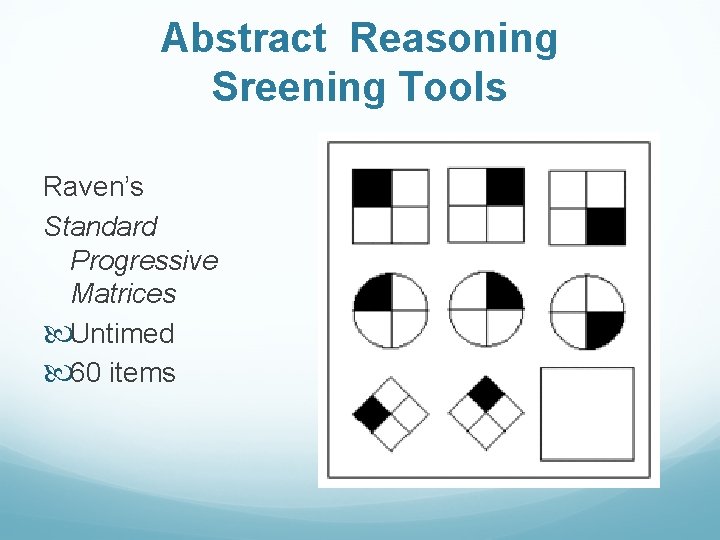
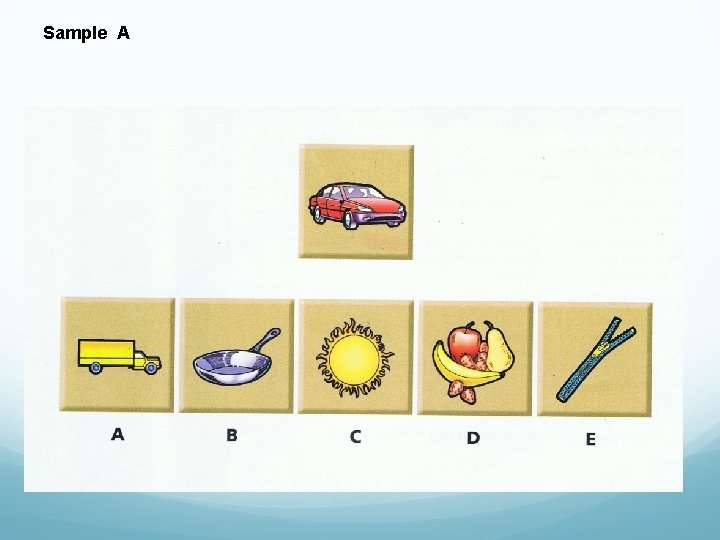
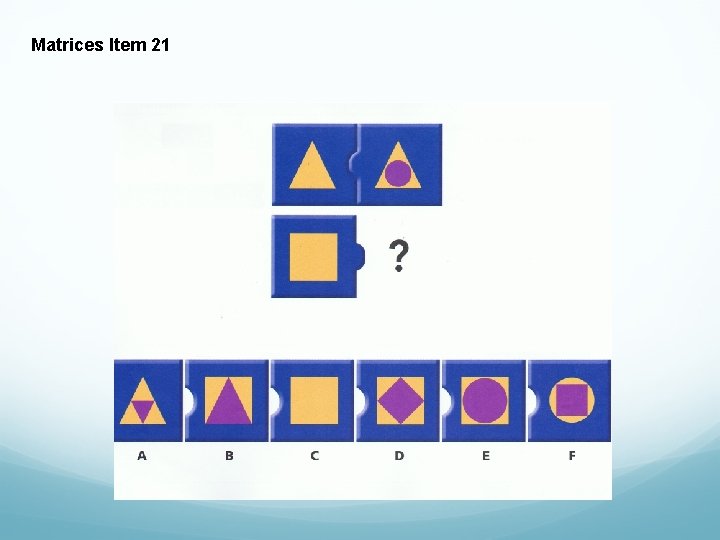
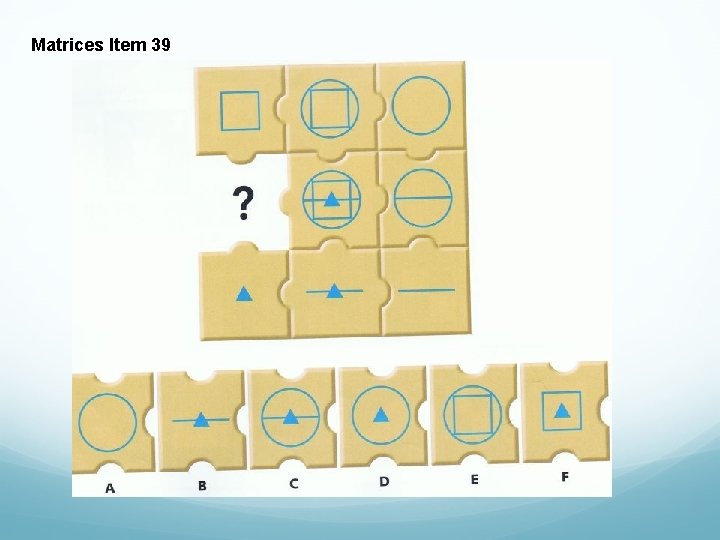
Abstract Reasoning Sreening Tools Raven’s Standard Progressive Matrices Untimed 60 items
Developmental Assessment Kaufmann Brief Intelligence Test K BIT
Purpose Obtain a quick estimate of intelligence Ages 4 90 20 minutes Estimate an individual’s verbal versus nonverbal intelligence
Two Distinct Abilities Verbal Scale Nonverbal Scale/ Matrices Measure a persons knowledge Solve novel problems of word meanings Verbal concept formation, reasoning ability, and range of general information. Emphasizes inductive reasoning and visual processing Taps executive functioning to solve problems
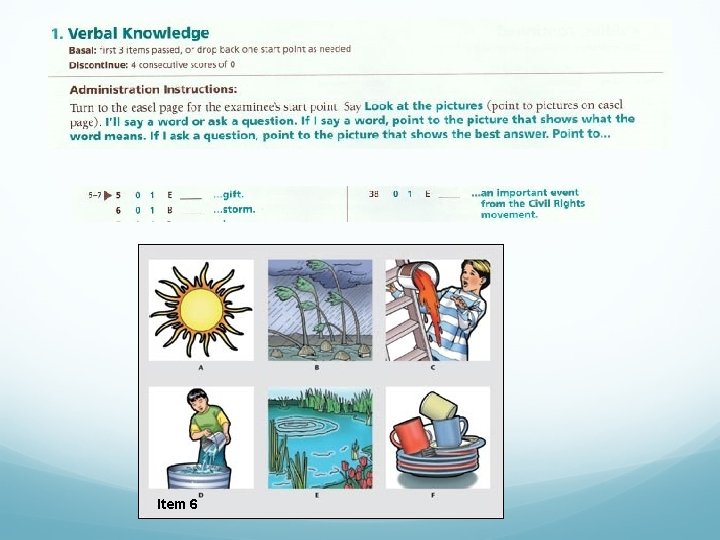
Item 6
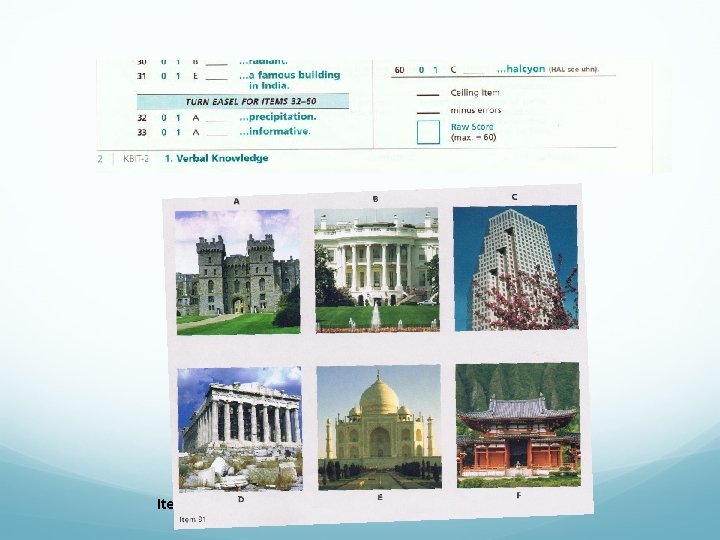
Item 60
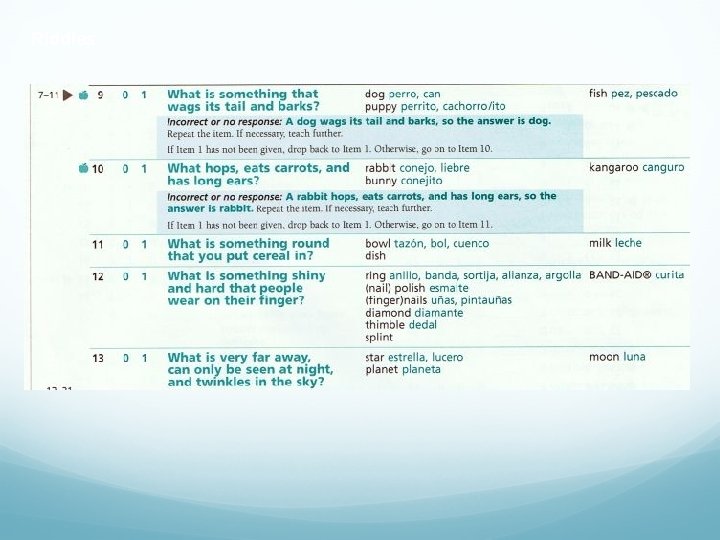
Riddles
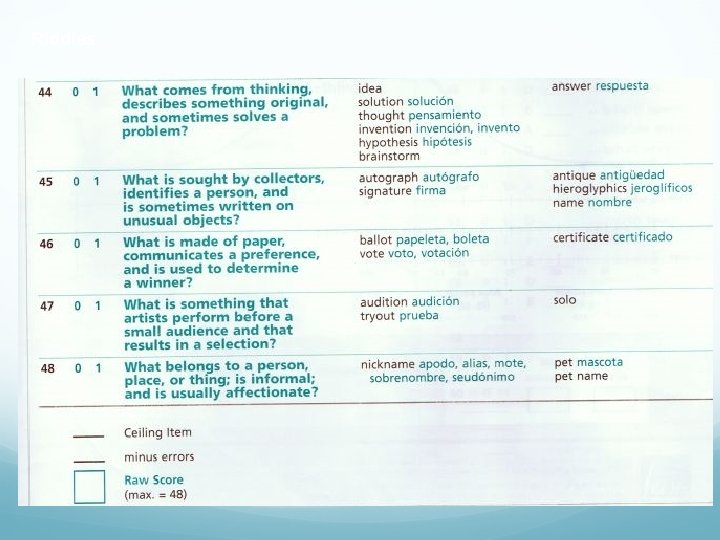
Riddles
Sample A
Matrices Item 21
Matrices Item 39

Pfeiffer’s Gifted Rating Scale Intellectual Ability Intellectual ability refers to the child’s verbal and/or nonverbal mental skills, capabilities, or competence. Aspects of intelligence measured by this scale include abstract learning, problem solving, reasoning, mental speed, and memory. Below Average Above Average 1. Solves problems quickly 1 2 3 4 5 6 7 8 9 6. Understands complex information or abstract ideas. 1 2 3 4 5 6 7 8 9 7. Answers questions in detail, with extensive information. 1 2 3 4 5 6 7 8 9
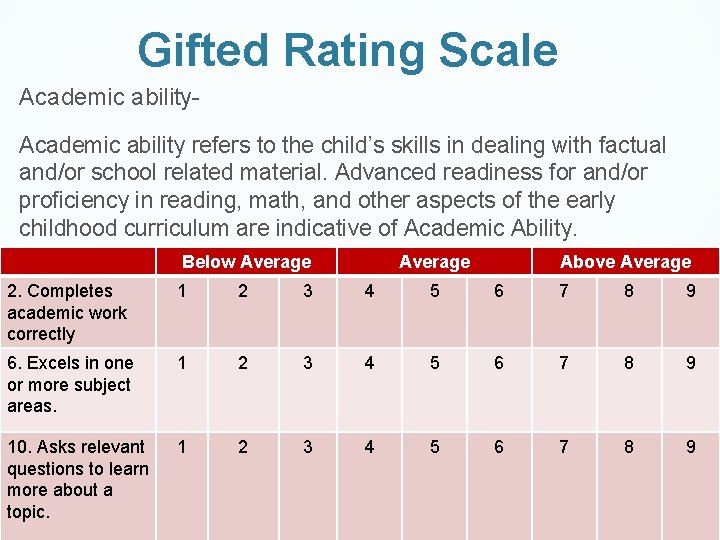
Gifted Rating Scale Academic ability refers to the child’s skills in dealing with factual and/or school related material. Advanced readiness for and/or proficiency in reading, math, and other aspects of the early childhood curriculum are indicative of Academic Ability. Below Average Above Average 2. Completes academic work correctly 1 2 3 4 5 6 7 8 9 6. Excels in one or more subject areas. 1 2 3 4 5 6 7 8 9 10. Asks relevant questions to learn more about a topic. 1 2 3 4 5 6 7 8 9

Gifted Rating Scale Creativity refers to the child’s ability to think, act, and/or produce unique, original, novel or innovative thoughts or products. Creativity can be expressed in a variety of ways: how a child solves problems, experiments with new ideas, and/or plays imaginatively. Below Average Above Average 2. Approaches the world “as a scientist” or explorer. 1 2 3 4 5 6 7 8 9 9. Demonstrates original thinking. 1 2 3 4 5 6 7 8 9 11. Takes creative risks, comfortable not having the 1 2 3 4 5 6 7 8 9
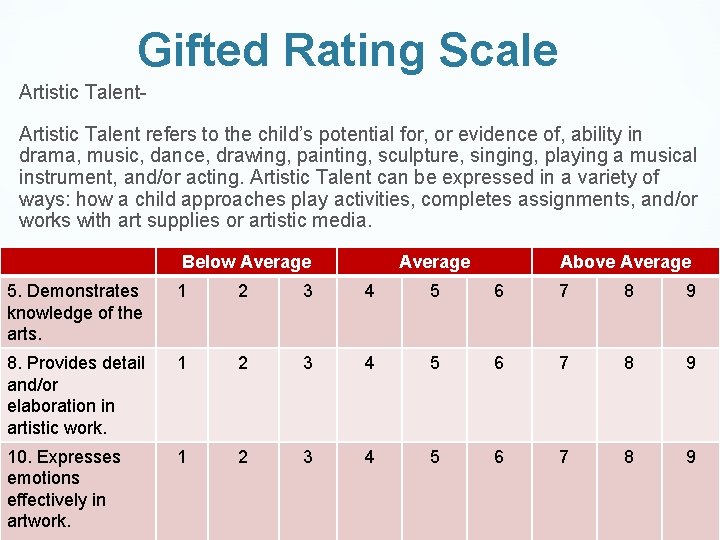
Gifted Rating Scale Artistic Talent refers to the child’s potential for, or evidence of, ability in drama, music, dance, drawing, painting, sculpture, singing, playing a musical instrument, and/or acting. Artistic Talent can be expressed in a variety of ways: how a child approaches play activities, completes assignments, and/or works with art supplies or artistic media. Below Average Above Average 5. Demonstrates knowledge of the arts. 1 2 3 4 5 6 7 8 9 8. Provides detail and/or elaboration in artistic work. 1 2 3 4 5 6 7 8 9 10. Expresses emotions effectively in artwork. 1 2 3 4 5 6 7 8 9
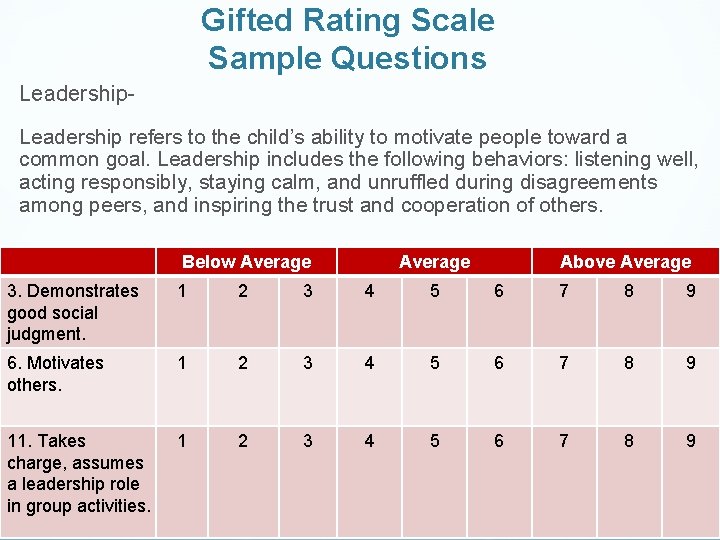
Gifted Rating Scale Sample Questions Leadership refers to the child’s ability to motivate people toward a common goal. Leadership includes the following behaviors: listening well, acting responsibly, staying calm, and unruffled during disagreements among peers, and inspiring the trust and cooperation of others. Below Average Above Average 3. Demonstrates good social judgment. 1 2 3 4 5 6 7 8 9 6. Motivates others. 1 2 3 4 5 6 7 8 9 11. Takes charge, assumes a leadership role in group activities. 1 2 3 4 5 6 7 8 9
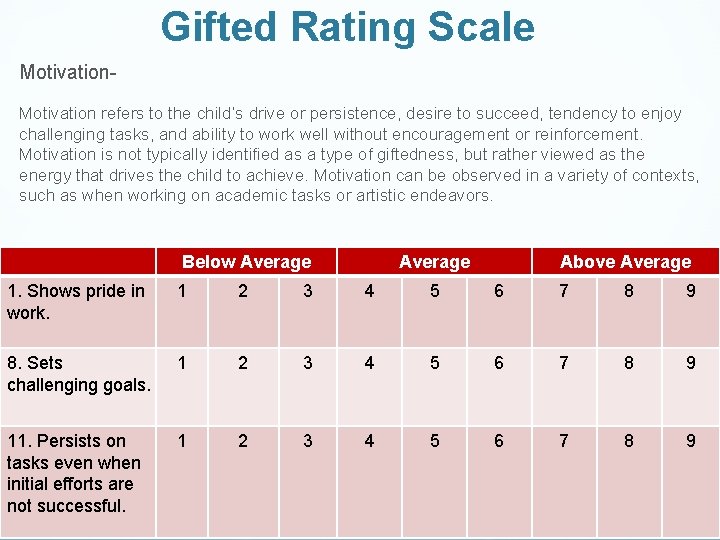
Gifted Rating Scale Motivation refers to the child’s drive or persistence, desire to succeed, tendency to enjoy challenging tasks, and ability to work well without encouragement or reinforcement. Motivation is not typically identified as a type of giftedness, but rather viewed as the energy that drives the child to achieve. Motivation can be observed in a variety of contexts, such as when working on academic tasks or artistic endeavors. Below Average Above Average 1. Shows pride in work. 1 2 3 4 5 6 7 8 9 8. Sets challenging goals. 1 2 3 4 5 6 7 8 9 11. Persists on tasks even when initial efforts are not successful. 1 2 3 4 5 6 7 8 9
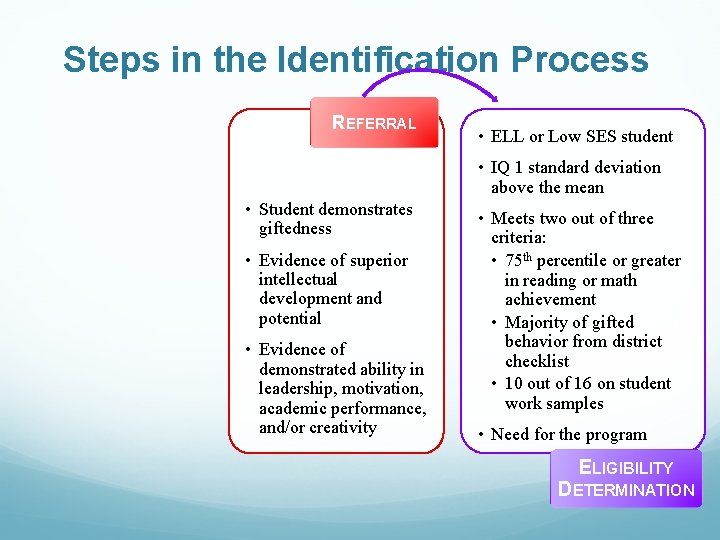
Steps in the Identification Process REFERRAL • ELL or Low SES student • IQ 1 standard deviation above the mean • Student demonstrates giftedness • Evidence of superior intellectual development and potential • Evidence of demonstrated ability in leadership, motivation, academic performance, and/or creativity • Meets two out of three criteria: • 75 th percentile or greater in reading or math achievement • Majority of gifted behavior from district checklist • 10 out of 16 on student work samples • Need for the program ELIGIBILITY DETERMINATION
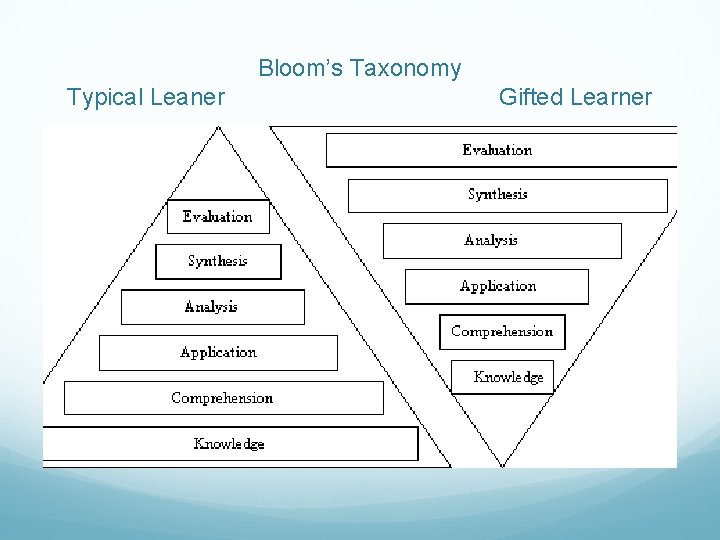
Bloom’s Taxonomy Typical Leaner Gifted Learner
e g a u g n a l d g e n i t t a c i t e n n e d Con d differ e t f i g n e a h t s t r r o a f n o i t c u r t s in 31
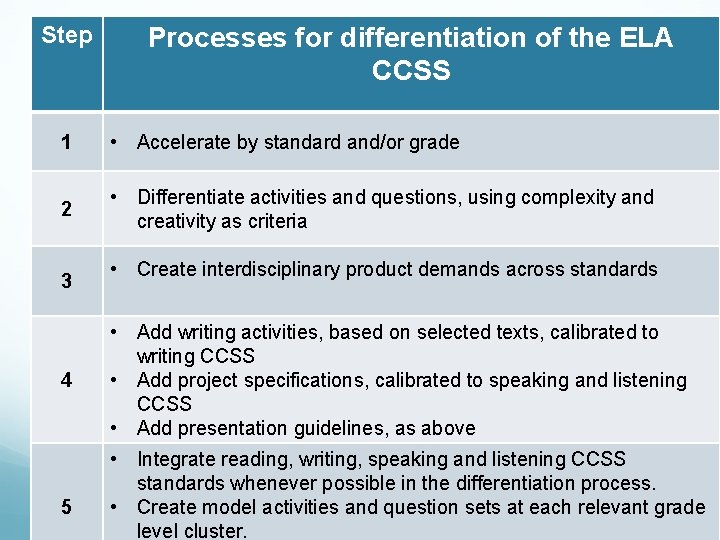
Step Processes for differentiation of the ELA CCSS 1 • Accelerate by standard and/or grade 2 • Differentiate activities and questions, using complexity and creativity as criteria 3 4 5 • Create interdisciplinary product demands across standards • Add writing activities, based on selected texts, calibrated to writing CCSS • Add project specifications, calibrated to speaking and listening CCSS • Add presentation guidelines, as above • Integrate reading, writing, speaking and listening CCSS standards whenever possible in the differentiation process. • Create model activities and question sets at each relevant grade level cluster.
Examples of Differentiated Task Demands: Gift of the Magi Differentiating CCSS English Language Arts 33
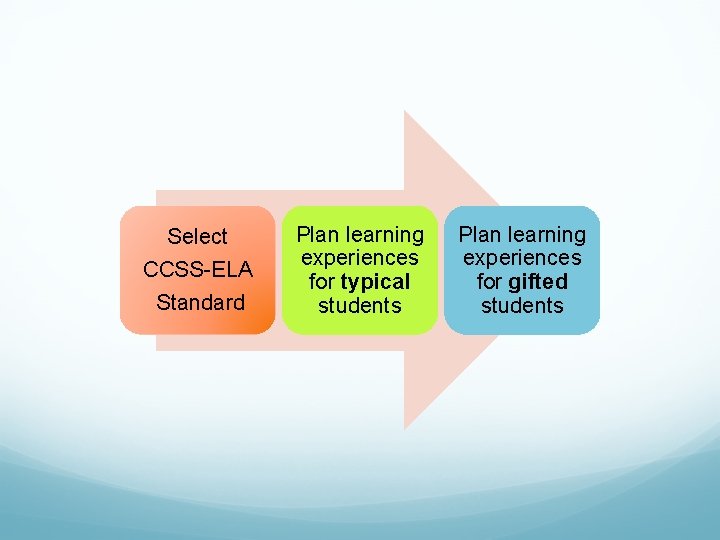
Select CCSS ELA Standard Plan learning experiences for typical students Plan learning experiences for gifted students
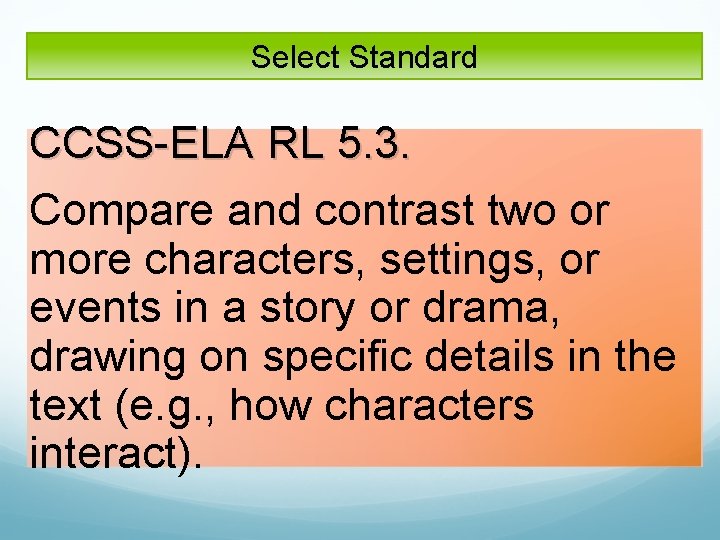
Select Standard CCSS ELA RL 5. 3. Compare and contrast two or more characters, settings, or events in a story or drama, drawing on specific details in the text (e. g. , how characters interact).
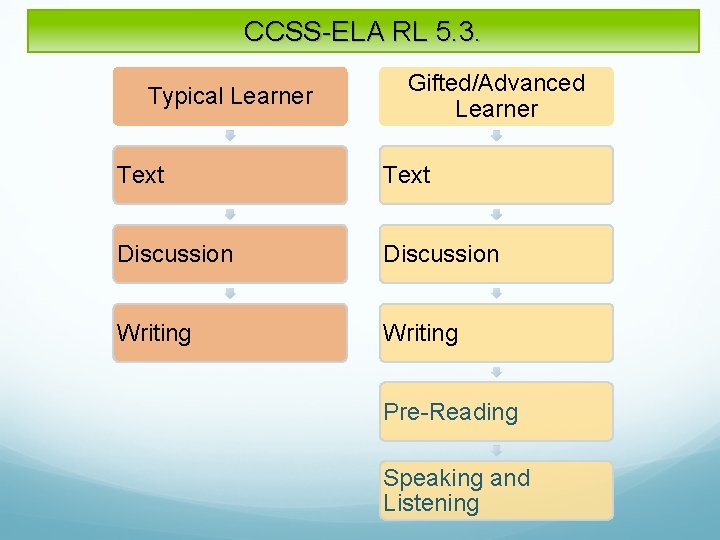
CCSS ELA RL 5. 3. Typical Learner Gifted/Advanced Learner Text Discussion Writing Pre Reading Speaking and Listening
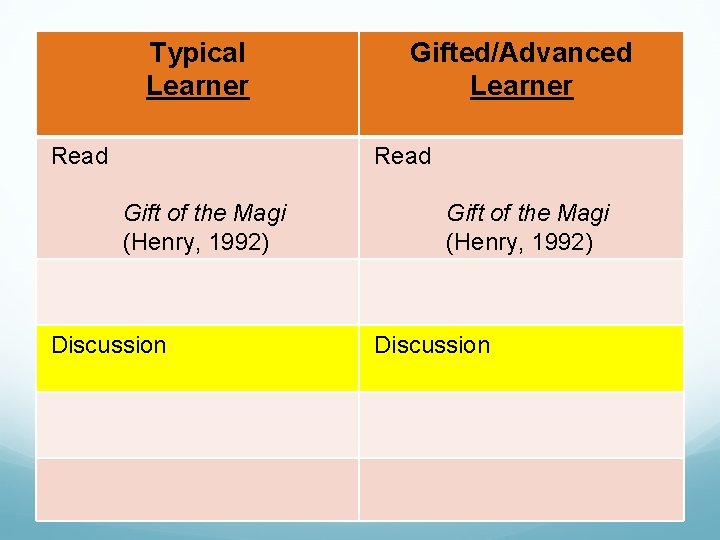
Typical Learner Read Gifted/Advanced Learner Read Gift of the Magi (Henry, 1992) Discussion
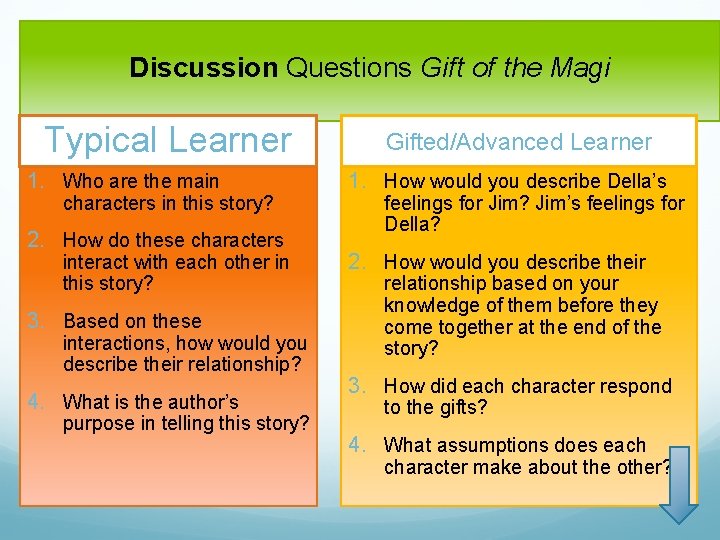
Discussion Questions Gift of the Magi Typical Learner 1. Who are the main characters in this story? 2. How do these characters interact with each other in this story? 3. Based on these interactions, how would you describe their relationship? 4. What is the author’s purpose in telling this story? Gifted/Advanced Learner 1. How would you describe Della’s feelings for Jim? Jim’s feelings for Della? 2. How would you describe their relationship based on your knowledge of them before they come together at the end of the story? 3. How did each character respond to the gifts? 4. What assumptions does each character make about the other?
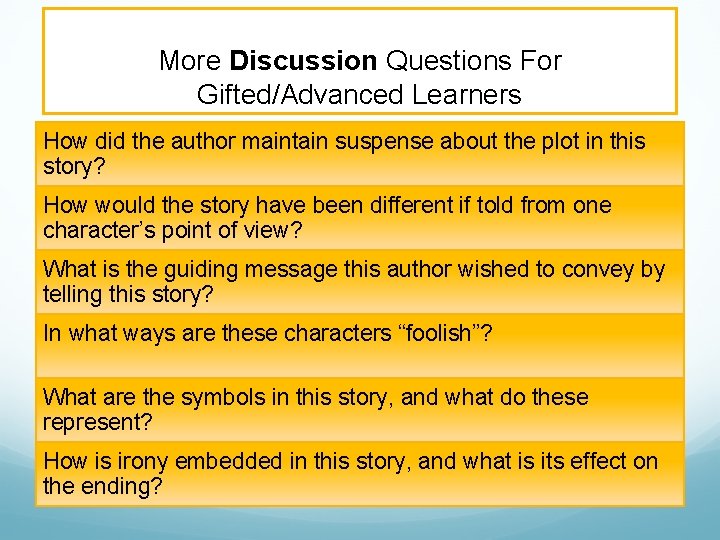
More Discussion Questions For Gifted/Advanced Learners How did the author maintain suspense about the plot in this story? How would the story have been different if told from one character’s point of view? What is the guiding message this author wished to convey by telling this story? In what ways are these characters “foolish”? What are the symbols in this story, and what do these represent? How is irony embedded in this story, and what is its effect on the ending?
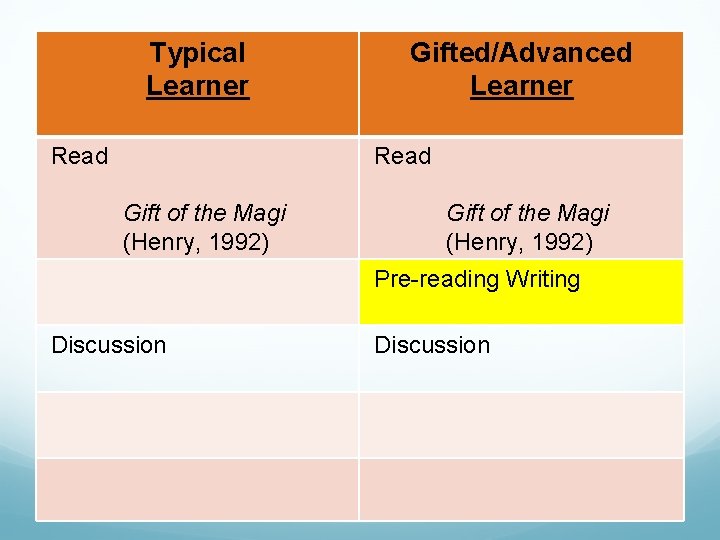
Typical Learner Read Gifted/Advanced Learner Read Gift of the Magi (Henry, 1992) Pre reading Writing Discussion
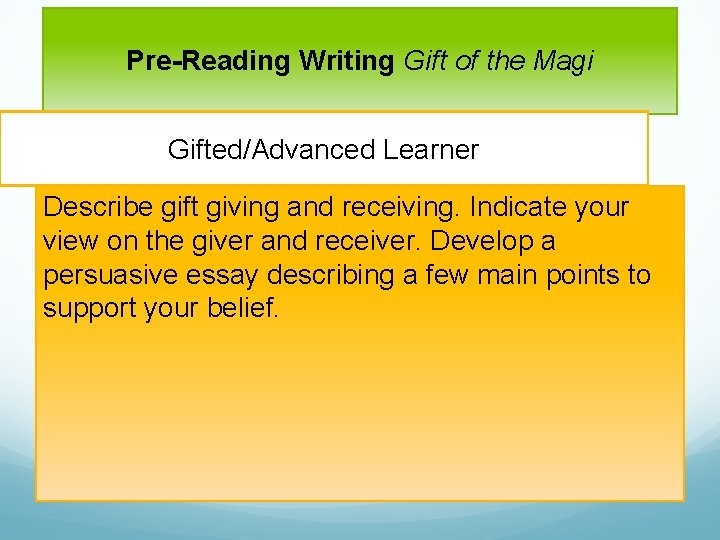
Pre-Reading Writing Gift of the Magi Gifted/Advanced Learner Describe gift giving and receiving. Indicate your view on the giver and receiver. Develop a persuasive essay describing a few main points to support your belief.
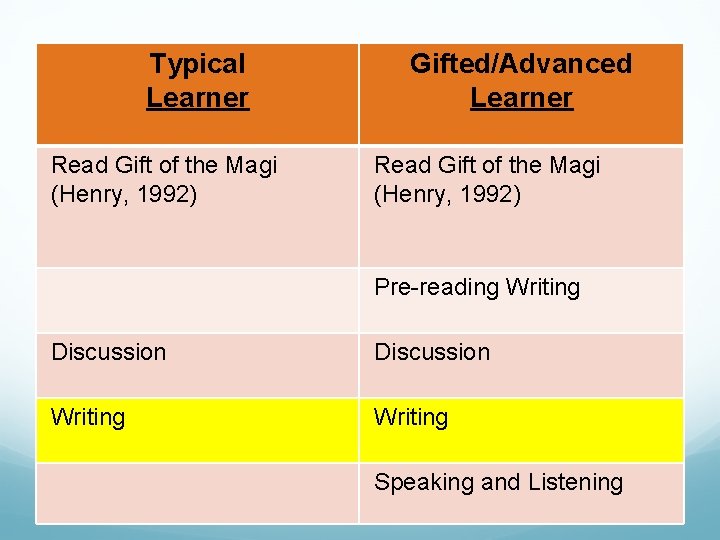
Typical Learner Read Gift of the Magi (Henry, 1992) Gifted/Advanced Learner Read Gift of the Magi (Henry, 1992) Pre reading Writing Discussion Writing Speaking and Listening
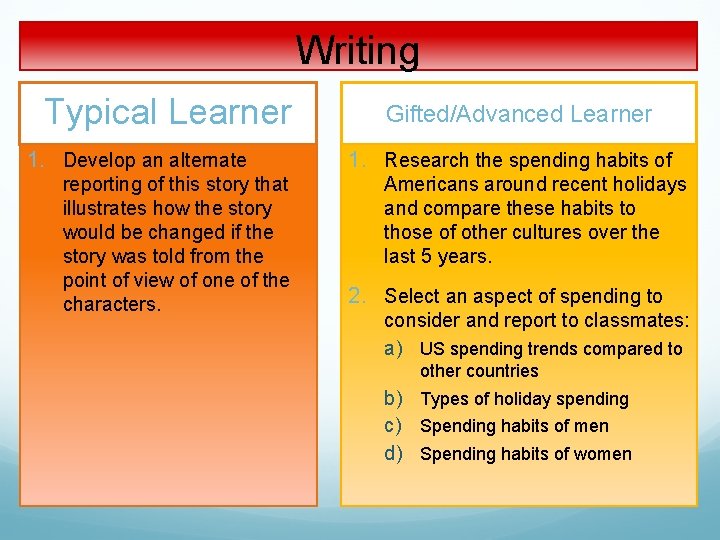
Writing Typical Learner 1. Develop an alternate reporting of this story that illustrates how the story would be changed if the story was told from the point of view of one of the characters. Gifted/Advanced Learner 1. Research the spending habits of Americans around recent holidays and compare these habits to those of other cultures over the last 5 years. 2. Select an aspect of spending to consider and report to classmates: a) US spending trends compared to other countries b) Types of holiday spending c) Spending habits of men d) Spending habits of women
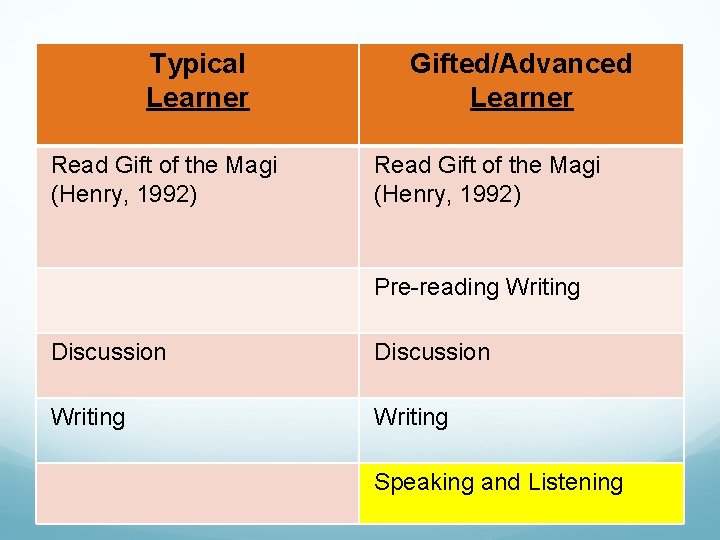
Typical Learner Read Gift of the Magi (Henry, 1992) Gifted/Advanced Learner Read Gift of the Magi (Henry, 1992) Pre reading Writing Discussion Writing Speaking and Listening
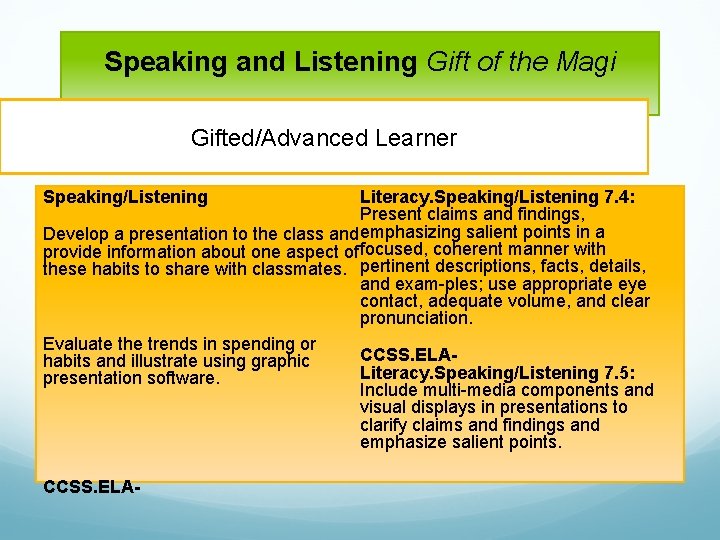
Speaking and Listening Gift of the Magi Gifted/Advanced Learner Literacy. Speaking/Listening 7. 4: Present claims and findings, Develop a presentation to the class and emphasizing salient points in a provide information about one aspect of focused, coherent manner with these habits to share with classmates. pertinent descriptions, facts, details, and exam ples; use appropriate eye contact, adequate volume, and clear pronunciation. Evaluate the trends in spending or CCSS. ELAhabits and illustrate using graphic Literacy. Speaking/Listening 7. 5: presentation software. Include multi media components and visual displays in presentations to clarify claims and findings and emphasize salient points. Speaking/Listening CCSS. ELA-
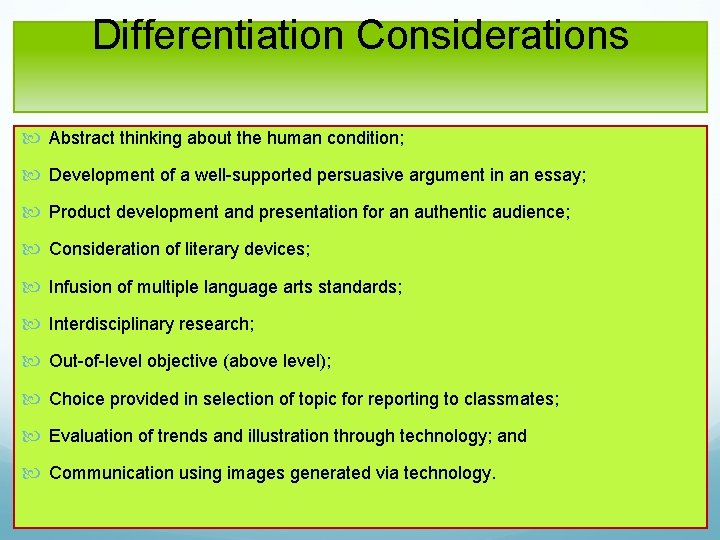
Differentiation Considerations Abstract thinking about the human condition; Development of a well supported persuasive argument in an essay; Product development and presentation for an authentic audience; Consideration of literary devices; Infusion of multiple language arts standards; Interdisciplinary research; Out of level objective (above level); Choice provided in selection of topic for reporting to classmates; Evaluation of trends and illustration through technology; and Communication using images generated via technology.
- Slides: 45