
Understanding Geolocation Accuracy using Network Geometry Brian Eriksson
Understanding Geolocation Accuracy using Network Geometry Brian Eriksson Technicolor Palo Alto Mark Crovella Boston University
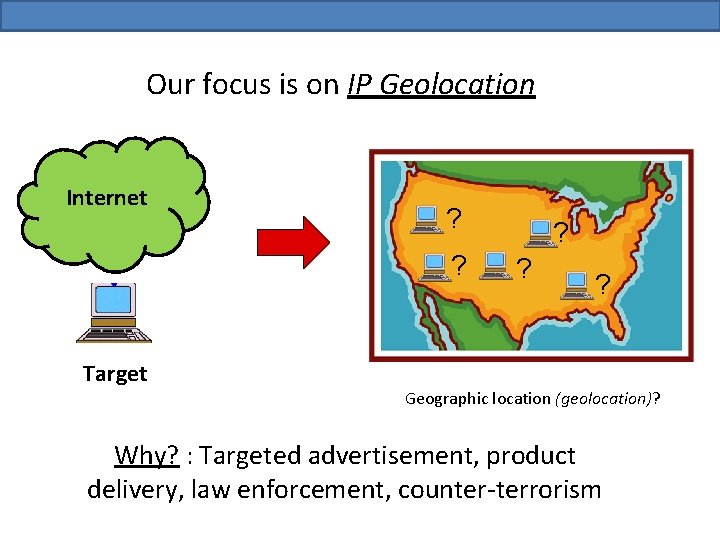
Our focus is on IP Geolocation Internet ? ? Target ? ? ? Geographic location (geolocation)? Why? : Targeted advertisement, product delivery, law enforcement, counter-terrorism
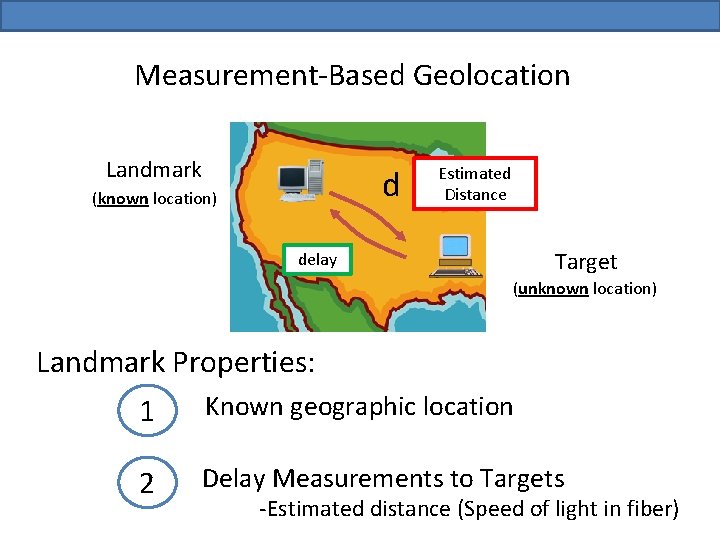
Measurement-Based Geolocation Landmark d (known location) Estimated Distance Target delay (unknown location) Landmark Properties: 1 Known geographic location 2 Delay Measurements to Targets -Estimated distance (Speed of light in fiber)
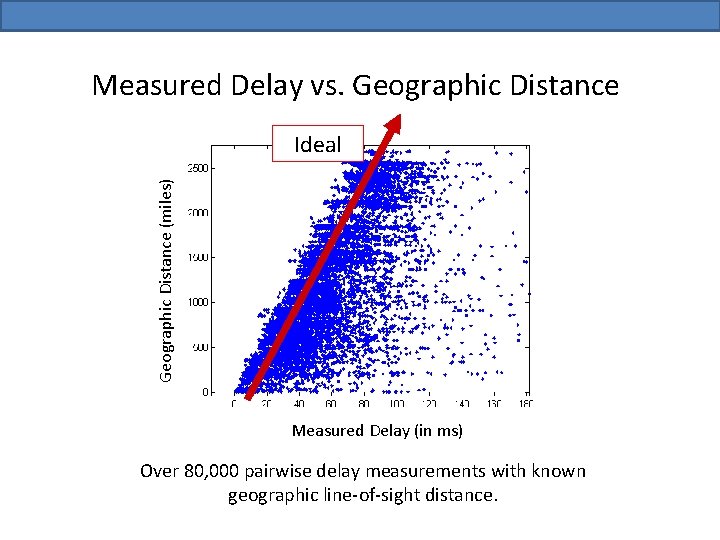
Measured Delay vs. Geographic Distance (miles) Ideal Measured Delay (in ms) Over 80, 000 pairwise delay measurements with known geographic line-of-sight distance.
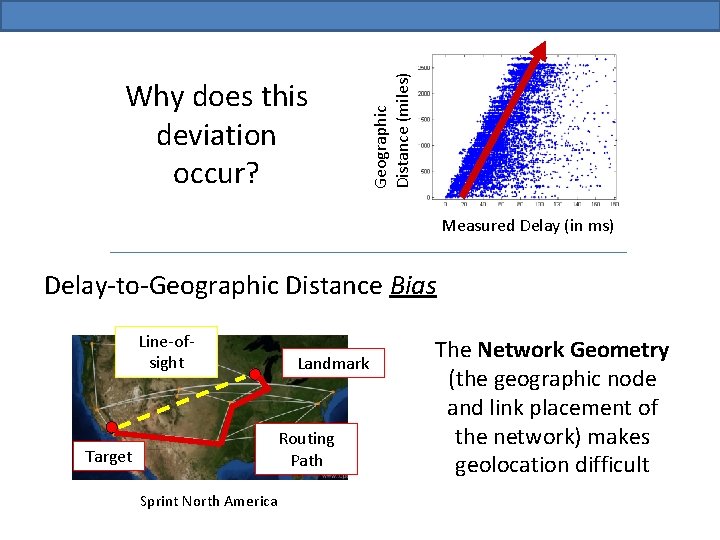
Geographic Distance (miles) Why does this deviation occur? Measured Delay (in ms) Delay-to-Geographic Distance Bias Line-ofsight Landmark Routing Path Target Sprint North America The Network Geometry (the geographic node and link placement of the network) makes geolocation difficult
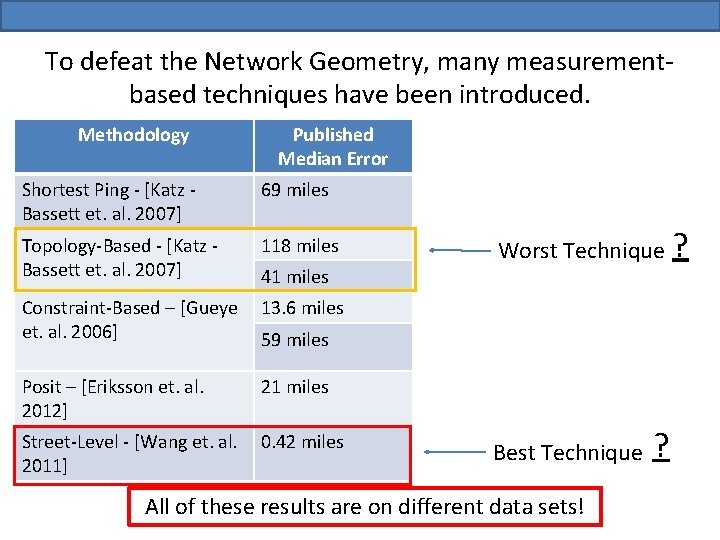
To defeat the Network Geometry, many measurementbased techniques have been introduced. Methodology Published Median Error Shortest Ping - [Katz Bassett et. al. 2007] 69 miles Topology-Based - [Katz Bassett et. al. 2007] 118 miles Constraint-Based – [Gueye et. al. 2006] 13. 6 miles Posit – [Eriksson et. al. 2012] 21 miles Street-Level - [Wang et. al. 2011] 0. 42 miles 41 miles Worst Technique 59 miles Best Technique All of these results are on different data sets! ? ?
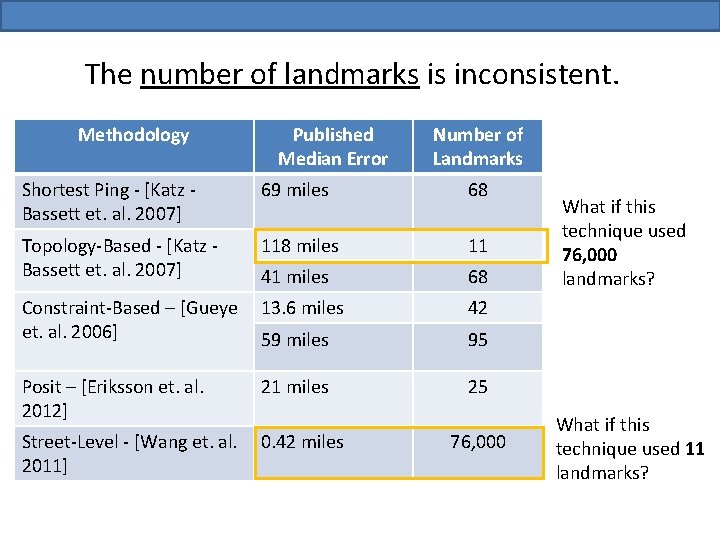
The number of landmarks is inconsistent. Methodology Published Median Error Number of Landmarks Shortest Ping - [Katz Bassett et. al. 2007] 69 miles 68 Topology-Based - [Katz Bassett et. al. 2007] 118 miles 11 41 miles 68 Constraint-Based – [Gueye et. al. 2006] 13. 6 miles 42 59 miles 95 Posit – [Eriksson et. al. 2012] 21 miles 25 Street-Level - [Wang et. al. 2011] 0. 42 miles 76, 000 What if this technique used 76, 000 landmarks? What if this technique used 11 landmarks?
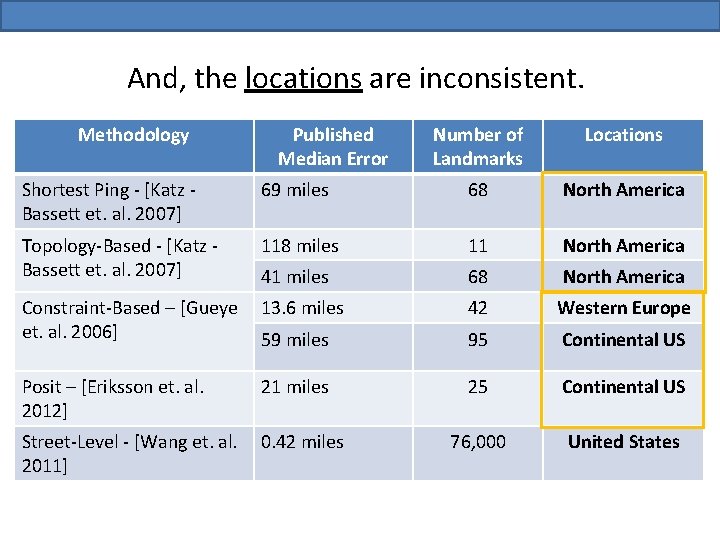
And, the locations are inconsistent. Methodology Published Median Error Number of Landmarks Locations Shortest Ping - [Katz Bassett et. al. 2007] 69 miles 68 North America Topology-Based - [Katz Bassett et. al. 2007] 118 miles 11 North America 41 miles 68 North America Constraint-Based – [Gueye et. al. 2006] 13. 6 miles 42 Western Europe 59 miles 95 Continental US Posit – [Eriksson et. al. 2012] 21 miles 25 Continental US Street-Level - [Wang et. al. 2011] 0. 42 miles 76, 000 United States
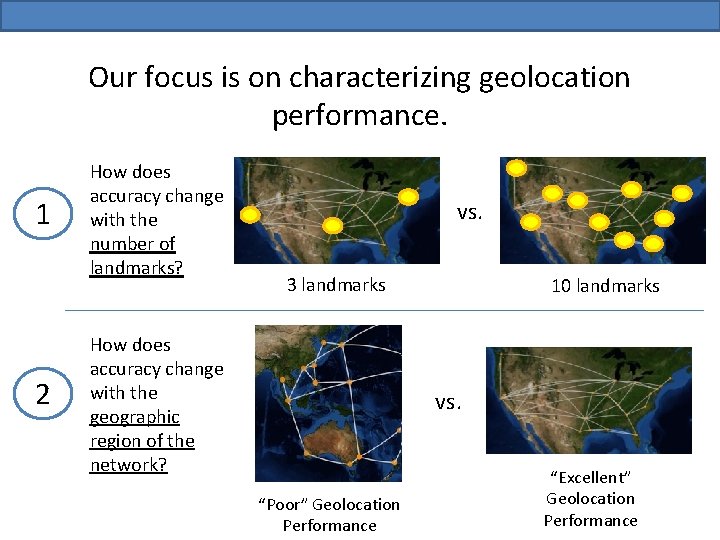
Our focus is on characterizing geolocation performance. 1 2 How does accuracy change with the number of landmarks? vs. 3 landmarks How does accuracy change with the geographic region of the network? 10 landmarks vs. “Poor” Geolocation Performance “Excellent” Geolocation Performance
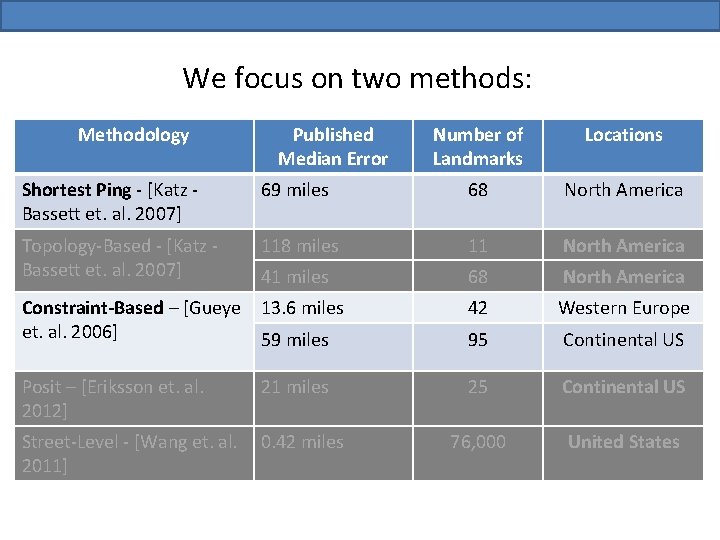
We focus on two methods: Methodology Published Median Error Number of Landmarks Locations Shortest Ping - [Katz Bassett et. al. 2007] 69 miles 68 North America Topology-Based - [Katz Bassett et. al. 2007] 118 miles 11 North America 41 miles 68 North America Constraint-Based – [Gueye 13. 6 miles et. al. 2006] 59 miles 42 Western Europe 95 Continental US Posit – [Eriksson et. al. 2012] 21 miles 25 Continental US Street-Level - [Wang et. al. 2011] 0. 42 miles 76, 000 United States
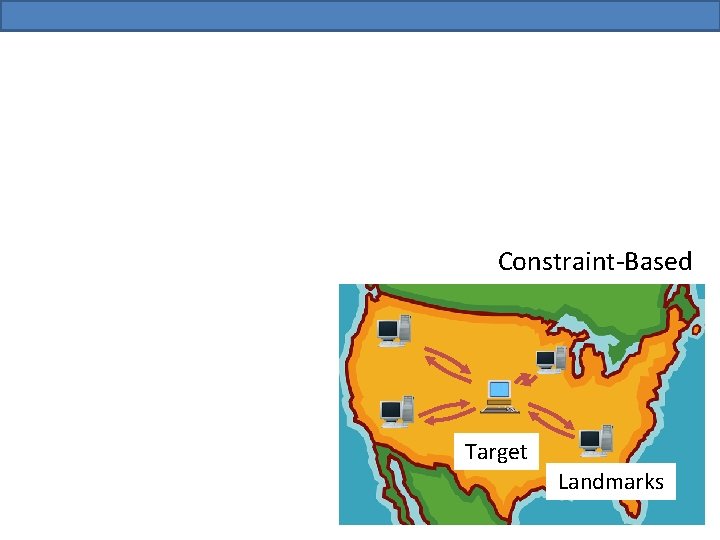
Constraint-Based Target Landmarks
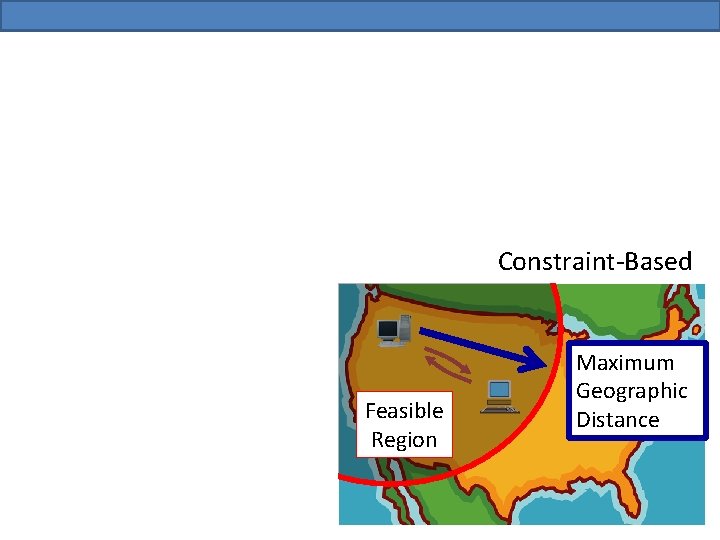
Constraint-Based Feasible Region Maximum Geographic Distance
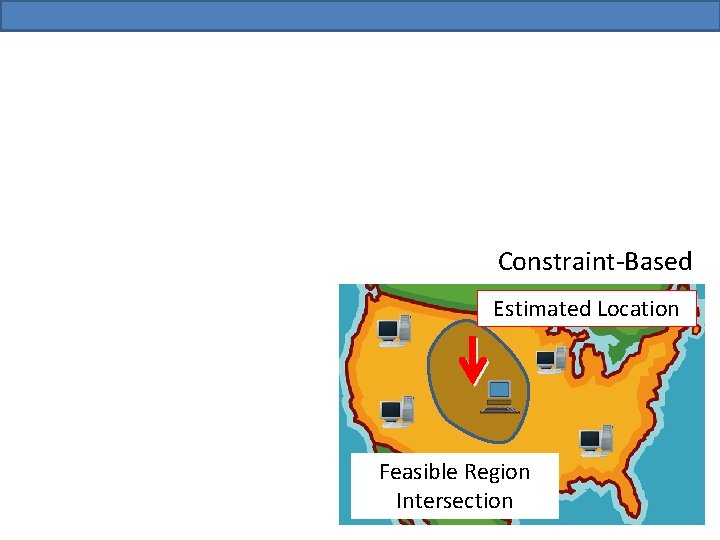
Constraint-Based Estimated Location Feasible Region Intersection
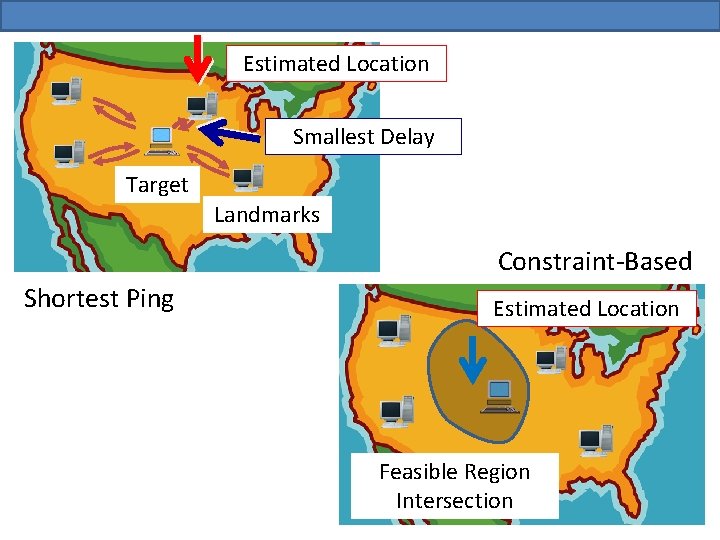
Estimated Location Smallest Delay Target Landmarks Constraint-Based Shortest Ping Estimated Location Feasible Region Intersection
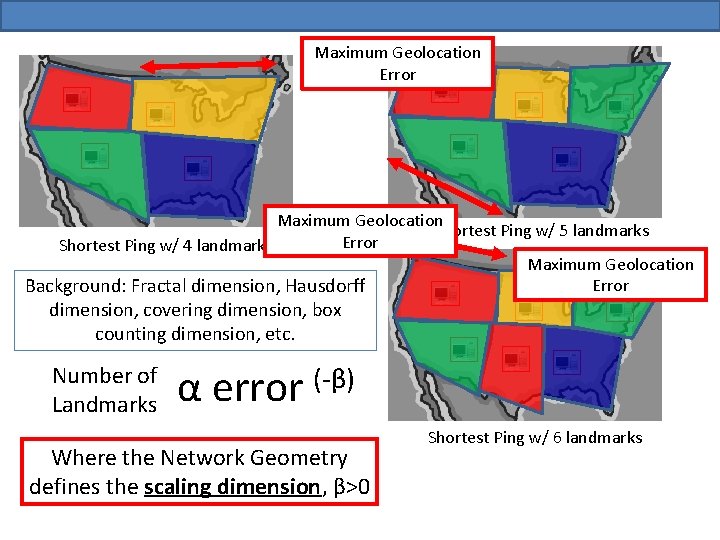
Maximum Geolocation Error Maximum Geolocation Shortest Ping w/ 5 landmarks Error Shortest Ping w/ 4 landmarks Maximum Geolocation Error Background: Fractal dimension, Hausdorff dimension, covering dimension, box counting dimension, etc. Number of Landmarks α error (-β) Where the Network Geometry defines the scaling dimension, β>0 Shortest Ping w/ 6 landmarks
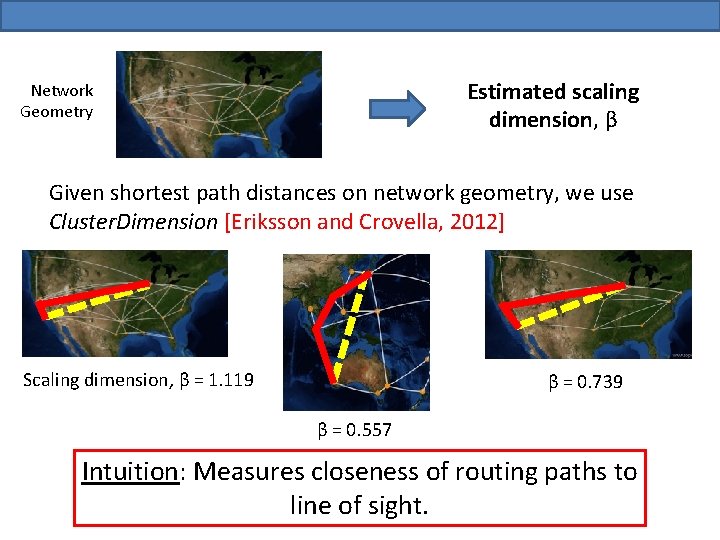
Estimated scaling dimension, β Network Geometry Given shortest path distances on network geometry, we use Cluster. Dimension [Eriksson and Crovella, 2012] Scaling dimension, β = 1. 119 β = 0. 739 β = 0. 557 Intuition: Measures closeness of routing paths to line of sight.
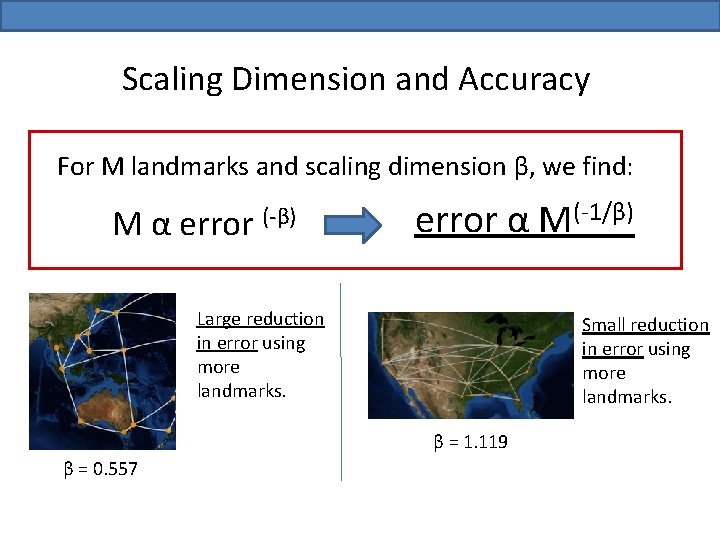
Scaling Dimension and Accuracy For M landmarks and scaling dimension β, we find: M α error (-β) error α M(-1/β) Large reduction in error using more landmarks. Small reduction in error using more landmarks. β = 1. 119 β = 0. 557
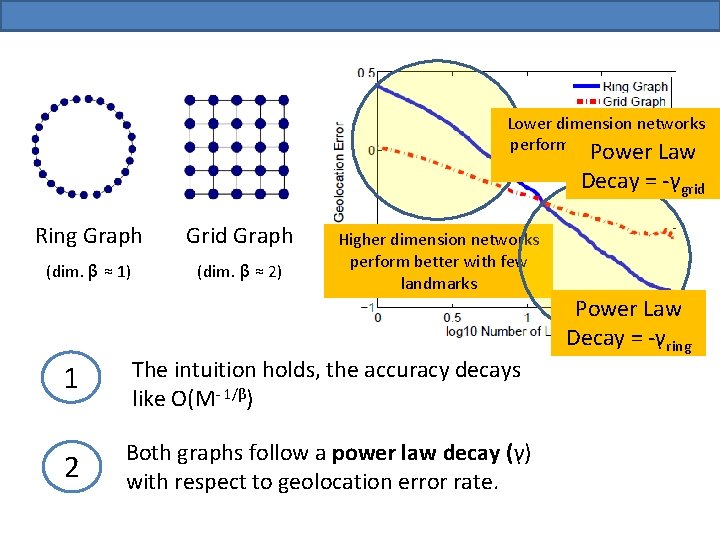
Lower dimension networks perform better with Law many Power landmarks Decay = -γgrid Ring Graph Grid Graph (dim. β ≈ 1) (dim. β ≈ 2) Higher dimension networks perform better with few landmarks 1 The intuition holds, the accuracy decays like O(M- 1/β) 2 Both graphs follow a power law decay (γ) with respect to geolocation error rate. Power Law Decay(M) = -γring
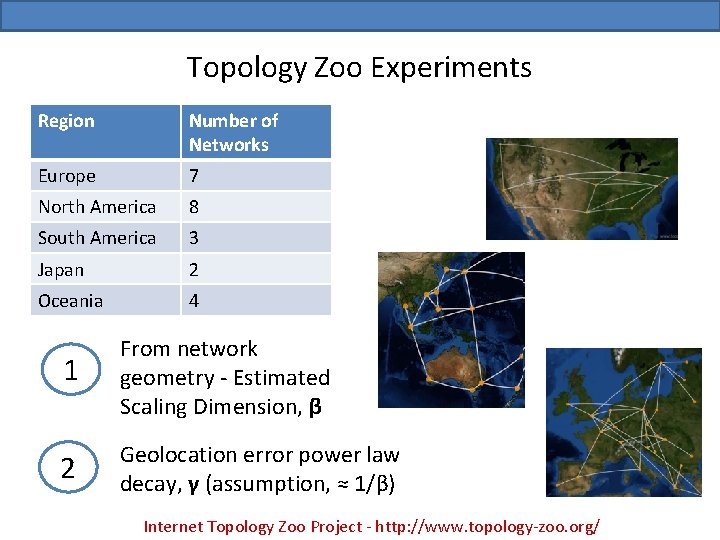
Topology Zoo Experiments Region Number of Networks Europe 7 North America 8 South America 3 Japan 2 Oceania 4 1 From network geometry - Estimated Scaling Dimension, β 2 Geolocation error power law decay, γ (assumption, ≈ 1/β) Internet Topology Zoo Project - http: //www. topology-zoo. org/
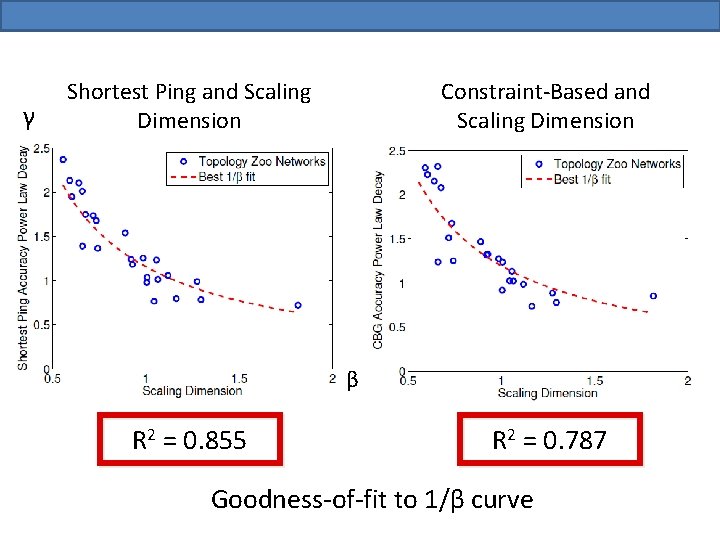
γ Constraint-Based and Scaling Dimension Shortest Ping and Scaling Dimension β R 2 = 0. 855 R 2 = 0. 787 Goodness-of-fit to 1/β curve
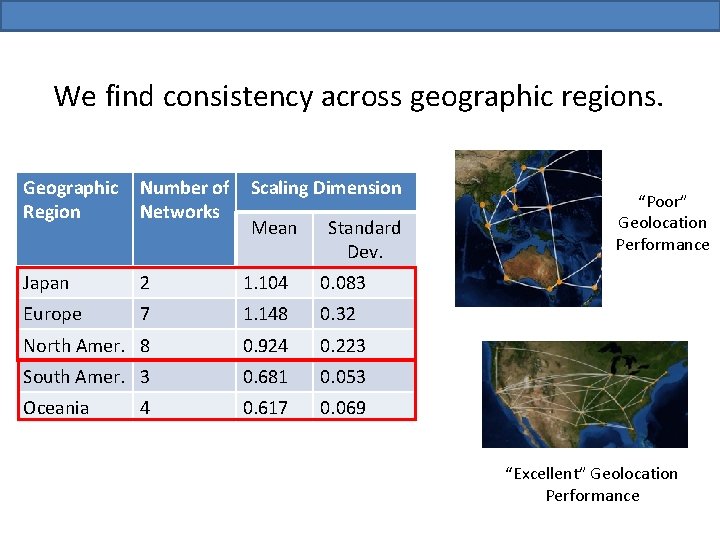
We find consistency across geographic regions. Geographic Region Number of Networks Japan 2 1. 104 0. 083 Europe 7 1. 148 0. 32 North Amer. 8 0. 924 0. 223 South Amer. 3 0. 681 0. 053 Oceania 0. 617 0. 069 4 Scaling Dimension Mean Standard Dev. “Poor” Geolocation Performance “Excellent” Geolocation Performance
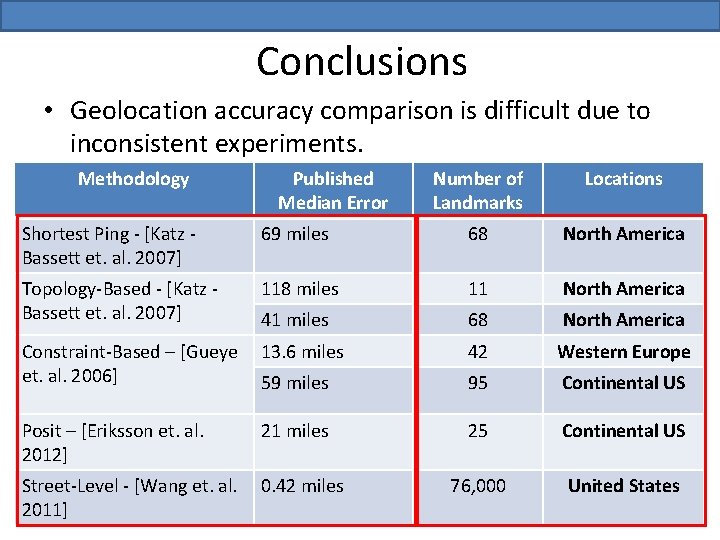
Conclusions • Geolocation accuracy comparison is difficult due to inconsistent experiments. Methodology Published Median Error Number of Landmarks Locations Shortest Ping - [Katz Bassett et. al. 2007] 69 miles 68 North America Topology-Based - [Katz Bassett et. al. 2007] 118 miles 11 North America 41 miles 68 North America Constraint-Based – [Gueye et. al. 2006] 13. 6 miles 42 Western Europe 59 miles 95 Continental US Posit – [Eriksson et. al. 2012] 21 miles 25 Continental US Street-Level - [Wang et. al. 2011] 0. 42 miles 76, 000 United States
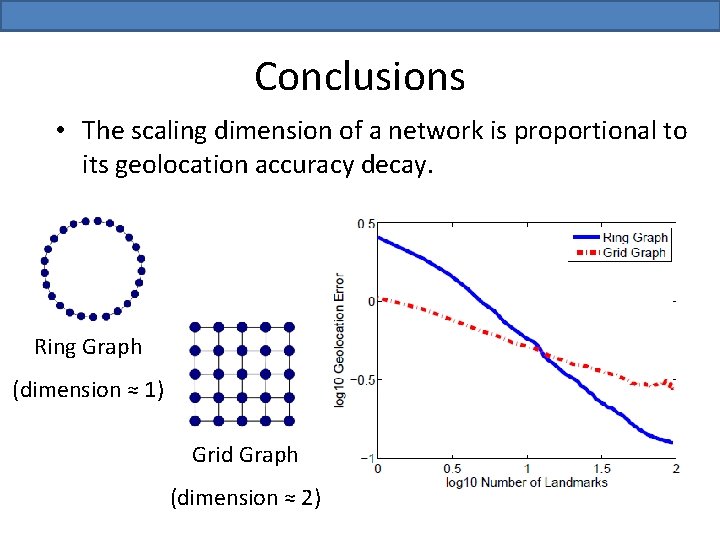
Conclusions • The scaling dimension of a network is proportional to its geolocation accuracy decay. Ring Graph (dimension ≈ 1) Grid Graph (dimension ≈ 2)
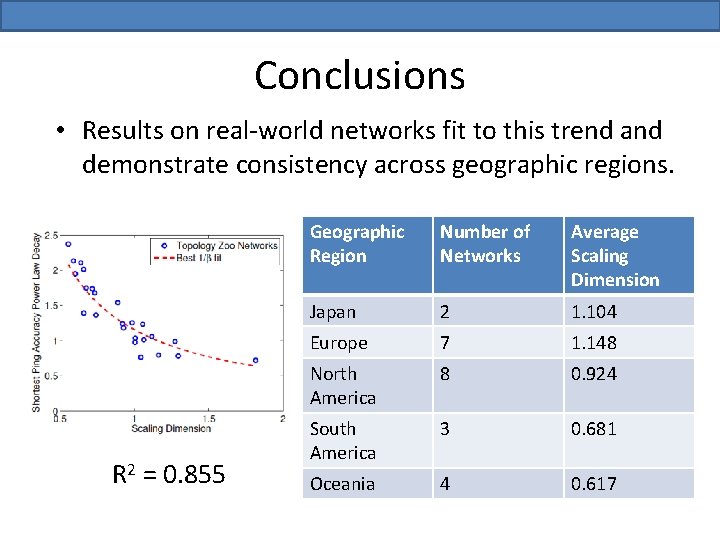
Conclusions • Results on real-world networks fit to this trend and demonstrate consistency across geographic regions. R 2 = 0. 855 Geographic Region Number of Networks Average Scaling Dimension Japan 2 1. 104 Europe 7 1. 148 North America 8 0. 924 South America 3 0. 681 Oceania 4 0. 617

Questions?
- Slides: 25