
Understanding Forms A Strategic Perspective Presented by Essociates
Understanding Forms: A Strategic Perspective Presented by: Essociates Group, Inc. Ray H. Killam, CFSP, CFC President

Introduction to Forms Definitions – Global Document Form Record n n n Document Management Forms Management Records Management
Introduction to Forms Definitions: Document n n n A document is a container of information The container makes it possible to organize, present, and manage the information related to an event, person, or topic The way data is organized and presented in the container provides meaning and context to the information A document could be a form, letter, spreadsheet, memorandum, photograph, video clip, or report The document can exist in any media New York State Office for Technology – EDMS Cookbook
Introduction to Forms Definitions: Form n Form: the basic business tool (whether printed or electronic) for collecting and transmitting information n the catalyst for getting things done, and n the record of what was done. n Copyright 1986 – Business Forms Management Association

Introduction to Forms Comparative Definitions n Forms vs. Records n A Form is a specialized document that contains one or more fields for the capture and / or display of variable data. n A specific instance of a form is a Record. A Document that is unique to a specific transaction becomes a Record.
Introduction to Forms Form Types n p. Forms – paper, or other physical substrates n e. Forms – digital forms used in non-browser environments n i. Forms – digital forms used in browsers
Introduction to Forms Management Systems n Document Management – focus on issues such as searching, archiving, retrieving, scanning, indexing and process management n Forms Management – includes specifications, analysis data, forms creation, approval management, deployment, forms production and inventory management
Introduction to Forms Management Systems n Records Management – n n n designation of official records retention requirements legal accessibility destruction authorizations storage and archiving methods
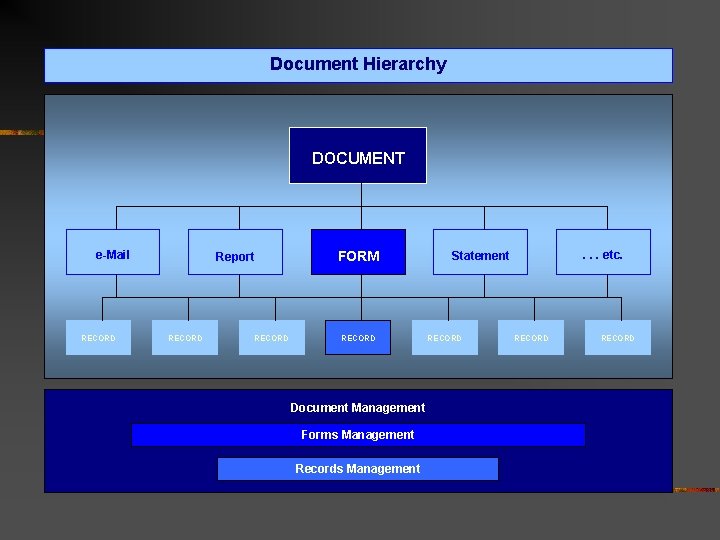
Document Hierarchy DOCUMENT e-Mail RECORD Report RECORD FORM RECORD Document Management Forms Management Records Management . . . etc. Statement RECORD

Introduction to Forms The Forms Industry n n Background & history Industry organization n n BFMA, IADT, DMIA Trend toward control by IT Where the industry is today Where the industry is going
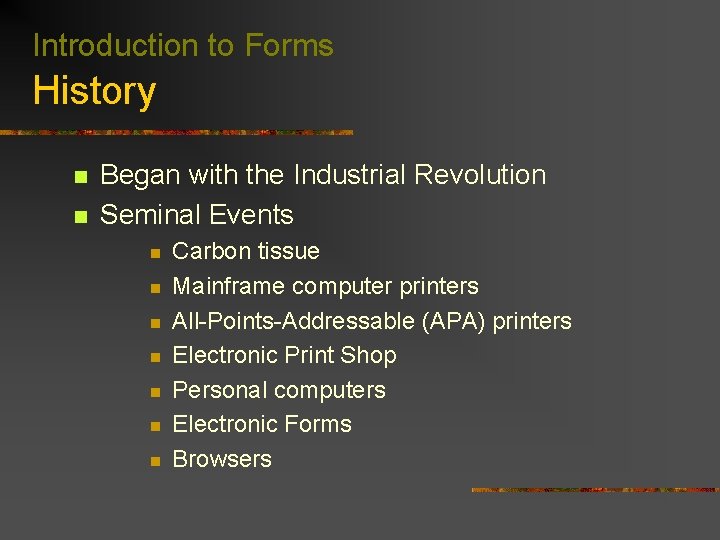
Introduction to Forms History n n Began with the Industrial Revolution Seminal Events n n n n Carbon tissue Mainframe computer printers All-Points-Addressable (APA) printers Electronic Print Shop Personal computers Electronic Forms Browsers
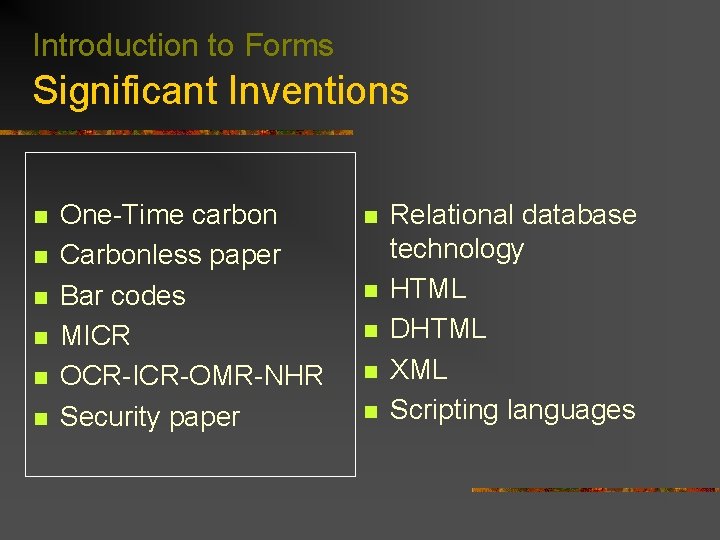
Introduction to Forms Significant Inventions n n n One-Time carbon Carbonless paper Bar codes MICR OCR-ICR-OMR-NHR Security paper n n n Relational database technology HTML DHTML XML Scripting languages
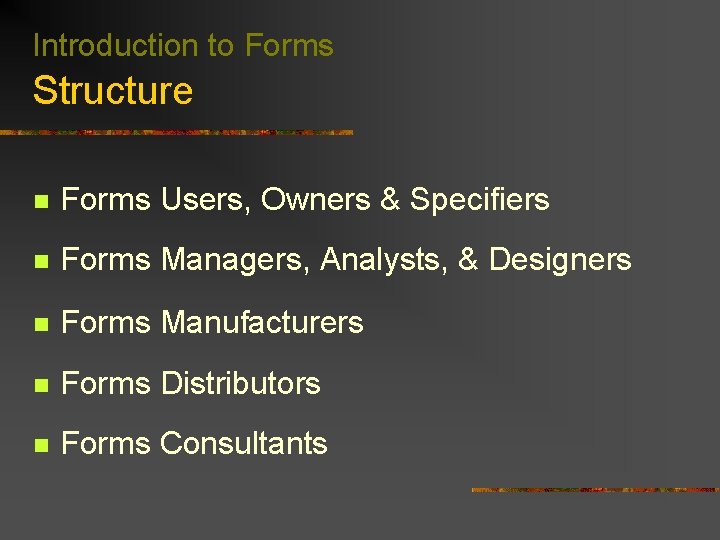
Introduction to Forms Structure n Forms Users, Owners & Specifiers n Forms Managers, Analysts, & Designers n Forms Manufacturers n Forms Distributors n Forms Consultants
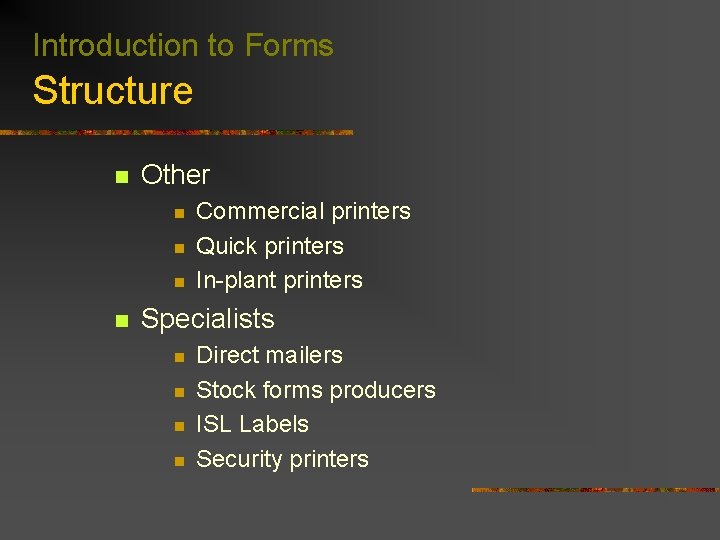
Introduction to Forms Structure n Other n n Commercial printers Quick printers In-plant printers Specialists n n Direct mailers Stock forms producers ISL Labels Security printers
Introduction to Forms Structure n Electronic n n n Software developers Integrators Systems developers General purpose software providers In-house Information Technology (IT) Consultants
Introduction to Forms Associations n Business Forms Management Association (BFMA) n Document Management Industries Association (DMIA) n International Association for Document Technologies (IADT) n AIIM, ARMA, NASPO, TAWPI, and others
Introduction to Forms Current State n n Large, mature industry that is in decline (Form. Trac 03 Study) Megatrends n n n fewer plies smaller sizes one part forms sheets versus continuous blank versus preprinted forms electronic format (paper-optional) and distribution
Introduction to Forms Current State n End Users – downsizing, outsourcing, transferring to IT, more specialized n Manufacturing – mergers & acquisitions, closings, more specialization, diversification n Distributors – Sales versus forms organizations n e. Forms – Adobe & Microsoft; 28+ software developers moving to XML standard
Introduction to Forms Future Scenarios n Extrapolate current state n Year “X” n IT Takeover n Radical technological advancements (New seminal events emerge)
Introduction to Forms Extrapolate Current State n Loss of industry identity n Merge with commercial printing n Emergence of electronic forms technologies n Diffusion of forms development to general business environment
Introduction to Forms Year “X” n n n n n Production of most print products will be digital Product production will be a commodity Inventories of printed products become obsolete Distribution will be digital Requisition systems become production order systems Print demand will grow-users want it New digital printing technologies will emerge Digital asset management becomes essential Requires continued incremental gains only
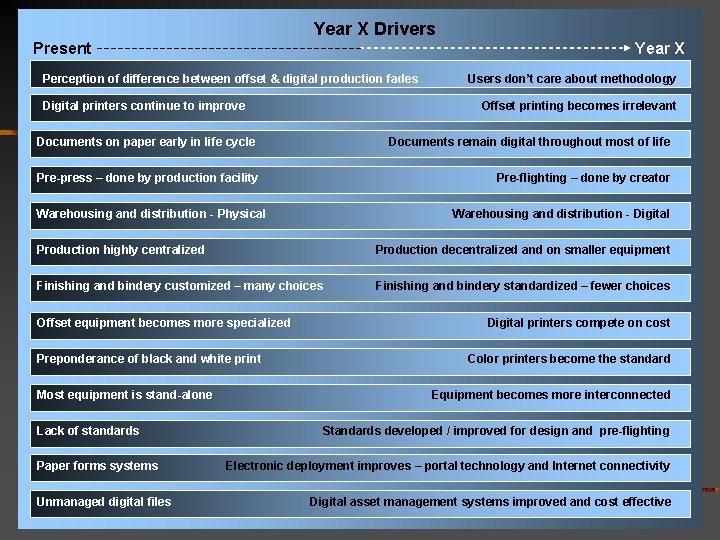
Year X Drivers Present Year X Perception of difference between offset & digital production fades Digital printers continue to improve Users don’t care about methodology Offset printing becomes irrelevant Documents on paper early in life cycle Documents remain digital throughout most of life Pre-press – done by production facility Pre-flighting – done by creator Warehousing and distribution - Physical Warehousing and distribution - Digital Production highly centralized Production decentralized and on smaller equipment Finishing and bindery customized – many choices Finishing and bindery standardized – fewer choices Offset equipment becomes more specialized Preponderance of black and white print Most equipment is stand-alone Lack of standards Paper forms systems Unmanaged digital files Digital printers compete on cost Color printers become the standard Equipment becomes more interconnected Standards developed / improved for design and pre-flighting Electronic deployment improves – portal technology and Internet connectivity Digital asset management systems improved and cost effective
Introduction to Forms IT Takeover n User acceptance of digital forms becomes widespread n Laws change to accommodate e. Forms technologies n Forms technologies become more complicated and technical n Business processes change to become fully online
Introduction to Forms New Seminal Events n Nanotechnology n Ubiquitous wireless networks n Digital inks n Flexible, portable substrates emerge n Low cost, effective voice-to-computer technology n Others ?
Thank You Essociates Group, Inc. 13305 West 126 th Street Overland Park, KS 66213 www. essociatesgroup. com Ray H. Killam, CFC, CFSP rkillam@essociatesgroup. com 913. 284. 6573 Carl W. Brannon, CFC, CFSP cbrannon@essociatesgroup. com 408. 978. 3417 Lisa Leach mleach@essociatesgroup. com 417. 882. 7512

- Slides: 27