
Understanding Federal Preemption December 19 2019 Stacey Gray
Understanding Federal Preemption December 19, 2019 Stacey Gray Pollyanna Sanderson Professor Peter Swire
FPF’s Privacy Legislation Series ● Goal: Providing independent, pragmatic resources to legislative staff and policy experts working on legislation, in support of a baseline, comprehensive privacy law in the United States ● FPF’s Mission: Bridging the policymaker-industry-academic gaps in privacy public policy; developing privacy protections, ethical norms, & responsible business practices. Upcoming Sessions: ● ● ● Child Privacy - January 10, 2020 Enforcement Location Data First Amendment … send us your ideas! sgray@fpf. org & psanderson@fpf. org www. fpf. org/legislative-resources
Webinar Agenda: Preemption 1. Federal Preemption 101 (Introduction and Taxonomy) Polly Sanderson 2. State Privacy Laws that might be Impacted by a Federal Law Professor Swire 3. Policy Arguments and Future State Laws Stacey Gray 4. Discussion: Building Towards Consensus Professor Swire Q&A (20 minutes) & Recommended Readings Q&A: All
Preemption

What is preemption? Supremacy Clause This Constitution, and the laws of the United States which shall be made in pursuance thereof; and all treaties made, or which shall be made, under the authority of the United States, shall be the supreme law of the land; and the judges in every state shall be bound thereby, anything in the Constitution or laws of any State to the contrary notwithstanding. (Article VI, Clause 2, United States Constitution)
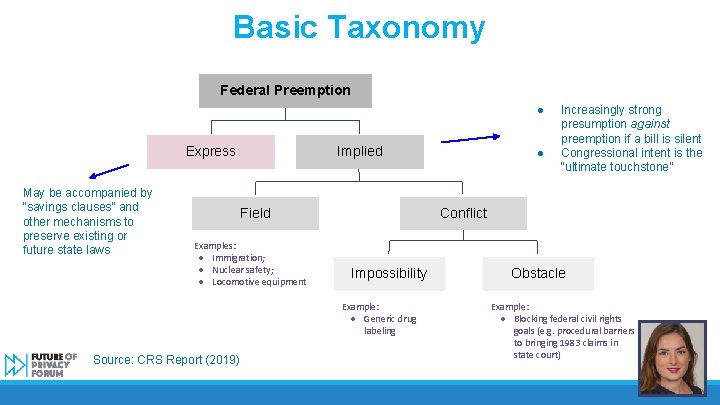
Basic Taxonomy Federal Preemption ● Express May be accompanied by “savings clauses” and other mechanisms to preserve existing or future state laws Implied Field Examples: ● Immigration; ● Nuclear safety; ● Locomotive equipment Conflict Impossibility Example: ● Generic drug labeling Source: CRS Report (2019) ● Increasingly strong presumption against preemption if a bill is silent Congressional intent is the “ultimate touchstone” Obstacle Example: ● Blocking federal civil rights goals (e. g. procedural barriers to bringing 1983 claims in state court)
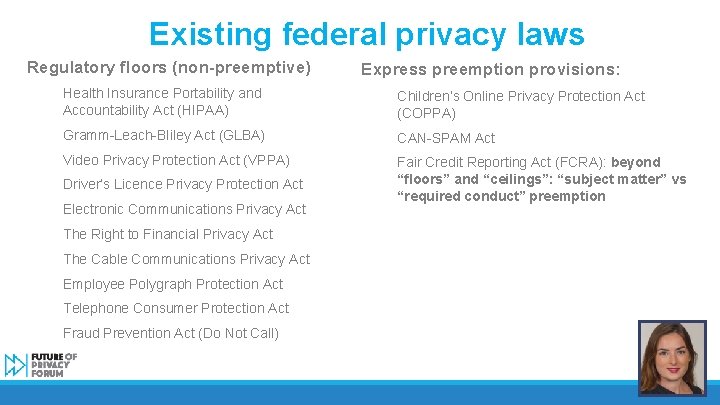
Existing federal privacy laws Regulatory floors (non-preemptive) Express preemption provisions: Health Insurance Portability and Accountability Act (HIPAA) Children’s Online Privacy Protection Act (COPPA) Gramm-Leach-Bliley Act (GLBA) CAN-SPAM Act Video Privacy Protection Act (VPPA) Fair Credit Reporting Act (FCRA): beyond “floors” and “ceilings”: “subject matter” vs “required conduct” preemption Driver’s Licence Privacy Protection Act Electronic Communications Privacy Act The Right to Financial Privacy Act The Cable Communications Privacy Act Employee Polygraph Protection Act Telephone Consumer Protection Act Fraud Prevention Act (Do Not Call)
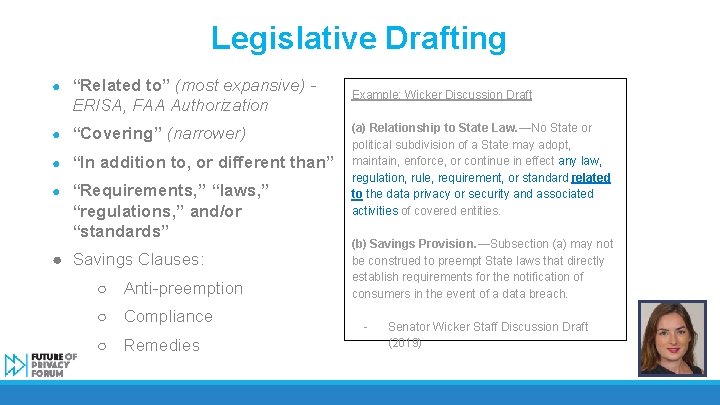
Legislative Drafting ● “Related to” (most expansive) ERISA, FAA Authorization ● “Covering” (narrower) ● “In addition to, or different than” ● “Requirements, ” “laws, ” “regulations, ” and/or “standards” ● Savings Clauses: ○ Anti-preemption ○ Compliance ○ Remedies Example: Wicker Discussion Draft (a) Relationship to State Law. —No State or political subdivision of a State may adopt, maintain, enforce, or continue in effect any law, regulation, rule, requirement, or standard related to the data privacy or security and associated activities of covered entities. (b) Savings Provision. —Subsection (a) may not be construed to preempt State laws that directly establish requirements for the notification of consumers in the event of a data breach. - Senator Wicker Staff Discussion Draft (2019)
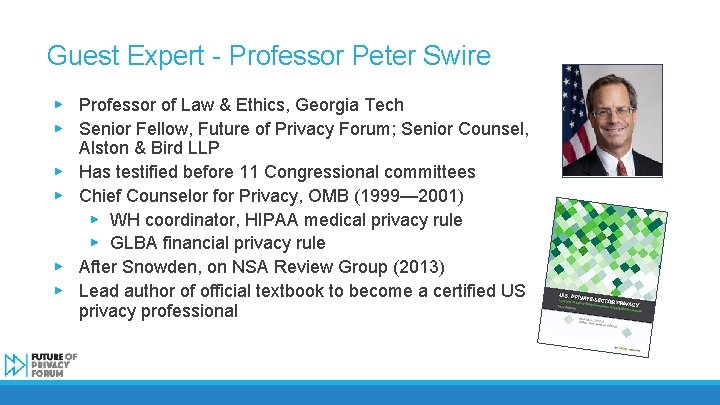
Guest Expert - Professor Peter Swire ▶ Professor of Law & Ethics, Georgia Tech ▶ Senior Fellow, Future of Privacy Forum; Senior Counsel, Alston & Bird LLP ▶ Has testified before 11 Congressional committees ▶ Chief Counselor for Privacy, OMB (1999— 2001) ▶ WH coordinator, HIPAA medical privacy rule ▶ GLBA financial privacy rule ▶ After Snowden, on NSA Review Group (2013) ▶ Lead author of official textbook to become a certified US privacy professional
My role in the discussion ▶ Seeking to share my experience from 25 years in the privacy field ▶ My goal – as close to neutral as possible on the scope of preemption ▶ Technical advisor – trying to help members and staff achieve the outcome you prefer ▶ I have no clients on this legislation, and have taken no position on any provisions
There are Many State Privacy Laws ▶ Robert Ellis Smith compilation, $9 on Kindle ▶ Some examples: ▶ State law prohibits employer from requiring social media password ▶ State laws restricting display and disclosure of SSN ▶ Student privacy laws (schools) ▶ Telephone marketing laws and Caller ID
State Contract, Tort, & Property Law ▶ Contracts are widespread for privacy protection ▶ HIPAA – “covered entity” and “business associate” ▶ EU – “controller” and “processor” ▶ Preempt the protections provided by these contracts? ▶ Torts ▶ Prosser 4 traditional privacy torts ▶ E. g. , right to personality (can’t use my likeness for your advertisement without permission) ▶ Property ▶ What counts as trespass, eavesdropping?
Laws of general application ▶ Fraud – every state prohibits this ▶ Preempt state identity theft criminal penalties? ▶ Every state has UDAP laws ▶ “unfair and deceptive acts and practices” ▶ Many non-privacy ways to act deceptively ▶ Preempt all state enforcement for deceptive practices?
Preemption and Business Certainty ▶ With so many state laws, will have innumerable gray areas – preempted or not ▶ Federal judges sometimes disagree ▶ Increases business uncertainty, during years of costly litigation ▶ Can create a process to clarify what is preempted ▶ COPPA – FTC has authority to decide whether a state law is preempted ▶ HIPAA – HHS has authority, upon request by a Governor, to permit a state law to apply, even if inconsistent with the federal standard ▶ Grandfathering/Plus One Strategy
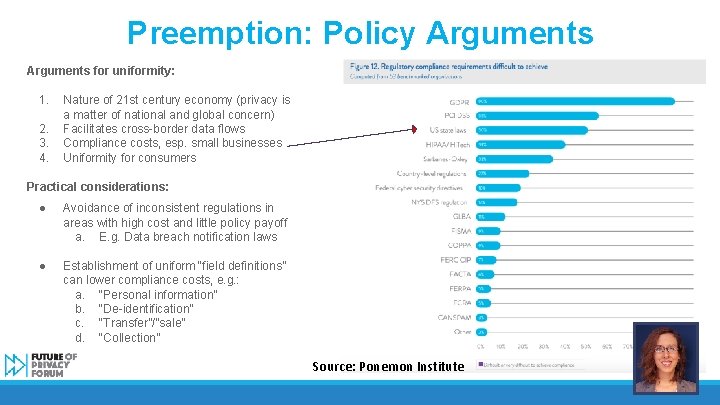
Preemption: Policy Arguments for uniformity: 1. 2. 3. 4. Nature of 21 st century economy (privacy is a matter of national and global concern) Facilitates cross-border data flows Compliance costs, esp. small businesses Uniformity for consumers Practical considerations: ● Avoidance of inconsistent regulations in areas with high cost and little policy payoff a. E. g. Data breach notification laws ● Establishment of uniform “field definitions” can lower compliance costs, e. g. : a. “Personal information” b. “De-identification” c. “Transfer”/”sale” d. “Collection” Source: Ponemon Institute
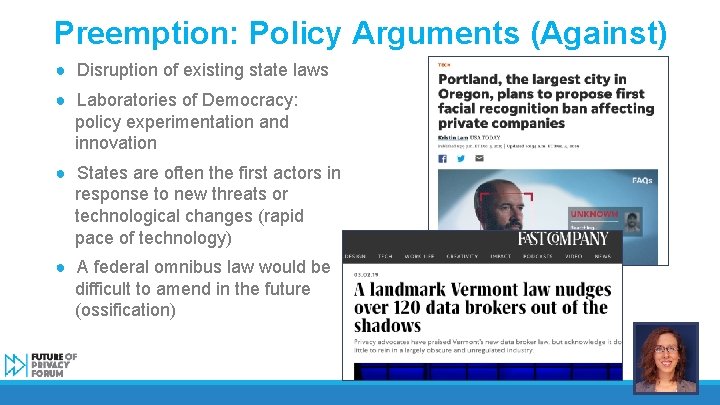
Preemption: Policy Arguments (Against) ● Disruption of existing state laws ● Laboratories of Democracy: policy experimentation and innovation ● States are often the first actors in response to new threats or technological changes (rapid pace of technology) ● A federal omnibus law would be difficult to amend in the future (ossification)
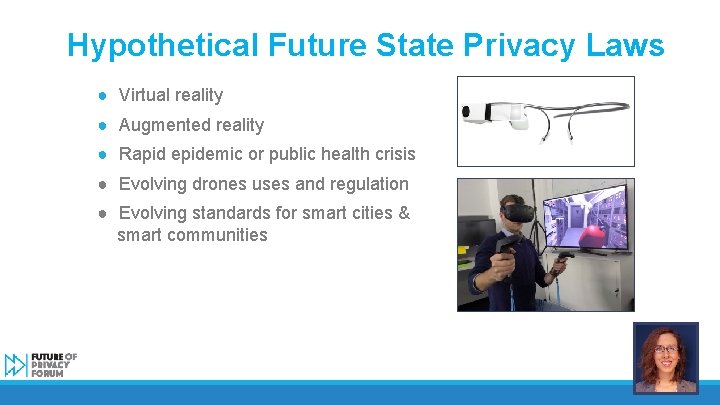
Hypothetical Future State Privacy Laws ● Virtual reality ● Augmented reality ● Rapid epidemic or public health crisis ● Evolving drones uses and regulation ● Evolving standards for smart cities & smart communities
Discussion: A Possible Path Toward Consensus ▶ Preemption can seem like a zero-sum issue ▶ Some privacy advocates want no preemption ▶ Some business supporters want maximum preemption ▶ If one side “wins” then the other side “loses” ▶ Here is one suggestion for a process that has worked before in Congress ▶ Find the places where people agree
How FISA Became Law in 1978 ▶ Post-Watergate, bipartisan support for some new limits on national security wiretaps ▶ For national security reasons, government couldn’t describe its actual practices ▶ Solution ▶ Developed multiple hypotheticals ▶ Have Congress consider what it wanted for those hypotheticals ▶ Then, drafted the text that became FISA
A Proposal to Find Areas of Consensus ▶ Examine 20 current state laws related to privacy and cybersecurity ▶ List which ones you think should remain in place ▶ For consensus items, go to leg counsel for text ▶ Examine 10 possible future state laws related to privacy and cybersecurity ▶ Again, see where have agreement ▶ Go to leg counsel for text
Breaking the Impasse ▶ Perhaps there is consensus on 60% or 80% of the case studies ▶ Draft text for those now ▶ Perhaps also draft alternative text for the case studies where you disagree ▶ That way, when you are close to a final deal, members can make an informed decision about how to negotiate on the remaining, fewer items
Questions? info@fpf. org www. fpf. org facebook. com/futureofprivacy @futureofprivacy
Recommended Reading ● ● ● Federal Preemption: A Legal Primer (July 2019) Congressional Research Service Peter Swire, US federal privacy preemption, part 1 & 2 (IAPP) Paul M Schwartz, Preemption and Privacy, 118 Yale L. J. 902, 912 (2009) Compilation of State and Federal Privacy Laws by Robert Ellis Smith U. S. Private-Sector Privacy, Second Edition, Peter Swire, De. Brae Kennedy-Mayo Joseph L. Seidel, The Consumer Credit Reporting Reform Act: Information Sharing and Preemption, 2 N. C. Banking Inst. 79 (1998) Patricia L. Bellia, Federalization in Information Privacy Law, 118 Yale L. J. 868 (2009) Margot E. Kaminsky, Drone Federalism: Civilian Drones and Things They Carry, 4 Cal. L. Rev. Circuit 57 (2013) Bilyana Petkova, The Safeguarding of Privacy Federalism, 20 Lewis & Clark L. Rev. 595 (2016) Ira S. Rubinstein, Privacy Localism, 93 Wash. L. Rev. 1961 (2018) For an industry perspective, see Brad Smith, Senior Vice President, Gen. Counsel, Microsoft Corp. , Protecting Consumers and the Marketplace: The Need for Federal Privacy Legislation (Nov. 2005)
- Slides: 23