
Understanding FDAs Food Supplier Verification Program FSVP MODERATOR


- Slides: 32
Understanding FDA’s Food Supplier Verification Program (FSVP) MODERATOR: Mike Lahar A. N. Deringer NCBFAA RAC Co-Chair PANELISTS: Stuart Schmidt UPS Kristen Spotz Domenic Veneziano GMA Veneziano Consulting
FDA- Food Safety Verification Program What U. S. Importers Need to Know March 2017
FDA Food Safety Verification Program (FSVP): What U. S. Importers Need to Know • Background • What’s Not Changing • What’s Changing • What food is not covered • When does reporting begin • What do Broker’s need to submit to FDA? • Helpful Resources Proprietary and Confidential: This presentation may not be used or disclosed to any person other than employees of customer, unless expressly authorized by UPS. © 2015 United Parcel Service of America, Inc. UPS, the UPS brandmark, the color brown and photos are trademarks of United Parcel Service of America, Inc. All rights reserved.
Background The FDA Food Safety Modernization Act of 2011 mandates the creation of a food safety system in which the focus is on preventing contamination rather than primarily reacting to problems after they occur. The FSMA rules include those that create preventive controls for the production of human and animal foods, and establish science-based standards for produce grown on farms. These rules apply to domestic food producers and those in other countries who export to the United States. • FDA States: The import community will be most impacted by the Foreign Supplier Verification Programs (FSVP) rule, which requires FSVP importers to verify that the food they import meets U. S. safety standards. FSVP importers are required to develop, maintain, and follow an FSVP for each food imported, unless an exemption applies. The goal is to ensure that each food is produced in a manner that provides the same level of public health protection as the preventive controls and produce safety regulations, if applicable, and the food is not adulterated or misbranded with respect to allergen labeling. Effective May 27, 2017 ACE will enforce new data elements related to the enforcement of FSVP for imported food products. Proprietary and Confidential: This presentation may not be used or disclosed to any person other than employees of customer, unless expressly authorized by UPS. © 2015 United Parcel Service of America, Inc. UPS, the UPS brandmark, the color brown and photos are trademarks of United Parcel Service of America, Inc. All rights reserved.
FSVP – What Is Not Changing • Prior Notice for importations of food • Definitions of food or food products • Registration - Domestic and foreign facilities that manufacture, process, pack, or hold food, as defined 21 CFR 1. 227, for human or animal consumption in the U. S. must register with FDA effective December 12, 2003. • No fee to register or update • Registration required to be renewed every two years beginning on Oct 1 and ending Dec 31 each even numbered year • Facilities exempt from registration • Who may register a facility, information required and the methods of registration • FDA Refusal of imported food manufactured by a non-registered facility Proprietary and Confidential: This presentation may not be used or disclosed to any person other than employees of customer, unless expressly authorized by UPS. © 2015 United Parcel Service of America, Inc. UPS, the UPS brandmark, the color brown and photos are trademarks of United Parcel Service of America, Inc. All rights reserved.
What food is not covered? Certain categories of imported food are not covered by FSVP. These include: • Juice, fish, and fishery products subject to and in compliance with FDA’s Hazard Analysis and Critical Control Point (HACCP) regulations for those products, and certain ingredients for use in juice and fishery products subject to the HACCP regulations. • Food for research or evaluation • Food for personal consumption • Alcoholic beverages and certain ingredients for use in alcoholic beverages • Food that is imported for processing and future export • Low-acid canned foods (LACF), such as canned vegetables, but only with respect to microbiological hazards covered by other regulations, as well as certain ingredients for use in LACF products (but only with respect to microbiological hazards). • Certain meat, poultry and egg products regulated by the U. S. Department of Agriculture at the time of importation Proprietary and Confidential: This presentation may not be used or disclosed to any person other than employees of customer, unless expressly authorized by UPS. © 2015 United Parcel Service of America, Inc. UPS, the UPS brandmark, the color brown and photos are trademarks of United Parcel Service of America, Inc. All rights reserved. 6
FSVP - What’s Changing A flexible, risk-based approach to foreign supplier verification Importers must meet the requirements of the final FSVP rule 1 • Verify that their foreign suppliers are producing food in a manner that provides the same level of public health protection as the preventive controls or produce safety regulations Importers are responsible for actions that include 2 • Establish and follow written procedures to comply • Develop, maintain and follow an FSVP for each imported food • Perform re-evaluation activities every three years • Conduct hazard analysis Proprietary and Confidential: This presentation may not be used or disclosed to any person other than employees of customer, unless expressly authorized by UPS. © 2015 United Parcel Service of America, Inc. UPS, the UPS brandmark, the color brown and photos are trademarks of United Parcel Service of America, Inc. All rights reserved.
When do I need to begin reporting? • FSVP importer whose foreign supplier is not subject to the PC or produce safety rules: May 30, 2017 • FSVP importer whose foreign supplier is required to comply with the PC rule for human food or FSVP importer of animal food whose foreign supplier is subject to the current good manufacturing practices (“CGMP”) requirements in subpart B of 21 CFR part 507 in the PC rule for animal food. • Compliance dates when foreign suppliers are in these categories: • Small businesses as defined in 21 CFR 117. 3: March 19, 2018 • Qualified Facilities (including Very Small Businesses) as defined in 21 CFR 117. 3: March 18, 2019 • Suppliers subject to the Pasteurized Milk Ordinance: March 18, 2019 (Human Food) • “All Other” Businesses Suppliers: May 30, 2017 Proprietary and Confidential: This presentation may not be used or disclosed to any person other than employees of customer, unless expressly authorized by UPS. © 2015 United Parcel Service of America, Inc. UPS, the UPS brandmark, the color brown and photos are trademarks of United Parcel Service of America, Inc. All rights reserved. 8
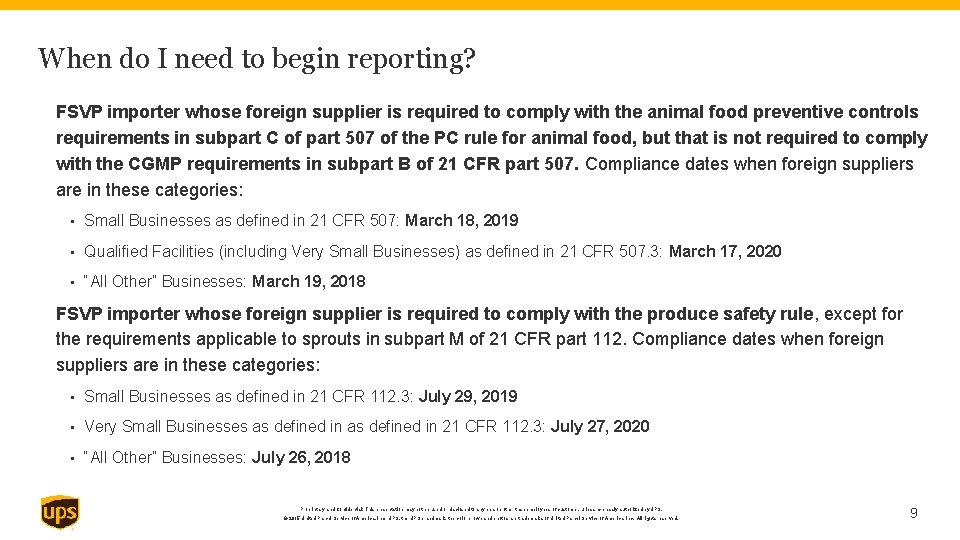
When do I need to begin reporting? FSVP importer whose foreign supplier is required to comply with the animal food preventive controls requirements in subpart C of part 507 of the PC rule for animal food, but that is not required to comply with the CGMP requirements in subpart B of 21 CFR part 507. Compliance dates when foreign suppliers are in these categories: • Small Businesses as defined in 21 CFR 507: March 18, 2019 • Qualified Facilities (including Very Small Businesses) as defined in 21 CFR 507. 3: March 17, 2020 • “All Other” Businesses: March 19, 2018 FSVP importer whose foreign supplier is required to comply with the produce safety rule, except for the requirements applicable to sprouts in subpart M of 21 CFR part 112. Compliance dates when foreign suppliers are in these categories: • Small Businesses as defined in 21 CFR 112. 3: July 29, 2019 • Very Small Businesses as defined in 21 CFR 112. 3: July 27, 2020 • “All Other” Businesses: July 26, 2018 Proprietary and Confidential: This presentation may not be used or disclosed to any person other than employees of customer, unless expressly authorized by UPS. © 2015 United Parcel Service of America, Inc. UPS, the UPS brandmark, the color brown and photos are trademarks of United Parcel Service of America, Inc. All rights reserved. 9
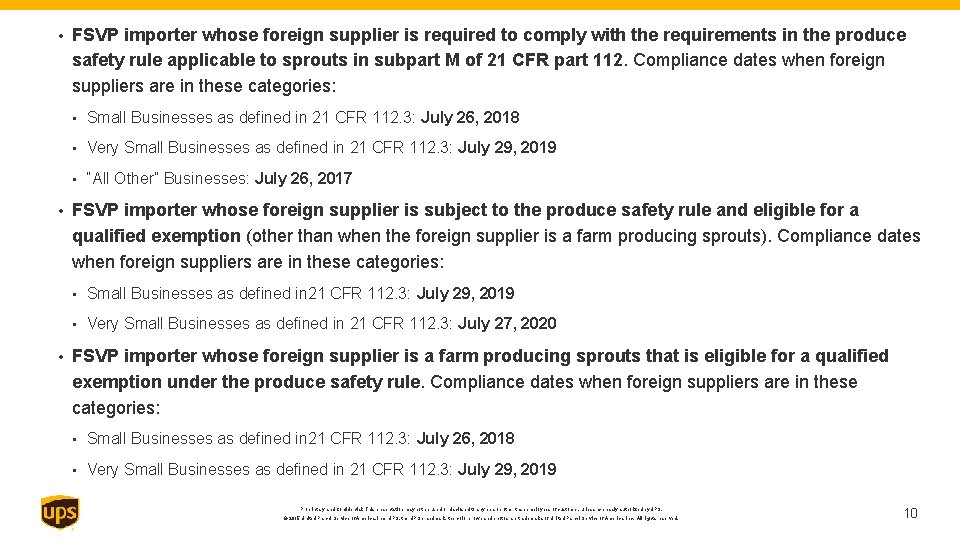
• • • FSVP importer whose foreign supplier is required to comply with the requirements in the produce safety rule applicable to sprouts in subpart M of 21 CFR part 112. Compliance dates when foreign suppliers are in these categories: • Small Businesses as defined in 21 CFR 112. 3: July 26, 2018 • Very Small Businesses as defined in 21 CFR 112. 3: July 29, 2019 • “All Other” Businesses: July 26, 2017 FSVP importer whose foreign supplier is subject to the produce safety rule and eligible for a qualified exemption (other than when the foreign supplier is a farm producing sprouts). Compliance dates when foreign suppliers are in these categories: • Small Businesses as defined in 21 CFR 112. 3: July 29, 2019 • Very Small Businesses as defined in 21 CFR 112. 3: July 27, 2020 FSVP importer whose foreign supplier is a farm producing sprouts that is eligible for a qualified exemption under the produce safety rule. Compliance dates when foreign suppliers are in these categories: • Small Businesses as defined in 21 CFR 112. 3: July 26, 2018 • Very Small Businesses as defined in 21 CFR 112. 3: July 29, 2019 Proprietary and Confidential: This presentation may not be used or disclosed to any person other than employees of customer, unless expressly authorized by UPS. © 2015 United Parcel Service of America, Inc. UPS, the UPS brandmark, the color brown and photos are trademarks of United Parcel Service of America, Inc. All rights reserved. 10
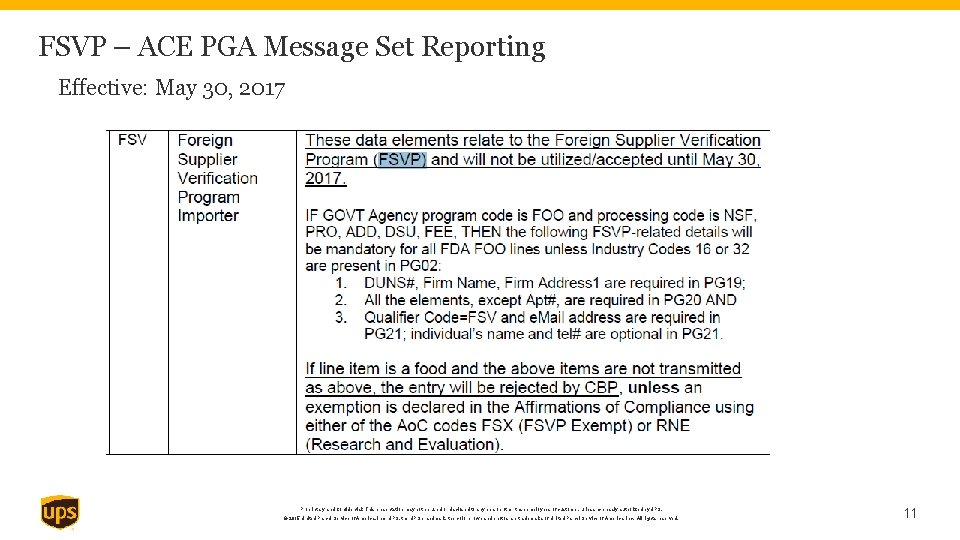
FSVP – ACE PGA Message Set Reporting Effective: May 30, 2017 Proprietary and Confidential: This presentation may not be used or disclosed to any person other than employees of customer, unless expressly authorized by UPS. © 2015 United Parcel Service of America, Inc. UPS, the UPS brandmark, the color brown and photos are trademarks of United Parcel Service of America, Inc. All rights reserved. 11
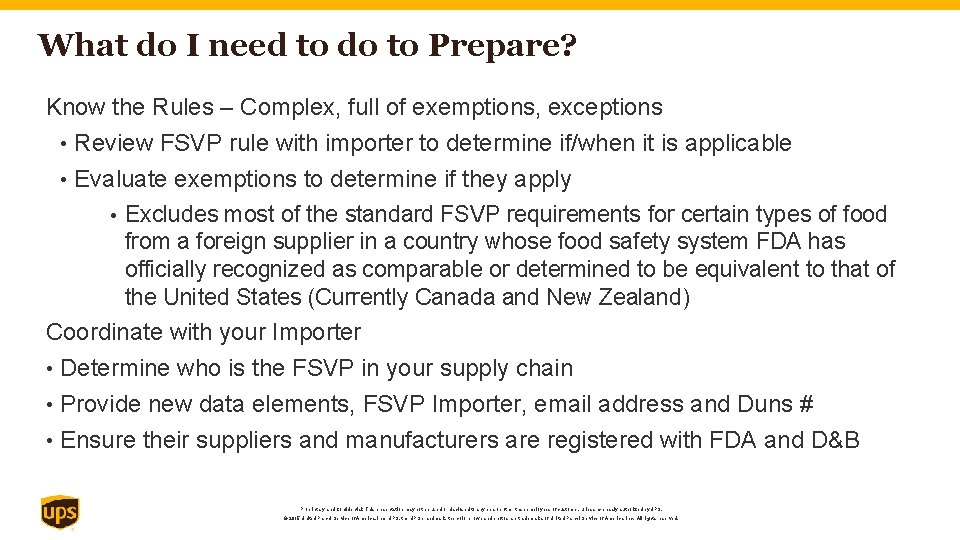
What do I need to do to Prepare? Know the Rules – Complex, full of exemptions, exceptions • Review FSVP rule with importer to determine if/when it is applicable Evaluate exemptions to determine if they apply • Excludes most of the standard FSVP requirements for certain types of food from a foreign supplier in a country whose food safety system FDA has officially recognized as comparable or determined to be equivalent to that of the United States (Currently Canada and New Zealand) Coordinate with your Importer • • Determine who is the FSVP in your supply chain • Provide new data elements, FSVP Importer, email address and Duns # • Ensure their suppliers and manufacturers are registered with FDA and D&B Proprietary and Confidential: This presentation may not be used or disclosed to any person other than employees of customer, unless expressly authorized by UPS. © 2015 United Parcel Service of America, Inc. UPS, the UPS brandmark, the color brown and photos are trademarks of United Parcel Service of America, Inc. All rights reserved.
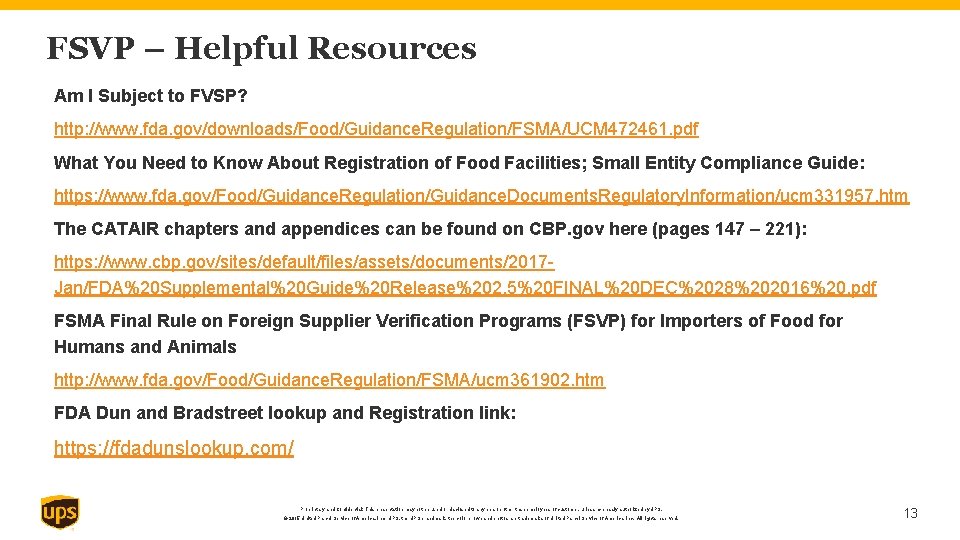
FSVP – Helpful Resources Am I Subject to FVSP? http: //www. fda. gov/downloads/Food/Guidance. Regulation/FSMA/UCM 472461. pdf What You Need to Know About Registration of Food Facilities; Small Entity Compliance Guide: https: //www. fda. gov/Food/Guidance. Regulation/Guidance. Documents. Regulatory. Information/ucm 331957. htm The CATAIR chapters and appendices can be found on CBP. gov here (pages 147 – 221): https: //www. cbp. gov/sites/default/files/assets/documents/2017 Jan/FDA%20 Supplemental%20 Guide%20 Release%202. 5%20 FINAL%20 DEC%2028%202016%20. pdf FSMA Final Rule on Foreign Supplier Verification Programs (FSVP) for Importers of Food for Humans and Animals http: //www. fda. gov/Food/Guidance. Regulation/FSMA/ucm 361902. htm FDA Dun and Bradstreet lookup and Registration link: https: //fdadunslookup. com/ Proprietary and Confidential: This presentation may not be used or disclosed to any person other than employees of customer, unless expressly authorized by UPS. © 2015 United Parcel Service of America, Inc. UPS, the UPS brandmark, the color brown and photos are trademarks of United Parcel Service of America, Inc. All rights reserved. 13
Understanding FDA’s Food Supplier Verification Program (FSVP) Kristen Spotz Grocery Manufactures Association Senior Manager, Food Safety and Quality Assurance
NCBFAA WEBINAR MAY 12, 2017 FOREIGN SUPPLIER VERIFICATION PROGRAM
AGENDA ØFSMA & FSVP compliance ØHow FSMA could impacts on Customs House Brokers ØExemptions & Modified Requirements
WHAT IS FSVP Ø It is a PROGRAM that importers must have in place to VERIFY that their foreign suppliers are producing food in a manner that provides the same level of public health protection as the preventive controls or produce safety regulations, as appropriate, and to ensure that the supplier’s food is not adulterated and is not misbranded with respect to allergen labeling
PROHIBITED ACT 301(zz): The importation or offering for importation of a food if the importer does not have in place a foreign supplier verification program in compliance with section 805. 801(a) If it appears from examination of such samples or otherwise that (3) …. or the importer is in violation of such section 805. then such article shall be refused admission.
Why FSMA Compliance is Important Failure to comply with FSMA can result in: ü Suspension of food facility registration ü Withdrawal of commercial contracts with major retail grocery food service customers ü Disruption of consumer confidence ü Placement on FDA Import Alerts ü Product recall ü Financial loss ü Will lead to FDA oversight in other areas (supplier, 3 rd party, VQIP) ü FDA Invoke section 414, if appropriate.
FDA Inspectional Strategy - FSVP Ø FY 16 forward: Outreach and Education ü Public meetings, webinars, FSMA website ü FSVP final rule ü Industry Guidance ü FSVP Alliance Course ü Regulator Training Ø FY 17 and FY 18: Field Assignments ü Initial importer inspections include “education” ü Conduct inspections using Intelligent Questionnaire ü Classify initial inspections; enforcement may be taken ü Goal is 600 inspections in FY 17 Ø FY 19 forward: Compliance Program In Effect
INSPECTIONAL PRIORITIZATION ü For-cause (e. g. , tied to an outbreak or recall, Lab Class 3 samples) ü Follow-up to FSVP problems (e. g. , OAI, VAI, Import Alerts) ü VQIP (maximum of 200 inspections in first year) ü Include importers whose foreign suppliers have been inspected by FDA ü Routine (all others)
VQIP GUIDANCE – ELIGIBILITY CRITERIA Ø Quality Assurance Program (QAP) Ø Assurance of compliance with the supplier verification and other importer responsibilities under the applicable FSVP or HACCP regulations Ø Current facility certification, including farms, issued under FDA’s Accredited Third-Party Certification regulations for each foreign supplier of food in VQIP Ø 3+ year history of importing good to the U. S. Ø No ongoing FDA administrative or judicial action (e. g. Import Alert, injunction, recall) or other history of non-compliance with food safety regulations by the importer, other entities in the supply chain (e. g. foreign suppliers, filers/brokers, and FSVP and HACCP importers) or food Ø Have a Dun & Bradstreet (D&B) Data Universal Numbering System (DUNS) number.
FSVP DATA ELEMENTS: IMPORTER IDENTIFICATION Ø Use Entity Role Code Foreign Supplier Verification Program Importer (FSV) & provide: Ø Firm Name Ø Firm Address Ø DUNS number Ø Email address Ø Individual’s name and telephone are optional Ø If product is a food and above data elements are not submitted, the entry will be rejected by CBP, unless an Affirmation of Compliance exemption code is applied: Ø FSVP Exempt or later compliance date (FSX) Ø Research and Evaluation (RNE) Ø TBA – An Unknown Code (UKN) Soft roll out Ø Obtain DUNS number for free at www. fda. dunslookup. com. Ø These data elements are separate & distinct from Prior Notice requirements.
FSVP EXEMPTIONS Ø Firms subject to juice or seafood HACCP regulations Ø Food for research or evaluation Ø Food for personal consumption Ø Alcoholic beverages and ingredients (when importer uses them to make an alcoholic beverage) Ø Food transshipped through U. S. Ø Food imported for processing and export Ø “U. S. goods returned” Ø Meat, poultry, and egg products subject to USDA regulation at time of importation
MODIFIED REQUIREMENTS Ø Low Acid Canned Food (not further processed) Ø Manufacturer/processor (1. 502(c)) Ø Dietary Supplements (21 CFR-1. 511) Ø Very Small Importers & Small Foreign Suppliers (21 CFR 1. 512) Ø Countries with Comparable or Equivalent Food Safety Systems (21 CFR 1. 513)
LOW ACID CANNED FOOD (NOT FURTHER PROCESSED) Ø You do not need an FSVP with respect to microbiological hazards for that food. Ø Instead, you must verify and document that the food was produced in accordance with 21 CFR part 113. Ø With respect to all matters that are not controlled by part 113 such as chemical and radiological, you must have an FSVP.
MANUFACTURER/PROCESSO R Ø If in compliance with PC you are deemed in compliance with most aspects of FSVP Ø requirement for importer identification at entry.
DIETARY SUPPLEMENTS Ø Importers subject to DS c. GMPs 111. 73 & 111. 75 ü You must utilize a Qualified individual and Qualified Auditor ü You must identify the FSVP importer at entry Ø Importers whose customers are subject to DS c. GMPs 111. 73 & 111. 75 ü ü You must utilize a Qualified individual and Qualified Auditor You must identify the FSVP importer at entry Required to have an annual written assurance Maintain Records
VERY SMALL: IMPORTER/FOREIGN SUPPLIER Ø You must document that you meet the definition of very small importer in with respect to human food and/or animal food before initially importing food as a very small importer and thereafter on an annual basis by December 31 of each calendar year. Ø You must obtain written assurance that your small foreign supplier complies with PC before first approving the supplier for an applicable calendar year and thereafter on an annual basis by December 31 of each calendar year, for the following calendar year. ü ü ü You must utilize a Qualified individual and Qualified Auditor You must identify the FSVP importer at entry Required to have an annual written assurance Maintain Records Corrective Actions
COUNTRIES WITH COMPARABLE OR EQUIVALENT FOOD SAFETY SYSTEMS Ø Generally, FSVP requirements do not apply when importing certain food from suppliers in countries whose food safety system FDA has officially recognized as comparable or determined to be equivalent (Systems recognition initiative) Ø Applies to food that will not be processed further (packaged food: fresh produce) Ø Importer must document that: ü Foreign supplier is under oversight of comparable or equivalent food safety system ü Food is within scope of official recognition or determination ü Supplier is in good compliance standing with comparable or equivalent food safety authority.
Questions? CONTACT INFORMATION Domenic J Veneziano CAPT USPHS (Retired) Independent FDA Regulatory and Strategic Consultant Email: Domenic. Veneziano@Yahoo. com Telephone: (240) 400 -0567
Understanding FDA’s Food Supplier Verification Program (FSVP) MODERATOR: Mike Lahar A. N. Deringer NCBFAA RAC Co-Chair PANELISTS: Stuart Schmidt UPS Kristen Spotz Domenic Veneziano GMA Veneziano Consulting