
UNDERSTANDING EXPONENTIAL GROWTH There are two types of
- Slides: 5
UNDERSTANDING EXPONENTIAL GROWTH
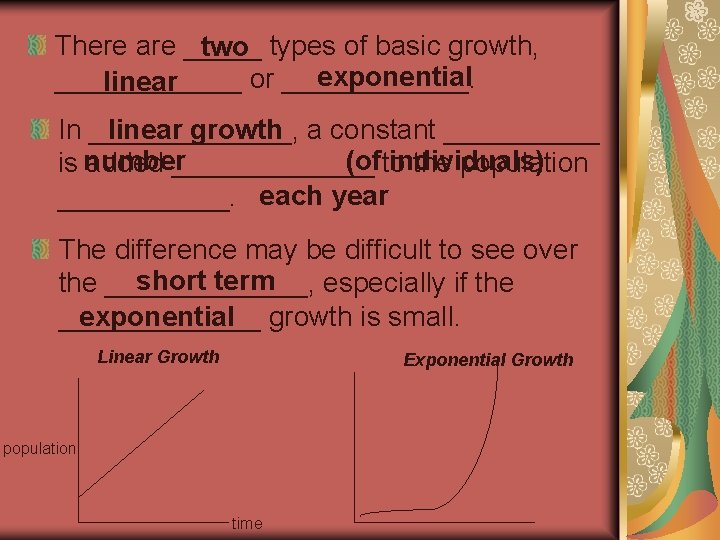
There are _____ two types of basic growth, exponential ______ or ______. linear In _______, linear growth a constant _____ (ofto individuals) is number added _______ the population ______. each year The difference may be difficult to see over short term the _______, especially if the _______ exponential growth is small. Linear Growth Exponential Growth population time
In _________ exponential growth a ______ percentage is added each year. _ If a population has a _____ constant birth rate limited by ____ food and is NEVER _____ or disease ______, it will experience __________. exponential growth However, in most real populations lack of disease and food and presence of ______, other_________ become limiting factors important as conditions become crowded ______.
There is an upper limit known as the Carrying capacity that the environment ________ can support. Most populations experience an S-Curve _____(sigmoidal)_consisting of 3 phases. LAG. A region of slow population growth. Only a small number of organisms are sexually mature and able to reproduce. The organisms may be adjusting to a new environment.
EXPONENTIAL. Many organisms have reached sexual maturity. They are able to reproduce. The organisms have adjusted to the conditions around them. They have adequate food, shelter, and water for survival. STABLE OR EQUILIBRIUM. The carrying capacity is reached. Population becomes constant. The number of deaths (mortality) equals the number of births (natality). Those moving in (immigrating) is also similar to those moving out (emigrating)