
Understanding Ethernet Building a Simple Network 2007 Cisco
Understanding Ethernet Building a Simple Network © 2007 Cisco Systems, Inc. All rights reserved. ICND 1 v 1. 0— 1 -1
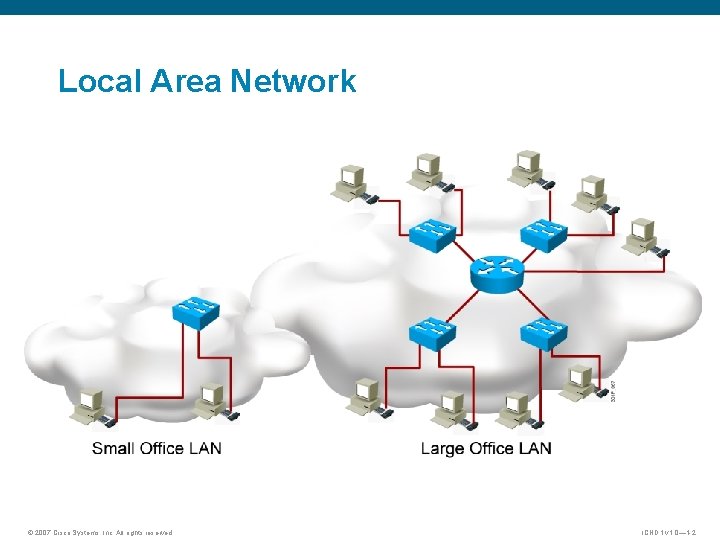
Local Area Network © 2007 Cisco Systems, Inc. All rights reserved. ICND 1 v 1. 0— 1 -2
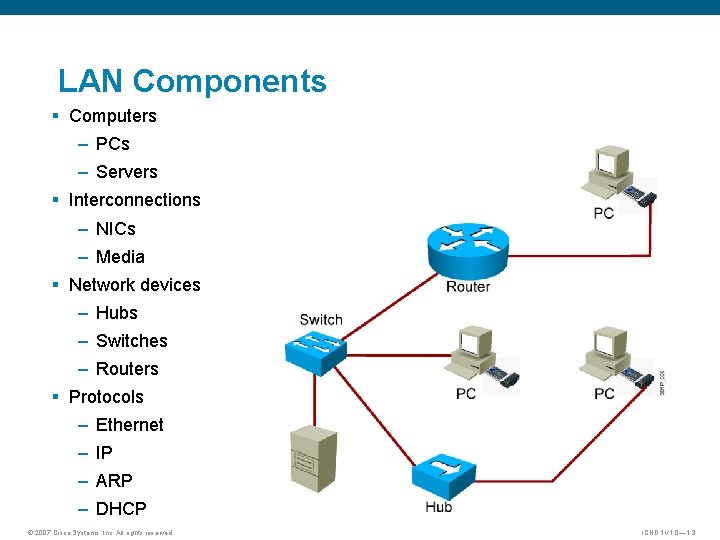
LAN Components § Computers – PCs – Servers § Interconnections – NICs – Media § Network devices – Hubs – Switches – Routers § Protocols – Ethernet – IP – ARP – DHCP © 2007 Cisco Systems, Inc. All rights reserved. ICND 1 v 1. 0— 1 -3
Functions of a LAN § Data and applications § Share resources § Provide communication path to other networks © 2007 Cisco Systems, Inc. All rights reserved. ICND 1 v 1. 0— 1 -4
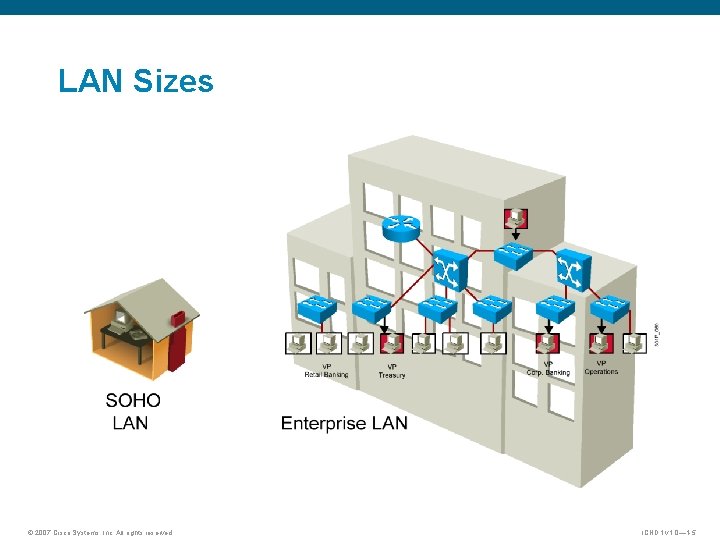
LAN Sizes © 2007 Cisco Systems, Inc. All rights reserved. ICND 1 v 1. 0— 1 -5
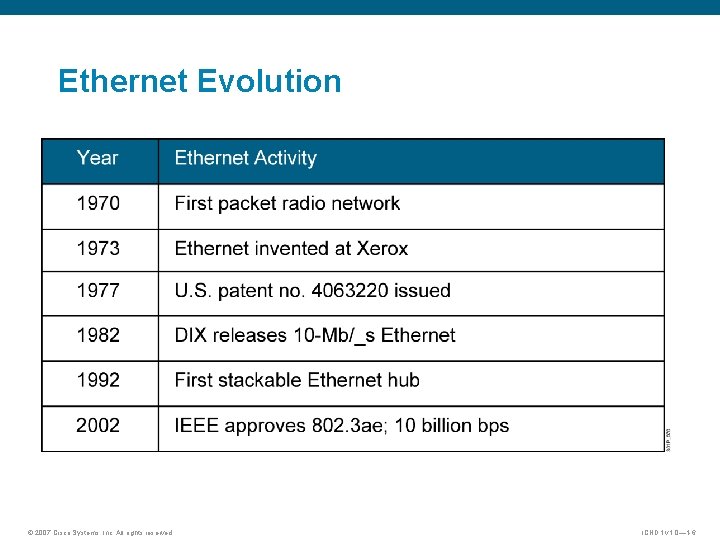
Ethernet Evolution © 2007 Cisco Systems, Inc. All rights reserved. ICND 1 v 1. 0— 1 -6
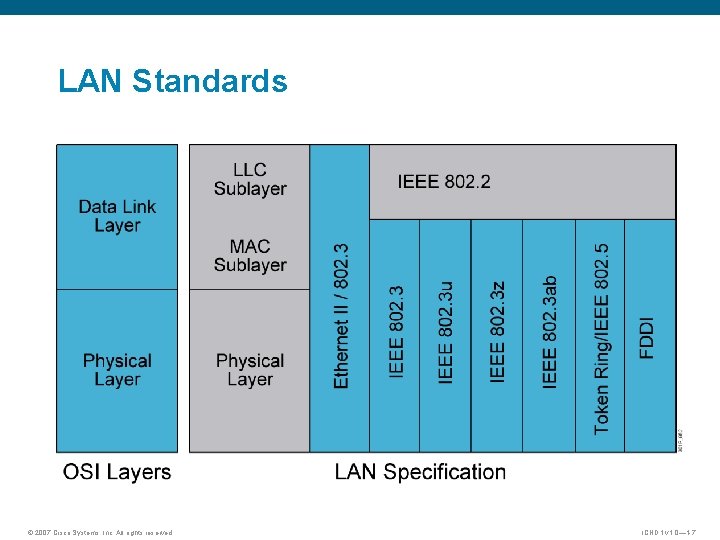
LAN Standards © 2007 Cisco Systems, Inc. All rights reserved. ICND 1 v 1. 0— 1 -7
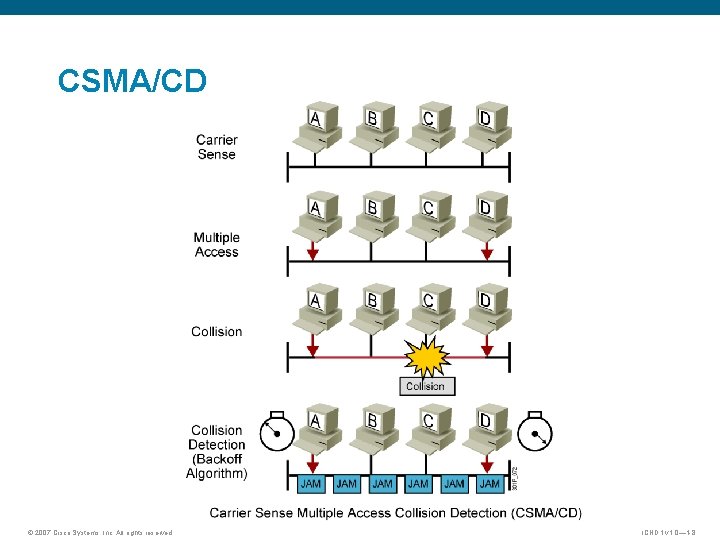
CSMA/CD © 2007 Cisco Systems, Inc. All rights reserved. ICND 1 v 1. 0— 1 -8

Ethernet Frame Structure © 2007 Cisco Systems, Inc. All rights reserved. ICND 1 v 1. 0— 1 -9
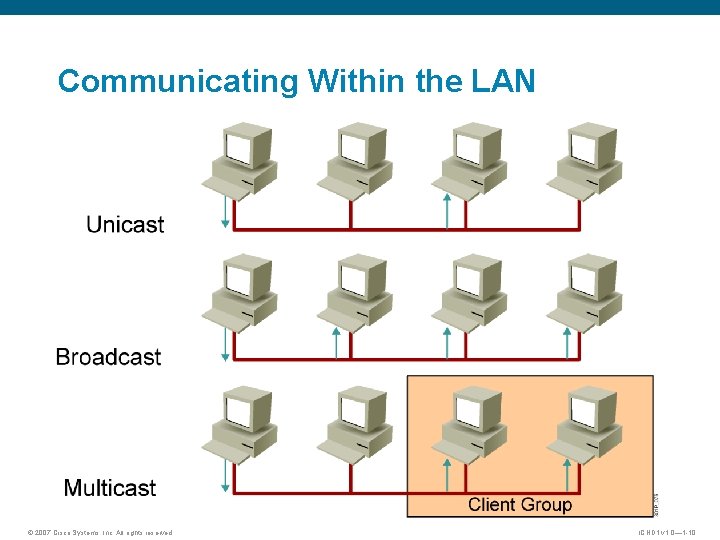
Communicating Within the LAN © 2007 Cisco Systems, Inc. All rights reserved. ICND 1 v 1. 0— 1 -10
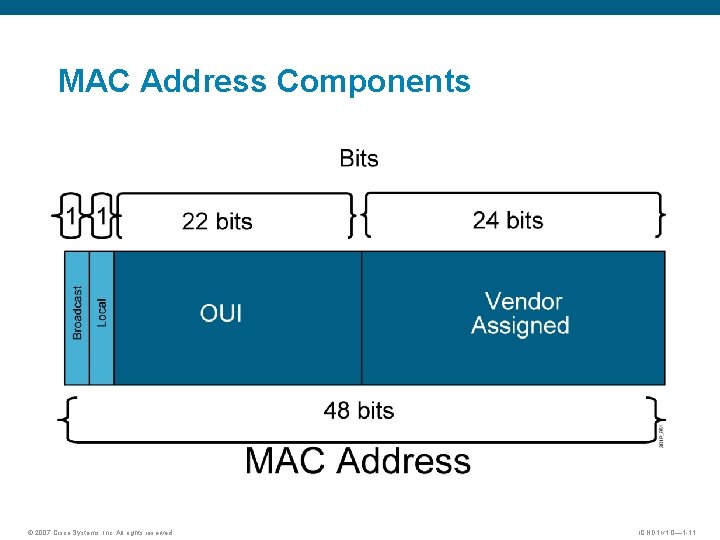
MAC Address Components © 2007 Cisco Systems, Inc. All rights reserved. ICND 1 v 1. 0— 1 -11
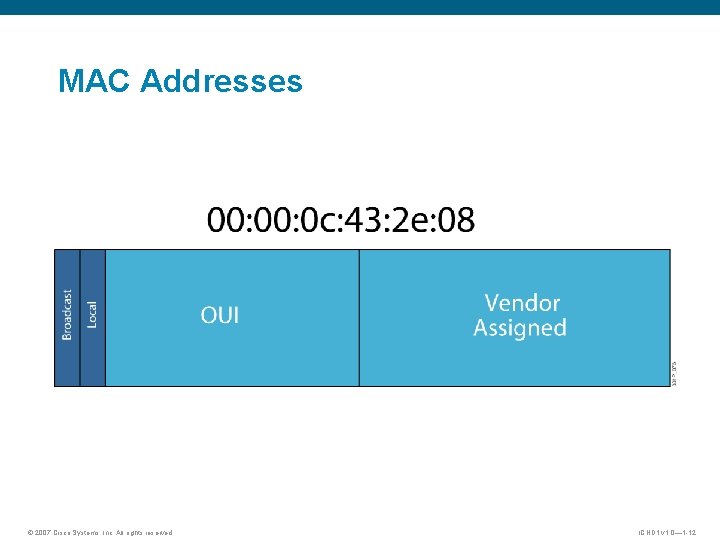
MAC Addresses © 2007 Cisco Systems, Inc. All rights reserved. ICND 1 v 1. 0— 1 -12
Summary § A LAN is a network that is located in a limited area, with the computers and other components that are part of this network located relatively close together. § Regardless of its size, several fundamental components are required for the operation of a LAN, including computers, interconnections, network devices, and protocols. § LANs provide both communication and resource-sharing functions for their users. § LANs can be configured in various sizes, to accommodate environments from SOHO to enterprise. © 2007 Cisco Systems, Inc. All rights reserved. ICND 1 v 1. 0— 1 -13
Summary (Cont. ) § Ethernet was originally developed in the 1970 s by DEC, Intel, and Xerox, and was called DIX Ethernet. When a workgroup of this body (referred to as IEEE 802. 3) defined new standards for Ethernet in the mid-1980 s to define Ethernet-like networks for public use, the standards were called Ethernet 802. 3 and 802. 2. § Ethernet LAN standards specify cabling and signaling at both the physical and data link layers of the OSI model. § Stations on a CSMA/CD LAN can access the network at any time. Before sending data, CSMA/CD stations listen to the network to determine whether it is already in use. If it is in use, they wait. If the network is not in use, the stations transmit. A collision occurs when two stations listen for network traffic, hear none, and transmit simultaneously. © 2007 Cisco Systems, Inc. All rights reserved. ICND 1 v 1. 0— 1 -14
Summary (Cont. ) § An Ethernet frame consists of fields, including preamble, start-offrame delimiter, destination address, source address, type/length, data and pad, and frame check sequence. § There are three major kinds of communications in networks: unicast, in which a frame is sent from one host addressed to one specific destination; broadcast, in which a frame is sent from one address to all other addresses; and multicast, in which a destination addresses a specific group of devices. § The address used in an Ethernet LAN is the means by which data is directed to the proper receiving location. © 2007 Cisco Systems, Inc. All rights reserved. ICND 1 v 1. 0— 1 -15
Summary (Cont. ) § The MAC sublayer handles physical addressing issues, and the physical address is a 48 -bit number usually represented in hexadecimal format. © 2007 Cisco Systems, Inc. All rights reserved. ICND 1 v 1. 0— 1 -16
© 2007 Cisco Systems, Inc. All rights reserved. ICND 1 v 1. 0— 1 -17
- Slides: 17