
Understanding El Nino Science Olympiad Oceanography Resource Anand
- Slides: 22
Understanding El Nino Science Olympiad Oceanography Resource Anand Gnanadesikan NOAA/Geophysical Fluid Dynamics Lab
In this lesson you will Learn about the largest pattern of climate variation on the planet… Learn how scientists track this variation Learn to predict it yourself!
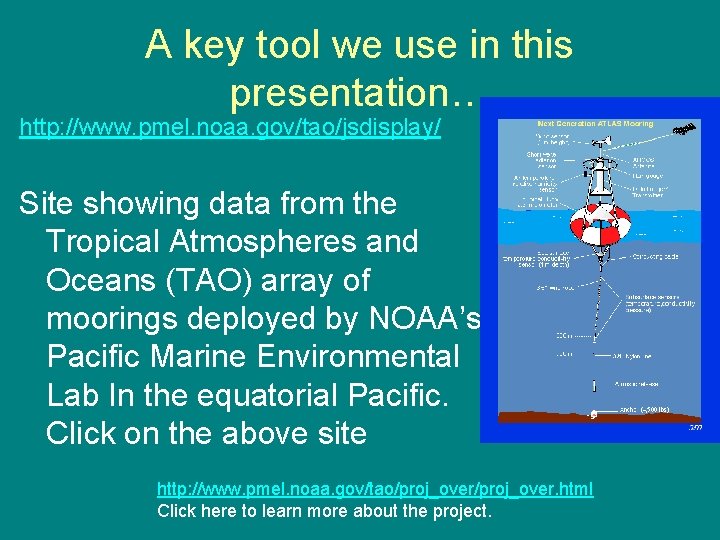
A key tool we use in this presentation… http: //www. pmel. noaa. gov/tao/jsdisplay/ Site showing data from the Tropical Atmospheres and Oceans (TAO) array of moorings deployed by NOAA’s Pacific Marine Environmental Lab In the equatorial Pacific. Click on the above site http: //www. pmel. noaa. gov/tao/proj_over. html Click here to learn more about the project.
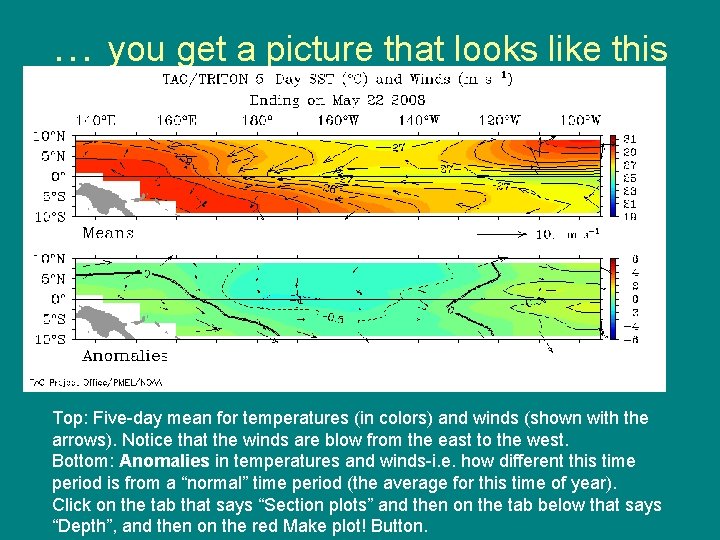
… you get a picture that looks like this Top: Five-day mean for temperatures (in colors) and winds (shown with the arrows). Notice that the winds are blow from the east to the west. Bottom: Anomalies in temperatures and winds-i. e. how different this time period is from a “normal” time period (the average for this time of year). Click on the tab that says “Section plots” and then on the tab below that says “Depth”, and then on the red Make plot! Button.
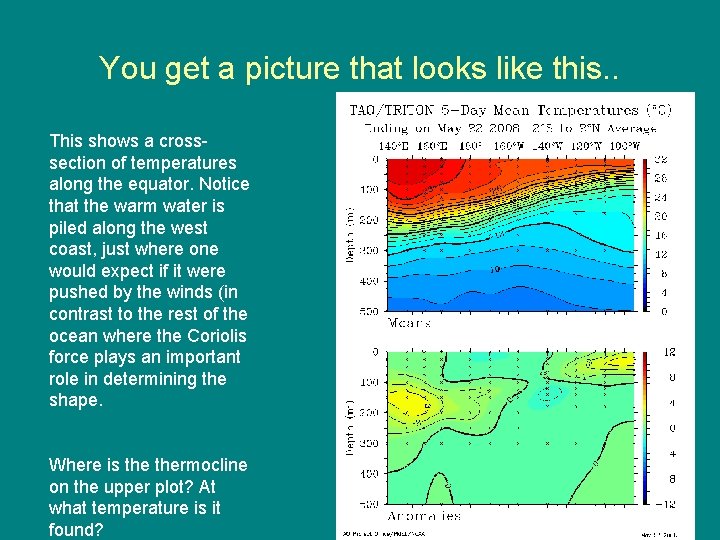
You get a picture that looks like this. . This shows a crosssection of temperatures along the equator. Notice that the warm water is piled along the west coast, just where one would expect if it were pushed by the winds (in contrast to the rest of the ocean where the Coriolis force plays an important role in determining the shape. Where is thermocline on the upper plot? At what temperature is it found?
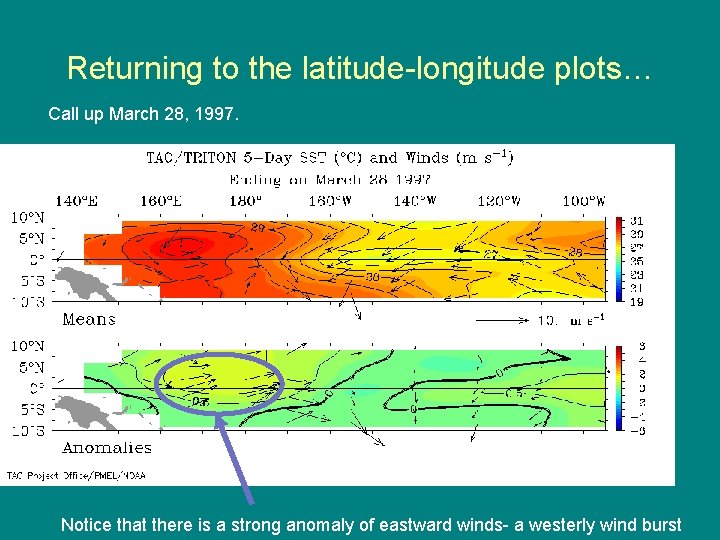
Returning to the latitude-longitude plots… Call up March 28, 1997. Notice that there is a strong anomaly of eastward winds- a westerly wind burst
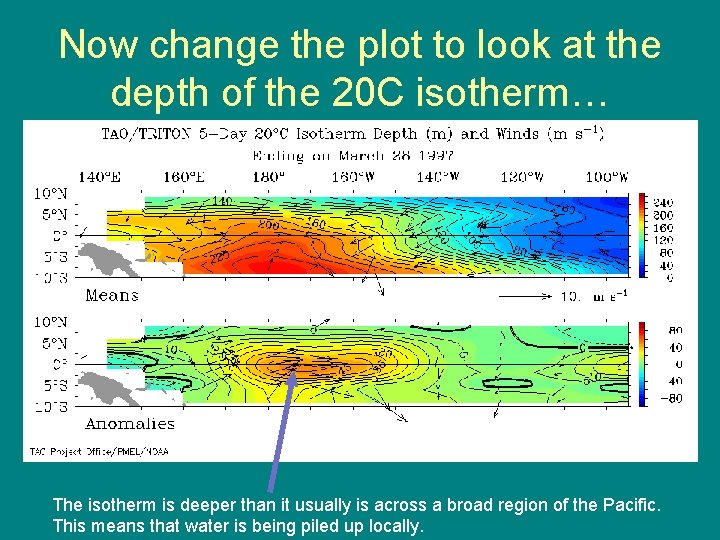
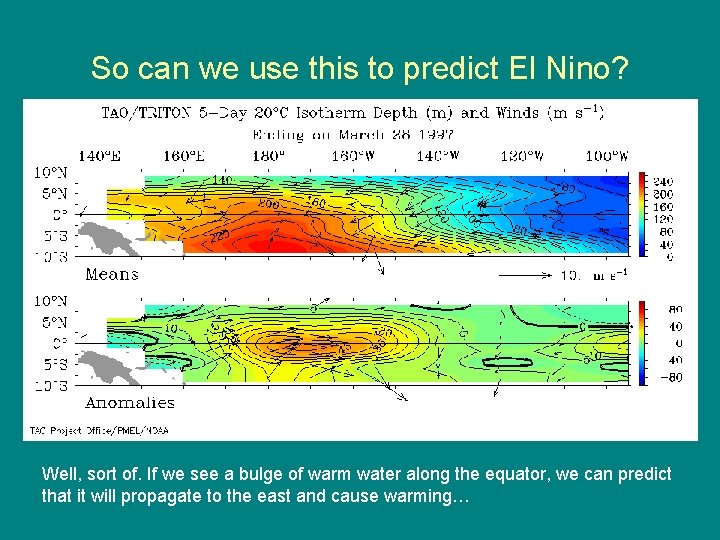
Now change the plot to look at the depth of the 20 C isotherm… The isotherm is deeper than it usually is across a broad region of the Pacific. This means that water is being piled up locally.
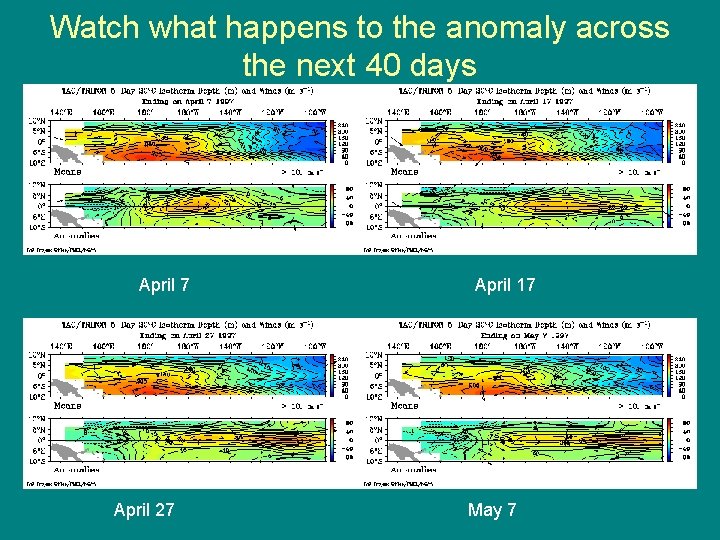
Watch what happens to the anomaly across the next 40 days April 7 April 27 April 17 May 7
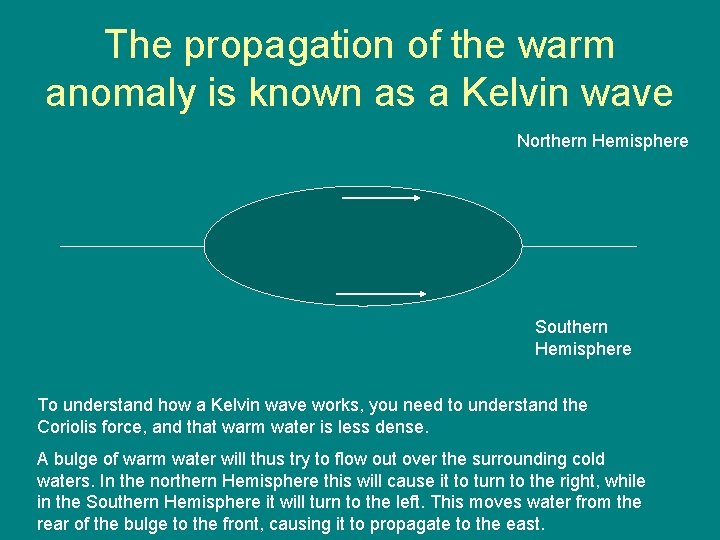
The propagation of the warm anomaly is known as a Kelvin wave Northern Hemisphere Southern Hemisphere To understand how a Kelvin wave works, you need to understand the Coriolis force, and that warm water is less dense. A bulge of warm water will thus try to flow out over the surrounding cold waters. In the northern Hemisphere this will cause it to turn to the right, while in the Southern Hemisphere it will turn to the left. This moves water from the rear of the bulge to the front, causing it to propagate to the east.
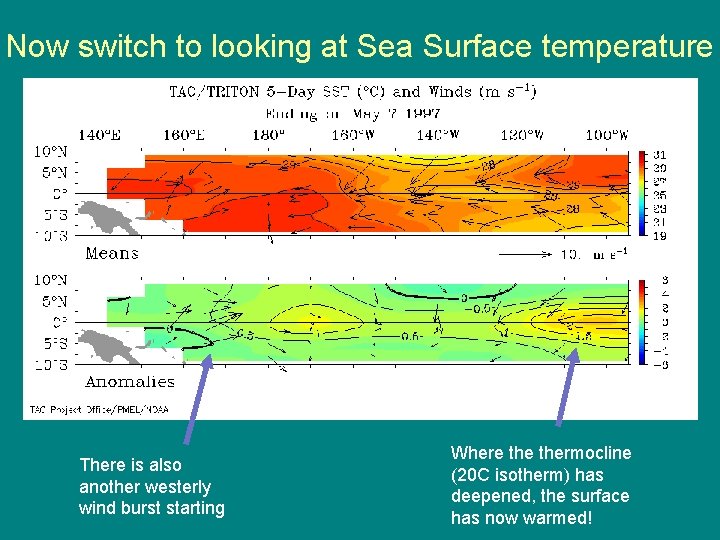
Now switch to looking at Sea Surface temperature There is also another westerly wind burst starting Where thermocline (20 C isotherm) has deepened, the surface has now warmed!
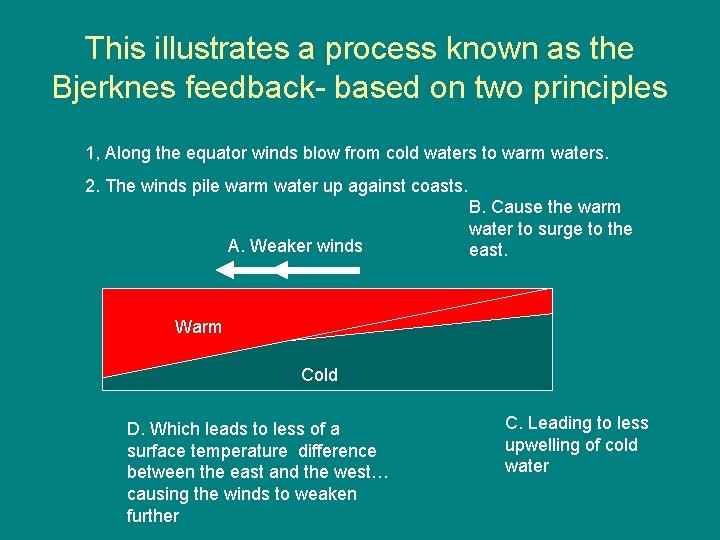
This illustrates a process known as the Bjerknes feedback- based on two principles 1, Along the equator winds blow from cold waters to warm waters. 2. The winds pile warm water up against coasts. A. Weaker winds B. Cause the warm water to surge to the east. Warm Cold D. Which leads to less of a surface temperature difference between the east and the west… causing the winds to weaken further C. Leading to less upwelling of cold water
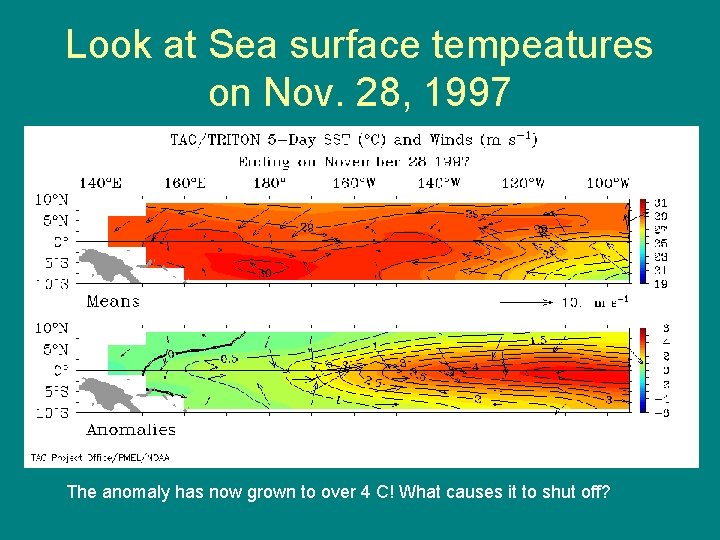
Look at Sea surface tempeatures on Nov. 28, 1997 The anomaly has now grown to over 4 C! What causes it to shut off?
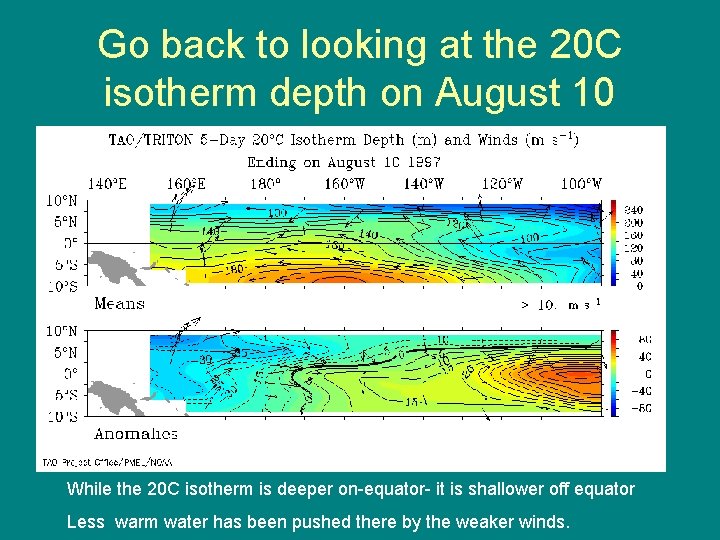
Go back to looking at the 20 C isotherm depth on August 10 While the 20 C isotherm is deeper on-equator- it is shallower off equator Less warm water has been pushed there by the weaker winds.
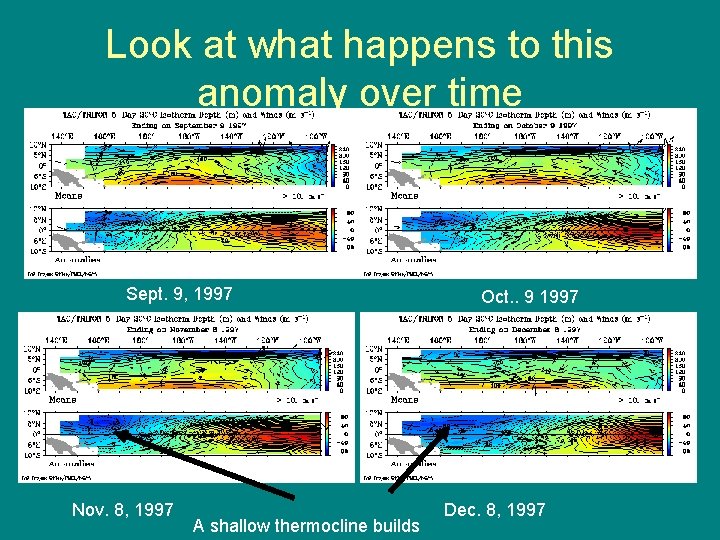
Look at what happens to this anomaly over time Sept. 9, 1997 Nov. 8, 1997 A shallow thermocline builds Oct. . 9 1997 Dec. 8, 1997
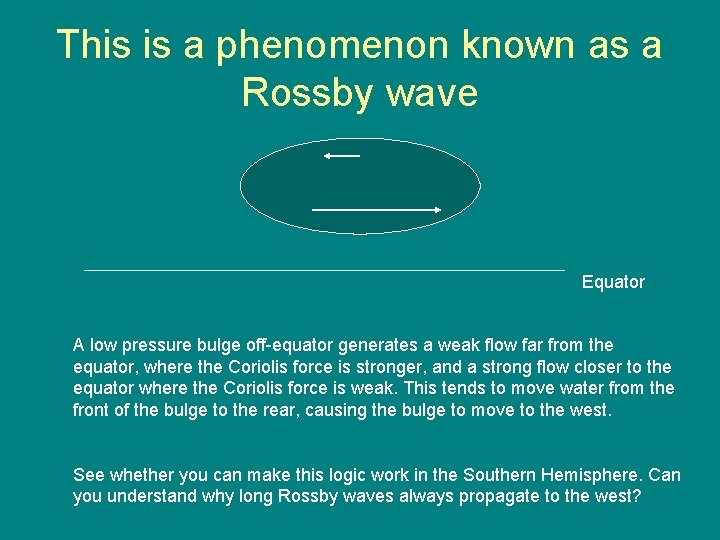
This is a phenomenon known as a Rossby wave Equator A low pressure bulge off-equator generates a weak flow far from the equator, where the Coriolis force is stronger, and a strong flow closer to the equator where the Coriolis force is weak. This tends to move water from the front of the bulge to the rear, causing the bulge to move to the west. See whether you can make this logic work in the Southern Hemisphere. Can you understand why long Rossby waves always propagate to the west?
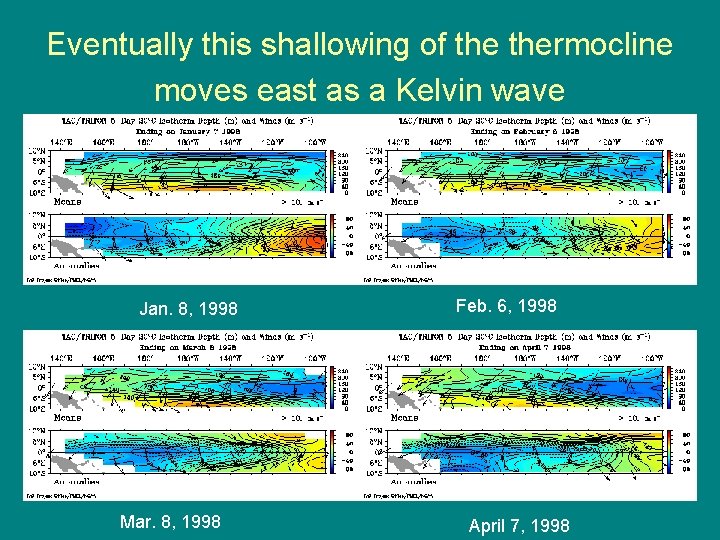
Eventually this shallowing of thermocline moves east as a Kelvin wave Jan. 8, 1998 Mar. 8, 1998 Feb. 6, 1998 April 7, 1998
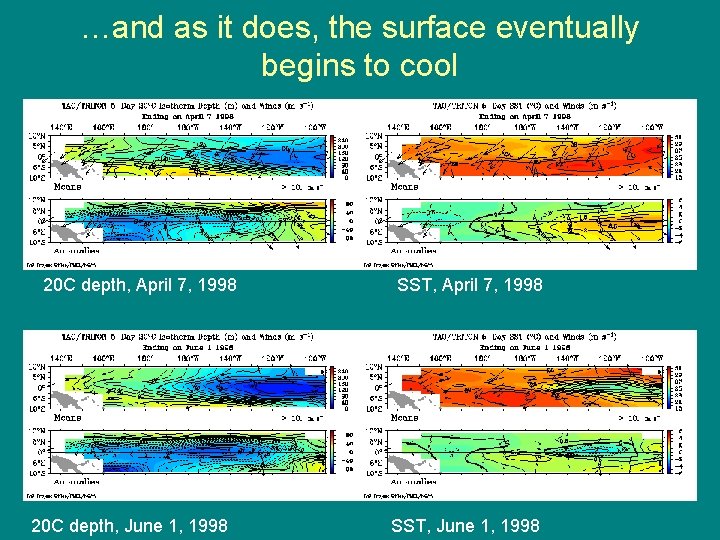
…and as it does, the surface eventually begins to cool 20 C depth, April 7, 1998 20 C depth, June 1, 1998 SST, April 7, 1998 SST, June 1, 1998
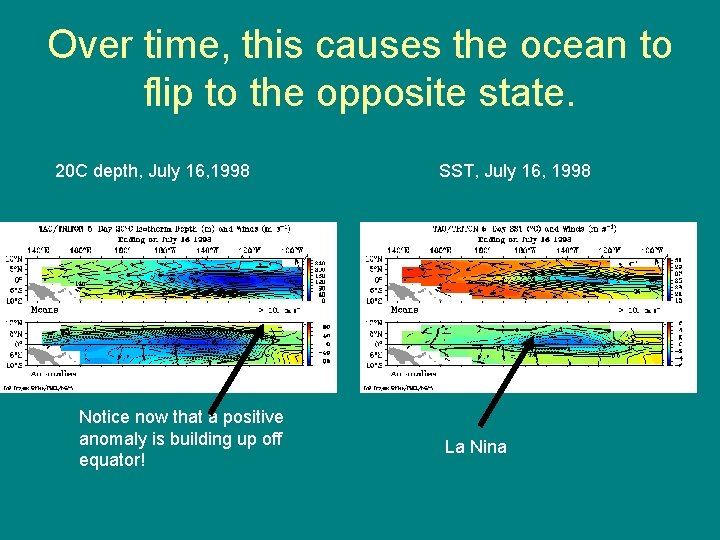
Over time, this causes the ocean to flip to the opposite state. 20 C depth, July 16, 1998 Notice now that a positive anomaly is building up off equator! SST, July 16, 1998 La Nina
So can we use this to predict El Nino? Well, sort of. If we see a bulge of warm water along the equator, we can predict that it will propagate to the east and cause warming…
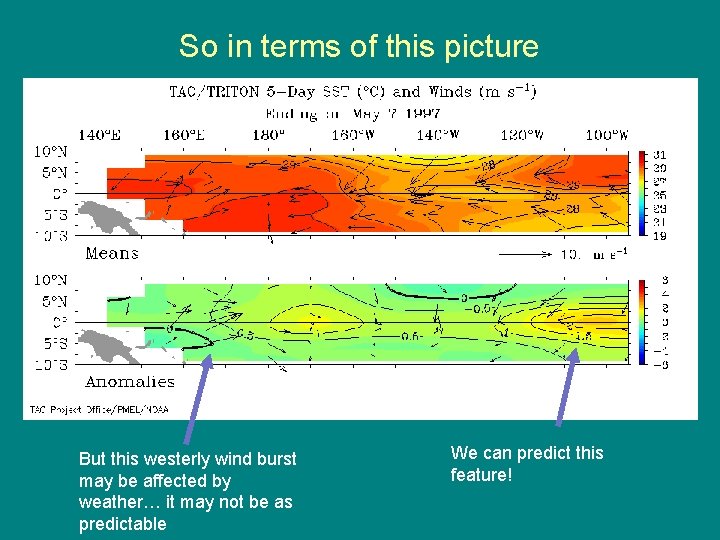
So in terms of this picture But this westerly wind burst may be affected by weather… it may not be as predictable We can predict this feature!
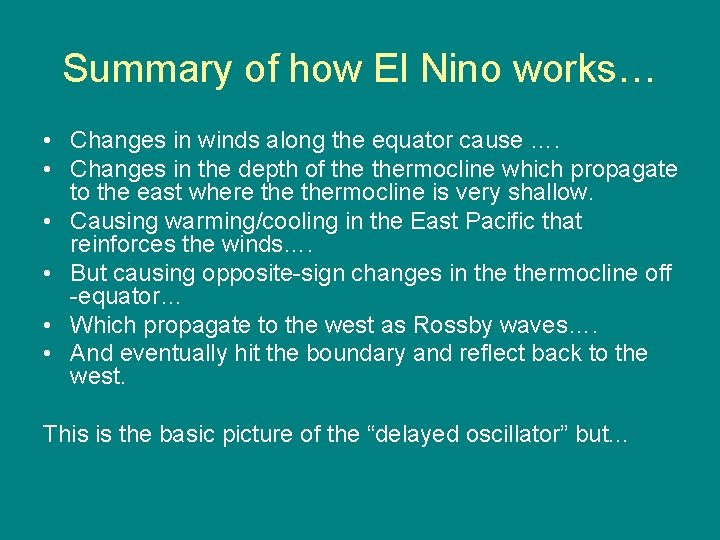
Summary of how El Nino works… • Changes in winds along the equator cause …. • Changes in the depth of thermocline which propagate to the east where thermocline is very shallow. • Causing warming/cooling in the East Pacific that reinforces the winds…. • But causing opposite-sign changes in thermocline off -equator… • Which propagate to the west as Rossby waves…. • And eventually hit the boundary and reflect back to the west. This is the basic picture of the “delayed oscillator” but. . .
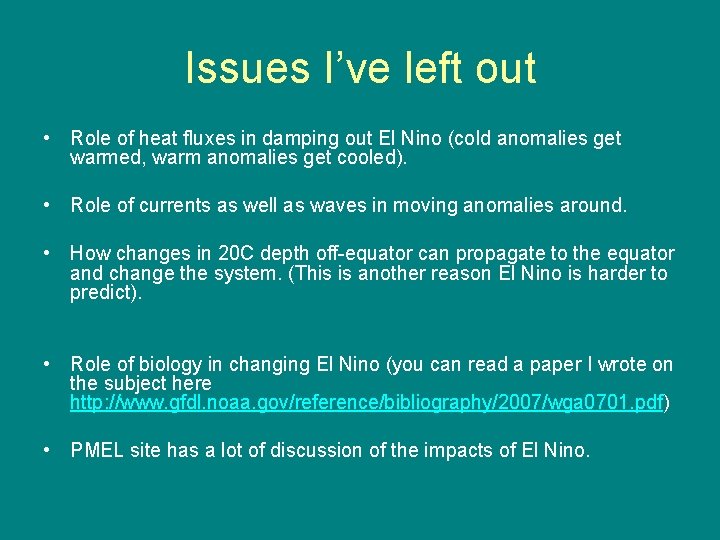
Issues I’ve left out • Role of heat fluxes in damping out El Nino (cold anomalies get warmed, warm anomalies get cooled). • Role of currents as well as waves in moving anomalies around. • How changes in 20 C depth off-equator can propagate to the equator and change the system. (This is another reason El Nino is harder to predict). • Role of biology in changing El Nino (you can read a paper I wrote on the subject here http: //www. gfdl. noaa. gov/reference/bibliography/2007/wga 0701. pdf) • PMEL site has a lot of discussion of the impacts of El Nino.